Optical Modules Soar, Why Is NOK the Second Leader After MRVL?

marsbitXuất bản vào 2026-06-03Cập nhật gần nhất vào 2026-06-03

Tóm tắt

Nokia's stock has surged nearly 170% to around $16.8 since Nvidia's $1 billion investment and AI-RAN partnership in October 2025, reflecting a market re-rating from a cyclical telecom equipment provider to an AI infrastructure player. This rise, adding roughly $60 billion in market cap, is driven by AI capex expansion into telecom edge, RAN, and optical networks. The company's Q1 2026 results showed strong momentum, with AI & Cloud net sales up 49% and 10 billion euros in new orders, prompting Nokia to raise its AI & Cloud market growth forecast to a 27% CAGR (2025-2028). Optical network growth of 20% further strengthens its position in connecting AI data centers. Recent tests with operators like T-Mobile and the opening of an AI Networking Innovation Lab demonstrate progress from concept to early commercial deployment. Nokia's strategy integrates Nvidia GPUs into its network hardware, enabling concurrent AI processing and RAN tasks for real-time optimization and new edge services. However, with a trailing P/E nearing 100x and consensus price targets lagging the current stock price, significant future growth is already priced in. The key constraint now is the pace and scale of large-scale operator deployments. While execution signals remain positive and the company's position in AI edge infrastructure is established, high valuation leaves limited room for error, making tangible commercial contracts the critical factor for further stock performance.

Nokia's share price is currently around $16.8, having accumulated an increase of nearly 170% since Nvidia's subscription to new shares at $6.01 in October 2025. Its market capitalization has increased by approximately $60 billion, reaching a 16-year high. The market no longer views it merely as a cyclical telecom equipment supplier but is rapidly re-rating it as an AI network and edge infrastructure player. Nvidia's equity investment and technical collaboration have been the most direct catalyst.

Behind this is the major trend of AI capital expenditure shifting from core data centers to the telecom edge, wireless access networks, and optical networks. The question is, how far has this re-rating progressed, and how much support can future actual implementation provide for the stock price?

Nokia's Stock Price Has Completed the AI Infrastructure Re-rating

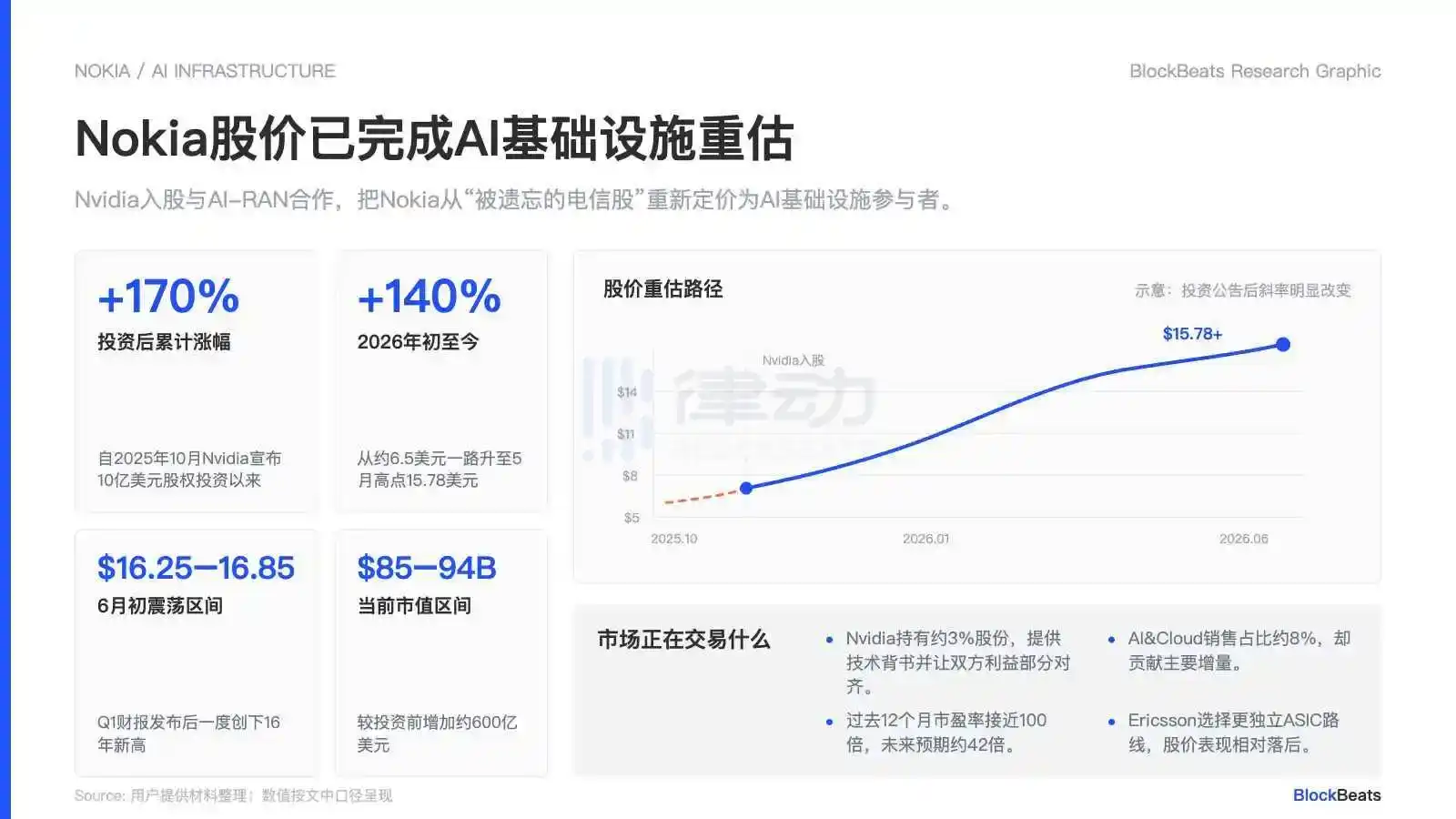
Since Nvidia announced a $1 billion equity investment and reached an AI-RAN strategic cooperation agreement in October 2025, Nokia's share price has accumulated gains of nearly 170%. Year-to-date in 2026, the increase exceeds 140%, rising from around $6.5 to a peak of $15.78 in May, and fluctuating in the $16.25-$16.85 range in early June. Following the Q1 earnings release, it once hit a 16-year high.

The current market capitalization is approximately $85-94 billion, an increase of about $60 billion from pre-investment. The AI&Cloud business accounts for about 8% of group sales but contributes the majority of the incremental value. The trailing twelve-month P/E ratio is close to 100 times, while the forward P/E ratio is about 42 times, significantly higher than traditional telecom peers but still lower than pure-play AI infrastructure companies. In contrast, Ericsson's share price performance lags due to its choice of a more independent ASIC chip strategy.

These changes indicate that the market is already trading on Nokia's transformation from a "forgotten telecom stock" to an AI infrastructure participant. Nvidia holds approximately 3% of the shares, providing both technical endorsement and partially aligning interests. Coupled with the narrative of the U.S. pushing to regain leadership in the telecom field, this has collectively accelerated this round of re-rating.

However, after significantly outperforming, what actual business progress is the market truly trading on?
Q1 Orders and Guidance Raise Validate Accelerated Transformation

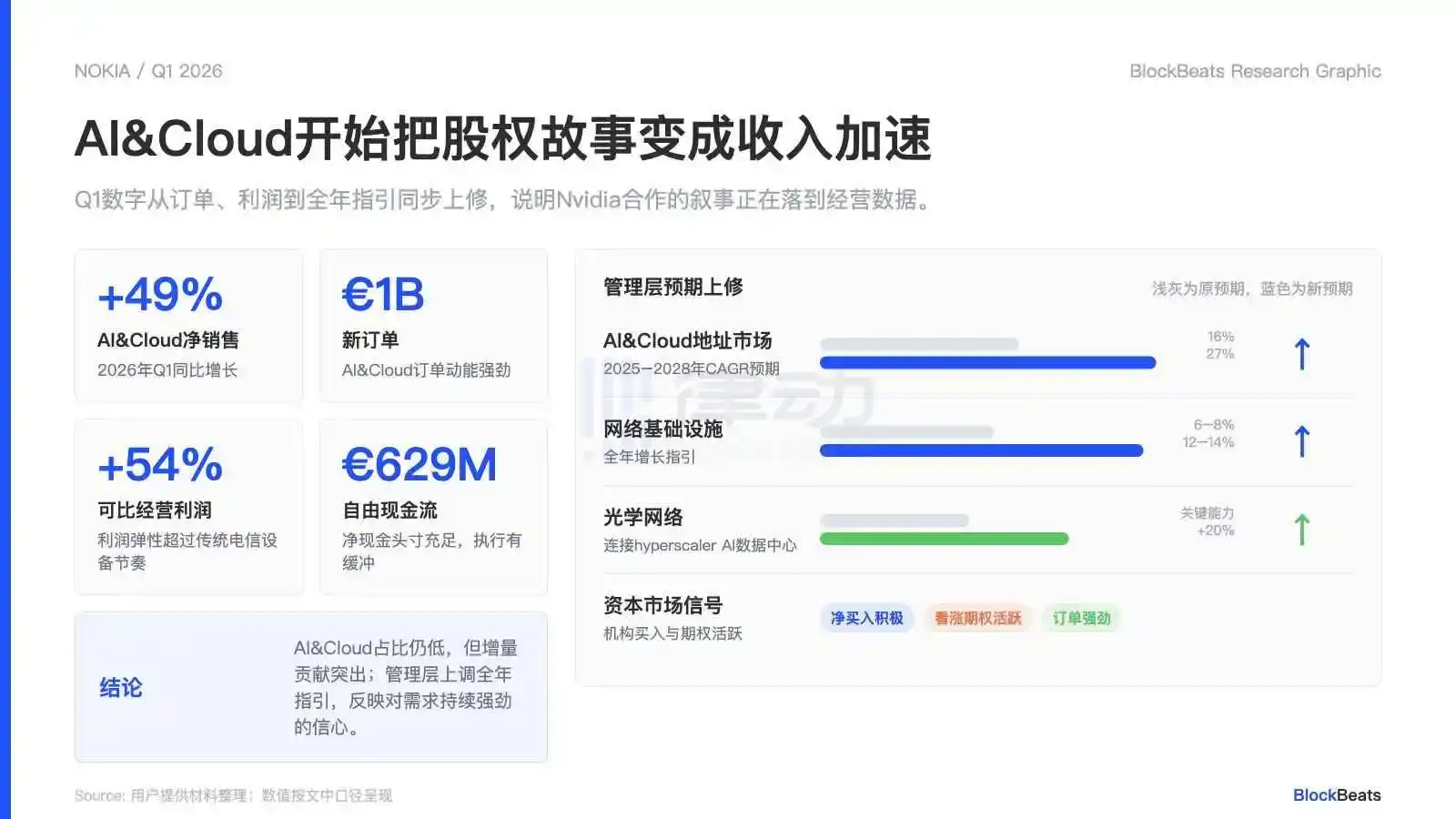
In the Q1 2026 earnings report, Nokia's AI&Cloud net sales increased by 49% year-over-year, securing €1 billion in new orders, with comparable operating profit surging by 54%. Consequently, the company raised its expected annual compound growth rate for the AI&Cloud addressable market from 16% to 27% for 2025-2028, and its full-year growth guidance for network infrastructure from 6-8% to 12-14%.

Optical network business grew by 20% during the same period, becoming a key part of connecting hyperscaler AI data centers. This capability was further strengthened following the acquisition of Infinera. New order intake is strong, free cash flow reached €629 million, and the net cash position is ample, providing a buffer for future execution.

These figures indicate that the cooperation with Nvidia is shifting from an equity story to visible revenue acceleration. Although AI&Cloud still represents a low proportion, its incremental contribution is prominent. The company's raised full-year guidance reflects management's confidence in sustained strong demand. Institutions have been net buyers over the past 12 months, and call option activity is higher than normal levels, further supporting this assessment.
MWC Tests and Innovation Lab Confirm Early Commercial Pathway

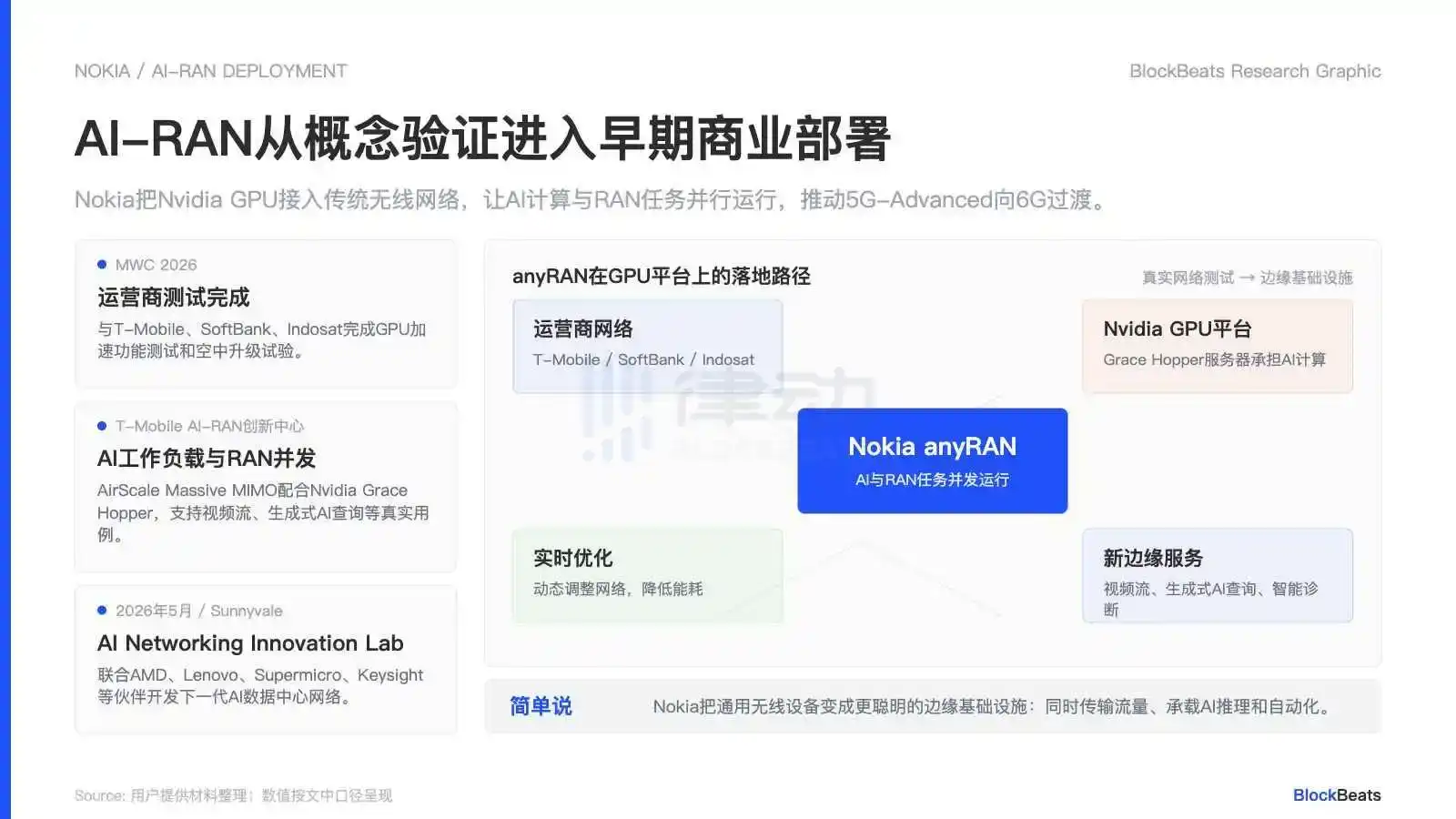
During MWC 2026, Nokia completed functional tests and over-the-air upgrade trials with operators like T-Mobile, SoftBank, and Indosat. At T-Mobile's AI-RAN Innovation Center, they used Nokia's AirScale Massive MIMO radio equipment alongside Nvidia Grace Hopper servers, successfully running AI workloads concurrently with RAN (Radio Access Network) tasks, supporting practical use cases like video streaming and generative AI queries.

In May 2026, Nokia opened the AI Networking Innovation Lab in Sunnyvale, California, collaborating with partners like AMD, Lenovo, Supermicro, and Keysight to develop next-generation AI data center networks. Concurrently, it introduced AI agent features for fixed broadband products, helping operators diagnose problems automatically, reduce costs, and accelerate fiber deployment.

These developments show that the acceleration path for Nokia's anyRAN software on Nvidia GPU platforms is now implementable. AI-RAN (using AI to optimize wireless access networks) is no longer just a concept but can deliver real-time optimization, reduce energy consumption, and generate new edge services within actual operator networks, providing a viable path for the transition from 5G-Advanced to 6G. Nokia CEO Justin Hotard stated that the cooperation is moving from validation to early commercial deployment.

Simply put, Nokia is applying Nvidia GPUs to traditional wireless network hardware, enabling AI computing and network transmission tasks to run in parallel. This allows for real-time network adjustments, saves power, and facilitates the development of new services. This approach turns general-purpose equipment into smarter edge infrastructure.
Deployment Scale Becomes the Biggest Constraint Under High Valuation

Although Q1 data, test results, and ecosystem partner expansion are relatively positive, the current P/E ratio is close to 100 times. Analyst consensus target prices are around €9.4-€12 (some investment banks have raised to around €12-€14), significantly lagging the current stock price. This indicates that the market has already priced in considerable optimism for long-term AI-RAN penetration and the 27% growth expectation, leaving a significantly compressed margin for error.

Over the next 12-24 months, the conversion speed of actual deployment contracts from major operators, the overall pace of AI capital expenditure, and differences in approach compared to Ericsson (which insists on independent ASICs, avoiding deep ties to a single GPU supplier) will become the core variables. If subsequent orders fall short of expectations or AI spending slows, the risk of a pullback will significantly increase.

Institutional net buying and bullish option preferences currently still support share price momentum, but these ultimately need to be validated by execution. Nokia's position as a representative AI edge infrastructure player has gained recognition, and the combination of optical networks with wireless access networks expands the overall market opportunity. However, there is a noticeable distance from current early orders to truly commercial deployment at hyperscaler scale.

It is still in the early acceleration phase, with overall execution signals being positive. However, the high valuation has already tightened the margin for error considerably. Investors should focus next on actual large-scale deployment progress rather than new demonstrations to gauge how much further this trend of AI expanding to the telecom edge can go.


Câu hỏi Liên quan

QAccording to the article, why has Nokia's stock price experienced a significant revaluation recently?

ANokia's stock price has been revalued because the market is no longer viewing it just as a cyclical telecom equipment vendor, but as an AI network and edge infrastructure player. This shift was catalyzed by a strategic investment and AI-RAN collaboration with Nvidia, aligning with the trend of AI capital expenditure moving from core data centers into telecom edges and optical networks.

QWhat were the key performance highlights for Nokia's AI & Cloud business in Q1 2026?

AIn Q1 2026, Nokia's AI & Cloud business saw net sales grow by 49% year-over-year, secured 1 billion euros in new orders, and comparable operating profit increased by 54%. Due to this strong performance, the company raised its growth expectations for the AI & Cloud addressable market.

QWhat practical demonstrations at MWC 2026 validated Nokia's AI-RAN path?

AAt MWC 2026, Nokia conducted functional tests and over-the-air upgrade trials with operators like T-Mobile, SoftBank, and Indosat. A key test at T-Mobile's AI-RAN Innovation Center successfully ran AI workloads concurrently with RAN tasks using Nokia's AirScale Massive MIMO hardware and Nvidia Grace Hopper servers, supporting real use cases like video streaming and generative AI queries.

QWhat is a major constraint for Nokia's stock mentioned in the article, given its current valuation?

AA major constraint is the high valuation, with a trailing P/E close to 100x. This high valuation reflects significant market optimism upfront, leaving little room for error. The key variable now is the conversion speed of large-scale operator deployment contracts and the overall pace of AI capital expenditure over the next 12-24 months.

QHow does Nokia's strategic approach differ from its competitor Ericsson's according to the article?

ANokia's strategy involves a deep technical collaboration and equity investment from Nvidia, integrating Nvidia's GPU technology into its telecom hardware. In contrast, Ericsson is pursuing a more independent ASIC chip route, avoiding deep binding to a single GPU vendor like Nvidia.

Nội dung Liên quan

Đề xuất HIP-4 của Hyperliquid tiếp sức cho HYPE staking khi niềm tin dài hạn gia tăng

Hyperliquid đã đề xuất nâng cấp HIP-4 nhằm mở rộng giao thức vượt ra ngoài thị trường hợp đồng tương lai vĩnh viễn để trở thành một lớp cơ sở hạ tầng cho các ứng dụng trên chuỗi. Theo đề xuất, các nhà triển khai phải stake 500,000 token HYPE để tạo thị trường mới, với các biện pháp kiểm soát nhằm đảm bảo chất lượng. Sự tự tin của nhà đầu tư đang tăng lên, được phản ánh qua việc lượng HYPE được stake đã đạt khoảng 438.7 triệu token, chiếm 43.9% tổng nguồn cung. Một trader lớn cũng chọn stake số HYPE trị giá 15.5 triệu USD thay vì chốt lời. Điều này cho thấy sự tin tưởng dài hạn vào mạng lưới. Cấu trúc thị trường cũng cho thấy động lực tích cực, với lãi suất tài trợ cân bằng và thanh lý hạn chế, cho thấy cách tiếp cận đầu tư có đo lường. Tổng giá trị bị khóa (TVL) và doanh thu giao thức đang tăng, củng cố triển vọng tăng trưởng cơ bản. Tóm lại, việc mở rộng cơ sở hạ tầng, sự tham gia stake mạnh mẽ và cấu trúc thị trường lành mạnh đang củng cố vị thế của Hyperliquid như một nền tảng cho tài chính kỹ thuật số trong tương lai, phụ thuộc vào việc áp dụng của người dùng và triển khai thành công các bản nâng cấp sắp tới.

ambcrypto17 phút trước

Đề xuất HIP-4 của Hyperliquid tiếp sức cho HYPE staking khi niềm tin dài hạn gia tăng

ambcrypto17 phút trước

7 tháng sau sự sụp đổ của Huiwang, thị trường nền tảng ký quỹ Đông Nam Á đại phẫu thuật

Sau 7 tháng sụp đổ của Huiwang, một nền tảng bảo đảm thanh toán được mệnh danh là "Alipay Đông Nam Á", thị trường bảo đảm trong khu vực đang trải qua một cuộc đại tái cấu trúc. Sự sụp đổ của tập đoàn Thái Tử ở Campuchia và việc tịch thu 12.7 vạn Bitcoin (trị giá khoảng 150 tỷ USD) của Mỹ đã chặt đứt nguồn cung thanh khoản, khiến Huiwang phá sản, 90 vạn người dùng mất trắng. Tuy nhiên, khoảng trống quyền lực nhanh chóng bị lấp đầy bởi các nền tảng bảo đảm mới nổi, thường hoạt động trong bóng tối và gắn liền với các hoạt động bất hợp pháp. Các cái tên nổi bật bao gồm: * **Tân Tệ (XinBi/Newpay):** Thu hút lượng lớn người dùng từ Huiwang, tổng doanh thu đã vượt quá 1.6 tỷ USDT. * **Lĩnh Hàng/Tiger Bảo đảm:** Chuyên cung cấp dịch vụ bảo đảm cho các giao dịch liên quan đến buôn bán người và lao động cưỡng bức. * **Kim Bối/Kim Bác:** Ban đầu liên kết với tập đoàn Thái Tử và các sòng bạc, chuyên phục vụ ngành cờ bạc trực tuyến. * **Đạt Lợi/Thiên Thành:** Kế thừa nhiều nhóm giao dịch công khai từ Huiwang, có mức tăng trưởng người dùng đáng kể. * **Phúc Lợi Lai:** Gắn liền với tập đoàn tội phạm gia đình họ Lưu ở miền Bắc Myanmar, chủ yếu phục vụ các khu công viên lừa đảo. Báo cáo từ Elliptic cho thấy thị trường bảo đảm Huiwang đã xử lý hơn 31 tỷ USD, trở thành thị trường bất hợp pháp trực tuyến lớn nhất từ trước đến nay. Các nền tảng bảo đảm này, thường được ngụy trang dưới vỏ bọc dịch vụ tài chính, trên thực tế đã trở thành trung gian quan trọng cho mạng lưới tội phạm bao gồm lừa đảo, rửa tiền, cờ bạc và buôn bán người tại Đông Nam Á. Danh hiệu "Alipay Đông Nam Á" chỉ là cái cớ, che đậy cho một hệ sinh thái tài chính ngầm đầy rủi ro và nguy hiểm.

Odaily星球日报26 phút trước

7 tháng sau sự sụp đổ của Huiwang, thị trường nền tảng ký quỹ Đông Nam Á đại phẫu thuật

Odaily星球日报26 phút trước

Ngày Tươi Sáng Khó Trở Lại, Các Quỹ VC Crypto Đang Trải Qua Điều Gì?

Đầu tư mạo hiểm chuyên sâu vào tiền mã hóa đang trải qua một sự chuyển đổi lớn. Các quỹ chuyên biệt hàng đầu như Paradigm (vừa huy động 1,2 tỷ USD) và Framework Ventures (huy động 400 triệu USD) đang mở rộng danh mục đầu tư sang các lĩnh vực khác như AI, robot, hàng không vũ trụ, thậm chí xóa bỏ các tham chiếu về "tiền mã hóa" khỏi thông điệp của mình. Quý I/2026 chỉ có 8 quỹ VC thuần túy về tiền mã hóa mới được thành lập, mức thấp nhất kể từ năm 2020. Theo lý thuyết chu kỳ công nghệ của Carlota Perez, tiền mã hóa đang chuyển từ giai đoạn "xây dựng" sang "phổ cập". Các gã khổng lồ truyền thống như Stripe, BlackRock, VISA đã hiểu và tích hợp công nghệ blockchain vào hoạt động cốt lõi của họ, làm xói mòn lợi thế thông tin độc quyền trước đây của các quỹ chuyên sâu. Ngành VC đang phân cực thành hình dạng "tạ tạ": một bên là các nền tảng đầu tư tổng hợp khổng lồ (a16z, Sequoia) có thể bao trùm toàn bộ lĩnh vực; bên kia là các quỹ nhỏ, chuyên sâu dựa vào hiểu biết sâu để đầu tư mạo hiểm vào các dự án tiên phong. Các quỹ quy mô trung bình thuần túy về tiền mã hóa đang bị mắc kẹt trong "vùng chết", vì không đủ lớn để cạnh tranh ở các vòng tăng trưởng, cũng không thể chỉ dựa vào các khoản đầu tư hạt giống nhỏ để đạt mức thoái vốn cần thiết (thường gấp 3 lần quỹ). Áp lực từ các nhà đầu tư (LP) cũng thúc đẩy sự thay đổi. Với lợi nhuận thực tế (DPI) thấp từ các quỹ năm 2021 và làn sóng AI hút 70% vốn đầu tư mạo hiểm, các nhà quản lý quỹ buộc phải đa dạng hóa để đáp ứng kỳ vọng của LP. Đối với các startup tiền mã hóa, điều này có nghĩa là việc gọi vốn sẽ khó khăn hơn. Họ phải cạnh tranh với vô số dự án AI để thu hút sự chú ý của các quỹ tổng hợp. Hơn nữa, các quỹ tổng hợp ít có khả năng đầu tư vào cơ sở hạ tầng công cộng hoặc nghiên cứu cơ bản (như MEV, công cụ cross-chain) – vốn rất quan trọng cho sự phát triển của hệ sinh thái nhưng khó có lợi nhuận thương mại trực tiếp. Tóm lại, "nhà đầu tư tiền mã hóa" như một danh mục riêng biệt đang trở nên lỗi thời. Tiền mã hóa đang trở thành cơ sở hạ tầng tài chính cơ bản. Các quỹ chuyên sâu cỡ trung đang thu hẹp hoặc biến mất. Tương lai sẽ là sự phân công: các quỹ tổng hợp lớn nắm giữ các khoản đầu tư tăng trưởng vào cơ sở hạ tầng tài chính dựa trên blockchain, trong khi các quỹ nhỏ, chuyên biệt tiếp tục ươm mầm cho các thí nghiệm tiên phong và ngách mới như mã hóa tài sản (tokenization), chứng khoán trên chuỗi.

Foresight News46 phút trước

Ngày Tươi Sáng Khó Trở Lại, Các Quỹ VC Crypto Đang Trải Qua Điều Gì?

Foresight News46 phút trước

Khi Sự Đồng Thuận Diễn Ra Ngày Càng Nhanh, Các Nhà Đầu Tư Trẻ Đang Đánh Cược Vào Điều Gì?

Khi sự đồng thuận thị trường ngày càng nhanh, các nhà đầu tư trẻ đang tập trung vào đâu? Đầu tư công nghệ hiện nay đang trải qua sự chuyển dịch rõ rệt, với bốn xu hướng chính được các nhà đầu tư trẻ hàng đầu quan tâm. **Xu hướng 1: AI rời màn hình, bước vào thế giới vật lý.** Trọng tâm đầu tư đang chuyển từ mô hình lớn và ứng dụng sinh dữ liệu sang robot, thiết bị AI, xe tự lái và hệ thống công nghiệp. Thách thức lớn không còn là khả năng của mô hình, mà là năng lực triển khai, độ tin cậy và hiệu quả chi phí khi tích hợp vào môi trường vật lý. Ngành giao hàng tự động (ví dụ: Bạch Tê Ngưu với hơn 2000 xe) là minh chứng cho xu hướng này. **Xu hướng 2: Lợi nhuận từ mô hình lớn chưa hết, cạnh tranh chuyển sang "Bánh xe thông minh".** Thay vì chỉ tìm kiếm kiến trúc kế tiếp, các nhà đầu tư tập trung vào các công ty có thể nhúng khả năng AI hiện có vào quy trình làm việc thực tế, tạo ra vòng lặp phản hồi "bánh xe thông minh": dữ liệu người dùng -> cải thiện mô hình -> trải nghiệm tốt hơn -> nhiều người dùng hơn. Sự thành công của Zhipu AI và Kling AI của Kuaishou cho thấy giá trị của việc xây dựng hệ thống tự củng cố này. **Xu hướng 3: Nghẽn dữ liệu thúc đẩy công nghệ nền tảng mới, mô hình cơ bản khoa học trở thành hướng đi không đồng thuận.** Khi dữ liệu chất lượng cao từ internet trở nên khan hiếm, việc đào tạo AI cần các nguồn kiến thức mới. Các phương pháp như học tăng cường, tự đối kháng và đặc biệt là **Mô hình Cơ bản Khoa học** (Scientific Foundation Models) hứa hẹn sử dụng dữ liệu và quy luật từ các lĩnh vực chuyên sâu (sinh học, vật liệu) để mở rộng biên giới của AI, mặc dù đây vẫn là một lĩnh vực đầy thách thức. **Xu hướng 4: Càng tiến vào vùng nước sâu của công nghệ cứng, càng cần vốn kiên nhẫn.** Trong các lĩnh vực như hàng không vũ trụ thương mại, máy tính lượng tử và năng lượng tiên tiến, chu kỳ xác minh dài hơn và con đường thương mại hóa không rõ ràng. Các nhà đầu tư cần xây dựng phán đoán sớm, tập trung vào năng lực nghiên cứu cốt lõi, khả năng kỹ thuật và sự kiên cường của đội ngũ, thay vì kỳ vọng lợi nhuận ngắn hạn. Sự quan tâm đến robot không gian, điện toán không gian và vật liệu năng lượng không gian phản ánh tầm nhìn dài hạn này. Tóm lại, các nhà đầu tư trẻ ngày nay không chỉ theo đuổi các khái niệm nóng, mà đang chuyển sang phân tích sâu sắc con đường tích hợp công nghệ vào ngành công nghiệp, tìm kiếm các hệ thống tạo ra vòng lặp phản hồi bền vững và sẵn sàng đồng hành cùng các dự án công nghệ cứng trong hành trình dài hạn.

marsbit1 giờ trước

Khi Sự Đồng Thuận Diễn Ra Ngày Càng Nhanh, Các Nhà Đầu Tư Trẻ Đang Đánh Cược Vào Điều Gì?

marsbit1 giờ trước

Giao dịch

Giao ngay
活动图片




