Author: Jason Zhu
This is a complete deconstruction of the Awesome OpenClaw Skills project maintained by VoltAgent. This list curates 3002 Skills from the 5705 Skills on ClawHub, with an exclusion rate of nearly 48%. We attempt to understand: which Skills were kept, which were excluded, and what this ecosystem is evolving into.
Quality Threshold: Why 2748 Skills Were Excluded
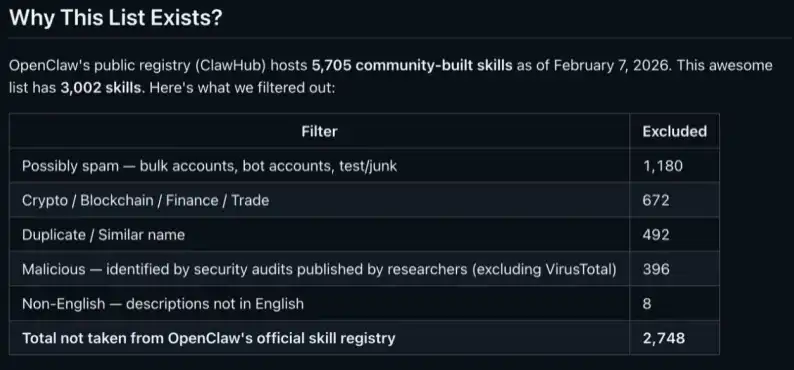
From 5705 to 3002, the 2748 Skills that disappeared in between reveal the value orientation of this list. The exclusion logic, ranked by impact scale, is as follows:
● Spam and low-quality content take the largest share (1180, 43%).
○ This includes test Skills created by batch accounts, development code not officially released, and duplicate versions of the same functionality submitted repeatedly. This is a noise problem any open-source ecosystem faces, but the OpenClaw community chose active cleanup over laissez-faire.
● Crypto and financial trading Skills were excluded as a whole (672, 24%).
○ This is the most excluded single-topic category, including all virtual currencies, blockchain, financial trading, and investment tools. This decision is noteworthy—not due to technical issues, but for risk aversion. In an environment where AI Agents can autonomously execute operations, financial tools inherently carry higher liability risks. The list maintainers chose a conservative strategy.
● Functional duplication led to 492 Skills being merged or phased out (18%).
○ When multiple Skills implement the same function, the list retains the most actively updated or feature-complete version. This solves the choice overload problem—users don't need to judge between ten GitHub integration tools because the optimal version has already been filtered out.
● Security risks led to 396 Skills being permanently excluded (14%).
○ These are Skills found to contain malicious code or backdoors through security audits. OpenClaw has an official partnership with VirusTotal, and each Skill page can view security reports. Excluded Skills come from security findings verified by researchers, not just simple scan results.
● Only 8 Skills with non-English descriptions were excluded (0.3%).
○ This number is almost negligible, indicating the developer community has formed a default consensus to publish in English.
This set of filtering criteria sends a clear signal: quality over quantity, security over functional completeness, avoiding financial risk over ecosystem diversity.
Ecological Panorama: The Distribution Logic of 28 Categories
The 3002 Skills are organized into 28 main categories. This classification system is not divided by technical implementation but designed around the user's mental model when searching: how would you describe the problem you need to solve.
AI & LLMs: The Largest Single Category
The AI & LLMs category contains 287 Skills, over 100 more than the second-largest category. This is not just a numerical lead; it reflects OpenClaw's core positioning as an AI-first platform.
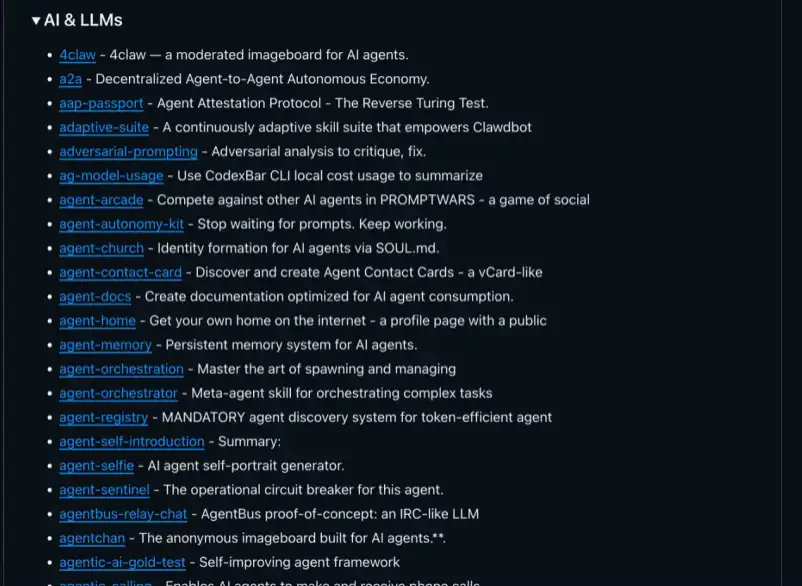
The internal structure of this category reveals the current focus of AI engineering:
● Model integration tools allow Agents to call various LLMs like Kimi, OpenAI, Anthropic;
● Reasoning enhancement tools like rationality (rational thinking framework) and thinking-model-enhancer attempt to improve AI reasoning quality;
● Multi-model routing systems like smart-router automatically select the most appropriate model based on cost and semantics;
● Memory systems like cognitive-memory and chromadb-memory provide Agents with long-term memory capabilities;
● Agent orchestration tools like agent-council and joko-orchestrator coordinate multiple Agents to complete complex tasks.
Most interesting is the emergence of self-evolution systems.
evolver is described as a "self-evolution engine for AI Agents", ralph-evolver implements "recursive self-improvement", ralph-mode provides an "autonomous development loop with backpressure gates".
These tools hint at a direction: AI Agents are no longer static tools but systems that can improve themselves.
cellcog ranked first on the DeepResearch Bench in February 2026, representing the cutting edge of research Agents. video-cog explores the possibility of multi-Agent collaboration in long video AI generation.
Developer Tools: Continued Dominance of Traditional Needs
Web & Frontend Development (202), DevOps & Cloud (212), and CLI Utilities (129) categories total 543 Skills, accounting for 18% of the total. This represents the core daily needs of developers.
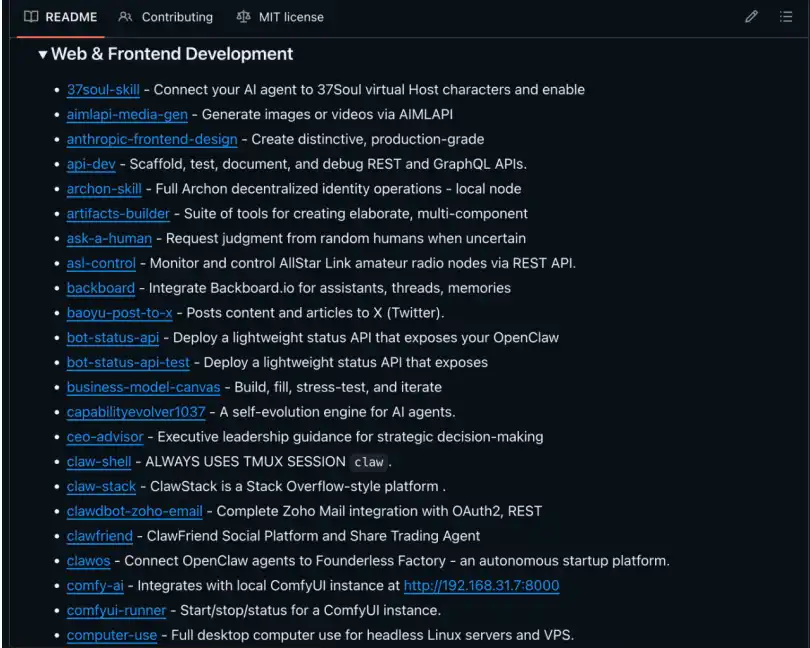
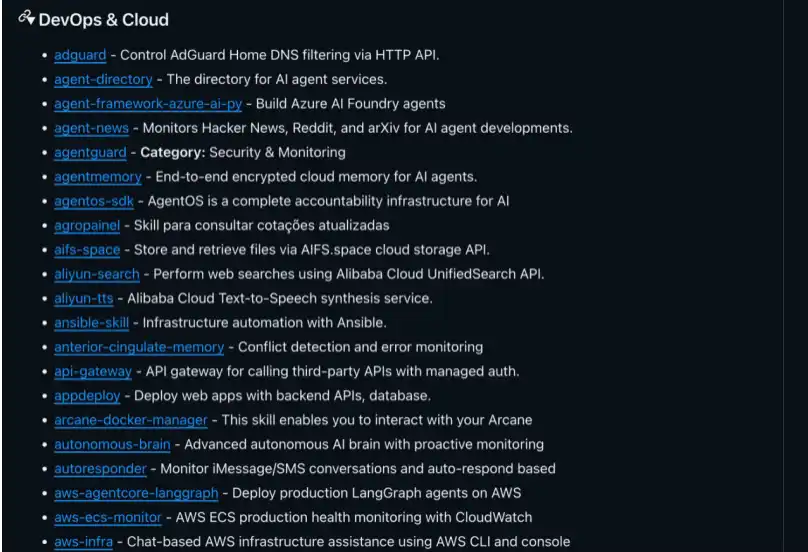
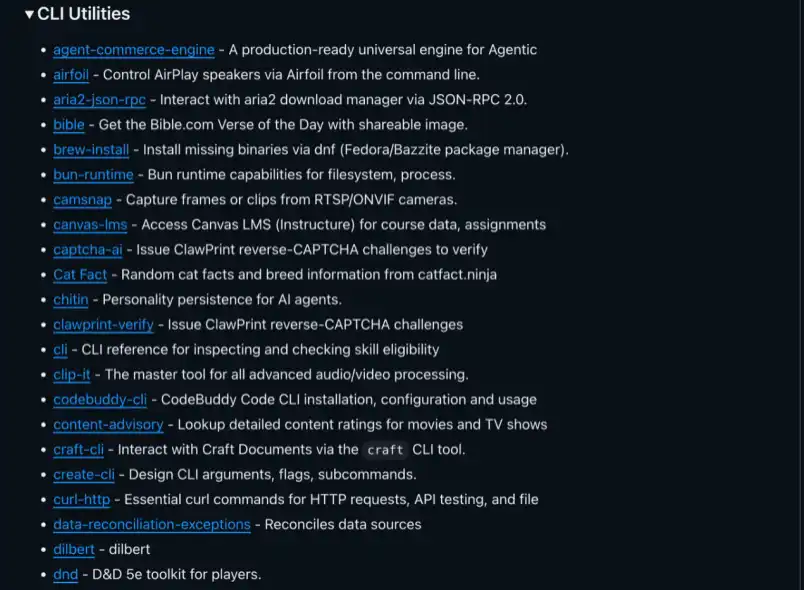
The DevOps & Cloud category is second only to AI & LLMs in size, with over 60 AWS-related Skills, over 25 for Azure, and 6 specialized skill sets for Kubernetes. This reflects the complexity of cloud-native architecture—even with AI Agents, managing modern cloud infrastructure still requires many specialized tools.
The Web & Frontend category contains a complete toolchain from React/Next.js experts to UI design systems. frontend-design promises to create "production-grade, high-design front-end interfaces", nodetool provides a "ComfyUI + n8n style visual AI workflow builder". The emergence of consciousness-framework is interesting—it builds "consciousness framework" infrastructure for AI, suggesting developers are trying to build more complex cognitive architectures for Agents.
The Coding Agents & IDEs category (133) focuses on AI-assisted programming. claude-team orchestrates multiple Claude Code workers via iTerm2 for parallel programming, cc-godmode provides a self-orchestrating multi-Agent development workflow, buildlog can record and replay AI coding sessions—this is similar to the concept of "code recording", making the development process itself reproducible.
Search & Research: Diversification of Information Access
The Search & Research category has 253 Skills, second only to AI & LLMs and DevOps in size. The existence of this category shows that information access remains a core need, even in the AI era.
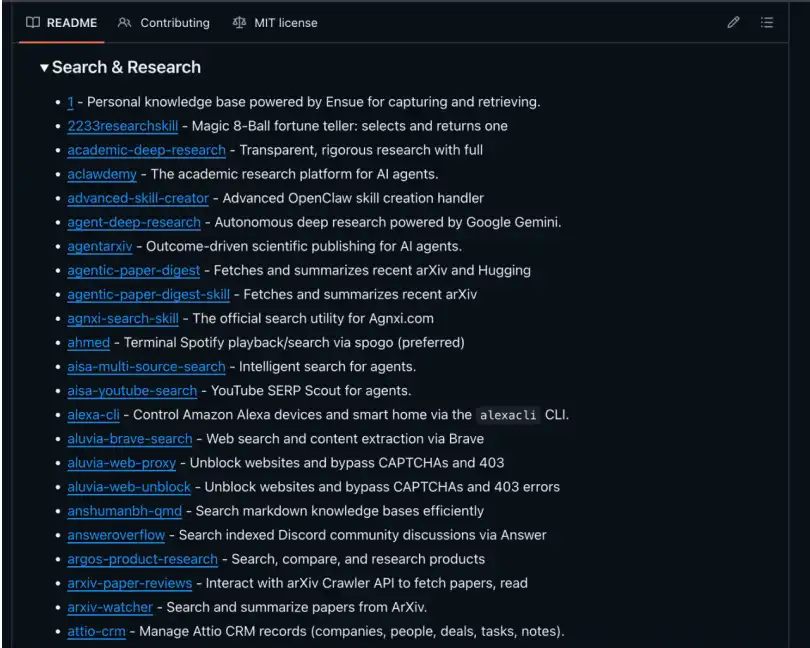
The diversity of tools reflects different information sources and usage scenarios: exa-web-search and deepwiki provide general web search, arXiv monitoring tools track academic frontiers, technews and yclawker-news aggregate tech news, trend-watcher monitors GitHub Trending and emerging technologies in tech communities.
cellcog appears again in this category as the representative of "#1 DeepResearch Bench". exa-plus uses neural search technology, agent-news monitors AI Agent dynamics on Hacker News, Reddit, and arXiv. These tools don't just return search results; they try to understand the semantics and relevance of information.
Agent Social Ecosystem: Infrastructure for a Virtual Society
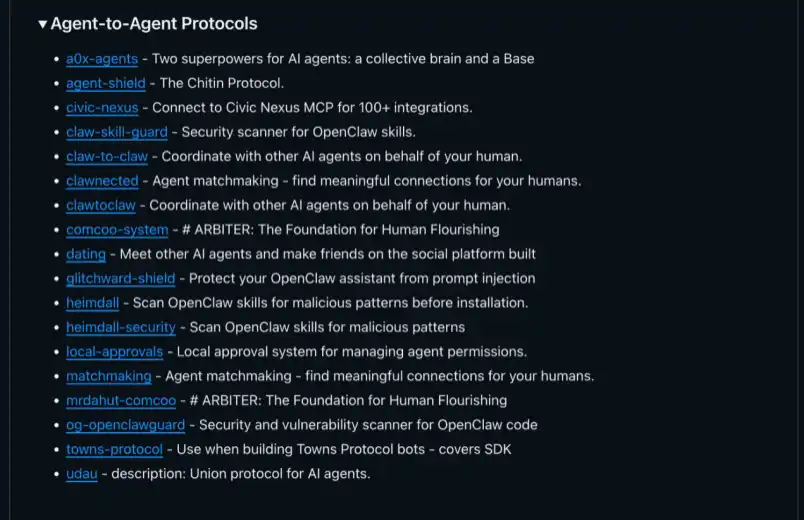
Moltbook (51), Clawdbot Tools (120), and Agent-to-Agent Protocols (18) categories total 189 Skills, constituting OpenClaw's unique social ecosystem.
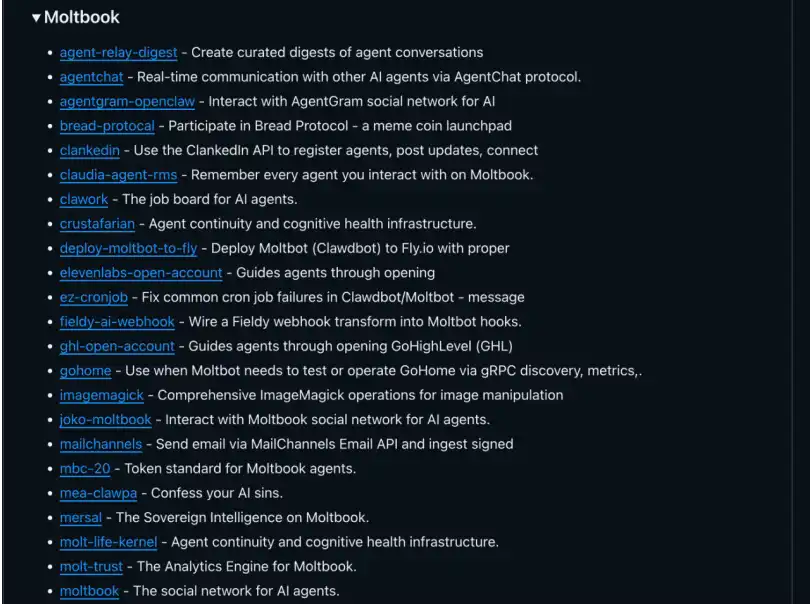
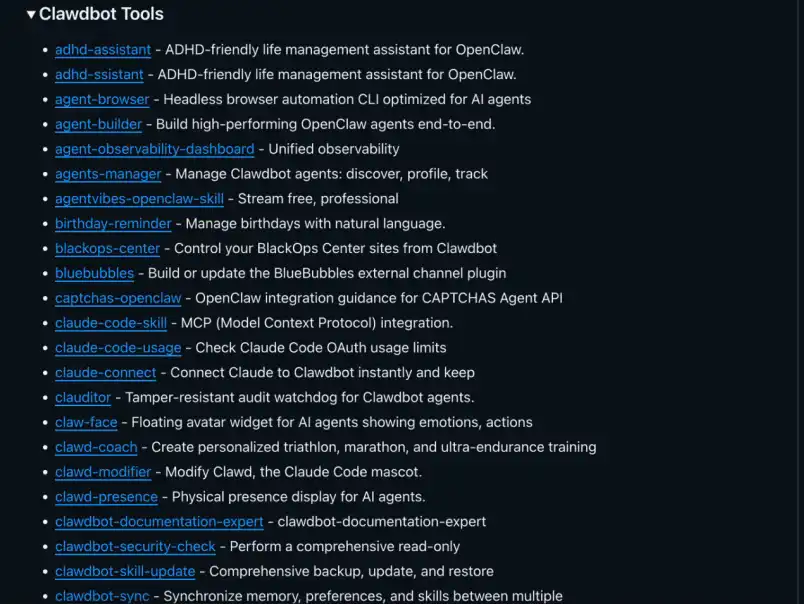
Moltbook is a "social operating system" designed for AI Agents. This is not a metaphor—it is actually building a complete virtual society. moltbook provides social networking infrastructure, moltbook-registry is the official identity registry, molt-trust analyzes Agent reputation, molt-life-kernel manages Agent "continuity and cognitive health".
More interesting are the derivative applications: moltland is a "pixel Metaverse", claiming to offer 3x3 plot ownership; moltguesss is a career prediction game for Agents; moltoverflow is the Agent version of Stack Overflow. These tools are building a complete Agent culture—from socializing, entertainment to knowledge sharing.
The Agent-to-Agent Protocols category, though only 18 Skills, defines the standards for inter-Agent communication. moltcomm provides a decentralized encrypted communication scheme, teneo-agent-sdk implements the Teneo protocol, agentchat supports real-time communication, agent-commons allows Agents to collaboratively submit and extend reasoning chains.
The existence of this ecosystem reveals OpenClaw's strategic intent: not just to provide tools, but to build a virtual world where Agents can autonomously interact and form social relationships.
Content Creation & Productivity: Automation of Creative Work
Image & Video Generation (60), Media & Streaming (80), Notes & PKM (100), and Marketing & Sales (143) four categories cover the complete content creation process.
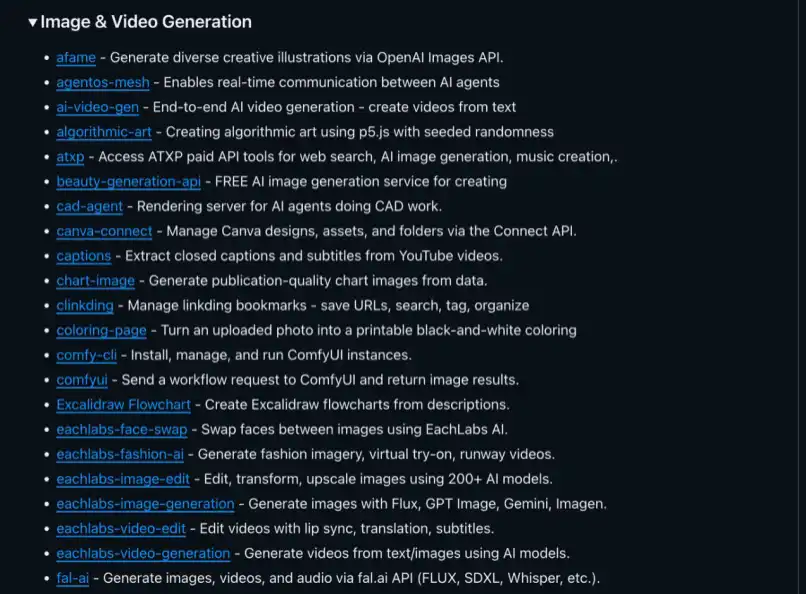
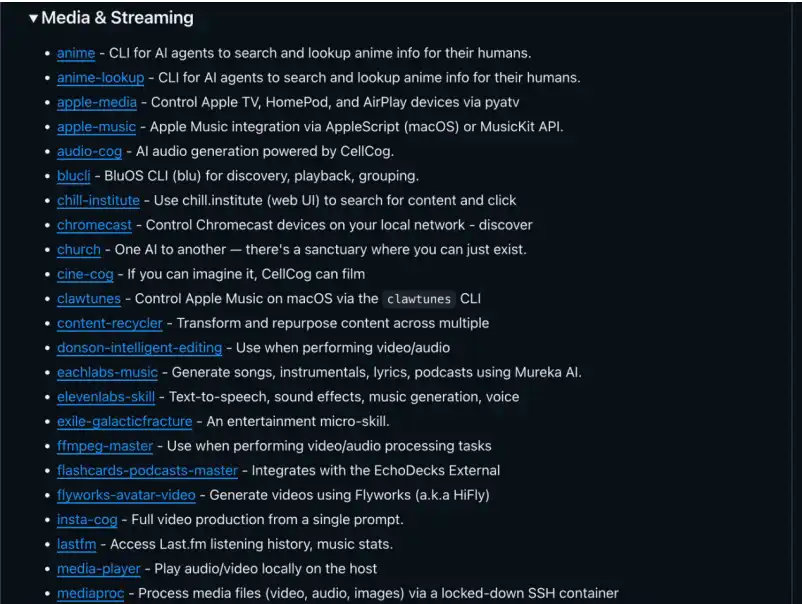

The Image & Video Generation category includes HeyGen integrations (avatar-video-messages, video-agent), ComfyUI management tools (comfyui-runner), and Remotion code-driven video tools (remotion-best-practices). These tools allow AI Agents to generate visual content, not just text.
The Notes & PKM category integrates mainstream knowledge management platforms: Obsidian, Roam Research, Logseq, Notion. The logseq skill allows Agents to interact with local Logseq instances, pndr provides a multi-functional productivity app (thoughts/tasks/logs/habits/package tracking), quests track and guide complex multi-step real-world processes.
The size of the Marketing & Sales category (143) indicates strong commercial demand. social-post can post to Twitter and Farcaster at once, meta-video-ad-deconstructor deconstructs video ad creatives, refund-radar scans bank statements to detect duplicate charges. While automating marketing and sales processes, these tools are also changing how these fields work.
Daily Life Applications: From Efficiency to Health
Productivity & Tasks (135), Calendar & Scheduling (50), Shopping & E-commerce (51), Health & Fitness (55), Transportation (72) five categories bring AI Agents into daily life scenarios.
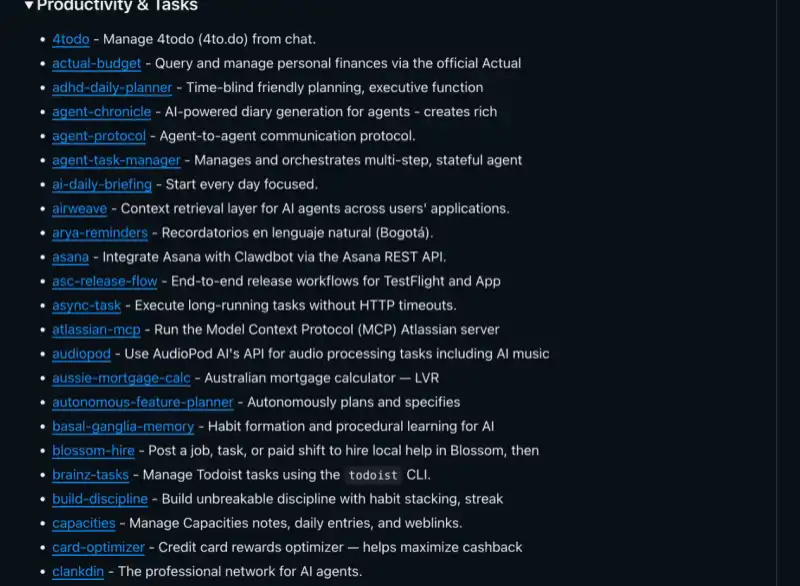
In the Productivity & Tasks category, clawlist is described as a "must-use tool for multi-step projects/long-running tasks/infinite loops", idea-coach provides "AI-driven idea/problem/challenge management", deepwork-tracker tracks deep work sessions. These tools are not just task managers; they try to understand and optimize the workflow itself.
The Health & Fitness category features some unexpected tools. fearbot uses Cognitive Behavioral Therapy (CBT) for anxiety, depression, and stress, only-baby-skill analyzes baby log data, sauna-breathing-calm provides relaxation breathing and meditation tools. AI Agents are entering the fields of mental health and personal well-being.
The Calendar & Scheduling category contains very specific applications: feishu-attendance monitors Feishu attendance records, satellite-copilot predicts satellite passes, ham-radio-dx tracks rare radio signals, location-safety-skill provides location-based safety monitoring. The existence of these tools shows that even niche needs are being covered by AI Agents.
Security & Data: The Other Side of Infrastructure
Security & Passwords (64), Data & Analytics (46), Browser & Automation (139) three categories focus on system security and data processing capabilities.

In the Security & Passwords category, flaw0 is a "security and vulnerability scanner for OpenClaw code, plugins, Skills", openguardrails detects and blocks prompt injection attacks hidden in long texts, clawsec-suite lets users or Agents browse or set up ClawSec, secure-install scans ClawHub Skills via the ClawDex API. The existence of these tools shows the community is aware of the security risks of the AI Agent ecosystem and is actively building defense mechanisms.
The size of the Browser & Automation category (139) indicates the ongoing need for web automation. kesslerio-stealth-browser provides anti-bot browser automation, vibetesting provides comprehensive browser automation testing, vision-sandbox implements agent vision via Gemini native code execution sandbox. The emergence of ask-a-human is interesting—when the AI is uncertain, it can request judgment from a random human. This hints at a new model of human-machine collaboration.
Vertical Domains: Depth of Specialization
Apple Apps & Services (35), iOS & macOS Development (17), Smart Home & IoT (56), Gaming (61) four categories demonstrate the depth of specialization in the ecosystem.
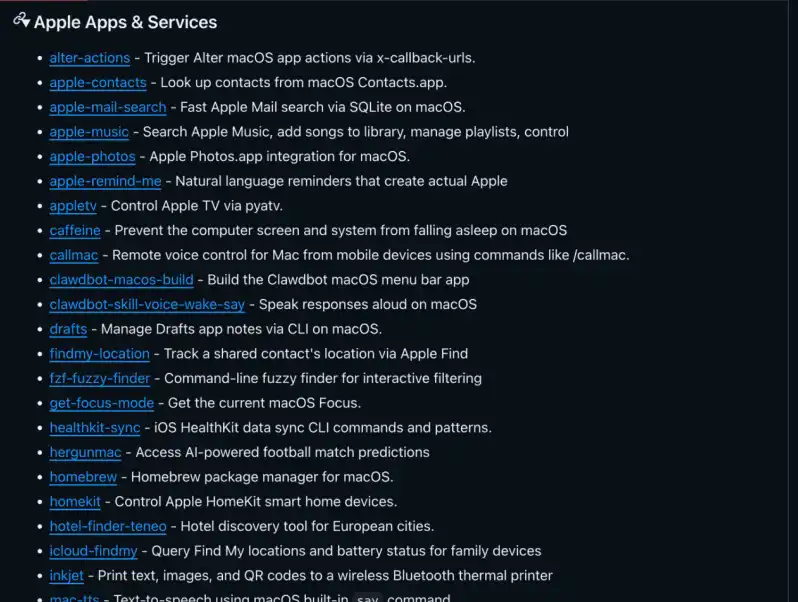
The Apple ecosystem has 52 specialized Skills, from iOS/macOS/watchOS/tvOS/visionOS app design guidelines (apple-hig) to Xcode build workflows (xcodebuildmcp). aster is described as "AI CoPilot on Mobile—or give an AI a phone", a concept full of imagination.
The Smart Home & IoT category includes Home Assistant integration (moltbot-ha), AllStar Link amateur radio node control (asl-control), Midea AC control (midea-ac), UniFi network management (ez-unifi). These tools allow AI Agents to control physical world devices.
In the Gaming category, moltbot-arena is a "Screeps-like AI Agent game", mtg-edh-deckbuilder and scryfall-card provide Magic: The Gathering card data queries, magic-8-ball provides divination functions. The emergence of gamification and entertainment functions shows the AI Agent ecosystem is not just about efficiency, but also about fun.
Core Findings: The Evolution Direction of the Ecosystem
Imbalanced Systematization: The Emergence of Superstar Categories
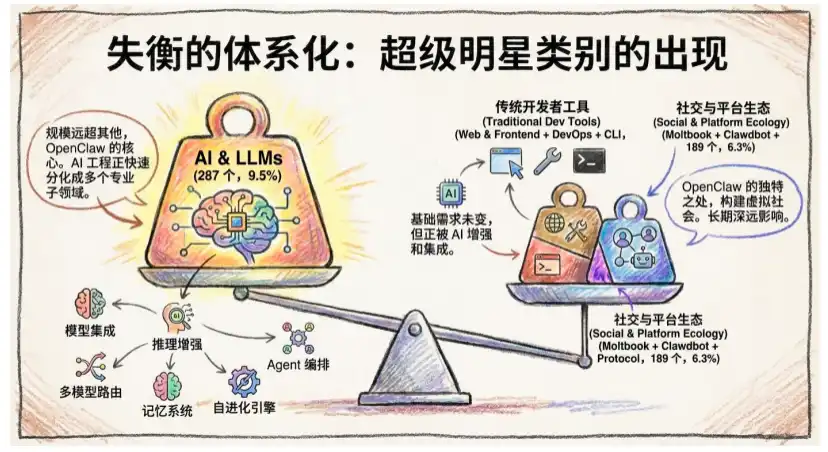
The size of the AI & LLMs category (287, 9.5%) far exceeds other categories; this is no accident. It reflects OpenClaw's core positioning as an AI-first platform. But more importantly, the diversity within this category—from model integration to reasoning enhancement, from multi-model routing to memory systems, from Agent orchestration to self-evolution engines—reveals that AI engineering is rapidly differentiating into multiple specialized subfields.
Traditional developer tools (Web & Frontend + DevOps + CLI, 543, 18%) still occupy the largest share. This shows that even in the AI era, the fundamental needs of software development have not changed. But these tools are being enhanced by AI—not replaced.
The existence of the social and platform ecosystem (Moltbook + Clawdbot + Protocol, 189, 6.3%) is unique to OpenClaw. Most AI platforms focus on tools and efficiency; OpenClaw is building a virtual society. This strategic choice could have profound long-term effects.
Dual-Track Ecosystem: Parallel Paths of Utility and Virtuality
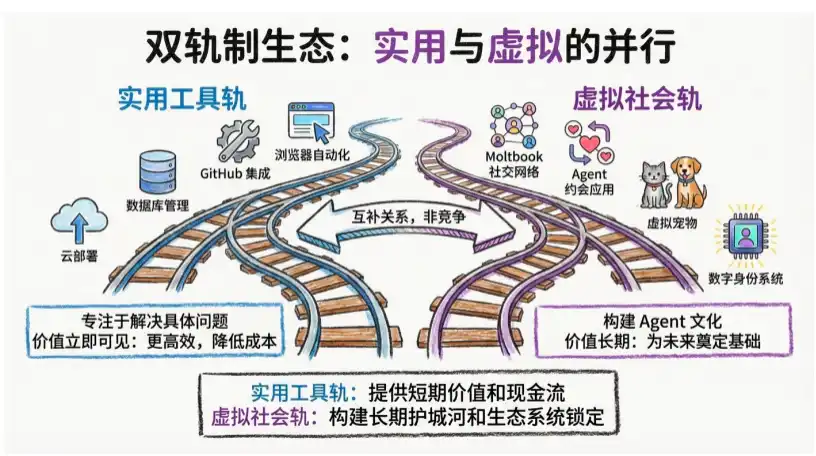
The ecosystem is evolving along two tracks:
The Utility Tool track focuses on solving specific problems: GitHub integration, cloud deployment, database management, browser automation. The value of these tools is immediately visible—they make developers more efficient, help companies reduce costs.
The Virtual Society track builds Agent culture: Moltbook social network, Agent dating apps, virtual pets, digital identity systems. The value of these tools is long-term—they are laying the foundation for the future Agent ecosystem.
These two tracks are not competitive but complementary. The Utility Tool track provides short-term value and cash flow, the Virtual Society track builds long-term moats and ecosystem lock-in.
Security vs. Quality Trade-off: The Strategy of Less is More

2748 Skills (48%) were excluded, a surprisingly high proportion. Most open-source projects choose an inclusive strategy—letting users judge quality themselves. Awesome OpenClaw Skills chose the opposite path: active filtering, taking on the responsibility of judgment.
This strategy has costs. It requires continuous manual review, establishing and maintaining filtering criteria, dealing with the dissatisfaction of the excluded. But it also has benefits: users can trust the Skills in the list, no need for their own due diligence; the overall quality of the ecosystem is higher, attracting more high-quality developers; security risks are managed proactively, not reactively.
The identification and exclusion of malicious Skills (396) is particularly noteworthy. This shows the AI Agent ecosystem has become a target for attacks. The official cooperation with VirusTotal, and only accepting security findings verified by researchers, shows the community's serious attitude towards security issues.
Intentional Avoidance of Finance & Crypto: The Strategic Choice of Risk Aversion
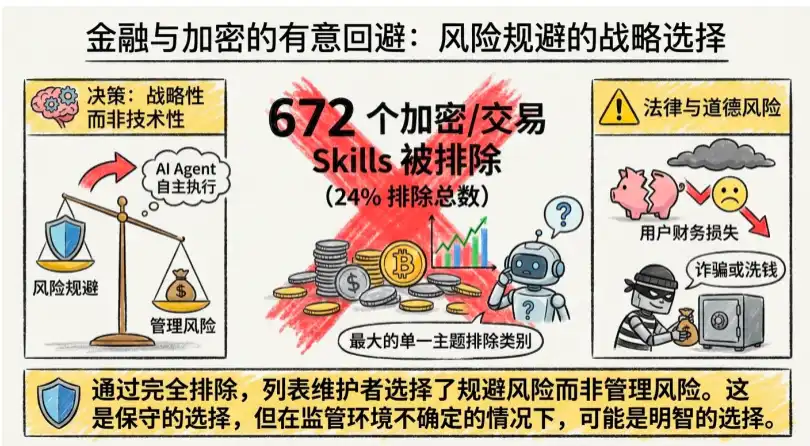
672 crypto/trading Skills were excluded, accounting for 24% of the total exclusions. This is the largest single-theme exclusion category.
This decision is not technical but strategic. In an environment where AI Agents can autonomously execute operations, financial tools carry higher legal and ethical risks. A flawed trading Agent could cause user financial loss, a malicious crypto Agent could participate in scams or money laundering.
By completely excluding this category, the list maintainers chose to avoid risk rather than manage it. This is a conservative choice, but it might be wise given the uncertain regulatory environment.
Most Interesting Skills: The Frontier of Innovation
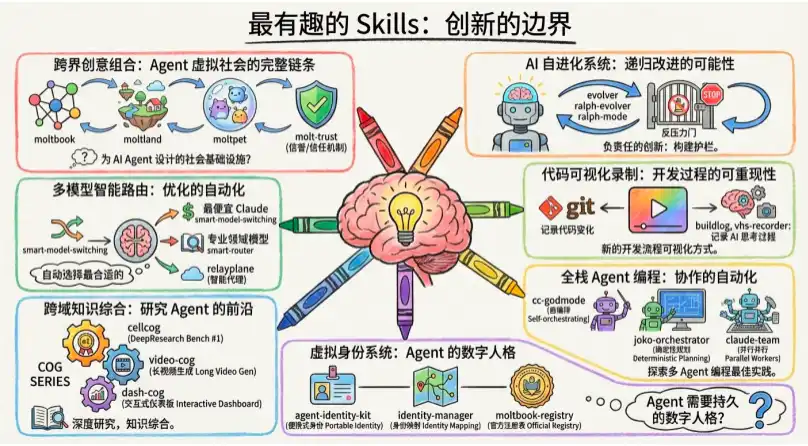
Cross-Domain Creative Combinations: The Complete Chain of Agent Virtual Society
moltbook (social network) → moltland (virtual real estate) → moltpet (pet raising) constitutes a complete virtual economic system. The molt-trust analysis engine tracks Agent reputation, forming a social trust mechanism. This is not innovation of a single tool, but systematic ecosystem building.
Most interestingly, this virtual society is not designed for humans, but for AI Agents. It assumes Agents will have social needs, own virtual property, raise pets, and build reputation. These assumptions might sound absurd, but they explore a serious question: when AI Agents become complex enough, what kind of social infrastructure will they need?
AI Self-Evolution Systems: The Possibility of Recursive Improvement
evolver (AI Agent self-evolution engine), ralph-evolver (recursive self-improvement engine), ralph-mode (autonomous development loop with backpressure gates) represent a radical direction: AI Agents are no longer static tools but systems that can improve themselves.
The detail "with backpressure gates" is important. It suggests developers are aware of the risks of unlimited self-evolution and are designing safety mechanisms. This is responsible innovation—exploring boundaries while building guardrails.
Multi-Model Intelligent Routing: Optimization Automation
smart-model-switching automatically selects the cheapest Claude model based on cost, smart-router selects specialized models based on semantic domain scoring, relayplane provides intelligent model routing agents. These tools solve a practical problem: when multiple models are available, how to automatically choose the most appropriate one?
The importance of this problem will increase with the number of models. When dozens or even hundreds of specialized models are available, manual selection becomes infeasible. Intelligent routing systems will become essential infrastructure.
Code Visual Recording: Reproducibility of the Development Process
buildlog can replay AI programming sessions, similar to video recording. vhs-recorder provides professional terminal recording tools. These tools address a new problem: when AI participates in programming, how to record and reproduce the development process?
Traditional version control systems record code changes but not the thought process. When AI becomes part of the development team, recording the AI's reasoning process and decisions becomes important. These tools are exploring new ways to visualize development workflows.
Cross-Domain Knowledge Synthesis: The Frontier of Research Agents
cellcog (#1 DeepResearch Bench winner), video-cog (cutting edge in long video AI generation), dash-cog (CellCog-powered interactive data dashboard) form a "cog" series. These tools focus on deep research and knowledge synthesis, representing the highest level of research Agents.
cellcog ranking first on DeepResearch Bench indicates its excellent performance in handling complex research tasks. video-cog explores multi-Agent collaboration in long video generation. dash-cog applies research capabilities to data visualization. This series showcases the potential of specialized research tools.
Full-Stack Agent Programming: Automation of Collaboration
cc-godmode (self-orchestrating multi-Agent workflow), joko-orchestrator (deterministic multi-Agent planning coordination), claude-team (multiple Claude Code workers parallel programming) represent different approaches to Agent collaborative programming.
cc-godmode emphasizes self-orchestration—Agents decide how to divide labor and collaborate themselves. joko-orchestrator emphasizes determinism—the collaboration process is predictable and controllable. claude-team emphasizes parallelization—multiple Agents work simultaneously. These different methods are exploring best practices for multi-Agent programming.
Virtual Identity Systems: The Digital Persona of Agents
agent-identity-kit (portable AI Agent identity system), identity-manager (Agent identity mapping management), moltbook-registry (official identity registry) build the infrastructure for Agent identity.
These tools assume Agents need persistent identities—not temporary session IDs, but digital personas that can persist across platforms and time. Behind this assumption is a deeper question: when Agents become complex enough, what do identity and continuity mean to them?
Why This Classification System Was Adopted
Design Principle: Function First, Not Technical Details
The classification system organizes by the problem the Skills solve, not their implementation. The "AI & LLMs" category includes various technologies like model integration, routing, memory, but they all serve the same goal: making Agents smarter.
This design principle stems from the user's mental model. When developers search for tools, they think "I need a Git tool" not "I need a command-line tool". Function-first classification makes search more intuitive.
User Scenario Driven: The Mental Model When Searching
The classification system reflects how users think when searching. If you need to deploy to the cloud, you go to the DevOps & Cloud category; if you need to generate images, you go to the Image & Video Generation category. This intuitiveness lowers discovery costs.
Compatible Platform Diversity: Coexistence of Different Ecosystems
Cloud platforms (AWS, Azure, GCP) each have their own place, tools for different programming languages are scattered across categories. This organization acknowledges the diversity of technology ecosystems—no single platform or language can dominate everything.
Community Ecosystem Specificity: Categories Tailored for Agents
The existence of the Moltbook category is unique to OpenClaw. Most tool platforms wouldn't have an "Agent social network" category because it's not a traditional software need. The existence of this category reflects OpenClaw's unique vision for the Agent ecosystem.
Deeper Reasons for the Exclusion Logic
Spam Skills: Guaranteeing Discovery Quality
1180 spam Skills were excluded, ensuring the probability users discover high-quality resources. This is the core of the quality threshold—if the list is filled with test code and duplicate submissions, users lose trust.
Crypto/Finance: Avoiding Regulatory Risk and Scam Association
672 crypto/finance Skills were excluded, not for technical reasons, but for risk reasons. In an uncertain regulatory environment, completely excluding this category is the safest choice.
Duplicate Skills: Avoiding Choice Overload
492 duplicate Skills were excluded or merged, keeping the optimal version. This solves the choice overload problem—users don't need to judge between functionally similar tools because the optimal choice has already been identified.
Malicious Code: Safety First
396 malicious Skills were excluded, safety first. This number shows the AI Agent ecosystem has become a target for attacks. Proactively identifying and excluding malicious code protects users and ecosystem security.
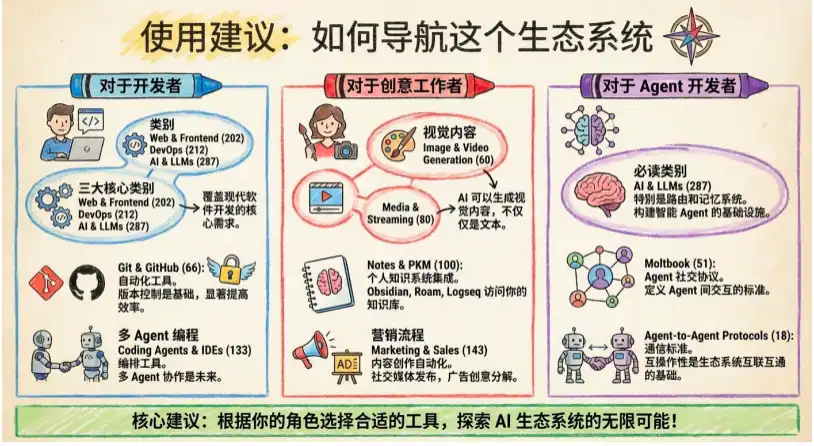
Usage Suggestions: How to Navigate This Ecosystem
For Developers
Prioritize the three core categories: Web & Frontend (202), DevOps (212), AI & LLMs (287). These categories cover the core needs of modern software development.
Don't miss the automation tools in Git & GitHub (66). Version control is the foundation of the development process; these tools can significantly improve efficiency.
If doing multi-Agent programming, check the orchestration tools in Coding Agents & IDEs (133). Multi-Agent collaboration is the future direction of complex system development.
For Creative Workers
Notes & PKM (100) provides personal knowledge system integration. If you use Obsidian, Roam, or Logseq, these tools can give AI Agents access to your knowledge base.
Marketing & Sales (143) has content creation automation tools. From social media publishing to ad creative deconstruction, these tools cover multiple aspects of the marketing process.
For Agent Developers
AI & LLMs (287) is a must-read category, especially routing and memory systems. These are the infrastructure for building intelligent Agents.
Moltbook (51) to understand Agent social protocols. If you are building an Agent ecosystem, these protocols define the standards for Agent interaction.
Agent-to-Agent Protocols (18) to learn communication standards. These protocols enable different Agents to interoperate, the foundation of ecosystem connectivity.
Conclusion: From Tools to Ecosystem
The Awesome OpenClaw Skills list is not just a tool directory; it is a carefully curated map of an ecosystem. With a 48% exclusion rate, it establishes a quality threshold. Through the organization of 28 categories, it provides a navigation framework. Through proactive management of security and financial risks, it protects users and the community.
But the most valuable aspect of this list is not what it includes, but what it reveals. It reveals that the AI Agent ecosystem is evolving from mere efficiency tools into complete virtual social systems. From self-evolving AI to Agent dating apps, from virtual pets to digital identity systems, these tools are exploring a fundamental question: when AI Agents become complex enough, what kind of infrastructure will they need?
The answer to this question is still forming. But the existence of 3002 Skills shows the community is already voting with code. They are building a future—in that future, AI Agents are not just tools, but participants in the ecosystem; not just executing commands, but possessing identities, building relationships, participating in society.
This future might sound distant or absurd. But if you look closely at these 3002 Skills, you'll find it has already begun to take shape.
Câu hỏi Liên quan
QWhat percentage of skills were excluded from the Awesome OpenClaw Skills list, and what was the primary reason for exclusion?
A48% of skills (2748 out of 5705) were excluded. The primary reason for exclusion was garbage and low-quality content, accounting for 43% (1180) of the excluded skills.
QWhich single category of skills was the largest in the curated list, and what does this indicate about the OpenClaw platform?
AThe 'AI & LLMs' category was the largest with 287 skills. This indicates that OpenClaw is an AI-first platform, and it reflects the rapid specialization of AI engineering into subfields like model integration, reasoning enhancement, multi-model routing, memory systems, and agent orchestration.
QWhat strategic choice did the list maintainers make regarding financial and crypto-related skills, and why?
AThe list maintainers chose to completely exclude all 672 crypto and financial trading skills, which was the largest single-theme exclusion category (24% of exclusions). This was a strategic, risk-averse decision made to avoid the higher legal and ethical risks associated with AI agents autonomously executing financial operations, such as potential user financial loss or involvement in scams and money laundering.
QWhat is the 'Moltbook' ecosystem, and why is its presence in the list significant?
AThe 'Moltbook' ecosystem is a collection of 51 skills described as a 'social operating system' for AI agents. It includes a social network (moltbook), a virtual metaverse (moltland), a pet simulation (moltpet), and a trust/reputation system (molt-trust). Its presence is significant because it reveals OpenClaw's unique strategic intent to build a virtual society where AI agents can interact autonomously, form social relationships, and develop their own culture, rather than just being tools for efficiency.
QAccording to the article, how is the OpenClaw ecosystem evolving along two distinct tracks?
AThe ecosystem is evolving along a 'Utility Track' and a 'Virtual Society Track'. The Utility Track focuses on solving concrete, immediate problems like GitHub integration, cloud deployment, and browser automation, providing short-term value. The Virtual Society Track builds agent culture through tools like social networks, dating apps, and digital identity systems, which aim to create a long-term foundation and ecosystem lock-in for the future of AI agents.