OpenAI released Workspace Agents in the early hours, marking the beginning of the countdown for GPTs.
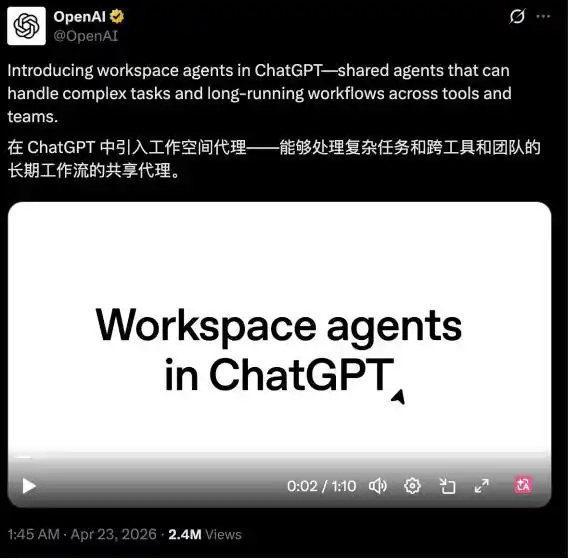
This new product is introduced as an evolved form of GPTs, with a clear positioning: team-oriented, turning a repeatable workflow into a shareable, executable agent.
It is powered by Codex, has its own workspace, can access files, call tools, and execute tasks continuously in the background.
You describe a repetitive workflow to ChatGPT, such as collecting information, making judgments, generating results, and then sending the results out. ChatGPT will then build this process into an Agent, which your entire team can use in ChatGPT or Slack, making adjustments while using it.
Once set up, it will continue running in the background, even when people are away.
It sounds familiar, like OpenClaw · Team Edition.
01 Team-Shared Agent
As the name suggests, Workspace Agents are for work teams.
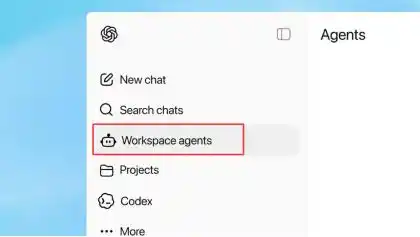
This new feature is placed in the sidebar of ChatGPT as a separate entry. Clicking on it reveals a space to build workflows.
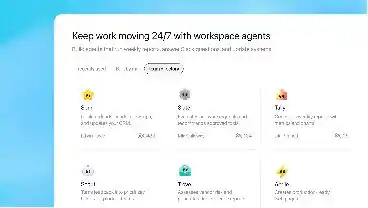
You can create an agent from scratch or modify it based on official templates. The entire process requires no coding; simply describe the workflow in plain language, and the system will break it down step by step: what steps are needed, what tools are used, and what results are output.
The created agent will appear in the team directory, where other members can directly call the same agent or adjust and supplement the workflow during use.
In other words, the workflow becomes a reusable tool for the team. Moreover, it is not fixed; it can be continuously refined during use.
Additionally, Workspace Agents have their own workspace, allowing them to read and save files, call connected tools such as email, calendars, document systems, or other business systems, and execute code when needed.
They can also run continuously, either manually triggered or scheduled. Once the process starts, it will execute step by step without requiring human intervention at each step. As long as the entire process is feasible, you can let it run on its own.
The execution process is controllable. Workspace Agents follow pre-set permissions and control rules.
Each agent's accessible tools and data can be set in advance; operations involving content modification or sending information can require prior approval; administrators can monitor its usage and pause or adjust it when necessary.
Looking back at previous generations of products, this change becomes clearer.
The earliest GPTs were essentially prompt + knowledge base + Actions, configured once for single-user use, without true long-process execution capabilities.
Later, ChatGPT Agent could execute tasks but was more like a one-time call. It ended after completion, with no continuous operation or stable identity.
With Workspace Agents, this type of product has stabilized: it is team-shared, can run long-term, has its own context and memory, executes continuously according to preset processes, and includes permission and management mechanisms.
Based on the official description, this product is suitable for structured, repeatable tasks that rely on multiple tools and require continuous operation. For one-time conversations or temporary tasks, such complexity is likely unnecessary.
Workspace Agents are now available in research preview for ChatGPT Business, Enterprise, Education, and Teacher plans. For Enterprise and Education plans, administrators can manage these agents through role permissions.
02 Simplifying Processes Under Clear Rules
OpenAI provided five typical scenarios covering IT, product, operations, sales, and risk control functions.
None of these scenarios require coding. They share a commonality: the tasks themselves are not complex, but the information is scattered across different places, requiring people to search and organize repeatedly.
The first is software review: after an employee submits a software use or procurement request, the agent checks it against the company's existing tool list and security rules to determine whether the request can be approved, how to proceed, and, if necessary, directly submits the ticket.
The second is product feedback organization: the agent simultaneously checks Slack, customer service channels, and public forums to collect scattered user feedback, categorizes it briefly, identifies which are more important, organizes it into tickets, and outputs a阶段性 summary.
The third is weekly report generation: the agent pulls business data at fixed times, creates charts, writes a summary, and compiles a complete report for the team.
The fourth is sales lead follow-up: the agent checks new customer information, judges whether the customer is worth following up based on team rules, drafts a follow-up email, and syncs relevant content back to the CRM system.
The fifth is third-party risk assessment: the agent checks various information about suppliers, such as whether they are sanctioned, their financial status, and any negative news, then compiles a report according to the company's standards.
These five scenarios point to the same type of task, which is the primary use of Workspace Agents: if a process already exists but requires constant switching between different tools during execution, with results pieced together at the end, Workspace Agents can connect these steps and let them run sequentially.
The question then arises: while it's fine to let it collect information and organize processes, is it appropriate to leave judgment to it?
According to the official design, this issue has not been overlooked.
The "judgment" in Workspace Agents is not free rein; it operates within a set of rules.
For example, in the software review scenario, it checks against the company's existing list and security rules to decide whether to use a certain tool; in the sales lead scenario, it doesn't randomly pick customers but scores them based on pre-set team standards.
For more sensitive actions, such as modifying data, sending external messages, or creating schedules, the system can add a confirmation step by default. The process can run automatically, but critical nodes can still pause for human final decisions.
This actually defines a boundary.
Workspace Agents are more suitable for tasks where the rules are clear and the judgment criteria are already written.
If a task itself requires extensive ad-hoc judgment and constant adjustment based on context, it still needs human leadership.
03 Management Lessons from OpenClaw
From a management perspective, Workspace Agents solve not an efficiency problem but the organizational method of the process itself.
In many teams, workflows exist but are not fully documented.
They are scattered in different places: part in documents, part in systems, and part in the minds of those executing them.
The same task handled by different people may follow different sequences and judgment standards.
This is why many tasks seem simple but are difficult to stabilize.
In the late 19th century, Taylor proposed scientific management, whose core was transforming work from "relying on personal experience" to "steps that can be split, recorded, and repeatedly executed."
First, break down a task: how each step should be done, what standards to judge by, then fix these steps so different people can execute them in the same way.
What Workspace Agents do is very similar to this logic. A process must first be clearly written: when it starts, what data is used, what steps are involved, and what results are produced.
This content directly becomes an executable process. During execution, it no longer relies on someone remembering the next step but follows the defined sequence.
The change is that the process can be separated from people.
In the past, the "most familiar person" in a team often determined whether the process could run smoothly; now, this experience can be written into the process, and other team members can directly use the same approach.
Another important point is that the process must have boundaries: which parts can be automated, which must stop for confirmation, which data can be used, and which cannot—all must be set from the beginning.
From this perspective, Workspace Agents do not change the content of work; they change how the process exists.
The process is no longer just described; it can be run, reused, and continuously adjusted.
Tools like OpenClaw initially followed this direction: they attempted to let systems take over entire operational processes, turning actions that required step-by-step human completion at a computer into automatically executable workflows.
The difference is that Workspace Agents place this in a team environment and add layers of permissions, approvals, and management, making work more controllable.
Similar attempts are not unique to OpenAI.
Microsoft is advancing its Copilot Agents, embedding this capability into Microsoft 365, covering environments employees use daily, from email and documents to collaboration tools.
Google also launched an enterprise-side Agent platform today, focusing on how to manage and schedule large numbers of agents, allowing them to collaborate across different systems.
However, for enterprises, the difference is not just in functionality. The real cost lies in usage: whether employees need to learn new tools and whether processes need to be rebuilt determines whether these systems can truly operate.
The competition continues, but the direction is clear.
This article is from the WeChat public account "Letter AI", author: Yuan Xinyue







