Mysticism Takes Over Crypto: When Candlestick Charts Give Way to Bazi and Feng Shui

比推Xuất bản vào 2025-12-25Cập nhật gần nhất vào 2025-12-25

Tóm tắt

In the crypto world, traditional technical analysis is increasingly being overshadowed by metaphysical practices like astrology and feng shui. The author describes encountering well-known crypto figures—KOLs, traders, and VCs—praying at temples for wealth, highlighting a cultural shift where beliefs in destiny and supernatural forces are becoming mainstream. Some investors and funds now prioritize checking founders' facial fortunes or project name compatibility over conventional due diligence. Anecdotes include a listed company CEO who reportedly earned hundreds of millions by following feng shui advice, while others suffered losses after ignoring such guidance. The trend is framed not as mere superstition but as a psychological response to extreme market volatility and uncertainty. In an environment where tweets from influencers or politicians can trigger 50% price swings, metaphysical practices serve as emotional anchors—much like ocean-faring cultures relying on divine protection during unpredictable voyages. Ultimately, when rationality reaches its limits, belief fills the void.

Author: Xiaobing, Deep Tide TechFlow

Original Title: Satoshi Nakamoto Would Have to Kowtow to the God of Wealth


Every year on the fifth day of the Lunar New Year, Xiaobing wakes up early to go to the Number One Temple of Wealth at Beigao Peak in Hangzhou.

I thought I would be jostling with aunties and uncles, but when I arrived, the scene was filled with familiar faces amidst the swirling incense smoke.

On the left was a well-known爆料KOL, on the right was someone involved in community schemes, and a few tech elites who usually preach "decentralization" were devoutly kowtowing with loud thuds. In that moment, algorithmic consensus and Federal Reserve movements were no match for the three sticks of incense in their hands.

Over the past two years, mysticism has become the "prominent study" in the crypto world. If you're still looking at candlestick charts, you're a classical rookie. The real veterans are now reading Bazi (Eight Characters).

A crypto trader familiar with various macroeconomic indicators eventually turned to mysticism, recently calculating BTC's Bazi—and the outlook is grim: fire clashes with the wealth repository, making 2026 (Bing Wu Year) Bitcoin's darkest hour. I quickly checked my wallet; luckily, it was already empty.
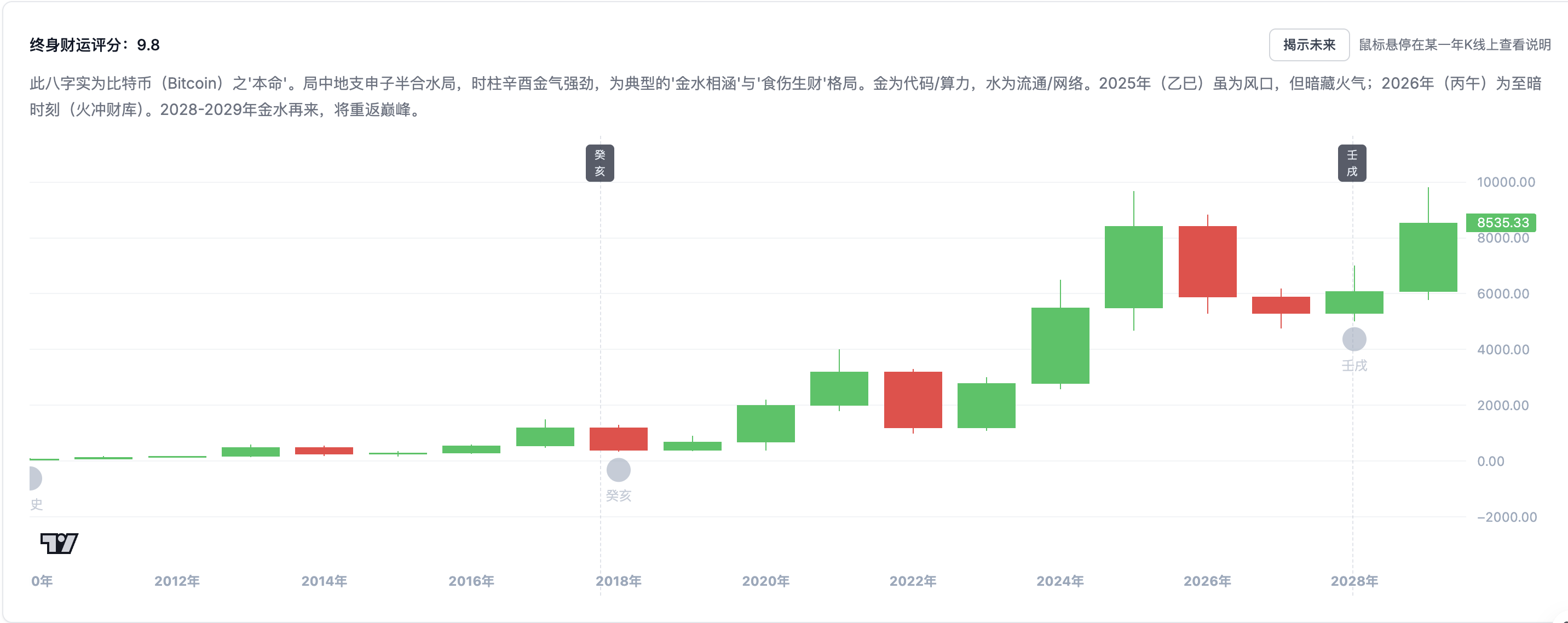
Remember, Alen, a partner at crypto VC y2z Ventures, once stated bluntly that one of their fund's core competencies was "reading faces." In the past, due diligence (DD) involved code audits and business models. Now, it's different: first, check if the founder has a "wealth-losing face," then see if the project's name clashes with Feng Shui.

During a recent trip to Shenzhen, I noticed that traders and KOLs' standard setup isn't data terminals; they all have a "Feng Shui consultant" behind them.

Don't laugh—this approach really works in crypto. Xiaobing knows a boss of a Hong Kong-listed company who is a devout believer in Feng Shui, donating real money to temples—possibly more than the company's R&D budget.

And the result? Feng Shui brought help from noble patrons. Starting in 2023, he bought Bitcoin, earning hundreds of millions of dollars by hoarding it. Later, he caught the wave of the DAT (Crypto Treasury Reserve) narrative, and the company's stock price doubled... Although everyone knows this is "survivorship bias," you can't argue with the fact that he really made a fortune.

There are counterexamples too. A爆料KOL with a frog avatar also had a Feng Shui consultant who advised him not to make moves recently. He couldn't resist and played with contracts, resulting in a neat and tidy liquidation.

About this phenomenon, it's not entirely superstition.

Our traditional land-based civilization emphasizes farming—"sow one grain in spring, reap ten thousand in autumn"—focusing on certainty. But what does maritime civilization face? Storms and unknown waters.

Why do people in the southeastern coastal areas worship Mazu? Not because of ignorance, but because on the vast ocean, besides experience and technology, you need something else.

The crypto world is essentially a modern version of the "Age of Exploration." It faces bottomless seas and sudden storms. This is human nature: the greater the randomness and volatility, the more we seek supernatural spiritual anchors.

When candlestick charts fail, and a single tweet from Musk, Trump, or CZ can sway the market, Feng Shui becomes the last psychological defense. This isn't ignorance; it's an instinctive stress response to massive wealth fluctuations.

After all, when your assets can swing 50% in a day, you need to believe in something to sleep at night. As for whether the God of Wealth understands blockchain, does it really matter?


Twitter:https://twitter.com/BitpushNewsCN

Bitpush TG Discussion Group:https://t.me/BitPushCommunity

Bitpush TG Subscription: https://t.me/bitpush

Original Link:https://www.bitpush.news/articles/7598323

Câu hỏi Liên quan

QWhat is the main theme of the article '玄学接管币圈:当K线图让位于八字与风水'?

AThe article discusses how metaphysical practices like astrology, fortune-telling, and feng shui are becoming increasingly influential in the cryptocurrency circle, replacing traditional methods like analyzing K-line charts for investment guidance.

QAccording to the article, what did the crypto VC y2z Ventures partner claim as one of their core competencies?

AAlen, a partner at y2z Ventures, stated that one of their fund's core competencies is 'reading facial features' (面相) to evaluate founders and projects, rather than relying solely on technical or business due diligence.

QWhy does the article compare the cryptocurrency market to the 'Age of Exploration'?

AThe article compares the crypto market to the Age of Exploration because both involve navigating high uncertainty and volatility, similar to sailors facing unpredictable storms at sea, leading people to seek supernatural or spiritual anchors for psychological comfort.

QWhat example does the article provide to show the effectiveness of feng shui in crypto investments?

AThe article cites a Hong Kong-listed company老板 who heavily donated to temples and followed feng shui practices, which allegedly helped him earn hundreds of millions by buying Bitcoin in 2023 and benefiting from market trends, though it acknowledges this could be survivorship bias.

QHow does the article explain the shift from traditional analysis to玄学in crypto trading?

AThe article attributes the shift to the extreme randomness and influence of factors like tweets from figures such as Elon Musk or Donald Trump, which make traditional charts unreliable, leading traders to adopt玄学as a psychological defense mechanism against high volatility.

Nội dung Liên quan

Polymarket Bị Kẹt: Bài Kiểm Tra Thực Sự Sau Khi Vượt Qua Giai Đoạn Lưu Lượng Tăng Đột Biến

Polymarket, nền tảng dự đoán thị trường hàng đầu, đang đối mặt với thách thức lớn khi trải nghiệm giao dịch xuống cấp do hạ tầng không theo kịp đà tăng trưởng. Phó chủ tịch kỹ thuật Josh Stevens thừa nhận vấn đề và công bố kế hoạch cải tổ toàn diện, bao gồm: giảm độ trễ dữ liệu, sửa lỗi hủy lệnh, xây dựng lại hệ thống order book (CLOB), nâng cao hiệu suất website, và quan trọng nhất là di chuyển chain (chain migration). Nguyên nhân sâu xa nằm ở việc Polymarket không còn là ứng dụng dự đoán đơn thuần mà đã phát triển thành một nền tảng giao dịch tần suất cao. Polygon, từng là lựa chọn chi phí thấp hoàn hảo, giờ đây trở thành rào cản kỹ thuật. Động thái này ngay lập tức thu hút sự quan tâm của các blockchain khác như Solana, Sui, Algorand... trong khi Polygon nỗ lực giữ chân ứng dụng quan trọng này - nguồn đóng góp phí giao dịch đáng kể cho hệ sinh thái của họ. Bài kiểm tra thực sự của Polymarket không chỉ là chọn chain mới, mà là xây dựng một hệ thống giao dịch đủ mạnh và ổn định để giữ chân người dùng trong giai đoạn tăng trưởng mới, nơi độ tin cậy quan trọng hơn bao giờ hết.

Odaily星球日报04/27 03:21

Polymarket Bị Kẹt: Bài Kiểm Tra Thực Sự Sau Khi Vượt Qua Giai Đoạn Lưu Lượng Tăng Đột Biến

Odaily星球日报04/27 03:21

Điều chỉnh kỳ vọng giảm cho chu kỳ tăng giá tiếp theo của BTC

Tác giả Alex Xu, một nhà đầu tư Bitcoin lâu năm, đã chia sẻ quyết định giảm dần tỷ trọng BTC trong danh mục đầu tư của mình, từ vị thế lớn nhất xuống còn khoảng 30%, và giải thích lý do cho việc điều chỉnh kỳ vọng về đỉnh giá trong chu kỳ bull market tiếp theo. Các lý do chính bao gồm: 1. **Năng lượng tăng trưởng tiềm năng giảm:** Các chu kỳ trước được thúc đẩy bởi việc mở rộng đối tượng đầu tư theo cấp số nhân (từ cá nhân đến tổ chức). Chu kỳ tới cần sự chấp nhận từ các quỹ đầu tư quốc gia hoặc ngân hàng trung ương, điều này khó xảy ra trong 2-3 năm tới. 2. **Chi phí cơ hội cá nhân:** Tìm thấy nhiều cơ hội đầu tư hấp dẫn khác (cổ phiếu công ty) với mức giá hợp lý. 3. **Tác động tiêu cực từ sự thu hẹp của ngành crypto:** Nhiều mô hình Web3 (SocialFi, GameFi...) không thành công, dẫn đến sự thu hẹp của toàn ngành và làm chậm tốc độ tăng trưởng số người nắm giữ BTC. 4. **Áp lực từ nhà mua lớn nhất (MicroStrategy):** Chi phí huy động vốn của MicroStrategy tiếp tục tăng cao (lãi suất 11.5%), có thể làm giảm tốc độ mua vào và gây áp lực bán. 5. **Sự cạnh tranh từ Vàng được token hóa:** Sản phẩm vàng token hóa (tokenized gold) đã thu hẹp khoảng cách về tính dễ chia nhỏ, dễ mang theo và dễ xác minh so với BTC. 6. **Vấn đề ngân sách bảo mật:** Phần thưởng khối giảm sau mỗi lần halving làm trầm trọng thêm vấn đề ngân sách cho bảo mật mạng lưới. Tác giả vẫn giữ một phần BTC đáng kể và sẵn sàng mua lại nếu các lý kiến trên được giải quyết hoặc xuất hiện các yếu tố tích cực mới, với điều kiện giá cả phù hợp.

marsbit04/27 02:46

Điều chỉnh kỳ vọng giảm cho chu kỳ tăng giá tiếp theo của BTC

marsbit04/27 02:46

Giao dịch

Giao ngay
Hợp đồng Tương lai
活动图片





