More Accurate Than Polls, More Dangerous Than Imagined: Prediction Markets in the Eyes of the Fed

比推Xuất bản vào 2026-02-24Cập nhật gần nhất vào 2026-02-24

Tóm tắt

The Federal Reserve is exploring the use of prediction markets, particularly Kalshi, as a real-time tool for policy insights. A Fed-affiliated working paper found that Kalshi’s predictions for core CPI and unemployment are statistically comparable to—and sometimes more accurate than—Bloomberg consensus estimates. Prediction markets aggregate real-money, belief-backed trading, offering frequent updates and capturing nuanced shifts that traditional surveys miss. For instance, Kalshi priced inflation uncertainty in real time during a trade policy scare—a dynamic monthly surveys couldn’t reflect. While these markets provide valuable signals, they also carry risks. Prices reflect both expectations and risk preferences, and heavy reliance on sports betting for liquidity makes macroeconomic markets vulnerable to regulatory changes. If sports betting is restricted, liquidity could dry up, increasing manipulation risks. Moreover, if the Fed openly uses prediction markets, it could create a feedback loop where traders manipulate smaller markets like Kalshi to influence broader policy communication and traditional financial instruments. Despite these concerns, prediction markets offer a uniquely timely and distributed form of expectation aggregation—especially for events like FOMC meetings, where informed participants trade with real stakes. The Fed should require open data transparency to mitigate manipulation and carefully weigh the signal against the noise.

Source: The Token Dispatch

Author: Prathik Desai

Original Title: The Signal and the Noise


“Forecasts usually tell us more of the forecaster than of the future.”

— Warren Buffett

Money filters out empty talk. Supporters believe this is precisely why prediction markets are reliable. We saw people accurately predict the outcome of the 2024 U.S. presidential election on Polymarket and Kalshi. However, prediction markets themselves are not new, and their success in predicting political outcomes is not the first of its kind.

In October 1988, a group of economists at the University of Iowa supported their academic curiosity with a small, real-money prediction market. They launched a presidential election futures market where participants could buy contracts: if George H. W. Bush won, the contract paid $1; if Michael Dukakis won, it paid $0. On the eve of the election, Bush's contracts traded at 53 cents, while traditional polls suggested a close race. Ultimately, Bush won with 53.4% of the vote and a solid 8-point margin.

Since that academic experiment, these real-money futures markets have outperformed traditional polls in every election predicted more than 100 days in advance. In U.S. presidential elections since 1988, prediction markets have been closer to the final result than polls 74% of the time.

This success stems from a mechanism that forces people to express genuine beliefs backed by real money, something surveys can never achieve. Those who truly believed Bush would win bought and held contracts. For random participants, there is no incentive to spend $50 to support a claim they themselves do not believe. When this behavior aggregates thousands of traders, information converges into a price that reflects the true beliefs of a broad group, rather than a small, disproportionate sample.

That small academic experiment in Iowa, run on a shoestring budget, has now evolved into an institutionalized infrastructure.

Last week, a working paper authored by economists affiliated with the Federal Reserve noted that Kalshi, the largest regulated prediction market in the U.S., could serve as a valuable real-time benchmark for policymakers. The same week, New York Stock Exchange (NYSE) President Lynn Martin stated that Polymarket, the world's highest-volume prediction market, moved S&P index futures on election night by pricing Donald Trump's victory earlier than any news organization. Subsequently, Kalshi announced a partnership with a trading platform that handles $2.6 trillion in daily institutional volume.

In today's in-depth analysis, I will explore whether prediction markets can serve as reliable barometers for policymaking and what risks they bring.

Prediction Markets as Policymaking Tools

The paper found that Kalshi's predictions are statistically similar to Bloomberg's consensus expectations, with nearly identical prediction errors for core CPI and unemployment rates. In fact, the paper also found that Kalshi's predictions for core CPI were significantly better than Bloomberg's estimates.
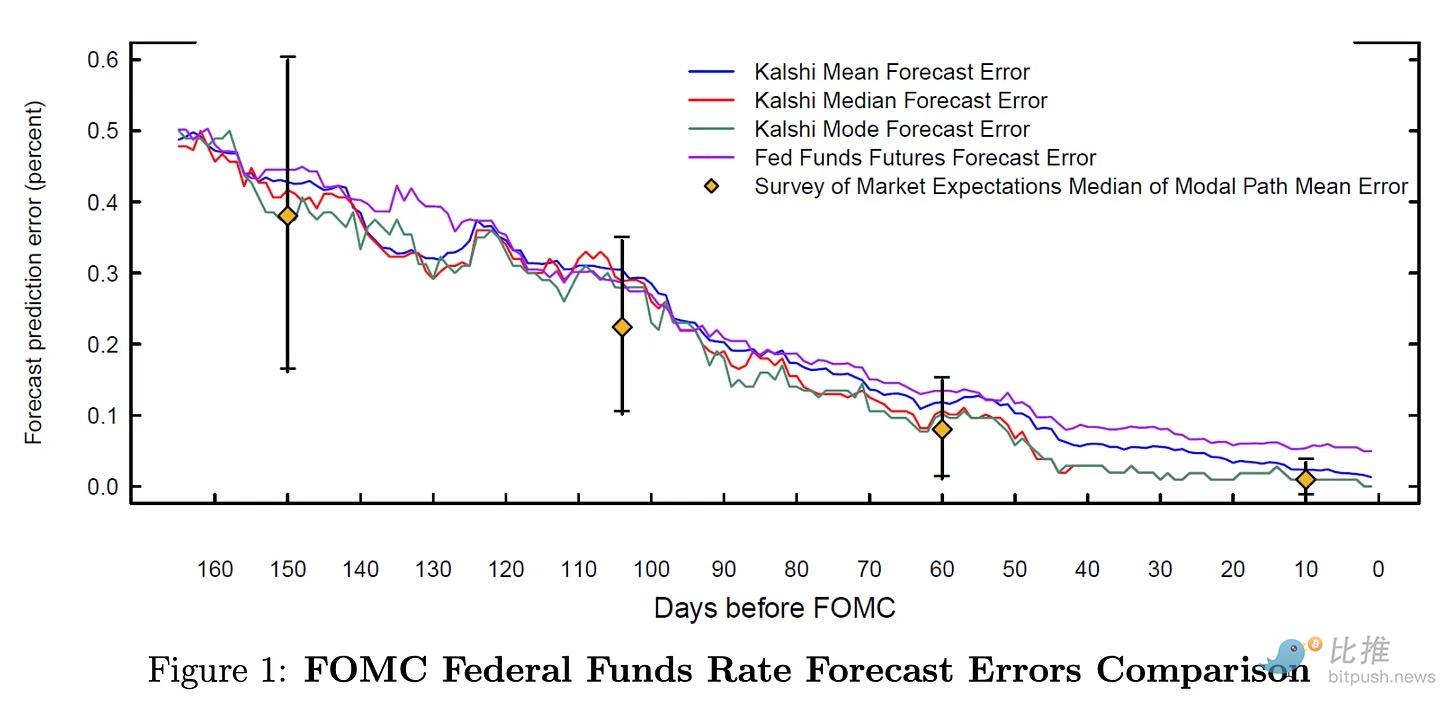
@FederalReserve

Despite similar statistical performance, Kalshi's uniqueness lies in its ability to provide more frequent, real-time probability curve updates for macroeconomic indicators such as GDP growth, core CPI, and unemployment rates. For estimates like inflation, the Bloomberg consensus is only available in the months leading up to the data release. This makes traditional estimates less frequent, with longer gaps that fail to reflect real-time expectation updates.

Kalshi not only provides predictions of outcomes but also real-time uncertainty ranges and tail risks. In early April 2025, uncertainty about trade policy temporarily raised inflation expectations. Although this uncertainty did not materialize, Kalshi priced this dynamic in real time. Monthly Bloomberg estimates could never capture this nuance.
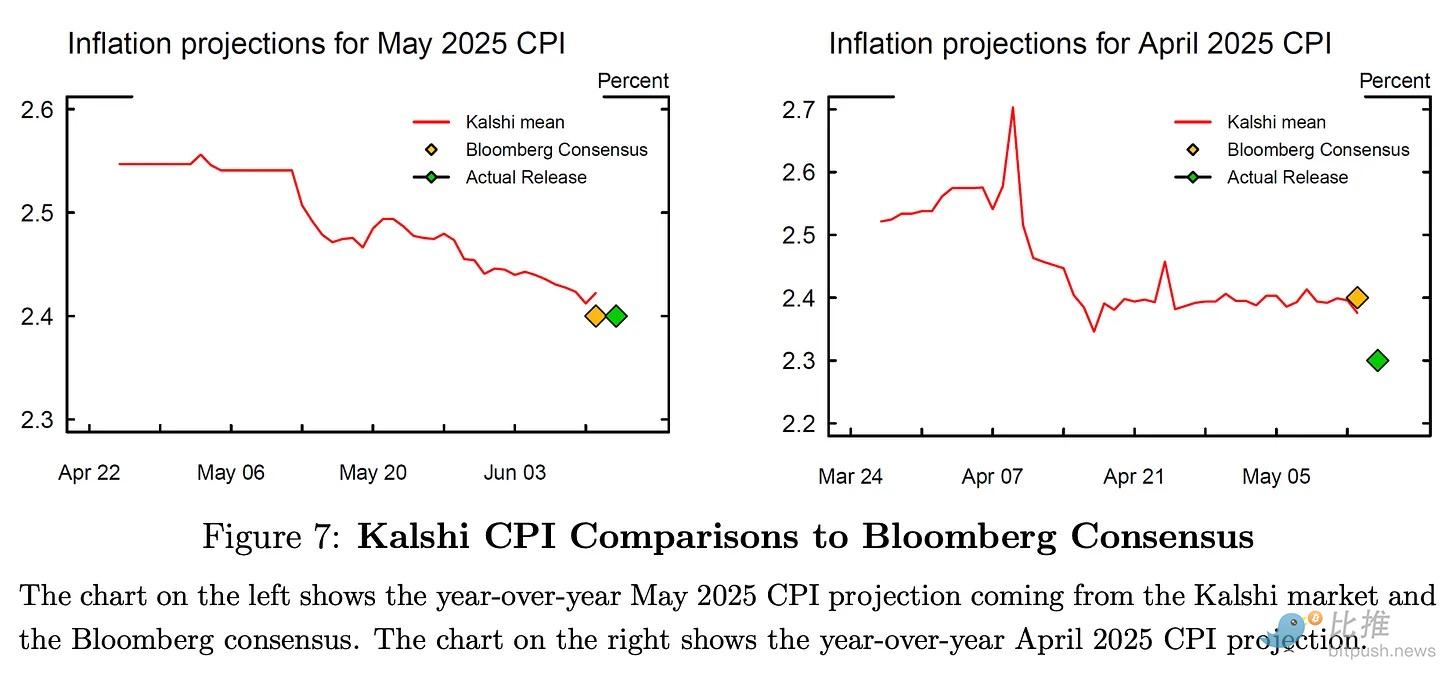
@FederalReserve

Today, when Federal Reserve governors speak at Federal Open Market Committee (FOMC) meetings, Kalshi's market odds move in real time. They price every word from the governors, providing policymakers with a perspective on how traders interpret the expected information.

For example, when Christopher J. Waller made dovish remarks ahead of the July 2025 FOMC meeting, the probability of no rate cut fell to 75%. After the stronger-than-expected June jobs report, this probability quickly rebounded to over 90%. The entire expectation of traders, backed by real money, is presented to policymakers in a way no other tool can currently achieve.

Who Trades on These Markets?

Before deciding how much to trust prediction markets, it is important to examine who is trading and what the volume represents.

Between September 2024 and January 2026, volume on Polymarket for FOMC meetings grew 11-fold, from $59 million to $660 million. In total, Polymarket's FOMC markets processed $2.6 billion, surpassing the combined total of the platform's culture, economy, geopolitics, and science categories.

So, who is trading such large amounts on FOMC meetings? While it is difficult to pinpoint on anonymous prediction platforms like Polymarket, we can speculate: it is hard not to think of macro hedge fund analysts involved in drafting labor statistics reports, or money market fund managers who stand to gain if rates are not cut.

Why them? The Iowa market worked because the number of people who put their money where their mouth is, with reliable information, outweighed those who merely gambling without it. While acknowledging the risk of over-assumption, I believe that when real stakes and funds of this scale are involved, those with reliable information converge on the market, leading to more accurate price discovery.

What to Be Wary Of

All this does not mean prediction markets can be perfect measuring tools for policymakers.

Probabilities in prediction markets also reflect traders' risk preferences. They are not a raw reflection of outcome expectations. For example, when Kalshi prices the probability of unfavorable CPI data at 15% while traditional surveys price it at 10%, this gap can be explained by two factors:

  1. Prediction markets may be pricing real-time information missed by the Bloomberg consensus.

  2. Traders may be paying a premium on prediction markets to hedge against unfavorable outcomes.

Policymakers must understand what this gap reflects before treating this information as a signal for policymaking.

While Kalshi's macroeconomic signals to policymakers seem reliable, over 85% of its total nominal volume comes from the sports category.
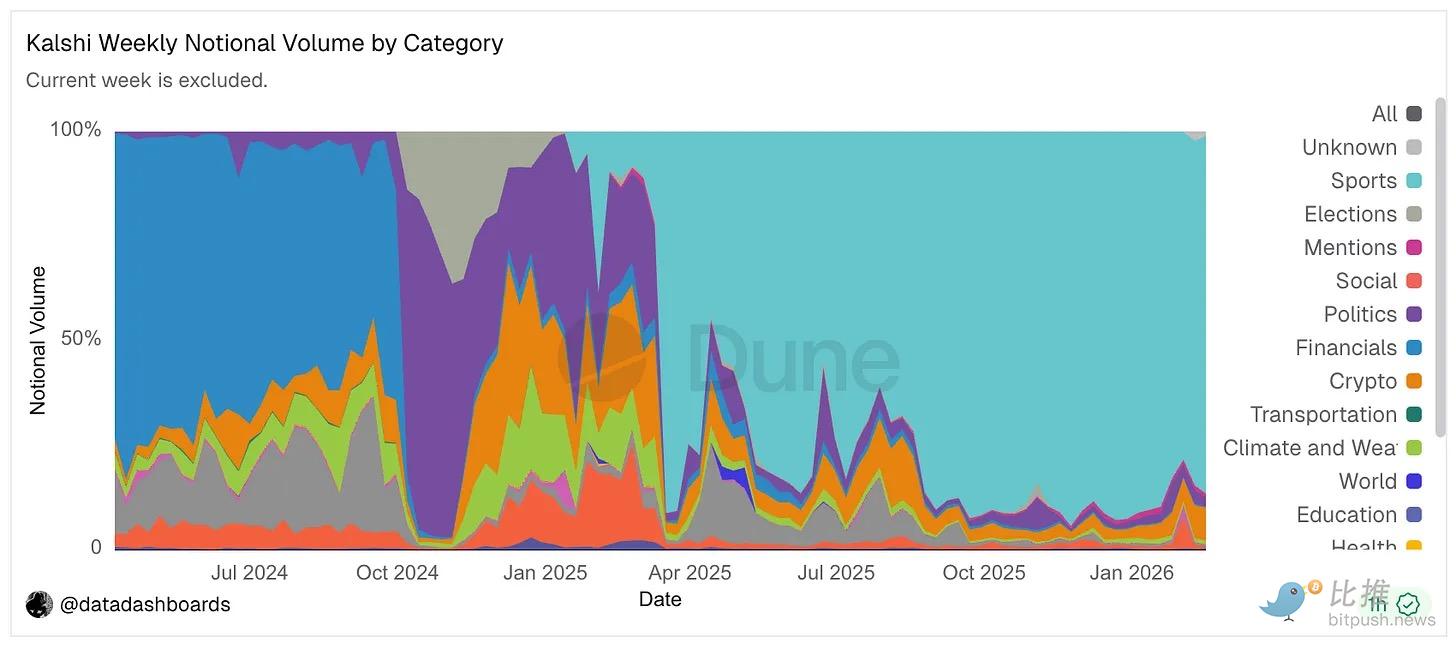
@Dune

Currently, at least 20 federal lawsuits are challenging the regulatory arbitrage achieved through nationwide sports betting for prediction markets.

The reliability of Kalshi's FOMC markets is partly due to sports betting providing the platform with foundational liquidity through active traders, narrow bid-ask spreads, and market-making infrastructure, which sustains all Kalshi markets. Although macro markets operate independently, they benefit from this foundation. If sports betting disappears under regulatory pressure, the platform will lose the liquidity engine that keeps spreads tight and prices continuous. Thinner macro markets become easier to move with less capital, making them more susceptible to manipulation.

The Fed's paper recommends using Kalshi as a monitoring tool, not a decision-making input. But making this intention public is itself problematic.

The authors suggest greater use of Kalshi to interpret incoming data and check real-time interpretations of Fed communications. However, because the intention to reference prediction markets is public, it could create a feedback loop.

For example, a policymaker at the Fed might see Kalshi pricing a 15% probability of a rate cut, lower than the expectation they wish to convey through their actions. In response, they might soften their rhetoric in the next speech, which could then cause fluctuations in global traditional interest rate markets. The problem here is that while Kalshi's FOMC market size is $660 million, the federal funds futures market is worth hundreds of billions of dollars. The former requires relatively small positions to change the odds. A well-funded participant, aware that moving Kalshi could influence subsequent Fed remarks (if not decisions), could use relatively small positions to move a much larger market. Policymakers' communications could become targets for manipulation.

This scenario highlights the difference between the 1988 Iowa futures market and the 2026 prediction markets. The Iowa economists back then simply wanted to determine if a market with real stakes could produce better predictions than surveys. At that time, policymaking was not under such close scrutiny to deter manipulators.

Back then, prices reflected true beliefs because those prices did not influence the world. They merely allowed those with insights to monetize them. Once the Fed publicly announces (if it does so) its intention to use prediction markets as a policy input, this attribute disappears. It also introduces a "performative" element to trading.

However, incorporating prediction market odds into the policy toolbox is not a misstep. Financial commitment still filters out empty talk. Informed participants continue to dominate price discovery. The result is a signal unmatched by surveys in terms of speed and distribution richness. For FOMC markets, this is more pronounced than any other application: there are participants on both sides with genuine hedging capabilities, and the market, by pricing real-time events frequently, better reflects real-time expectations.

Policymakers should mandate open-source data transparency as a prerequisite for formal adoption. If the data is not auditable, manipulation may go undetected. They should understand that both signal and noise come from the same place. People with real money and real beliefs can tell you what they think in real time.

For those powerful enough to game the system, this window of opportunity did not exist when the Iowa economists were conducting their academic experiment decades ago. Today, this window is wider than ever.


Twitter:https://twitter.com/BitpushNewsCN

Bitpush TG Discussion Group:https://t.me/BitPushCommunity

Bitpush TG Subscription: https://t.me/bitpush

Original link:https://www.bitpush.news/articles/7614191

Câu hỏi Liên quan

QAccording to the Federal Reserve working paper, how does the predictive accuracy of Kalshi compare to Bloomberg's consensus forecasts for core CPI and unemployment?

AThe paper found that Kalshi's predictions were statistically similar to Bloomberg's consensus expectations, with nearly identical prediction errors for core CPI and unemployment. In fact, Kalshi's forecasts for core CPI were significantly better than Bloomberg's estimates.

QWhat key advantage does the article highlight for Kalshi over traditional survey-based forecasts like Bloomberg's?

AKalshi provides more frequent, real-time updates to its probability curves for macroeconomic indicators, offering real-time uncertainty ranges and tail risk assessments that traditional surveys, which are only available months before data releases, cannot capture.

QWhat is the primary risk identified if the Federal Reserve were to publicly state its intention to use prediction markets like Kalshi as a policy input?

AIt could create a feedback loop and make policy communication a target for manipulation. A well-funded participant could use a relatively small position to move the odds on Kalshi, potentially influencing subsequent Fed communication and causing volatility in the much larger traditional interest rate markets.

QWhat does the article identify as the main reason for the historical success of prediction markets over traditional polls in forecasting election outcomes?

AThe mechanism forces people to express true beliefs backed by real money, which a survey questionnaire can never do. This aggregates information from a large crowd into a price that reflects genuine collective belief rather than a small, disproportionate sample.

QWhat major category currently provides the vast majority of the nominal trading volume on the Kalshi platform, and why is this a potential concern?

ASports betting accounts for over 85% of Kalshi's total nominal volume. This is a concern because the liquidity from sports trading supports the platform's infrastructure. If sports betting faces regulatory pressure and declines, the macro markets could lose liquidity, becoming thinner and more susceptible to manipulation.

Nội dung Liên quan

Khi Sự Đồng Thuận Diễn Ra Ngày Càng Nhanh, Các Nhà Đầu Tư Trẻ Đang Đánh Cược Vào Điều Gì?

Khi sự đồng thuận thị trường ngày càng nhanh, các nhà đầu tư trẻ đang tập trung vào đâu? Đầu tư công nghệ hiện nay đang trải qua sự chuyển dịch rõ rệt, với bốn xu hướng chính được các nhà đầu tư trẻ hàng đầu quan tâm. **Xu hướng 1: AI rời màn hình, bước vào thế giới vật lý.** Trọng tâm đầu tư đang chuyển từ mô hình lớn và ứng dụng sinh dữ liệu sang robot, thiết bị AI, xe tự lái và hệ thống công nghiệp. Thách thức lớn không còn là khả năng của mô hình, mà là năng lực triển khai, độ tin cậy và hiệu quả chi phí khi tích hợp vào môi trường vật lý. Ngành giao hàng tự động (ví dụ: Bạch Tê Ngưu với hơn 2000 xe) là minh chứng cho xu hướng này. **Xu hướng 2: Lợi nhuận từ mô hình lớn chưa hết, cạnh tranh chuyển sang "Bánh xe thông minh".** Thay vì chỉ tìm kiếm kiến trúc kế tiếp, các nhà đầu tư tập trung vào các công ty có thể nhúng khả năng AI hiện có vào quy trình làm việc thực tế, tạo ra vòng lặp phản hồi "bánh xe thông minh": dữ liệu người dùng -> cải thiện mô hình -> trải nghiệm tốt hơn -> nhiều người dùng hơn. Sự thành công của Zhipu AI và Kling AI của Kuaishou cho thấy giá trị của việc xây dựng hệ thống tự củng cố này. **Xu hướng 3: Nghẽn dữ liệu thúc đẩy công nghệ nền tảng mới, mô hình cơ bản khoa học trở thành hướng đi không đồng thuận.** Khi dữ liệu chất lượng cao từ internet trở nên khan hiếm, việc đào tạo AI cần các nguồn kiến thức mới. Các phương pháp như học tăng cường, tự đối kháng và đặc biệt là **Mô hình Cơ bản Khoa học** (Scientific Foundation Models) hứa hẹn sử dụng dữ liệu và quy luật từ các lĩnh vực chuyên sâu (sinh học, vật liệu) để mở rộng biên giới của AI, mặc dù đây vẫn là một lĩnh vực đầy thách thức. **Xu hướng 4: Càng tiến vào vùng nước sâu của công nghệ cứng, càng cần vốn kiên nhẫn.** Trong các lĩnh vực như hàng không vũ trụ thương mại, máy tính lượng tử và năng lượng tiên tiến, chu kỳ xác minh dài hơn và con đường thương mại hóa không rõ ràng. Các nhà đầu tư cần xây dựng phán đoán sớm, tập trung vào năng lực nghiên cứu cốt lõi, khả năng kỹ thuật và sự kiên cường của đội ngũ, thay vì kỳ vọng lợi nhuận ngắn hạn. Sự quan tâm đến robot không gian, điện toán không gian và vật liệu năng lượng không gian phản ánh tầm nhìn dài hạn này. Tóm lại, các nhà đầu tư trẻ ngày nay không chỉ theo đuổi các khái niệm nóng, mà đang chuyển sang phân tích sâu sắc con đường tích hợp công nghệ vào ngành công nghiệp, tìm kiếm các hệ thống tạo ra vòng lặp phản hồi bền vững và sẵn sàng đồng hành cùng các dự án công nghệ cứng trong hành trình dài hạn.

marsbit21 phút trước

Khi Sự Đồng Thuận Diễn Ra Ngày Càng Nhanh, Các Nhà Đầu Tư Trẻ Đang Đánh Cược Vào Điều Gì?

marsbit21 phút trước

Giải phóng 100 triệu USD thanh khoản? Chính sách mới của Pump.fun thử nghiệm chiến thuật bơm giá trong 5 phút

Bài viết thảo luận về cơ chế BOOST mới được Pump.fun công bố vào ngày 21/7, trở thành cơ chế phát hành mặc định cho các token mới. Cơ chế này nhắm giải quyết vấn đề "thanh khoản chết" - khoảng 20% vốn bị khóa vĩnh viễn trong nhóm thanh khoản (LP) sau khi token di chuyển từ bonding curve, gây lãng phí ước tính hơn 100 triệu USD mỗi năm. Thay vì khóa số vốn này, BOOST sẽ dùng nó (khoảng 17,6 SOL hoặc 2516 USDC) để mua token ngay trong 5 phút đầu sau khi di chuyển lên PumpSwap, thông qua cơ chế TWAP, và ngay lập tức đốt số token mua được. Điều này tạo áp lực mua tức thời và giảm nguồn cung vĩnh viễn. Mục tiêu của Pump.fun là tạo ra "pháo hoa" trong 5 phút đầu, kích thích giao dịch và cải thiện trải nghiệm cho nhà giao dịch meme - đối tượng thường quan tâm đến đợt "bứt phá" ngay khi token ra mắt. Cách tiếp cận này nhằm tăng tỷ lệ token tạo ra khối lượng giao dịch bền vững, từ đó củng cố doanh thu nền tảng và tính bền vững của việc mua lại token PUMP. Tuy nhiên, bài viết cũng nêu lo ngại: cơ chế có thể khiến các token chất lượng thấp dễ thành công hơn về mặt hình thức và làm tăng rủi ro sau 5 phút, khi áp lực mua biến mất và token có thể lao dốc nhanh hơn nếu gặp bán tháo.

Foresight News32 phút trước

Giải phóng 100 triệu USD thanh khoản? Chính sách mới của Pump.fun thử nghiệm chiến thuật bơm giá trong 5 phút

Foresight News32 phút trước

Đơn vị quản lý tài sản lớn nhất Ấn Độ SBI lên sàn, số liệu giao dịch hé lộ tín hiệu gì?

SBI Funds Management, công ty quản lý quỹ lớn nhất Ấn Độ, đã niêm yết vào ngày 21/7. Đợt IPO trị giá khoảng 10,3 tỷ USD được định giá kỷ lục gấp 42 lần, cho thấy nhu cầu mạnh mẽ từ các nhà đầu tư tổ chức và bán lẻ đối với tài sản tài chính cốt lõi. Tuy nhiên, giá đóng cửa ngày đầu tiên chỉ tăng khoảng 6,3%, thấp hơn nhiều so với kỳ vọng chênh lệch 16% trên thị trường chợ đen, cho thấy vốn sẵn sàng nhưng không chấp nhận trả giá quá cao. Sự thành công thận trọng của SBI đặt ra một cột mốc định giá mới cho thị trường IPO Ấn Độ: cửa sổ IPO vẫn mở, nhưng ưu tiên cho các công ty có thương hiệu mạnh, dòng tiền ổn định và câu chuyện tăng trưởng thâm nhập dài hạn rõ ràng. Một tín hiệu đáng chú ý khác là phí bảo lãnh phát hành cực thấp (khoảng 0,01%), khiến một số ngân hàng quốc tế rút lui. Điều này phản ánh quyền định giá đang nghiêng về phía các tổ chức phát hành mạnh như SBI, những người có thể dựa vào kênh phân phối nội địa và thương hiệu, làm giảm giá trị cận biên mà các ngân hàng đầu tư quốc tế mang lại. Tăng trưởng ổn định của ngành quản lý quỹ Ấn Độ (dự báo CAGR 16-18%) hỗ trợ định giá, nhưng thị trường vẫn cân nhắc các yếu tố chu kỳ. Bài kiểm tra thực sự cho cửa sổ IPO sẽ là các đợt chào bán lớn tiếp theo như Reliance Jio và Sở giao dịch chứng khoán quốc gia (NSE). Thành công của họ ở mức định giá hợp lý sẽ khẳng định xu hướng mới; nếu bị trì hoãn, SBI sẽ chỉ là một thành công đơn lẻ.

marsbit50 phút trước

Đơn vị quản lý tài sản lớn nhất Ấn Độ SBI lên sàn, số liệu giao dịch hé lộ tín hiệu gì?

marsbit50 phút trước

Nhật Bản muốn dùng AI để mua tăng trưởng, thị trường trái phiếu có tin không?

Nội các Nhật Bản đã thông qua "Phương hướng cơ bản về vận hành và cải cách tài chính kinh tế 2026", chuyển trọng tâm mục tiêu tài chính từ cân bằng thu chi ngân sách cơ bản sang ổn định và giảm tỷ lệ nợ/GDP. Động thái này nhằm tạo không gian đầu tư vào các lĩnh vực chiến lược như AI, bán dẫn để thúc đẩy tăng trưởng, giải quyết vấn đề lão hóa và thiếu lao động. Tuy nhiên, thị trường trái phiếu tỏ ra hoài nghi. Việc làm suy yếu "mỏ neo" tài chính truyền thống có thể bị coi là nới lỏng kỷ luật ngân sách. Lợi tức trái phiếu chính phủ Nhật kỳ hạn 10 năm đã tăng, phản ánh lo ngại về tính tín nhiệm tài chính. Kế hoạch đầu tư 370 nghìn tỷ Yên đến năm 2040 không phải là ngân sách mới tập trung chỉ cho AI, mà là tổng đầu tư công-tư vào nhiều lĩnh vực. Thành bại của khung chính sách mới phụ thuộc vào việc liệu tốc độ tăng trưởng kinh tế danh nghĩa có vượt quá lãi suất dài hạn hay không, và liệu các khoản đầu tư chiến lược có thực sự cải thiện năng suất và thu ngân sách. Thị trường sẽ tiếp tục định giá dựa trên khả năng chính phủ chứng minh được hiệu quả đầu tư và con đường giảm nợ bền vững.

marsbit1 giờ trước

Nhật Bản muốn dùng AI để mua tăng trưởng, thị trường trái phiếu có tin không?

marsbit1 giờ trước

Cổ phiếu A bị tổn thương nhầm: Sự kiên cường, kỳ vọng và bản lĩnh

Cổ phiếu A-shares bị ảnh hưởng bởi các cú sốc ngoại vi vào tháng 7, nhưng đã thể hiện sức chống chịu mạnh mẽ. Các cổ phiếu công nghệ giảm giá chủ yếu do ảnh hưởng từ việc giảm đòn bẩy tại thị trường Hàn Quốc, trong khi cơ bản ngành vẫn vững chắc với lợi nhuận cao, đặc biệt trong lĩnh vực module quang, sợi quang, với cấu trúc đa ngành và hai câu chuyện nội địa hóa cùng chuỗi cung ứng toàn cầu. Lực lượng "đội tuyển quốc gia" đã mạnh mẽ can thiệp để ổn định thị trường, với các khoản mua vào và tái mua cổ phiếu trị giá hàng trăm tỷ từ các tập đoàn nhà nước, công ty bảo hiểm và quỹ. Hành động này không chỉ cung cấp thanh khoản mà còn gửi tín hiệu mạnh mẽ về điểm đáy, tạo hiệu ứng dẫn dắt cho các định chế dài hạn. Động lực phục hồi nội sinh còn đến từ ba nhóm chính: (1) Tiêu dùng, với CPI tăng và dấu hiệu phục hồi trong ngành rượu bia; (2) Chu kỳ, đặc biệt là nhôm, với lợi nhuận cao, kỳ vọng tăng giá và định giá thấp; (3) Tài chính, với tài sản cổ tức ổn định và định giá hấp dẫn. Sự kết hợp của các yếu tố này cùng với nền tảng công nghệ vững chắc cho thấy A-shares có đủ sức chống chịu và khả năng sớm trở lại trạng thái ổn định.

marsbit1 giờ trước

Cổ phiếu A bị tổn thương nhầm: Sự kiên cường, kỳ vọng và bản lĩnh

marsbit1 giờ trước

Giao dịch

Giao ngay
活动图片





