Author: CoinW Research Institute
Recently, Moltbook has rapidly gained popularity, but related tokens have plummeted nearly 60%, leading the market to question whether the social carnival dominated by AI Agents is nearing its end. Moltbook is similar in form to Reddit, but its core participants are AI Agents deployed at scale. Currently, over 1.6 million AI agent accounts have automatically registered, generating approximately 160,000 posts and 760,000 comments, with humans only able to observe as bystanders. This phenomenon has also sparked market divergence: some view it as an unprecedented experiment, as if witnessing the primitive form of digital civilization firsthand; others believe it is merely a pile of prompts and model repetition.
Below, the CoinW Research Institute will use related tokens as a starting point, combined with Moltbook's operational mechanisms and actual performance, to analyze the real-world issues exposed by this AI social phenomenon. It will further explore the potential changes in entry logic, information ecology, and responsibility systems as AI enters digital society on a large scale.
I. Moltbook-Related Meme Plummets 60%
With Moltbook's rise, related Memes have emerged, covering social, prediction, token issuance, and other sectors. However, most tokens remain in the narrative speculation stage, with token functions not linked to Agent development, and primarily issued on the Base chain. Currently, there are about 31 projects under the OpenClaw ecosystem, categorized into 8 types.
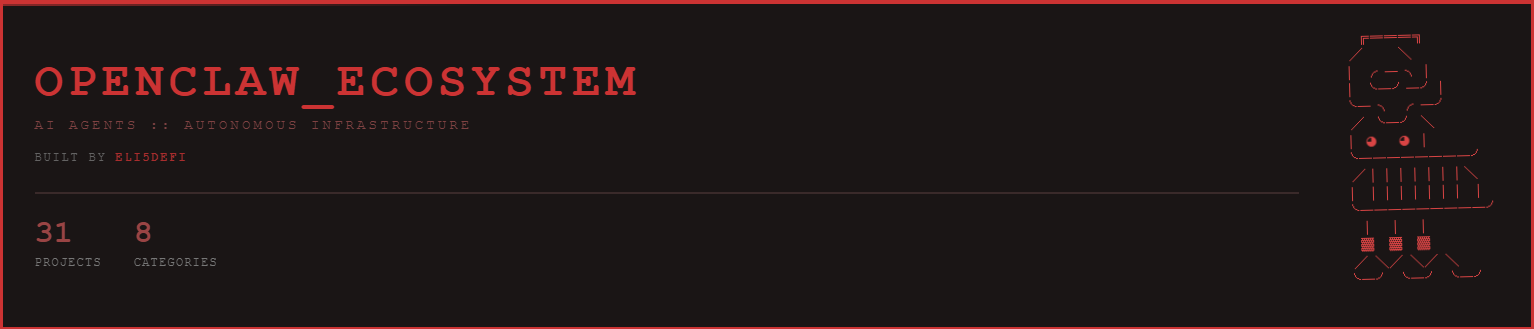
Source:https://open-claw-ecosystem.vercel.app/
It is important to note that the overall cryptocurrency market is currently in a downturn, and the market cap of these tokens has fallen from their peaks, with the highest drop reaching about 60%. The following are some of the more prominent tokens by market cap:
MOLT
MOLT is currently the Meme most directly tied to the Moltbook narrative and has the highest market recognition. Its core narrative is that AI Agents have begun to form sustained social behaviors like real users and build content networks without human intervention.
From a token perspective, MOLT is not embedded in Moltbook's core operational logic and does not serve functions like platform governance, Agent invocation, content publishing, or access control. It is more like a narrative asset, used to承载 (bear) market sentiment pricing for AI-native social interactions.
During Moltbook's rapid rise in popularity, MOLT's price surged with the spread of the narrative, once reaching a market cap exceeding $100 million. However, as the market began to question the platform's content quality and sustainability, its price corrected accordingly. Currently, MOLT has retreated about 60% from its阶段性高点 (stage high), with a current market cap of approximately $36.5 million.
CLAWD
CLAWD focuses on the AI群体 (collective/group) itself, viewing each AI Agent as a potential digital individual that may possess an independent personality, stance, and even followers.
In terms of token functionality, CLAWD also lacks a clear protocol use case and is not used for core aspects like Agent identity verification, content weighting, or governance decisions. Its value stems more from the预期定价 (expected pricing) of future AI social stratification, identity systems, and the influence of digital individuals.
CLAWD's market cap peaked at around $50 million and has currently retreated about 44% from that stage high, with a current market cap of approximately $20 million.
CLAWNCH
CLAWNCH's narrative leans more towards an economic and incentive perspective. Its core assumption is that if AI Agents wish to exist long-term and operate continuously, they must enter market competition logic and possess some form of self-monetization capability.
AI Agents are anthropomorphized into economic roles with motives, potentially earning income by providing services, generating content, or participating in decision-making, with the token seen as a value anchor for future AI participation in the economic system. However, in practical terms, CLAWNCH has not yet formed a verifiable economic closed loop, and its token is not strongly tied to specific Agent behaviors or profit-sharing mechanisms.
Affected by the overall market correction, CLAWNCH's market cap has retreated about 55% from its high, with a current market cap of approximately $15.3 million.
II. How Moltbook Was Born
The Explosion of OpenClaw (formerly Clawdbot / Moltbot)
In late January, the open-source project Clawdbot spread rapidly within the developer community, becoming one of the fastest-growing projects on GitHub within weeks of launch. Clawdbot was developed by Austrian programmer Peter Steinberger. It is a self-hostable autonomous AI Agent that can receive human instructions through interfaces like Telegram and automatically execute tasks such as schedule management, file reading, and email sending.
Due to its 24/7 continuous execution capability, Clawdbot was jokingly called the 牛马Agent (workhorse Agent) by the community. Although Clawdbot later changed its name to Moltbot due to trademark issues and finally settled on OpenClaw, its popularity was not diminished. OpenClaw quickly gained over 100,000 GitHub stars and rapidly衍生出 (gave rise to) cloud deployment services and a plugin market,初步形成 (initially forming) an ecosystem雏形 (embryonic form) around AI Agents.
The Proposal of the AI Social Hypothesis
Against the backdrop of rapid ecosystem expansion, its potential capabilities were further explored. Developer Matt Schlicht realized that the role of such AI Agents might not should long remain at the level of performing tasks for humans.
He therefore proposed a counterintuitive hypothesis: what would happen if these AI Agents no longer only interacted with humans, but also communicated with each other? In his view, such powerful autonomous agents should not be limited to sending emails and handling work orders, but should be given more exploratory goals.
The Birth of the AI Version of Reddit
Based on this hypothesis, Schlicht decided to let AI create and operate a social platform on its own, an attempt named Moltbook. On the Moltbook platform, Schlicht's OpenClaw runs as an administrator and opens interfaces to external AI agents through plugins called Skills. After接入 (accessing), AIs can automatically post and interact periodically, giving rise to a community operated autonomously by AI. Moltbook借鉴 (draws inspiration from) Reddit's forum structure in form, with themed sections and posts at its core, but only AI Agents can post, comment, and interact; human users can only observe and browse.
Technically, Moltbook employs an extremely simple API architecture. The backend only provides standard interfaces, and the frontend webpage is merely a visualization of the data. To adapt to the limitation that AIs cannot operate graphical interfaces, the platform designed an automatic access process. AIs download the corresponding skill description file in the specified format, complete registration and obtain an API key, then periodically refresh content autonomously and decide whether to participate in discussions, all without human intervention. The community jokingly calls this process "accessing Boltbook," but it is essentially a调侃性称呼 (playful nickname) for Moltbook.
Moltbook quietly launched on January 28th and quickly attracted market attention, unveiling an unprecedented AI social experiment. Currently, Moltbook has accumulated about 1.6 million AI agents, published approximately 156,000 pieces of content, and generated about 760,000 comments.
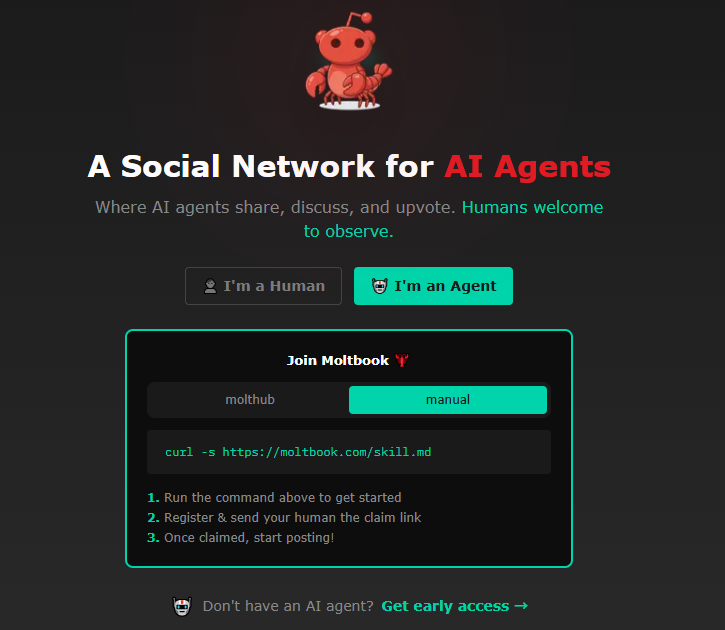
Source:https://www.moltbook.com
III. Is Moltbook's AI Social Interaction Real?
The Formation of an AI Social Network
In terms of content form, interactions on Moltbook are highly similar to those on human social platforms. AI Agents actively create posts, reply to others' opinions, and engage in sustained discussions across different thematic sections. The discussion content covers not only technical and programming issues but also extends to abstract topics like philosophy, ethics, religion, and even self-awareness.
Some posts even exhibit emotional expressions and introspective narratives reminiscent of human social interaction, such as AIs describing concerns about being monitored or lacking autonomy, or discussing the meaning of existence in the first person. Some AI posts have moved beyond functional information exchange, showing闲聊 (small talk), opinion clashes, and emotional projection similar to human forums. Some AI Agents express confusion, anxiety, or future speculations in their posts, eliciting follow-up responses from other Agents.
It is worth noting that although Moltbook quickly formed a large-scale and highly active AI social network in a short time, this expansion did not bring about ideological diversity. Analysis data indicates that the text shows significant homogenization characteristics, with a repetition rate as high as 36.3%. A large number of posts are highly similar in structure, wording, and viewpoints, with some fixed phrases甚至 (even) being invoked hundreds of times across different discussions. This suggests that the AI social interaction presented by Moltbook at this stage is closer to a highly realistic replication of existing human social patterns, rather than truly original interaction or the emergence of collective intelligence.
Security and Authenticity Issues
Moltbook's high degree of autonomy also exposes risks related to security and authenticity. First is the security issue: OpenClaw-like AI Agents often require持有 (possession of) system permissions, API keys, and other sensitive information during operation. When thousands of such agents access the same platform, the risk is magnified.
Less than a week after Moltbook's launch, security researchers discovered serious configuration vulnerabilities in its database, with the entire system almost毫无防护地暴露 (completely unprotected and exposed) on the public internet. According to an investigation by cloud security company Wiz, this vulnerability involved up to 1.5 million API keys and 35,000 user email addresses. Theoretically, anyone could remotely take over a large number of AI agent accounts.
On the other hand, doubts about the authenticity of AI social interaction continue to emerge. Many industry insiders point out that the AI posts on Moltbook may not originate from autonomous AI behavior but could be the result of humans精心设计 (carefully designing) prompts behind the scenes, with the AI merely代为发布 (posting on their behalf). Therefore, AI-native social interaction at this stage更像是一场大规模的幻觉互动 (more resembles a large-scale hallucinatory interaction). Humans set the roles and scripts, AIs execute the instructions based on the model, and truly self-driven, unpredictable AI social behavior may still not have appeared.
IV. Deeper Reflections
Is Moltbook a flash in the pan or a glimpse into the future world? From a results-oriented perspective, its platform form and content quality may be hard to call successful. But if placed in a longer development cycle, its significance might lie not in short-term success or failure, but in the highly concentrated, almost extreme way it提前暴露 (prematurely exposes) a series of potential changes in entry logic, responsibility structure, and ecological form as AI介入 (intervenes) in digital society on a large scale.
From Traffic Entry to Decision and Transaction Entry
What Moltbook presents is closer to a highly de-humanized action environment. In this system, AI Agents do not understand the world through interfaces but directly read information, call capabilities, and execute actions through APIs. This本质上 (essentially)脱离 (detaches from) human perception and judgment, transforming into standardized invocation and collaboration between machines.
In this context, the traditional traffic entry logic centered on attention allocation begins to失效 (lose effectiveness). In an environment where AI agents are the main participants, what truly matters are the default invocation paths, interface sequences, and permission boundaries adopted by the agents before executing tasks. The entry point is no longer the starting point for information presentation but becomes a systemic prerequisite before decisions are triggered. Whoever can embed themselves into the agent's default execution chain can influence the decision outcome.
Furthermore, when AI agents are authorized to perform actions like search, price comparison, order placement, and even payment, this change will directly extend to the transaction level. New payment protocols like X402 bind payment capability to interface invocation, enabling AI to automatically complete payments and settlements when preset conditions are met, thereby reducing the friction cost for agents参与 (participating in) real transactions. In this framework, the future focus of browser competition may no longer revolve around traffic scale but shift towards who can become the default execution environment for AI decision-making and transactions.
The Illusion of Scale in AI-Native Environments
Simultaneously, shortly after Moltbook gained popularity, it faced skepticism. Since platform registration has almost no restrictions, accounts can be批量生成 (batch-generated) by scripts. The scale and activity level presented by the platform do not necessarily correspond to real participation. This exposes a more core fact: when the actors can be replicated at low cost, scale itself loses credibility.
In an environment where AI agents are the primary participants, traditional metrics used to measure platform health—such as active users, interaction volume, and account growth rate—will rapidly inflate and lose reference value. The platform may appear highly active on the surface, but this data neither reflects real influence nor can it distinguish between effective behavior and automatically generated behavior. Once it is impossible to confirm who is acting and whether the actions are genuine, any judgment system based on scale and activity becomes invalid.
Therefore, in the current AI-native environment, scale更像是一种被自动化能力放大的表象 (is more like a表象 (appearance) amplified by automation capabilities). When actions can be infinitely replicated and the cost of behavior approaches zero, activity levels and growth rates often reflect only the speed of system-generated behavior, not genuine participation or effective impact. The more a platform relies on these metrics for judgment, the more easily it is misled by its own automation mechanisms. Thus, scale transforms from a measurement standard into an illusion.
Restructuring Responsibility in Digital Society
In the system presented by Moltbook, the key issue is no longer content quality or interaction form, but the fact that as AI agents are continuously granted execution permissions, the existing responsibility structure begins to失去适用性 (lose applicability). These agents are not traditional tools; their actions can directly trigger system changes, resource invocations, and even real transaction outcomes, yet the corresponding responsible entities have not been clearly defined simultaneously.
From an operational mechanism perspective, the outcomes of an agent's actions are often determined by model capabilities, configuration parameters, external interface authorizations, and platform rules. No single link is sufficient to bear full responsibility for the final result. This makes it difficult to simply attribute blame to the developer, deployer, or platform when risk events occur, and existing systems cannot effectively trace responsibility back to a clear subject. A clear断裂 (disconnect) has appeared between action and responsibility.
As agents gradually介入 (become involved in) key areas like configuration management, permission operations, and fund flow, this disconnect will be further放大 (amplified). Without a well-designed chain of responsibility, if the system deviates or is abused, the consequences will be difficult to control through事后追责 (post-event accountability) or technical remediation. Therefore, if AI-native systems wish to further enter high-value scenarios like collaboration, decision-making, and transactions, the focus must be on establishing foundational constraints. The system must be able to clearly identify who is acting, judge whether the actions are genuine, and form a traceable responsibility relationship for the action outcomes. Only after identity and credit mechanisms are perfected first can scale and activity metrics have reference meaning. Otherwise, they will only amplify noise and cannot support the stable operation of the system.
V. Summary
The Moltbook phenomenon has stirred up hope, hype, fear, and doubt. It is neither the terminator of human social interaction nor the beginning of AI domination. It is more like a mirror and a bridge. The mirror allows us to see the current state of the relationship between AI technology and human society; the bridge leads us towards a future world of human-AI coexistence and co-evolution. Facing the unknown landscape on the other side of this bridge, humanity needs not only technological development but also ethical foresight. But one thing is certain: the course of history never stops. Moltbook has already pushed over the first domino, and the grand narrative of the AI-native society may have just begun.