Markets Close on Weekends, Risks Never Stop: RWA is Rewriting the Market Clock

比推Xuất bản vào 2026-03-03Cập nhật gần nhất vào 2026-03-03

Tóm tắt

On February 28, 2026, a U.S.-Israel airstrike on Iran during a weekend exposed critical vulnerabilities in traditional financial markets. By targeting a weekend—when major exchanges like CME were closed—the attack deliberately suppressed immediate panic-driven selling in stocks and forex, granting authorities a 48-hour window to manage fallout. However, capital swiftly migrated to crypto markets, where gold tokens like XAUT and PAXG on Ethereum saw surging activity, enabling continuous price discovery and hedging absent in traditional systems. This event underscored how Real World Asset (RWA) tokenization is reshaping global financial infrastructure. Unlike traditional T+1/T+2 settlements and limited trading hours, RWAs offer 24/7 liquidity, atomic settlements, and real-time risk management. During the attack, crypto-based gold tokens effectively became price oracles, leading traditional markets upon Monday’s open and allowing arbitrageurs to capitalize on cross-market disparities. The incident highlights RWAs' core value: expanding liquidity across time and reducing systemic gaps. As geopolitical and macroeconomic risks grow, the ability to trade and hedge instantaneously via blockchain—without reliance on legacy clearinghouses or banking hours—becomes a critical advantage. This shift may accelerate institutional adoption of tokenized assets (e.g., bonds, commodities) and hybrid TradFi-DeFi strategies, ultimately redefining global market hours and liquidity access.

Author: Max.s

Original Title: War, Weekends, and Locked Liquidity: How RWA is Reshaping Global Trading Time from the Iran Airstrike Incident


On February 28, 2026 (Saturday), air raid sirens in the Middle East pierced the tranquility of global geopolitics. The United States and Israel launched a meticulously planned large-scale airstrike on targets within Iran.

The timing of this military operation, like an extremely precise surgical strike, was reflected not only in the physical coordinates of the tactical attack but also in the grasp of the "time coordinates" of the global financial markets. Choosing to launch the surprise attack during the weekend, when traditional Western financial markets are closed, was deeply significant: it maximally prevented the immediate spread of panic in the stock and foreign exchange markets, while also giving governments and central banks a full 48-hour buffer period to intervene and guide market expectations.

However, in this deliberately created "trading vacuum," global capital did not sit idly by. When the CME (Chicago Mercantile Exchange) gold and crude oil futures boards froze at Friday's closing prices, and the buy/sell buttons for various ETFs were grayed out by the system, real undercurrents were surging in another never-sleeping network. Cryptocurrency gold tokens represented by XAUT (Tether Gold) and PAXG (PAX Gold) experienced a trading peak on blockchain networks like Ethereum.
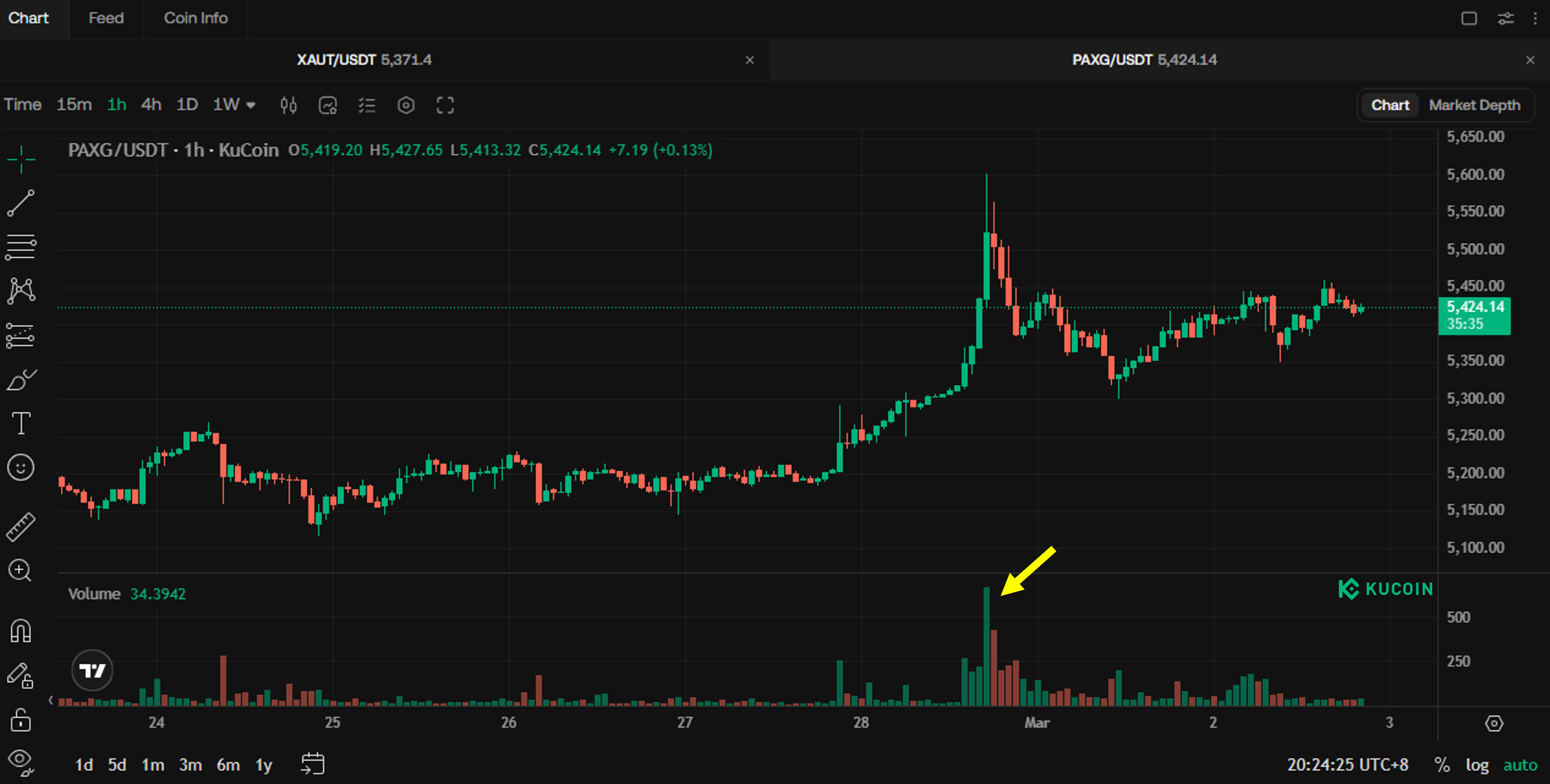
This is not just a game of geopolitical chess; it is a stress test about "liquidity privilege." The airstrike incident, in an extremely extreme way, declared to all traditional financial practitioners: traditional financial infrastructure based on T+1 or T+2 settlement, limited to working days and fixed trading hours, is being left behind by the times. The tokenization of real-world assets (RWA) and the completion of 24/7 trading settlement through digital assets are no longer social experiments by geeks but an inevitable trend in the global capital's fight for pricing power and trading Alpha.

From the perspective of quantitative trading and hedge funds, the core of risk management lies in the accessibility of hedging tools. After the airstrike on February 28, the risk exposure of macro hedge funds skyrocketed instantly. In theory, crude oil and gold are the preferred safe-haven hedging targets. But on that Saturday morning, tens of thousands of financial institutions and professional traders became "liquidity prisoners."

The infrastructure of traditional financial markets is built on the industrial era's schedule. Although electronic trading has been popularized for decades, the underlying clearing and settlement systems (such as DTCC, Euroclear systems, and the SWIFT network) still heavily rely on the batch processing of centralized institutions and banking hours. When a black swan event occurs outside trading hours, the reaction mechanism of traditional markets is completely frozen. Investors can only watch information spread at the speed of light while capital flows are trapped like insects in amber, unable to move.

This "deliberate avoidance of trading days" strike essentially compresses all market volatility and gap risk into the few short minutes of Monday's opening. For quantitative market makers and high-frequency trading institutions, this kind of discontinuous hedging gap risk is fatal. During the highly information-asymmetric and liquidity-dry Monday opening phase, it is extremely easy to trigger a chain reaction of long squeezes or short blow-ups.

In contrast, the cryptocurrency market demonstrated a dimension-reducing resilience. Within minutes of the news of the February 28 attack spreading, capital rapidly flowed into crypto liquidity pools. XAUT and PAXG trading pairs on major centralized crypto exchanges absorbed a massive level of safe-haven demand. As shown in the chart, the funding rate (longs pay shorts) reached 0.5% on February 28.
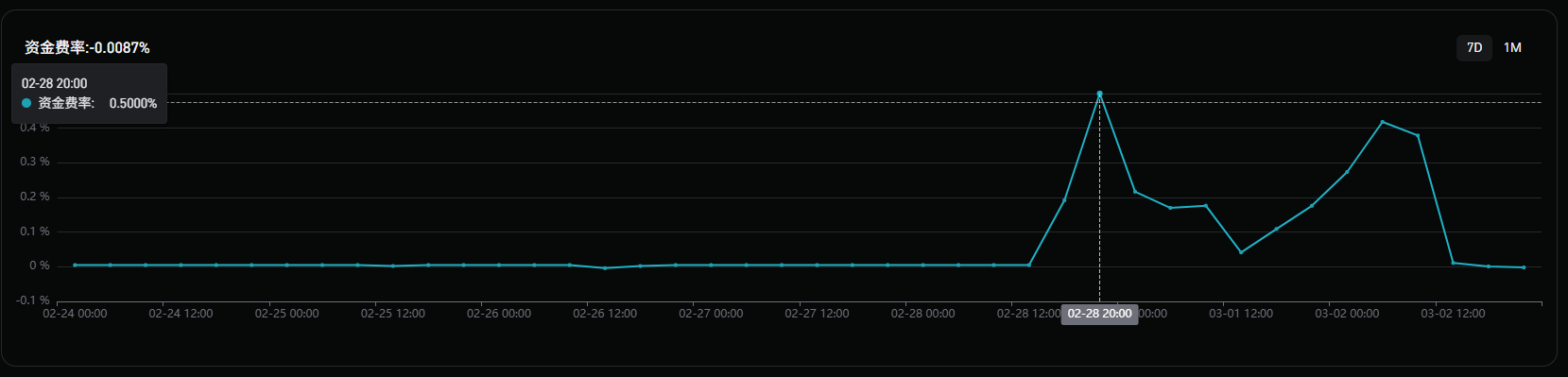
We can clearly see this smooth and steep value growth curve from the on-chain data: no market close, no trading halts, no opening gap uncertainty. The price of on-chain gold tokens followed every update from the front-line battle reports, performing continuous pricing in milliseconds. Before the CME opened on Monday, the price of on-chain XAUT had already completed sufficient price discovery.

This brings about a highly disruptive financial phenomenon: the pricing power of traditional commodities, for the first time in history during a major geopolitical crisis, temporarily shifted to the digital asset market.

When the Asian early trading session opened on March 2 (Monday), traditional gold spot and futures markets surged at the open. Over that weekend, XAUT was no longer a shadow asset of GLD (SPDR Gold ETF) or COMEX gold futures. Instead, on-chain tokens, in a sense, became the "price oracle" for Wall Street's Monday opening. Sharp arbitrageurs used this 48-hour time difference to build sufficient positions on-chain and, at the moment the traditional market opened on Monday, arbitraged the high basis to narrow the price gap between the two worlds.
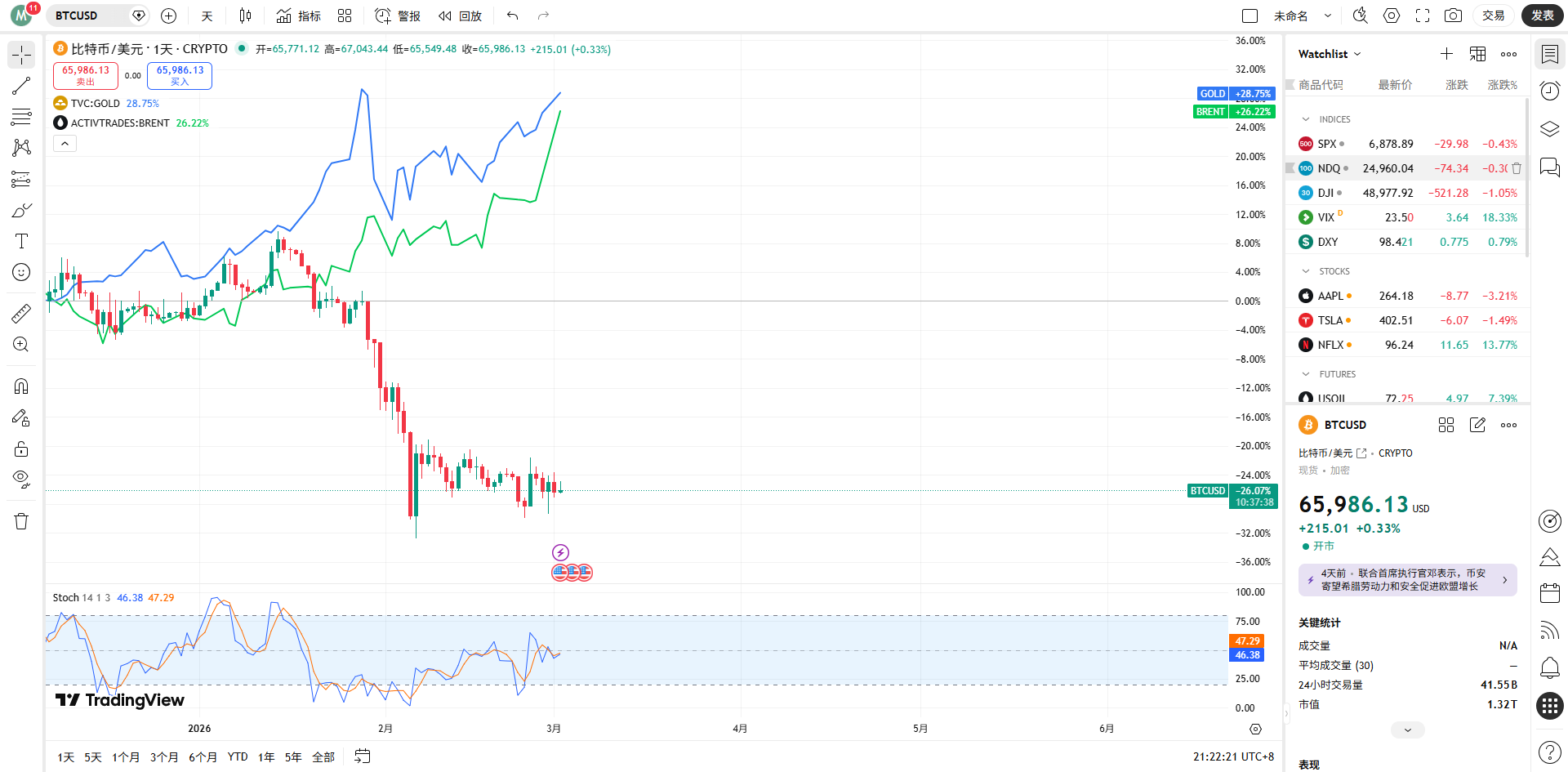
The weekend's gold token trading frenzy revealed the most core value proposition of RWA assets: the expansion of the time dimension of liquidity.

In previous narratives, people often focused the advantages of RWA on lowering thresholds, fractionalizing ownership, or improving transparency. But for professional financial practitioners, the greatest appeal of RWA lies in the T+0 underlying logic of "settlement equals clearing" and the 7x24x365 non-stop operation mechanism.

Imagine if what broke out on the weekend was not a Middle East airstrike, but a sovereign debt default of a certain country, the collapse of a major bank, or an unexpected emergency central bank interest rate cut. Traditional institutions could only passively bear huge exposure risks before the Monday open. However, if government bonds, foreign exchange, and even core stock indices achieved deep tokenization and established sufficient liquidity pools on the blockchain, institutional investors could immediately use smart contracts to complete risk hedging and asset swaps the moment the risk occurs.

In this event, not only gold but also the exchange network between stablecoins and crypto-native assets acted as a super highway for capital safe havens. In the traditional financial system, cross-border, cross-institution fund transfers require complex correspondent bank confirmations and multiple compliance reviews, taking days to complete. On-chain, hundreds of millions of dollars in hedging positions can be atomically swapped within one block time (12 seconds for Ethereum), with no counterparty default risk.

For Wall Street, the weekend at the end of February 2026 was a profound research and education experience. Previously, many traditional institutions took a wait-and-see attitude towards the rise of RWA protocols like BlackRock's launch of BUIDL (tokenized treasury fund) and Ondo Finance, considering it just a gimmick to attract existing crypto funds. But the airstrike incident proved that in the face of extreme black swans, the liquidity premium provided by tokenized assets is a hardcore Alpha that no excellent quantitative model can replace.

Quantitative funds will no longer be satisfied with the trading interfaces provided by CME or Nasdaq; they will massively connect APIs to on-chain DEXs and RWA trading pools with institutional-grade compliance systems. To capture "non-synchronous trading opportunities" during weekends and holidays, building cross-border arbitrage models spanning TradFi and DeFi will become standard configuration for top hedge funds.

When brokers and market-making institutions realize that a large amount of trading demand and commission profits are leaking to blockchain networks on weekends, the drive for profit will force them to actively become liquidity providers for on-chain assets. In the future, large market makers like Jane Street and Jump Trading will not only make markets for ETFs on weekdays but will also inject liquidity into 24/7 RWA asset pools on weekends.

Starting with highly standardized commodities like gold and crude oil, gradually spreading to short-term treasury bonds, high-quality corporate bonds, and even US stock indices. The载体 of financial assets will completely migrate from the ledgers of trust companies and clearinghouses to distributed ledgers. No more T+2 capital occupation, no more weekend anxiety about selling for safety on Friday afternoon; global capital will truly achieve seamless circulation in physical time and space.

"Money never sleeps" was once one of Wall Street's most famous slogans, but the reality is that traditional Wall Street not only sleeps but also takes weekends and public holidays. The artillery fire on February 28, 2026, proved in a cruel way that in the face of an increasingly complex and unpredictable global macro environment, fragmented trading time and locked liquidity are themselves the greatest systemic risks.

The price discovery process led by digital assets like XAUT this weekend sounded the death knell for the traditional clearing system. RWA is not just about moving real-world assets onto the blockchain; it is about using code to reconstruct the time rules of financial operation. For quantitative analysts, traders, and financial engineers, the future battlefield is no longer limited to the trading screen for 5 days a week, 8 hours a day. Whoever masters the trading and settlement infrastructure of 24/7 digital assets first will be able to grasp the throat of the global market on the next unexpected black swan night.


Twitter:https://twitter.com/BitpushNewsCN

Bitpush TG Discussion Group:https://t.me/BitPushCommunity

Bitpush TG Subscription: https://t.me/bitpush

Original link:https://www.bitpush.news/articles/7616124

Câu hỏi Liên quan

QWhat was the main financial implication of the 2026 Iran airstrike occurring on a weekend, according to the article?

AThe airstrike exposed the vulnerability of traditional financial markets due to their reliance on fixed trading hours and T+1/T+2 settlement systems, creating a 'liquidity vacuum' where investors were unable to react immediately. This highlighted the advantage of RWA tokenization, which enables 24/7 trading and instant settlement, allowing capital to flow into crypto gold tokens like XAUT and PAXG during the crisis.

QHow did tokenized gold assets (like XAUT and PAXG) perform during the weekend airstrike event?

ATokenized gold assets experienced a surge in trading activity on blockchain networks, with XAUT and PAXG serving as primary hedging tools. They enabled continuous price discovery and absorbed significant避险 demand, with funding rates reaching 0.5%. Their 24/7 availability allowed them to act as a price oracle for traditional markets when they reopened.

QWhat core advantage of RWA (Real World Asset) tokenization does the article emphasize for professional financial practitioners?

AThe article emphasizes that the core advantage of RWA tokenization for professionals is the expansion of liquidity in the time dimension—specifically, 'settlement即清算' (settlement equals clearing) T+0 logic and a 7x24x365 non-stop operating mechanism, which allows immediate risk hedging and asset reallocation during off-hours or black swan events.

QWhat shift in pricing power did the event demonstrate between traditional and digital asset markets?

AThe event demonstrated a historic, temporary shift in pricing power for commodities like gold from traditional markets (e.g., COMEX futures, GLD ETF) to digital asset markets. Chain-based token prices completed full price discovery over the weekend, effectively becoming a reference point ('price oracle') for traditional markets when they opened on Monday, with arbitrageurs exploiting the time差 to profit from the basis difference.

QHow might the event influence the future behavior of quantitative funds and market makers, as predicted in the article?

AThe article predicts that quantitative funds will increasingly integrate APIs with链上 DEXs and compliant RWA trading pools to capture 'non-synchronous trading opportunities' during weekends and holidays. Market makers (e.g., Jane Street, Jump Trading) will be driven by profit to provide liquidity for RWA assets全天候, leading to cross-border arbitrage models spanning TradFi and DeFi as a standard配置 for top hedge funds.

Nội dung Liên quan

Phúc Kiến Tấn Giang, một kỳ lân công nghệ lưu trữ siêu cấp im lặng vươn lên

Những ngày này, khi Trường Tân Công nghệ Hợp Phì lên sàn A, và Trường Giang Tích Trữ Vũ Hán đang trong giai đoạn chuẩn bị IPO, một "kỳ lân siêu cấp" trong lĩnh vực bộ nhớ vẫn lặng lẽ hoạt động tại Tấn Giang, Phúc Kiến - Công ty TNHH Mạch tích hợp Tấn Hoa Phúc Kiến (Phúc Kiến Tấn Hoa). Từng là một trong ba trụ cột sản xuất chip bộ nhớ trong nước cùng với Trường Giang Tích Trữ và Trường Tân Công nghệ, thậm chí có thời điểm được đánh giá cao hơn, nhưng số phận của Tấn Hoa lại không suôn sẻ. Ngay trước khi sản phẩm ra đời, công ty đã bị Bộ Thương mại Mỹ đưa vào danh sách đen và đối mặt với cáo trạng hình sự từ Bộ Tư pháp Mỹ vào năm 2018, khiến dây chuyền sản xuất đình trệ. Phải đến tháng 2/2024, tòa án liên bang Mỹ mới tuyên án vô tội, kết thúc 6 năm vướng vào tranh chấp. Nhân vật then chốt đằng sau Tấn Hoa là Trần Chính Khôn, cựu kỹ sư của Micron. Với khát vọng phát triển công nghệ DRAM tự chủ, ông đã dẫn dắt đội ngũ hợp tác với United Microelectronics Corporation (UMC) của Đài Loan. Dù vấp phải lệnh trừng phạt nghiêm trọng, nhóm của ông vẫn kiên trì tái thiết dây chuyền sản xuất, tối ưu hóa thiết bị trong nước để giảm thiểu sự phụ thuộc vào công nghệ Mỹ. Hiện tại, Tấn Hoa tập trung vào thị trường DRAM chuyên biệt (niche DRAM), với sản phẩm ứng dụng trong TV thông minh, thiết bị mạng và công nghiệp. Năng lực sản xuất ổn định ở mức khoảng 40.000 tấm wafer 12-inch mỗi tháng, dự kiến mở rộng lên 60.000 vào năm 2026. Dù vậy, công ty vẫn nằm trong danh sách đen của Mỹ. Sự tồn tại và phục hồi của Tấn Hoa có sự hậu thuẫn mạnh mẽ từ chính quyền địa phương Tấn Giang - một thành phố vốn nổi tiếng với giày thể thao và thực phẩm. Thành phố này đã mạnh dạn đầu tư vào ngành công nghiệp bán dẫn, coi Tấn Hoa là hạt nhân để xây dựng cụm công nghiệp mạch tích hợp hoàn chỉnh, với tổng vốn đầu tư hàng trăm tỷ nhân dân tệ. Sự kiên định của chính quyền trong việc hỗ trợ Tấn Hoa vượt qua khủng hoảng là minh chứng cho chiến lược phát triển công nghiệp mới đầy tham vọng của Tấn Giang. Dù quy mô và doanh thu hiện tại (khoảng 2 tỷ nhân dân tệ/năm) còn cách xa các đối thủ trong nước, Tấn Hoa đại diện cho một thực tế: một doanh nghiệp từng bị siết chặt vẫn có thể đứng dậy. Trong chu kỳ siêu tăng trưởng mới của ngành bộ nhớ được AI thúc đẩy, Tấn Hoa vẫn giữ được vị trí trên bàn chơi.

marsbit33 phút trước

Phúc Kiến Tấn Giang, một kỳ lân công nghệ lưu trữ siêu cấp im lặng vươn lên

marsbit33 phút trước

«Cưa mùa hè» tiếp tục: Phá vỡ $67,000 sẽ là khởi đầu cho đà tăng của Bitcoin

Giá Bitcoin giảm xuống 62.217 USD vào ngày 1/8, tiếp tục giai đoạn củng cố trong phạm vi 58.000 - 67.000 USD kể từ đầu tháng 6. Thị trường đang chia rẽ về hướng đi tiếp theo. Các nhà phân tích kỹ thuật chỉ ra hai kịch bản chính. Một số, như Crypto Candy và Jelle, dự báo khả năng giảm về vùng 60.000 USD nếu giá không vượt lên trên 66.000 USD, đồng thời mô tả thị trường đang trong giai đoạn "củng cát mùa hè" kéo dài. Ngược lại, những người khác như Daan Crypto Trades và Roman nhấn mạnh rằng việc phá vỡ mốc 67.000 USD với khối lượng giao dịch đủ mạnh có thể mở đường cho đợt tăng mạnh lên vùng 70.000 - 80.000 USD. Về góc nhìn dài hạn, nhà phân tích Gert van Lagen xem đây là giai đoạn tích lũy, với Bitcoin đang thử nghiệm đường viền cổ của mô hình "cốc và tay cầm" hình thành suốt 7 năm. Ông cũng lưu ý rằng các nhà đầu tư nắm giữ dài hạn vẫn kiên định, không chịu bán tháo. Tóm lại, thị trường Bitcoin đang trong thời kỳ tích lũy quan trọng, với hai mức giá then chốt là 60.000 USD và 67.000 USD. Việc phá vỡ một trong hai mức này sẽ định hình xu hướng chính tiếp theo.

cryptonews.ru2 giờ trước

«Cưa mùa hè» tiếp tục: Phá vỡ $67,000 sẽ là khởi đầu cho đà tăng của Bitcoin

cryptonews.ru2 giờ trước

Tuần tới cần chú ý|Đạo luật CLARITY dự kiến được biểu quyết tại Thượng viện; SpaceX, Circle công bố báo cáo tài chính (3.8-9.8)

**Tóm tắt các sự kiện quan trọng từ ngày 3 đến 9 tháng 8:** **Tuần tới sẽ có nhiều sự kiện đáng chú ý trong lĩnh vực tiền điện tử và công nghệ:** * **Pháp luật & Quy định:** Dự luật CLARITY Act, nhằm thiết lập khung quy định liên bang cho tiền điện tử, có khả năng được đưa ra biểu quyết toàn thể tại Thượng viện Mỹ vào tuần tới. Các nhà đàm phán cần đạt được 60 phiếu ủng hộ trước ngày 7/8. * **Báo cáo tài chính:** Nhiều công ty lớn sẽ công bố báo cáo tài chính quý II/2026, bao gồm **SpaceX (ngày 4/8)**, công ty khai thác Bitcoin **Hut 8 (ngày 4/8)**, **Circle (ngày 5/8)** và công ty khai thác liên quan đến gia đình Trump là **American Bitcoin (ngày 3/8)**. * **Sự kiện SpaceX:** Bên cạnh báo cáo tài chính, cổ phiếu của SpaceX sẽ bắt đầu được mở khóa từ ngày 6/8, với đợt đầu tiên có thể lên tới 12% tổng số cổ phiếu. * **Dữ liệu kinh tế:** Báo cáo việc làm phi nông nghiệp (Non-Farm) quan trọng của Mỹ cho tháng 7 sẽ được công bố vào ngày 7/8. * **Cập nhật công nghệ:** * **XRP Ledger:** Phiên bản mới xrpld 3.3.0 với 5 tính năng mới dự kiến phát hành vào tuần tới. * **Grok:** Elon Musk thông báo Grok 4.6 dự kiến ra mắt vào khoảng ngày 7/8. * **Bitcoin:** Việc gửi tín hiệu bắt buộc cho BIP-110 sẽ bắt đầu vào khoảng ngày 8/8. * **Ngừng hoạt động:** Một số dịch vụ tiền điện tử sẽ ngừng hoạt động vào ngày 3/8, bao gồm công cụ theo dõi danh mục DeFi **Zapper** và ví **Ctrl Wallet**. * **Niêm yết & Hủy niêm yết:** Sàn Upbit Hàn Quốc sẽ hủy niêm yết token AQT và AERGO từ ngày 3/8. Trong khi đó, công ty robot **宇树科技 (Unitree Robotics)** sẽ tiến hành thăm dò giá ban đầu cho đợt IPO trên STAR Market vào ngày 5/8.

marsbit2 giờ trước

Tuần tới cần chú ý|Đạo luật CLARITY dự kiến được biểu quyết tại Thượng viện; SpaceX, Circle công bố báo cáo tài chính (3.8-9.8)

marsbit2 giờ trước

Giao dịch

Giao ngay
活动图片





