Mapping Volatility Through Time: Implied Volatility Heatmaps

insights.glassnodeXuất bản vào 2026-03-23Cập nhật gần nhất vào 2026-03-23

Tóm tắt

Glassnode introduces two new implied volatility (IV) heatmap metrics—IV Moneyness Heatmap and IV Delta Heatmap—that visualize how options markets price risk across strikes and maturities over time, rather than at a single point. These tools help identify volatility regimes, such as periods of calm, stress, and transitions between them. The heatmaps display IV using color gradients, with red indicating high volatility and blue indicating low volatility. Key patterns include elevated put-side IV during drawdowns (signaling hedging demand), tail-risk repricing in deep out-of-the-money options, and regime shifts that inform trading strategies like hedging in low-vol environments or selling premium in high-vol periods. Available in Glassnode Studio, these metrics provide a dynamic view of market expectations and risk sentiment.

Options markets encode information about how participants expect prices to move. With the release of our interpolated IV metrics earlier this year, users gained access to a clean, structured volatility surface across deltas and maturities.

Now, we are extending that foundation with a new set of metrics that track how implied volatility evolves over time: the IV Moneyness Heatmap and the IV Delta Heatmap.

These metrics allow you to observe how the market prices expected movement across strikes and maturities; not just at a single point in time, but across weeks, months, and years.

Explore the live metrics in Glassnode Studio. Now available to Professional plan users for all major liquid markets, with 10-minute, hourly, and daily resolutions.

Explore heatmaps

From Snapshots to Regimes

A single IV curve gives insight into how the market is pricing risk right now. But since markets are dynamic, a snapshot view misses the broader context: Was volatility rising or falling into this point? Has the skew been shifting gradually or did it change suddenly?

The IV Heatmap captures these dynamics by plotting implied volatility across strikes over time. Instead of a single curve, it provides a continuous map that reveals volatility regimes: extended periods of calm, episodes of stress, and the transitions between them.

This allows us to observe how the market priced the buildup to a major move, how quickly fear dissipated after a drawdown, or whether elevated put demand persisted for days or weeks. Such patterns are hidden in a single snapshot view.

The IV Moneyness Heatmap

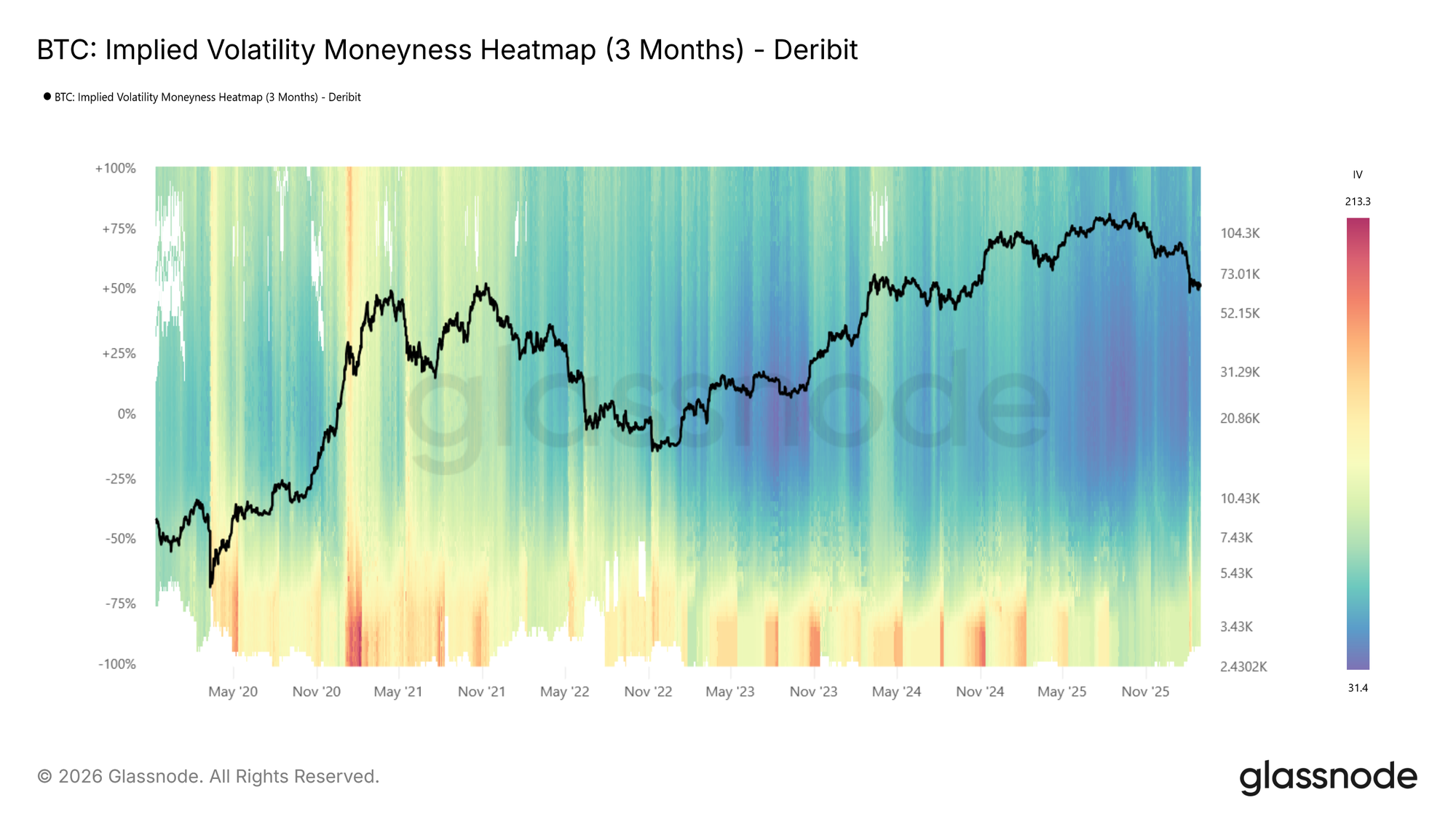
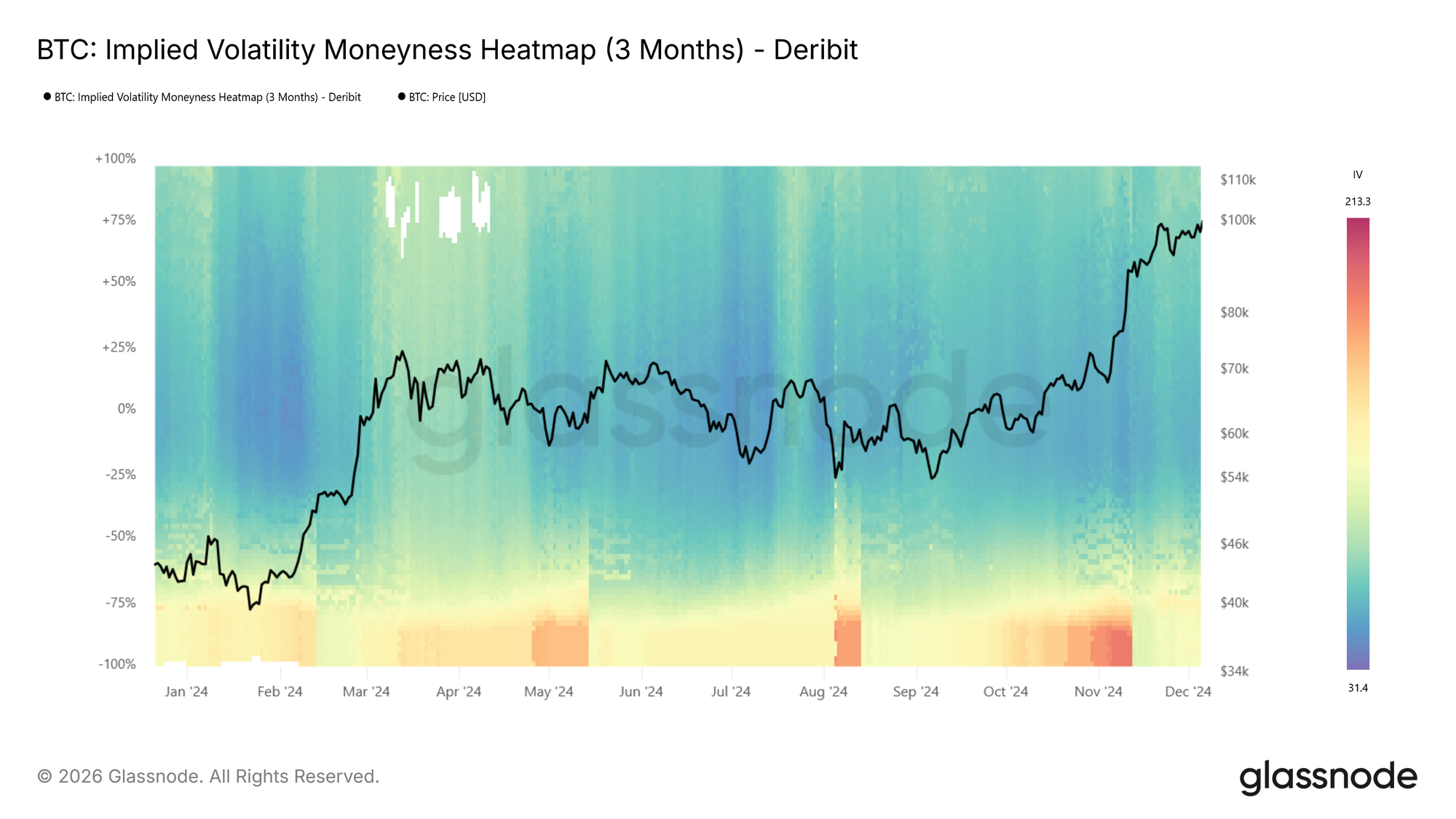
The moneyness heatmap plots implied volatility as a function of distance from spot price (% from spot) over time. Moneyness ranges from -100% to +100%, with puts below the center line (negative moneyness) and calls above it (positive moneyness). The at-the-money level runs horizontally through the middle. Warmer colors (red to dark red) indicate higher IV, while cooler colors (blue to dark blue) indicate lower IV.

IV is sampled at each target maturity and interpolated across moneyness to produce a smooth, continuous surface. The metric is available at four standardized tenors (1 week, 1 month, 3 months, and 6 months) with lookback windows ranging from 1 month to the full available history.
Visit live chart

Looking at the BTC moneyness heatmap (3m tenor), volatility regimes are clearly visible: elevated IV in 2021, a return to high volatility in spring 2024 and again around the turn of 2025, followed by a sharp compression into a very low-vol environment (dark blue).

How to read it:

  • Dark blue across both sides indicates a low-volatility regime, where the market expects limited movement.
  • Red bands on the put side (below center) signal elevated demand for downside protection.
  • Asymmetry between the put and call sides reflects directional skew, showing how much more the market is willing to pay for protection versus upside exposure.
  • Vertical color shifts, or abrupt changes in intensity across all moneyness levels, mark regime transitions.

The IV Delta Heatmap

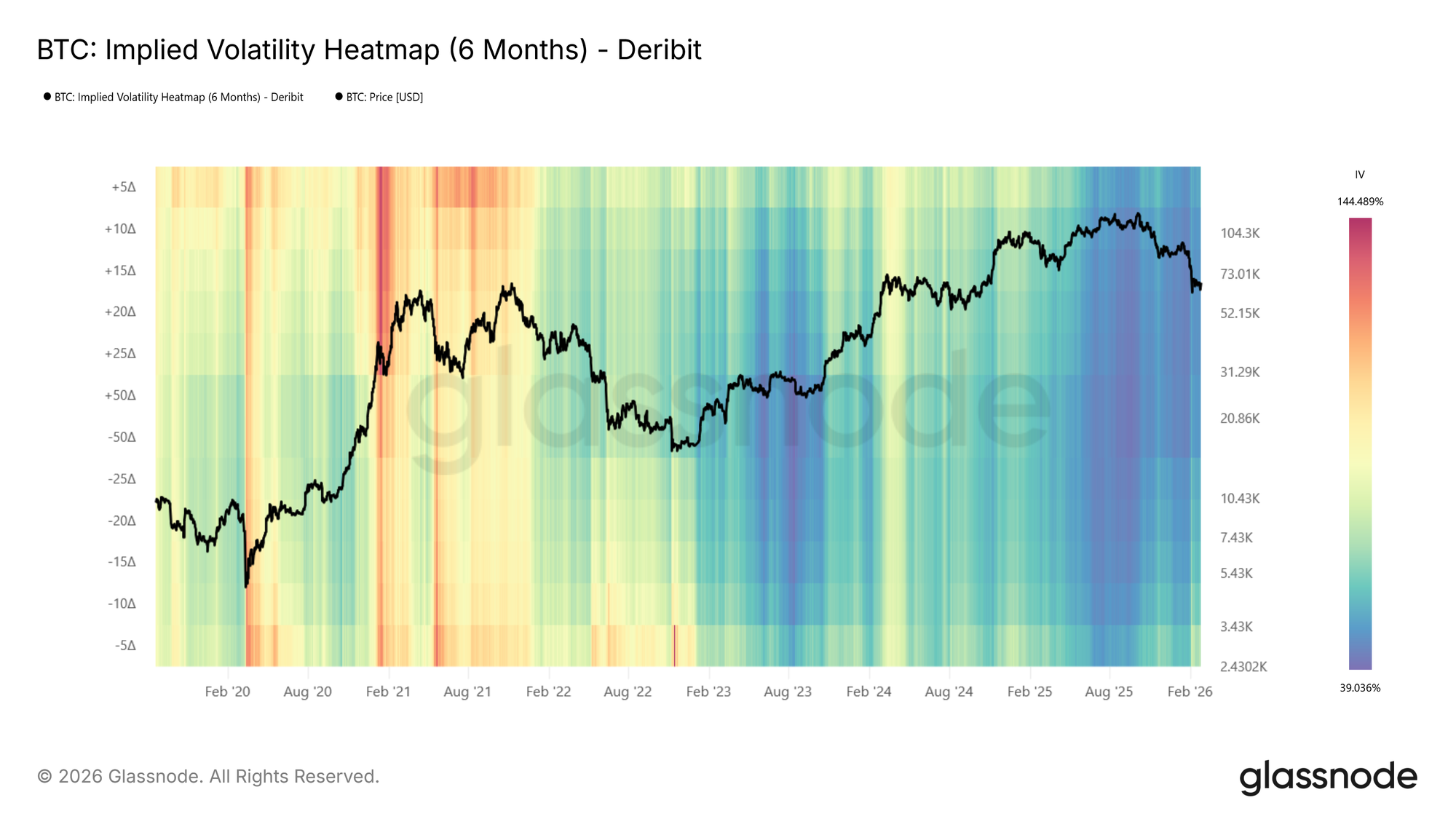
The moneyness heatmap shows IV at fixed distances from spot, a natural and intuitive way to view the surface. The same information can also be expressed in terms of delta, which normalizes each strike by its probability of expiring in the money. The IV Delta Heatmap applies this representation, built on the interpolated IV metrics described in this metric launch article. Deltas range from 5D puts to 50D (at-the-money) to 5D calls, across the same tenors and lookback windows.
Visit live chart

Examining the BTC delta heatmap (6m tenor), one notable feature emerges: during the 2021 bull run, call-side IV (above center, particularly the 5D call region) was significantly elevated compared to put-side IV. The market was pricing in large upside moves, reflecting the euphoric momentum of that period. This call-side dominance is a pattern that tends to appear during strong rallies and is clearly visible in the delta representation.

Reading the Heatmap: Patterns and Implications

Below, we identify some of the primary observable patterns in the heatmaps, describe how they present, and outline their practical relevance.

Elevated Put-Side IV: Risk Hedging in Action
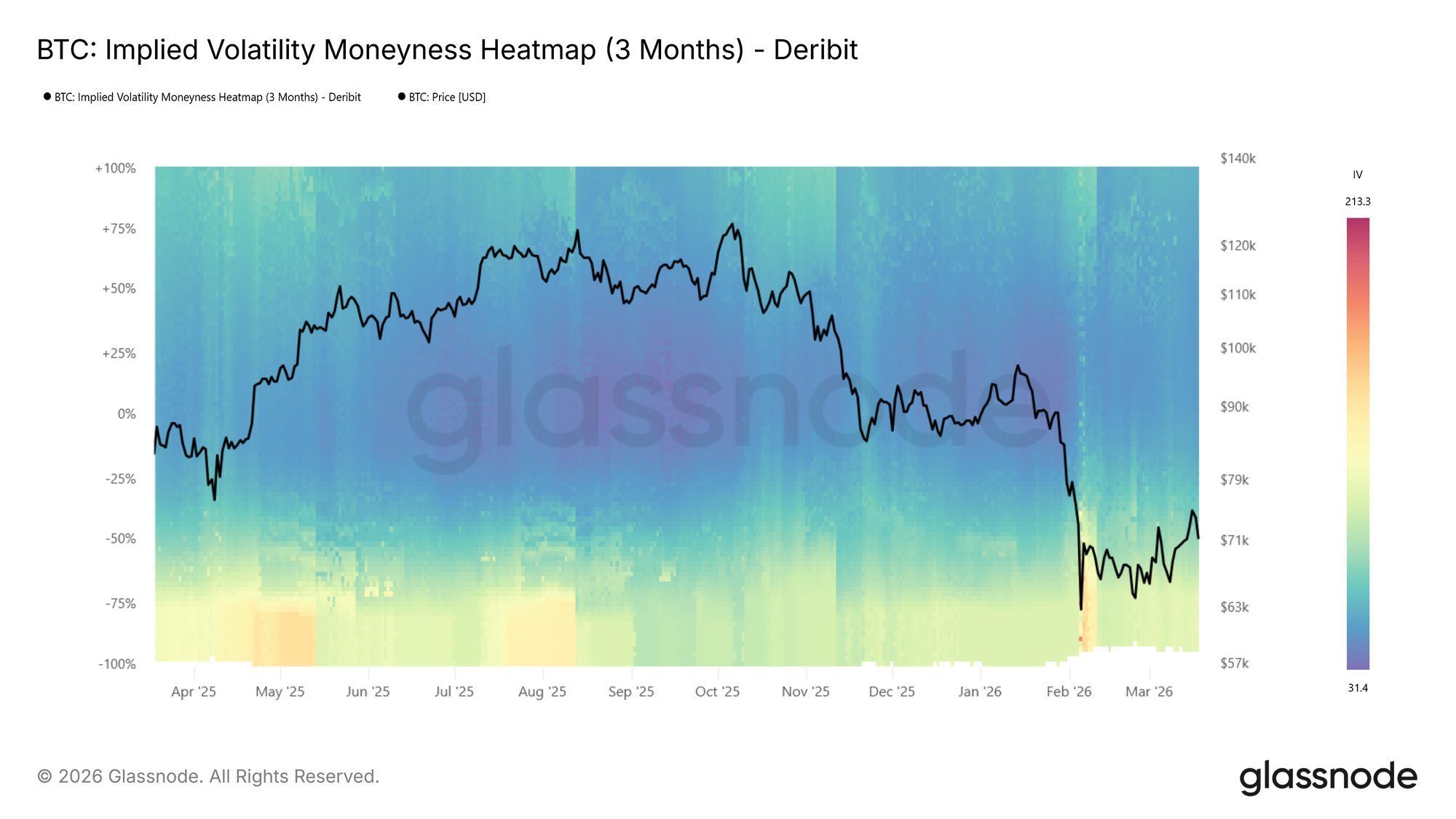
During the recent drop to $60k the put side IVs spiked strongly, shown by the transition to warm colours on the put side as price moved lower in the BTC moneyness heatmap (3m tenor) above.

During sharp drawdowns, risk hedging activity increases. Put demand rises as participants seek downside protection, pushing implied volatility higher on the put side. On the heatmap, this appears as a warm band emerging below the center line where colors were previously neutral, often intensifying to dark red as price falls further.

This is also reflected in rising expected price dispersion. Higher IV across a broader range of strikes signals growing uncertainty about where price will settle.

📈 Trading implications: Elevated put-side IV during drawdowns confirms active hedging demand. If the red band persists, the market is pricing continued risk. If it fades quickly, fear may be receding.

Tail Risk Repricing: When Outer Strikes Light Up

Sometimes the most telling signal is not where IV is already elevated, but where it wasn’t and suddenly is. During calm markets, deep OTM strikes tend to show very low IV because few participants are actively pricing or hedging at those levels. When that changes, and previously dark regions of the heatmap begin to brighten, the market is repricing tail risk.

This is distinct from a general rise in volatility. A broad increase lifts the entire surface. Tail repricing, by contrast, shows up as the warm band widening vertically into moneyness levels that had been ignored. Participants are starting to consider outcomes they had previously deemed too unlikely to hedge against.

📈 Trading implications: Watch the edges of the heatmap. If warm colors begin creeping into deep OTM levels that were previously dark blue, the market is assigning meaningful probability to larger moves. On the put side, this typically accompanies severe stress as participants hedge against outsized drawdowns. On the call side, the same pattern can emerge during euphoric rallies as the market starts pricing in large upside moves.

Low-Volatility Regimes: Cheap Protection, Expensive Later

Extended periods of subdued IV appear as dark blue across the heatmap. These regimes often correspond to consolidation phases, where the market expects limited movement in either direction.

📈 Trading implications: Crucially, low IV means option premiums are compressed. For hedgers, this presents an opportunity: downside protection via puts is relatively cheap, making it an attractive time to insure portfolios. For directional traders, buying options (calls or puts) in a low-vol environment is a pure volatility play: if IV expands, the position benefits regardless of direction.

However, prolonged compression often precedes volatility expansion. Here, it makes sense to watch for the first signs of color shifting from dark blue toward red as an early warning.

High-Volatility Regimes: Income Generation

The inverse holds as well. When the heatmap is dominated by warm colors across a wide range of strikes, option premiums are elevated. This creates opportunities for income-oriented strategies: selling options (covered calls, cash-secured puts) captures rich premiums, and benefits from the eventual mean-reversion of volatility back toward lower levels.

At BTC moneyness heatmap (3m tenor) below, we see an example showing a transition from hot (red) to cool (blue), e.g., the local top in spring 2024 followed by IV compression.
Regime Transitions

The most actionable signals often come at transition points: when the heatmap shifts from blue to red (or vice versa) across multiple moneyness levels simultaneously. Unlike a transient spike that fades within a day or two, a regime transition is a sustained shift in the baseline level of expected volatility.

📈 Trading implications: Regime shifts warrant reassessing position sizing, hedge ratios, and strategy selection. A transition from low to high vol may favor momentum and long-volatility positions, while the reverse may favor mean-reversion and premium-selling strategies.

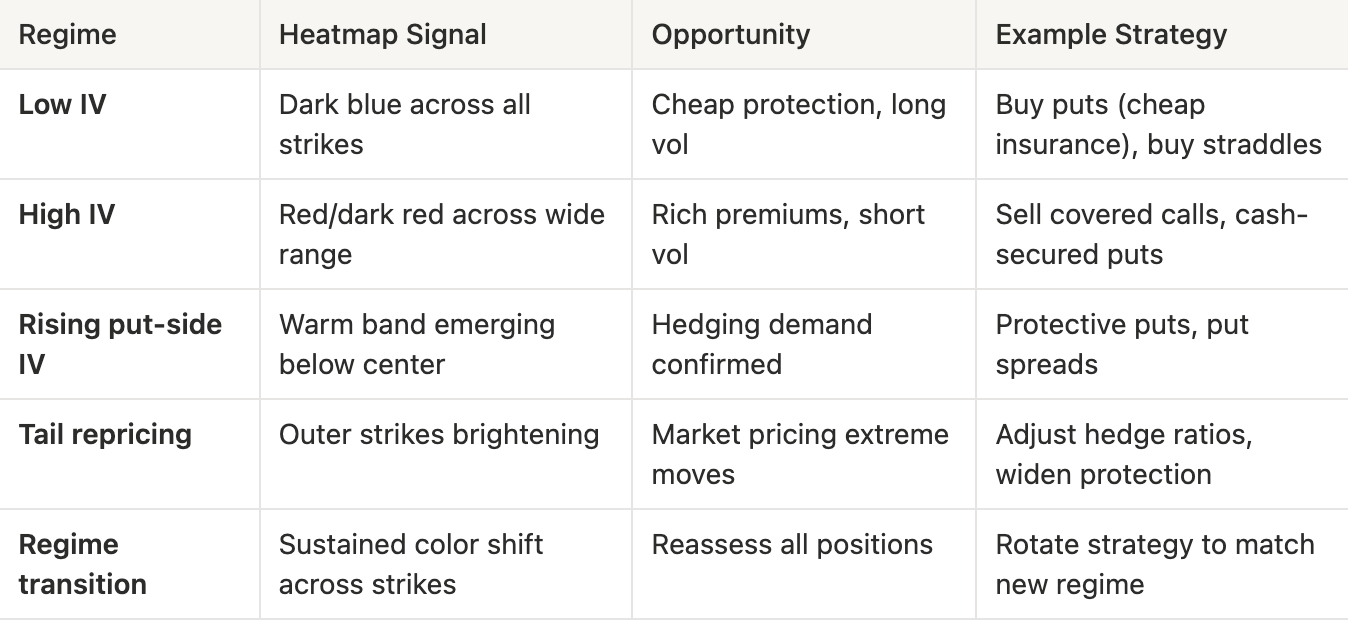
Vol Regime Quick Reference
What to look for:

  • Color intensity changes: Shifts in the overall level of expected volatility
  • Put/call asymmetry: Directional risk sentiment. Is the market more concerned about downside or upside?
  • Term structure divergence: Compare the 1-week heatmap to the 3-month heatmap. If front-end IV spikes while longer-dated IV stays flat, the market sees the stress as temporary
  • Width of elevated regions: A narrow red band at specific moneyness levels suggests targeted hedging; broad red indicates widespread uncertainty

Conclusion

The IV Moneyness Heatmap and IV Delta Heatmap bring a temporal dimension to volatility analysis. Rather than asking “what does the vol surface look like now?”, you can now ask “how has it changed, and what regime are we in?”

Whether you are a discretionary trader identifying volatility regimes, or a systematic fund screening for vol regime transitions via our API, these heatmaps provide a structured, visual lens into how the options market prices risk over time.

If you want to learn more about our options data and metric offering, or gain access to these metrics, contact our dedicated team today.


  • Follow us on X for timely market updates and analysis
  • Join our Telegram channel for regular market insights
  • For on-chain metrics, dashboards, and alerts, visit Glassnode Studio

Disclaimer: This report is for informational and educational purposes only. The analysis represents a limited case study with significant constraints and should not be interpreted as investment advice or definitive trading signals. Past performance patterns do not guarantee future results. Always conduct thorough due diligence and consider multiple factors before making investment decisions.


Câu hỏi Liên quan

QWhat are the two new metrics introduced in the article for tracking implied volatility over time?

AThe two new metrics are the IV Moneyness Heatmap and the IV Delta Heatmap.

QHow does the IV Moneyness Heatmap visually represent different levels of implied volatility?

AIt uses a color scale where warmer colors like red to dark red indicate higher implied volatility, and cooler colors like blue to dark blue indicate lower implied volatility.

QAccording to the article, what does a persistent red band on the put side of the heatmap typically indicate?

AA persistent red band on the put side indicates elevated demand for downside protection, signaling that the market is pricing in continued risk or fear.

QWhat trading opportunity does a low-volatility regime (dark blue on the heatmap) present for hedgers?

AIn a low-volatility regime, option premiums are compressed, making downside protection via puts relatively cheap. This presents an attractive opportunity for hedgers to insure their portfolios at a lower cost.

QWhat is a key difference between a general rise in IV and the repricing of tail risk as shown on the heatmap?

AA general rise in volatility lifts the entire IV surface uniformly. In contrast, tail risk repricing appears as a warm band widening vertically into deep out-of-the-money strikes that were previously dark blue, indicating the market is starting to assign meaningful probability to larger, previously ignored moves.

Nội dung Liên quan

Sự lựa chọn khác biệt sau đợt sụt giảm mạnh: Tổ chức mua đáy, trader chuyển hướng sang chứng khoán Mỹ

Ngày 6/6, Bitcoin (BTC) từng giảm xuống dưới 70.000 USD, chạm đáy quanh 59.130 USD. Đến ngày 8/6, giá đã phục hồi lên khoảng 63.000 USD nhưng tâm lý thị trường vẫn rất hoang mang, với chỉ số sợ hãi ở mức 15. Các chuyên gia đưa ra những quan điểm khác nhau về việc liệu đây có phải thời điểm mua vào: * **Từ các tổ chức:** * **Glassnode:** Nhà đồng sáng lập Rafael cho rằng vùng đáy có xác suất cao nằm trong khoảng 46.000 - 54.000 USD, dựa trên các mô hình định giá dài hạn như giá thực hiện và CVDD. * **Ngân hàng Standard Chartered:** Geoffrey Kendrick nhận định đáy gần như đã hình thành, và việc Strategy có thể mua lại BTC với khối lượng lớn sẽ là tín hiệu quan trọng. * **Strive Asset Management:** Giám đốc điều hành Matt Cole coi việc BTC chạm đường trung bình động 200 tuần (lần thứ 5 trong lịch sử) là cơ hội mua vào lịch sử. * **Từ các nhà giao dịch:** * **Chuyển hướng sang chứng khoán Mỹ:** Nhà giao dịch Eugene Ng Ah Sio tuyên bố đã rút phần lớn vốn khỏi thị trường tiền mã hóa từ giữa tháng 5 để tập trung vào cổ phiếu, do thấy cơ hội hấp dẫn hơn và lo ngại rủi ro từ Strategy. * **Cơ hội "mua thế hệ":** Nhà giao dịch Killa lại coi đợt giảm giá là cơ hội mua vào và đã sử dụng 90% vốn. * **Các góc nhìn khác:** * **NYDIG:** Greg Cipolaro chỉ ra rằng dòng tiền có thể đang chuyển từ crypto sang các cổ phiếu AI đang hoạt động mạnh, nhưng nhiều chỉ số (như MVRV) đang tiến gần mức đáy lịch sử. * **Dữ liệu thị trường dự đoán (Polymarket):** 72% người tham gia dự đoán BTC có khả năng giảm xuống dưới 55.000 USD, nhưng chỉ 21% nghĩ rằng nó sẽ giảm xuống 35.000 USD. Tóm lại, trong khi nhiều tổ chức lạc quan và coi đây là vùng giá hấp dẫn để tích lũy dài hạn, một số nhà giao dịch cá nhân tỏ ra thận trọng và đang tìm kiếm cơ hội ở các thị trường khác.

marsbit29 phút trước

Sự lựa chọn khác biệt sau đợt sụt giảm mạnh: Tổ chức mua đáy, trader chuyển hướng sang chứng khoán Mỹ

marsbit29 phút trước

Cổ Phiếu Công Nghệ Đang Thực Hiện Giải Đòn Bẩy: Thay Vì Vội Vàng Mua Đáy, Hãy Đợi Môi Trường Đại Cục Ổn Định Trước

Tác giả phân tích đợt điều chỉnh mạnh của cổ phiếu công nghệ gần đây, cho rằng nguyên nhân cốt lõi là đà tăng quá mạnh, giao dịch quá tập trung và lo ngại về lãi suất cao kéo dài, cùng với việc huy động vốn IPO của SpaceX, đã kích hoạt quá trình giảm đòn bẩy. So sánh với đợt điều chỉnh hồi tháng 12, lần này thị trường chủ yếu lo ngại về phía "mẫu số" (lãi suất, lạm phát, Fed, địa chính trị) hơn là nghi ngờ logic cơ bản của AI. Về không gian và thời gian điều chỉnh, đợt sóng giảm chính có thể đã hoàn thành phần lớn. Tuần này khả năng tiếp tục lao dốc mạnh thấp, nhưng cũng khó có đảo chiều hình chữ V ngay. Thị trường có xu hướng dao động mạnh, phòng thủ và chờ đợi trong khi chưa có tín hiệu rõ ràng. Để thị trường thực sự đảo chiều, cần chờ một tín hiệu "cầm máu" từ mặt vĩ mô trước, như CPI không quá xấu, lợi suất trái phiếu Mỹ ngừng tăng mạnh, hoặc FOMC không trở nên quá diều hâu. Chỉ khi áp lực từ phía mẫu số (lãi suất, định giá) dịu bớt, thị trường mới có thể quay lại tập trung giao dịch các logic ngành cơ bản của AI như thiếu hụt năng lực tính toán, tăng giá bộ nhớ và tăng tốc thương mại hóa. Do đó, lời khuyên là không nên vội vàng mua vào đáy, mà nên kiên nhẫn chờ môi trường vĩ mô ổn định trở lại.

marsbit36 phút trước

Cổ Phiếu Công Nghệ Đang Thực Hiện Giải Đòn Bẩy: Thay Vì Vội Vàng Mua Đáy, Hãy Đợi Môi Trường Đại Cục Ổn Định Trước

marsbit36 phút trước

Chứng khoán Hàn Quốc sụt giảm mạnh, vốn toàn cầu rút ra: Cơ bản ngành bán dẫn thực sự đã thay đổi?

Thị trường Hàn Quốc vừa trải qua đợt bán tháo mạnh mẽ, với KOSPI lao dốc gần 9% và các gã khổng lồ bán dẫn như Samsung, SK Hynix chịu ảnh hưởng nặng nề. Động thái này diễn ra ngay sau khi chỉ số bán dẫn Philadelphia của Mỹ sụt giảm, cho thấy sự lo ngại của giới đầu tư về định giá cao của các cổ phiếu công nghệ. Tuy nhiên, một kịch bản trái ngược đang diễn ra trong chuỗi cung ứng. Giám đốc điều hành NVIDIA, Jensen Huang, trong chuyến thăm Hàn Quốc, đã công bố thỏa thuận hợp tác nhiều năm mới với SK Hynix để phát triển thế hệ bộ nhớ tiếp theo cho trung tâm dữ liệu AI. Ông cũng nhấn mạnh cơ sở hạ tầng AI vẫn đang ở giai đoạn đầu, củng cố mối quan hệ với các đối tác Hàn Quốc. Sự tương phản này làm nổi bật cuộc tranh luận hiện tại: Liệu đợt sụt giảm có phải là tín hiệu dự báo đỉnh chu kỳ AI, hay chỉ là một đợt điều chỉnh kỹ thuật để giảm đòn bẩy sau thời gian tăng mạnh? Bài viết chỉ ra rằng thị trường Hàn Quốc đã trở thành một "ETF bộ nhớ AI" lớn, cực kỳ nhạy cảm với các dòng tiền toàn cầu luân chuyển vào và ra khỏi chủ đề AI. Trọng tâm thị trường dường như đang chuyển dịch. Từ câu chuyện tăng trưởng chung của AI, giờ đây các nhà đầu tư bắt đầu đánh giá kỹ lưỡng hơn về "hồ lợi nhuận" AI - tức là ai sẽ thực sự hưởng lợi và khả năng hiện thực hóa lợi nhuận. Do đó, biến động có thể xảy ra từ các yếu tố như hướng dẫn doanh thu, điều chỉnh kế hoạch vốn, hoặc tin tức về chuỗi cung ứng. Hướng đi tương lai của thị trường Hàn Quốc sẽ phụ thuộc vào các dữ liệu cơ bản then chốt: đơn hàng từ NVIDIA, cung-cầu HBM và chi tiêu vốn của các nhà cung cấp dịch vụ đám mây. Nếu những yếu tố này vẫn mạnh mẽ, đợt bán tháo có thể chỉ là sự thanh lọc cần thiết. Ngược lại, nếu chúng có dấu hiệu yếu đi, đó có thể là khởi đầu cho một đợt điều chỉnh định giá sâu hơn.

marsbit1 giờ trước

Chứng khoán Hàn Quốc sụt giảm mạnh, vốn toàn cầu rút ra: Cơ bản ngành bán dẫn thực sự đã thay đổi?

marsbit1 giờ trước

Trump tìm đến công ty AI thảo luận phân chia lợi nhuận, một áp lực tường thuật gần ngang tầm với Cách mạng Công nghiệp bắt đầu

Trong hai năm qua, thị trường AI chỉ tập trung vào một câu hỏi: Ai có thể kiếm được nhiều tiền nhất? Tuy nhiên, một câu hỏi mới đang nổi lên: Nếu AI thực sự tạo ra của cải chưa từng có, liệu số tiền đó có nên chỉ thuộc về các công ty, nhân viên và cổ đông không? Đây là lý do cuộc thảo luận về Quỹ Tài sản Công của OpenAI trở nên đáng chú ý. Nó không phải là chính sách đã được thực thi, mà là lần đầu tiên ngành AI đưa vấn đề "phân phối lợi nhuận siêu ngạch trong tương lai" ra bàn thảo công khai. Động thái này phản ánh một áp lực về mặt tường thuật gần như ở cấp độ Cách mạng Công nghiệp: Khi AI thay đổi năng suất, ai sẽ được hưởng lợi? Theo các báo cáo, các quan chức Nhà Trắng đã có những cuộc thảo luận sơ bộ với các công ty AI hàng đầu về việc "tự nguyện nhượng lại một phần cổ phần". OpenAI cũng đã đề xuất thành lập một quỹ tài sản công, trong khi đề xuất của Thượng nghị sĩ Bernie Sanders thì cực đoan hơn, đòi hỏi tỷ lệ cổ phần và quyền quản trị cao cho công chúng. Bản chất, việc OpenAI chủ động đề xuất là để mua "giấy phép xã hội", giảm bớt rủi ro chính trị tiềm ẩn như thuế cao, kiểm soát chặt hơn hoặc áp lực chống độc quyền trong tương lai bằng một cơ chế chia sẻ lợi nhuận có thể kiểm soát được. Tác động đến định giá là khác nhau tùy theo phương án. Một khoản đóng góp tự nguyện, tỷ lệ nhỏ, không có quyền biểu quyết giống như một chi phí chính sách dài hạn có thể tính toán được. Ngược lại, các phương án bắt buộc với tỷ lệ cao và can thiệp vào quản trị sẽ làm thay đổi đáng kể logic định giá, ảnh hưởng đến quyền kiểm soát và tự do tăng trưởng của công ty. Hiện tại, vấn đề này vẫn ở giai đoạn đầu. Các điểm quan sát chính bao gồm: liệu các công ty AI khác có làm theo không, Nhà Trắng có chính thức hóa đề xuất không, các tài liệu huy động vốn/IPO có tiết lộ rủi ro mới không, và thị trường có phản ứng giá không. Có thể nói, thị trường AI trước đây chỉ định giá cho tăng trưởng, giờ đây bắt đầu định giá cho việc phân phối.

marsbit1 giờ trước

Trump tìm đến công ty AI thảo luận phân chia lợi nhuận, một áp lực tường thuật gần ngang tầm với Cách mạng Công nghiệp bắt đầu

marsbit1 giờ trước

Giao dịch

Giao ngay
Hợp đồng Tương lai
活动图片