Kalshi's Pre-Market Stock Price Surges, Is It Still Time to Buy?

Odaily星球日报Xuất bản vào 2026-01-29Cập nhật gần nhất vào 2026-01-29

Tóm tắt

Kalshi, a leading US-regulated prediction market platform, has seen its pre-IPO stock price surge by 21.7% in the past 30 days, significantly outperforming major cryptocurrencies like BTC and ETH. The prediction market sector is experiencing explosive growth, with total trading volume exceeding $50 billion in 2025. Kalshi reported a record $23.8 billion in annual trading volume for 2025, a 12x year-over-year increase, and is projected to reach a monthly trading volume of $9.1 billion in January 2026. Backed by major investors like Paradigm and Sequoia, Kalshi's valuation has soared to $11 billion. Pre-IPO share prices for Kalshi vary across platforms, ranging from $307 on Nasdaq Private Market to $450 on crypto-native platforms, reflecting high market interest. The article analyzes whether investing in Kalshi's pre-IPO market is still worthwhile given its rapid growth and dominant market position.

Original|Odaily Planet Daily(@OdailyChina)

Author|Wenser(@wenser 2010)

The scale, trading volume, and other data of the prediction markets continue to grow rapidly. The pre-IPO markets of leading platforms like Kalshi and Polymarket have also attracted significant market attention and liquidity. According to data from the PreStocks platform, Kalshi's pre-market stock price has surged 21.7% in the past 30 days, far exceeding the gains of mainstream cryptocurrencies like BTC and ETH over the past month.

Before the IPO cake is served, the Pre-IPO sector might be the battleground suitable for more people to participate in early. This article by Odaily Planet Daily will analyze whether the pre-market for prediction market stocks is worth a heavy bet, from the perspectives of the industry sector, platform data, and capital valuation.

Behind the "Prediction Markets Still Have 100x Upside" Judgment: Total Trading Volume Exceeds $50 Billion in 2025

Last August, 1confirmation founder Nick Tomaino boldly claimed that "prediction market trading volume will grow 100 times".

At that time, the "twin titans of prediction markets," Polymarket and Kalshi, had not yet secured funding above the $1 billion mark, their valuations were far from the $10 billion scale, and the overall prediction market trading volume in July was less than $2 billion, nearly halved from the historical high of over $4 billion in October 2024. The judgment of 100x growth space seemed like nonsense.

But soon, in October 2025, Polymarket announced a $2 billion investment from ICE Group, the parent company of the NYSE, skyrocketing its valuation to $9 billion, and later sought a new round of funding at a valuation of $12-15 billion; Kalshi, meanwhile, completed 2 rounds of financing between October and December, with the latest round reaching $1 billion, surging its valuation to $11 billion, led by Paradigm, with participation from Sequoia, a16z, Meritech Capital, IVP, ARK Invest, Anthos Capital, CapitalG, and Y Combinator.

Behind the capital's fervent pursuit is the rapid and vigorous development of the prediction markets.

According to data from our previously published article "2025 Prediction Market Review: Total Trading Volume Exceeds $50 Billion, Dual Giants Command Over 97.5% Market Share":

  1. In September 2025, the combined trading volume of Kalshi and Polymarket reached $1.44 billion;
  2. In October 2025, prediction market trading volume reached $8.7 billion, with Kalshi leading and Polymarket following;
  3. In November 2025, the combined trading volume of Kalshi and Polymarket approached $10 billion, with Kalshi's trading volume reaching $5.8 billion, a 32% increase month-over-month; Polymarket's trading volume reached $3.74 billion, a 23.8% increase month-over-month.
  4. In December 2025, analyst Patrick Scott stated that prediction market trading volume exceeded $13 billion in November 2025, more than three times the trading volume during the peak of the 2024 election.

Thus, in just a few months, the overall monthly trading volume of prediction markets increased about 6-fold. Viewed this way, 100x growth is not out of reach.

After all, 100 times $2 billion is only $200 billion. Compared to the prediction market's total trading volume of over $50 billion in 2025, it only requires a 4x growth. Behind such a迅猛的 (rapid) growth rate is the狂飙突进 (galloping advance) of Kalshi, this US-compliant prediction market platform.

Kalshi Poised to Become the "Leading Stock in Prediction Markets": 2025 Trading Volume Nearly $24 Billion, January Volume Could Reach $9 Billion

The emphasis on Kalshi's "compliant status in the US market" is because, based on its various licenses and compliance preparations, the door to an IPO is easier for Kalshi to open. Furthermore, as a pioneer prediction market platform founded in 2018 (Odaily Planet Daily Note: The platform officially launched in July 2021, slightly later than Polymarket), Kalshi's business growth in recent years has been extremely impressive.

Kalshi's 2025 Report Card: Annual Trading Volume $23.8 Billion, Number of Trades Reached 97 Million

KalshiData previously stated that all metrics of Kalshi achieved record growth in 2025.

  • In terms of notional trading volume, the annual amount reached $23.8 billion, a year-on-year increase of 1108%, approximately 12.1 times. December set a monthly historical high of $6.38 billion, the 4th week of December set a weekly historical high of $1.7 billion, and December 21st set a daily historical high of $381.7 million.
  • In terms of the number of trades, the annual total reached 97 million, a year-on-year increase of 1680%, approximately 17.8 times. December saw 27.67 million trades, the 4th week of December saw 7.6 million trades, and December 21st saw 1.5 million trades, all setting historical highs.

And as time entered 2026, the growth of Kalshi's business data can be described as恐怖 (terrifying/astounding).

Kalshi's Business Surge: January 2026 Notional Trading Volume Expected to Exceed $9 Billion

On December 16, 2025, Kalshi CEO Tarek Mansour stated that with the launch of the Combo feature, the platform's single-day trading volume hit a historical high of $340 million;

On January 12, 2026, the single-day trading volume of prediction markets grew to approximately $702 million, setting a new historical high; among which, Kalshi accounted for approximately $465 million, about two-thirds of the total, while Polymarket and Opinion collectively contributed about $100 million in trading volume.

On January 26, KalshiData stated that as of January 23, Kalshi's monthly notional trading volume was approximately $6.7 billion, with a daily average trading volume of approximately $293 million. If the current pace is maintained, Kalshi's notional trading volume for January is expected to reach approximately $9.1 billion.

It is worth mentioning that last October, the overall prediction market trading volume was $8.7 billion, with Kalshi's market share around 45%-55%; now, the monthly trading volume of just the Kalshi platform exceeds the overall market size at that time. This reflects both the红利期 (dividend period) of the prediction market整体处于时代风口 (being in the trend of the times), and also shows the可怕 (astounding) business growth rate of Kalshi.
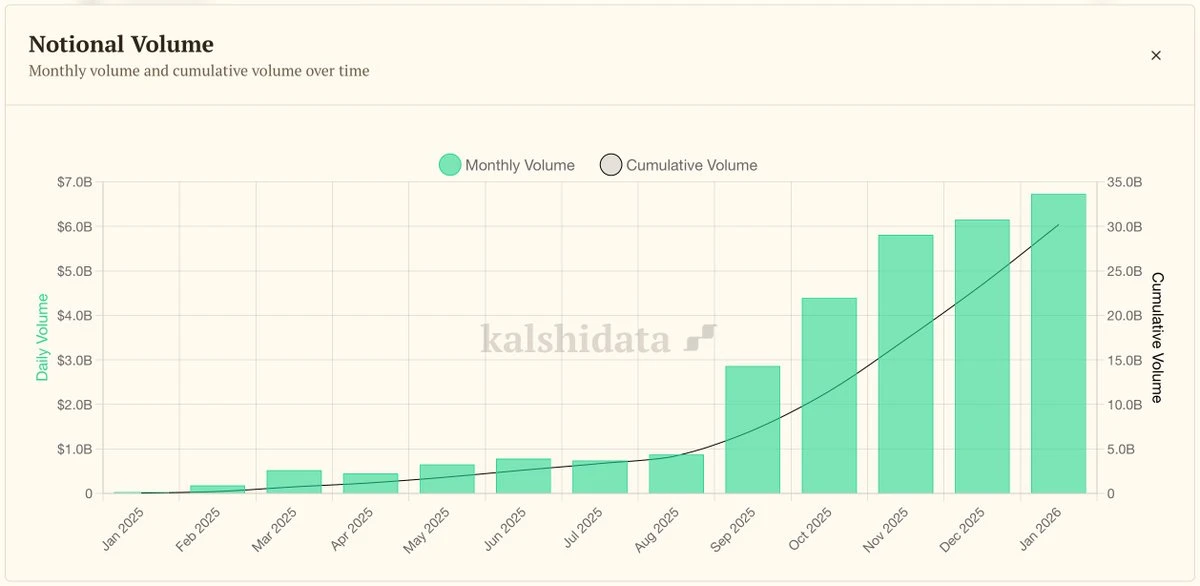
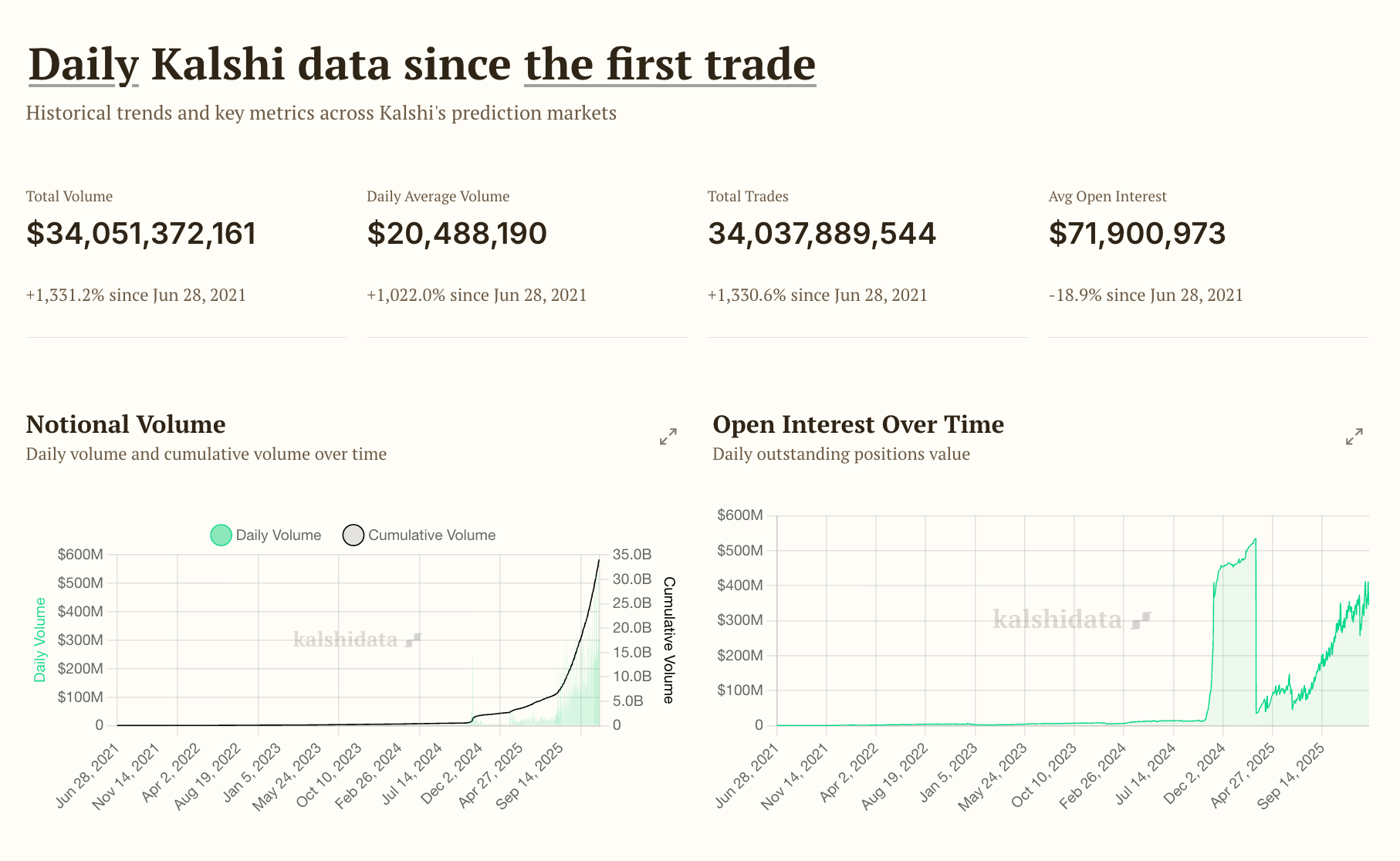
According to data from the KalshiData website, as of January 29, Kalshi's historical total trading volume exceeded $34.05 billion, with a daily average trading volume exceeding $20.48 million; looking at its notional trading volume K-line chart, it has grown almost exponentially since September 2025.
Capital Market Pricing Range: Kalshi Single Share Price is $300-$450

Finally, as the current number one prediction market platform, although Kalshi's specific IPO time and number of shares to be issued are not yet determined,结合 (combined with) its previous financing news and external statements, an IPO is a certainty. Currently, there are many divergences in the pre-market stock pricing between traditional financial markets and cryptocurrency markets:

The pre-market in traditional financial markets prices Kalshi's stock relatively lower——

  • On Nasdaq Private Market, Kalshi's single share is priced around $307;
  • On Hiive, Kalshi's single share is priced around $357.

The pre-market in cryptocurrency markets prices Kalshi's stock relatively higher——

  • On PreStocks, Kalshi's implied market capitalization is approximately $14 billion, with a single share price of approximately $407;
  • On Jarsy, Kalshi's market valuation is $11 billion, with a单独定价 (single price) of $450.

In the next article, Odaily Planet Daily will analyze in detail the price range worth buying for Kalshi's stock pre-market, dissecting the investment opportunities in prediction market stocks from the perspective of the pre-market.


Nội dung Liên quan

Sự phân bổ giá trị của stablecoin

Tác giả phân tích sự phân phối giá trị trong ngành stablecoin, chia thành 4 tầng: 1. **Lớp phát hành** (như Tether, Circle): Đúc stablecoin, nắm tài sản dự trữ, hưởng chênh lệch lãi suất. 2. **Lớp cơ sở hạ tầng** (như Bridge, BVNK): Kết nối stablecoin với hệ thống tài chính thực - xử lý nạp/rút tiền pháp định, đối ngân hàng, tuân thủ, quản lý tài sản. Đây là công việc phức tạp, tạo ra rào cản cạnh tranh. 3. **Lớp thu nhận/phân phối** (như Stripe, Coinbase): Tích hợp stablecoin vào hệ thống doanh nghiệp, quản lý thanh toán. 4. **Lớp ứng dụng**: Người dùng và doanh nghiệp cuối cùng. Lớp phát hành thu lợi nhuận lớn nhất. Tuy nhiên, tác giả nhấn mạnh tầm quan trọng tiềm năng của **lớp cơ sở hạ tầng**. Khó khăn thực sự không nằm ở chuyển tiền trên blockchain, mà ở việc kết nối nó với thế giới thực: đối ngân hàng, xử lý quy định, tích hợp vào quy trình nghiệp vụ doanh nghiệp. Các công ty như Stripe (mua lại Bridge) và Mastercard (mua lại BVNK) đang tranh giành để trở thành cổng kết nối mặc định này. Lớp cơ sở hạ tầng hiện ở giai đoạn đầu, vất vả, cần vốn, và bị kẹt giữa các tầng khác. Nhưng một khi stablecoin trở thành phương thức tài chính phổ biến, những công ty đã xây dựng được mạng lưới kết nối rộng khắp và sâu vào hệ thống doanh nghiệp sẽ có vị thế mạnh và quyền định giá.

marsbit3 giờ trước

Sự phân bổ giá trị của stablecoin

marsbit3 giờ trước

Tại sao NVIDIA không thiếu tiền nhưng vẫn muốn vay 200 tỷ USD?

Tóm tắt: Mặc dù có dòng tiền tự do mạnh mẽ (khoảng 486 tỷ USD trong quý gần nhất) và không thiếu tiền mặt, NVIDIA vẫn có kế hoạch phát hành ít nhất 20 tỷ USD trái phiếu (hối phiếu cao cấp) với kỳ hạn lên đến 30 năm. Động thái này không phải vì thiếu vốn, mà là một chiến lược quản lý vốn chủ động, tận dụng xếp hạng tín dụng AA vừa được nâng cấp để huy động vốn dài hạn với chi phí thấp. Mục đích của việc vay nợ bao gồm tái cấp vốn, đầu tư vào cơ sở hạ tầng và trung tâm dữ liệu AI, nghiên cứu & phát triển, thanh toán trước cho chuỗi cung ứng và các khoản đầu tư chiến lược. So với việc phát hành thêm cổ phiếu (làm loãng lợi ích của cổ đông hiện tại), việc phát hành trái phiếu được coi là có lợi hơn cho cổ đông khi NVIDIA có thể vừa duy trì các chương trình mua lại cổ phiếu và cổ tức lớn, vừa tài trợ cho sự mở rộng dài hạn. Hành động của NVIDIA phản ánh một xu hướng rộng hơn trong ngành công nghệ, nơi các gã khổng lồ như Alphabet, Meta và Amazon cũng đang sử dụng vốn vay để tài trợ cho chu kỳ chi tiêu vốn nặng về AI. Điều này cho thấy câu chuyện đầu tư AI đang chuyển sang một giai đoạn mới, đòi hỏi nguồn vốn dài hạn và quy mô lớn cho cơ sở hạ tầng. Thách thức chính trong tương lai là khả năng sinh lời từ các khoản đầu tư AI này phải đủ cao và đúng hạn để biện minh cho kỳ vọng và cấu trúc vốn mới.

marsbit4 giờ trước

Tại sao NVIDIA không thiếu tiền nhưng vẫn muốn vay 200 tỷ USD?

marsbit4 giờ trước

Liberland Sa Thải Bộ Trưởng Công Nghệ Sau Vụ Cố Gắng Chiếm Quyền Blockchain Và Trang Web

Theo một nghị quyết chính thức được công bố, Quốc hội Liberland - một dự án vi quốc gia - đã bỏ phiếu bãi nhiệm Bộ trưởng Công nghệ Dorian Stern Vukotić. Ông bị cáo buộc thực hiện một loạt hành động nhằm giành quyền kiểm soát cơ sở hạ tầng kỹ thuật của dự án, bao gồm việc gỡ bỏ bảo vệ đa chữ ký (multisig) trên tài khoản quản trị Sudo, cố gắng chiếm quyền điều khiển tên miền Liberland.org, chặn quyền bỏ phiếu của Tổng thống Vít Jedlička và phát hành token trái phép. Sự việc này nêu bật những rủi ro quản trị thực tế trong không gian crypto, vượt ra ngoài các lỗ hổng hợp đồng thông minh đơn thuần. Nó liên quan đến quyền kiểm soát các điểm then chốt ngoài chuỗi như tài khoản quản trị, tên miền website, quyền truy cập biểu quyết và thiết kế đa chữ ký. Tranh chấp tại Liberland trở thành một nghiên cứu điển hình về cách thức các dự án phụ thuộc vào sự pha trộn giữa quản trị on-chain và các cơ chế kiểm soát off-chain. Bài học chính cho người dùng crypto là những tuyên bố về phi tập trung cần được kiểm chứng với thực tế vận hành. Nếu chỉ một số ít người có thể kiểm soát các chức năng quản trị hoặc quyền truy cập then chốt, thì hệ thống quản trị vẫn có thể dễ bị tổn thương. Sự kiện này phản ánh xu hướng rộng hơn trong thị trường crypto, nơi cơ sở hạ tầng, bảo mật và quản trị ngày càng trở nên quan trọng ngang bằng với biến động giá.

bitcoinist5 giờ trước

Liberland Sa Thải Bộ Trưởng Công Nghệ Sau Vụ Cố Gắng Chiếm Quyền Blockchain Và Trang Web

bitcoinist5 giờ trước

Làm Thế Nào Để Nghiên Cứu Tốt: Rèn Luyện Những Khả Năng Thực Sự Có Thể 'Luyện Tập Chủ Động'

Chưa ai thực sự dạy bạn cách làm nghiên cứu. Hầu hết mọi người chỉ học cách "trông giống" một nhà nghiên cứu, trong khi năng lực thực sự là sự tích lũy các kỹ năng có thể rèn luyện có chủ ý. **Chọn vấn đề của riêng bạn:** Đừng chỉ tiếp nhận vấn đề từ người khác. Hãy bắt đầu từ một kết quả bạn thực sự muốn đạt được và suy ngược để thiết kế thí nghiệm. Điều này tạo ra tính độc đáo. "Khiếu thẩm mỹ" trong nghiên cứu giống như một cơ bắp, có thể phát triển thông qua việc dự đoán kết quả thí nghiệm và kiểm tra lại các dự đoán đó. **Nâng cấp đầu vào:** Đừng chỉ đọc các xu hướng mới nhất. Tài liệu cũ (như bài phát biểu của Claude Shannon năm 1952) và các lĩnh vực rộng (thần kinh học, thống kê, kiến ​​trúc máy tính) thường mang lại những hiểu biết sâu sắc có giá trị. Hãy đọc chính bài báo gốc, đặc biệt là phần phụ lục và hạn chế. **Viết mọi thứ xuống:** Viết lách là cơ chế phòng thủ rẻ nhất chống lại sự tự lừa dối. Nó phơi bày những lỗ hổng trong suy nghĩ. Giữ một cuốn nhật ký ghi lại giả thuyết, cài đặt, dự đoán, kết quả và bài học. Xem lại nó sẽ dạy bạn sự khiêm tốn. Tóm lại, nghiên cứu hiệu quả dựa trên việc chủ động chọn vấn đề, mở rộng nguồn tri thức và ghi chép trung thực để rèn giũa tư duy.

marsbit6 giờ trước

Làm Thế Nào Để Nghiên Cứu Tốt: Rèn Luyện Những Khả Năng Thực Sự Có Thể 'Luyện Tập Chủ Động'

marsbit6 giờ trước

Tăng Trưởng Vượt 150% Trong Nửa Tháng, Đằng Sau Sự Bùng Nổ Của Backpack

Backpack (BP), token của sàn giao dịch cùng tên, đã tăng hơn 150% trong nửa tháng, đạt mức cao 0,48 USD. Động lực chính đến từ việc ra mắt nền tảng Backpack Securities vào đầu tháng 6, cung cấp dịch vụ môi giới cổ phiếu Mỹ được quy định và hỗ trợ token hóa tài sản truyền thống. Sự kiện đáng chú ý là việc phát hành token SPCX, được neo 1:1 với cổ phiếu SpaceX thật, trên Solana vào ngày 12/6. Sản phẩm này cho phép giao dịch trên chuỗi 24/7 và có thể đổi ngược về tài khoản chứng khoán truyền thống, tạo cầu nối giữa thị trường vốn truyền thống và DeFi. BP có tổng cung 10 tỷ token với cơ chế phân phối độc đáo: 25% đầu tiên được airdrop cho cộng đồng, 37.5% tiếp theo sẽ mở khóa theo các cột mốc phát triển sản phẩm, và 37.5% cuối cùng sẽ được khóa cho đến sau IPO. Đội ngũ phát triển không nhận token ngay từ đầu. Người dùng có thể stake BP để nhận quyền chuyển đổi token thành cổ phần công ty khi công ty IPO, cùng các đặc quyền khác. Hiện khoảng 66% lượng token lưu hành đang được stake. Mặc dù từng có tranh cãi về cơ chế airdrop, sự chú ý của thị trường hiện đang dồn vào sự mở rộng thực tế của nền tảng và tiềm năng lâu dài của token BP trong hệ sinh thái mới kết hợp chứng khoán và tài sản token hóa.

marsbit6 giờ trước

Tăng Trưởng Vượt 150% Trong Nửa Tháng, Đằng Sau Sự Bùng Nổ Của Backpack

marsbit6 giờ trước

Giao dịch

Giao ngay
Hợp đồng Tương lai
活动图片



