The PC industry, with its 40-year history, is truly about to undergo a dramatic transformation.
In early June, at GTC Taipei 2026, NVIDIA unveiled the RTX Spark, a new super chip for Windows-based personal computers, officially announcing its entry into the PC core processor market. This grand event aimed at redefining the AI PC had an air of "official endorsement" with Microsoft's backing.
Simultaneously, a lineup of PC manufacturers representing nearly the entire terminal market—Acer, Asus, Dell, Gigabyte, HP, Lenovo, MSI—also unanimously stood behind this single chip.
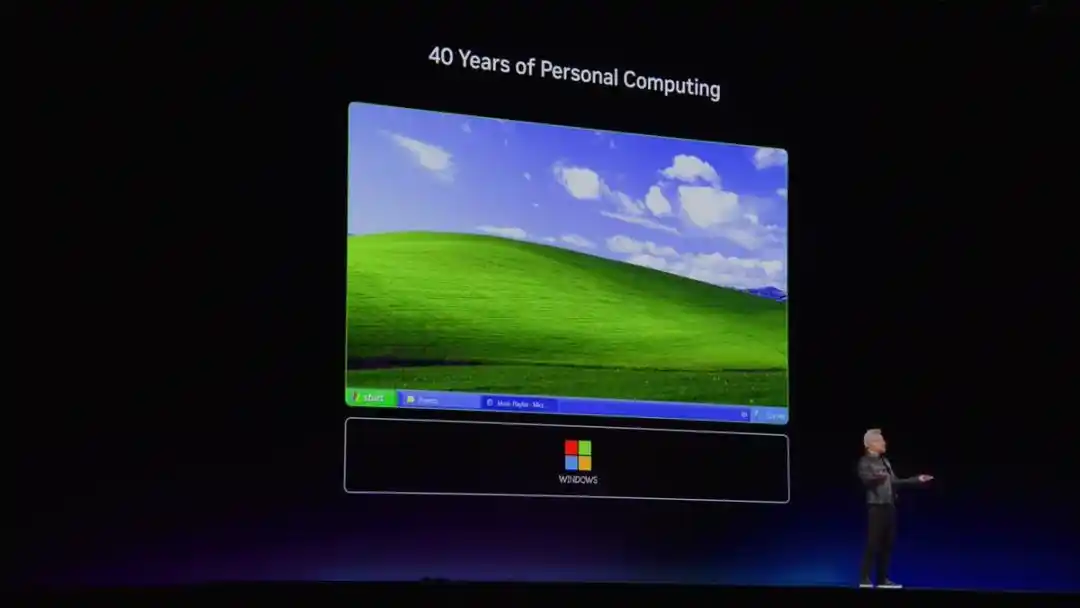
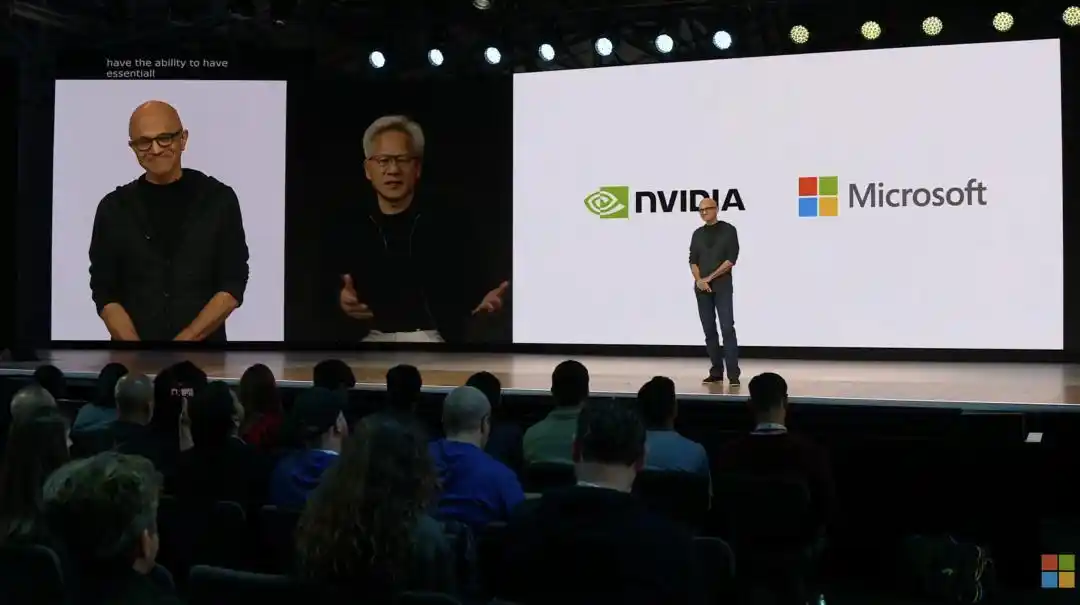
Moreover, at the Microsoft Build 2026 conference two days later, Microsoft CEO Satya Nadella redefined Windows as the "native runtime platform for local AI Agents" and launched the Surface RTX Spark Dev Box—a desktop workstation equipped with RTX Spark capable of running a 120B parameter large language model locally.
In a video call, Jensen Huang stated that after more than forty years, the personal computer is approaching a new inflection point. AI agents are reshaping the form of the PC industry, and NVIDIA and Microsoft are "reinventing" the personal computer, enabling local PCs to possess independent AI agent capabilities. The PC is evolving from a personal computer into a personal AI.
He gave an example: when a user is out, they can message their PC, allowing the local Agent to call tools, modify code, advance a design, and then continue iterating with the user. He emphasized that the PC is no longer just a tool operated by people; it is also becoming an AI assistant that can continuously run tasks.
However, an easily overlooked fact is that the concept of AI PC was not first introduced by NVIDIA. In fact, Intel was the one who proposed the concept of AI PC.
As early as January this year, at CES, Intel launched the new third-generation Core Ultra processor platform. For Intel itself, this was the debut of the advanced Intel 18A process technology, also crucial for its future development. For the PC industry, "Core Ultra" holds another layer of significance; it can be seen as a key anchor point for the emerging field of AI PC.
However, with NVIDIA's aggressive entry into the AI PC market, Intel indeed appears somewhat passive.
Furthermore, it cannot be ignored that in this industrial upheaval concerning personal computing, other players are gradually entering the fray. For example, Qualcomm continues to strengthen its focus on PC chips, AMD has successively launched new products integrating AI computing power, and Apple has demonstrated the feasibility of ARM architecture running on personal computing devices with its M-series chips.
All these moves point to the same key technological trend: AI is unprecedentedly moving towards personal computing devices.
Building High Towers, Feasting Guests, Then the Towers Collapse
To tell the story of the PC industry, one must first mention the Wintel alliance—but it has never been limited to just Wintel.
In 1980, IBM planned to produce its own brand of PC. At the time, IBM was a towering figure in the computer field, while Intel, though somewhat successful, had limited influence. Among peers in microprocessors, Motorola was also present and was stronger overall than Intel.
However, Don Estridge, who was in charge of IBM's PC business, made a decision that would influence the landscape for decades to come: the processor procurement order went to Intel, and the operating system order went to Microsoft.
Microsoft at that time could not be considered a software industry giant. But the story of this combination later became a decisive chapter in the history of PC development. In the early 1990s, Microsoft and Intel jointly wrested control of the PC from IBM.
This was the "Wintel alliance"—the personal computer architecture composed of Microsoft's Windows operating system and Intel's CPU. For over twenty years thereafter, the Wintel alliance monopolized the desktop market. Relying on Intel's Moore's Law and the iterative upgrades of Microsoft's Windows system, the two companies jointly regulated downstream PC manufacturers and reaped enormous profits.
During these two decades, the power structure of the PC industry was like this: Intel controlled the core processors, Microsoft controlled the operating system, and PC manufacturers could only compete on price within the rules set by the upstream.
But to understand today's situation, looking only at Intel and Microsoft is not enough; a third name must be included—that is NVIDIA.
However, during the forty years of Wintel hegemony, NVIDIA's positioning was very clear: a component supplier.
When PC users bought a computer, they thought, "This computer uses an Intel processor." Graphics card? That was an add-on component for gaming and rendering. NVIDIA's GPU was just an accessory plugged into a PCIe slot; the PC's core architecture was determined by the CPU and managed by the operating system.
For decades, although NVIDIA's role became increasingly important, it did not change the underlying logic of the PC; strictly speaking, it was merely a performance amplifier.
It wasn't until 2020 that Apple announced it would abandon Intel chips in the Mac series and adopt its own chips. The M1 chip proved one thing: packaging the CPU, GPU, NPU, unified memory, and system scheduling together indeed delivers a different user experience. But that was within Apple's own walled garden; the landscape in the Windows camp didn't change much.
In 2024, Microsoft released the Copilot+ PC definition, requiring NPU computing power to reach over 40 TOPS. Qualcomm's Snapdragon X Elite, Intel's Core Ultra, and AMD's Ryzen 8000 series collectively made their debut. The shipment volume of AI PCs rapidly grew from a conceptual stage to over ten million units within a year, with penetration rates doubling.
Canalys data shows that global PC shipments reached 262 million units in 2024, a year-on-year increase of 3.1%, marking the first positive growth after two consecutive years of decline; global PC shipments in 2025 are expected to reach 274 million units, a year-on-year growth of 4.1%, indicating that the global PC industry has moved from a period of demand overhang to a steady recovery phase.
But the market soon discovered a problem: most AI capabilities still relied on the cloud, and local computing power lacked application scenarios. Consumers bought them home and found that AI PCs were not fundamentally different from ordinary PCs.
Coming to 2025, more industry players began to realize that AI PCs cannot just pile up computing power; they must solve the problem of "what local AI applications are there." Canalys predicts that the penetration rate of AI PCs in mainland China will reach 34% in 2025 and further rise to 52% in 2026, but the growth of the global PC market is not particularly impressive—IDC and Gartner even predict that PC shipments may experience double-digit contraction in 2026. Essentially, it's a structural replacement driven by enterprise device replacement and consumer upgrades, rather than the market magically creating a new space of hundreds of millions of units.
In other words, the profit distribution logic of this cycle is: whoever secures a key position in the BOM (bill of materials) upgrade and value chain transfer gets the meat, not an equal share for all PC manufacturers. For NVIDIA, this is a leap from "component supplier" to "platform provider."
If successful, it rewrites not just one or two quarters of shipments, but the underlying power structure of the Wintel alliance over the past thirty years.
Jensen Huang's Entry Point: Still Ecosystem
For NVIDIA, it doesn't need the PC as a new growth point. So why did Jensen choose to enter the AI PC market at this time?
The answer is actually quite clear.
In March 2026, at the annual GTC conference, while commemorating the 20th anniversary of CUDA, NVIDIA announced a number that made the entire AI industry's eyes light up: 6 million developers.
These 6 million people write code with CUDA, running on NVIDIA's GPUs. Covering AI training, inference, scientific computing, graphics rendering, and video production. The software stack of the entire AI industry is built on CUDA at its foundation.
What does 6 million mean?
Apple has about 30 million iOS developers, Android has about 7 million. The scale of CUDA developers has reached about one-third the level of mainstream mobile platforms.
But the real power of CUDA lies not in the number, but in the switching cost. Developers write AI code with CUDA → PyTorch, TensorFlow default to optimizing for CUDA → NVIDIA's GPUs sell better → More developers continue to choose CUDA. This is NVIDIA's version of the ecosystem flywheel, highly similar to the logic of Android's developer ecosystem.
From the moment a developer starts learning PyTorch, the framework defaults to the CUDA backend; once a team accumulates a codebase, toolchain, and engineering experience on CUDA, what about migrating to ROCm (AMD's similar platform) or other platforms?
Theoretically, AMD's official migration tools claim code changes of less than 5%, but whenever it involves custom kernels, VRAM access optimization, or deeply dependent call chains on cuBLAS/cuDNN, the workload is definitely not just 5%.
This is why, even though AMD's MI300 series may not perform poorly in benchmarks, NVIDIA's market share in AI training remains high.
Where were these 6 million CUDA developers in the past? In data centers, using GPUs costing tens of thousands of dollars each. What RTX Spark does is bring CUDA to laptops.
After all, RTX Spark is not a graphics card; it's a complete SoC. It integrates a 20-core ARM Grace CPU, 6144 CUDA cores, fifth-generation Tensor Cores, and up to 128GB of LPDDR5X unified memory. NVIDIA announced AI computing power data as high as 1 Petaflop, supporting local operation of 120 billion parameter large language models.
In the future, the code these people write can run directly on a laptop without modification or recompilation. The architecture is compatible.
Jensen Huang also said one more thing at the launch event: We are going to reinvent humanity's most important tool; he was referring to the PC.
He also announced that the second and third-generation chips following RTX Spark are already in planning. Future generations of NVIDIA's platform architecture will each include a Spark chip, with over 30 notebook models and more than 10 desktop models launching simultaneously.
Moreover, Jensen Huang is thinking of an even more distant future—from the current Blackwell, to the upcoming Rubin, then to Feynman—NVIDIA has laid out its chip roadmap for desktops, notebooks, and workstations all the way to 2030 in one go.
However, whether CUDA can truly grow onto every terminal depends on a variable NVIDIA itself cannot control: price.
Global DRAM is currently in a cycle of tight supply, memory prices are rising; the starting price for the first batch of notebook products won't be low; for CUDA to cover not just power users but more generations of users, it will require multiple product generations and coordination with the cost curves of manufacturing processes and memory.
NVIDIA chose to make its move at this time. Simply put, because it saw a window: computing demand is migrating from the cloud to the edge.
"Large but sparse" models have large parameter counts, but relatively few activated parameters. This type of model requires higher storage capacity but not very high computing power, making it more suitable for edge-side operation.
"Small but specialized" models are small models formed through distillation and model acceleration techniques, performing well in specific professional domains. These models are also suitable for edge-side deployment.
These two major trends of large models are the fundamental reason for the rise of edge AI.
As an important player in edge AI, Intel has also been continuously advancing edge computing power in recent years, increasing edge-side computing power 48-fold over three years. Additionally, Microsoft is beginning to seriously address edge AI; the ARM architecture has gained scaled OEM support on Windows for the first time; CUDA's developer base is already large enough.
Entering the AI PC market at this time is, for NVIDIA, both a crucial step in seizing the edge ecosystem and an inevitable choice to ensure the long-term competitiveness of the CUDA ecosystem.
The PC Industry's Self-Reformation Has Already Begun
Currently, several key signals are emerging in the PC industry.
The first signal is the shift from "CPU-centric" to "AI SoC-centric."
Apple's M-series has already validated the feasibility of the direction: "CPU + GPU + NPU + unified memory + system scheduling all packaged together."
Intel's Lunar Lake has also started packaging memory into the package, and AMD's Strix Halo is following the large memory pool route. Now NVIDIA is entering with its Blackwell GPU, Arm CPU, unified memory, CUDA, and RTX ecosystem, essentially applying the data center's AI platform strategy to personal computers.
It's no longer just adding a graphics card to a PC; it's directly becoming part of the PC's main platform. CPU, GPU, AI computing power, unified memory, and software ecosystem are all bundled together. This is not "component thinking" anymore; this is "platform thinking."
There are three layers of advantage here.
First, NVIDIA has moved its GPU advantage forward to the SoC foundation layer. In the past, AI PCs talked about NPU TOPS, which sounded exciting, but for actually running local large models, AI videos, 3D creation, and gaming, GPU and memory pools are the real hard currency. If RTX Spark can use unified memory to solve data transfer and model loading issues, the experience could be smoother than the traditional "CPU + discrete GPU + separate memory."
Second, NVIDIA is embedding CUDA, RTX, DLSS, TensorRT, and other elements deeper into the PC's foundation. This is more critical than hardware. In the AI era, whoever controls the development frameworks, inference libraries, model optimization, and creator toolchains holds platform power. Jensen clearly understands that chips are just the entry ticket; the ecosystem is the moat.
Third, NVIDIA is starting to capture the fattest part of the entire machine's BOM. In the past, for a high-end Windows computer, the CPU money went to Intel or AMD, and the discrete GPU money went to NVIDIA. In the future, if NVIDIA's AI SoC becomes the core of the whole machine, it would consume not just the graphics card value but also the CPU platform value, the AI experience premium, and the pricing power from the developer ecosystem.
The second signal is the shift from the PC as "a tool operated by people" to "a platform where people and Agents work together."
Jensen Huang depicted a future like this: when you are out, you can message your PC, letting the local Agent call tools, modify code, advance a design, and then continue iterating with you upon your return. The PC is no longer just a tool operated by people; it is also beginning to become an AI assistant capable of continuously running tasks.
Windows' positioning is undergoing a similar migration—Microsoft not only redefined Windows as the native runtime platform for local AI Agents but also introduced a secure execution container and OpenClaw for Windows, enabling AI Agents to safely execute multi-step tasks in a controlled environment. This means Windows is no longer just a container for applications but a runtime for Agents.
The third signal is that the global 6 million CUDA developers have found new hardware carriers.
NVIDIA uses RTX Spark to bring CUDA to every notebook. Behind this lies a complete ecosystem flywheel: developers are familiar with CUDA → runs natively on RTX Spark → optimizes applications and models → attracts more users to purchase → drives more developers to join.
GPU iteration cycles are measured in years, while the cultivation of developer habits is measured in generations. Once this flywheel starts spinning on the PC side, latercomers have almost no chance to overturn it.
However, the speed of RTX Spark's adoption and its commercial success depend on three key variables. First, whether the final pricing can cover a broader user base. Second, whether the software ecosystem for Windows on ARM can fill critical gaps in the short to medium term. Third, whether Microsoft can truly drive local AI Agents from concept to killer applications substantial enough to drive upgrade decisions.
Looking back, in this industrial upheaval centered on AI PC, rather than saying NVIDIA wants to enter the AI PC market and change the entire power structure of the PC industry, it is more accurate to say that the development of AI technology itself is seeking the best way to exert its influence within the PC industry, which has existed for 40 years—this is a technological trend that no player can resist.
And don't forget, Intel is not going against this major trend.
As early as the beginning of 2026, Intel also targeted the local market and launched the third-generation Core Ultra processor (codenamed Panther Lake)—the world's first consumer computing platform based on the Intel 18A process, utilizing RibbonFET gate-all-around transistors and PowerVia backside power delivery technology, with total AI computing power reaching up to 180 TOPS.
To some extent, Intel is also moving in this same direction.
So, ultimately, whether it's NVIDIA, Microsoft, or even Intel, each is just a player in this game of technological transformation. The difference lies in who can identify this trend earlier, who can reform more decisively, and who moves faster—who will have the opportunity to keep pace with the tide of technological development more quickly and benefit from it.
From this perspective, Microsoft's role in the PC industry is actually even more "transcending past and present."
In any case, what is certain is that with NVIDIA's entry, the new era of AI PC has arrived, and the PC industry is indeed being reinvented—next, let's see what historical choices Apple will make in its own preserve, the Mac.
This article is from the WeChat public account "Timelines", author: Zhao Ming







