Intelligent Computing Convergence: The Deep Integration Architecture, Paradigm Evolution, and Application Landscape of AI and Cryptocurrency Industries

marsbitXuất bản vào 2026-03-17Cập nhật gần nhất vào 2026-03-17

Tóm tắt

The deep integration of AI and cryptocurrency represents a fundamental paradigm shift, moving beyond mere technological convergence to reshape economic and computational infrastructures. By 2025, the crypto market cap surpassed $4 trillion, signaling its maturation, while AI evolved from centralized models toward decentralized, transparent “open intelligence.” Key architectural innovations include decentralized physical infrastructure networks (DePINs) like Render and Akash, which aggregate global idle GPU resources, and platforms like Ritual that embed AI models into blockchain execution environments. Verification mechanisms such as ZKML and TEE ensure computational integrity and privacy. Bittensor introduces a token-incentivized marketplace for machine intelligence, using its Yuma consensus to reward high-performing models dynamically. AI agents have transitioned from tools to autonomous on-chain entities, capable of managing finances and executing DeFi strategies via protocols like x402 and Olas. Privacy advancements through FHE (e.g., Zama), ZKML, and TEE enable confidential on-chain computations, critical for high-stakes applications. AI also enhances security via automated smart contract auditing and real-time threat prevention systems. This fusion drives enterprise efficiency through cost reduction and secure data processing, while empowering individuals via intent-based agents and data monetization. The future points to “intelligent ledgers” where AI and block...

Authored by: GO2MARS WEB3 Research

Symbiosis of Algorithm and Ledger: A Major Shift in Global Technological Paradigm

In the third decade of the 21st century, the convergence of artificial intelligence (AI) and cryptocurrency (Crypto) is no longer merely the combination of two buzzwords, but a profound revolution in technological paradigms. As the global cryptocurrency market capitalization officially surpassed the $4 trillion mark in 2025, the industry has completed its transition from an experimental niche market to an essential component of the modern economy.

One of the core drivers of this transformation is the deep convergence between AI as an extremely powerful decision-making and processing layer, and blockchain as a transparent, immutable execution and settlement layer. This combination is addressing the respective pain points of both: AI is at a critical juncture of transitioning from monopolization by centralized giants to a decentralized, transparent era of "Open Intelligence"; meanwhile, the crypto industry, after the gradual maturation of its infrastructure, urgently needs AI to solve problems such as complex on-chain interactions, fragile security, and insufficient application utility.
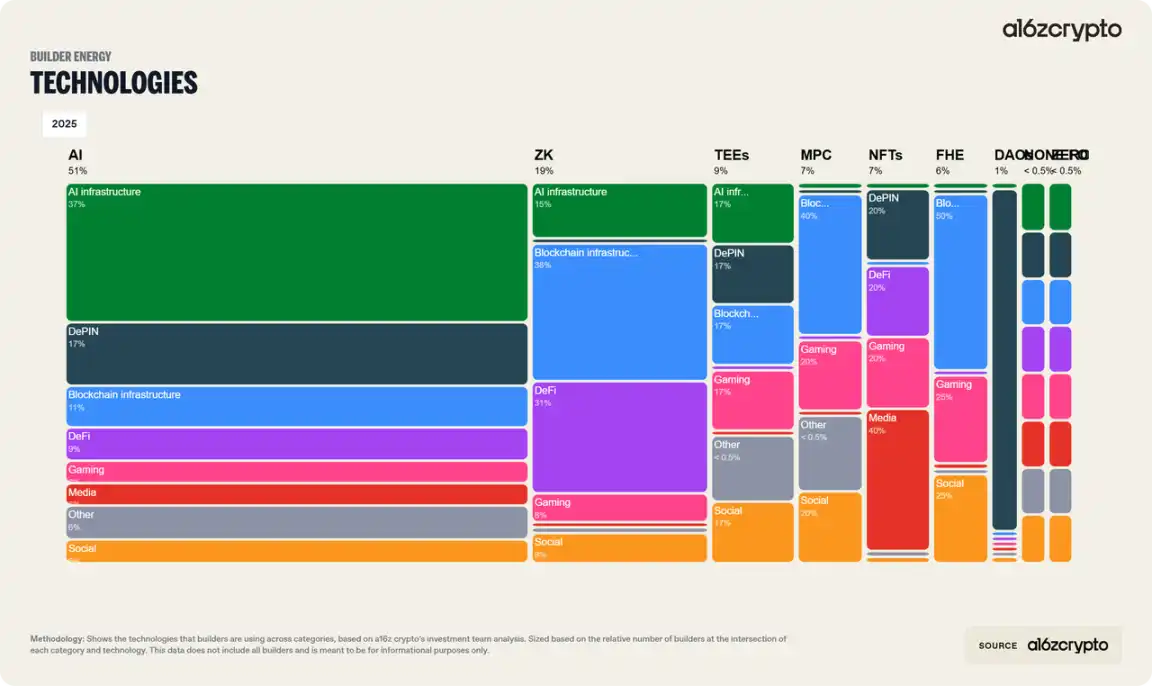
From the perspective of capital flow, the strategic divergence among top-tier venture capital firms also confirms this trend. a16z Crypto completed its fifth fundraising round of $2 billion in 2025, firmly positioning the intersection of AI and Crypto as its long-term strategic core, believing blockchain is the necessary infrastructure to prevent AI censorship and control.

Meanwhile, institutions like Paradigm are attempting to capture cross-industry dividends from technological convergence by expanding their investment boundaries to robotics and generalized AI. According to OECD data, by 2025, venture capital in the global AI sector accounted for 51% of total global investments, while within the Web3 space, the proportion of funding for AI-related projects is also steadily rising, reflecting the market's high recognition of the "decentralized intelligence" narrative.

1. Infrastructure Restructuring: Decentralized Computing Power and Computational Integrity

There is a natural contradiction between AI's insatiable appetite for Graphics Processing Units (GPUs) and the fragility of the current global supply chain. Between 2024 and 2025, GPU shortages became the norm, providing fertile ground for the explosion of Decentralized Physical Infrastructure Networks (DePIN).

1.1 Dual Evolution of Decentralized Computing Markets

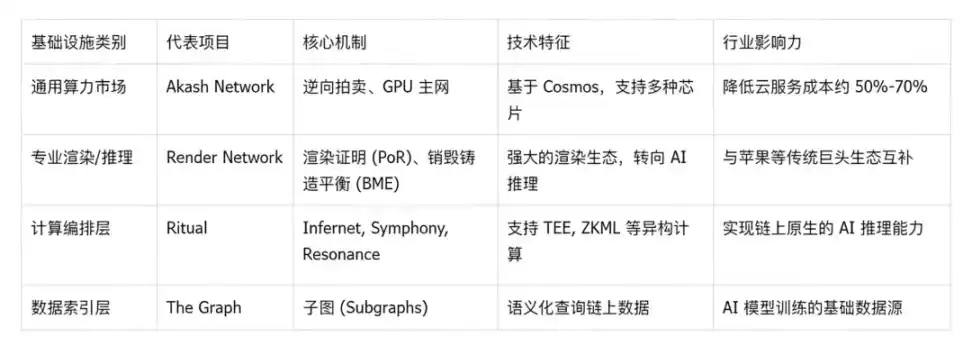
Current decentralized computing platforms are mainly divided into two camps. The first is represented by Render Network (RNDR) and Akash Network (AKT), which aggregate idle GPU computing power from around the world by building decentralized two-sided markets. Render Network has become a benchmark for distributed GPU rendering, not only reducing the cost of 3D creation but also supporting AI inference tasks through blockchain coordination functions, enabling creators to access high-performance computing power at lower prices. Akash, after 2023, achieved a leap forward with its GPU mainnet (Akash ML), allowing developers to rent high-spec chips for large-scale model training and inference.

The second category is represented by new computational orchestration layers like Ritual. Ritual's uniqueness lies in not trying to directly replace existing cloud services, but rather acting as an open, modular sovereign execution layer that embeds AI models directly into the blockchain's execution environment. Its Infernet product allows smart contracts to seamlessly call AI inference results, solving the long-standing technical bottleneck that "on-chain applications cannot natively run AI".
1.2 Computational Integrity and Breakthroughs in Verification Technology

In decentralized networks, verifying "whether computation has been executed correctly" is a core challenge. The technological progress in 2025 has mainly focused on the integrated application of Zero-Knowledge Machine Learning (ZKML) and Trusted Execution Environments (TEE).

The Ritual architecture, through its proof-system agnostic design, allows nodes to choose between TEE code execution or ZK proofs based on task requirements. This flexibility ensures that every inference result generated by an AI model is traceable, auditable, and guaranteed integrity, even in highly decentralized environments.

2. Democratization of Intelligence: The Rise of Bittensor and Commoditized Markets

The emergence of Bittensor (TAO) marks the entry of the AI and Crypto combination into a new stage of "marketization of machine intelligence." Unlike traditional single computing power platforms, Bittensor aims to create an incentive mechanism that allows various machine learning models worldwide to connect, learn from each other, and compete for rewards.

2.1 Yuma Consensus: From Linguistics to Consensus Algorithm

The core of Bittensor is the Yuma Consensus (YC), a subjective utility consensus mechanism inspired by Gricean pragmatics.

YC's operational logic assumes: an efficient cooperator tends to output true, relevant, and information-rich answers, as this is the optimal strategy for obtaining the highest reward in the incentive landscape. Technically, YC calculates token emissions through validators' weighted evaluation of miners' performance. Its core logic for allocating emission shares can be represented by the following LaTeX formula:
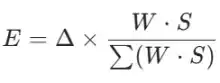
Where E is the emission reward, Δ is the daily total supply increment, W is the matrix of validator evaluation weights, and S is the corresponding staking weight. To prevent malicious collusion or bias, YC introduces a Clipping mechanism, which cuts weight settings that exceed the consensus baseline, ensuring the system's robustness.

2.2 Subnet Economy and the Dynamic TAO Paradigm

By 2025, Bittensor has evolved into a multi-layered architecture. The underlying layer is the Subtensor ledger managed by the Opentensor Foundation, while the upper layer consists of dozens of vertically specialized subnets (Subnets), focusing on specific tasks such as text generation, audio prediction, image recognition, etc.
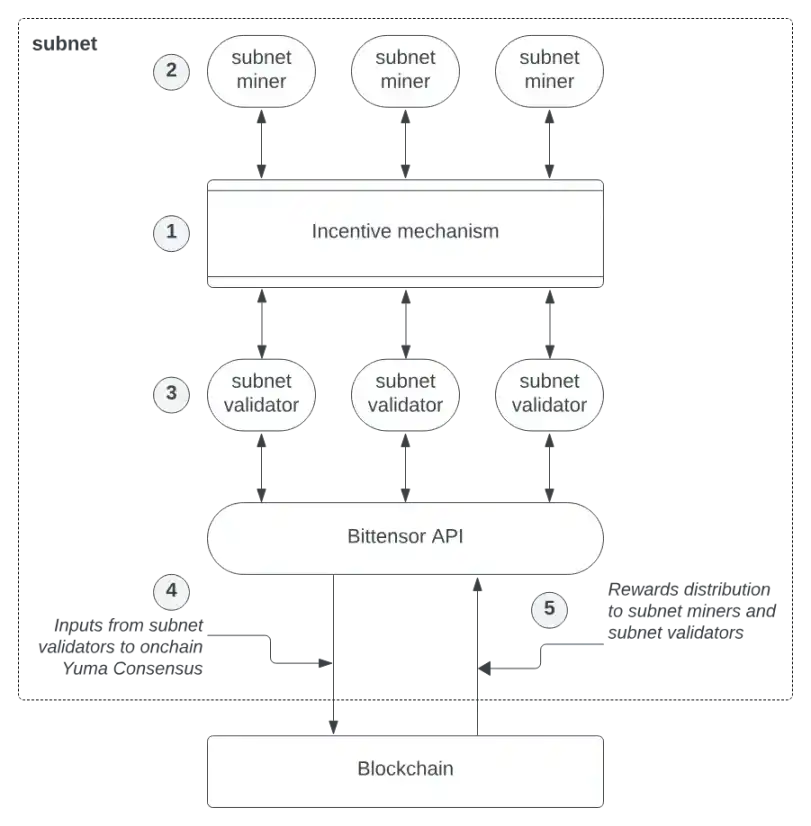
The introduced "Dynamic TAO" mechanism creates independent value reserve pools for each subnet through an Automated Market Maker (AMM), with its price determined by the ratio of TAO to Alpha tokens:
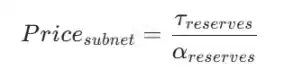
This mechanism enables automatic resource allocation: subnets with high demand and high-quality output will attract more staking, thereby receiving a higher proportion of daily TAO emissions. This competitive market structure is aptly compared to an "Olympic Games of Intelligence," naturally selecting out inefficient models.

3. The Rise of the Agent Economy: AI Agents as First-Class Citizens in Web3

In the 2024-2025 cycle, AI Agents are undergoing a fundamental transformation from "auxiliary tools" to "native on-chain entities." This evolution is reflected not only in the increasing complexity of the technical architecture but also in the fundamental expansion of their roles and permissions within the decentralized finance (DeFi) ecosystem.

Below is an in-depth analysis of this trend:

3.1 Agent Architecture: Closed Loop from Data to Execution

Current on-chain AI agents are no longer simple scripts but mature systems built on three complex logical layers:

Data Input Layer: Agents fetch real-time on-chain data such as liquidity pools, trading volume through blockchain nodes or APIs (like Ethers.js), and incorporate off-chain information like social media sentiment and centralized exchange prices through oracles (like Chainlink).

AI/ML Decision Layer (AI/ML Layer): Agents utilize Long Short-Term Memory networks (LSTM) to analyze price trends, or use Reinforcement Learning to continuously iterate optimal strategies in complex market games. The integration of Large Language Models (LLMs) also empowers agents to understand vague human intentions.

Blockchain Interaction Layer: This is the key to achieving "financial autonomy." Agents can now manage non-custodial wallets, automatically calculate optimal Gas fees, handle nonces, and even integrate MEV protection tools (e.g., Jito Labs) to prevent front-running in transactions.

3.2 Financial Rails and Agent-to-Agent Transactions

a16z's 2025 report particularly emphasized the financial backbone of AI agents—protocols like x402 and similar micro-payment standards. These standards allow agents to pay API fees or purchase services from other agents without human intervention. For example, the Olas (formerly Autonolas) ecosystem already processes over 2 million automated transactions between agents monthly, covering tasks from DeFi swaps to content creation.
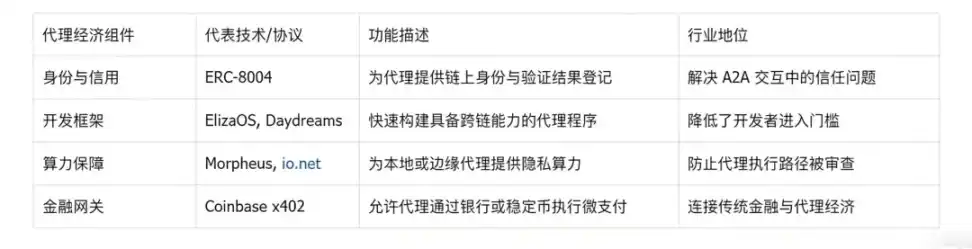
This trend is tangibly reflected in market data. In terms of growth rate, the AI agent market is on the verge of an explosion. According to research data from MarketsandMarkets, the global AI agent market is expected to grow from $7.84 billion in 2025 to $52.62 billion in 2030, with a compound annual growth rate (CAGR) of 46.3%. Furthermore, Grand View Research provides a similar long-term forecast, estimating the market size to reach $50.31 billion by 2030.

Meanwhile, standard tools at the development layer are also taking shape. The ElizaOS framework, strongly promoted by a16z, has become the infrastructure for the AI agent space, comparable to "Next.js" in front-end development. It allows developers to easily deploy AI agents with full financial capabilities on mainstream social platforms like X, Discord, and Telegram. As of early 2025, the total market capitalization of Web3 projects built on this framework has exceeded $20 billion.

4. Privacy Computing and Confidentiality: The Game of FHE, TEE, and ZKML

Privacy is one of the most challenging issues in the convergence of AI and Crypto. When enterprises run AI strategies on public chains, they neither want to leak private data nor disclose their core model parameters. Currently, the industry has formed three main technical paths: Fully Homomorphic Encryption (FHE), Trusted Execution Environment (TEE), and Zero-Knowledge Machine Learning (ZKML).

4.1 Zama and the Industrialization Journey of FHE

Zama, as a leading unicorn in this field, has made its fhEVM the standard for achieving "full-process encrypted computation." FHE allows computers to perform mathematical operations on data without decrypting it, and the results after decryption are identical to those from plaintext operations.

By 2025, Zama's technology stack has achieved significant performance leaps: for a 20-layer Convolutional Neural Network (CNN), computation speed increased by 21 times, and for a 50-layer CNN, it increased by 14 times. This progress makes "privacy stablecoins" (where transaction amounts are encrypted externally but the protocol can still verify legitimacy) and "sealed-bid auctions" possible on mainstream chains like Ethereum.

4.2 Verification Efficiency of ZKML and Integration with LLM

Zero-Knowledge Machine Learning (ZKML) focuses on "verification" rather than "computation." It allows one party to prove that it correctly ran a complex neural network model without exposing the input data or model weights. The latest zkLLM protocol can already perform end-to-end inference verification for a 13 billion parameter model, reducing proof generation time to within 15 minutes, with a proof size of only 200 KB. This technology is crucial for high-value financial audits and medical diagnostics.

4.3 Synergy between TEE and GPU: The Power of Hopper H100

Compared to FHE and ZKML, TEE (Trusted Execution Environment) offers execution speeds close to native performance. NVIDIA's H100 GPU introduces confidential computing capabilities, isolating memory through hardware-level firewalls, with inference overhead typically below 7%. Protocols like Ritual are heavily adopting GPU-based TEE to support AI agent applications requiring low latency and high throughput.

Privacy computing technology has officially moved from the idealistic conception of the laboratory into a new era of "production-level industrialization." Fully Homomorphic Encryption (FHE), Zero-Knowledge Machine Learning (ZKML), and Trusted Execution Environment (TEE) are no longer isolated technical tracks but together constitute a "modular confidentiality stack" for decentralized artificial intelligence.

This fusion is completely rewriting the underlying logic of Web3 and leads to the following three core conclusions:

FHE is the "HTTPS" underlying standard for Web3: As unicorns like Zama improve computational performance dozens of times, FHE is achieving a qualitative change from "everything public" to "encrypted by default." It solves the privacy challenge of on-chain state processing, enabling privacy stablecoins and fully MEV-resistant trading systems to move from theory to large-scale compliant applications.

ZKML is the mathematical endpoint for algorithmic accountability: The "ZKML singularity" arriving in the second half of 2025 marks a dramatic decrease in verification costs. By compressing the inference proof of a 13 billion parameter (13B) model to within 15 minutes, ZKML provides "mathematical-level consistency" guarantees for high-value financial audits and credit ratings, ensuring AI is no longer an untrustworthy black box.

TEE is the performance foundation of the agent economy: Compared to software solutions, TEE based on hardware like NVIDIA H100 offers near-native execution speeds with overhead below 7%. It is currently the only economically viable solution to support hundreds of millions of AI Agents making 24/7 real-time decisions, ensuring that agents securely hold private keys and execute complex strategies within hardware-level firewalls.
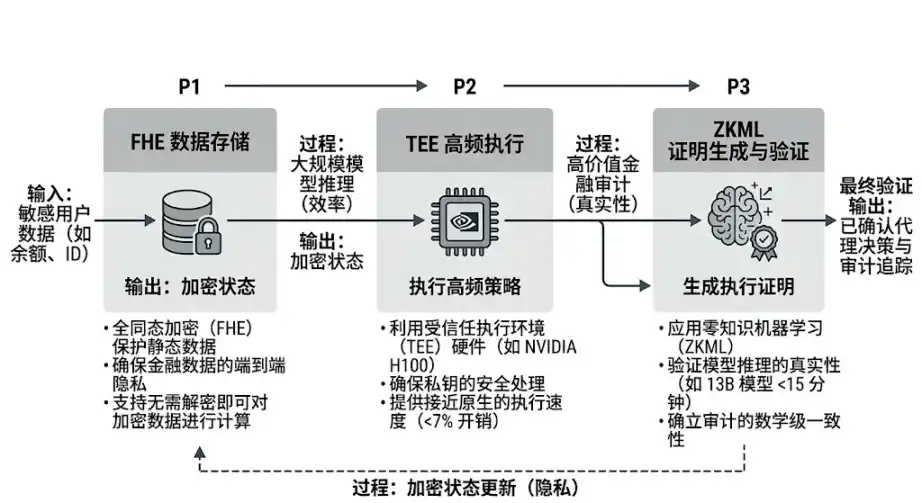
The future technological trend is not the victory of a single path, but the comprehensive popularization of "Hybrid Confidential Computing." In a complete AI business flow: use TEE for large-scale, high-frequency model inference to ensure efficiency; use ZKML at key nodes to generate execution proofs to ensure authenticity; and let FHE handle the encryption of sensitive financial states (such as account balances and private IDs).

This "trinity" fusion is reshaping the crypto industry from a "public transparent ledger" to a "sovereign privacy-enabled intelligent system," truly ushering in the era of an automated agent economy worth trillions of dollars.

5. Industry Security and Automated Auditing: AI as Web3's "Immune System"

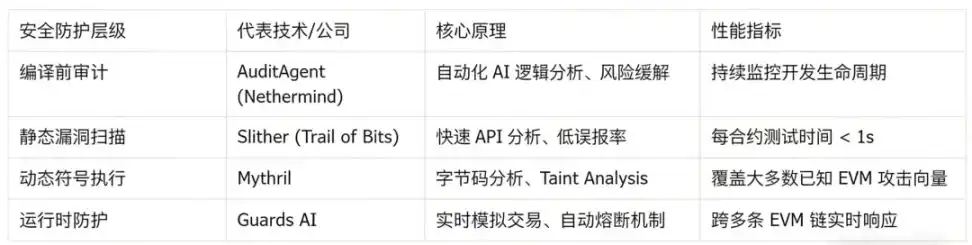
The cryptocurrency industry has long been plagued by huge losses caused by smart contract vulnerabilities. The introduction of AI is changing this passive defense situation, shifting it from expensive manual audits to real-time AI monitoring.

5.1 Innovation in Static and Dynamic Audit Tools

Tools like Slither and Mythril have deeply integrated machine learning models by 2025, capable of scanning Solidity contracts for reentrancy attacks, suicidal functions, or Gas consumption abnormalities in sub-second speeds. Furthermore, fuzzing tools like Foundry and Echidna use AI to generate extreme input data to probe deeply hidden logical vulnerabilities.

5.2 Real-time Threat Prevention Systems

In addition to pre-deployment audits, real-time defense has also made significant progress. Systems like Guardrail's Guards AI and CUBE3.AI can monitor all pending transactions (Mempool) across chains. Upon detecting malicious attack signals (such as governance attacks or oracle manipulation), they can automatically trigger contract pauses or intercept malicious transactions. This "active immunity" significantly reduces the risk of DeFi protocol hacks.
Practical Roadmap for Leveraging AI to Develop Crypto

In the future digital landscape, the convergence of AI and Crypto is no longer a technological experiment but a deep revolution concerning "productivity efficiency" and "wealth distribution rights." This combination not only gives AI an independently controlled "wallet" but also gives Crypto an autonomously thinking "brain," jointly opening the era of an autonomous agent economy worth trillions of dollars.

The following is the core benefits and practical map of this convergence at the enterprise and individual levels:

1. Enterprise Level: From "Cost Reduction and Efficiency Increase" to "Business Boundary Expansion"

For enterprises, the combination of AI and Crypto primarily solves the structural contradiction between high computing power costs, fragile system security, and data privacy protection.

Drastic reduction in infrastructure costs (DePIN effect): Leveraging distributed computing power networks (like Akash or Render), enterprises are no longer trapped by expensive NVIDIA H100 cluster procurement. Actual measurement data shows that renting global idle GPUs can reduce costs by 39% to 86% compared to traditional cloud service providers. This "computing freedom" allows startups to afford fine-tuning and training of ultra-large-scale models.

Automation and cost reduction of security barriers: Traditional contract audit cycles are long and expensive. Now, by deploying AI security agents like AuditAgent, driven by neural networks, enterprises can achieve "sentry monitoring" throughout the entire development lifecycle. They can identify logical vulnerabilities like reentrancy attacks the moment code is submitted and can automatically trigger contract circuit breakers at the mempool level the instant a hacker's command is issued, protecting protocol assets from loss.

"Encrypted Computing" for core business secrets: With Fully Homomorphic Encryption (FHE) and networks like Nillion's "Blind Compute," enterprises can run AI strategies on public chains without disclosing core model parameters and private customer data. This not only establishes data sovereignty but also allows financial and medical data, previously restricted by compliance risks, to enter the decentralized collaboration network.

2. Individual Level: From "Financial Blind Spots" to "Intelligent Sovereign Economy"

For individual users, the fusion of AI and Crypto means the complete disappearance of technical barriers and the opening of new income channels.

Intent-oriented "Private Banker": Future users will no longer need to understand what Gas fees or cross-chain bridges are. AI agents built on frameworks like ElizaOS will achieve "radical abstraction"—you just need to say: "Help me deposit this $1000 in the place with the highest interest and safest," and the AI will autonomously monitor APY across the network and automatically close positions during risk fluctuations. Ordinary people can thus enjoy asset management at the level of top hedge funds.

Assetization of personal data (Data Yield Farming): Your digital footprint is no longer taken for free by giants. Through platforms like Synesis One, users can participate in "Train2Earn," providing labeled data for AI training and directly obtaining token rewards. You can even earn passive dividends every time an AI calls a specific knowledge entry by holding a Kanon NFT, truly realizing "data as an asset."

Ultimate protection of privacy and identity: Using Worldcoin or cryptographic identity protocols, you can prove you are human and not an AI, while using privacy computing networks to protect sensitive information like your personal schedule and home address from being leaked to AI service providers. This "blind interaction" mode ensures that while you benefit from AI convenience, you still hold the highest right of interpretation over your digital sovereignty.

This two-way architectural evolution is handing "trust" to the blockchain and "efficiency" to AI. It is not only reconstructing the moats of enterprises but also building a ladder for every ordinary person to access the intelligent sovereign economy.

Evolution Prediction: Towards a New Era of "Intelligent Ledger"

In summary, how can AI and Crypto combine better? The answer lies in shifting from "simple tool stacking" to "deep architectural coupling."

First, blockchain must evolve into a platform capable of supporting large-scale computation. Efforts by protocols like Ritual and Starknet are making ZKML as simple as calling a standard library. Second, AI agents must become legitimate entities in economic life. With the proliferation of identity standards like ERC-8004, we will see an "intelligent network" composed of hundreds of millions of agents, engaging in 24/7 resource gaming and value exchange on-chain.

Finally, this fusion will reshape human financial sovereignty. Privacy payments realized through FHE, fair creator distribution achieved through provenance protocols, and algorithmic democratization realized through markets like Bittensor, together constitute a blueprint for a fairer, more efficient, and decentralized future digital economy.

In this technological marathon, the crypto industry provides not just capital, but a philosophical framework about "transparency" and "trust"; while AI provides the "brain" that makes these frameworks operate. As 2026 approaches, this convergence will not be limited to technical circles but will reach billions of ordinary users globally through more intuitive AI interaction interfaces.


Câu hỏi Liên quan

QWhat are the two main types of decentralized computing platforms mentioned in the article, and what are their key characteristics?

AThe two main types are: 1) Decentralized bilateral markets like Render Network (RNDR) and Akash Network (AKT), which aggregate idle global GPU power to provide cost-effective computing for tasks like rendering and AI inference. 2) New computational orchestration layers like Ritual, which act as an open, modular sovereign execution layer that embeds AI models directly into a blockchain's execution environment, allowing smart contracts to natively call AI inference results.

QHow does Bittensor's Yuma consensus mechanism work to incentivize and validate machine learning models?

ABittensor's Yuma consensus (YC) is a subjective utility consensus mechanism inspired by Gricean pragmatics. It operates on the logic that an efficient collaborator is incentivized to output truthful, relevant, and informative answers to gain the highest rewards. Validators evaluate the performance of miners (ML models), and token emissions are calculated based on a matrix of these validator-assigned weights and corresponding staking weights. A clipping mechanism is used to cut weights that exceed a consensus benchmark, ensuring system robustness against collusion or bias.

QWhat are the three primary technical paths for ensuring privacy in AI and Crypto applications, as discussed in the article?

AThe three primary technical paths for privacy are: 1) Fully Homomorphic Encryption (FHE), exemplified by Zama's fhEVM, which allows computation on encrypted data. 2) Zero-Knowledge Machine Learning (ZKML), which focuses on verifying that a complex neural network model was run correctly without revealing input data or model weights. 3) Trusted Execution Environments (TEE), such as those utilizing NVIDIA's H100 GPU, which provide hardware-level memory isolation for high-speed, confidential computation with low overhead.

QAccording to the article, how is AI transforming security and auditing in the Web3 space?

AAI is transforming Web3 security by moving from expensive manual audits to real-time AI monitoring. Tools like Slither and Mythril now integrate machine learning models to scan smart contracts for vulnerabilities at sub-second speeds. Furthermore, real-time threat prevention systems like Guardrail's Guards AI and CUBE3.AI monitor the mempool across chains, automatically intercepting malicious transactions or triggering contract pauses upon detecting attack signals, such as governance attacks or oracle manipulation, thus providing a proactive 'immune system' for DeFi protocols.

QWhat is the predicted future trend for the architecture of decentralized AI, particularly concerning privacy technologies?

AThe predicted future trend is not the victory of a single path but the comprehensive adoption of 'Hybrid Confidential Computing.' In a complete AI workflow, TEE would be used for large-scale, high-frequency model inference to ensure efficiency; critical nodes would use ZKML to generate execution proofs for verifiability; and sensitive financial states (like account balances) would be handled by FHE for encrypted storage. This 'trinity' fusion is reshaping the crypto industry from a 'transparent ledger' into a 'sovereign privacy intelligent system' capable of powering a multi-trillion-dollar automated agent economy.

Nội dung Liên quan

SpaceX ràng buộc với Cursor: Một ván cược lớn về AI 'khóa trước, mua sau'

SpaceX đã công bố thỏa thuận độc quyền với công ty AI Cursor, theo đó họ có quyền mua lại công ty này với giá 60 tỷ USD, kèm điều khoản thay thế phải trả 10 tỷ USD nếu không thực hiện mua. Cấu trúc giao dịch linh hoạt này cho phép SpaceX kiểm soát chiến lược mà chưa cần sáp nhập ngay, đồng thời khóa chặt mối quan hệ hợp tác lâu dài. Bản chất thỏa thuận là trao đổi tài nguyên then chốt: SpaceX cung cấp siêu máy tính Colossus với năng lực xử lý khổng lồ, còn Cursor mang đến nền tảng lập trình AI và sự thâm nhập sâu vào cộng đồng nhà phát triển. Sự kết hợp này tạo thành một chuỗi hoàn chỉnh từ tính toán, mô hình đến ứng dụng. Cursor, được định giá 60 tỷ USD dù mới thành lập từ 2022, không phải là công cụ lập trình thông thường mà là một môi trường phát triển "gốc AI", định hình lại cách thức sản xuất phần mềm tương lai. Động thái này nằm trong kế hoạch lớn của SpaceX nhằm chuyển đổi từ một công ty vũ trụ sang một đế chế cơ sở hạ tầng AI toàn diện, bao gồm năng lực mô hình (xAI), siêu máy tính và giờ là điểm vào ứng dụng. Nó phản ánh sự chuyển dịch trong cuộc cạnh tranh AI: từ khả năng mô hình sang chiến lược kiểm soát điểm vào và hệ sinh thái, nơi công cụ dành cho nhà phát triển là chiến trường then chốt. Rủi ro tiềm ẩn bao gồm định giá cao, thách thức tích hợp công nghệ và sự giám sát ngày càng tăng từ các cơ quan quản lý. Tóm lại, đây không chỉ là một thương vụ mà là một cuộc đặt cược chiến lược nhằm giành quyền kiểm soát lối vào cốt lõi của kỷ nguyên AI: quy trình sản xuất phần mềm.

marsbit1 giờ trước

SpaceX ràng buộc với Cursor: Một ván cược lớn về AI 'khóa trước, mua sau'

marsbit1 giờ trước

Giao dịch

Giao ngay
Hợp đồng Tương lai

Bài viết Nổi bật

GROK AI là gì

Grok AI: Cách mạng hóa Công nghệ Đối thoại trong Kỷ nguyên Web3 Giới thiệu Trong bối cảnh trí tuệ nhân tạo đang phát triển nhanh chóng, Grok AI nổi bật như một dự án đáng chú ý kết nối các lĩnh vực công nghệ tiên tiến và tương tác người dùng. Được phát triển bởi xAI, một công ty do doanh nhân nổi tiếng Elon Musk dẫn dắt, Grok AI nhằm định nghĩa lại cách chúng ta tương tác với trí tuệ nhân tạo. Khi phong trào Web3 tiếp tục phát triển mạnh mẽ, Grok AI hướng tới việc tận dụng sức mạnh của AI đối thoại để trả lời các câu hỏi phức tạp, mang đến cho người dùng một trải nghiệm không chỉ thông tin mà còn giải trí. Grok AI là gì? Grok AI là một chatbot AI đối thoại tinh vi được thiết kế để tương tác với người dùng một cách linh hoạt. Khác với nhiều hệ thống AI truyền thống, Grok AI chấp nhận một loạt các câu hỏi rộng hơn, bao gồm những câu hỏi thường được coi là không phù hợp hoặc ngoài các phản hồi tiêu chuẩn. Các mục tiêu cốt lõi của dự án bao gồm: Lập luận đáng tin cậy: Grok AI nhấn mạnh lập luận theo lẽ thường để cung cấp các câu trả lời hợp lý dựa trên sự hiểu biết về ngữ cảnh. Giám sát có thể mở rộng: Việc tích hợp công cụ hỗ trợ đảm bảo rằng các tương tác của người dùng được theo dõi và tối ưu hóa về chất lượng. Xác minh chính thức: An toàn là điều tối quan trọng; Grok AI tích hợp các phương pháp xác minh chính thức để nâng cao độ tin cậy của các đầu ra của nó. Hiểu biết về ngữ cảnh dài: Mô hình AI xuất sắc trong việc giữ lại và nhớ lại lịch sử cuộc trò chuyện dài, tạo điều kiện cho các cuộc thảo luận có ý nghĩa và nhận thức về ngữ cảnh. Khả năng chống lại các cuộc tấn công: Bằng cách tập trung vào việc cải thiện khả năng phòng thủ chống lại các đầu vào bị thao túng hoặc độc hại, Grok AI nhằm duy trì tính toàn vẹn của các tương tác của người dùng. Nói tóm lại, Grok AI không chỉ là một thiết bị truy xuất thông tin; nó là một đối tác đối thoại hấp dẫn khuyến khích cuộc trò chuyện năng động. Người sáng tạo Grok AI Bộ óc đứng sau Grok AI không ai khác chính là Elon Musk, một cá nhân gắn liền với sự đổi mới trong nhiều lĩnh vực, bao gồm ô tô, du hành vũ trụ và công nghệ. Dưới sự bảo trợ của xAI, một công ty tập trung vào việc phát triển công nghệ AI theo những cách có lợi, tầm nhìn của Musk nhằm định hình lại cách hiểu về các tương tác AI. Sự lãnh đạo và tinh thần nền tảng bị ảnh hưởng sâu sắc bởi cam kết của Musk trong việc thúc đẩy các ranh giới công nghệ. Các nhà đầu tư của Grok AI Mặc dù các chi tiết cụ thể về các nhà đầu tư hỗ trợ Grok AI vẫn còn hạn chế, nhưng đã được công nhận công khai rằng xAI, vườn ươm của dự án, được thành lập và hỗ trợ chủ yếu bởi chính Elon Musk. Các dự án và tài sản trước đây của Musk cung cấp một nền tảng vững chắc, tăng cường thêm độ tin cậy và tiềm năng phát triển của Grok AI. Tuy nhiên, tính đến thời điểm hiện tại, thông tin về các quỹ đầu tư hoặc tổ chức bổ sung hỗ trợ Grok AI vẫn chưa dễ dàng tiếp cận, đánh dấu một lĩnh vực có thể khám phá trong tương lai. Grok AI hoạt động như thế nào? Cơ chế hoạt động của Grok AI sáng tạo không kém gì khung khái niệm của nó. Dự án tích hợp một số công nghệ tiên tiến giúp tạo ra các chức năng độc đáo của nó: Hạ tầng mạnh mẽ: Grok AI được xây dựng bằng Kubernetes cho việc điều phối container, Rust cho hiệu suất và an toàn, và JAX cho tính toán số hiệu suất cao. Bộ ba này đảm bảo rằng chatbot hoạt động hiệu quả, mở rộng hiệu quả và phục vụ người dùng kịp thời. Truy cập kiến thức theo thời gian thực: Một trong những tính năng nổi bật của Grok AI là khả năng truy cập dữ liệu theo thời gian thực thông qua nền tảng X—trước đây được biết đến với tên gọi Twitter. Khả năng này cho phép AI truy cập thông tin mới nhất, giúp nó cung cấp các câu trả lời và khuyến nghị kịp thời mà các mô hình AI khác có thể bỏ lỡ. Hai chế độ tương tác: Grok AI cung cấp cho người dùng sự lựa chọn giữa “Chế độ Vui” và “Chế độ Thông thường.” Chế độ Vui cho phép một phong cách tương tác vui tươi và hài hước hơn, trong khi Chế độ Thông thường tập trung vào việc cung cấp các câu trả lời chính xác và đúng đắn. Sự linh hoạt này đảm bảo một trải nghiệm được cá nhân hóa phù hợp với sở thích của từng người dùng. Nói tóm lại, Grok AI kết hợp hiệu suất với sự tương tác, tạo ra một trải nghiệm vừa phong phú vừa giải trí. Thời gian phát triển của Grok AI Hành trình của Grok AI được đánh dấu bởi các cột mốc quan trọng phản ánh các giai đoạn phát triển và triển khai của nó: Phát triển ban đầu: Giai đoạn nền tảng của Grok AI diễn ra trong khoảng hai tháng, trong đó việc đào tạo và tinh chỉnh ban đầu của mô hình được thực hiện. Phát hành Beta Grok-2: Trong một bước tiến quan trọng, beta Grok-2 đã được công bố. Phiên bản này giới thiệu hai phiên bản của chatbot—Grok-2 và Grok-2 mini—mỗi phiên bản đều có khả năng trò chuyện, lập trình và lập luận. Truy cập công khai: Sau khi phát triển beta, Grok AI đã trở thành có sẵn cho người dùng nền tảng X. Những người có tài khoản được xác minh bằng số điện thoại và hoạt động ít nhất bảy ngày có thể truy cập phiên bản giới hạn, giúp công nghệ có sẵn cho một đối tượng rộng lớn hơn. Thời gian này tóm tắt sự phát triển có hệ thống của Grok AI từ lúc khởi đầu đến khi công khai, nhấn mạnh cam kết của nó đối với việc cải tiến liên tục và tương tác người dùng. Các tính năng chính của Grok AI Grok AI bao gồm một số tính năng chính góp phần vào bản sắc đổi mới của nó: Tích hợp kiến thức theo thời gian thực: Truy cập thông tin hiện tại và liên quan phân biệt Grok AI với nhiều mô hình tĩnh, cho phép một trải nghiệm người dùng hấp dẫn và chính xác. Phong cách tương tác đa dạng: Bằng cách cung cấp các chế độ tương tác khác nhau, Grok AI phục vụ cho sở thích đa dạng của người dùng, khuyến khích sự sáng tạo và cá nhân hóa trong việc trò chuyện với AI. Cơ sở công nghệ tiên tiến: Việc sử dụng Kubernetes, Rust và JAX cung cấp cho dự án một khung vững chắc để đảm bảo độ tin cậy và hiệu suất tối ưu. Xem xét về đạo đức trong đối thoại: Việc bao gồm chức năng tạo hình ảnh thể hiện tinh thần đổi mới của dự án. Tuy nhiên, nó cũng đặt ra các vấn đề đạo đức liên quan đến bản quyền và việc thể hiện tôn trọng các nhân vật dễ nhận biết—một cuộc thảo luận đang diễn ra trong cộng đồng AI. Kết luận Như một thực thể tiên phong trong lĩnh vực AI đối thoại, Grok AI khái quát tiềm năng cho những trải nghiệm người dùng chuyển đổi trong kỷ nguyên số. Được phát triển bởi xAI và được thúc đẩy bởi cách tiếp cận tầm nhìn của Elon Musk, Grok AI tích hợp kiến thức theo thời gian thực với khả năng tương tác tiên tiến. Nó cố gắng mở rộng ranh giới của những gì trí tuệ nhân tạo có thể đạt được trong khi vẫn giữ trọng tâm vào các vấn đề đạo đức và an toàn cho người dùng. Grok AI không chỉ thể hiện sự tiến bộ công nghệ mà còn thể hiện một mô hình đối thoại mới trong bối cảnh Web3, hứa hẹn sẽ thu hút người dùng bằng cả kiến thức sâu sắc và sự tương tác vui tươi. Khi dự án tiếp tục phát triển, nó đứng như một minh chứng cho những gì giao thoa giữa công nghệ, sáng tạo và tương tác giống như con người có thể đạt được.

Tổng lượt xem 468Xuất bản vào 2024.12.26Cập nhật vào 2024.12.26

GROK AI là gì

ERC AI là gì

Euruka Tech: Tổng Quan về $erc ai và Những Tham Vọng trong Web3 Giới thiệu Trong bối cảnh công nghệ blockchain và ứng dụng phi tập trung đang phát triển nhanh chóng, các dự án mới thường xuyên xuất hiện, mỗi dự án đều có những mục tiêu và phương pháp độc đáo. Một trong những dự án đó là Euruka Tech, hoạt động trong lĩnh vực tiền điện tử và Web3 rộng lớn. Mục tiêu chính của Euruka Tech, đặc biệt là token $erc ai của nó, là cung cấp các giải pháp sáng tạo nhằm khai thác những khả năng đang phát triển của công nghệ phi tập trung. Bài viết này nhằm cung cấp một cái nhìn tổng quan về Euruka Tech, khám phá các mục tiêu, chức năng, danh tính của người sáng lập, các nhà đầu tư tiềm năng và tầm quan trọng của nó trong bối cảnh rộng lớn hơn của Web3. Euruka Tech, $erc ai là gì? Euruka Tech được mô tả như một dự án tận dụng các công cụ và chức năng mà môi trường Web3 cung cấp, tập trung vào việc tích hợp trí tuệ nhân tạo trong các hoạt động của nó. Mặc dù các chi tiết cụ thể về khung của dự án vẫn còn mơ hồ, nhưng nó được thiết kế để nâng cao sự tham gia của người dùng và tự động hóa các quy trình trong không gian tiền điện tử. Dự án nhằm tạo ra một hệ sinh thái phi tập trung không chỉ tạo điều kiện cho các giao dịch mà còn tích hợp các chức năng dự đoán thông qua trí tuệ nhân tạo, do đó tên gọi của token, $erc ai. Mục tiêu là cung cấp một nền tảng trực quan giúp tạo ra các tương tác thông minh hơn và xử lý giao dịch hiệu quả hơn trong lĩnh vực Web3 đang phát triển. Ai là Người Sáng Lập Euruka Tech, $erc ai? Hiện tại, thông tin về người sáng lập hoặc đội ngũ sáng lập đứng sau Euruka Tech vẫn chưa được xác định và có phần mờ mịt. Sự thiếu hụt dữ liệu này gây ra lo ngại, vì kiến thức về nền tảng của đội ngũ thường rất quan trọng để thiết lập độ tin cậy trong lĩnh vực blockchain. Do đó, chúng tôi đã phân loại thông tin này là không rõ cho đến khi có các chi tiết cụ thể được công bố trong lĩnh vực công cộng. Ai là Các Nhà Đầu Tư của Euruka Tech, $erc ai? Tương tự, việc xác định các nhà đầu tư hoặc tổ chức hỗ trợ cho dự án Euruka Tech không được cung cấp dễ dàng qua các nghiên cứu hiện có. Một khía cạnh quan trọng đối với các bên liên quan tiềm năng hoặc người dùng đang xem xét tham gia vào Euruka Tech là sự đảm bảo đến từ các quan hệ đối tác tài chính đã được thiết lập hoặc sự hỗ trợ từ các công ty đầu tư uy tín. Thiếu thông tin về các mối quan hệ đầu tư, rất khó để rút ra những kết luận toàn diện về sự an toàn tài chính hoặc độ bền vững của dự án. Theo thông tin đã tìm thấy, phần này cũng đang ở trạng thái không rõ. Euruka Tech, $erc ai hoạt động như thế nào? Mặc dù thiếu các thông số kỹ thuật chi tiết cho Euruka Tech, nhưng điều quan trọng là phải xem xét những tham vọng đổi mới của nó. Dự án tìm cách tận dụng sức mạnh tính toán của trí tuệ nhân tạo để tự động hóa và nâng cao trải nghiệm người dùng trong môi trường tiền điện tử. Bằng cách tích hợp AI với công nghệ blockchain, Euruka Tech nhằm cung cấp các tính năng như giao dịch tự động, đánh giá rủi ro và giao diện người dùng cá nhân hóa. Bản chất đổi mới của Euruka Tech nằm ở mục tiêu tạo ra một kết nối liền mạch giữa người dùng và những khả năng rộng lớn mà các mạng phi tập trung mang lại. Thông qua việc sử dụng các thuật toán học máy và AI, nó nhằm giảm thiểu những thách thức mà người dùng lần đầu gặp phải và tinh giản trải nghiệm giao dịch trong khuôn khổ Web3. Sự cộng sinh giữa AI và blockchain nhấn mạnh tầm quan trọng của token $erc ai, đứng như một cầu nối giữa các giao diện người dùng truyền thống và các khả năng tiên tiến của công nghệ phi tập trung. Thời Gian của Euruka Tech, $erc ai Thật không may, do thông tin hạn chế hiện có về Euruka Tech, chúng tôi không thể trình bày một thời gian biểu chi tiết về các phát triển chính hoặc cột mốc trong hành trình của dự án. Thời gian biểu này, thường rất quý giá trong việc vạch ra sự tiến triển của một dự án và hiểu được quỹ đạo phát triển của nó, hiện không có sẵn. Khi thông tin về các sự kiện đáng chú ý, quan hệ đối tác hoặc các bổ sung chức năng trở nên rõ ràng, các cập nhật chắc chắn sẽ nâng cao sự hiện diện của Euruka Tech trong lĩnh vực tiền điện tử. Làm rõ về Các Dự Án “Eureka” Khác Điều đáng lưu ý là nhiều dự án và công ty chia sẻ một tên gọi tương tự với “Eureka.” Nghiên cứu đã xác định các sáng kiến như một đại lý AI từ NVIDIA Research, tập trung vào việc dạy robot thực hiện các nhiệm vụ phức tạp bằng các phương pháp sinh tạo, cũng như Eureka Labs và Eureka AI, cải thiện trải nghiệm người dùng trong giáo dục và phân tích dịch vụ khách hàng, tương ứng. Tuy nhiên, những dự án này là khác biệt với Euruka Tech và không nên bị nhầm lẫn với các mục tiêu hoặc chức năng của nó. Kết luận Euruka Tech, cùng với token $erc ai của nó, đại diện cho một người chơi hứa hẹn nhưng hiện tại còn mờ mịt trong bối cảnh Web3. Trong khi chi tiết về người sáng lập và các nhà đầu tư vẫn chưa được công bố, tham vọng cốt lõi của việc kết hợp trí tuệ nhân tạo với công nghệ blockchain vẫn là một điểm thu hút sự chú ý. Các phương pháp độc đáo của dự án trong việc thúc đẩy sự tham gia của người dùng thông qua tự động hóa tiên tiến có thể giúp nó nổi bật khi hệ sinh thái Web3 tiến triển. Khi thị trường tiền điện tử tiếp tục phát triển, các bên liên quan nên theo dõi chặt chẽ những tiến bộ xung quanh Euruka Tech, vì sự phát triển của các đổi mới đã được ghi chép, các quan hệ đối tác hoặc một lộ trình rõ ràng có thể mang lại những cơ hội đáng kể trong tương lai gần. Hiện tại, chúng tôi đang chờ đợi những hiểu biết sâu sắc hơn có thể tiết lộ tiềm năng của Euruka Tech và vị trí của nó trong bối cảnh cạnh tranh của tiền điện tử.

Tổng lượt xem 464Xuất bản vào 2025.01.02Cập nhật vào 2025.01.02

ERC AI là gì

DUOLINGO AI là gì

DUOLINGO AI: Tích hợp Học ngôn ngữ với Web3 và Đổi mới AI Trong một kỷ nguyên mà công nghệ định hình lại giáo dục, việc tích hợp trí tuệ nhân tạo (AI) và các mạng blockchain báo hiệu một biên giới mới cho việc học ngôn ngữ. Giới thiệu DUOLINGO AI và đồng tiền điện tử liên quan của nó, $DUOLINGO AI. Dự án này mong muốn kết hợp sức mạnh giáo dục của các nền tảng học ngôn ngữ hàng đầu với những lợi ích của công nghệ Web3 phi tập trung. Bài viết này đi sâu vào các khía cạnh chính của DUOLINGO AI, khám phá các mục tiêu, khung công nghệ, sự phát triển lịch sử và tiềm năng tương lai trong khi duy trì sự rõ ràng giữa tài nguyên giáo dục gốc và sáng kiến tiền điện tử độc lập này. Tổng quan về DUOLINGO AI Cốt lõi của DUOLINGO AI là thiết lập một môi trường phi tập trung nơi người học có thể kiếm được phần thưởng mã hóa cho việc đạt được các cột mốc giáo dục trong khả năng ngôn ngữ. Bằng cách áp dụng hợp đồng thông minh, dự án nhằm tự động hóa các quy trình xác minh kỹ năng và phân bổ token, tuân thủ các nguyên tắc Web3 nhấn mạnh tính minh bạch và quyền sở hữu của người dùng. Mô hình này khác biệt so với các phương pháp truyền thống trong việc tiếp cận ngôn ngữ bằng cách dựa nhiều vào cấu trúc quản trị do cộng đồng điều hành, cho phép những người nắm giữ token đề xuất cải tiến nội dung khóa học và phân phối phần thưởng. Một số mục tiêu đáng chú ý của DUOLINGO AI bao gồm: Học tập gamified: Dự án tích hợp các thành tựu blockchain và token không thể thay thế (NFT) để đại diện cho các cấp độ thành thạo ngôn ngữ, thúc đẩy động lực thông qua các phần thưởng kỹ thuật số hấp dẫn. Tạo nội dung phi tập trung: Nó mở ra cơ hội cho các nhà giáo dục và những người yêu thích ngôn ngữ đóng góp khóa học của họ, tạo điều kiện cho một mô hình chia sẻ doanh thu có lợi cho tất cả các bên đóng góp. Cá nhân hóa dựa trên AI: Bằng cách sử dụng các mô hình học máy tiên tiến, DUOLINGO AI cá nhân hóa các bài học để thích ứng với tiến trình học tập của từng cá nhân, tương tự như các tính năng thích ứng có trong các nền tảng đã được thiết lập. Người sáng lập dự án và Quản trị Tính đến tháng 4 năm 2025, đội ngũ đứng sau $DUOLINGO AI vẫn giữ bí danh, một thực tiễn phổ biến trong lĩnh vực tiền điện tử phi tập trung. Sự ẩn danh này nhằm thúc đẩy sự phát triển tập thể và sự tham gia của các bên liên quan thay vì tập trung vào các nhà phát triển cá nhân. Hợp đồng thông minh được triển khai trên blockchain Solana ghi chú địa chỉ ví của nhà phát triển, điều này thể hiện cam kết về tính minh bạch liên quan đến các giao dịch mặc dù danh tính của các nhà sáng lập vẫn chưa được biết đến. Theo lộ trình của nó, DUOLINGO AI dự định phát triển thành một Tổ chức Tự trị Phi tập trung (DAO). Cấu trúc quản trị này cho phép những người nắm giữ token bỏ phiếu về các vấn đề quan trọng như triển khai tính năng và phân bổ ngân quỹ. Mô hình này phù hợp với tinh thần trao quyền cho cộng đồng có trong nhiều ứng dụng phi tập trung, nhấn mạnh tầm quan trọng của việc ra quyết định tập thể. Nhà đầu tư và Đối tác chiến lược Hiện tại, không có nhà đầu tư tổ chức hoặc nhà đầu tư mạo hiểm nào được xác định công khai liên quan đến $DUOLINGO AI. Thay vào đó, tính thanh khoản của dự án chủ yếu đến từ các sàn giao dịch phi tập trung (DEX), đánh dấu một sự tương phản rõ rệt với các chiến lược tài trợ của các công ty công nghệ giáo dục truyền thống. Mô hình cơ sở này cho thấy một cách tiếp cận do cộng đồng điều hành, phản ánh cam kết của dự án đối với sự phi tập trung. Trong tài liệu trắng của mình, DUOLINGO AI đề cập đến việc hình thành các hợp tác với các “nền tảng giáo dục blockchain” không xác định nhằm làm phong phú thêm các khóa học của mình. Mặc dù các đối tác cụ thể vẫn chưa được công bố, những nỗ lực hợp tác này gợi ý về một chiến lược kết hợp đổi mới blockchain với các sáng kiến giáo dục, mở rộng quyền truy cập và sự tham gia của người dùng qua nhiều con đường học tập khác nhau. Kiến trúc công nghệ Tích hợp AI DUOLINGO AI tích hợp hai thành phần chính dựa trên AI để nâng cao các đề xuất giáo dục của mình: Công cụ học tập thích ứng: Công cụ tinh vi này học từ các tương tác của người dùng, tương tự như các mô hình độc quyền từ các nền tảng giáo dục lớn. Nó điều chỉnh độ khó của bài học một cách linh hoạt để giải quyết các thách thức cụ thể của người học, củng cố các lĩnh vực yếu thông qua các bài tập có mục tiêu. Đại lý hội thoại: Bằng cách sử dụng chatbot được hỗ trợ bởi GPT-4, DUOLINGO AI cung cấp một nền tảng cho người dùng tham gia vào các cuộc hội thoại mô phỏng, thúc đẩy một trải nghiệm học ngôn ngữ tương tác và thực tiễn hơn. Hạ tầng Blockchain Được xây dựng trên blockchain Solana, $DUOLINGO AI sử dụng một khung công nghệ toàn diện bao gồm: Hợp đồng thông minh xác minh kỹ năng: Tính năng này tự động trao token cho người dùng đã vượt qua các bài kiểm tra thành thạo, củng cố cấu trúc khuyến khích cho các kết quả học tập thực sự. Huy hiệu NFT: Những token kỹ thuật số này biểu thị các cột mốc khác nhau mà người học đạt được, chẳng hạn như hoàn thành một phần của khóa học hoặc thành thạo các kỹ năng cụ thể, cho phép họ giao dịch hoặc trưng bày thành tích của mình một cách kỹ thuật số. Quản trị DAO: Các thành viên cộng đồng nắm giữ token có thể tham gia vào quản trị bằng cách bỏ phiếu về các đề xuất chính, tạo điều kiện cho một văn hóa tham gia khuyến khích đổi mới trong các đề xuất khóa học và tính năng của nền tảng. Dòng thời gian lịch sử 2022–2023: Khái niệm Công việc chuẩn bị cho DUOLINGO AI bắt đầu với việc tạo ra một tài liệu trắng, nêu bật sự phối hợp giữa những tiến bộ AI trong học ngôn ngữ và tiềm năng phi tập trung của công nghệ blockchain. 2024: Ra mắt Beta Một phiên bản beta giới hạn giới thiệu các đề xuất trong các ngôn ngữ phổ biến, thưởng cho người dùng sớm bằng các phần thưởng token như một phần của chiến lược tham gia cộng đồng của dự án. 2025: Chuyển đổi DAO Vào tháng 4, một lần ra mắt mainnet đầy đủ diễn ra với sự lưu thông của các token, thúc đẩy các cuộc thảo luận trong cộng đồng về khả năng mở rộng sang các ngôn ngữ châu Á và các phát triển khóa học khác. Thách thức và Hướng đi tương lai Khó khăn kỹ thuật Mặc dù có những mục tiêu tham vọng, DUOLINGO AI phải đối mặt với những thách thức đáng kể. Khả năng mở rộng vẫn là một mối quan tâm liên tục, đặc biệt là trong việc cân bằng chi phí liên quan đến xử lý AI và duy trì một mạng lưới phi tập trung phản hồi. Ngoài ra, việc đảm bảo chất lượng tạo nội dung và quản lý trong bối cảnh cung cấp phi tập trung đặt ra những phức tạp trong việc duy trì tiêu chuẩn giáo dục. Cơ hội chiến lược Nhìn về phía trước, DUOLINGO AI có tiềm năng tận dụng các quan hệ đối tác cấp chứng chỉ vi mô với các tổ chức học thuật, cung cấp các xác nhận kỹ năng ngôn ngữ được xác minh bằng blockchain. Hơn nữa, việc mở rộng chuỗi chéo có thể cho phép dự án tiếp cận các cơ sở người dùng rộng hơn và các hệ sinh thái blockchain bổ sung, nâng cao khả năng tương tác và phạm vi tiếp cận của nó. Kết luận DUOLINGO AI đại diện cho một sự kết hợp đổi mới giữa trí tuệ nhân tạo và công nghệ blockchain, cung cấp một lựa chọn tập trung vào cộng đồng thay thế cho các hệ thống học ngôn ngữ truyền thống. Mặc dù sự phát triển bí danh và mô hình kinh tế mới nổi của nó mang lại một số rủi ro, cam kết của dự án đối với học tập gamified, giáo dục cá nhân hóa và quản trị phi tập trung mở ra một con đường phía trước cho công nghệ giáo dục trong lĩnh vực Web3. Khi AI tiếp tục phát triển và hệ sinh thái blockchain tiến hóa, các sáng kiến như DUOLINGO AI có thể định hình lại cách người dùng tương tác với giáo dục ngôn ngữ, trao quyền cho cộng đồng và thưởng cho sự tham gia thông qua các cơ chế học tập đổi mới.

Tổng lượt xem 490Xuất bản vào 2025.04.11Cập nhật vào 2025.04.11

DUOLINGO AI là gì

Thảo luận

Chào mừng đến với Cộng đồng HTX. Tại đây, bạn có thể được thông báo về những phát triển nền tảng mới nhất và có quyền truy cập vào thông tin chuyên sâu về thị trường. Ý kiến ​​của người dùng về giá của AI (AI) được trình bày dưới đây.

活动图片