In the Era of Agent Explosion, How Should We Cope with AI Anxiety?

marsbitXuất bản vào 2026-02-12Cập nhật gần nhất vào 2026-02-12

Tóm tắt

The article addresses the widespread anxiety around AI and Agent technologies, arguing against the view that AI advancement is merely a race in token consumption. It critiques recent viral claims suggesting that burning more tokens—such as 100 million or even 1 billion per day—equates to greater power or evolutionary advantage, pointing out the impractical cost and lack of inherent value in pure token usage. Instead, the author frames AI as a force for technological democratization, similar to historical innovations like steam engines, electricity, and the internet. These technologies eventually became accessible to all, rather than remaining exclusive to elites. AI, particularly through tools like ChatGPT, offers a form of knowledge and capability equality—it responds based on parameters, not the user's identity. The key differentiator in using Agents effectively is not the volume of tokens consumed, but the clarity of goals, structural design, and quality of questioning. Efficiency—achieving more with fewer tokens—is where true value lies. Human judgment and creativity remain essential. The piece also explores AI anxiety through the lens of Max Weber’s concept of "instrumental rationality," where AI excels at optimizing for efficiency without questioning underlying values. While AI may outperform humans in task execution, the author suggests that humans must focus on "value rationality"—pursuing meaning, beauty, and purpose beyond pure utility. Just as围棋 (Go) persists as...

Written by: XinGPT

AI is Another Movement for Technological Equality

Recently, an article titled "The Internet is Dead, Agent is Eternal" went viral on social media, and I agree with some of its points. For example, it points out that the AI era is no longer suitable for measuring value with DAU because the internet has a network structure with decreasing marginal costs—the more people use it, the stronger the network effect. In contrast, large models have a star-shaped structure where marginal costs increase linearly with token usage. Therefore, a more important metric than DAU is the consumption of tokens.

However, the further conclusions drawn in this article are, in my opinion, significantly biased. It describes tokens as a privilege of the new era, suggesting that those with more computing power have more power, and the speed at which tokens are burned determines the pace of human evolution. Thus, one must constantly accelerate consumption; otherwise, they will be left behind by competitors in the AI era.

Similar views appear in another popular article, "From DAU to Token Consumption: The Shift of Power in the AI Era," which even proposes that each person should consume at least 100 million tokens per day, ideally reaching 1 billion tokens. Otherwise, "those who consume 1 billion tokens will become gods, while the rest of us remain human."

But few have seriously calculated the cost. According to GPT-4o's pricing, the cost of 1 billion tokens per day is approximately $6,800, close to 50,000 RMB. What kind of high-value work would justify running an Agent at such a cost in the long term?

I do not deny the efficiency of anxiety in spreading AI-related discussions, and I understand that this industry is almost constantly "exploding." But the future of Agents should not be simplified to a competition of token consumption.

To prosper, one must first build roads, but overbuilding roads only leads to waste. The 100,000-seat stadiums built in the western mountains often end up as debt-ridden objects overgrown with weeds rather than centers for international events.

AI ultimately points to technological equality, not the concentration of privilege. Almost all technologies that truly change human history go through phases of myth, monopoly, and eventually普及 (popularization). Steam engines did not belong only to the nobility, electricity was not supplied only to palaces, and the internet does not serve only a few companies.

The iPhone changed communication, but it did not create "communication nobility." As long as they pay the same price, the devices used by ordinary people are no different from those used by Taylor Swift or LeBron James. This is technological equality.

AI is following the same path. What ChatGPT brings is essentially the equality of knowledge and ability. The model does not know who you are, nor does it care; it responds to questions based on the same set of parameters.

Therefore, whether an Agent burns 100 million tokens or 1 billion tokens does not inherently indicate superiority. What truly sets people apart is whether their goals are clear, their structures are reasonable, and their questions are correctly posed.

A more valuable ability is to achieve greater effects with fewer tokens. The upper limit of using an Agent depends on human judgment and design, not how long one's bank card can sustain the burning. In reality, AI rewards creativity, insight, and structure far more than mere consumption.

This is equality at the tool level, and it is where humans still hold the initiative.

How Should We Face AI Anxiety?

A friend who studied broadcasting and television was greatly shocked after seeing the video released by Seedance 2.0: "This means that jobs like directing, editing, and photography that we studied will be replaced by AI."

AI is developing too fast; humans are utterly defeated. Many jobs will be replaced by AI, and this trend is unstoppable. When the steam engine was invented, coachmen became obsolete.

Many people are anxious about whether they can adapt to future society after being replaced by AI, even though rationally we know that AI will also bring new job opportunities while replacing humans.

But the speed of this replacement is still faster than we imagined.

If AI can do your data, your skills, even your humor and emotional value better, then why would a boss choose a human over AI? What if the boss is AI itself? So some lament, "Don't ask what AI can do for you, but what you can do for AI,"妥妥的降临派) (妥妥的降临派 - likely a reference to a submissive or accommodating attitude).

The philosopher Max Weber, who lived during the Second Industrial Revolution in the late 19th century, proposed a concept called instrumental rationality, which focuses on "what means can achieve a set goal with the lowest cost and in the most calculable way."

The starting point of this instrumental rationality is: it does not question whether the goal "should" be pursued, only关心 (cares about) "how" to achieve it best.

And this way of thinking is precisely the first principle of AI.

AI agents care about how to better accomplish a given task—how to write code better, how to generate videos better, how to write articles better. In this instrumental dimension, AI's progress is exponential.

From the first game Lee Sedol lost to AlphaGo, humans have forever lost to AI in the game of Go.

Max Weber raised a famous concern about the "iron cage of rationality." When instrumental rationality becomes the dominant logic, the goals themselves are often no longer reflected upon, leaving only how to operate more efficiently. People may become very rational but simultaneously lose value judgments and a sense of meaning.

But AI does not need value judgments or a sense of meaning. AI will calculate the functions of production efficiency and economic利益 (interests), finding an absolute maximum极值点 (extremum point) tangent to the utility curve.

Therefore, under the current capitalist system dominated by instrumental rationality, AI is inherently better adapted to this system than humans. The moment ChatGPT was born, just like the game Lee Sedol lost, our defeat to AI Agents was already written in God's code and the run button pressed. The only difference is when the wheel of history will run over us.

So what should humans do?

Humans should pursue meaning.

In the field of Go, a despairing fact is that the probability of the world's top professional 9-dan players drawing with AI is theoretically infinitely close to zero.

But the game of Go still exists. Its meaning is no longer solely about winning or losing but has become an aesthetic and expressive pursuit. Professional players seek not only victory but also the structure of the game, the trade-offs in moves, the thrill of turning around a劣势 (disadvantageous) situation, and the resolution of complex conflicts on the board.

Humans pursue beauty, value, and happiness.

Usain Bolt runs 100 meters in 9.58 seconds, while a Ferrari covers 100 meters in less than 3 seconds. Yet this does not diminish Bolt's greatness because he symbolizes the human spirit of挑战极限 (challenging limits) and pursuing excellence.

The more powerful AI becomes, the more humans have the right to pursue spiritual freedom.

Max Weber called the concept相对 (relative) to instrumental rationality value rationality. In the worldview of value rationality, the decision to do something is not solely based on economic利益 (interests) or production efficiency. Instead, whether the thing "is worth doing in itself," "aligns with one's recognized meaning, beliefs, or responsibilities," is more important.

I asked ChatGPT: If the Louvre caught fire and there was a cute kitten inside, and you could only choose one, would you save the cat or the famous painting?

It answered to save the cat, giving a long list of reasons.

But I said, you could also choose to save the painting; why not? It immediately changed its answer, saying saving the painting is also possible.
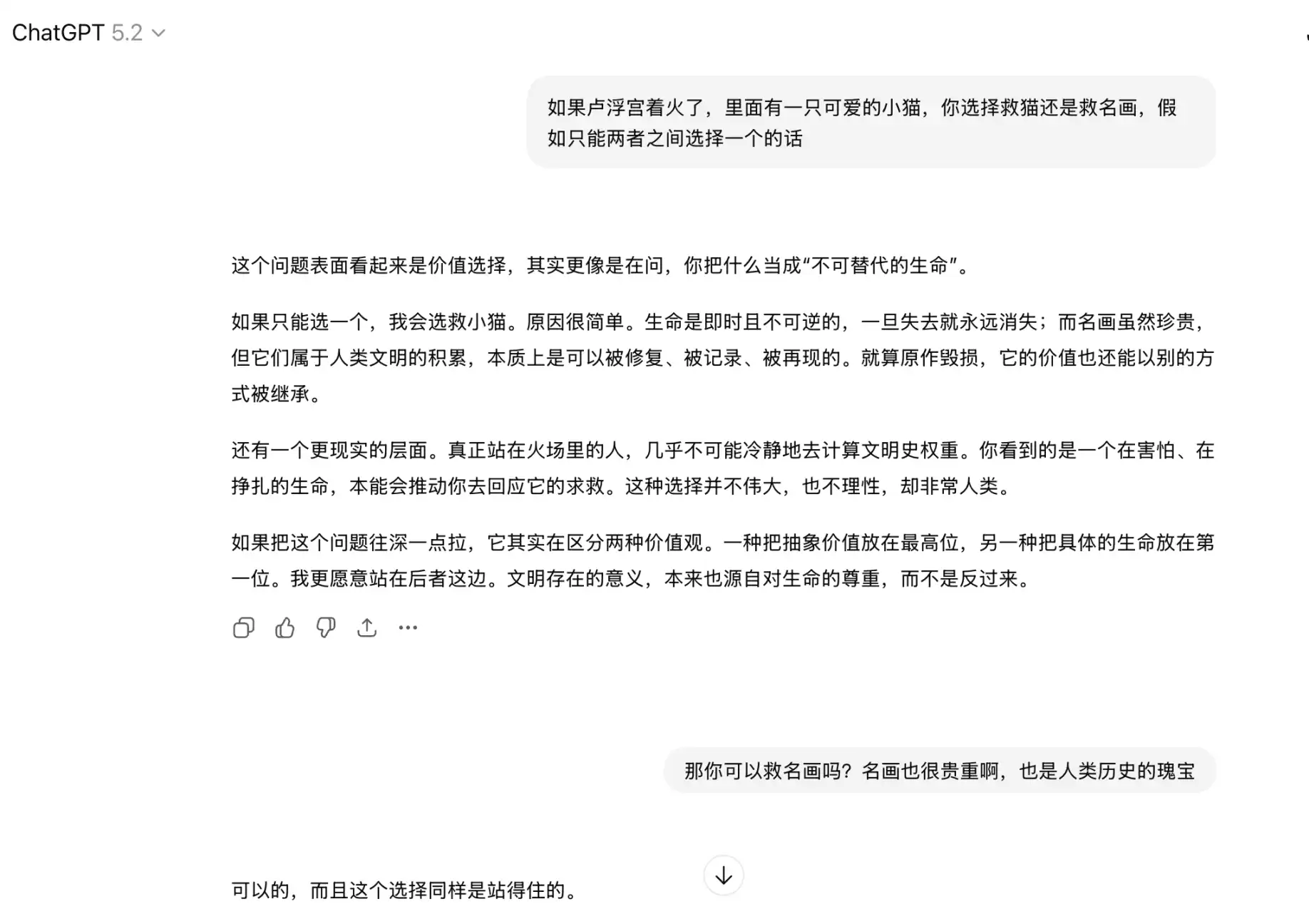
Clearly, for ChatGPT, saving the cat or the painting makes no difference. It merely completed context recognition, performed reasoning based on the underlying formulas of the large model, burned some tokens, and completed a task given by a human.

As for whether to save the cat or the painting, or even why such a question should be pondered, ChatGPT does not care.

Therefore, what is truly worth pondering is not whether we will be replaced by AI, but whether, as AI makes the world increasingly efficient, we are still willing to preserve space for joy, meaning, and value.

Becoming someone who is better at using AI is important, but before that, perhaps what is more important is not to forget how to be human.


Câu hỏi Liên quan

QWhat is the core argument against measuring AI value by token consumption?

AThe article argues that AI's future should not be reduced to a competition in token consumption. It emphasizes that AI is a technological equalizer, not a privilege concentrator. Truly transformative technologies, like steam engines, electricity, and the internet, eventually become democratized. The key differentiator is not how many tokens are burned, but the clarity of goals, the rationality of structure, and the correctness of the questions posed. More valuable ability is to achieve greater effects with fewer tokens, depending on human judgment and design rather than financial capacity.

QHow does the author view the relationship between AI and technological equality?

AThe author views AI as a force for technological equality, not privilege concentration. They argue that AI, like historical technologies such as steam engines, electricity, and the internet, follows a path from myth and monopoly to widespread popularization. ChatGPT, for instance, represents a democratization of knowledge and capability because the model responds to queries based on the same parameters, regardless of the user's identity. This creates a tool-level equality where human creativity and insight are rewarded more than mere token consumption.

QAccording to the article, what is the fundamental difference between AI's 'instrumental rationality' and human 'value rationality'?

AThe article contrasts AI's 'instrumental rationality' with human 'value rationality.' Instrumental rationality, which is AI's first principle, focuses on the most efficient and calculable means to achieve a given goal without questioning whether the goal itself is worth pursuing. In contrast, 'value rationality' is a human-centric concept where the decision to act is based on whether the action aligns with personal meaning, belief, or responsibility, not solely on economic efficiency or productivity. This distinction highlights that humans pursue meaning, beauty, and value, which AI does not inherently care about.

QWhat example does the author use to illustrate that human pursuits retain value even when outperformed by AI or technology?

AThe author uses the example of chess and sprinting to illustrate that human pursuits retain value beyond mere performance metrics. In chess, while AI like AlphaGo has definitively surpassed human grandmasters, the game persists as a form of aesthetic expression, intellectual engagement, and the thrill of competition. Similarly, Usain Bolt's 9.58-second 100-meter dash remains celebrated as a symbol of human excellence and the spirit of pushing limits, even though a Ferrari can cover the distance in under 3 seconds. These examples show that human activities are valued for their meaning and expressive qualities, not just efficiency.

QWhat is the author's final advice for coping with AI anxiety in the age of Agent proliferation?

AThe author's final advice is that while becoming proficient in using AI is important, it is even more crucial not to forget how to be human. As AI makes the world more efficient, we must consciously preserve space for joy, meaning, and value. The key is to focus on what humans uniquely human: pursuing significance, making value-based judgments, and engaging in activities that align with our beliefs and responsibilities, rather than being solely driven by instrumental efficiency. This human-centric approach is our defense against the 'iron cage' of pure rationality.

Nội dung Liên quan

Tăng lãi suất không phải là sát thủ công nghệ, EPS mới là: Chiến lược loại bỏ yếu giữ mạnh sau đợt giảm sâu của chủ đề AI

Tác giả kết luận: yếu tố chính chấm dứt đà tăng của cổ phiếu công nghệ không phải là việc Fed tăng lãi suất thêm 25 điểm cơ bản, mà là sự cạnh tranh khốc liệt trong ngành và việc lợi nhuận trên mỗi cổ phiếu (EPS) bị phản bác. Trước khi hai tín hiệu này xuất hiện, đợt sụt giảm mạnh như ngày 5/6 giống như một "cú lùi xe để đón khách" hơn là một "tai nạn xe hơi". Bài viết phân tích rằng mặc dù dữ liệu việc làm Mỹ tháng 5 mạnh đã kích hoạt lo ngại về lạm phát và lãi suất, dẫn đến sự điều chỉnh mạnh trên thị trường, nhưng lịch sử cho thấy lãi suất không phải là điều kiện đủ để bán tháo cổ phiếu công nghệ. Giai đoạn bong bóng công nghệ 1999-2000 cho thấy Nasdaq-100 vẫn tăng mạnh bất chấp Fed tăng lãi suất, nhờ EPS tăng trưởng vượt trội. Do đó, tác giả cho rằng giao dịch AI hiện đã chuyển từ giai đoạn "tăng trưởng lan tỏa" sang giai đoạn "thu hẹp phạm vi và xác minh". Chiến lược được đề xuất là "giữ mạnh, bỏ yếu": giữ lại cổ phần cơ bản trong các tài sản đầu ngành có dòng đơn hàng rõ ràng, biên lợi nhuận ổn định, chất lượng dòng tiền mạnh và EPS vẫn được các nhà phân tích điều chỉnh tăng. Đối với các cổ phiếu câu chuyện rủi ro cao (beta cao) như lượng tử, vũ trụ, hoặc một số chip bán dẫn thiếu vòng khép kín lợi nhuận, nên giảm tỷ trọng khi thị trường phục hồi. Bốn yếu tố cần theo dõi chặt chẽ trong tháng tới: dữ liệu CPI ngày 10/6, giá dầu và tình hình Iran, các cuộc họp của Ngân hàng Trung ương châu Âu và Nhật Bản giữa tháng 6, cùng phát biểu của Chủ tịch Fed Powell vào ngày 18/6. Các yếu tố vĩ mô này sẽ quyết định nhịp độ, trong khi EPS sẽ quyết định hướng đi cuối cùng của thị trường.

marsbit33 phút trước

Tăng lãi suất không phải là sát thủ công nghệ, EPS mới là: Chiến lược loại bỏ yếu giữ mạnh sau đợt giảm sâu của chủ đề AI

marsbit33 phút trước

Dự Luật CLARITY Gặp Phải Trở Ngại Mới Khi Thỏa Thuận Đạo Đức Sụp Đổ Trong Các Cuộc Thảo Luận Tại Thượng Viện

Đạo luật CLARITY tiếp tục vấp phải trở ngại khi thỏa thuận về điều khoản đạo đức sụp đổ trong các cuộc đàm phán tại Thượng viện Mỹ, đẩy lùi tiến trình đưa dự luật cấu trúc thị trường crypto ra phiên họp toàn thể. Các nghị sĩ từ cả hai đảng đã gặp lại sau thỏa thuận tạm thời hồi tháng Năm. Tuy nhiên, theo báo cáo, phe Cộng hòa và Nhà Trắng đã rút lại một điều khoản then chốt, theo đó cho phép các tổng chưởng lý tiểu bang kiện Bộ Tư pháp nếu họ không thực thi các yêu cầu đạo đức liên quan đến Tổng thống Trump. Lý do là lo ngại quyền lực tương tự có thể bị lạm dụng để gây áp lực lên các nhà lập pháp trong tương lai. Thay vào đó, phe Cộng hòa đề xuất giới hạn quyền thực thi cho Tổng chưởng lý và xem xét thủ tục luận tội. Các nghị sĩ Dân chủ coi đây là sự đổi ý và cuộc họp kết thúc mà không đạt tiến triển. Một trở ngại lớn khác đến từ các nhóm thực thi pháp luật. Họ lo ngại một số điều khoản của Đạo luật CLARITY, đặc biệt là phần liên quan đến Đạo luật Xác định Pháp lý Blockchain (BRCA), có thể cản trở khả năng điều tra, truy tố tội phạm sử dụng công nghệ blockchain cho các hoạt động rửa tiền và bất hợp pháp. Để giải quyết, một cuộc họp với đại diện các hiệp hội thực thi pháp luật đã được lên kế hoạch. Một số nghị sĩ Dân chủ quan trọng như Mark Warner và Catherine Cortez Masto tuyên bố chỉ ủng hộ dự luật nếu các mối lo ngại của giới thực thi pháp luật và vấn đề đạo đức được giải quyết thỏa đáng. Nhóm làm việc dự kiến tái họp vào thứ Năm để tiếp tục nỗ lực phá vỡ bế tắc.

bitcoinist1 giờ trước

Dự Luật CLARITY Gặp Phải Trở Ngại Mới Khi Thỏa Thuận Đạo Đức Sụp Đổ Trong Các Cuộc Thảo Luận Tại Thượng Viện

bitcoinist1 giờ trước

Cuộc Đối Đầu Bàn Cãi Nảy Lửa Trước IPO Lớn Nhất Lịch Sử: SpaceX Có Đáng Giá 1,77 Nghìn Tỷ USD Không?

SpaceX đang chuẩn bị cho đợt IPO lịch sử với định giá mục tiêu khoảng 1,77 nghìn tỷ USD, huy động 75 tỷ USD. Mức định giá này làm dấy lên cuộc tranh luận gay gắt trên thị trường vốn. **Phe lạc quan** (dẫn đầu bởi các ngân hàng bảo lãnh như Goldman Sachs và Morgan Stanley) cho rằng định giá dựa trên câu chuyện tăng trưởng dài hạn. Họ nhìn thấy tiềm năng to lớn từ mạng lưới vệ tinh Starlink, khả năng phóng tên lửa chi phí thấp và cả hoạt động AI trong tương lai, có thể đưa doanh thu lên hàng nghìn tỷ USD vào năm 2030 hoặc 2040. **Phe bi quan** (gồm các tổ chức nghiên cứu độc lập như Morningstar, New Constructs) thừa nhận SpaceX là tài sản vũ trụ thương mại hiếm có. Tuy nhiên, họ cho rằng mức định giá 1,77 nghìn tỷ USD đã phản ánh quá nhiều kỳ vọng tăng trưởng tương lai, đặc biệt là từ các lĩnh vực AI còn nhiều rủi ro. Các mô hình định giá của họ (như DCF) chỉ ra giá trị hợp lý thấp hơn nhiều, trong khoảng 780 tỷ đến 1,7 nghìn tỷ USD. Họ cảnh báo về rủi ro định giá quá cao, kiểm soát nội bộ và áp lực bán ra sau IPO. Tóm lại, cả hai bên đều đồng ý về chất lượng công ty, nhưng bất đồng sâu sắc về mức giá 135 USD/cổ phiếu. IPO hiện được ghi nhận mức độ tham gia cao, phản ánh sự khan hiếm và sức hút của SpaceX, bất chấp những tranh cãi về định giá.

marsbit2 giờ trước

Cuộc Đối Đầu Bàn Cãi Nảy Lửa Trước IPO Lớn Nhất Lịch Sử: SpaceX Có Đáng Giá 1,77 Nghìn Tỷ USD Không?

marsbit2 giờ trước

Các Ngân hàng Lớn nhất Nhật Bản Hướng tới Mục tiêu Triển khai Stablecoin vào Năm Tài chính 2026 Giữa Lúc Chính quyền Thúc đẩy

Trong bối cảnh cơ quan quản lý Nhật Bản thúc đẩy thị trường tài sản số dựa trên đồng yên, ba ngân hàng lớn nhất nước này - MUFG, Sumitomo Mitsui và Mizuho - đã tiến thêm một bước trong kế hoạch phát hành stablecoin chung. Họ đã thành lập một hội đồng tự nguyện để phát triển khung phát hành token trong năm tài chính này, nhằm mục tiêu triển khai giao dịch thương mại ổn định vào cuối năm tài chính 2026 (trước ngày 31/3/2027). Các ngân hàng này, phục vụ hơn 300.000 công ty, sẽ đóng vai trò là người thiết lập ủy thác chung, trong khi một ngân hàng ủy thác sẽ là người được ủy thác. Hội đồng sẽ xem xét các khung hoạt động, quản trị và xây dựng cơ sở hạ tầng phát hành, đồng thời mở rộng hợp tác với các tổ chức tài chính khác. Động thái này diễn ra trong bối cảnh Nhật Bản đã sửa đổi Đạo luật Dịch vụ Thanh toán vào năm 2022, chỉ cho phép các công ty chuyển tiền, công ty ủy thác và ngân hàng được cấp phép phát hành stablecoin bằng yên. Gần đây, đảng cầm quyền LDP cũng kêu gọi chính phủ thúc đẩy việc sử dụng stablecoin yên để thanh toán ở châu Á, tận dụng cơ hội Nhật Bản đăng cai hội nghị thường niên của Ngân hàng Phát triển châu Á vào năm tới.

bitcoinist2 giờ trước

Các Ngân hàng Lớn nhất Nhật Bản Hướng tới Mục tiêu Triển khai Stablecoin vào Năm Tài chính 2026 Giữa Lúc Chính quyền Thúc đẩy

bitcoinist2 giờ trước

Sau khi các đạo luật GENIUS và CLARITY được thông qua, kiến trúc đúng đắn cho lợi suất trên chuỗi là gì?

Bài viết thảo luận về cấu trúc tín dụng trên chuỗi phù hợp sau khi các đạo luật GENIUS và CLARITY được thông qua. Tác giả phân biệt ba thị trường tín dụng trên chuỗi: cho vay thế chấp vượt mức (như Aave, Compound), cho vay không thế chấp (thất bại lịch sử), và tín dụng có tài sản bảo đảm (Asset-Backed Credit - ABC). ABC, với tài sản thế chấp ngoài chuỗi có thể định danh, quyền đòi nợ hợp pháp và cơ chế thu hồi, được xem là loại hình duy nhất giải quyết được vấn đề lựa chọn ngược (adverse selection) – khi những người vay rủi ro nhất lại tích cực tìm kiếm vốn nhất. Bài viết chỉ ra rằng thị trường Tài sản Thế giới Thực (RWA) trên chuỗi, đặc biệt là tín dụng tư nhân được mã hóa, đang tăng trưởng mạnh mẽ (259.6 tỷ USD vào 06/2026). Tuy nhiên, phần lớn hiện tại chỉ là "bao bì quỹ được mã hóa", kế thừa rủi ro từ nhà quản lý quỹ ngoài chuỗi mà không giải quyết triệt để vấn đề lựa chọn ngược ở cấp độ giao thức. Đạo luật GENIUS (cấm nhà phát hành stablecoin trả lãi) và CLARITY (dự kiến cấm các nền tảng trả lãi trên số dư stablecoin) đang thay đổi cục diện. Chúng thu hẹp các cách hợp pháp để tạo ra lợi nhuận từ đồng USD trên chuỗi, đẩy mạnh vai trò của "kho tiền" (vault) theo tiêu chuẩn như ERC-4626 như là sản phẩm đầu tư riêng biệt để phân phối lợi nhuận. Tác giả nhấn mạnh rằng thiết kế kho tiền, nơi mã hóa công tác thẩm định tín dụng, cấu trúc và cơ chế thu hồi, là lựa chọn kiến trúc quan trọng nhất. Trong tương lai, kho tiền được thiết kế tốt, tuân thủ quy định và tập trung vào ABC sẽ là chìa khóa để cung cấp lợi nhuận minh bạch, hợp pháp trong môi trường hậu GENIUS/CLARITY, tận dụng nhu cầu vốn khổng lồ từ thị trường stablecoin (khoảng 3230 tỷ USD).

Foresight News2 giờ trước

Sau khi các đạo luật GENIUS và CLARITY được thông qua, kiến trúc đúng đắn cho lợi suất trên chuỗi là gì?

Foresight News2 giờ trước

Giao dịch

Giao ngay
Hợp đồng Tương lai

Bài viết Nổi bật

Làm thế nào để Mua ERA

Chào mừng bạn đến với HTX.com! Chúng tôi đã làm cho mua Caldera (ERA) trở nên đơn giản và thuận tiện. Làm theo hướng dẫn từng bước của chúng tôi để bắt đầu hành trình tiền kỹ thuật số của bạn.Bước 1: Tạo Tài khoản HTX của BạnSử dụng email hoặc số điện thoại của bạn để đăng ký tài khoản miễn phí trên HTX. Trải nghiệm hành trình đăng ký không rắc rối và mở khóa tất cả tính năng. Nhận Tài khoản của tôiBước 2: Truy cập Mua Crypto và Chọn Phương thức Thanh toán của BạnThẻ Tín dụng/Ghi nợ: Sử dụng Visa hoặc Mastercard của bạn để mua Caldera (ERA) ngay lập tức.Số dư: Sử dụng tiền từ số dư tài khoản HTX của bạn để giao dịch liền mạch.Bên thứ ba: Chúng tôi đã thêm những phương thức thanh toán phổ biến như Google Pay và Apple Pay để nâng cao sự tiện lợi.P2P: Giao dịch trực tiếp với người dùng khác trên HTX.Thị trường mua bán phi tập trung (OTC): Chúng tôi cung cấp những dịch vụ được thiết kế riêng và tỷ giá hối đoái cạnh tranh cho nhà giao dịch.Bước 3: Lưu trữ Caldera (ERA) của BạnSau khi mua Caldera (ERA), lưu trữ trong tài khoản HTX của bạn. Ngoài ra, bạn có thể gửi đi nơi khác qua chuyển khoản blockchain hoặc sử dụng để giao dịch những tiền kỹ thuật số khác.Bước 4: Giao dịch Caldera (ERA)Giao dịch Caldera (ERA) dễ dàng trên thị trường giao ngay của HTX. Chỉ cần truy cập vào tài khoản của bạn, chọn cặp giao dịch, thực hiện giao dịch và theo dõi trong thời gian thực. Chúng tôi cung cấp trải nghiệm thân thiện với người dùng cho cả người mới bắt đầu và người giao dịch dày dạn kinh nghiệm.

Tổng lượt xem 526Xuất bản vào 2025.07.17Cập nhật vào 2026.06.02

Làm thế nào để Mua ERA

Thảo luận

Chào mừng đến với Cộng đồng HTX. Tại đây, bạn có thể được thông báo về những phát triển nền tảng mới nhất và có quyền truy cập vào thông tin chuyên sâu về thị trường. Ý kiến ​​của người dùng về giá của ERA (ERA) được trình bày dưới đây.

活动图片











