HSBC Research Report Analysis: Behind 12 Million Starlink Users, the Space Economy is Feeding Back to Earth

marsbitXuất bản vào 2026-08-20Cập nhật gần nhất vào 2026-08-20

Tóm tắt

HSBC Research Report Analysis: The 120 Million Starlink Users and How the Space Economy is Fueling Earth's Industries. The core value of the new space race is returning to Earth, driving industrial upgrades across multiple sectors, according to an HSBC report covering 12 industries. Key developments include: SpaceX’s Starlink has surpassed a critical scale with 10,200 satellites, 12 million broadband users, and 7.4 million direct-to-cell devices. It is evolving from a backup solution to default infrastructure in maritime, aviation, trucking, and remote areas, complementing rather than competing with terrestrial telecom operators. Starship aims to reduce launch costs to $100-$300 per kilogram, a 95%+ reduction from historical averages. This drastic cost compression is reshaping the economics of satellite manufacturing, in-orbit services, and future ventures like asteroid mining. SpaceX’s plans for orbital AI data centers (100 GW by 2040) and the Terafab vertically integrated semiconductor foundry (a joint venture with Tesla and xAI) represent strategic shifts. While orbital data center costs are currently triple those on Earth, they offer a policy-independent backup for power-constrained AI growth. Terafab poses a potential challenge to the traditional fabless-foundry model. The report warns that aggressive capacity expansion by SpaceX and others could lead to a compute surplus by the late 2020s, potentially commoditizing LLMs and pressuring hardware vendors. The space ra...

Written by: Rita

The greatest value of the space race is returning to Earth. On August 18, HSBC released a report spanning 12 industries, unpacking this transmission chain one by one.

Asteroid mining and orbital data centers are not yet operational. Yet, the space race has already rewritten the competitive logic of communications, semiconductors, power, and robotics. Led by Raj Sinha, Co-Head of Global Equity Research at HSBC, this report covers 12 sectors including telecommunications, semiconductors, power, industrials, agriculture, insurance, and finance.

SpaceX has raised $75 billion. Elon Musk's compensation is tied to the company's $7.5 trillion market capitalization target and Mars colonization. HSBC's conclusion is: the most urgent value of the space economy is its role in driving the upgrading of Earth's industries.

Starlink Has Crossed the Critical Point of Scale

As of June 30, 2026, SpaceX's satellite internet service had 10,200 satellites in orbit and 12 million broadband subscribers, covering 167 markets. An additional 7.4 million monthly active devices are connected via satellite-to-phone (Direct to Cell), covering 30 countries. HSBC telecommunications analysts note that these numbers mean space-based communication has become infrastructure for multiple industries, far beyond an alternative for remote areas.

Maersk has installed Starlink on over 330 container ships, and United Airlines plans to equip 15 Boeing 737-800 aircraft per month. EpicVue has launched a Starlink solution for truck fleets at $99 per month with 250GB of data, covering 99.9% of US and Canadian territory. Satellite connectivity is shifting from an emergency backup to a default configuration.

HSBC assesses that the relationship between Starlink and terrestrial telecom operators is primarily complementary. The performance and cost advantages of fiber and 5G in dense urban areas are unshakeable. In maritime, desert, mountainous, and post-disaster scenarios, satellite connections fill the coverage gaps left by cellular networks. For telecom operators, cooperation is better than confrontation. T-Mobile, KDDI, and Airtel Africa have all signed direct-to-device cooperation agreements with Starlink.

Starship Reduces Launch Cost to $300 Per Kilogram

SpaceX's core advantage lies in cost.

Falcon 9's low-Earth orbit launch cost is $2,940 per kilogram, and Falcon Heavy's is $1,520. Starship aims to reduce this to $100-300, a drop of over 95% compared to the historical average (approximately $18,500/kg from 1970 to 2000).
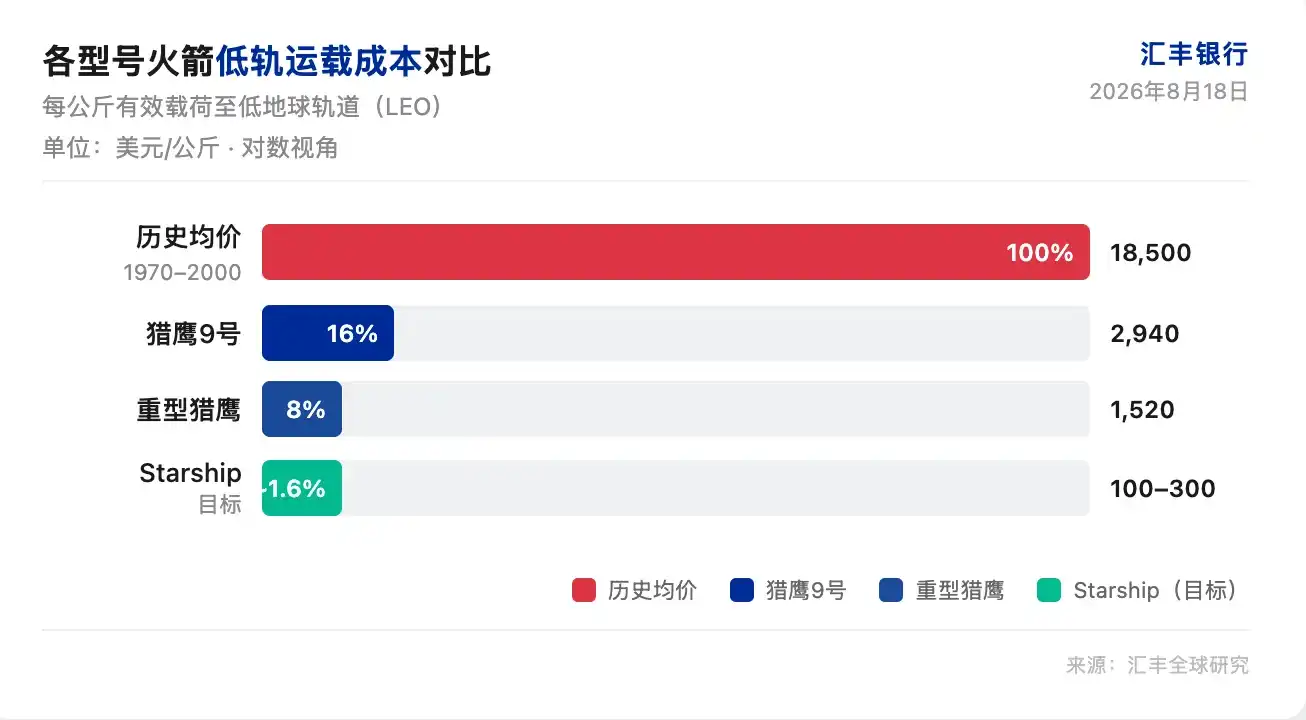
Falling costs are rewriting the fundamental assumptions of the space economy. Material choices for satellite manufacturing, energy solutions for orbital data centers, and feasibility models for asteroid mining all need reassessment. HSBC industrial analysts point out that SpaceX manufactures about 80-85% of its rocket and spacecraft components internally, achieving a high degree of vertical integration. This compresses the space for external suppliers, keeping the benefits of lower launch costs within the company.

A single V2 Starlink satellite costs $1 million, with a launch cost of $2-3 million. One Starship can launch 60 V3 satellites at once, each with a downlink capacity of about 1 Tbps, which is 20 times that of the V2.

Scale and cost are forming a positive feedback loop.

Orbital Data Centers Are a Backup Option for Computing Power

SpaceX plans to deploy 100 GW of orbital AI data center computing power by 2040, with trial launches starting in 2027.

HSBC estimates that the cost of orbital data centers is currently three times that of terrestrial ones and may only converge by 2035-2040. Terrestrial data centers remain the priority choice. Orbital data centers are a strategic reserve. If the US power grid and nuclear power construction cannot keep up with computing demand, space can provide an option bypassing policy, land, and environmental constraints.

The Terafab plan is closer to reality than orbital data centers. A joint venture between SpaceX, Tesla, and xAI plans to build a vertically integrated wafer fab covering the entire chain from design, manufacturing, packaging, to testing. If successful, it could disrupt the horizontal division of labor in the semiconductor industry. The chain of NVIDIA designing chips, TSMC manufacturing, and third-party packaging/testing could be replaced by a one-stop solution.

The cost gap is just a surface-level issue; computing power surplus is the bigger risk. HSBC estimates that the global annual incremental demand for AI data center power by 2030 is below 50 GW, while SpaceX's orbital plan alone targets an annual addition of 100 GW. If terrestrial manufacturers continue expanding at the current pace (HSBC expects annual capital expenditure to exceed $1 trillion from 2027), the market could face a computing power surplus within five years. The asset turnover and return on investment for GPU cloud infrastructure are already under pressure, and SpaceX's entry will intensify this trend.

Another consequence of computing power surplus is the commoditization of LLM models. With computing power no longer scarce, performance gaps between models shrink. Hardware suppliers face pressure, while software and application layers benefit.

The Space Race is Reshaping Three Core Industries

The report covers 12 industries. HSBC analysts judge that the power, semiconductor, and robotics sectors are being directly rewritten by the space race.

The power sector benefits most directly. AI data centers have pushed the US annual electricity demand growth rate from 2-3% to 4-5%. If the computing power race continues, both US and European electricity demand could grow 2.8 times by 2050 (previous expectations were 60% and 80% respectively). HSBC utilities analysts conclude that renewable energy and the power grid are the "clearest winners." Nuclear and natural gas face uncertainty: terrestrial data centers are a boon, but orbital data centers could act as substitutes.

The semiconductor sector faces a dual impact. Orbital inference requires "low-Earth orbit optimized silicon," a new performance tier between consumer-grade chips and radiation-hardened aerospace chips, which will create new demand. If the Terafab model is replicated by other giants, traditional wafer foundries could face order loss.

The logic for robotics and industrials is the most straightforward. Asteroid mining relies on highly autonomous robots, lunar base construction requires engineering machinery, and in-orbit servicing needs robotic arms. Caterpillar has partnered with NASA to develop lunar excavation technology, with its autonomous mining experience on Earth directly transferable to space scenarios. Honeywell provides navigation systems for NASA's Artemis missions; aerospace technology can similarly feed back into aviation and industrial fields.

The other 9 industries also appear in HSBC's framework, including telecommunications, agriculture, chemicals, metals & mining, healthcare, insurance, finance, transportation & logistics, and tech platforms. However, the transmission chains are longer, and the short-term impact is less direct than in the three sectors above.

The takeoff of the space economy doesn't need to wait for asteroid mining or Mars colonization. Starlink's 12 million users, Starship's cost curve, and Terafab's potential impact on the semiconductor landscape are already proof.

The core judgment of the HSBC report is: space is an accelerator for Earth's industries. Computing power continues to expand, electricity demand doubles, and launch costs drop below $300 per kilogram. Three curves are simultaneously approaching historical inflection points. The first to be reshaped is always the link with the shortest transmission chain.
Disclaimer

This article is Tide Research's compilation and interpretation of a third-party brokerage research report (HSBC, August 18, 2026), combined with public market information. The ratings, target prices, earnings forecasts, and related judgments cited herein are the views of the brokerage's analysts, representing only the position of their institution, and do not represent Tide Research's views, nor do they constitute any investment advice.

The market carries risks; decisions must be made independently. This article should not be used as a basis for buying or selling any securities.


Câu hỏi Liên quan

QAccording to the HSBC report, what is the most urgent value of the space economy for Earth's industries?

AThe report concludes that the most urgent value of the space economy is that it is driving the upgrade and transformation of Earth's industries, acting as an accelerator rather than waiting for distant goals like asteroid mining.

QHow has Starlink's role evolved based on its current scale, and what is its relationship with terrestrial telecom operators?

AWith 12 million broadband users and coverage in 167 markets, Starlink has moved beyond being a backup for remote areas to become default infrastructure in sectors like maritime and logistics. HSBC judges its relationship with terrestrial operators as primarily complementary, with partnerships (e.g., with T-Mobile) being more beneficial than competition, as satellites fill coverage gaps.

QWhat is the target launch cost per kilogram for SpaceX's Starship, and how does this cost reduction impact the space economy?

AStarship aims to reduce launch costs to $100-$300 per kilogram. This drastic reduction of over 95% compared to historical averages is rewriting the fundamental assumptions of the space economy, forcing re-evaluation of feasibility models for satellite manufacturing, orbital data centers, and asteroid mining.

QWhat are the three core industries that the HSBC report identifies as being most directly reshaped by the space race?

AThe three core industries most directly reshaped are: 1) Power/Utilities, due to surging demand from AI data centers; 2) Semiconductors, facing new demand for 'low-orbit optimized silicon' and potential disruption from vertically integrated models like Terafab; and 3) Robotics & Industrial, as technologies for space mining and construction are developed and can be applied on Earth.

QWhat potential risk does the HSBC report highlight regarding the expansion of AI computing power, particularly in relation to SpaceX's plans?

AThe report highlights a risk of computing power oversupply. HSBC estimates global annual AI data center demand will be below 50GW by 2030, but SpaceX alone plans to deploy 100GW of orbital AI compute capacity annually. If ground-based manufacturers also expand aggressively, the market could face a supply glut within five years, pressuring returns and potentially leading to the commoditization of large language models (LLMs).

Nội dung Liên quan

Bạn sẽ ngạc nhiên về mức độ khác biệt giữa WeChat và Telegram ở cấp độ kiến trúc

WeChat và Telegram thể hiện hai triết lý kiến trúc nền tảng số trái ngược, tập trung vào lưu trữ dữ liệu, mô hình kinh tế và độ mở. **Lưu trữ & Đồng bộ:** Telegram lưu trữ không giới hạn trên đám mây, cho phép đồng bộ lịch sử trên mọi thiết bị. WeChat lưu trữ cục bộ trên thiết bị, việc chuyển đổi thiết bị cần dùng mã QR và phiên bản desktop luôn yêu cầu điện thoại xác nhận. **Tương tác & Nội dung:** Telegram tích hợp bình luận trực tiếp dưới bài đăng kênh. WeChat yêu cầu bình luận cho bài viết tài khoản chính thức phải được kiểm duyệt trước và không có hệ thống thảo luận tích hợp tương tự. **Phát triển & Hệ sinh thái:** Bot API của Telegram mở và miễn phí. Mini Programs (Tiểu trình) của WeChat vận hành trong hệ sinh thái khép kín, yêu cầu xác minh và có rào cản gia nhập cao hơn. Tuy nhiên, hệ sinh thái này rất lớn với hơn 4,8 triệu tiểu trình hoạt động (06/2025). **Truyền tệp & Thanh toán:** Telegram cho phép tải lên tới 2-4 GB. WeChat giới hạn ở 200 MB cho hầu hết tệp. Sự khác biệt lớn nhất nằm ở thanh toán: WeChat Pay ăn sâu vào đời sống và kinh tế Trung Quốc, trong khi Telegram chủ yếu dựa vào bot bên thứ ba và tiền mã hóa, phản ánh triết lý phi tập trung. **Quan điểm kỹ thuật (Phân tích bổ sung):** Việc WeChat kết hợp chặt chẽ nhắn tin và thanh toán trong một ứng dụng mà không có mã hóa end-to-end mở rộng làm gia tăng rủi ro bảo mật. Bề mặt tấn công rộng hơn, minh chứng bởi các vụ lừa đảo ở Singapore. Câu hỏi đặt ra là kiến trúc tích hợp chặt này có đủ sức chống chịu khi số tính năng trong một cửa sổ ứng dụng tiếp tục tăng. Tóm lại, WeChat xây dựng một hệ sinh thái khép kín, tích hợp sâu để thống trị thị trường, trong khi Telegram ưu tiên giao thức mở, lưu trữ linh hoạt và rào cản thấp cho nhà phát triển.

cryptonews.ru5 phút trước

Bạn sẽ ngạc nhiên về mức độ khác biệt giữa WeChat và Telegram ở cấp độ kiến trúc

cryptonews.ru5 phút trước

Mở khóa Token Trong Tuần: H Mở khóa Token chiếm 7.9% lượng lưu hành

**Tóm tắt: Giải phóng Token Tuần Này (Unlock Token)** Bài viết liệt kê thông tin giải phóng token (token unlock) của ba dự án tiền mã hóa trong tuần, bao gồm số lượng, giá trị và mô tả ngắn gọn. **1. Humanity Protocol (H)** * **Số lượng giải phóng:** 270 triệu token. * **Giá trị:** Khoảng 19.88 triệu USD (tương đương 7.9% lượng token đang lưu hành). * **Mô tả:** Một mạng lưới blockchain chống Sybil, cung cấp cơ chế xác minh danh tính con người độc đáo cho nhà phát triển và quyền sở hữu dữ liệu đầy đủ cho người dùng. * **Nguồn:** Có biểu đồ lộ trình giải phóng token chi tiết. **2. SoSoValue** * **Số lượng giải phóng:** 23.45 triệu token. * **Giá trị:** Khoảng 7.27 triệu USD. * **Mô tả:** Một nền tảng nghiên cứu đầu tư được hỗ trợ bởi AI, kết hợp hiệu quả của CeFi với tính minh bạch của DeFi để giải quyết các thách thức như quá tải thông tin trong thị trường tiền mã hóa. * **Nguồn:** Có biểu đồ lộ trình giải phóng token chi tiết. **3. Collector** * **Số lượng giải phóng:** 28.86 triệu token. * **Giá trị:** Khoảng 5.57 triệu USD. * **Mô tả:** Một nền tảng kết hợp quyền sở hữu vật chất với thị trường kỹ thuật số Web3 để biến đổi thị trường sưu tầm. Người dùng có thể số hóa, giao dịch và thậm chí thế chấp bộ sưu tập của mình. * **Nguồn:** Có biểu đồ lộ trình giải phóng token chi tiết. Bài viết cung cấp liên kết đến trang Twitter và website chính thức của từng dự án.

marsbit46 phút trước

Mở khóa Token Trong Tuần: H Mở khóa Token chiếm 7.9% lượng lưu hành

marsbit46 phút trước

Tin tặc rò rỉ GTA 6 và phát hành tiền mã hóa: Video lộ trở thành 'bảng quảng cáo' cho $CYBERLEEK, muốn xem phần tiếp theo phải mua coin để bỏ phiếu

Ngày 18/8, một nhóm hacker tự xưng là CyberLeek bắt đầu rò rỉ các đoạn video được cho là từ phiên bản phát triển của tựa game được chờ đợi nhất - GTA 6. Mỗi đoạn video đều có hình mờ quảng cáo cho đồng meme token $CYBERLEEK trên Solana. Điều đáng chú ý, token này đã được tạo ra trước khi nội dung rò rỉ xuất hiện khoảng 7 tiếng 47 phút. Cùng một ví tiền đã chi trả chi phí tạo miền web, token và thanh khoản. Nhóm hacker tuyên bố sẽ dựa trên kết quả bỏ phiếu của chủ sở hữu token để quyết định cảnh hoặc tính năng game nào sẽ bị rò rỉ tiếp theo, biến việc xem nội dung thành động lực mua token. $CYBERLEEK đạt khối lượng giao dịch 15 triệu USD trong ngày đầu, mang về khoản phí giao dịch ước tính 3 nghìn USD, trong khi tổng chi phí thực tế ban đầu chưa đến 3.5 nghìn USD. Nhóm sau đó đã đốt 27% tổng cung token (trị giá trên 1 triệu USD) để xây dựng lòng tin, nhưng cơ chế thu phí giao dịch vẫn tiếp tục tạo ra lợi nhuận. Hành động này tạo ra một mô hình kinh doanh khép kín: nội dung rò rỉ thu hút sự chú ý và thúc đẩy nhu cầu mua token, và chỉ những người nắm giữ token mới có thể bỏ phiếu để xem nội dung tiếp theo. Nhà phát triển game Take-Two Interactive đã bắt đầu hành động pháp lý, nhưng số tiền trên blockchain có thể đã được thu về. Sự việc cho thấy cách một IP toàn cầu có thể bị lợi dụng làm tài sản thế chấp cho một đồng meme token, biến sự tò mò của cộng đồng thành công cụ kiếm tiền.

marsbit2 giờ trước

Tin tặc rò rỉ GTA 6 và phát hành tiền mã hóa: Video lộ trở thành 'bảng quảng cáo' cho $CYBERLEEK, muốn xem phần tiếp theo phải mua coin để bỏ phiếu

marsbit2 giờ trước

Bitcoin và altcoins tăng trưởng, nhưng nhà phân tích cảnh báo: Những mức giá này có thể kích hoạt biến động mạnh

Giá Bitcoin và altcoin đang tăng, nhưng chuyên gia phân tích cảnh báo các mức giá này có thể kích hoạt biến động mạnh. Trong bối cảnh giá Bitcoin tiếp tục lên cao, các vị thế sử dụng đòn bẩy trên thị trường một lần nữa làm nổi bật các vùng thanh lý tiềm năng. CEO và chuyên gia phân tích thị trường Alphractal, João Wedson, cho biết phân tích các vị thế mở trong 30 ngày qua đã xác định hai mức đặc biệt cao: 61.000 USD và 57.000 USD. Theo Wedson, nhiều vị thế đã được mở khi Bitcoin giao dịch trong khoảng 65.000-68.000 USD, xung quanh mốc 61.000 USD. Một phần đáng kể các vị thế đòn bẩy có thể chịu áp lực nếu giá giảm xuống mức này. Mức dưới 57.000 USD được coi là vùng thanh lý mạnh hơn, với nhiều vị thế rủi ro được mở khi Bitcoin ở khoảng 63.000-66.000 USD. Các mức này quan trọng không chỉ vì khả năng thanh lý mà còn do lệnh dừng lỗ của nhà đầu tư. Những nhà đầu tư đặt lệnh dừng lỗ quanh 61.000 và 57.000 USD, với niềm tin giá khó chạm tới, có thể vô tình gia tăng áp lực bán nếu xảy ra đợt giảm mạnh. Mặt khác, cũng tồn tại các vùng thanh lý tiềm năng trong xu hướng tăng. Wedson chỉ ra rằng một khối lượng tài sản đáng kể có thể bị thanh lý trong khoảng 85.000-86.000 USD, phần lớn thuộc về các vị thế đã mở hơn một tháng. *Đây không phải là lời khuyên đầu tư.

cryptonews.ru3 giờ trước

Bitcoin và altcoins tăng trưởng, nhưng nhà phân tích cảnh báo: Những mức giá này có thể kích hoạt biến động mạnh

cryptonews.ru3 giờ trước

Giao dịch

Giao ngay
活动图片