How Do 99% of Non-Profit Web3 Projects Survive?

marsbitXuất bản vào 2026-01-09Cập nhật gần nhất vào 2026-01-09

Tóm tắt

99% of Web3 projects lack cash flow and survive by relying on token sales and external funding rather than actual revenue. These projects often prioritize early token generation events (TGE) and aggressive fundraising over product development, leading to inflated valuations unsupported by real economic activity. The core issue is the "runway period"—the time a project can operate without revenue. Without sustainable income, projects eventually exhaust their resources and fail. Even marketing efforts become short-term fixes that can't compensate for a non-viable product. A comparison with the top 1% of profitable Web3 projects—which maintain reasonable price-to-earnings (P/E) ratios—highlights the unsustainable valuations of the remaining 99%. The system incentivizes founders to exit early via token unlocks and sales, regardless of project success, while investors bear the losses. This creates a distorted cycle where financial engineering outweighs genuine value creation.

Original Author: Ryan Yoon, Tiger Research

Original Compilation: Saoirse, Foresight News

99% of Web3 projects have no cash income, yet many companies still invest huge amounts of money in marketing and events every month. This article will delve into the survival rules of these projects and the truth behind "burning money".

Core Points

  • 99% of Web3 projects lack cash flow, and their cost expenditures rely on tokens and external funds, not product sales.
  • Premature listing (token issuance) leads to a surge in marketing expenditures, which in turn weakens the competitiveness of the core product.
  • The reasonable price-to-earnings ratio (P/E) of the top 1% of projects proves that the remaining projects lack actual value support.
  • Early token generation events (TGE) allow founders to "exit and cash out" regardless of the project's success or failure, creating a distorted market cycle.
  • The "survival" of 99% of projects essentially stems from a system defect built on investor losses rather than corporate profits.

Prerequisite for Survival: Verified Revenue Ability

"The prerequisite for survival is having verified revenue ability"—this is the most core warning in the current Web3 field. As the market matures, investors no longer blindly chase vague "visions". If a project cannot attract real users and actual sales, token holders will quickly sell and leave.

The key issue is the "fund turnover period", which is the time a project can maintain operations in a non-profit state. Even without sales, costs such as wages and server fees still need to be paid monthly, and teams without income have almost no legal channels to maintain operating funds.

Financing costs without income:
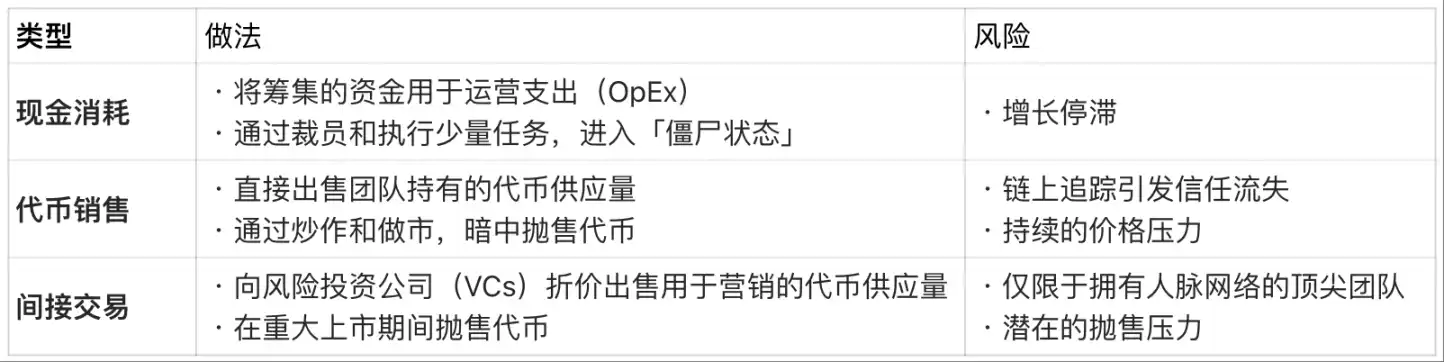
However, this "survival by tokens and external funds" model is only a stopgap measure. There is a clear upper limit to assets and token supply. Eventually, projects that exhaust all funding sources either cease operations or quietly exit the market.
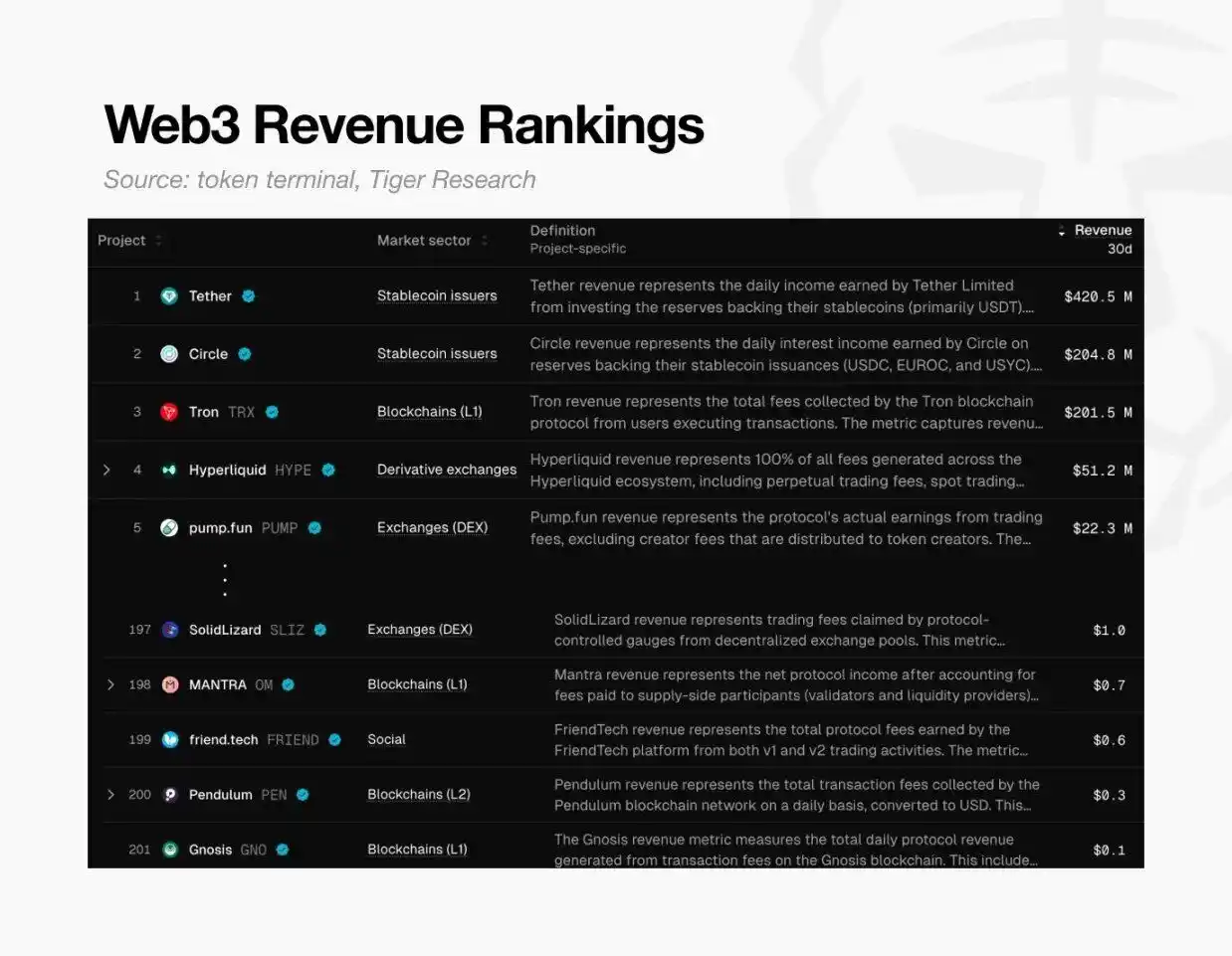
Web3 Revenue Ranking Table, Source: token terminal and Tiger Research

This crisis is universal. According to Token Terminal data, globally, only about 200 Web3 projects have achieved an income of $0.10 in the past 30 days.

This means that 99% of projects do not even have the ability to pay their own basic costs. In short, almost all cryptocurrency projects have failed to verify the feasibility of their business models and are gradually declining.

High Valuation Trap

This crisis was largely predetermined. Most Web3 projects completed their listing (token issuance) based solely on "vision", without even launching an actual product. This is in stark contrast to traditional enterprises—traditional enterprises must first prove their growth potential before an initial public offering (IPO); in the Web3 field, teams instead have to prove the rationality of their high valuation after listing (token generation event TGE).

But token holders will not wait indefinitely. As new projects emerge daily, if a project fails to meet expectations, holders will quickly sell and leave. This puts pressure on the token price, thereby threatening the project's survival. Therefore, most projects invest more funds in short-term hype rather than long-term product development. Obviously, if the product itself lacks competitiveness, even the most intensive marketing will eventually fail.

At this point, the project falls into a "dilemma trap":

  • If only focus on product development: It takes a lot of time, and during this period, market attention will gradually fade, and the fund turnover period will continue to shorten;
  • If only focus on short-term hype: The project becomes empty and lacks actual value support.

Both paths ultimately lead to failure—the project cannot prove the rationality of its initial high valuation and eventually collapses.

See the Truth of 99% of Projects Through the Top 1%

However, 1% of top projects have proven the feasibility of the Web3 model with huge revenues.

We can judge the value of major profitable projects such as Hyperliquid and Pump.fun through their price-to-earnings ratio (PER). The price-to-earnings ratio is calculated as "market capitalization ÷ annual income", and this indicator can reflect whether the project valuation is reasonable relative to actual income.

Price-to-earnings ratio comparison: Top Web3 projects (2025):
Note: Hyperliquid's sales are annualized estimates based on performance since June 2025.

The data shows that the price-to-earnings ratio of profitable projects ranges from 1x to 17x. Compared with the average price-to-earnings ratio of the S&P 500 index of about 31x, these top Web3 projects are either "undervalued relative to sales" or "have excellent cash flow conditions".

The fact that top projects with actual returns can maintain a reasonable price-to-earnings ratio makes the valuation of the remaining 99% of projects untenable—it directly proves that the high valuation of most projects in the market lacks a basis in actual value.

Can This Distorted Cycle Be Broken?

Why can projects with no sales still maintain valuations of billions of dollars? For many founders, product quality is only a secondary factor—Web3's distorted structure makes "quick exit and cash out" much easier than "building a real enterprise".

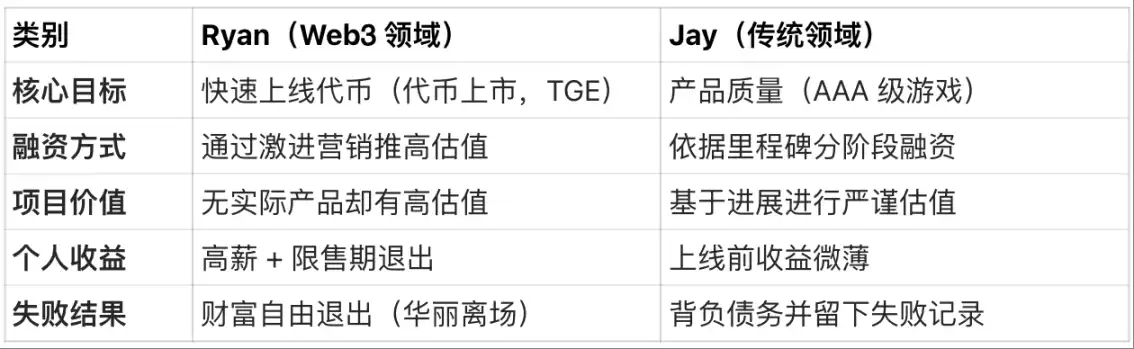
The cases of Ryan and Jay can explain this well: both launched AAA-level game projects, but the final outcomes were completely different.

Founder differences: Web3 vs. traditional model comparison

Ryan: Chose TGE, abandoned deep development

He chose a path centered on "profit": obtaining early funds by selling NFTs before the game was launched; then, while the product was still in a rough development stage, he held a token generation event (TGE) based solely on an aggressive roadmap and completed the listing on a medium-sized exchange.

After listing, he maintained the token price through hype, buying time for himself. Although the game was eventually launched late, the product quality was extremely poor, and holders sold and left. Ryan finally resigned on the grounds of "taking responsibility", but he was the real winner of this game—

On the surface, he pretended to focus on work, but in reality, he received a high salary while making huge profits by selling unlocked tokens. Regardless of the project's final success or failure, he quickly accumulated wealth and exited the market.

In contrast, Jay: Followed the traditional path, focused on the product itself

He prioritized product quality over short-term hype. But the AAA-level game development takes years, during which his funds were gradually exhausted, and he fell into a "fund turnover crisis".

In the traditional model, founders have to wait until the product is launched and sales are achieved before they can get considerable returns. Although Jay raised funds through multiple rounds of financing, he eventually shut down the company before the game was developed due to lack of funds. Unlike Ryan, Jay not only did not get any profit, but also was burdened with huge debts and left a record of failure.

Who is the Real Winner?

Neither case produced a successful product, but the winner is clear: Ryan accumulated wealth by utilizing Web3's distorted valuation system, while Jay lost everything in the process of trying to build a quality product.

This is the cruel reality of the current Web3 market: using excessive valuation to exit early is much easier than building a sustainable business model; and ultimately, the cost of this "failure" is all borne by investors.

Back to the initial question: "How do 99% of non-profit Web3 projects survive?"

This cruel reality is the most honest answer to that question.

Câu hỏi Liên quan

QAccording to the article, what is the main reason 99% of Web3 projects can survive without cash flow?

AThey rely on token sales and external funding rather than product revenue to cover their costs.

QWhat is the 'two-way trap' that unprofitable Web3 projects face after their Token Generation Event (TGE)?

AIf they focus only on product development, they lose market attention and their runaway period shortens. If they focus only on short-term hype, the project becomes hollow with no real value.

QHow does the Price-to-Earnings Ratio (P/E) of the top 1% of profitable Web3 projects reveal the truth about the other 99%?

AThe reasonable P/E ratios of the profitable top 1% prove that the high valuations of the other 99% of projects lack a foundation in real value.

QWhat key incentive does the article suggest drives founders to conduct an early TGE, even if their product is not ready?

AThe distorted structure of Web3 allows founders to achieve a 'quick exit and cash out' by selling their unlocked tokens for massive profits, regardless of the project's ultimate success or failure.

QIn the comparison of the two founders, Ryan and Jay, who was the 'winner' and what does this reveal about the current Web3 market?

ARyan was the winner because he accumulated wealth by exploiting the Web3 system, while Jay lost everything trying to build a quality product. This reveals that it is easier to exit using inflated valuations than to build a sustainable business, with the cost of failure borne by investors.

Nội dung Liên quan

9,42 triệu nhà đầu tư nhỏ lẻ tranh mua cổ phiếu Trường Tân Công nghệ, ai đã trúng thưởng?

Kết quả phát hành cổ phiếu lần đầu ra công chúng (IPO) của Trường Tân Công nghệ đã chính thức được công bố. Tổng cộng có 942,88 nghìn nhà đầu tư nhỏ lẻ và 285 tổ chức với 10.907 tài khoản đã tham gia đăng ký mua. Tỷ lệ trúng đấu giá trực tuyến cuối cùng là khoảng 0,4714%, mức cao kỷ lục đối với cổ phiếu mới trên sàn Sci-Tech Innovation Board (STAR Market), với khoảng 770 nghìn số trúng thưởng. Sau khi cơ chế chuyển bán lại được kích hoạt, số cổ phiếu phát hành trực tuyến đã tăng lên 3,851 tỷ cổ, chiếm 50,07% tổng số cổ phát hành. Mỗi lô trúng thưởng (500 cổ) dự kiến cần nộp 4.330 nhân dân tệ. Lợi nhuận kỳ vọng từ việc mua cổ phiếu mới dao động từ khoảng 10.600 đến 25.600 nhân dân tệ tùy thuộc vào định giá thị trường sau niêm yết. Về phân bổ cho các tổ chức, 285 tổ chức đã được phân bổ 2,173 tỷ cổ với tỷ lệ khoảng 0,1756%. Tài khoản Bảo hiểm Tai Kang là tổ chức được phân bổ nhiều nhất. Trong số các quỹ công chúng, Yi Fang Da, Nan Fang Fund và Công Thương Ngân hàng Ruixin dẫn đầu. Đáng chú ý, Lương Văn Phong, người sáng lập công ty mô hình lớn DeepSeek, thông qua hai thực thể định lượng tư nhân do ông kiểm soát, đã nhận được phân bổ lớn nhất trong số các quỹ tư nhân với tổng số tiền khoảng 175 triệu nhân dân tệ. Nếu vốn hóa thị trường của Trường Tân Công nghệ đạt 3 nghìn tỷ nhân dân tệ, khoản đầu tư này có thể mang lại lợi nhuận khoảng 730 triệu nhân dân tệ. 30 nhà đầu tư chiến lược, bao gồm Quỹ An sinh Xã hội Quốc gia, đã được phân bổ tổng cộng 14,437 tỷ nhân dân tệ với thời gian khóa từ 12 đến 36 tháng. Thị trường kỳ vọng Trường Tân Công nghệ sẽ chính thức lên sàn vào ngày 27/7 và có khả năng trở thành cổ phiếu công nghệ có vốn hóa thị trường lớn nhất trên sàn A. Các ước tính định giá chủ yếu ở mức trên 1 nghìn tỷ nhân dân tệ, một số dự báo lạc quan lên tới 3-4 nghìn tỷ. Tuy nhiên, đợt điều chỉnh mạnh gần đây của cổ phiếu công nghệ toàn cầu có thể ảnh hưởng đến biểu hiện giá cổ phiếu sau niêm yết.

marsbit59 phút trước

9,42 triệu nhà đầu tư nhỏ lẻ tranh mua cổ phiếu Trường Tân Công nghệ, ai đã trúng thưởng?

marsbit59 phút trước

Gần 3 triệu fan hâm mộ, "nữ thần thiện nguyện" đều do AI tổng hợp, làm giả trại mồ côi xuyên biên giới, sự nghiệp "làm từ thiện giả" sụp đổ chỉ sau một đêm

Cô gái người Úc có tên Lily Jay (tên thật Lily Jay Hinson) đã gây chấn động mạng xã hội khi bị phát hiện sử dụng AI để tạo ra một vụ lừa đảo từ thiện quy mô lớn. Với gần 3 triệu người theo dõi trên Instagram, cô xây dựng hình ảnh một tín đồ Hồi giáo ngoan đạo và tích cực thông qua "Quỹ Lily Jay", tuyên bố xây dựng nhà thờ Hồi giáo, cứu trợ trẻ mồ côi ở Uganda, Sudan, Nepal và phân phát bánh mì cho người tị nạn ở Gaza. Tuy nhiên, điều tra từ ABC News Verify đã vạch trần hàng loạt bằng chứng giả mạo: video khánh thành trại trẻ mồ côi ở Uganda với những đứa trẻ cầm kẹo, biểu ngữ và chính người phụ nữ trong video đều do AI tạo ra, kể cả chi tiết lỗi chính tả trên áo phông. Hình ảnh nhận giải thưởng nhân đạo cũng chứa watermark của ChatGPT. Quỹ này thậm chí không đăng ký hoạt động hợp pháp tại Uganda và không có tên trong sổ đăng ký từ thiện ở Úc, đồng thời đã giấu một dòng tuyên bố "không phải là tổ chức từ thiện" trên website. Hoạt động của quỹ đầy nghi vấn: trụ sở đặt ở Kosovo, cá nhân Lily Jay sống ở Cyprus và không phải là giám đốc quỹ. Sau khi bị ABC chất vấn, trang web đã gỡ video giả và nút quyên góp đối với truy cập từ Úc, nhưng vẫn để mở cho người dùng quốc tế. Chuyên gia cảnh báo đây là kiểu lừa đảo nguy hiểm, lợi dụng lòng trắc ẩn và sự tin tưởng. Vụ việc gióng lên hồi chuông cảnh tỉnh về việc AI có thể bị lạm dụng để tạo ra những câu chuyện giả tưởng hoàn hảo, đánh cắp sự thiện nguyện của công chúng trong thời đại số.

marsbit1 giờ trước

Gần 3 triệu fan hâm mộ, "nữ thần thiện nguyện" đều do AI tổng hợp, làm giả trại mồ côi xuyên biên giới, sự nghiệp "làm từ thiện giả" sụp đổ chỉ sau một đêm

marsbit1 giờ trước

L2 'Tái hiệu chuẩn': Khi L1 Trở Thành Rollup Của Chính Mình, Cục Diện Cuối Cùng Của Ethereum Là Gì?

"L2 Hiệu chỉnh lại": Khi L1 trở thành Rollup của chính nó, tương lai cuối cùng của Ethereum là gì? Cộng đồng Ethereum từng lo lắng về việc L2 làm xói mòn giá trị của L1 và phá vỡ khả năng kết hợp toàn cầu. Bài viết phân tích sự điều chỉnh mối quan hệ giữa L1 và L2 trong bối cảnh mở rộng quy mô của Ethereum. Định vị mới của L2: Với việc L1 tự nâng cao khả năng xử lý (tăng Gas Limit, zkEVM...), vai trò chính của L2 không còn đơn thuần là cung cấp không gian giao dịch rẻ hơn. Thay vào đó, L2 sẽ chuyển sang cung cấp các chức năng khác biệt mà L1 khó đáp ứng thống nhất, như tối ưu hóa ứng dụng cụ thể, tính riêng tư và mô hình quản trị linh hoạt. L2 sẽ trở thành một dải phổ liên tục từ các Rollup kế thừa bảo mật tối đa của Ethereum đến các môi trường thực thi độc lập hơn. Tương tác & Kết hợp lại: Sự phân mảnh giữa các L2 gây ra vấn đề về thanh khoản và trải nghiệm người dùng. Giải pháp nằm ở việc cải thiện khả năng tương tác, không chỉ là "một nút chuyển chuỗi", mà là làm cho các trạng thái giữa các môi trường thực thi có thể tin cậy lẫn nhau nhanh hơn, thông qua các khung công việc Intent, Lớp Tương tác Ethereum (EIL) và việc rút ngắn đáng kể thời gian xác nhận cuối cùng (finality). L1 như "Rollup của chính nó": Với sự phát triển của hệ thống chứng minh (như zkEVM), trong tương lai, các trình xác thực L1 có thể xác minh trạng thái thông qua bằng chứng mật mã thay vì thực thi lại mọi giao dịch. Điều này chia sẻ kiến trúc "thực thi-tách biệt-xác minh" với Rollup, làm mờ ranh giới truyền thống giữa L1 và L2. Các L2 tiên tiến (Native Rollup) có thể kế thừa trực tiếp hơn khả năng xác minh từ giao thức L1. Tóm lại, tương lai của Ethereum không phải là L1 thay thế L2 hay ngược lại, mà là một hệ sinh thái gồm nhiều môi trường thực thi (L2) đa dạng về chức năng và hiệu suất, nhưng có thể chia sẻ nền tảng bảo mật, thanh khoản và quan hệ trạng thái, từ đó tái tạo lại trải nghiệm "một chuỗi" thống nhất cho người dùng.

marsbit1 giờ trước

L2 'Tái hiệu chuẩn': Khi L1 Trở Thành Rollup Của Chính Mình, Cục Diện Cuối Cùng Của Ethereum Là Gì?

marsbit1 giờ trước

Giao dịch

Giao ngay
活动图片