How Do 99% of Non-Profit Web3 Projects Survive?

marsbitXuất bản vào 2026-01-09Cập nhật gần nhất vào 2026-01-09

Tóm tắt

99% of Web3 projects lack cash flow and survive by relying on token sales and external funding rather than actual revenue. These projects often prioritize early token generation events (TGE) and aggressive fundraising over product development, leading to inflated valuations unsupported by real economic activity. The core issue is the "runway period"—the time a project can operate without revenue. Without sustainable income, projects eventually exhaust their resources and fail. Even marketing efforts become short-term fixes that can't compensate for a non-viable product. A comparison with the top 1% of profitable Web3 projects—which maintain reasonable price-to-earnings (P/E) ratios—highlights the unsustainable valuations of the remaining 99%. The system incentivizes founders to exit early via token unlocks and sales, regardless of project success, while investors bear the losses. This creates a distorted cycle where financial engineering outweighs genuine value creation.

Original Author: Ryan Yoon, Tiger Research

Original Compilation: Saoirse, Foresight News

99% of Web3 projects have no cash income, yet many companies still invest huge amounts of money in marketing and events every month. This article will delve into the survival rules of these projects and the truth behind "burning money".

Core Points

  • 99% of Web3 projects lack cash flow, and their cost expenditures rely on tokens and external funds, not product sales.
  • Premature listing (token issuance) leads to a surge in marketing expenditures, which in turn weakens the competitiveness of the core product.
  • The reasonable price-to-earnings ratio (P/E) of the top 1% of projects proves that the remaining projects lack actual value support.
  • Early token generation events (TGE) allow founders to "exit and cash out" regardless of the project's success or failure, creating a distorted market cycle.
  • The "survival" of 99% of projects essentially stems from a system defect built on investor losses rather than corporate profits.

Prerequisite for Survival: Verified Revenue Ability

"The prerequisite for survival is having verified revenue ability"—this is the most core warning in the current Web3 field. As the market matures, investors no longer blindly chase vague "visions". If a project cannot attract real users and actual sales, token holders will quickly sell and leave.

The key issue is the "fund turnover period", which is the time a project can maintain operations in a non-profit state. Even without sales, costs such as wages and server fees still need to be paid monthly, and teams without income have almost no legal channels to maintain operating funds.

Financing costs without income:

However, this "survival by tokens and external funds" model is only a stopgap measure. There is a clear upper limit to assets and token supply. Eventually, projects that exhaust all funding sources either cease operations or quietly exit the market.
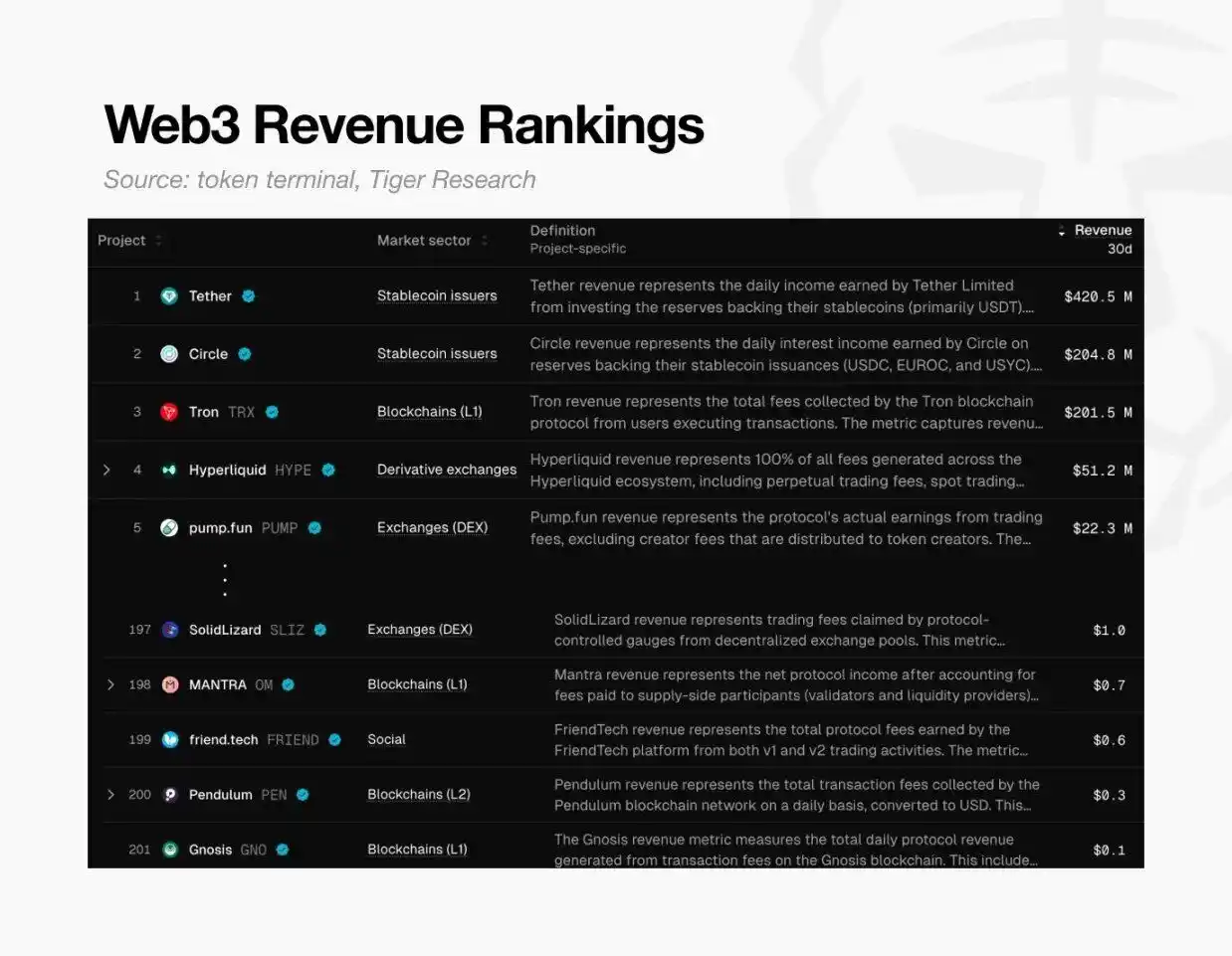
Web3 Revenue Ranking Table, Source: token terminal and Tiger Research

This crisis is universal. According to Token Terminal data, globally, only about 200 Web3 projects have achieved an income of $0.10 in the past 30 days.

This means that 99% of projects do not even have the ability to pay their own basic costs. In short, almost all cryptocurrency projects have failed to verify the feasibility of their business models and are gradually declining.

High Valuation Trap

This crisis was largely predetermined. Most Web3 projects completed their listing (token issuance) based solely on "vision", without even launching an actual product. This is in stark contrast to traditional enterprises—traditional enterprises must first prove their growth potential before an initial public offering (IPO); in the Web3 field, teams instead have to prove the rationality of their high valuation after listing (token generation event TGE).

But token holders will not wait indefinitely. As new projects emerge daily, if a project fails to meet expectations, holders will quickly sell and leave. This puts pressure on the token price, thereby threatening the project's survival. Therefore, most projects invest more funds in short-term hype rather than long-term product development. Obviously, if the product itself lacks competitiveness, even the most intensive marketing will eventually fail.
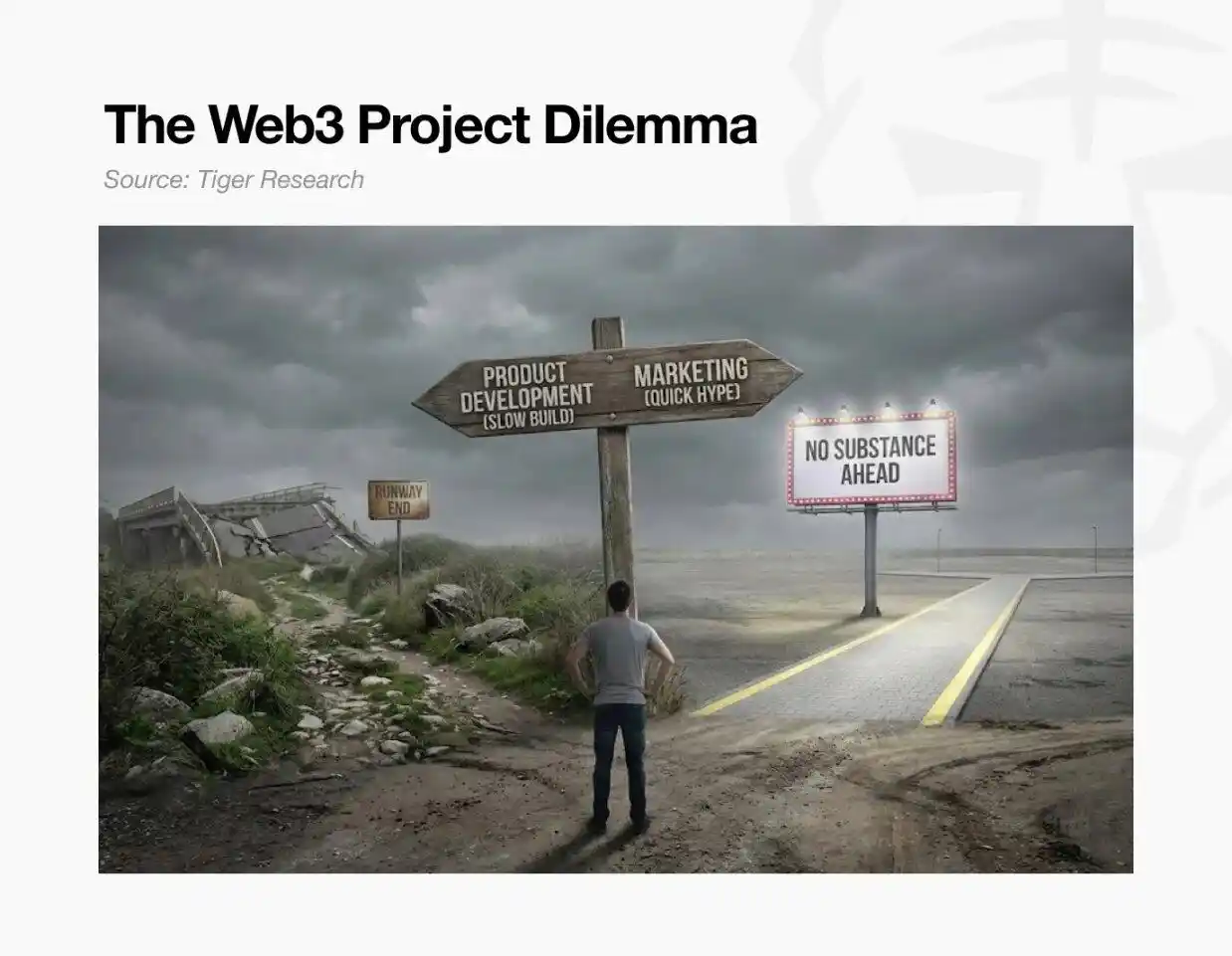
At this point, the project falls into a "dilemma trap":

  • If only focus on product development: It takes a lot of time, and during this period, market attention will gradually fade, and the fund turnover period will continue to shorten;
  • If only focus on short-term hype: The project becomes empty and lacks actual value support.

Both paths ultimately lead to failure—the project cannot prove the rationality of its initial high valuation and eventually collapses.

See the Truth of 99% of Projects Through the Top 1%

However, 1% of top projects have proven the feasibility of the Web3 model with huge revenues.

We can judge the value of major profitable projects such as Hyperliquid and Pump.fun through their price-to-earnings ratio (PER). The price-to-earnings ratio is calculated as "market capitalization ÷ annual income", and this indicator can reflect whether the project valuation is reasonable relative to actual income.

Price-to-earnings ratio comparison: Top Web3 projects (2025):
Note: Hyperliquid's sales are annualized estimates based on performance since June 2025.

The data shows that the price-to-earnings ratio of profitable projects ranges from 1x to 17x. Compared with the average price-to-earnings ratio of the S&P 500 index of about 31x, these top Web3 projects are either "undervalued relative to sales" or "have excellent cash flow conditions".

The fact that top projects with actual returns can maintain a reasonable price-to-earnings ratio makes the valuation of the remaining 99% of projects untenable—it directly proves that the high valuation of most projects in the market lacks a basis in actual value.

Can This Distorted Cycle Be Broken?

Why can projects with no sales still maintain valuations of billions of dollars? For many founders, product quality is only a secondary factor—Web3's distorted structure makes "quick exit and cash out" much easier than "building a real enterprise".

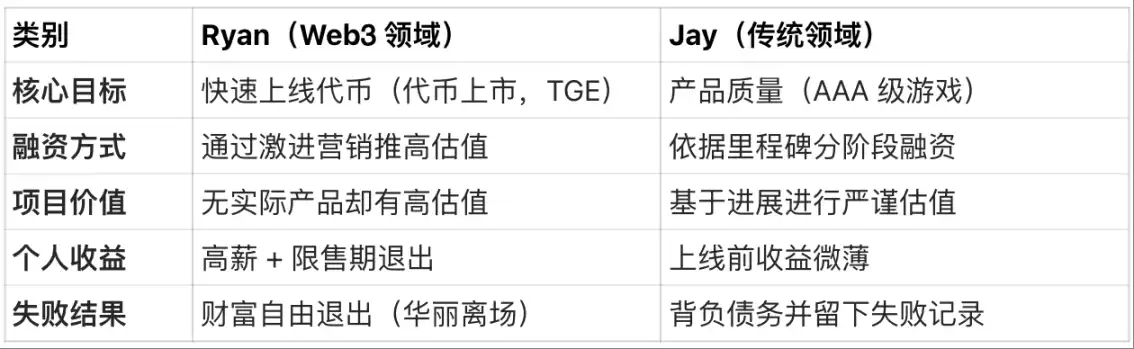
The cases of Ryan and Jay can explain this well: both launched AAA-level game projects, but the final outcomes were completely different.

Founder differences: Web3 vs. traditional model comparison

Ryan: Chose TGE, abandoned deep development

He chose a path centered on "profit": obtaining early funds by selling NFTs before the game was launched; then, while the product was still in a rough development stage, he held a token generation event (TGE) based solely on an aggressive roadmap and completed the listing on a medium-sized exchange.

After listing, he maintained the token price through hype, buying time for himself. Although the game was eventually launched late, the product quality was extremely poor, and holders sold and left. Ryan finally resigned on the grounds of "taking responsibility", but he was the real winner of this game—

On the surface, he pretended to focus on work, but in reality, he received a high salary while making huge profits by selling unlocked tokens. Regardless of the project's final success or failure, he quickly accumulated wealth and exited the market.

In contrast, Jay: Followed the traditional path, focused on the product itself

He prioritized product quality over short-term hype. But the AAA-level game development takes years, during which his funds were gradually exhausted, and he fell into a "fund turnover crisis".

In the traditional model, founders have to wait until the product is launched and sales are achieved before they can get considerable returns. Although Jay raised funds through multiple rounds of financing, he eventually shut down the company before the game was developed due to lack of funds. Unlike Ryan, Jay not only did not get any profit, but also was burdened with huge debts and left a record of failure.

Who is the Real Winner?

Neither case produced a successful product, but the winner is clear: Ryan accumulated wealth by utilizing Web3's distorted valuation system, while Jay lost everything in the process of trying to build a quality product.

This is the cruel reality of the current Web3 market: using excessive valuation to exit early is much easier than building a sustainable business model; and ultimately, the cost of this "failure" is all borne by investors.

Back to the initial question: "How do 99% of non-profit Web3 projects survive?"

This cruel reality is the most honest answer to that question.

Câu hỏi Liên quan

QAccording to the article, what is the main reason 99% of Web3 projects can survive without cash flow?

AThey rely on token sales and external funding rather than product revenue to cover their costs.

QWhat is the 'two-way trap' that unprofitable Web3 projects face after their Token Generation Event (TGE)?

AIf they focus only on product development, they lose market attention and their runaway period shortens. If they focus only on short-term hype, the project becomes hollow with no real value.

QHow does the Price-to-Earnings Ratio (P/E) of the top 1% of profitable Web3 projects reveal the truth about the other 99%?

AThe reasonable P/E ratios of the profitable top 1% prove that the high valuations of the other 99% of projects lack a foundation in real value.

QWhat key incentive does the article suggest drives founders to conduct an early TGE, even if their product is not ready?

AThe distorted structure of Web3 allows founders to achieve a 'quick exit and cash out' by selling their unlocked tokens for massive profits, regardless of the project's ultimate success or failure.

QIn the comparison of the two founders, Ryan and Jay, who was the 'winner' and what does this reveal about the current Web3 market?

ARyan was the winner because he accumulated wealth by exploiting the Web3 system, while Jay lost everything trying to build a quality product. This reveals that it is easier to exit using inflated valuations than to build a sustainable business, with the cost of failure borne by investors.

Nội dung Liên quan

Sun Zhengyi - Người bị phá sản bởi những câu chuyện hay, đang chờ đợi Alibaba tiếp theo của mình

Son Masayoshi đã trở lại. Sau nhiều năm thất bại với những khoản đầu tư như WeWork và tổn thất lớn từ Quỹ Vision, ông giờ đây được cứu rỗi bởi làn sóng AI. Cổ phiếu Arm và cổ phần OpenAI trong tay ông tăng giá mạnh, đưa SoftBank bật tăng và đưa Son Masayoshi trở lại vị trí người giàu nhất châu Á. Ông từng trải qua đỉnh cao internet những năm 1990, giàu lên nhanh chóng nhờ Yahoo và Alibaba, nhưng cũng chứng kiến tài sản bốc hơi 700 tỷ USD khi bong bóng vỡ. Giai đoạn 2017-2022 là chuỗi ngày đen tối: WeWork sụp đổ, Vision Fund thua lỗ nặng, hàng loạt startup thất bại. Son Masayoshi thừa nhận sai lầm, rút vào im lặng và chuyển sang "chế độ phòng thủ". Bước ngoặt đến với Arm - công ty ông mua năm 2016 với giá cao nay trở thành "cần câu vàng" trong kỷ nguyên AI. IPO năm 2023 giúp SoftBank thu về gấp 10 lần. Nhưng quyết định lớn nhất là đổ hàng trăm tỷ USD vào OpenAI, khoản đầu tư hiện đã sinh lời khoảng 450 tỷ USD. Nhờ hai tài sản AI này, SoftBank phục sinh ngoạn mục. Son Masayoshi, người luôn tìm kiếm những câu chuyện vĩ đại để thay đổi thế giới, một lần nữa được vận may mỉm cười.

marsbit1 giờ trước

Sun Zhengyi - Người bị phá sản bởi những câu chuyện hay, đang chờ đợi Alibaba tiếp theo của mình

marsbit1 giờ trước

WeChat Agent phát "Hùng Lệnh", nửa bầu trời Internet hưởng ứng

Để cung cấp trải nghiệm tương tác thông minh hơn, WeChat Open Platform đã ban hành hướng dẫn cho nhà phát triển về AI WeChat, cho phép các mini-program tích hợp vào hệ sinh thái AI WeChat. Sau khi tích hợp, các mini-program có cơ hội được AI WeChat đề xuất và gọi. Meituan, Ctrip, Tongcheng và các nền tảng dịch vụ khác đã công bố tích hợp hàng đầu. AI WeChat, hay Agent WeChat, dự kiến sẽ cho phép người dùng thực hiện các tác vụ như đặt đồ uống hoặc nhà hàng thông qua lệnh bằng giọng nói. Agent này có thể điều phối hàng triệu mini-program trong hệ sinh thái WeChat, tạo thành một siêu ứng dụng với khả năng hiểu ý định, gọi công cụ, xử lý thanh toán và quản lý ngữ cảnh. Nền tảng kỹ thuật bao gồm UI-Oceanus, một mô hình thế giới để dự đoán kết quả thao tác trên mini-program. WeChat là nền tảng lý tưởng cho Agent này nhờ bối cảnh phong phú từ chuỗi quan hệ, mini-program, thanh toán và nội dung. Các sản phẩm AI khác của Tencent như Yuanbao, WorkBuddy, ima và Marvis đã tích lũy năng lực cho AI WeChat thông qua cơ chế Thiết kế chung (Co-Design), cho phép chuyển giao năng lực giữa các sản phẩm. Tencent chọn cách tiếp cận Giao thức Agent-to-Agent (A2A) để các Agent từ các nhà sản xuất khác (như Honor, Xiaomi) có thể giao tiếp và gọi các chức năng có kiểm soát trong WeChat, thay vì phương pháp Giao diện người dùng đồ họa (GUI) có thể bị chặn. Điều này giúp Tencent kiểm soát quyền truy cập và các quy tắc trong hệ sinh thái của mình. Với 1,432 tỷ người dùng hoạt động hàng tháng, chi phí vận hành AI WeChat là rất lớn. Tencent có thể sử dụng chiến lược đa mô hình, kết hợp các mô hình nhỏ cho tác vụ cơ bản và mô hình mạnh cho tác vụ phức tạp. Khoản đầu tư tiềm năng 10 tỷ nhân dân tệ vào DeepSeek và việc điều chỉnh giá trên Tencent Cloud cho thấy mối quan hệ hợp tác chiến sâu sắc, có thể cung cấp năng lực suy luận chi phí thấp cho AI WeChat. Các chuyên gia của Tencent nhấn mạnh rằng AI là một cuộc chơi dài hạn, nơi giá trị thực tiễn quan trọng hơn điểm số trên bảng xếp hạng. AI WeChat hướng tới giải quyết các "vấn đề hay" trong cuộc sống hàng ngày của hàng tỷ người dùng, đánh dấu sự bước vào hiệp hai của Tencent trong lĩnh vực AI.

marsbit1 giờ trước

WeChat Agent phát "Hùng Lệnh", nửa bầu trời Internet hưởng ứng

marsbit1 giờ trước

MicroStrategy Sẽ Không Chết Trong Đợt Sụt Giảm Này: Tính Phản Chiếu, MSTR Hồi Neo Và Logic Tự Cứu 'Bán Cổ Phiếu Không Bán Coin'

**Tóm tắt bài viết "MicroStrategy Không Chết Vì Đợt Giảm Giá Này: Tính Phản Chiếu, STRC Hồi Neo Mệnh Giá và Logic Tự Cứu 'Bán Cổ Phiếu, Không Bán Bitcoin'"** Đợt sụt giảm nhanh chóng của Bitcoin (BTC) gần đây có thể là một cuộc tấn công có chủ đích nhắm vào MicroStrategy (MSTR), khai thác lo ngại về khủng hoảng thanh khoản. Điều này minh họa **tính phản chiếu (reflexivity)**: kỳ vọng thị trường có thể tự biến thành hiện thực. Kịch bản tấn công: dự trữ tiền mặt giảm → kỳ vọng MSTR buộc phải bán BTC → bán tháo gây áp lực giảm giá BTC → giá BTC giảm làm xấu đi bảng cân đối kế toán và giá trị tài sản ròng điều chỉnh theo BTC (mNAV) → kỳ vọng "không thể chống đỡ" càng được củng cố. Cổ phiếu ưu đãi STRC của MSTR (thực chất là trái phiếu lãi suất thả nổi) cũng giảm theo do thị trường định giá lại rủi ro và yêu cầu tỷ suất sinh lợi cao hơn lãi suất danh nghĩa hiện tại. Tuy nhiên, với bản chất là công cụ **lãi suất thả nổi**, giá STRC về lâu dài sẽ có xu hướng quay trở lại neo tại mệnh giá 100. Đây là điều kiện tiên quyết để MSTR có thể tiếp tục sử dụng STRC như một công cụ gây vốn hiệu quả. Để phá vỡ vòng xoáy phản chiếu và củng cố dự trữ tiền mặt, MSTR có hai lựa chọn: **bán BTC** hoặc **phát hành thêm cổ phiếu phổ thông**. * **Bán BTC** có thể giải quyết khủng hoảng ngắn hạn nhưng là hành động "uống thuốc độc giải cơn khát". Nó phá vỡ câu chuyện "không bao giờ bán BTC" – nguồn gốc tạo ra **mNAV premium** (khi mNAV > 1). Việc này khiến cổ phiếu phổ thông bị định giá lại, làm thu hẹp hoặc xóa sổ khoản premium, hủy hoại "bánh đà" tăng trưởng dựa trên việc phát hành cổ phiếu để mua thêm BTC. Hơn nữa, bán BTC làm giảm lượng BTC trên mỗi cổ phiếu và có thể làm xấu hơn tỷ lệ nợ. * **Phát hành thêm cổ phiếu phổ thông** (khi mNAV > 1) là giải pháp ưu việt. MSTR có thể sử dụng một phần số tiền huy động được để tăng dự trữ tiền mặt (làm dịu lo ngại của trái chủ STRC), trong khi phần còn lại mua BTC vẫn tạo ra giá trị cho cổ đông nhờ vào premium. Cách này bảo vệ được lượng BTC trên mỗi cổ phiếu, không làm tổn hại đến câu chuyện đầu tư, và còn cải thiện tỷ lệ nợ. Tóm lại, MSTR khó có thể chết trong đợt sụt giảm này vì có các công cụ để ứng phó. Tuy nhiên, lựa chọn giữa **bán cổ phiếu** và **bán BTC** sẽ quyết định tính bền vững lâu dài của mô hình và câu chuyện đầu tư mà công ty đã xây dựng. Việc bán BTC, dù có thể giải cứu ngắn hạn, sẽ đặt ra câu hỏi về kết cục trong tương lai khi vòng xoáy phản chiếu tiếp diễn.

marsbit1 giờ trước

MicroStrategy Sẽ Không Chết Trong Đợt Sụt Giảm Này: Tính Phản Chiếu, MSTR Hồi Neo Và Logic Tự Cứu 'Bán Cổ Phiếu Không Bán Coin'

marsbit1 giờ trước

Giao dịch

Giao ngay
Hợp đồng Tương lai
活动图片