On February 25th, a team called Nous Research quietly released a v0.1.0 on GitHub. Initially, the Hermes model only had a one-line installation command and a one-sentence product positioning: "An agent that grows with you".
At the time, very few people noticed it. Even though Nous Research has a certain reputation in the model community, and their Hermes series models have accumulated 33 million downloads on HuggingFace, the entire developer community's attention was focused on the deified OpenClaw "Crawfish". Gaining stars 33% faster than React to become the historical number one, "Crawfish" became the fastest-growing project in GitHub history, peaking at 710 stars per hour. But at the same time, security researchers were disclosing vulnerabilities at an average rate of 2.2 CVEs per day within the same time window, accumulating 138 security vulnerabilities over 63 days. The entire community began to rethink a question: Can this thing actually be used in a production environment?
Against this backdrop, Hermes Agent, as a competing product, finally found an opportunity and welcomed its own first period of rapid growth.
Hermes wrote a one-click migration tool from OpenClaw into its code. Those developers leaving OpenClaw needed a place to land, and Hermes Agent became a well-recommended choice passed around by word of mouth.
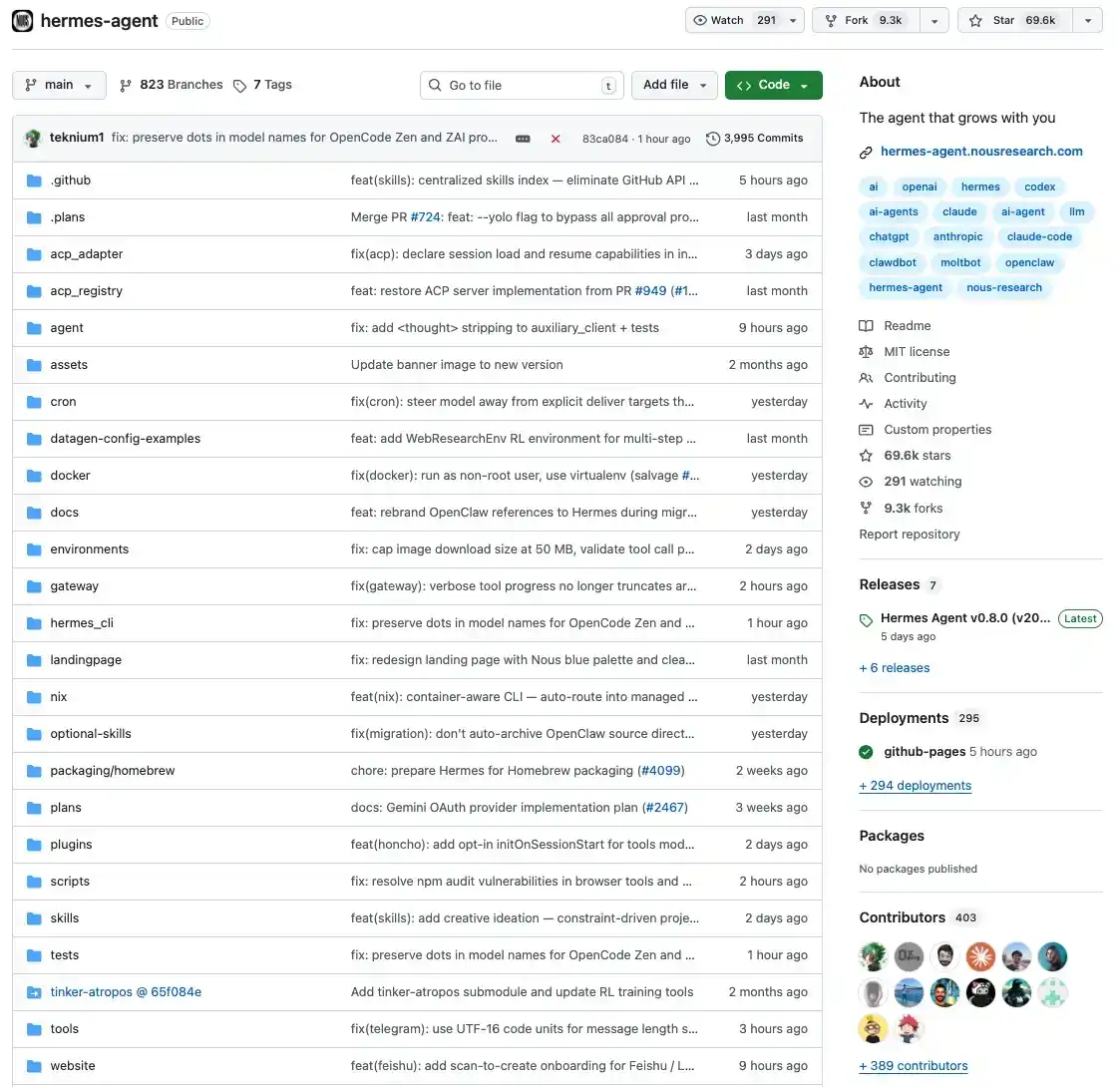
So, starting from early March, Hermes Agent broke into GitHub Trending, reaching a high of 11th place, with stars surpassing 2200. AwesomeAgents called it "the most ambitious open-source Agent release of 2026 so far". Currently, Hermes has 69.9k Stars and 9k Forks on GitHub.
Today, BlockBeats will talk to everyone about what makes this Agent different.
What is Hermes Agent?
Hermes Agent is a self-evolving AI agent built by Nous Research, and it is currently the only Agent with a built-in learning loop.
It can automatically create skills from usage experience, continuously improve these skills during use, actively solidify knowledge into reusable assets, retrieve its own past conversation history, and continuously deepen its understanding of you, the user, across multiple sessions.
So, simply put, the biggest advantage of Hermes Agent is: The more you use it, the smarter and more handy it becomes.
Its positioning is not a programming assistant bound to an IDE, nor is it a chat wrapper for a single API, but a truly autonomous agent that resides on your server, remembers what it has learned, and grows stronger the longer it runs.
Nous Research has positioned itself from the beginning as an open-source first, decentralization-oriented AI lab, aiming to build AI that users can control autonomously, rather than concentrating intelligence in the hands of a few closed companies. Their early work focused on the Hermes model series, while also investing heavily in infrastructure and systems level, exploring technologies like DisTrO for model training across globally distributed consumer-grade GPUs, and simulation environments like WorldSim and Doomscroll for multi-agent interaction and long-term behavior.
The team behind Hermes Agent is the same group that previously built a series of models like Nomos and Psyche.
What are the useful tools?
The core mechanisms of Hermes Agent are its memory system and skill system. The Agent maintains two concise core files: MEMORY.md stores environmental information, conventions, and experiences summarized from past tasks; USER.md stores your preferences and communication style. These two files are automatically injected into the system prompt at the start of each session, acting as the Agent's "long-term working memory". Additionally, all historical sessions are stored in a SQLite full-text search database, allowing the Agent to retrieve conversation content from weeks ago.
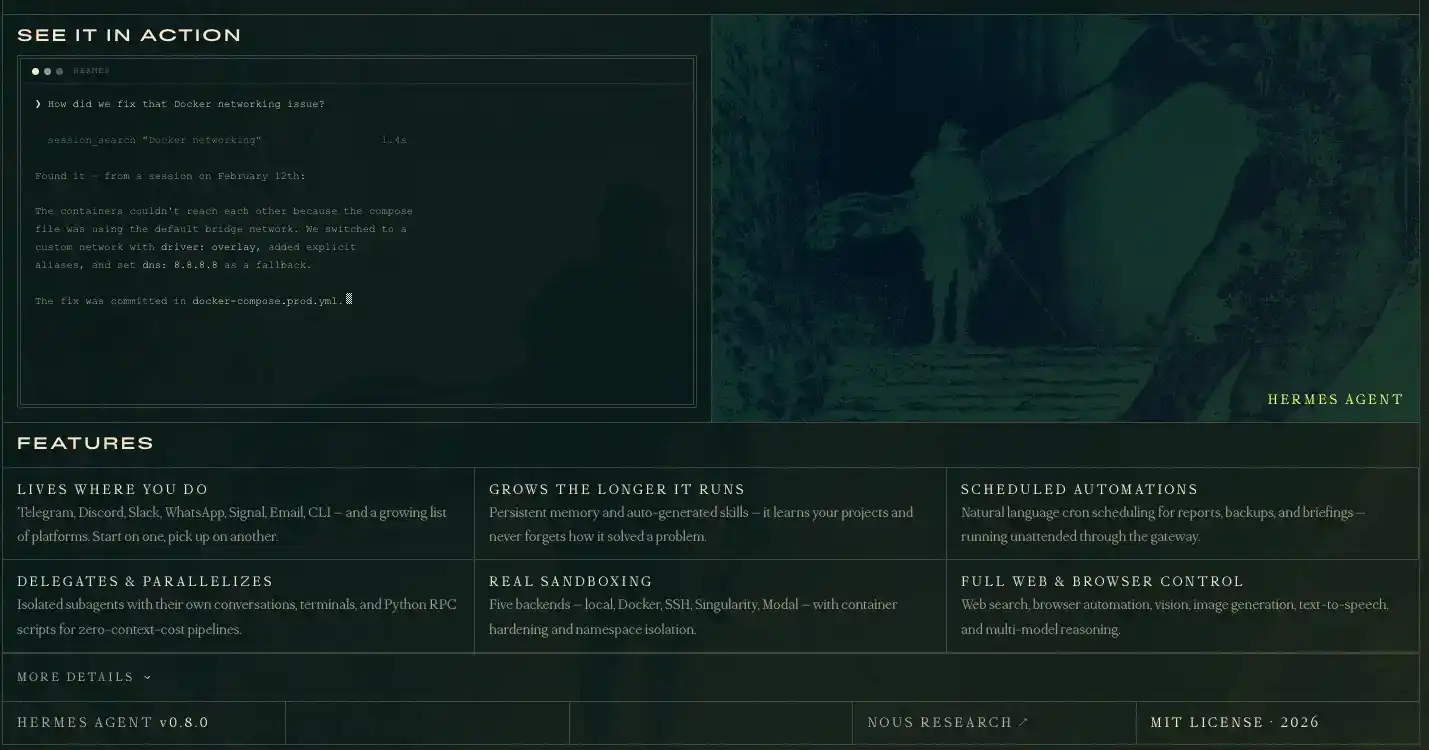
Regarding the skill system, each time a complex task is completed (typically involving 5 or more tool calls), the Agent autonomously creates a structured Markdown "skill document" recording the steps, known information, and verification methods for future reuse. Skill files follow a progressive disclosure pattern: the Agent by default only sees the skill name and description (about 3000 tokens), and loads the full content of a specific skill only when needed, thus controlling token consumption.
At the tool level, Hermes Agent comes with over 40 built-in tools, covering web search, browser automation, visual understanding, image generation, text-to-speech, and also supports setting up scheduled tasks via natural language, allowing the Agent to automatically perform periodic work like report generation, data backup, and system monitoring unattended.
Among these, the most popular tools, meaning those with the highest frequency of use by the community users, the most feedback, and based on Hermes's functional architecture and the typical needs of the developer community, the ones ranked at the top are these:
Hindsight is currently the hottest single tool in the ecosystem and is the officially recommended long-term memory plugin for Hermes. It automatically recalls relevant context before each LLM call, supports local PostgreSQL or cloud deployment, and is already integrated into Hermes as a native Memory Provider.
Anthropic-Cybersecurity-Skills is the skill pack with the highest Stars in the ecosystem, containing 753+ structured cybersecurity skills, fully mapping the MITRE ATT&CK framework, suitable for security research and penetration testing scenarios.
mission-control is currently the most popular Agent orchestration dashboard in the ecosystem, supporting Agent fleet management, task distribution, cost tracking, and multi-Agent collaborative workflows, recommended by the community as the standard for production-level deployment.
Hermes Agent Self-Evolution is an evolutionary self-improvement technique using DSPy + GEPA to optimize skills, prompts, and code.
Hermes Workspace is the native workspace for Hermes, integrating a chat interface, terminal, and skill manager, and is the most popular graphical entry point.
Furthermore, it can spawn independent sub-agents, each with its own dialogue context, independent terminal, and Python RPC scripts, enabling zero-context-cost parallel pipelines.
In terms of infrastructure flexibility, it supports six terminal backends: local run, Docker, SSH remote, Daytona serverless, Singularity containers, and Modal cloud functions. Daytona and Modal hibernate when idle, costing almost nothing. You can run it on a $5 VPS or a GPU cluster, issue commands through Telegram, and have it work on cloud servers you never SSH into directly.
Hermes Agent currently constitutes the most direct competition with OpenClaw, as both are open-source Agent frameworks aimed at developers.
The architectural philosophies of the two are截然不同 (distinctly different): OpenClaw's design core is a "control plane", a unified long-running process responsible for managing sessions, routing, tool execution, and state—everything flows through this central controller. Hermes, however, centers around the Agent's own execution loop, building the gateway, task scheduler, tool runtime, etc., all around this "do, learn, improve" iterative cycle.
The difference in the skill systems is particularly significant: OpenClaw's skills are mostly manually written, loaded from different levels like workspace, personal, shared, or plugins; Hermes's approach is to let the Agent generate skills from experience itself, forming a true autonomous learning loop.
How to Install and Use
Getting started is extremely simple. A single command, "curl -fsSL https://raw.githubusercontent.com/NousResearch/hermes-agent/main/scripts/install.sh | bash", completes the installation. It works on Linux, macOS, and WSL2. Hermes Agent automatically completes all configuration without manual operation.
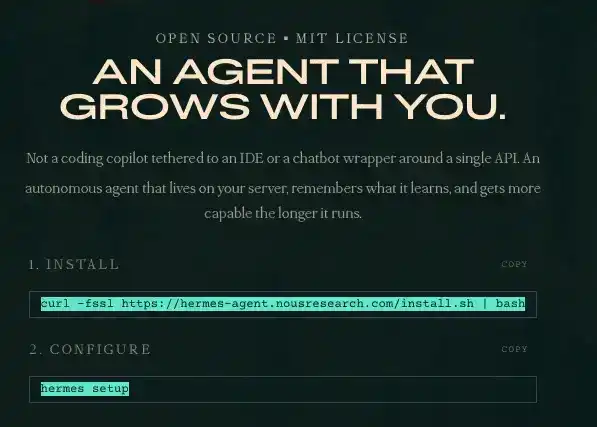
Hermes Official Website
After Hermes Agent is installed, run "hermes setup" to start the setup wizard. Select your model provider (supports Nous Portal, OpenRouter, OpenAI, or any custom endpoint), connect your messaging platform (Telegram, Discord, Slack, or WhatsApp), and then start your first conversation. From the first interaction, Hermes Agent immediately enters learning mode, starting to build memory, create skills, and becoming more capable after each session.
Core commands for daily use include:
hermes (start conversation),
hermes model (select LLM provider and model),
hermes tools (configure which tools to enable),
hermes gateway (start message gateway, connect to Telegram, Discord, etc.),
hermes setup (run the full setup wizard, configure everything at once),
hermes claw migrate (migrate from OpenClaw),
hermes update (update to the latest version),
hermes doctor (diagnose problems);
Hermes Agent is suitable for scenarios including: General AI assistants that need to remember context across sessions and continuously improve capabilities; Custom Agent workflows that need to combine tools, plugins, MCP servers, browsers, or Shell; Deploying Agents on local hardware, cloud VMs, or low-cost serverless infrastructure; and Persistent assistant scenarios that require cross-platform searchable conversation history and acquired skills.
More specifically, you can use it to talk to it on Telegram while it executes tasks on a cloud VM, set up automations and push reports to any platform, have it take over periodic tasks; you can also integrate it into Slack or Discord to provide AI collaboration support for the entire team; or utilize its trajectory export function to generate training data for RL training of next-generation tool-calling models.