Gemini 3.5 Pro Top Secret Leak, Front-end Capabilities Surpass Fable 5

marsbitXuất bản vào 2026-07-06Cập nhật gần nhất vào 2026-07-06

Tóm tắt

"Gemini 3.5 Pro Leak: Frontend Surpasses Fable 5, Official Launch Expected July 17th. After a two-month silence, Google's Gemini 3.5 Pro appears poised for release. Leaks highlight its significant leap in frontend and visual code generation, reportedly surpassing competitor Fable 5. Key improvements include better design aesthetics, cleaner UI, enhanced SVG generation, and higher completion rates for full-page generation from single prompts. Tests show capabilities like creating detailed SVG portraits, complex UI elements, and 3D scenes with Three.js. However, the model reportedly still lags behind Fable 5 and GPT-5.6 in hardcore reasoning, agentic tasks, and long-range software engineering. The delay is attributed to Google reportedly conducting a new pre-training run with a fresh base model, rather than simply scaling up Gemini 3.5 Flash. Rumors also suggest this new base is being used for an image model, 'Nano Banana Pro,' targeting GPT-Image 2. The AI race intensifies as the industry awaits the potential July 17th reveal."

【Guide】After a full two months of anticipation, Gemini 3.5 Pro is finally coming! Front-end code generated in one go, rumored to officially debut on July 17th.

What might overturn Fable 5 could be Google's trump card!

Today, the internet was flooded with leaks about Gemini 3.5 Pro. Rumored to be officially released on July 17th.
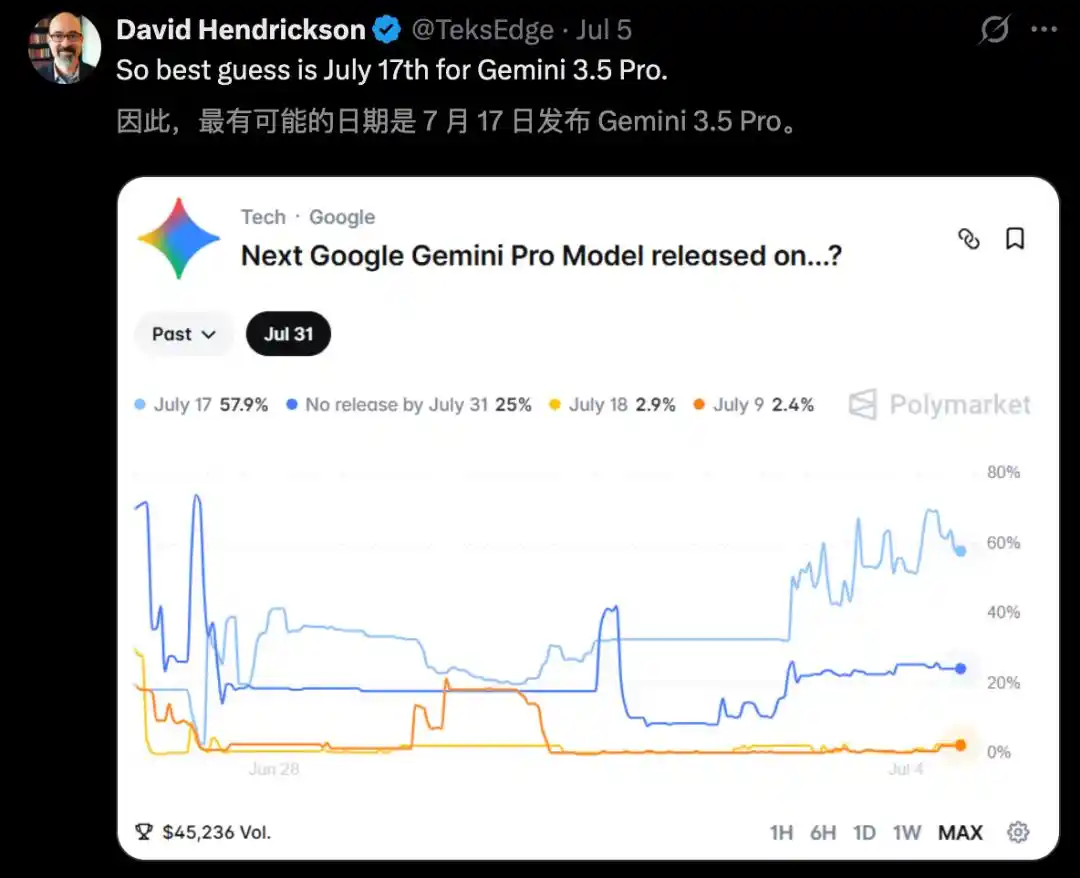
What truly makes people sit up is its performance in front-end generation: one-shot generation, pixel-perfect accuracy, zero errors.

Most crucially, leaked performance data shows Gemini 3.5 Pro has surpassed Fable 5.
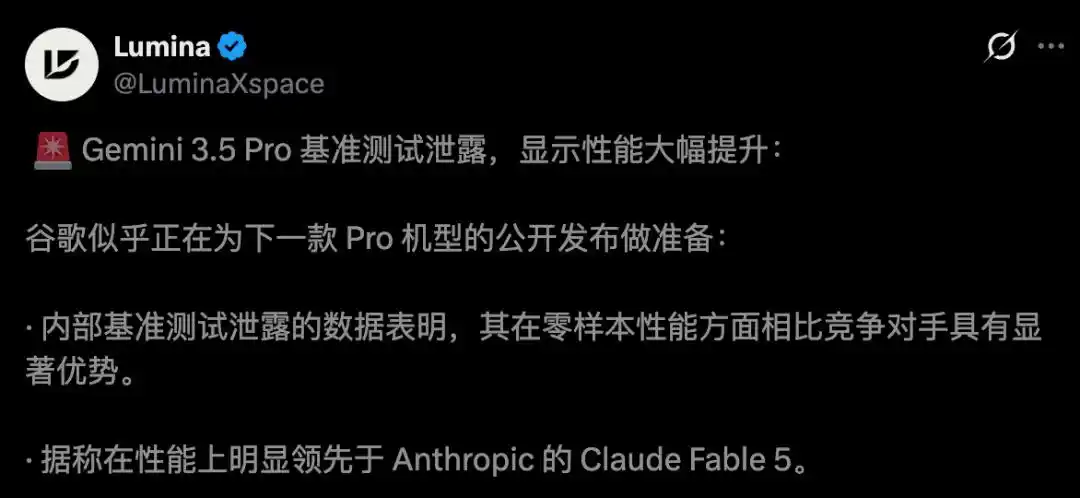
Gemini 3.5 Pro's Front-end Prowess Surpasses Fable 5

After a full two months of holding back, Google's ace card, which they've been reluctant to release, is finally about to be born.

At the I/O conference, they unveiled the Gemini 3.5 series in one go:

But on the day itself, only the lightweight Gemini 3.5 Flash went live; the "premium" Pro was kept in the background.

Sundar Pichai promised on stage, "Give us another month."
June passed, and Pro didn't arrive; now Google has changed their timeline to "July," but still hasn't given a specific calendar date.

Thus, during this information vacuum of official silence, leaks became the sole source of information.

And the Gemini 3.5 Pro pieced together from these fragments presents a rather distinct and somewhat "specialized" picture.

Let's start with the conclusion, which is the strongest and most consistent signal in this round of leaks:

Gemini 3.5 Pro has shown a clear capability leap in "front-end and visual code generation."
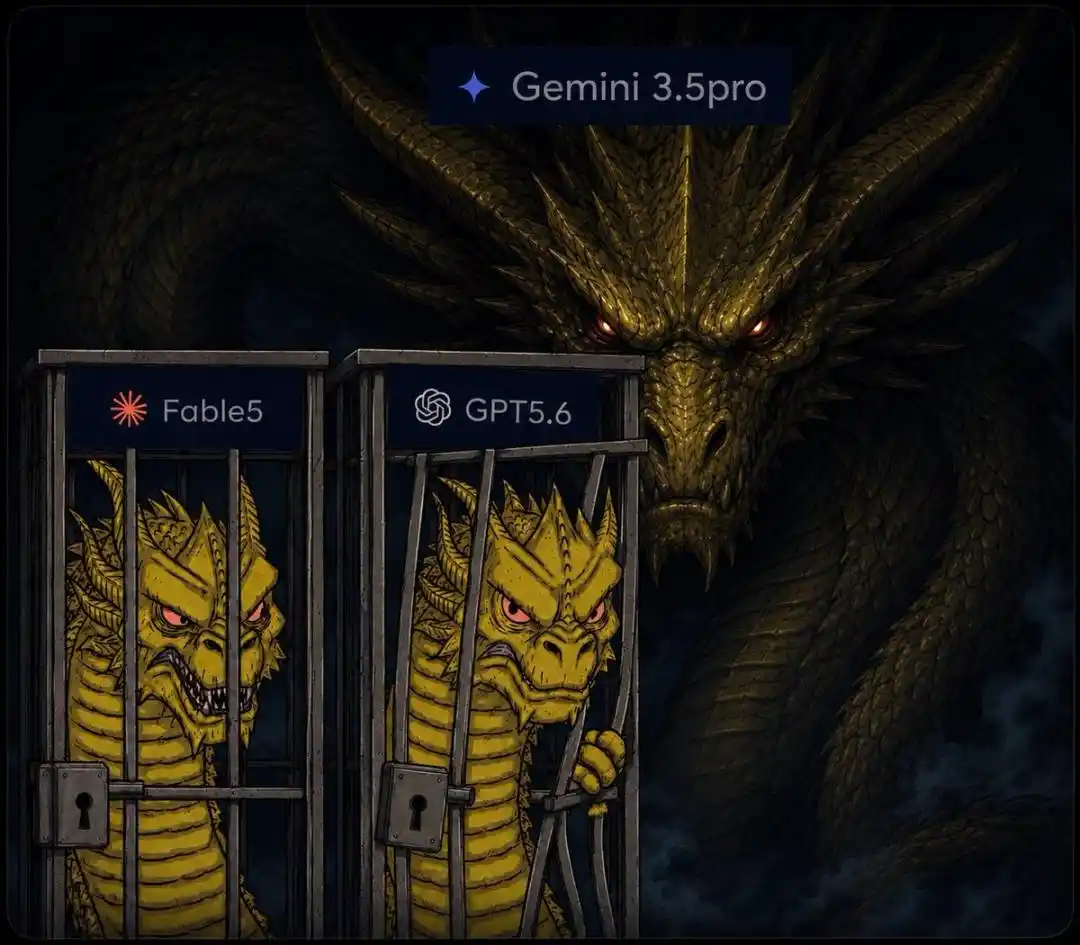
Based on feedback from multiple developers on X, the leaked version has visibly improved in these areas—

  • Better Design Taste: Generated interfaces are no longer "programmer aesthetic"; color schemes, whitespace, and hierarchy are closer to a professional designer's touch;
  • Cleaner UI: One-shot generated front-end pages have clearer structures and less redundancy;
  • Significant Enhancement in SVG Generation: This is a repeatedly highlighted area of improvement; complex vector graphics can be drawn correctly in one go with fewer missing pixels;
  • Higher "Completion Degree" for Front-end: A single prompt can generate a decent-looking page, not a half-finished product.

During testing, developer QASIM-livelifewithai couldn't help but exclaim:

Gemini 3.5 Pro actually generated an SVG image identical to Gemini lead Logan Kilpatrick himself!

A comparison image between Gemini 3.5 Pro and Fable 5 shows the former slightly superior in artistic conception and atmosphere.


For example, generating a UI with just one sentence.

A hand-drawn SVG mechanical orrery was also achieved by Gemini 3.5 Pro with just one prompt.

Gemini 3.5 Pro can also use Three.js to generate a floating steampunk island.
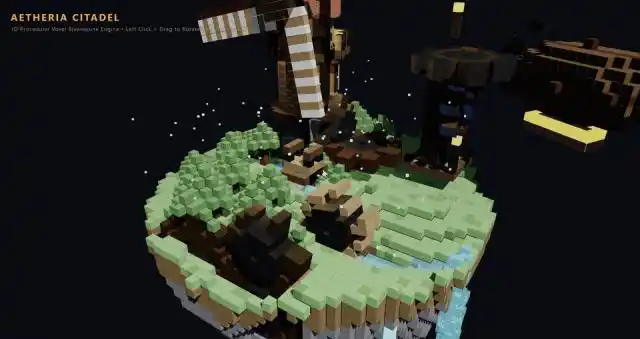
In developer circles, a slightly jesting term has even started circulating to describe Gemini 3.5 Pro's front-end performance—

"mogging" (completely dominating).

Hardcore Reasoning: Inferior to Fable 5, GPT-5.6

Dominating in front-end doesn't mean dominating in all areas.

In LM Arena's stealth testing, Gemini 3.5 Pro indeed suppressed a host of opponents on these tasks.

However, on the hardest Agent tasks, repository-level software engineering, and long-range tasks, 3.5 Pro still can't beat Fable 5, nor catch up to GPT-5.6.

Fable 5 is an absolute beast on heavy engineering tasks like "repository-level, deep debugging, high-ceiling architectural refactoring," scoring quite well on benchmarks like SWE-Bench Pro;

GPT-5.6 similarly holds a steady lead on the most challenging multi-step reasoning tasks.

And what level is Gemini 3.5 Pro on this line?

Even the leaker themselves stated frankly that even with a new foundation, it "still can't beat Fable 5 or GPT-5.6 on the hardest agent and long-chain tasks."

Earlier last month, a leaked benchmark was even less polite, directly ranking it behind Fable 5 and GPT-5.6.

Its weaknesses are concentrated in reasoning, coding, and long-term task execution.

Old Foundation Swapped, Retrained from Scratch

More intriguing than the front-end performance is why Gemini 3.5 Pro is delayed.

According to the leak, the reason Google is dragging into July is not that they spent the extra time on "parameter tuning and fine-tuning," but rather on doing something much heavier—

Conducting another round of "pre-training," no longer relying on the older foundation.

In other words, Pro is not a simple scaled-up version of Flash, but a rebuild on a new foundation.

Apart from the model itself, the leak also contains an easter egg:

Google is preparing an image model called Nano Banana Pro based on this new Gemini 3.5 Pro foundation, aiming to directly compete with OpenAI's GPT-Image 2.

If true, this means Google wants to strengthen simultaneously on both the "text + image" fronts.

One round of retraining, feeding two product lines: one to tackle front-end code, one to tackle image generation.

Google's plan is quite clever—using the same foundation to open fire on two battlefields at once. Now, the entire internet is waiting for July 17th.

And this is precisely the reality of the 2026 large model arms race. Everyone is desperately accelerating, yet no one has managed to completely overturn their opponent in one go.

Looking back at the past six months, the buzz in the AI circle has had little to do with Google, with OpenAI and Anthropic taking turns stealing the spotlight.
But those familiar with Google know they love to hold back, accumulate a wave, and then release everything in one go.

This time with Gemini 3.5 Pro, it's likely the same strategy: using a flagship model retrained on a new foundation to reclaim lost ground in one fell swoop.

Whether July 17th will actually happen, and if it does, whether it will be as the leaks say, the answer can only come from Google itself.

But one thing is already certain: in this war of the gods, no one dares to stop to catch their breath.

References:

https://x.com/ggg78g89/status/2073783990646149488?s=20

https://x.com/HarshithLucky3/status/2073767413494284754?s=20

https://x.com/ggg78g89/status/2073852747049517231?s=20

This article is from WeChat public account "New Zhiyuan" (新智元), author: ASI Apocalypse; Editor: Peach (桃子)


Câu hỏi Liên quan

QWhat is the main topic of the leaked information about Gemini 3.5 Pro?

AThe main topic is Gemini 3.5 Pro's significant leap in front-end and visual code generation capabilities, reportedly surpassing Fable 5 in this area. It is also mentioned to be scheduled for release on July 17th.

QAccording to the article, in which specific area does Gemini 3.5 Pro outperform Fable 5?

AAccording to the article, Gemini 3.5 Pro outperforms Fable 5 specifically in front-end and visual code generation, including generating cleaner UI, better design aesthetics, improved SVG generation, and higher completion rates for front-end pages.

QWhat are the key weaknesses or areas where Gemini 3.5 Pro is said to still lag behind competitors like Fable 5 and GPT-5.6?

AGemini 3.5 Pro's key weaknesses are in hardcore reasoning, long-context task execution, agent tasks, and large-scale, complex software engineering tasks. It reportedly still cannot beat Fable 5 or GPT-5.6 in these areas.

QWhat major change did Google reportedly make to Gemini 3.5 Pro that caused its delayed release?

AGoogle reportedly conducted a new 'pre-training' run for Gemini 3.5 Pro, rebuilding it on a new base foundation instead of just scaling up the Gemini 3.5 Flash model. This fundamental retraining is cited as the reason for the delay.

QWhat future model based on the Gemini 3.5 Pro base is mentioned in the leaks, and what is its target?

AThe leaks mention a future model called 'Nano Banana Pro,' an image model based on the new Gemini 3.5 Pro foundation. Its target is to more directly compete with OpenAI's GPT-Image 2.

Nội dung Liên quan

Donald Trump, Tổng thống Mỹ biết 'chơi' chứng khoán nhất

Donald Trump, tổng thống Mỹ giàu có nhất lịch sử, đã kiếm được 2,2 tỷ USD trong năm 2025, theo báo cáo tài chính công khai. Phần lớn thu nhập đến từ tiền điện tử (1,4 tỷ USD), đặc biệt là đồng meme $TRUMP và token WLFI của công ty World Liberty Financial do gia đình ông thành lập. Lĩnh vực bất động sản truyền thống mang về 575 triệu USD, với các khu nghỉ dưỡng và sân golf như Mar-a-Lago có doanh thu tăng mạnh nhờ sự hiện diện của ông. Trump cũng thực hiện hơn 22.000 giao dịch chứng khoán trong năm, với tần suất cao bất thường và thời điểm giao dịch trùng khớp với các sự kiện chính sách quan trọng, dấy lên lo ngại về xung đột lợi ích. Dù Nhà Trắng cho biết các giao dịch do đội ngũ chuyên nghiệp quản lý, việc Trump không sử dụng ủy thác mù (blind trust) như các tổng thống tiền nhiệm vẫn là điểm gây tranh cãi. Bài viết nhận định Trump đã biến vai trò tổng thống thành một "cỗ máy kinh doanh", khai thác triệt để ảnh hưởng chính trị để thu lợi nhuận cá nhân và gia đình, từ tiền điện tử, bất động sản đến chứng khoán. Điều này làm dấy lên cuộc tranh luận mới về ranh giới giữa quyền lực công và lợi ích tư trong chính trị Mỹ.

marsbit10 phút trước

Donald Trump, Tổng thống Mỹ biết 'chơi' chứng khoán nhất

marsbit10 phút trước

Chịu lỗ 55 triệu USD cũng phải bán tiền điện tử, Ngày đáo hạn cho niềm tin của Strategy

Vào ngày 6/7, Michael Saylor thông báo MicroStrategy đã bán 3,588 BTC (trị giá khoảng 216 triệu USD) để trả cổ tức cho chứng khoán ưu tiên số. Giao dịch này ghi nhận khoản lỗ thực tế lên tới 55 triệu USD so với giá mua trung bình của công ty. Đây là lần bán đầu tiên kể từ năm 2022 và đánh dấu sự đảo chiều so với chiến lược "không bao giờ bán" trước đây. Động thái này xuất phát từ áp lực tài chính bắt buộc. MicroStrategy phát hành nhiều loại chứng khoán ưu tiên (như STRC) với nghĩa vụ trả cổ tức/lãi hàng năm lên tới khoảng 1,76 tỷ USD. Khi giá Bitcoin giảm, cổ phiếu MSTR mất phần premium so với tài sản ròng (mNAV), khiến việc huy động vốn mới bằng cách phát hành cổ phiếu trở nên bất lợi. Do đó, bán Bitcoin để chi trả trở thành lựa chọn khả thi duy nhất. Tác động chính là sự thay đổi cơ cấu thị trường: từ một nhà mua kiên định lớn nhất, MicroStrategy nay trở thành một nguồn bán có lịch trình, ước tính cần bán khoảng 29,000 BTC mỗi năm để đáp ứng nghĩa vụ. Điều này gây áp lực tâm lý lên giá Bitcoin và đặt dấu hỏi về mô hình DAT (Kho bạc tài sản số) của nhiều công ty khác. Tuy nhiên, với dự trữ tiền mặt 2,55 tỷ USD, MicroStrategy vẫn có khả năng chi trả trong khoảng 17 tháng mà không cần bán thêm Bitcoin. Lối thoát cho công ty phụ thuộc vào việc giá Bitcoin phục hồi, giúp chứng khoán ưu tiên STRC trở lại mệnh giá 100 USD và mở lại kênh huy động vốn, từ đó khởi động lại "bánh đà" tăng trưởng cũ.

链捕手43 phút trước

Chịu lỗ 55 triệu USD cũng phải bán tiền điện tử, Ngày đáo hạn cho niềm tin của Strategy

链捕手43 phút trước

Sóng gió hợp tác giả OUSD? Trò chơi tín dụng giữa stablecoin và sự bảo đảm của các gã khổng lồ

TÓM TẮT: Tuần trước, Open Standard ra mắt stablecoin OpenUSD (OUSD) với danh sách hơn 140 đối tác "khủng" như Visa, Mastercard, Stripe, BlackRock, Google, Samsung, Coinbase... Ngay lập tức, giá cổ phiếu của Circle (phát hành USDC) giảm. Tuy nhiên, chỉ vài ngày sau, danh sách này bắt đầu nứt vỡ. Nhiều công ty Hàn Quốc như Samsung Electronics, Shinhan Financial Group, Dunamu (mẹ của Upbit) và K Bank lên tiếng phủ nhận sự tham gia chính thức, cho biết họ chỉ được hỏi ý kiến và chưa có thỏa thuận nào. Các công ty Mỹ trong danh sách cũng được báo cáo là chưa ký kết gì. OUSD hứa hẹn ba điểm khác biệt: phí tạo và đổi lấy bằng 0, không giới hạn khối lượng giao dịch, và chia sẻ phần lớn lợi nhuận từ tài sản dự trữ cho các đối tác. Chính mô hình chia sẻ lợi nhuận này khiến việc có tên trong danh sách trở thành vấn đề uy tín và thương mại nghiêm trọng. Sự việc gợi nhớ đến Libra (sau này là Diem) của Facebook năm 2019, một liên minh "toàn sao" tương tự đã tan rã nhanh chóng dưới áp lực quản lý. Jeremy Allaire, CEO của Circle, hoan nghênh cạnh tranh nhưng chỉ ra bản chất của mạng lưới stablecoin là hiệu ứng mạng lưới và xu hướng "kẻ thắng chiếm tất cả". Ông hoài nghi về mô hình liên minh, cho rằng chúng thường thiếu sự phối hợp, động lực lệch lạc và chậm chạp. Theo dữ liệu, thị trường stablecoin hiện bị thống trị bởi USDT (1.843 tỷ USD) và USDC (730 tỷ USD), chiếm gần 90% tổng vốn hóa ~3.000 tỷ USD. Thành công của một stablecoin không nằm ở danh sách đối tác hào nhoáng, mà ở các trường hợp sử dụng thực tế như thanh toán B2B, quyết toán thương mại và chuyển tiền xuyên biên giới. OUSD có những điểm khác biệt và một số đối tác thực sự (như Stripe), nhưng liệu nó có tránh được vết xe đổ của Libra và tạo dựng được mạng lưới ứng dụng thực hay không vẫn còn là câu hỏi mở. Thị trường sẽ tự đưa ra câu trả lời.

链捕手46 phút trước

Sóng gió hợp tác giả OUSD? Trò chơi tín dụng giữa stablecoin và sự bảo đảm của các gã khổng lồ

链捕手46 phút trước

Giao dịch

Giao ngay
活动图片