The year 2025 is destined to leave a profound mark on global financial history, hailed as the "Sovereign Integration Year" for the crypto asset industry. If 2024 was the "Wall Street Moment" brought by Bitcoin ETFs, then 2025 marks the year digital assets officially leaped from mere financial speculation tools to becoming geopolitical strategic chips and national reserve assets. The core driver of this transformation stems from a dramatic shift in the U.S. executive branch—the Trump administration's historic move to establish a "Bitcoin Strategic Reserve" upon taking office, fundamentally rewriting the underlying logic of global monetary competition.
This year witnessed frequent watershed events in regulation: the signing of the GENIUS Act granted stablecoins legitimate dollar status; the World Liberty Financial (WLFI) project, directly involving the Trump family, blurred the lines between politics and DeFi; and the pardons of Ross Ulbricht and CZ signaled the resolution of the crypto "wild west era" and the dawn of a new order.
This article will review what the author considers the 10 most milestone events in the crypto industry in 2025.
These events constitute the "points of no return" for the industry's development in 2025—decisive moments that irrevocably altered market structure, regulatory environment, or technological paradigms.
1. The Geopolitical Pivot: Establishment of the U.S. Bitcoin Strategic Reserve
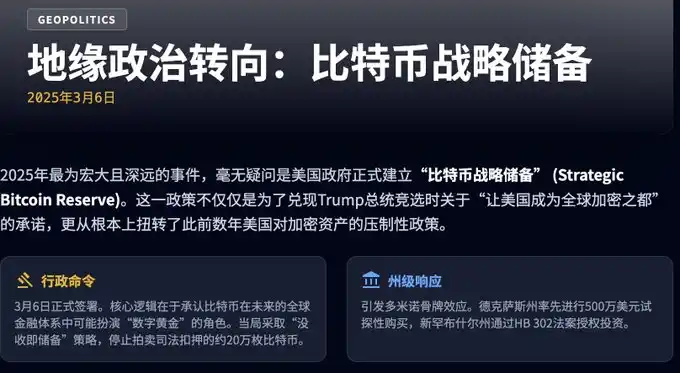
The most monumental and far-reaching event of 2025 was undoubtedly the U.S. government's formal establishment of the "Bitcoin Strategic Reserve." This policy was not only about fulfilling President Trump's campaign promise to "make America the crypto capital of the world," but it also fundamentally reversed years of suppressive U.S. policies towards crypto assets, elevating them to the status of a national strategic resource on par with gold and oil.
1.1 Policy Origin and Execution Mechanism
President Trump signed an executive order shortly after taking office and formally issued the directive to establish the reserve on March 6. Its core logic was to acknowledge Bitcoin's potential role as "digital gold" in the future global financial system.
On the execution front, the administration adopted a "confiscation as reserve" strategy—halting the auction of approximately 200,000 bitcoins previously seized by judicial authorities (e.g., the Silk Road case, Bitfinex case) and transferring them to a newly created "Digital Asset Reserve" for permanent holding. Furthermore, the executive order directed the Treasury and Commerce Departments to devise a "budget-neutral" accumulation strategy, meaning the U.S. government effectively transformed from the largest potential seller into a long-term holder of this asset class.
1.2 The "Lummis Plan" and Legislative Gambit
Senator Cynthia Lummis resubmitted the "Bitcoin Strategic Reserve Act," proposing the use of Federal Reserve surplus funds to purchase 1 million bitcoins (about 5% of total supply) over five years and hold them for at least 20 years. While somewhat fanciful and sparking fierce debate in Congress, the prior enactment of the executive order at least set a positive precedent.
1.3 Domino Effect at the State Level
The federal government's shift in attitude triggered a "digital arms race" among states. As of December 2025, 16 states had either tabled relevant legislation for discussion or moved it forward.
- Texas: Pioneered a "tentative" purchase of $5 million through the Comptroller's office.
- New Hampshire: Passed HB 302, authorizing the state Treasury to invest reserve funds in digital assets, marking a major breakthrough in state government treasury management观念.
2. The Regulatory Endgame: The GENIUS Act and the "Dollarization" of Stablecoins, The Arrival of MiCA
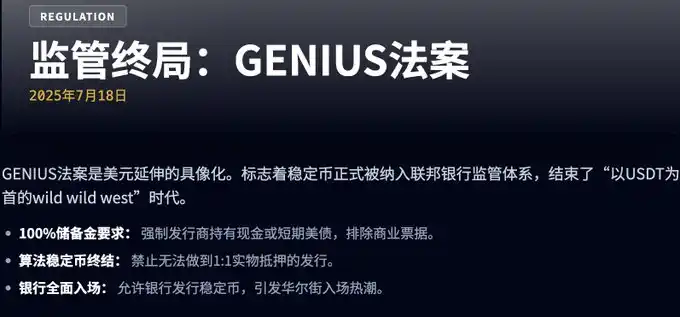
The GENIUS Act, signed into law on July 18, 2025, is the embodiment of the dollar's extension. This act marked the formal incorporation of stablecoins into the federal banking regulatory system, ending the "wild wild west era led by USDT."
2.1 Ending the Regulatory Vacuum
The GENIUS Act essentially established a unified regulatory framework at the federal level:
100% Reserve Requirement: Mandated issuers to hold 100% "high-quality liquid assets" (cash, short-term U.S. Treasuries) as reserves, directly excluded commercial paper, and enhanced credit quality.
End of Algorithmic Stablecoins: Effectively banned the issuance of algorithmic stablecoins that could not achieve 1:1 physical collateralization.
2.2 Full-Scale Bank Entry
The act allowed banks and their subsidiaries to issue stablecoins, triggering a wave of Wall Street entry.
Visa's Strategic Move: Visa quickly announced the U.S. launch of USDC settlement services on the Solana blockchain, leveraging the legal certainty provided by the act to massively integrate stablecoin settlement.
JPMorgan's On-Chain Fund: Launched a tokenized money market fund (MONY) on Ethereum, serving as a prelude to the bank's exploration of compliant stablecoin issuance.
2.3 Europe's MiCA Finally Arrives
The EU's Markets in Crypto-Assets (MiCA) regulation came into full effect in early 2025, becoming the world's first comprehensive regulatory framework covering 27 countries with unified standards. Its "passport" system eliminated regulatory fragmentation, forced non-compliant stablecoins out of the European market, and established a new global benchmark for compliant operations.
3. The President's Token: TRUMP and the Rise of World Liberty Financial (WLFI)
On January 17, just three days before Trump's presidential inauguration, he launched his own memecoin $TRUMP. Setting aside the potential profits for the Trump family, this move not only strained the already shaky Solana meme liquidity but also directly ignited the "celebrity coin" effect. A private dinner in April pushed this spectacle to its peak.
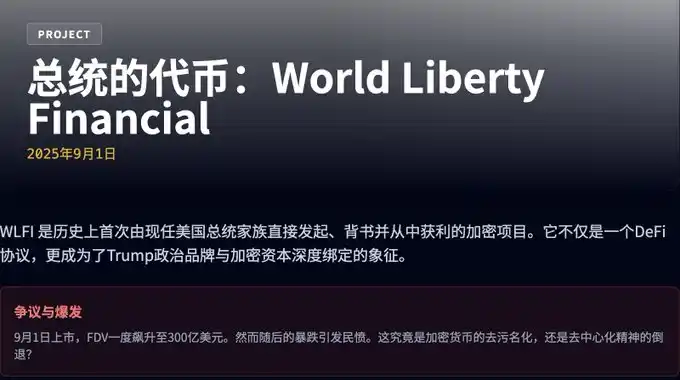
But that wasn't the end. World Liberty Financial (WLFI) became another major weapon for the Trump family. Bearing the "presidential halo," it was not just a DeFi protocol but a symbol of the deep entanglement between the Trump political brand and crypto capital.
Led by the Trump family, WLFI aimed to "democratize finance." After multiple rounds of financing, it even set up a corresponding DAT before listing. WLFI officially went public on September 1, 2025.
Its fully diluted valuation (FDV) briefly soared above $30 billion at opening before sharply retreating. Beyond the public outrage caused by the price crash, the project sparked massive controversy, particularly regarding质疑 that foreign capital (like Justin Sun and Aqua 1) might be making disguised political contributions by purchasing tokens. Some saw WLFI's emergence as marking the complete de-stigmatization of cryptocurrency and introducing millions of MAGA supporters to DeFi wallets for the first time; others argued it made the supposedly decentralized crypto industry more "centralized," pushing the entire market backward.
4. Institutional Explosion: Approval of Solana and XRP ETFs, The Rampancy of Altcoin DATs
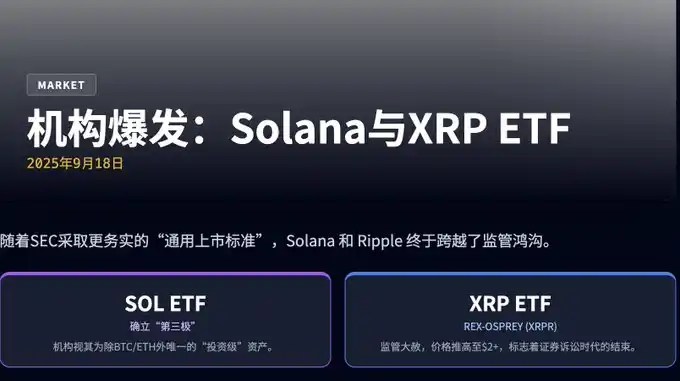
2025 was the year altcoin ETFs fully blossomed, even if altcoin performance was "notable but mixed." With the SEC adopting a more pragmatic "universal listing standard," Solana and Ripple finally crossed the regulatory chasm. The U.S. Securities and Exchange Commission (SEC) passed new standard listing rules, shortening the crypto ETF approval window from the original 240-270 days to just 75 days. This institutional change directly ushered in the "altcoin ETF era," with spot ETFs for assets like Solana, XRP, and Litecoin quickly approved thereafter, marking the institutionalized transition of crypto assets from a single asset class to diversified investment portfolios.
4.1 Solana ETF: Establishing the "Third Pole"
Solana ETF applications saw light in the second half of 2025, with market expectations for approval extremely high. This became the core driver keeping SOL prices strong throughout 2025, as institutional investors began to see it as the only "investment-grade" public chain asset besides BTC and ETH.
4.2 Ripple ETF: From "Security" to "Commodity"
With the resolution of Ripple's lawsuit with the SEC, the listing of an XRP ETF became 2025's biggest reversal. The REX-Osprey XRP ETF (XRPR) listed on September 18. This symbolized a regulatory "amnesty" for historical遗留 issues, pushing XRP prices above $2 and signaling to the market that compliance整改 could lead to entry into the mainstream system.
4.3 The Altcoin DAT Carnival
The frenzy around [presumably a specific fund or strategy] in the first half made the market see another possibility, so imitators emerged one after another. From well-known names like ETH, HYPE, BNB, AVAX to smaller-cap altcoins, everyone was eager to catch this wave. Their purposes varied: some sought larger capital inflows, others merely for marketing effect. With nav < 1 today, one wonders if this will lead to their own liquidation? But it undoubtedly brought them onto traditional capital's radar and unprecedentedly normalized "coin-token linkage" operations.
This opens up more possibilities for tokens and their extensions like DeFi, NFTs, ve-tokens, staking, and buybacks.
5. Infrastructure's Rapid Evolution: Firedancer, Pectra, and Fusaka Upgrades
5.1 Solana Firedancer
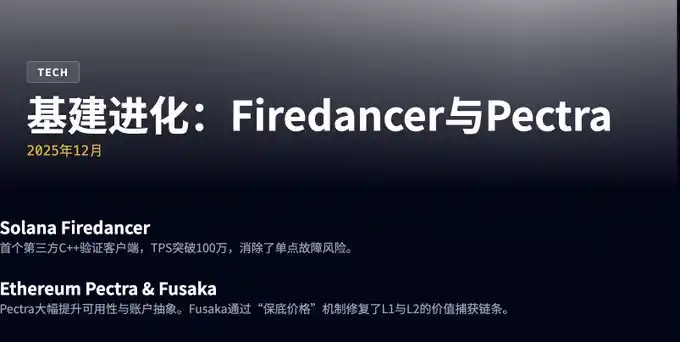
In December 2025, the Firedancer validator client, developed by Jump Crypto, launched on the Solana mainnet. This was the first validator node software rewritten in C++ by a third party, achieving over 1 million TPS in test environments. It brought crucial client diversity to Solana, eliminating single-point-of-failure risks and laying the groundwork for the entry of giants like Visa.
5.2 Ethereum Pectra and Fusaka Upgrades
The Pectra upgrade, executed in May 2025, significantly enhanced Ethereum's usability.
- Staking Threshold Optimization: Increased the maximum effective stake balance for validators to 2048 ETH, reducing operational costs for large institutions.
- Account Abstraction: Introduced "programmable wallet" functionality, allowing regular accounts to possess smart contract capabilities, greatly lowering the user entry barrier.
The Fusaka upgrade, executed in December 2025, primarily "fixed" the value capture chain between L1 and L2—essentially, L2s must pay tribute to L1. EIP-7918 introduced a "floor price" mechanism—a price hike. It stipulated that the base fee for Blobs would no longer be allowed to drop indefinitely to 1 wei. Instead, the minimum price for Blobs would be pegged to the Gas price of L1's execution layer. If implemented as planned, this could generate significant revenue for ETH.
6. Maturation of Corporate Equity: Circle, Kraken, and HashKey IPOs
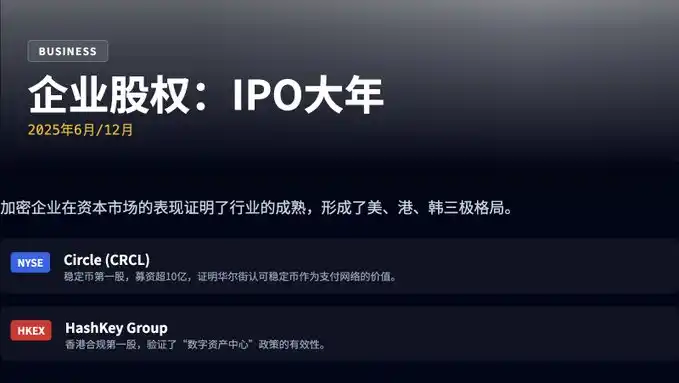
In 2025, the performance of crypto enterprises in capital markets demonstrated the industry's maturity, forming a tri-polar listing landscape across the U.S., Hong Kong, and South Korea.
6.1 Circle IPO: The Stablecoin Pioneer
USDC issuer Circle successfully IPOed on the NYSE on June 5, 2025, under the ticker CRCL. It raised over $1 billion with a valuation of approximately $8 billion. Its success proved Wall Street's recognition of the long-term value of "stablecoins as payment networks," making it the most significant industry IPO since Coinbase. (This article skips Bullish)
6.2 Kraken: Valuation Repair and Transformation
Although Kraken did not complete its IPO in 2025, it secured $800 million in Pre-IPO funding, reaching a valuation of $20 billion. After settling with the SEC, Kraken successfully transformed into a full-service institutional broker, planning to list in 2026 to challenge Coinbase's position.
6.3 HashKey Group IPO: Hong Kong's Compliance Pioneer
In the East, HashKey Group officially listed on the main board of the Hong Kong Stock Exchange (HKEX) on December 17, 2025. HashKey's IPO raised approximately HK$1.67 billion (about $215 million), giving it a market capitalization of around $2.5 billion.
Milestone Significance: This marked the first listed licensed crypto asset exchange group in Hong Kong and Asia. HashKey's successful listing validated the effectiveness of Hong Kong's "digital asset hub" policy, paving the way for Asian crypto enterprises to raise capital in local markets.
6.4 Bithumb Seeks U.S. IPO; Upbit Fully Acquired by Naver
South Korea's crypto market also saw its capital exit moment this year, with the top 2 exchanges announcing their respective listing plans.
7. The Settlement Layer Revolution: Visa, USDC, and the RWA Explosion
2025 saw the large-scale implementation of RWA tokenization and the on-chain migration of payment settlements.
7.1 Visa Chooses Solana
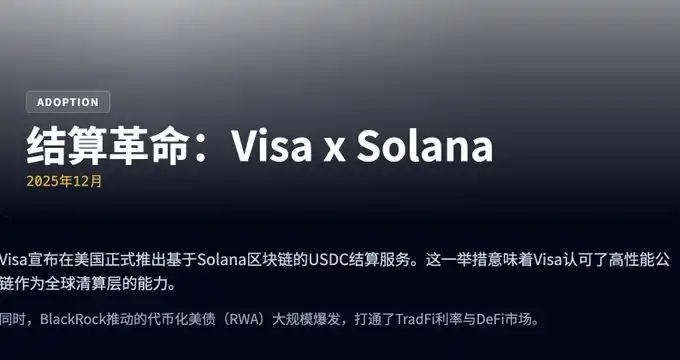
In December 2025, Visa announced the formal U.S. launch of USDC settlement services based on the Solana blockchain. This move signified Visa's recognition of high-performance public chains as capable global clearing layers, integrating blockchain into the core global payment network.
7.2 Scaling Tokenized U.S. Treasuries
Tokenized U.S. Treasuries promoted by giants like BlackRock (e.g., the BUIDL fund) exploded in 2025 and gradually became collateral for DeFi protocols. This connected TradFi interest rates with the DeFi market, vastly improving capital efficiency.
8. The Security Alarm: Bybit's $1.5 Billion Hack
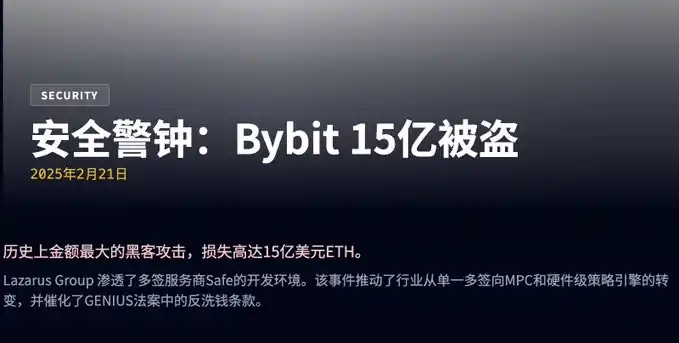
On February 21, 2025, Bybit exchange suffered the largest hack in history by value, losing $1.5 billion worth of ETH.
The Lazarus Group infiltrated the computer of a developer at the multi-signature service provider Safe, implanting malicious code that altered the frontend UI. The Bybit team, unaware, signed transactions transferring funds to the hackers.
The incident shocked the entire industry, prompting a shift from单一 multi-sig towards MPC and hardware-level policy engines, and served as a key catalyst for the anti-money laundering条款 in the U.S.'s push for the GENIUS Act.
This hack also revealed the invisible hand of "alliances" among exchanges, showing that the competitive relationship on the surface was just a misunderstanding.
9. Market Cycle Extremes: The "10.11 Event" and The Great Leverage Purge
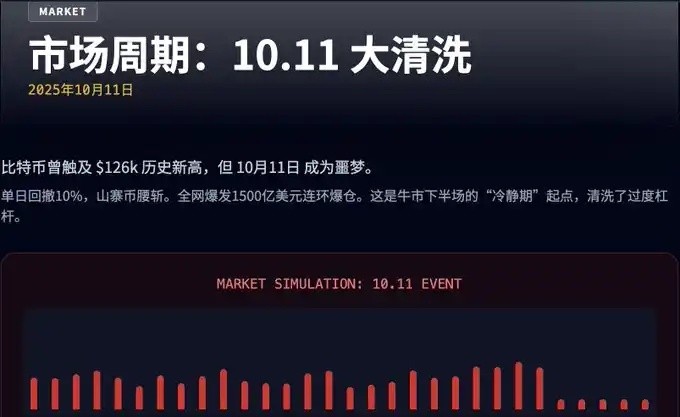
The market in 2025 experienced a rollercoaster from extreme狂热 to brutal清算, with the "10.11 Event" becoming the watershed moment for the year's行情.
Driven by the Trump election victory effect and the establishment of the strategic reserve, Bitcoin hit an all-time high of around $126,000 on October 6. However, the market then underwent a violent reversal.
October 11 became the most terrifying day in the 2025 secondary market. On this day, BTC and ETH pulled back 10%, some altcoins almost dropped to zero, the entire market was a sea of red, suffering a bloodbath. Binance even conducted the largest compensation payout in history for this.
With "smart money" buried, market makers "frequently reported爆雷消息," and order books showing only tiny buy orders, panic quickly spread. In the following days, a series of liquidations totaling approximately $150 billion occurred across the network, and the Bitcoin price rapidly retreated to the $85,000 range. The "10.11 Event" was seen as the starting "cooling-off period" for the second half of the 2025 bull market, brutally purging speculative capital overly reliant on leverage. The situation was extremely惨烈.
10. The Century Pardon: The Return of Ross Ulbricht and CZ

2025 witnessed fateful turns for two iconic figures in the crypto industry, seen as symbolic of a某种 "reconciliation" between the U.S. government and crypto libertarianism及 the early exchange era.
10.1 Ross Ulbricht's Pardon
On January 21, 2025, the day after his inauguration, President Trump signed a pardon, announcing the unconditional release of Silk Road founder Ross Ulbricht. Ulbricht had been sentenced to double life imprisonment plus 40 years for creating the dark web market Silk Road and had served 12 years. In the eyes of the crypto community, he was seen as a martyr for libertarianism.
This pardon fulfilled a Trump campaign promise and was viewed as a huge victory by libertarians and early Bitcoin adopters, symbolizing that the government would no longer treat code writers as "drug lords," but rather acknowledge the historical limitations and contributions of early internet explorers.
10.2 CZ's Liberation
In October 2025, CZ also had his moment of pardon. CZ's return (though likely not as CEO) and Ross's freedom marked the definitive turning of the page on the crypto industry's "wild west era."
These two pardons were not just changes in personal fate; they also hinted that, within the new geopolitical and capital landscape, former "outlaws" could be re-accepted by "mainstream" society through the运作 of capital, public opinion, and politics.
Conclusion: From Speculation to Cornerstone
Looking back at 2025, from Bitcoin becoming a (prospective) national reserve, to the listings of HashKey and Circle, and the pardons of Ross and CZ, all events point in the same direction: the comprehensive institutionalization of crypto assets.
Former rebels were co-opted, former fringe assets became national wealth. 2025 is not the end of the cycle, but the starting point of "crypto realism." In this new era, code is still law, but the law has finally learned how to coexist with code—and even utilize it.
Postscript
If there's anything truly exciting, it's probably
11. The Establishment of the Global Trend of Corporate Balance Sheet "Bitcoinization"
By the end of 2025, over 200 listed companies and funds held approximately 5.1% of Bitcoin's total supply. Beyond MicroStrategy (holding over 670,000 BTC), "Digital Asset Treasury" (DAT) companies, including several fintech firms, collectively attracted $92 billion in capital inflows. Bitcoin has evolved from the gamble of个别 companies into a standardized tool for corporations to hedge against inflation and optimize capital structure.




















