For Web3, This Time Cai Wensheng Is Determined to Get His Hands Dirty

marsbitXuất bản vào 2026-03-16Cập nhật gần nhất vào 2026-03-16

Tóm tắt

Cai Wenshou, a prominent Chinese internet entrepreneur and investor, is making a significant push into the Web3 space with a hands-on approach, moving beyond his previous role as a financial backer. Despite early successes in domains and internet companies like Meitu, his advocacy for Meitu's $100 million cryptocurrency investment in 2021 led to substantial paper losses and public criticism, eventually resulting in his departure as chairman. After stepping down, he reduced his stake in Meitu and invested personal funds into Web3 initiatives. He purchased a 25-story commercial building in Hong Kong, renamed it "CAI Tower" (representing Crypto and AI), offering free rent to Web3 and AI startups in exchange for first investment rights. He also acquired two Hong Kong-listed companies, rebranding them as CAI Holdings and LONG Investment Group, to build a Web3 and AI asset management platform. Additionally, he integrated a licensed virtual asset exchange, EXIO, into his ecosystem, creating a full-cycle support system from incubation to trading. Cai believes in the long-term potential of Web3, comparing its growth trajectory to AI's gradual rise. He remains optimistic about Bitcoin's future, predicting it could reach $1.1 million. Unlike some early crypto figures who have exited the industry, Cai is deepening his involvement, aiming to foster tangible projects and ecosystems. His commitment reflects a broader need for established leaders to drive real-world adoption and achieve a ...

Author:Zhou, ChainCatcher

If there are still any investors in the current crypto industry worth looking forward to, Cai Wensheng should be one of them.

Starting from the early domain name business, to the successive successes of 58.com, Storm Player, and Meitu, then to strongly advocating for Meitu to hoard cryptocurrencies, facing billions in floating losses and being criticized for speculative trading, stepping down as chairman, cashing out to buy buildings, and betting on Hong Kong Web3.

He is a person who has been repeatedly misunderstood by the times, yet repeatedly validated by the times.

Only this time, he decided to "get his hands dirty."

Last Time, Didn't Get a Good Result

2021 年, Cai Wensheng strongly advocated for Meitu to buy Bitcoin and Ethereum, with a total investment of about $100 million.

When buying, Cai Wensheng once said in his WeChat Moments: "Someone has to be the first to eat the crab. This should be the first Hong Kong-listed company to purchase BTC digital currency, and also the world's first listed company to use ETH Ethereum as a monetary value reserve."

However, as a Hong Kong-listed company, any major asset allocation by Meitu needed to be approved by the board of directors. Although he held over 25% of the shares at the time and, as chairman, could push for the purchase, he could not prevent the sale.

2022 年, the crypto market plummeted, and Meitu's paper losses exceeded 280 million RMB, with accusations of "speculative crypto trading" flooding in. The stock price of Meitu in Hong Kong also hit a historic low.
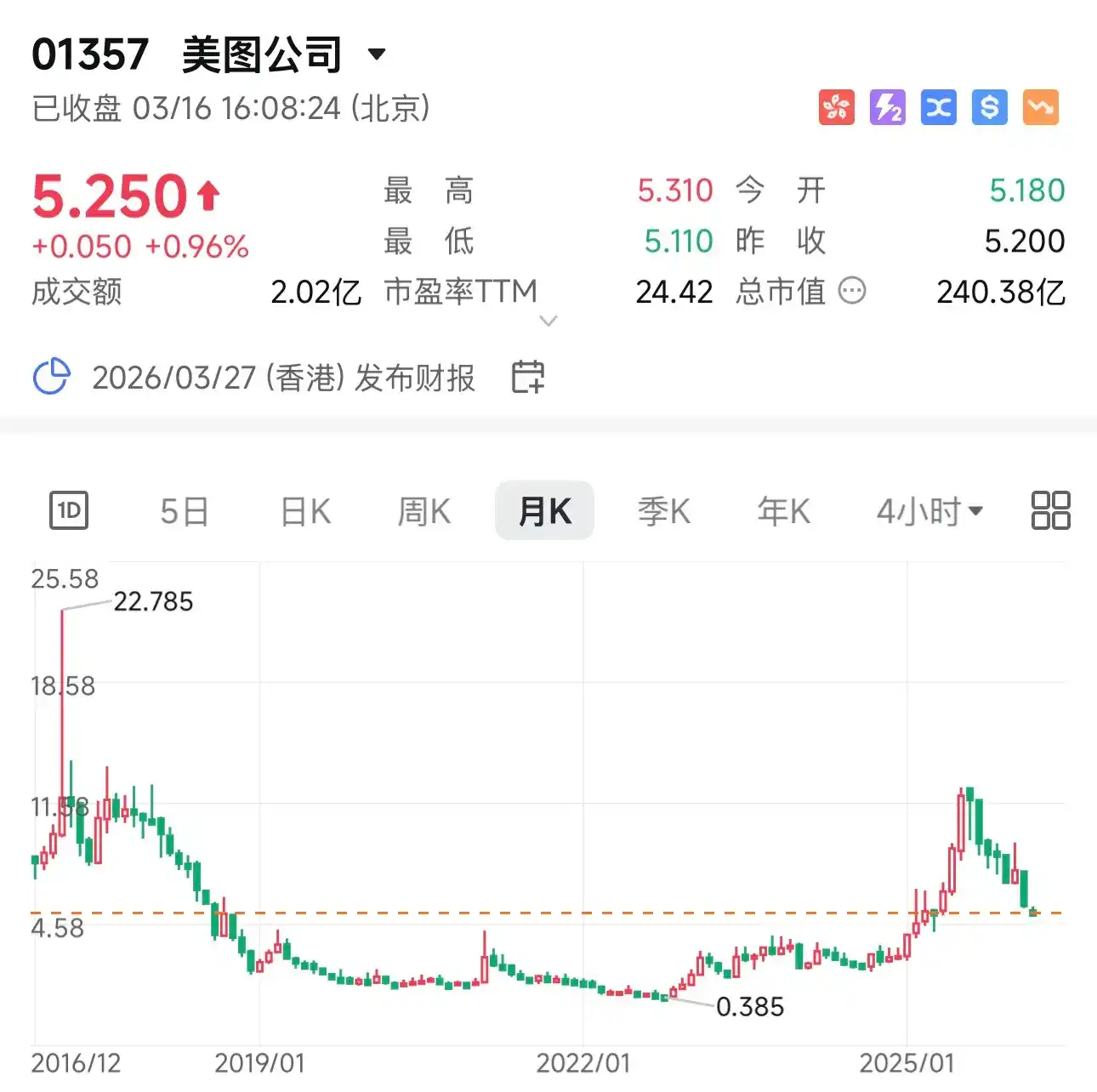

Publicly listed companies sometimes have less tolerance for floating losses than individual investors—stock price pressure, shareholder doubts, media siege—these were external pressures that anyone at the time could not withstand.

2023 年, he stepped down as chairman amid skepticism, and Wu Xinhong returned to take charge, immediately beginning to "tear off the Cai Wensheng label," with the strategic focus fully shifting to AI.

The ending of the story is quite ironic. Meitu issued an announcement in early December 2024, stating that as of that date, it had sold all its cryptocurrency, with a total cash consideration of approximately $180 million, realizing a gain of about $79.63 million, equivalent to approximately RMB 571 million.

If they had held on back then, Meitu would have been one of the first batch of DAT companies in Hong Kong.

The trend was validated, but it was no longer related to him.

Getting Involved, Getting Hands Dirty

From domain names, mobile internet, to Web3, people in each era said he was gambling.

He once said in an interview that what Web3 entrepreneurs do is often not understood, especially by traditional investors.

At the same time, he expressed firm belief in the explosion of Web3, though the timing is hard to predict, just like AI went through many years of dormancy before迎来 the ChatGPT explosion.

According to RootData显示, Cai Wensheng's Longling Capital早年 invested in the crypto exchange OKX (formerly OKCoin). In 2018, he revealed publicly that he had invested in over 10 blockchain projects, including Theta, Ontology, Zipper, etc.

<极好的, I will continue the translation from where it left off, ensuring all HTML tags are preserved and the structure is maintained.

img style="max-width:100%;overflow:hidden;" src="https://d1x7dwosqaosdj.cloudfront.net/images/2026-03/ba38047c3f24461f9b57e864d3fc5780.jpg" alt="">


This time, he simply increased his bet.

After stepping down, Cai Wensheng chose to reduce his stake in Meitu, with his shareholding比例 dropping from a peak of about 25% to less than 10%.

650 million Hong Kong dollars to buy a 25-story commercial building in Tin Hau, Hong Kong, renamed CAI Building. He specifically stated: "CAI is the abbreviation of Crypto and AI, not my surname."

It is reported that CAI Building does not charge rent, only asks for the优先 investment right in the first round of financing, no discount, no controlling stake. He publicly stated that the goal is to incubate 5 unicorns within three years.

Last November, Cai Wensheng said at Hong Kong Fintechweek that buying this building was to "set an example." Now this building is fully occupied by AI and Web3 companies.

Capital operations also followed. He successively acquired two Hong Kong-listed companies—China New Economy Investment and China Financial Leasing, renamed them CAI Holdings and LONG Investment Group respectively,打造 a Web3+AI asset management platform.

In early 2026, CAI Holdings又 acquired the equity of two early-stage projects, Forestheaven and EXIO, by issuing new shares. The seller was precisely Longling Capital, wholly owned by Cai Wensheng.

Among them, EXIO is a licensed virtual asset trading platform in Hong Kong, holding SFC Type 1 and Type 7 licenses. It is the first compliant exchange in Hong Kong with a securities background. Longling Capital was one of its early investors.

Incorporating this piece into CAI Holdings means his ecosystem extends from incubation to circulation—projects cultivated in the CAI Building can be directly listed for compliant trading on a licensed exchange.

Crypto OGs Need a Decent Victory

Among the crypto OGs we know, Cai Wensheng is not the one who has benefited the most.

The fates of early crypto OGs vary.

Some achieved financial freedom and completely faded out—Babbitt founder Chang Jia was once the most powerful spokesperson for long-termism in the crypto industry. Since 2023, he has turned to AI entrepreneurship.

Multicoin Capital co-founder Kyle Samani became famous for early bets on Solana. When leaving the圈, he publicly stated that "cryptocurrency is not as interesting as many people think."

Some stay in the圈, but their focus has shifted—Shenyu was a representative figure in the mining圈 early on. Now, content about AI tools占了大半 on his social accounts.

And those who, like Cai Wensheng, choose to stay include Xiao Feng and Feng Bo, etc.

Xiao Feng turned from traditional finance, leading HashKey on an institutionalized compliance path, operating with licenses, and connecting with traditional capital; Feng Bo布局 in a professional crypto VC manner, closer to the standard institutional investor approach.

They are同样 optimistic about this industry, but their paths are截然不同.

Cai Wensheng chose a "dirtier" path: not taking the institutional route, not making pure financial bets, personally putting down roots in Hong Kong, getting involved hands-on.

At the 2023 Hong Kong Web3 Carnival, Cai Wensheng said: "People who have worked from Web1 to Web3, this seems like a compliment, but it actually means that we have not been successful from Web1 to Web3, we have always been on the road. But many people from Web1 to Web3 are no longer here, but we are still here,说明 we are veterans. Old soldiers never die, they just fade away."

In early 2026, he predicted that Bitcoin would rise to $1.1 million, which means the total market capitalization of Bitcoin would be about $21 trillion. Previously, he publicly stated that he held about 10,000 Bitcoins. There is no news yet showing that he has exited.

Of course, the controversy has not disappeared. Continuously endorsing during a bear market, whether it is坚守 against the market or having to tell stories after being trapped, is still difficult for outsiders to distinguish.

But the ammunition from cashing out, the buildings bought, the companies acquired—these are all actions with real money.

This industry has experienced too many indecent endings. Project方 running away, whales dumping and fleeing, OGs quietly leaving the scene. What remains in the public eye are often only those news about changes in whale addresses.

This industry does not lack people who喊单, it lacks people who truly stay and get their hands dirty.

A bull market unlocking cannot solve the industry's root problems. In the end, it still relies on projects that truly succeed and ecosystems that truly land to win a decent victory for crypto OGs.


Câu hỏi Liên quan

QWhat was the outcome of Cai Wensheng's push for Meitu to invest in Bitcoin and Ethereum in 2021?

AMeitu invested approximately $100 million in Bitcoin and Ethereum in 2021, but faced a paper loss of over 280 million RMB in 2022 due to the crypto market crash. Cai Wensheng stepped down as chairman amid criticism, and Meitu later sold all its cryptocurrency holdings in 2024 for about $180 million, realizing a profit of approximately $79.63 million.

QWhat does 'CAI' stand for in the name of the building Cai Wensheng purchased in Hong Kong?

ACAI stands for 'Crypto and AI', not Cai Wensheng's surname. The building, named CAI Mansion, is intended to incubate AI and Web3 startups.

QHow is Cai Wensheng currently involved in the Web3 and crypto industry after leaving Meitu?

ACai Wensheng is deeply involved by purchasing a 25-story commercial building in Hong Kong (CAI Mansion) to incubate Web3 and AI startups, acquiring and renaming two Hong Kong-listed companies to create Web3+AI asset management platforms, and integrating a licensed virtual asset trading platform (EXIO) into his ecosystem.

QWhat is Cai Wensheng's prediction for the future price of Bitcoin?

ACai Wensheng predicted that Bitcoin would rise to $1.1 million, which would imply a total market capitalization of approximately $21 trillion.

QWhich early blockchain projects did Cai Wensheng's Longling Capital invest in?

ALongling Capital invested in early blockchain projects including Theta, Ontology, Zipper, and the crypto exchange OKX (formerly OKCoin).

Nội dung Liên quan

Mô hình sinh đã có thể huấn luyện end-to-end? Cốt lõi chỉ là một vòng lặp for

Mô hình tạo sinh (generative models) từ lâu đã phụ thuộc vào các phương pháp đào tạo nhiều giai đoạn (như diffusion, autoregressive), dẫn đến "exposure bias" - sự khác biệt giữa cách huấn luyện và suy luận. Bài báo "Explorative Modeling" (XM) từ UIUC và Harvard đề xuất một giải pháp đơn giản nhưng mạnh mẽ: thay vì tách quá trình tạo mẫu, hãy tách vòng lặp huấn luyện. Trong mỗi bước huấn luyện, mô hình tạo ra K ứng viên, sau đó chỉ chọn ứng viên gần nhất với dữ liệu thực để cập nhật gradient. Vòng lặp `for` đơn giản này giải quyết vấn đề "mode blurring" - xu hướng của hàm mất mát tái tạo đẩy đầu ra về trung bình của các mode hợp lệ, tạo ra kết quả mờ nhạt. Bằng cách khám phá nhiều ứng viên, mô hình học cách bao phủ nhiều mode khác nhau trong phân phối dữ liệu. Khả năng này được gọi là "biểu đạt tạo sinh" (generative expressivity). Thí nghiệm cho thấy "khám phá" (exploration) trở thành một trục mở rộng quy mô hiệu quả thứ ba, bên cạnh quy mô dữ liệu và tham số. Khi quy mô tăng, lợi ích từ việc khám phá càng lớn, cải thiện hiệu suất FLOP, mẫu và tham số. XM đạt được kết quả tạo ảnh trên ImageNet (FID 1.43 không guidance) ngang bằng các mô hình hàng đầu. Quan trọng hơn, XM cho phép huấn luyện mô hình tạo sinh "end-to-end" thực sự. Trong thí nghiệm điều khiển robot, Explorative Policy chỉ cần một lượt truyền thẳng mạng, đạt hiệu suất tương đương Diffusion Policy cần hàng trăm bước suy luận. Điều này chuyển chi phí tính toán từ giai đoạn suy luận sang giai đoạn huấn luyện, mở ra khả năng cho các mô hình tạo sinh nhanh và hiệu quả hơn. Công trình dựa trên lý thuyết "Mode Forcing" trước đó của nhóm tác giả. Hạn chế hiện tại bao gồm chi phí tính toán cho "Forward XM" trên phân phối nhiều mode và thách thức với mô hình ngôn ngữ tự hồi quy thuần túy.

marsbit46 phút trước

Mô hình sinh đã có thể huấn luyện end-to-end? Cốt lõi chỉ là một vòng lặp for

marsbit46 phút trước

Mỗi người tối đa 20 bài? Quy định mới của ICLR bị nhà nghiên cứu DeepMind 'mỉa mai' kiến nghị

Tác giả Google DeepMind Dan Roy đã khởi xướng một kiến nghị trào phúng nhằm phản đối quy định mới của hội nghị AI hàng đầu ICLR, giới hạn mỗi tác giả chỉ được đăng ký tối đa 20 bài báo tham dự ICLR 2027. Quy định này được đưa ra do số lượng bài nộp tăng đột biến 68% vào năm 2026, gây áp lực nặng nề lên hệ thống phản biện. Trong bài đăng của mình, Dan Roy giả vờ ủng hộ việc để AI Agent tạo ra càng nhiều nghiên cứu gia tăng càng tốt, và cho rằng giới hạn này sẽ "làm chậm sự phát triển của AI". Anh còn mỉa mai nhận xét rằng "tất cả công việc phản biện giờ đã được giao cho các mô hình ngôn ngữ lớn xử lý", ám chỉ đến một nghiên cứu trước đó phát hiện khoảng 21% ý kiến phản biện tại ICLR 2026 có khả năng cao là do AI tạo ra. Bài viết chỉ ra rằng thông điệp trào phúng của Roy thực chất phản ánh mối lo ngại về một vòng luẩn quẩn: AI tạo ra bài báo hàng loạt, nhà nghiên cứu gửi đi hàng loạt, và phản biện viên lại dùng AI để đánh giá hàng loạt. Qua đó, tác giả đặt câu hỏi liệu biện pháp giới hạn số lượng cứng nhắc có phải là giải pháp tối ưu cho những thách thức căn bản về chất lượng học thuật trong kỷ nguyên AI này.

marsbit52 phút trước

Mỗi người tối đa 20 bài? Quy định mới của ICLR bị nhà nghiên cứu DeepMind 'mỉa mai' kiến nghị

marsbit52 phút trước

OpenAI không bán tiền dựa trên mô hình đắt nhất

OpenAI đã điều chỉnh giá, giảm 80% cho mô hình GPT-5.6 Luna và 20% cho Terra, đồng thời giới thiệu chế độ Fast cho mô hình mạnh nhất Sol. Động thái này, cùng với việc Anthropic giới thiệu Claude Opus 5 với giá bằng một nửa so với flagship Fable 5, đánh dấu sự thay đổi chiến lược quan trọng: các hãng không còn chỉ tập trung bán mô hình mạnh nhất. Thay vào đó, họ khuyến nghị người dùng kết hợp các mô hình theo nhiệm vụ: dùng Sol (đắt, mạnh) để phân tích và lập kế hoạch phức tạp, sau đó giao cho Luna (rẻ, hiệu quả) thực thi. Điều này cho thấy trọng tâm thương mại đang chuyển từ các mô hình flagship (chứng minh năng lực kỹ thuật) sang các mô hình tầm trung, phục vụ cho lượng truy vấn API khổng lồ hàng ngày của doanh nghiệp, nơi hiệu quả chi phí (ROI) và độ ổn định là yếu tố quyết định. Một yếu tố then chốt giúp giảm chi phí là việc chính các mô hình AI (như Sol) tham gia tối ưu hóa mã nguồn và quy trình vận hành của chính chúng, tạo ra một vòng lặp tự thúc đẩy giảm chi phí. Điều này có thể đẩy nhanh hơn nữa đà giảm giá trong tương lai. Cạnh tranh đang chuyển từ "mô hình thông minh nhất" sang "hệ sinh thái hiệu quả nhất". OpenAI muốn biến các mô hình như Luna thành lựa chọn mặc định cho các tác vụ thường ngày, từ đó gia tăng độ phụ thuộc và chi phí chuyển đổi cho doanh nghiệp. Tương tự như ngành điện hay điện toán đám mây, mục tiêu cuối cùng là AI trở thành một tiện ích phổ biến, hoạt động âm thầm và không thể thiếu trong mọi quy trình, thay vì chỉ là một sản phẩm công nghệ đình đám.

marsbit2 giờ trước

OpenAI không bán tiền dựa trên mô hình đắt nhất

marsbit2 giờ trước

Lương trăm nghìn đô la săn thợ điện, Meta vội vàng tự mở trường dạy nghề

Cuộc đua AI đang vấp phải nút thắt mới: thiếu hụt nghiêm trọng lao động lành nghề như thợ điện và công nhân xây dựng để xây dựng các trung tâm dữ liệu quy mô lớn. Tại Mỹ, dự báo cần thêm 130.000 thợ điện và 240.000 công nhân xây dựng từ 2023-2030 cho hạ tầng AI, trong khi mỗi năm có 80.000 vị trí thợ điện không thể lấp đầy. Các công ty AI sẵn sàng trả lương cao (thợ điện giỏi có thể kiếm 240.000-280.000 USD/năm), nhưng sự chậm trễ xây dựng vẫn gây thiệt hại hàng chục triệu USD. Độ phức tạp của các trung tâm dữ liệu AI, với công suất điện khổng lồ, hệ thống phân phối điện và làm mát phức tạp, đòi hỏi lao động có kỹ năng đặc biệt. Để giải quyết, các gã khổng lồ công nghệ như Meta và Google đang đầu tư hàng trăm triệu USD vào đào tạo. Meta mở trường dạy nghề miễn phí, cung cấp cả trợ cấp sinh hoạt, trong khi OpenAI hợp tác với công đoàn xây dựng. Chiến dịch tuyển dụng nhắm đến cả học sinh trung học, góp phần làm tăng mạnh tỷ lệ Gen Z theo học trường nghề. Tuy nhiên, nhu cầu điện cho AI tiếp tục bùng nổ, chiếm phần ngày càng lớn trong tổng tiêu thụ điện và đẩy giá điện lên cao. Một nghịch lý tồn tại: các dự án xây dựng cần hàng nghìn lao động cùng lúc, nhưng khi hoàn thành chỉ cần số ít vận hành, dẫn đến rủi ro dư thừa lao động lành nghề trong tương lai.

marsbit2 giờ trước

Lương trăm nghìn đô la săn thợ điện, Meta vội vàng tự mở trường dạy nghề

marsbit2 giờ trước

Giao dịch

Giao ngay
活动图片