Exporting to Domestic Sales: The Chinese-style Outbound Journey of an AI Short Film

marsbitXuất bản vào 2026-05-14Cập nhật gần nhất vào 2026-05-14

Tóm tắt

From Export to Domestic Boom: The Chinese-Style Overseas Journey of an AI Short Film The story begins with PJ Ace, a prominent Hollywood AI filmmaker, launching a public search on X for the creator of a stunning AI-generated short film titled "Zombie Scavenger." The film, featuring a robot cowboy in a post-apocalyptic wasteland, impressed Ace with its quality, which he estimated would have cost $500,000 and six months pre-AI. The trail led back to China. The creator, Mx-Shell, is a self-described amateur from China with a photography and music background. Using ByteDance's AI video tool, Seedance 2.0, he independently produced the short in about ten days for a minimal cost. Ironically, while the film went viral overseas after Ace's endorsement, it initially gained little traction on Chinese platforms like Bilibili. This sparked a "cross-server" search. Ace posted in English on X, while Mx-Shell, who doesn't speak English, posted his QQ email in Chinese comment sections. With netizens' help, they connected. Ace extended an invitation, asking if Mx-Shell was interested in becoming a Hollywood director. The article highlights this as a case of "talent export" or "brilliance going overseas." A creator in China, using domestic AI tools and computing power, captured global attention first. This "export-to-domestic-sales" path succeeded due to China's competitive, low-cost AI video tool market and its vast pool of untapped creative talent. Mx-Shell's success underscores that AI...

Author: David, Shenchao TechFlow

Hollywood is searching the internet for a Chinese person. But the person being sought didn't even leave a usable contact method.

On the evening of May 10th, PJ Ace, the founder of the Los Angeles-based AI film studio Genre.ai, reposted an AI short film called "Zombie Sweeper" on X. PJ Ace is probably one of the most influential figures in the AI video circle, with his own content garnering over 300 million views across platforms.

His evaluation of this film was extremely high, calling it "one of the best short films I've seen in recent years."

The premise of the short film is roughly this: a robot cowboy rides an ostrich through a post-apocalyptic wasteland, battles zombies, and has a love affair with a plastic mannequin. Besides having a sufficiently cyberpunk and fantastical theme, the visuals and music also possess a blockbuster quality.

(Viewers who haven't seen it can click here to get a feel for it.)

Within a few hours of PJ's post going live, its views had already reached 5 million.
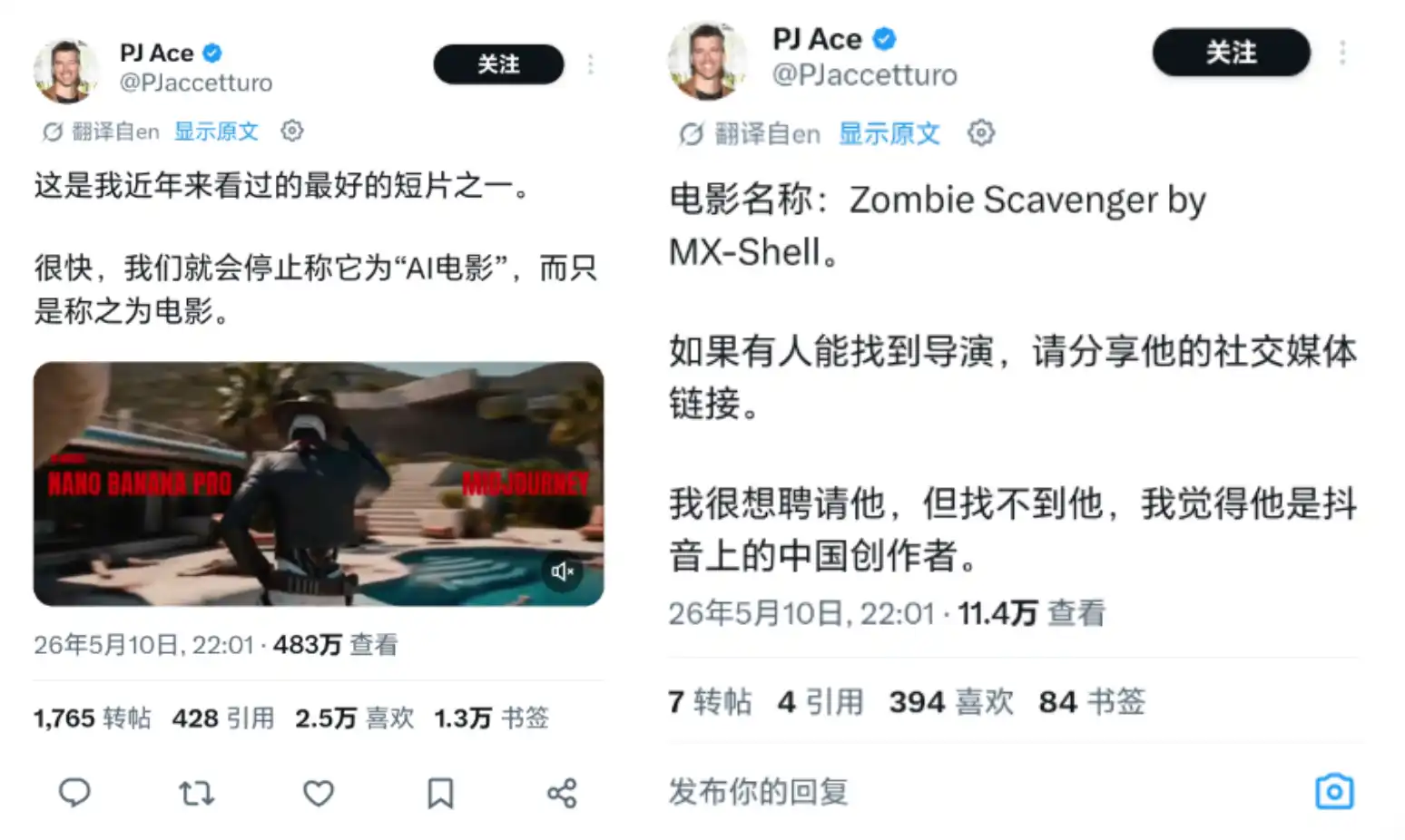
He then followed up with a search post: "I really want to hire the director of this film, but I can't find him. I think he's a Chinese creator on Douyin."

A person holding Hollywood content production resources is posting a lost-and-found notice on Twitter to find a Chinese person? The author finds this scenario even more surreal than the short film itself...

His reasoning was that before AI, something of this quality would have cost at least $500,000 and 6 months, yet this creator achieved this level with just his own efforts. So, the comments quickly turned into a search party. Some searched for the author ID 'MX-Shell', others traced clues back to Bilibili.

A large-scale cross-platform search, stretching from Hollywood to Bilibili's comment section, had just begun.

However, on the same day PJ Ace was anxiously posting missing person notices on Twitter, this short film hadn't caused much of a stir on Bilibili and Douyin, lying quietly in the information feed.

A short film made by a Chinese person using Chinese AI tools had to first circle around to the other side of the Pacific, become popular there, and then be seen by its own people. The process of this large-scale cross-platform search making its way back to China itself became an "export to domestic sales" phenomenon.

Letting the Hobby Be Seen

The person PJ Ace is looking for has labeled himself on Bilibili with five characters: Amateur Enthusiast.

The author, Mx-Shell, claims in the comments to be from Yunnan, graduated from a technical secondary school, never attended university, and never worked for any film company. The description on his Bilibili profile, 'Non-professional amateur enthusiast', seems sincerely humble rather than mere self-deprecation.

Reportedly, "Zombie Sweeper" was made by him using ByteDance's AI video tool Seedance 2.0. One person, no team, no investment, independently completed from conception to final cut, even the background music was self-produced.

The production cycle was about 10 days, with the token cost equivalent to roughly 3,000 RMB.

And then came the part the author finds most fascinating in the whole incident.

PJ Ace's search post was seen by millions on X, but Mx-Shell himself couldn't see it at all, unaware that a Hollywood director across the Pacific was looking for him.

When the news eventually made its way back to China, the comments under the video exploded, but Mx-Shell himself neither understood English nor had channels to connect with overseas media. He even posted his QQ email, asking netizens to help forward it to the other side.
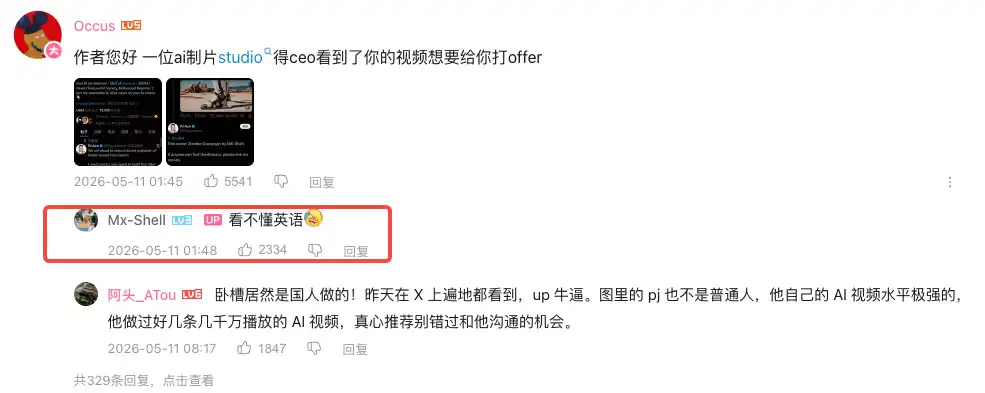

Hollywood was looking for him in English on Twitter, and he was looking for Hollywood in the Bilibili comment section with a QQ email. This cross-platform conversation had a happy ending thanks to the matchmaking efforts of netizens.

Currently, PJ has already emailed him. In the letter, PJ Ace said he runs a film studio in Los Angeles, the short film got over 4 million views the day it was shared, and then asked: Are you interested in becoming a Hollywood director?

An amateur enthusiast received an olive branch extended by Hollywood. This is perhaps another wonderful and serendipitous instance of talent discovery in the AI era.

Talent Going Outbound, Export to Domestic Sales

Let's talk about why this film was quiet on Bilibili at first but exploded when posted on X.

On Bilibili, a short film labeled 'Contains AI-generated content' has to compete for the same information feed with professional animations from million-follower UP owners, gameplay streams, and popular fan-made content. Mx-Shell had only a few thousand followers at the time, no recommendation spots—a grain of sand falling into a desert.

X is a completely different world. The overseas AI creator community has developed its own ecosystem over the past two years, with key opinion leaders, consensus on evaluation, and mature dissemination networks.

PJ Ace is a core node in this ecosystem. When he saw "Zombie Sweeper," he saw the work itself; AI was just the tool. The fan base spread it through relay, igniting the content within hours.

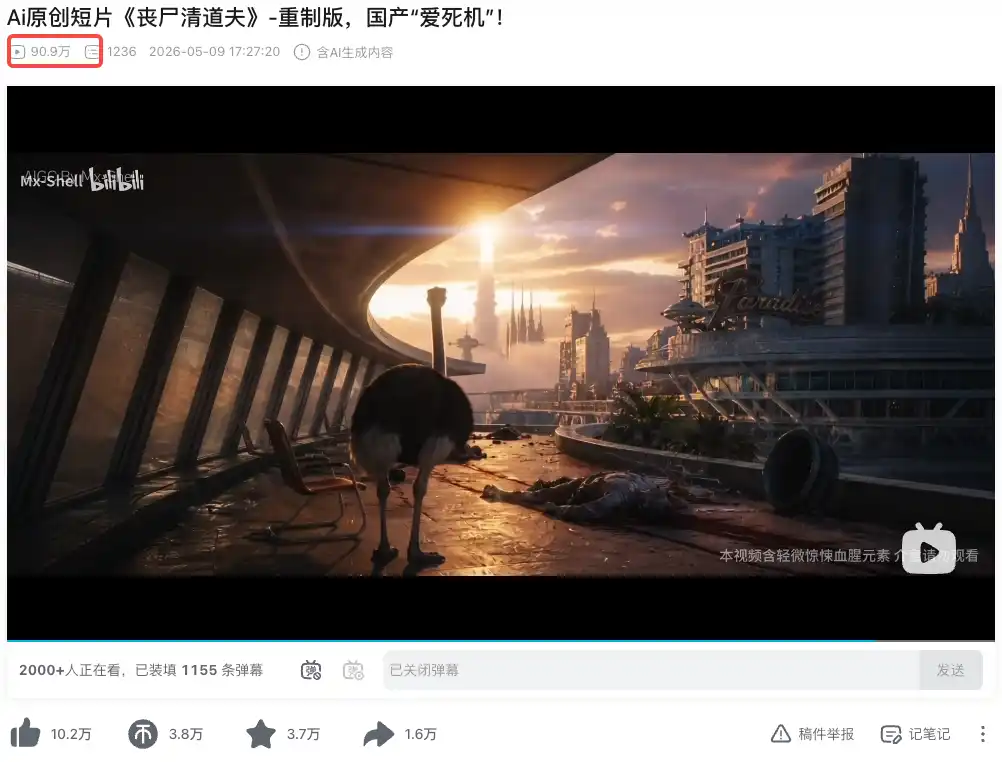
The subsequent data backflow also illustrates this point. Domestic viewers recognized its merit as well, with Bilibili garnering over 900,000 views and 100,000 likes. Content has never been the primary problem in the AI era; the problem is whether it gets delivered to the right audience.
This reminds the author of a similar phenomenon: Token outbound.

Chinese large language models sell computing power to the world via APIs. The electricity never leaves China's power grid, but value is delivered cross-border via tokens. Mx-Shell's story is the creative version of the same logic. Talent and aesthetics never left his computer, but the work, through a short film, also completed cross-border delivery. Seedance is ByteDance's, the computing power is from Chinese data centers, the creator is from Yunnan, and the first large-scale audience was across the Pacific.

If token outbound is electricity outbound, then "Zombie Sweeper" is talent outbound.

Why is this path being paved starting from China? Probably because China simultaneously possesses two things. The world's most fiercely competitive AI video tool market, where ByteDance, Alibaba, and Kuaishou are stepping on each other's toes, driving generation costs to the floor. The Seedance 2.0 used by Mx-Shell has relatively low spending costs.

And a large number of creative people who previously had no outlet—people with aesthetic sense and ideas, lacking only a handy tool.

The former gave the latter a key. Once the door was pushed open, the global market was on the other side.

AI is a Good Shovel, But You Have to Dig Yourself

The story isn't over yet.

After Mx-Shell connected with PJ Ace, he posted a lengthy article responding to the public attention. Thirteen points, each one substantial. The author thinks this text itself is worth a careful read.

He said the style of "Zombie Sweeper" is called Atom Punk, a form of retro-futurism. The creative inspiration came from Pixar's "WALL-E" and was made according to the standards of the popular Netflix series "Love, Death & Robots."

One of the creative intents was to let overseas audiences see the current level of domestic AI production.

Shot control relies on prompts, which were basically crafted by hand. Post-production was done by one person. Even the background music was original. Looking at these details together, you realize Mx-Shell is definitely not just someone who "got lucky with AI tools."

He has visual aesthetics, being a photographer by background. He has auditory aesthetics, being an independent musician. He has a sense for narrative, setting his own bar according to Love, Death & Robots standards.

AI tools gave him productivity, but the aesthetics and judgment are his own.

So, the author feels the saying "AI lets everyone make movies" is only half right. AI has indeed lowered the production barrier to the floor, but computing power can be bought; aesthetics cannot.

Anyone can use Seedance 2.0, so why was it specifically Mx-Shell who created something that made Hollywood post a search notice? The tools are equal, but the people using them are vastly different.

This leads to another interesting angle.

The investment ByteDance has put into Seedance 2.0 is unknown to the outside world, but so far, the best advertisement for this tool might have been made by a technical secondary school graduate from Yunnan.

ByteDance's marketing department couldn't have planned such a story because the story's persuasive power lies precisely in it being spontaneous, grassroots, and unexpected.

The strongest proof for a platform product is always users creating things that exceed the platform's expectations. Taobao's early benchmark stories were rural women earning millions selling local specialties; YouTube's benchmark was teenagers in bedrooms making shows better than TV. Seedance 2.0's benchmark story is more creators like Mx-Shell.

According to DataEye data, the overseas AI short drama and webtoon market size is expected to reach $650 million in 2026, a sixfold year-on-year increase. Currently, two paths are running in this market:

One is the industrial route. Domestic teams mass-produce AI short dramas—zombies, werewolves, rags-to-riches stories—packaged into genre shells familiar to Western audiences, monetized through TikTok ad buys. Reports indicate multiple works have already achieved tens of millions of views. This path competes on capital, team, and production capacity, somewhat like the short video factories of the past.

The other is the path Mx-Shell took. One person, one computer, no ad buys, no scale. The content itself is the driving force for dissemination. A few thousand RMB in token cost, less than two weeks in cycle, exchanged not for platform revenue share, but for Hollywood actively reaching out.

Both paths can succeed, but the author finds the second path more noteworthy.

Because the barrier to the first path is money. If you have money, you can do it; it doesn't have much to do with the individual creator. The barrier to the second path is the person—the aesthetics, the judgment of content. These things AI cannot give you, and money cannot buy them.

He won't be the last to walk this path.

China has a large number of creators with aesthetic sense, ideas, and a desire to express. Previously, what stood in their way was equipment, funds, teams, education. Now, these barriers are being dismantled one by one by AI tools. The only remaining question is: how to be seen?

Mx-Shell's answer was a QQ email and a group of enthusiastic netizens. The next person might have a different method.

But before a truly developed domestic ecosystem for AI creation grows, this detour of export to domestic sales will probably have to be taken a while longer.


Câu hỏi Liên quan

QWho is looking for the Chinese creator of the AI short film 'Zombie Scavenger', and why is it significant?

APJ Ace, the founder of the Hollywood AI film studio Genre.ai, is searching for the creator because he believes the short film is one of the best he's seen in recent years. This is significant as it represents a top Hollywood professional actively seeking out and offering opportunities to an unknown, self-taught creator from China, highlighting how AI is democratizing creative recognition.

QWhat key details about the creator Mx-Shell and the film's production are mentioned in the article?

AThe creator, Mx-Shell, is a self-described amateur from Yunnan with a technical secondary school education and no formal film training or industry experience. He produced 'Zombie Scavenger' independently in about 10 days using ByteDance's AI tool Seedance 2.0, with a cost of approximately 3000 RMB (in tokens). He handled the concept, visuals, and even composed the original soundtrack himself.

QAccording to the article, what are the two different paths emerging for Chinese AI short film creators targeting the overseas market?

AThe two paths are: 1) An industrialized route, where domestic teams mass-produce AI short dramas (e.g., zombie, werewolf, revenge stories) tailored for Western audiences, relying on TikTok advertising for monetization. 2) An individual creator path, exemplified by Mx-Shell, where a single person uses AI tools to create high-quality, original content that gains traction through its own artistic merit, leading to opportunities like the one from Hollywood.

QWhy did the short film initially gain massive attention on X (Twitter) but not on Bilibili?

AOn Bilibili, the film was buried in a vast information stream competing with content from established creators. On X, it was discovered and shared by PJ Ace, a key influencer within the established overseas AI creator community. His endorsement triggered a network effect, rapidly amplifying the film's visibility to millions, demonstrating the power of niche, connected communities versus broad, saturated platforms.

QWhat does the article suggest is the 'real barrier' for creators in the AI era, and what role does AI play?

AThe article suggests that the real, lasting barrier is not access to tools or capital (which AI has dramatically lowered), but the creator's inherent aesthetic sense, judgment, and narrative ability—qualities that AI cannot provide. AI acts as a powerful 'shovel' that removes production hurdles, but the 'treasure'—the valuable, standout content—must be unearthed by the creator's own vision and taste.

Nội dung Liên quan

Phí 'Kimchi' ở Hàn Quốc Chính Thức Chuyển Sang Âm, Quốc Gia 'Cày' Crypto Cuối Cùng Cũng Thành Quốc Gia 'Cày' Cổ Phiếu

Tác giả Doo (Compound Foundation) phân tích hiện tượng "phí kim chi" (Kimchi Premium) của Hàn Quốc – chênh lệch giá crypto giữa các sàn Hàn Quốc và thế giới – lần đầu tiên chuyển sang âm, tức giá tại Hàn Quốc rẻ hơn. Điều này trái ngược với truyền thống, nơi thường có mức phí bảo hiểm cao do kiểm soát vốn. Có ba lý do chính: 1) Thị trường đầu cơ suy giảm, đặc biệt với altcoin; 2) Thị trường chứng khoán Hàn Quốc tăng trưởng mạnh (gần gấp đôi), thu hút dòng tiền từ crypto; 3) Luật thuế crypto dự kiến áp dụng từ năm sau tác động đến tâm lý. Dữ liệu thời gian thực từ một kênh Telegram Hàn Quốc cho thấy mức chiết khấu duy trì trên 2% trong ngày, với USDT được giao dịch thấp hơn tỷ giá USD/KRW, chứng tỏ nhu cầu mua yếu. Điều này củng cố nhận định rằng vốn từ retail investor đang rút khỏi thị trường crypto để chuyển sang chứng khoán. Tổng vốn hóa thị trường chứng khoán Hàn Quốc đã tăng 86% lên 5 nghìn tỷ USD, vượt lên vị trí thứ 6 toàn cầu, trong khi "phí kim chi" âm là dấu hiệu rõ ràng cho sự thay đổi lớn trong dòng tiền và sở thích đầu tư.

marsbit6 phút trước

Phí 'Kimchi' ở Hàn Quốc Chính Thức Chuyển Sang Âm, Quốc Gia 'Cày' Crypto Cuối Cùng Cũng Thành Quốc Gia 'Cày' Cổ Phiếu

marsbit6 phút trước

Vị trí mới tại Thung lũng Silicon FDE đang thịnh hành, doanh nghiệp cần nhân tài AI như thế nào?

Bài viết thảo luận về sự xuất hiện và nổi bật của vị trí Kỹ sư Triển khai Tiền tuyến AI (AI Forward Deployed Engineer - FDE) trong thung lũng Silicon, được các công ty như OpenAI và Anthropic chú trọng. Vai trò chính của FDE là làm việc trực tiếp với khách hàng để tùy chỉnh và tích hợp các mô hình ngôn ngữ lớn (LLM) chung vào quy trình nghiệp vụ cụ thể, tạo ra luồng công việc Agent phù hợp. Tuy nhiên, bài viết nhấn mạnh rằng tác động lớn hơn của AI đến thị trường việc làm không phải là sự thay thế đơn thuần, mà là sự phân hóa và tạo ra các vai trò mới. Tác giả dự đoán nhu cầu lớn hơn sẽ dành cho các Kỹ sư AI nội bộ của doanh nghiệp. Những kỹ sư này cần thành thạo nhiều kỹ năng như viết prompt, sử dụng khung Agent, hệ thống đánh giá, cũng như các công cụ lập trình AI như Claude Code hay Codex để nhúng khả năng AI vào phần mềm và hệ thống nghiệp vụ. Sự phát triển này được so sánh với quá trình chuyên môn hóa của kỹ sư phần mềm trước đây, khi vai trò chung ban đầu dần phân nhánh thành front-end, back-end, mobile, DevOps... Tương tự, vai trò Kỹ sư AI tổng quát hiện nay được kỳ vọng sẽ tiến hóa thành nhiều vị trí chuyên sâu hơn trong tương lai, chẳng hạn như Kỹ sư LLMOps, Kỹ sư Đánh giá (Evals Engineer), Kỹ sư Dữ liệu AI... Điều quan trọng nhất là nhu cầu về những người vừa có năng lực kỹ thuật xuất sắc, vừa hiểu sâu sắc về bối cảnh và nhu cầu kinh doanh cụ thể.

marsbit9 phút trước

Vị trí mới tại Thung lũng Silicon FDE đang thịnh hành, doanh nghiệp cần nhân tài AI như thế nào?

marsbit9 phút trước

a16z còn bao xa nữa để lên sàn? 600 tỷ USD, 7 quỹ, tự xây dựng truyền thông, công ty VC Thung lũng Silicon đang biến thành Blackstone tiếp theo

a16z đang quản lý khoảng 600 tỷ USD tài sản, gần bằng quy mô của Blackstone trước khi IPO. Bài viết phân tích động thái gần đây của hãng VC này - gọi vốn 150 tỷ USD cho 7 quỹ, xây dựng nền tảng truyền thông riêng (Future, a16z.news, Turpentine), thuê các đối tác chuyên về xây dựng tường thuật - không chỉ là hoạt động tiếp thị thông thường mà giống như diễn tập cho một đợt chào bán công khai (IPO) trong tương lai. Bài viết lập luận a16z đang âm thầm chuyển đổi từ một công ty đối tác truyền thống sang một công ty quản lý tài sản thay thế đa chiến lược, với cấu trúc tương tự Blackstone hay KKR. Các bước chuẩn bị bao gồm: có tư cách Cố vấn Đầu tư Đã đăng ký (RIA) từ 2019, xây dựng danh mục quỹ đa dạng, và quan trọng là sở hữu hạ tầng truyền thông để kiểm soát câu chuyện tài chính - một nhu cầu thiết yếu của một công ty đại chúng. Dự đoán thời điểm IPO khả thi nhất là khoảng năm 2028-2030, sau một làn sóng thoái vốn AI thành công. Nếu a16z niêm yết, nó có thể thiết lập tiền lệ, buộc các hãng VC lớn khác như General Catalyst, Sequoia phải làm theo, thay đổi vĩnh viễn các quy tắc của ngành công nghiệp đầu tư mạo hiểm.

marsbit10 phút trước

a16z còn bao xa nữa để lên sàn? 600 tỷ USD, 7 quỹ, tự xây dựng truyền thông, công ty VC Thung lũng Silicon đang biến thành Blackstone tiếp theo

marsbit10 phút trước

Bán 32 BTC để chi trả cổ tức: Strategy phá vỡ lời thề "không bao giờ bán"

Ngày 1 tháng 6, MicroStrategy đã nộp hồ sơ 8-K cho SEC, tiết lộ việc bán 32 Bitcoin từ ngày 26 đến 31 tháng 5 với giá trung bình 77.135 USD, thu về khoảng 2,5 triệu USD. Khoản bán này, mặc dù chỉ chiếm 0,004% tổng nắm giữ và có ý nghĩa tài chính nhỏ, nhưng mang tính biểu tượng lớn vì đánh dấu lần bán đầu tiên nhằm mục đích chi trả cổ tức (cho cổ phiếu ưu đãi), phá vỡ cam kết "không bao giờ bán" trước đây của công ty. Công ty đã phát hành dồn dập cổ phiếu ưu đãi từ đầu năm 2025 với nghĩa vụ trả cổ tức cố định, tích lũy hơn 693 triệu USD. Khoản dự trữ tiền mặt 2,25 tỷ USD được lập cuối năm 2025 để chi trả đã giảm còn 9 tỷ USD vào cuối tháng 5/2026. Trong cuộc gọi thu nhập Q1, CEO Phong Le lần đầu đề cập đến việc "bán Bitcoin có kỷ luật" như một công cụ quản lý vốn, báo trước cho động thái này. Việc bán hàng xảy ra đồng thời với một thị trường dự đoán trị giá hơn 111 triệu USD trên Polymarket về việc liệu MicroStrategy có bán Bitcoin trước ngày 31/5 hay không, gây ra tranh cãi về thời điểm công bố thông tin. Bối cảnh thị trường cũng đang yếu, với Bitcoin giảm xuống dưới 72.000 USD và các sản phẩm đầu tư kỹ thuật số ghi nhận dòng tiền ra ròng lớn trong tháng 5. Nhiều công ty nắm giữ Bitcoin kho bạc khác như MARA, Riot Platforms cũng đã bán ra số lượng lớn trong quý I để tái cấp vốn hoặc trả nợ, cho thấy áp lực bán tập thể. Mô hình kho bạc Bitcoin đang đối mặt với thách thức khi vòng xoáy tăng giá - phát hành cổ phiếu - mua thêm bị đảo ngược. Dù vậy, MicroStrategy vẫn là người mua ròng mạnh mẽ trong tháng 5 (hơn 20 tỷ USD), cho thấy khoản bán 2,5 triệu USD hiện chưa phải là khủng hoảng thanh khoản. Tuy nhiên, hành động này đã gửi đi tín hiệu quan trọng: ngay cả "kẻ tích trữ" Bitcoin lớn nhất cũng bắt đầu xem xét việc bán như một lựa chọn khả thi.

marsbit12 phút trước

Bán 32 BTC để chi trả cổ tức: Strategy phá vỡ lời thề "không bao giờ bán"

marsbit12 phút trước

Chiến trường mới của cuộc cạnh tranh AI: Bộ nhớ dài hạn trở thành điểm yếu, người dùng làm sao bảo vệ quyền sở hữu ngữ cảnh của mình

Tác giả: Zen, PANews Trong cuộc cạnh tranh AI hiện nay, khi các mô hình ngày càng mạnh và giống nhau, "trí nhớ dài hạn" và "quyền sở hữu ngữ cảnh" của người dùng đang nổi lên như một điểm nghẽn và chiến trường mới. AI đang chuyển từ công cụ trò chuyện một lần thành trợ lý số cá nhân, tham gia sâu vào quy trình công việc, tích lũy hiểu biết về thói quen và sở thích của người dùng. Tuy nhiên, những ký ức và ngữ cảnh này hiện bị khóa trong các "hòn đảo" nền tảng riêng lẻ như ChatGPT, Claude hay Gemini, khiến người dùng mất dữ liệu khi chuyển đổi. ZetaChain, từ một cơ sở hạ tầng chuỗi chéo, đã chuyển hướng sang AI để giải quyết vấn đề này. Họ giới thiệu Lớp bộ nhớ riêng tư (Private Memory Layer) và sản phẩm tiêu dùng Anuma, nhằm trao cho người dùng quyền sở hữu và kiểm soát bộ nhớ AI được mã hóa của mình. Người dùng có thể mang ngữ cảnh và sở thích của mình qua lại giữa các mô hình AI khác nhau một cách liền mạch. Hệ thống cũng cho phép lập trình, kiểm tra và thu hồi quyền truy cập của Agent, với tất cả được ghi lại trên chuỗi. Tầm nhìn xa hơn của ZetaChain là xây dựng "Lớp tiêu dùng AI" (AI Consumer Layer), nơi nhiều trợ lý AI chuyên biệt có thể cộng tác dựa trên một hệ thống ngữ cảnh, danh tính và quyền thống nhất do người dùng sở hữu. Đồng thời, mã thông báo ZETA được định vị lại thành "mã thông báo cơ sở hạ tầng AI", dùng để thanh toán, mở khóa dịch vụ và tạo điều kiện cho nền kinh tế sáng tạo nơi kiến thức chuyên môn có thể được đóng gói và kiếm tiền. Bản chất của ZetaChain là thách thức mô hình kiểm soát của nền tảng, tìm cách trả lại quyền sở hữu dữ liệu, ngữ cảnh và danh tính kỹ thuật số của người dùng trong kỷ nguyên AI.

marsbit17 phút trước

Chiến trường mới của cuộc cạnh tranh AI: Bộ nhớ dài hạn trở thành điểm yếu, người dùng làm sao bảo vệ quyền sở hữu ngữ cảnh của mình

marsbit17 phút trước

Giao dịch

Giao ngay
Hợp đồng Tương lai
活动图片