Editor's Note: Amid the noise of geopolitics, electoral games, and macro narratives, the author of this article, Arthur Hayes (co-founder of the crypto exchange BitMEX), deliberately avoids moral judgments and value stances. Instead, from the cold perspective of a trader, he compresses complex issues into a few core variables that can be verified by the market: nominal GDP, oil prices, credit expansion, and the resulting impact on risk asset pricing.
As one of the most controversial and representative "trader voices" in the crypto market, Hayes consistently deconstructs the trading implications behind political events from the perspectives of power, liquidity, and price. In this article, he converges the US election, energy prices, and money-printing logic into a stark question: will money printing continue, and will risk assets continue to rise?
Below is the original text:
A "Overheard Conversation"
Scene: US President Donald Trump joins via video link an airplane transporting Venezuelan President Pepe Maduro from Caracas to New York.
Trump: Pepe Maduro, you are such a bad guy. Your country's oil belongs to me now. USA! USA! USA!
Pepe Maduro: Fuck! You crazy American.
I can imagine that, at this moment, a certain segment of the Venezuelan diaspora is letting loose in the Western Hemisphere's "capital of narco-finance"—Miami, USA—dancing wildly to upbeat songs like Elvis Crespo's "Suavemente".
As a qualified "armchair" macro-economic gambler, I naturally have to offer my take on this historic, game-changing, authoritarian, militarized... (feel free to insert any superlative adjective or derogatory term here)—the US's "kidnapping/legal arrest" of a sovereign nation's leader.
I'm sure countless AI-assisted authors will produce "word salads" measuring in the millions of tokens, attempting to define these events, model them, and predict future directions. They will judge these actions from moral high grounds and tell you how other countries "should respond".
I will do none of that.
I only care about one question: Will the US's colonization of Venezuela cause the price of Bitcoin/cryptocurrency to rise or fall?
I'm a ski bum; to understand this chaotic universe, I need an analytical framework as simple as possible. Let me reiterate: The sole, primary goal of any democratically elected politician, at all times, is re-election.
The glory of God, loyalty to the country, or any lofty ideal must take a back seat to winning votes. Because if you are not in a position of power, you can't change anything. In this sense, this obsession with re-election is "rational".
For US President Trump, two elections truly matter: the midterms in November and the presidential election in 2028.
Although he himself will not be running for re-election in 2026 nor can he run for a third presidential term in 2028, the loyalty and obedience of his political supporters depend on their own successful re-elections. Right now, people are constantly "defecting" from the tattered MAGA tent precisely because they fear their future electoral prospects will dim if they continue to act as Trump demands.
So the question becomes: What can Trump do to ensure that those undecided voters—neither fully "Blue Team Democrat" nor fully "Red Team Republican"—walk into the voting booths in 2026 and 2028 and vote "the right way"?
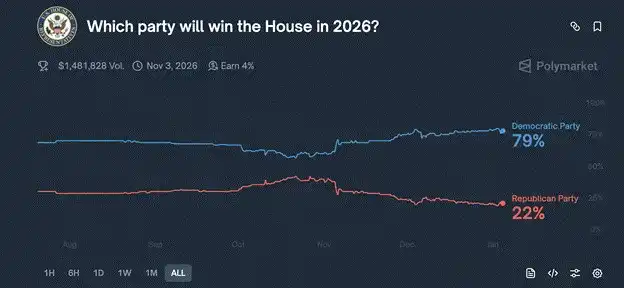
As of now, the Blue Team (Democrats) is set to retake the House of Representatives. If Trump still wants to be a winner, he needs to get things in order quickly; there isn't much time left for policy U-turns to sway voters to switch sides.
Most importantly, I will use some statistics and charts to prove that the only thing the median voter truly cares about is the economy. The cultural issues that Trump's opponents and supporters obsess over on social media (although the memes are indeed good) are nothing compared to the feeling of being "richer or poorer" when a voter walks into the voting booth and pulls the curtain.
Stimulating the economy is actually easy, I'm talking about nominal GDP. This essentially boils down to one question: How much credit is Trump willing to create? A rise in nominal GDP pushes up financial asset prices; the wealthy will also "dutifully" hand over their "bribes"—ahem, I mean campaign donations to the Red Team, as a thank you. But in the US, the rule is one person, one vote. If a rise in nominal GDP is accompanied by soaring inflation, the masses at the bottom are fully capable of sinking an entire political party.
Trump and US Treasury Secretary "Wild Bill" Besant have indicated they will let the economy run hot. I believe they will do this, but the question is: How do they plan to control inflation?
The inflation that truly sinks re-election prospects is food and energy inflation. For Americans, the most crucial indicator is gasoline prices, because for most people, convenient and affordable public transportation is almost non-existent. In the US, if you are a proletarian worker without a car, you can barely live a normal life—it's unfortunate, but it's reality. This is also why Trump and his aides are "colonizing" Venezuela for its oil.
When talking about Venezuelan oil, many immediately point out: This country has the world's largest proven oil reserves. But the question is, who cares how much oil is buried underground? The key is: Can this oil be profitably extracted?
I don't know the answer to this question, but Trump clearly believes that as soon as he turns the valve, Venezuelan oil will flow steadily to refineries on the Gulf Coast, and cheap gasoline will pacify the masses by suppressing energy inflation. I cannot say whether Trump is correct, but the WTI and Brent crude markets will be the real "truth serum".
The question is: When nominal GDP and US dollar credit supply rise, do oil prices rise or fall?
If GDP and oil prices rise together, the Blue Team Democrats win; if GDP rises but oil prices stagnate or fall, the Red Team Republicans win.
The beauty of this analytical framework is: Oil prices will reflect the reactions of all other oil-producing nations and military powers—especially Saudi Arabia, Russia, and China—to the US's "colonization" of Venezuela.
Another advantage is: The market is reflexive. We all know Trump adjusts his policies based on the stock market, US Treasuries, and oil prices. As long as stocks keep rising and oil prices remain low, he will keep printing money, keep expanding, and keep taking action around oil.
As investors, we can react on almost the same timescale as Trump—this is the best we can hope for. This method reduces the need for us to predict the ultimate outcome of an extremely complex geopolitical system. Read the charts, adjust with the trend, gamblers.
Below are some charts and statistics that clearly show: For Trump to win the election, he must boost nominal GDP and brutally crush oil prices.
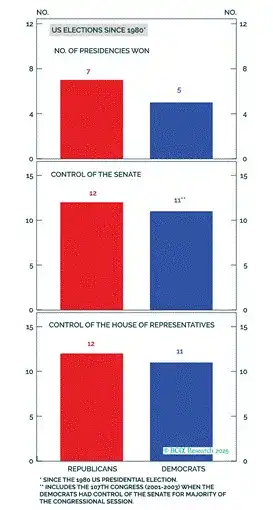
The Red Team and Blue Team are evenly matched.
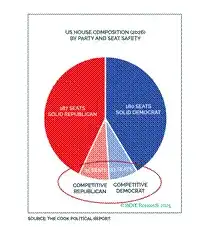
Only a small portion of Americans decides which party controls the government.
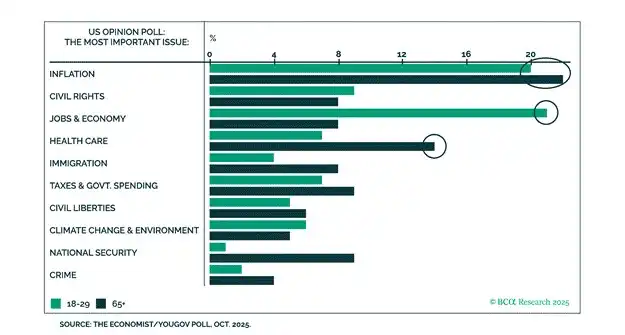
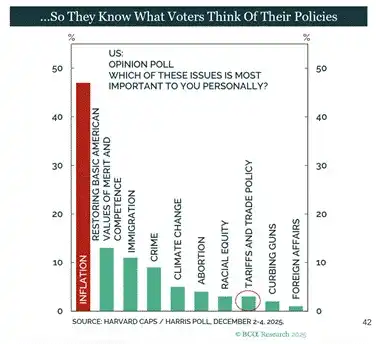
The economy and inflation are the two issues voters care about most; there is nothing else.
The "10% Rule": If, in the three months before an election, the national average gasoline price rises by 10% or more compared to the average level in January of the same calendar year, one or more branches of government often change party hands.
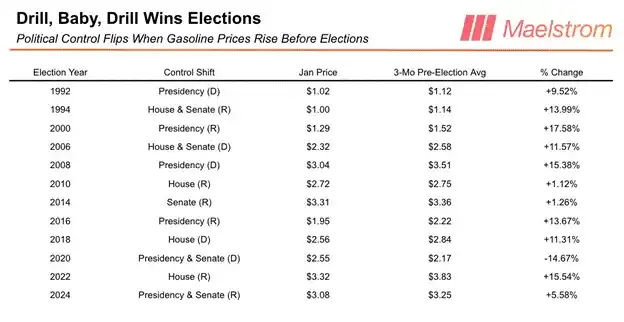
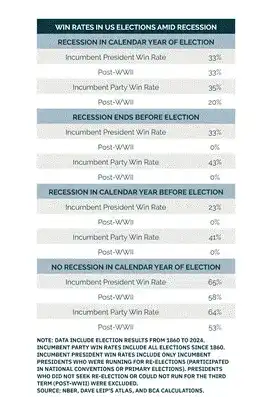
Bitcoin Mooning
Because Proof-of-Work (PoW) mining consumes massive amounts of energy, Bitcoin is the purest form of monetary abstraction. Therefore, the energy price itself has no direct relationship with the Bitcoin price—because whether energy prices rise or fall, all miners face the same directional change in costs simultaneously.
The real importance of oil prices lies in whether they force politicians to stop printing money. If, due to the expansion of economic activity (which is itself a derivative of energy), oil prices rise too fast and too high, then politicians must find a way to bring them down—for example, by "taking oil from other countries" or slowing credit creation—otherwise they risk being voted out of office by the electorate.
The 10-year US Treasury yield and the MOVE index, which measures volatility in the US bond market, will tell us if oil prices have become unacceptably high.
Investors face a difficult choice: invest in financial assets or invest in physical assets.
When energy costs are low and stable, investing in financial assets like government bonds is reasonable; but when energy costs are high and volatile, it is more prudent to store wealth in energy commodities.
Therefore, when oil prices reach a certain level, investors will demand higher returns from government bonds, especially the 10-year US Treasury. US politicians cannot stop fiscal deficit spending because "free money" is always a winning strategy in elections.
When oil prices rise and the 10-year Treasury yield approaches 5%, politicians are forced to change their behavior. The reason is: As the 10-year yield nears 5%, the massive leverage embedded in this dirty fiat financial system begins to spiral out of control, and bond market volatility (measured by the MOVE index) rises sharply.
The entire fiat system is essentially a highly leveraged carry trade. When volatility rises, investors must sell assets, or they risk losing even their custom-tailored Savile Row suits.
A recent example is: "Liberation Day" on April 2nd last year, and the "Trump TACO" event 7 days later on April 9th.
If you recall, Trump threatened to impose extremely high tariffs, high enough to actually reduce global trade and financial flow imbalances—which would be highly deflationary macro-wise. The market plummeted in response, and the MOVE index briefly surged to a high of 172 intraday.
And just the day after volatility spiked, Trump "backed down" (TACO), announcing a "pause" on tariff measures. The market subsequently bottomed and rebounded sharply.
MOVE Index (white line) vs. Nasdaq 100 Index (yellow line)
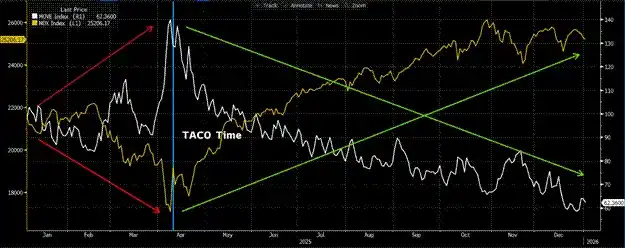
It is pointless to try to use historical data to determine at what level oil prices and the 10-year Treasury yield will force Trump to tighten the Fed's money printer. We will know when it happens; if oil prices and yields start rising sharply, it means—time to become cautious on risk assets.
The base case scenario is: Oil prices remain low, or even fall directly, while Trump and "Wild Bill" Besant print money like crazy, just like in 2020. The reason is that the market will initially believe: US control over Venezuelan oil will lead to a massive increase in daily crude production. Whether these optimistic predictions about a surge in crude supply will actually materialize after engineers actually bring millions of barrels per day of capacity online is anyone's guess.
But that doesn't matter. You just need to remember one thing: Trump will run the money printer faster than Israeli Prime Minister Benjamin "Bedouin Butcher" Netanyahu changes his justifications for "why Iran deserves another round of military strikes".
If this logic isn't enough to convince you: now is the time to go long on all risk assets because of aggressive US money printing, then remember—Trump is the most "socialist" US president since Roosevelt.
He printed trillions of dollars, and unlike previous presidents, in 2020 he sent money directly to everyone. You better believe he will not lose an election because he "didn't print enough".
Mamdani and Trump are both New Yorkers, you know—birds of a feather flock together.
Real traders must stop projecting emotions onto words like "socialism, communism, capitalism". No government truly operates according to the pure form of these "isms"; everyone is just bastardizing and cobbling these concepts together for their own political purposes.
Don't be a sucker, just buy.
If we understand the situation as Trump and his aides describe it, then it's certain: Credit *will* expand.
Red Team Republican legislators will continue to pass fiscally deficit spending; the Treasury Department led by "Wild Bill" Besant will issue bonds to finance it; and the "beta cuck, towel boy" Jerome Powell, and his successor leading the Fed, will print money to buy those bonds.
This "self-pleasuring loop" truly kicked into high gear in 2008. As Lyn Alden says: "Nothing is going to stop this train."
As the quantity of dollars continuously expands, the price of Bitcoin and some cryptocurrencies will moon.
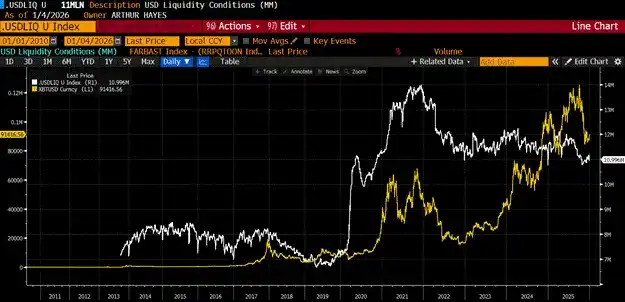
Bitcoin's (digital gold) rise is directly caused by money printing. This can be clearly seen in the US Dollar Liquidity Conditions Index I constructed (Bloomberg ticker: .USDLIQ U Index).
Trading Tactics
Before talking about Maelstrom's current positions, I want to do a quick review of my trading performance last year.
I say "my performance" because all trading decisions were made by me personally. Last year, my liquidity steering was overall profitable. My goal is to cover daily expenses with trading profits, and I've done that multiple times. Although it was profitable in the end, I also wasted a fair amount of PNL on a few bad trades.
My single biggest loss came from trading PUMP tokens immediately after they launched. Also, I must stay away from meme coins—the only meme coin I made money on was TRUMP.
On the bright side: My most profitable trades came from HYPE, BTC, PENDLE, and ETHFI.
Only 33% of trades were profitable last year, but my position sizing was correct: the average gain on winning trades was 8.5 times the average loss on losing trades.
This year I will improve my performance by focusing on what I'm truly good at: building medium-term large positions based on clear macro liquidity logic, and this logic must support a "plausible-sounding" altcoin narrative. As for purely fun bets on shitcoins or meme coins, I will significantly reduce position sizes.
Looking ahead, the core market narrative this year will revolve around privacy. ZEC will be the beta for the privacy track, and we have already built a very large ZEC long position at an excellent price in Q3 2025.
The Maelstrom team's current focus is to find at least one true breakout altcoin leader within the privacy narrative that can deliver alpha returns to the portfolio in the coming years.
Maelstrom is entering 2026 with risk exposure almost maxed out. We will continue to invest idle cash generated from various financing deals into Bitcoin, so our USD stablecoin positions are very low.
To achieve alpha relative to BTC and ETH: I will sell BTC to increase exposure to privacy-related assets; I will sell ETH to increase exposure to DeFi. In both cases, assuming I pick correctly, these altcoins I hold should outperform the majors as fiat credit continues to expand.
If / when oil prices rise and cause credit creation to slow, I hope to be able to take profits by then, stack more sats, and buy some mETH.
It's been a fulfilling day.
I wrote this article on a rest day from skiing in the backcountry. Now it's time to hit the gym hard, lift some heavy iron, and make sure I'm still jacked when I "emerge from hibernation" in March.







