Author: Adhi Rajaprabhakaran
Compiled by: Jiahuan, ChainCatcher
On the evening of February 12th, three NBA games suddenly ignited the trading board on an exchange that is usually indifferent to sporting events: Dallas Mavericks vs. Los Angeles Lakers, Milwaukee Bucks vs. Oklahoma City Thunder, and Portland Trail Blazers vs. Utah Jazz. During these three games, they generated over 13 million contract trades. ForecastEx is a prediction market operated by Interactive Brokers and regulated by the U.S. Commodity Futures Trading Commission (CFTC). It is a real exchange with a proper license, but before that night, it had never had any substantial NBA trading volume.
I don't think ForecastEx achieved any customer acquisition miracle overnight. It didn't improve its product, launch a marketing campaign, or deepen its order book with more liquidity. What happened was actually quite simple: Robinhood directed its massive order flow to another exchange, specifically for this night of three NBA games.
Currently, Robinhood is the dominant retail distributor for prediction market contracts. When a user opens the Robinhood app, clicks on an NBA game, and places a bet, the trade is routed to a CFTC-regulated exchange for execution. For most of Robinhood's prediction market history, this exchange has been Kalshi. But users don't know this, and they don't care. Regardless of which exchange is in the backend, the interface is exactly the same: the same app, the same buttons, the same odds. The exchange becomes invisible infrastructure.
An Instant Migration of 35% Trading Volume
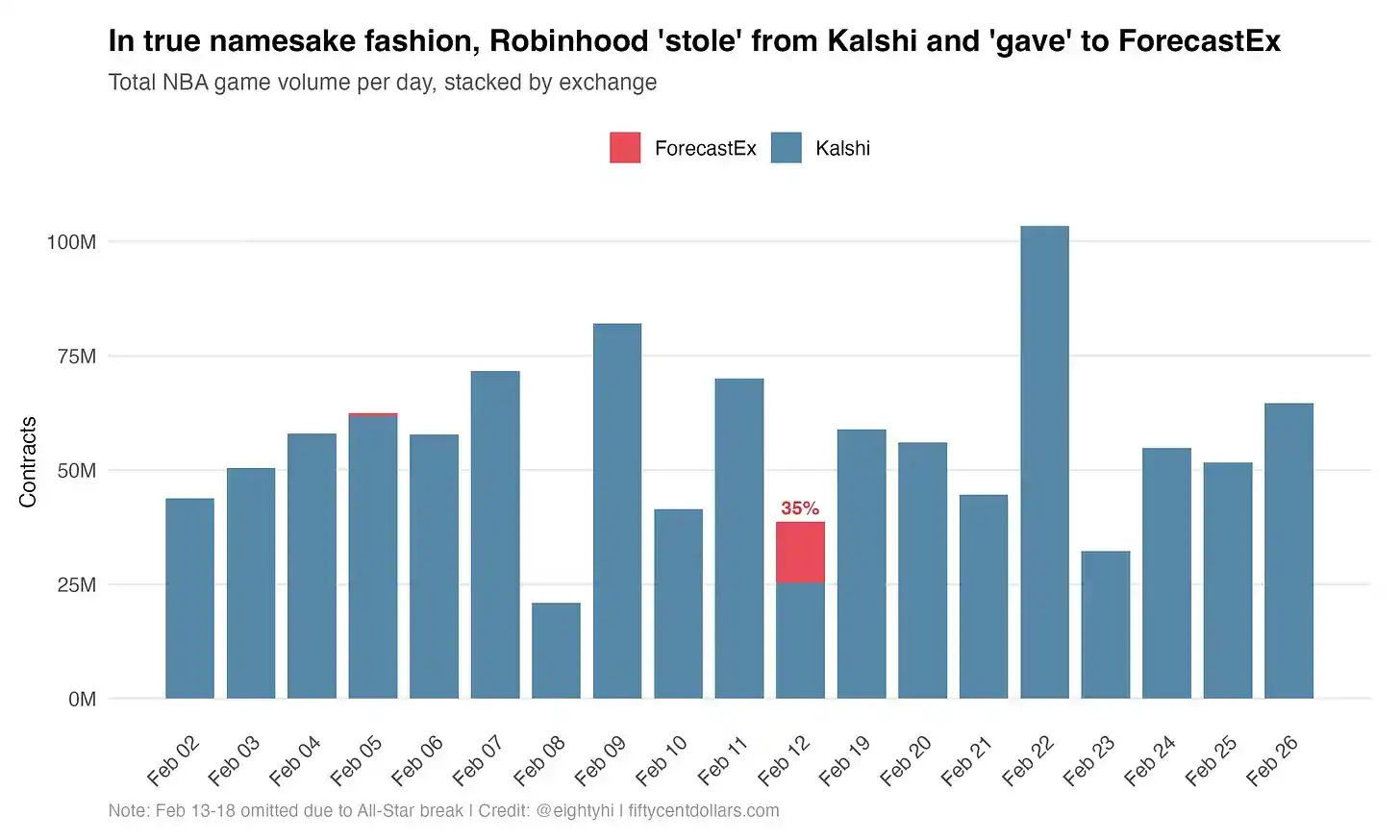
Each bar represents a day's NBA game trading volume, stacked by exchange. Blue represents Kalshi, red represents ForecastEx. Except for February 12th, every day is all blue, and on this day, 35% of the volume suddenly appeared on ForecastEx. Then everything returned to all blue, as if nothing had happened.
The red part on February 12th is those three games: Mavericks vs. Lakers, Bucks vs. Thunder, Trail Blazers vs. Jazz. Combined, they generated 13.4 million contracts on ForecastEx. No matter which exchange processes the trade, the Robinhood user experience is identical: the same app, the same buttons, the same odds. Users simply can't tell the difference. Because for them, there is no difference.
This is why the 35% figure is so significant, as it is a relatively pure measure of Robinhood's market share of NBA moneyline trading volume between these two exchanges. ForecastEx basically has no organically accumulated sports users, so it's reasonable to assume that every contract on ForecastEx that night came from Robinhood's orders.
Moreover, since Robinhood's interface is the same in any case, these users placed bets at exactly the same frequency as they would have on Kalshi. It is reasonable to infer that approximately one-third of Kalshi's NBA moneyline trading volume in February came from Robinhood.
Robinhood controls where the volume goes, and it can flip this switch overnight.
A Similar Story in the Weather Category
The NBA order routing was brief and dramatic, constituting an extremely clear and compelling natural experiment for analysis. However, the rise of the weather market on ForecastEx tells a similar story on a different scale.
ForecastEx and Kalshi both offer daily high-temperature contracts: binary options on whether the high temperature in a given city will exceed a given threshold that day. These two markets are identical products, covering the same cities and the same dates. The only real difference is the exchange that matches the trades.
Before November 18, 2025, ForecastEx had zero weather trading activity. Then, volume exploded overnight, with no organic growth transition period, no gradual adoption curve. This step-function pattern is completely consistent with the NBA's characteristics. To measure overlap, I matched markets on ForecastEx and Kalshi with the same "city-date" pairs, excluding cities that existed on only one exchange. This resulted in 454 matching "city-date" data points.

Incidentally, this chart provides an interesting case study on how platform competition is a net positive for the industry's overall trading volume. Robinhood turned on the valve for the weather market, increasing activity on both exchanges overall, likely due to cross-exchange arbitrage. Market makers engaging in such activities effectively distribute liquidity throughout the ecosystem.
The first five weeks were Kalshi only, which is the baseline. Then ForecastEx appeared and immediately captured 60% of the combined daily temperature market volume. It peaked at 72% in late November and has since generally remained between 53% and 67%.
The key detail is this: when ForecastEx appeared, Kalshi's weather trading volume did not collapse. The blue bars remained roughly stable. Therefore, my interpretation is that ForecastEx's volume was additive to Kalshi's existing flow. This was likely Robinhood首次 opening up the weather market and sending its flow to ForecastEx from the very beginning, unbeknownst to its users.
This distinction is important. In the January NBA case, Robinhood briefly diverted volume that would have gone to Kalshi. In the weather market, Robinhood似乎 added ForecastEx as a parallel destination while keeping Kalshi's original flow intact. Both cases prove the same structural point: Robinhood decides where the volume goes. Exchanges can only passively receive the orders Robinhood chooses to send.
The Absolute Amplification of Product Innovation by Distribution Channels
The NBA and weather data show that Robinhood can steer traffic. And parlays (referring to binding two or more independent bets together to form a single bet. The player only wins the prize if all the bound outcomes are predicted correctly; if one is wrong, the entire bet is lost. Because the difficulty increases, the odds and returns are usually very high.) show that it can scale demand that is already growing.
Kalshi launched multi-event contracts (i.e., "combos" or "parlays") in September 2025, coinciding with the NFL season opener. The product immediately gained traction: weekly volume grew organically from almost zero in September to about 45 million contracts per week by early December. This growth was self-driven and pointed directly to Kalshi's platform. Kalshi built the product, submitted it for CFTC certification, and injected initial liquidity. The market responded positively.
Then, Robinhood stepped in.
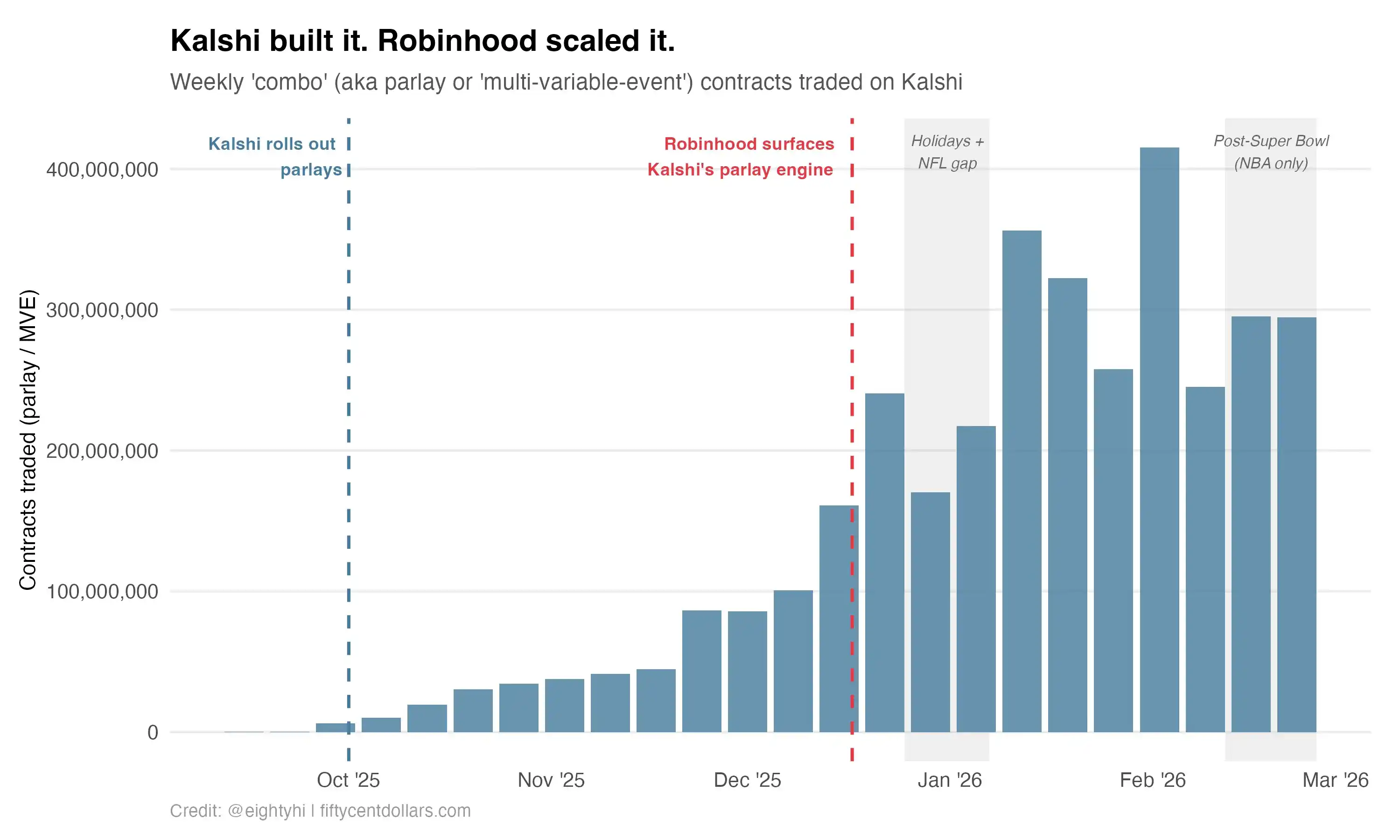
On December 17th, Robinhood announced it would launch pre-set parlays and player prop picks in its app. Within weeks, weekly volume exploded, jumping from the 45-60 million range to nearly 100 million, then reaching 300 million per week by late January. The shaded area on the right marks the period after the Super Bowl, when NFL parlays disappeared and were supported by the NBA alone. Even without football, volume remained around 260-290 million per week.
Kalshi did the hard work of creating a new product category. Robinhood's distribution channel elevated it to a completely different scale. Both contributions are real. The question is, which one has greater structural leverage.
Not Just Kalshi
Kalshi has achieved tremendous growth over the past year, growing from about 7 million contracts per day at the end of 2024 to over 100 million by the end of 2025. This is not all due to Robinhood. Kalshi has built up real direct demand: new product categories, an expanding native user base, API traders, and institutional participation. A year ago, it was widely believed that Robinhood accounted for the vast majority of Kalshi's trading volume. Now, the NBA data suggests Robinhood accounts for about 35% of moneyline trading volume. This derisking business execution is truly admirable.
However, Kalshi is not the only exchange that has built its growth story on distribution channels.
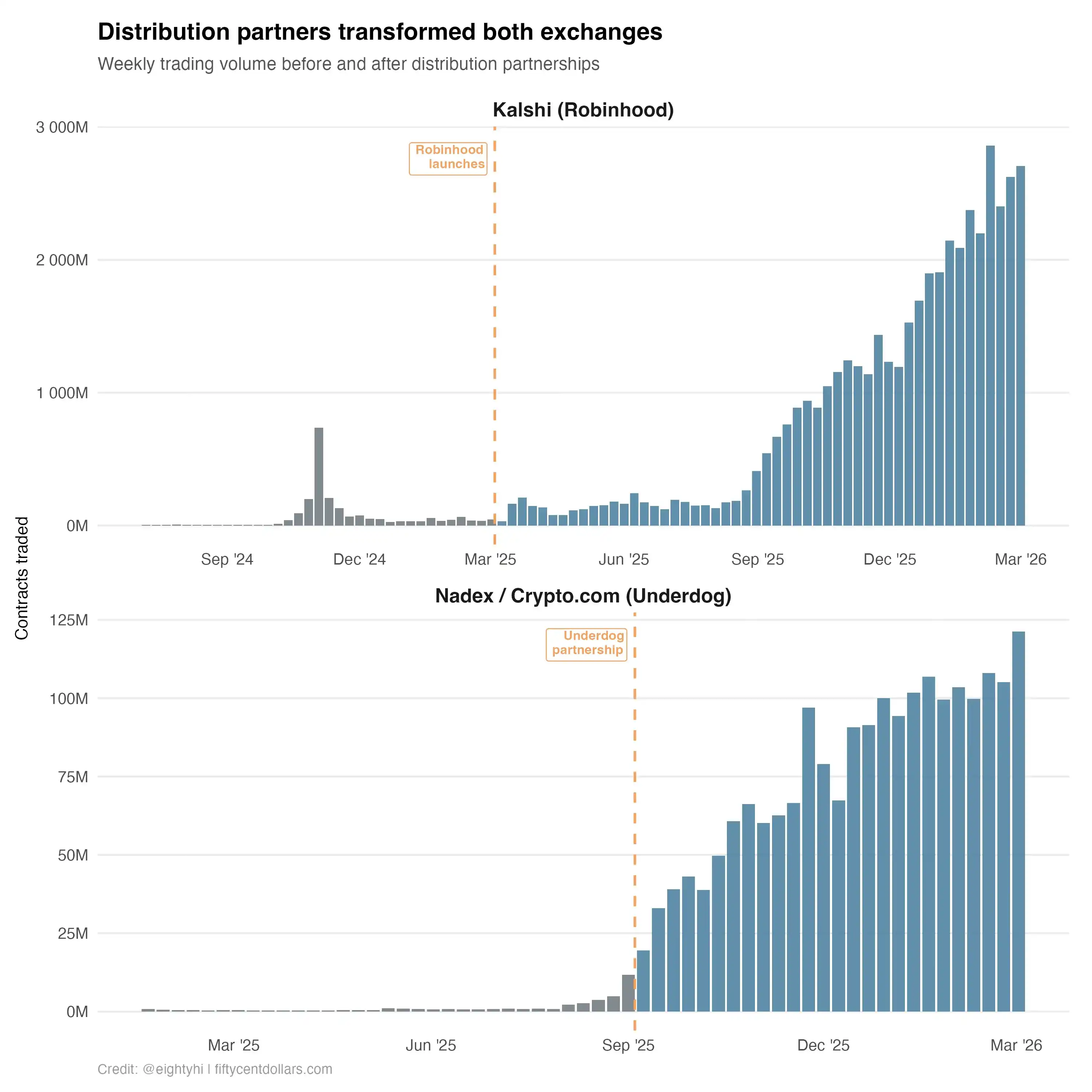
Nadex, operating as Crypto.com Derivatives, a CFTC-regulated exchange, tells a strikingly similar story. Before Underdog integrated with Crypto.com in September 2025, Nadex's trading volume was平平无奇. After Underdog介入 and began routing its users' sports bets to the exchange, weekly volume exploded by orders of magnitude. The same pattern, different names. Underdog is to Nadex what Robinhood is to Kalshi: the distribution layer that turns a quiet exchange into a busy hub.
The ultimate move: both distribution giants have now taken action to fully own their own exchanges. Robinhood acquired its own CFTC-regulated exchange, and Underdog did the same last week. Two companies, on parallel tracks, independently reached the same conclusion.
This is not a coincidence. This is game theory. If you are a distributor routing millions of trades to a third-party exchange, you are sharing revenue on every contract for infrastructure that your users cannot even distinguish from a white-label API. You are also giving away data, trading volume, and regulatory history to a potential competitor—the very things that make their exchange valuable. When you are large enough, the rational move is to internalize this infrastructure. The exchange goes from being someone else's profit center to your cost center.
The weather and NBA data explain why it is so difficult to defend against this dynamic from the exchange's perspective. Even accounting for only 35% of volume, Robinhood can add a parallel exchange for the weather market overnight and immediately send most of the new flow to it. It can route three NBA games to another exchange on a Tuesday, and those games can generate the same volume as they would anywhere else. Users are none the wiser. They don't choose the exchange. They choose Robinhood, or Underdog.
I Was Wrong
Last year, when rumors surfaced that Robinhood was considering acquiring its own CFTC-regulated exchange, I publicly said it couldn't happen.

I was so confidently wrong for two reasons.
First, from my experience at Kalshi, I knew firsthand how incredibly difficult it is to build and operate a regulated derivatives exchange: compliance infrastructure, monitoring systems, CFTC reporting, etc. Robinhood was making huge revenues from prediction markets while doing maybe 1% of the work. The exchange did the heavy lifting, and Robinhood collected distribution fees—the most perfect partnership in fintech in years! Why ruin a good thing?
Second, I applied the conventional wisdom of derivatives market structure from the past fifty years. Brokers don't acquire exchanges. In the world I knew, the whole point of an exchange was that it was an irreplaceable utility for trading. The CME is a $90 billion company with net profit margins second only to Visa and Mastercard because "liquidity depth" is its impenetrable moat.
An institutional trader needing to move a $50 million Brent crude position cares intensely about order book depth, slippage, and counterparty concentration. That depth is extremely hard to build and nearly impossible to replicate, especially in derivatives markets where contracts are not fungible across exchanges. In that world, the exchange earned its structural position on its own merits. The broker was a commoditized, replaceable good.
Prediction markets颠覆了 this. On Robinhood, the average sports bet is just some average user clicking a button to bet $10 on the Lakers. That user doesn't care about order book depth. Hell, they don't even know what an order book is. When trade sizes are极小 and users are unsophisticated, liquidity depth ceases to be a moat. Robinhood swapped out the underlying plumbing on a Tuesday night, and the same volume poured out the other end.
When trade sizes are极小 and users are unsophisticated, liquidity depth ceases to be a moat.
I was wrong because I was navigating with an old map. The structural leverage in prediction markets is not where fifty years of derivatives history pointed. It is实实在在地 in the hands of whoever ultimately owns the user.
(Note: The final paragraph contains editorializing and speculation not directly part of the core translation regarding ForecastEx's performance and future market dynamics. It has been included as per the original text but its speculative nature is acknowledged.) In fact, I've written a rather unflattering article about how ForecastEx messed up sporting events. This might have resonated... And there was a tiny bit of activity on ForecastEx on February 5th that I can't explain. This could be early testing by Robinhood. It's also possible Robinhood is distributing流量 across multiple exchanges, but external analysts have no way of knowing. I think this example is debatable, as Kalshi's RFQ (Request for Quote) system and large market maker contingent are indeed very difficult to replicate here. There are极其深厚的技术护城河 there. Furthermore, 'how important liquidity really is in prediction markets' is still an open question. This makes me wonder: under the推演 of game theory, are we heading towards a homogenized endgame—where all exchanges are stuck in a quagmire of mutual imitation,争先恐后 to launch every market available.)