DTCC Is Not Tokenizing Stocks: What's Really Changing?

marsbitXuất bản vào 2026-01-04Cập nhật gần nhất vào 2026-01-04

Tóm tắt

The article clarifies a key distinction in securities tokenization: DTCC's recent SEC approval tokenizes *security entitlements* within the existing indirect holding system, not the underlying shares themselves. This "digital twin" model modernizes the current infrastructure (e.g., enabling 24/7 settlement, reducing collateral needs) but preserves its core structure, including netting efficiency and intermediary layers. In contrast, a separate "direct ownership" model tokenizes the actual shares on a blockchain, enabling true self-custody, peer-to-peer transfers, and DeFi composability, but sacrifices the liquidity and efficiency of the centralized system. The author argues these are complementary, not competing, paths: DTCC's upgrade optimizes the existing market for institutions, while direct ownership enables new functionality for investors seeking autonomy. The real winner is investor choice, as both models will coexist, driving competition and innovation.

Author:Chuk @Stablecoin Blueprint

Compiled by: Payment 201

Introduction: Not the 'Tokenization' You Think

The Depository Trust & Clearing Corporation (DTCC) has received a "no-action letter" from the U.S. Securities and Exchange Commission (SEC), allowing it to begin tokenizing securities infrastructure. This is a meaningful upgrade to the "plumbing" of the U.S. capital markets: DTCC holds $99 trillion in securities and supports annual trading volumes measured in "quadrillions."

However, the market's reaction to this announcement reveals an "expectation vs. reality gap": What is being tokenized are security entitlements, not the shares themselves, and this distinction dictates everything that follows.

Today's "security tokenization" narrative is not a single, unified future arriving all at once. In fact, two distinct models are emerging simultaneously: one is an internal modernization upgrade to the current "indirect holding system"; the other is redefining the very concept of "share ownership." (Note: For simplicity, this article does not distinguish between DTCC's subsidiary DTC and its parent company.)

How Securities Ownership Actually Works Today

In the U.S. public markets, investors do not directly hold shares of a company. They exist within a chain of multiple layers of intermediaries. At the bottom layer is the issuer's shareholder registry, typically maintained by a transfer agent. For almost all public companies, only one name appears on this registry: Cede & Co. — DTCC's nominee. This means the issuer does not need to maintain records for millions of individual shareholders.

Above this is the DTCC, which holds shares in bulk in an "immobilized" manner.
DTCC's direct participants are called clearing brokers, who handle custody and settlement on behalf of retail brokers, who are the entities that interface directly with customers and receive trade orders. The DTCC records the number of shares each participant is "entitled to."

At the very top are the investors. They do not actually own specific shares; instead, they hold "security entitlements"—a legally protected claim on the underlying shares, a right against their broker, which in turn holds down through the clearing broker to the DTCC.

What DTCC is tokenizing are these security entitlements, not the underlying shares. This upgrade improves system operation but does not solve the limitations inherent in the multi-layered intermediary structure itself.
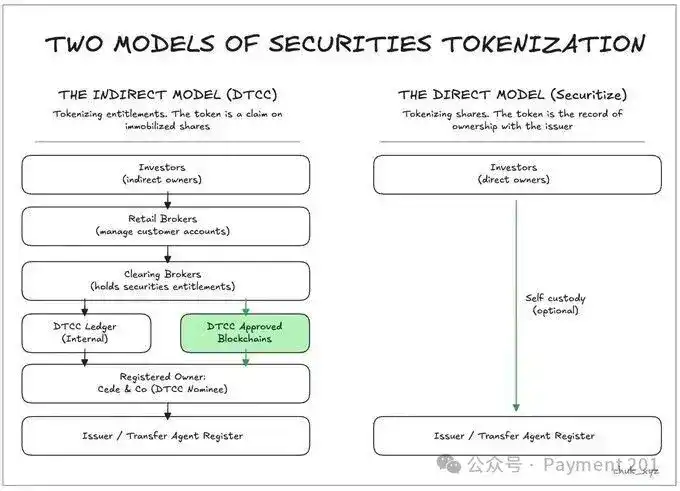
In other words, DTCC is tokenizing "claims"; the direct model tokenizes "the shares themselves." Both are called "tokenization," but the problems they solve are completely different.

Why This Upgrade?

The U.S. securities system is very robust, but its architecture still has some limitations.

  • Settlement relies on delayed, business-hours processing;

  • Corporate actions and reconciliation still run on batch messaging systems, not shared state;

  • Because ownership is a complex network of multiple layers of intermediaries, each with its own technology upgrade cycle, real-time processes cannot be supported unless every layer enables the capability, and DTCC is the key "gatekeeper" among them.

This design also "locks up" capital: the long settlement cycle requires tens of billions of dollars in margin to manage risk between trade execution and final settlement. These optimization designs originated from an era when "money moved slowly and was expensive." If the settlement cycle could be shortened, or if some participants could opt for "instant settlement," the scale of capital tied up could be significantly reduced, costs lowered, and competition increased.

Some of these benefits can be achieved by upgrading existing infrastructure; but others—especially those involving direct ownership and faster innovation cycles—require entirely new models.

Tokenizing the Existing System (The DTCC Model)

In the DTCC's path, the underlying securities remain "immobilized" and continue to be registered in the name of Cede & Co.
What changes is the载体 of the "record of entitlements": it no longer exists solely in proprietary ledger systems but has a digital twin on an "approved blockchain."

This is crucial because it enables modernization without disrupting the existing market structure: DTCC can introduce 24/7 fund flows between participants, reduce reconciliation burdens, and ultimately facilitate faster use of entitlement tokens in collateral liquidity and automated workflows, while still retaining the efficiencies of the centralized system, such as net settlement.

Multilateral netting can compress trillions of dollars in gross trading activity into hundreds of billions in final settlement, an efficiency that is a core advantage of the current market structure.

But these boundaries are "deliberately set": these tokens do not make the holder a direct shareholder. They remain permitted, revocable rights under the same legal framework. They cannot become freely composable collateral in DeFi, cannot bypass DTC participants, and do not change the issuer's shareholder records.

In short: it improves the system we have, but retains the intermediary structure and its advantages.

Tokenizing "Ownership Itself" (The Direct Holding Model)

The second model starts "outside the boundaries" of the DTCC model: it aims to tokenize not entitlements, but the shares themselves. Ownership is registered directly on the issuer's shareholder registry, maintained by the transfer agent. When the token is transferred, the shareholder record changes accordingly. Here, Cede & Co. is no longer in the chain of ownership.

This unlocks features that are structurally impossible in the DTCC model: self-custody, direct relationships between investors and issuers, peer-to-peer transfer, and composability with programmable and on-chain financial infrastructure (such as collateralization, lending, and innovative structures not yet invented).

This model is not theoretical. Galaxy Digital shareholders can already tokenize and hold shares on-chain through Superstate, appearing on the issuer's cap table. And in early 2026, Securitize will enable the same mechanism, with 24/7 trading through a regulated broker-dealer system.

However, the trade-offs are very real: without the indirect holding system, liquidity is fragmented, and netting efficiency disappears. Brokerage services (such as margin trading, securities lending) must be redesigned. Operational risk also shifts from intermediaries to the holders themselves.

But the autonomy offered by direct ownership allows investors to choose these trade-offs themselves, rather than having them imposed. Within the DTCC framework, this "choice" is nearly impossible, as any innovation regarding entitlements must go through multiple approval processes involving governance, operations, and regulation.
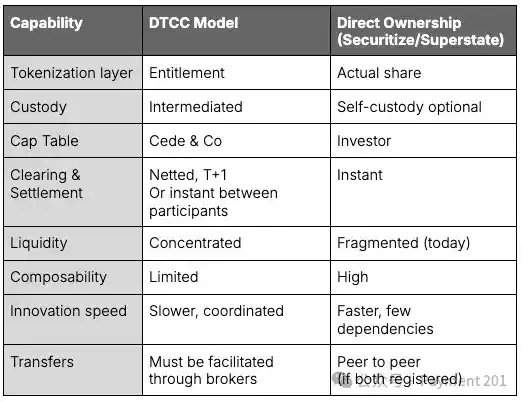
Overall, the DTCC model is more compatible and scalable; the direct holding model allows for more innovation around self-custody.

Why These Models Are Not Currently in Competition

The DTCC model and the direct holding model are not in competition; they solve different problems. The DTCC's path is an upgrade to the existing indirect holding system, preserving net settlement, liquidity concentration, and system stability. It targets institutions that require scale, settlement guarantees, and regulatory continuity.

The direct ownership model serves a different set of needs: self-custody, programmable assets, and on-chain composability. It targets investors and issuers who want new capabilities, not just greater efficiency. Although the direct holding model may one day reshape the entire market, achieving this will require years of technological, regulatory, and liquidity migration transition; it cannot happen overnight. The evolution of clearing rules, issuer behavior, participant readiness, and global interoperability moves slower than technological progress.

The realistic future is one of parallel coexistence: infrastructure modernization on one side, ownership innovation on the other. Currently, neither can replace the other.

What It Means for Market Participants

These two tokenization models have distinctly different impacts on the market ecosystem:

Retail Investors:

For retail investors, the DTCC upgrade is almost "invisible." Retail brokers already abstract away most friction for their clients (e.g., fractional shares, instant buying power, weekend trading), and these advantages will still be provided through brokers.

It is the direct holding model that will bring real change: self-custody, peer-to-peer transfer, instant settlement, and the potential to use stocks as on-chain collateral. Currently, stock trading is beginning to appear on platforms like Coinbase, Kraken, and wallets like Phantom, but most still rely on "wrapped representations." In the future, these tokens could become registered equity, not a synthetic layer.

Institutional Investors:

Institutions are the ones who benefit the most from DTCC tokenization. Their operations rely on collateral liquidity, securities lending, ETF processes, and multi-party reconciliation, and tokenized entitlements can significantly reduce burdens and increase speed in these areas.

The direct holding model is more attractive to some institutions, particularly trading firms seeking the advantages of programmable collateral and settlement. But due to liquidity fragmentation, broader institutional adoption will start at the edges.

Brokers & Clearing Houses:

Brokers are at the center of this change. In the DTCC model, their role is reinforced, but innovation also gravitates towards them: clearing houses that最早 adopt tokenized entitlements can gain a differentiated advantage, and vertically integrated companies can develop new products on top of this.

In the direct holding model, brokers do not disappear—they are reshaped. Licensing and compliance still exist, but new "on-chain native intermediaries" will emerge to serve users who value direct ownership features.

Conclusion: Investor Choice is the Real Winner

The future of tokenized securities lies not in which model "wins," but in how the two evolve and interact. The "entitlement tokenization" model will modernize the core of the public markets; the "direct ownership" model will expand from the edges, offering self-custody and programmable features.

As migration between the two models becomes smoother, we will see a broader market landscape: existing rails become faster and cheaper; new rails support new behaviors that the existing system cannot承载. Both paths will create winners and losers, but the existence of a direct ownership channel means: investors are the ultimate winners—they will get better infrastructure due to competition and have the right to choose freely between the two models.


Câu hỏi Liên quan

QWhat is the key difference between the two models of securities tokenization discussed in the article?

AThe key difference is that the DTCC model tokenizes 'security entitlements' (indirect claims on shares within the existing intermediary system), while the direct holding model tokenizes the 'shares themselves' (direct ownership recorded on the issuer's shareholder registry).

QWhat is the primary benefit of the DTCC's tokenization model for the existing market structure?

AThe primary benefit is the modernization of the existing system's 'plumbing'—it enables 24/7 fund movement, reduces reconciliation burdens, and improves efficiency for collateral liquidity and automated workflows—all while preserving the core advantages of the centralized system, such as multilateral netting.

QWhat new capabilities does the direct ownership (or direct holding) tokenization model unlock that the DTCC model cannot?

AThe direct ownership model unlocks capabilities like self-custody, a direct relationship between investors and issuers, peer-to-peer transfers, and the programmability and composability of assets with on-chain financial infrastructure, which are structurally impossible within the DTCC's intermediary framework.

QAccording to the article, why are the DTCC model and the direct holding model not in competition with each other?

AThey are not in competition because they solve different problems. The DTCC model is an upgrade to the existing indirect holding system for scale and stability, while the direct model serves the demand for self-custody and programmability. The realistic future is one of parallel coexistence.

QWho is identified as the ultimate winner in the evolution of these two tokenization models, and why?

AThe investor is the ultimate winner. The existence of a direct ownership channel creates competition, leading to better infrastructure overall. Investors gain the power to choose between the efficiency of the upgraded legacy system and the new functionalities of direct, programmable ownership.

Nội dung Liên quan

Phiên điều trần của Warsh kết thúc, những tín hiệu đáng chú ý nào đối với ngành công nghiệp tiền mã hóa?

Phiên điều trần của ứng viên Fed Judy Shelton (có biệt danh "Warsh") kết thúc với nhiều tín hiệu quan trọng cho ngành crypto. Bà khẳng định sẽ duy trì độc lập trong chính sách tiền tệ trước sức ép giảm lãi suất từ cựu Tổng thống Trump, nhưng vấp phải chỉ trích từ đảng Dân chủ về tính minh bạch. Đáng chú ý, Shelton sở hữu danh mục đầu tư lớn vào các công ty crypto và blockchain (như Solana, Lemon Cash) nhưng cam kết sẽ thoái vốn để tuân thủ quy định đạo đức. Bà chỉ trích Cục Dự trữ Liên bang (Fed) đã "sai lầm chết người" trong kiểm soát lạm phát và kêu gọi cải cách toàn diện, bao gồm thay đổi khung lạm phát và phương thức giao tiếp. Đối với thị trường crypto, quan điểm của bà về việc thu hẹp bảng cân đối kế toán của Fed (hiện 6.700 tỷ USD) sẽ tác động trực tiếp đến thanh khoản toàn cầu. Mặc dù tránh đề cập trực tiếp đến crypto, việc một chủ tịch Fed am hiểu công nghệ blockchain lên nắm quyền được kỳ vọng sẽ mang lại góc nhìn cởi mở hơn, dù vẫn cần thận trọng trước áp lực chính trị từ Nhà Trắng.

marsbit2 giờ trước

Phiên điều trần của Warsh kết thúc, những tín hiệu đáng chú ý nào đối với ngành công nghiệp tiền mã hóa?

marsbit2 giờ trước

Cuộc điều trần Fed 'hình thức hơn thực chất': Warsh không bàn lãi suất, nhưng mang đến 'liều thuốc an thần' cho crypto

Cuộc điều trần của ứng viên Chủ tịch Cục Dự trữ Liên bang Mỹ (Fed) Kevin Warsh trước Ủy ban Ngân hàng Thượng viện diễn ra vào ngày 21/4 được đánh giá là một màn trình diễn chính trị "hình thức hơn thực chất". Thay vì thảo luận sâu về chính sách lãi suất, Warsh tập trung bảo vệ tính độc lập của Fed, khẳng định ông sẽ không chịu sự chi phối của cựu Tổng thống Trump. Mặc dù chuẩn bị bản phát biểu dài gần 2000 từ, Warsh hầu như không đề cập đến định hướng chính sách tiền tệ cụ thể, chỉ nhấn mạnh việc thu hẹp bảng cân đối kế toán một cách thận trọng. Diễn biến quan trọng nhất nằm ngoài cuộc điều trần: việc Warsh có được xác nhận hay không phụ thuộc vào thương lượng giữa Trump và Thượng nghị sĩ Thom Tillis - người đe dọa chặn đề cử nếu Trump không ngừng điều tra Chủ tịch đương nhiệm Jerome Powell. Đối với ngành crypto, Warsh mang đến tín hiệu tích cực. Ông cam kết thoái vốn khỏi các tài sản crypto nếu được bổ nhiệm, nhưng đồng thời khẳng định: "Tài sản kỹ thuật số là một phần của ngành dịch vụ tài chính Mỹ", công nhận tính hợp pháp và tầm quan trọng của ngành. Tuyên bố này được giới đầu tư đánh giá cao, coi đây là dấu hiệu cho thấy Fed dưới sự lãnh đạo của Warsh có thể sẽ thân thiện hơn với crypto.

Odaily星球日报4 giờ trước

Cuộc điều trần Fed 'hình thức hơn thực chất': Warsh không bàn lãi suất, nhưng mang đến 'liều thuốc an thần' cho crypto

Odaily星球日报4 giờ trước

Giao dịch

Giao ngay
Hợp đồng Tương lai

Bài viết Nổi bật

AGENT S là gì

Agent S: Tương Lai của Tương Tác Tự Động trong Web3 Giới thiệu Trong bối cảnh không ngừng phát triển của Web3 và tiền điện tử, các đổi mới đang liên tục định nghĩa lại cách mà cá nhân tương tác với các nền tảng kỹ thuật số. Một dự án tiên phong như vậy, Agent S, hứa hẹn sẽ cách mạng hóa tương tác giữa con người và máy tính thông qua khung tác nhân mở của nó. Bằng cách mở đường cho các tương tác tự động, Agent S nhằm đơn giản hóa các nhiệm vụ phức tạp, cung cấp các ứng dụng chuyển đổi trong trí tuệ nhân tạo (AI). Cuộc khám phá chi tiết này sẽ đi sâu vào những phức tạp của dự án, các tính năng độc đáo của nó và những tác động đối với lĩnh vực tiền điện tử. Agent S là gì? Agent S đứng vững như một khung tác nhân mở đột phá, được thiết kế đặc biệt để giải quyết ba thách thức cơ bản trong việc tự động hóa các nhiệm vụ máy tính: Thu thập Kiến thức Cụ thể theo Miền: Khung này học một cách thông minh từ nhiều nguồn kiến thức bên ngoài và kinh nghiệm nội bộ. Cách tiếp cận kép này giúp nó xây dựng một kho lưu trữ phong phú về kiến thức cụ thể theo miền, nâng cao hiệu suất của nó trong việc thực hiện nhiệm vụ. Lập Kế Hoạch Qua Các Tầm Nhìn Nhiệm Vụ Dài Hạn: Agent S sử dụng lập kế hoạch phân cấp tăng cường kinh nghiệm, một cách tiếp cận chiến lược giúp phân chia và thực hiện các nhiệm vụ phức tạp một cách hiệu quả. Tính năng này nâng cao đáng kể khả năng quản lý nhiều nhiệm vụ con một cách hiệu quả và hiệu suất. Xử Lý Các Giao Diện Động, Không Đều: Dự án giới thiệu Giao Diện Tác Nhân-Máy Tính (ACI), một giải pháp đổi mới giúp nâng cao tương tác giữa các tác nhân và người dùng. Sử dụng các Mô Hình Ngôn Ngữ Lớn Đa Phương Thức (MLLMs), Agent S có thể điều hướng và thao tác các giao diện người dùng đồ họa đa dạng một cách liền mạch. Thông qua những tính năng tiên phong này, Agent S cung cấp một khung vững chắc giải quyết các phức tạp liên quan đến việc tự động hóa tương tác giữa con người với máy móc, mở ra nhiều ứng dụng trong AI và hơn thế nữa. Ai là Người Tạo ra Agent S? Mặc dù khái niệm về Agent S là hoàn toàn đổi mới, thông tin cụ thể về người sáng lập vẫn còn mơ hồ. Người sáng lập hiện vẫn chưa được biết đến, điều này làm nổi bật giai đoạn sơ khai của dự án hoặc sự lựa chọn chiến lược để giữ kín các thành viên sáng lập. Bất chấp sự ẩn danh, sự chú ý vẫn tập trung vào khả năng và tiềm năng của khung này. Ai là Các Nhà Đầu Tư của Agent S? Vì Agent S còn tương đối mới trong hệ sinh thái mã hóa, thông tin chi tiết về các nhà đầu tư và những người tài trợ tài chính của nó không được ghi chép rõ ràng. Sự thiếu vắng thông tin công khai về các nền tảng đầu tư hoặc tổ chức hỗ trợ dự án dấy lên câu hỏi về cấu trúc tài trợ và lộ trình phát triển của nó. Hiểu biết về sự hỗ trợ là rất quan trọng để đánh giá tính bền vững và tác động tiềm năng của dự án. Agent S Hoạt Động Như Thế Nào? Tại cốt lõi của Agent S là công nghệ tiên tiến cho phép nó hoạt động hiệu quả trong nhiều bối cảnh khác nhau. Mô hình hoạt động của nó được xây dựng xung quanh một số tính năng chính: Tương Tác Giống Như Con Người: Khung này cung cấp lập kế hoạch AI tiên tiến, cố gắng làm cho các tương tác với máy tính trở nên trực quan hơn. Bằng cách bắt chước hành vi của con người trong việc thực hiện nhiệm vụ, nó hứa hẹn nâng cao trải nghiệm người dùng. Ký Ức Tường Thuật: Được sử dụng để tận dụng các trải nghiệm cấp cao, Agent S sử dụng ký ức tường thuật để theo dõi lịch sử nhiệm vụ, từ đó nâng cao quy trình ra quyết định của nó. Ký Ức Tình Huống: Tính năng này cung cấp cho người dùng hướng dẫn từng bước, cho phép khung này cung cấp hỗ trợ theo ngữ cảnh khi các nhiệm vụ diễn ra. Hỗ Trợ OpenACI: Với khả năng chạy cục bộ, Agent S cho phép người dùng duy trì quyền kiểm soát đối với các tương tác và quy trình làm việc của họ, phù hợp với tinh thần phi tập trung của Web3. Tích Hợp Dễ Dàng với Các API Bên Ngoài: Tính linh hoạt và khả năng tương thích với nhiều nền tảng AI khác nhau đảm bảo rằng Agent S có thể hòa nhập liền mạch vào các hệ sinh thái công nghệ hiện có, làm cho nó trở thành lựa chọn hấp dẫn cho các nhà phát triển và tổ chức. Những chức năng này cùng nhau góp phần vào vị trí độc đáo của Agent S trong không gian tiền điện tử, khi nó tự động hóa các nhiệm vụ phức tạp, nhiều bước với sự can thiệp tối thiểu của con người. Khi dự án phát triển, các ứng dụng tiềm năng của nó trong Web3 có thể định nghĩa lại cách mà các tương tác kỹ thuật số diễn ra. Thời Gian Phát Triển của Agent S Sự phát triển và các cột mốc của Agent S có thể được tóm tắt trong một dòng thời gian nêu bật các sự kiện quan trọng của nó: 27 tháng 9, 2024: Khái niệm về Agent S được ra mắt trong một bài nghiên cứu toàn diện mang tên “Một Khung Tác Nhân Mở Sử Dụng Máy Tính Như Một Con Người,” trình bày nền tảng cho dự án. 10 tháng 10, 2024: Bài nghiên cứu được công bố công khai trên arXiv, cung cấp một cái nhìn sâu sắc về khung và đánh giá hiệu suất của nó dựa trên tiêu chuẩn OSWorld. 12 tháng 10, 2024: Một video trình bày được phát hành, cung cấp cái nhìn trực quan về khả năng và tính năng của Agent S, thu hút thêm sự quan tâm từ người dùng và nhà đầu tư tiềm năng. Những dấu mốc trong dòng thời gian không chỉ minh họa sự tiến bộ của Agent S mà còn chỉ ra cam kết của nó đối với sự minh bạch và sự tham gia của cộng đồng. Những Điểm Chính Về Agent S Khi khung Agent S tiếp tục phát triển, một số thuộc tính chính nổi bật, nhấn mạnh tính đổi mới và tiềm năng của nó: Khung Đổi Mới: Được thiết kế để cung cấp cách sử dụng máy tính trực quan giống như tương tác của con người, Agent S mang đến một cách tiếp cận mới cho việc tự động hóa nhiệm vụ. Tương Tác Tự Động: Khả năng tương tác tự động với máy tính thông qua GUI đánh dấu một bước tiến tới các giải pháp tính toán thông minh và hiệu quả hơn. Tự Động Hóa Nhiệm Vụ Phức Tạp: Với phương pháp mạnh mẽ của nó, nó có thể tự động hóa các nhiệm vụ phức tạp, nhiều bước, làm cho các quy trình nhanh hơn và ít sai sót hơn. Cải Tiến Liên Tục: Các cơ chế học tập cho phép Agent S cải thiện từ các trải nghiệm trước đó, liên tục nâng cao hiệu suất và hiệu quả của nó. Tính Linh Hoạt: Khả năng thích ứng của nó trên các môi trường hoạt động khác nhau như OSWorld và WindowsAgentArena đảm bảo rằng nó có thể phục vụ một loạt các ứng dụng rộng rãi. Khi Agent S định vị mình trong bối cảnh Web3 và tiền điện tử, tiềm năng của nó để nâng cao khả năng tương tác và tự động hóa quy trình đánh dấu một bước tiến quan trọng trong công nghệ AI. Thông qua khung đổi mới của mình, Agent S minh họa cho tương lai của các tương tác kỹ thuật số, hứa hẹn một trải nghiệm liền mạch và hiệu quả hơn cho người dùng trên nhiều ngành công nghiệp khác nhau. Kết luận Agent S đại diện cho một bước nhảy vọt táo bạo trong sự kết hợp giữa AI và Web3, với khả năng định nghĩa lại cách chúng ta tương tác với công nghệ. Mặc dù vẫn còn ở giai đoạn đầu, những khả năng cho ứng dụng của nó là rộng lớn và hấp dẫn. Thông qua khung toàn diện của mình giải quyết các thách thức quan trọng, Agent S nhằm đưa các tương tác tự động lên hàng đầu trong trải nghiệm kỹ thuật số. Khi chúng ta tiến sâu hơn vào các lĩnh vực tiền điện tử và phi tập trung, các dự án như Agent S chắc chắn sẽ đóng một vai trò quan trọng trong việc định hình tương lai của công nghệ và sự hợp tác giữa con người với máy tính.

Tổng lượt xem 640Xuất bản vào 2025.01.14Cập nhật vào 2025.01.14

AGENT S là gì

Làm thế nào để Mua S

Chào mừng bạn đến với HTX.com! Chúng tôi đã làm cho mua Sonic (S) trở nên đơn giản và thuận tiện. Làm theo hướng dẫn từng bước của chúng tôi để bắt đầu hành trình tiền kỹ thuật số của bạn.Bước 1: Tạo Tài khoản HTX của BạnSử dụng email hoặc số điện thoại của bạn để đăng ký tài khoản miễn phí trên HTX. Trải nghiệm hành trình đăng ký không rắc rối và mở khóa tất cả tính năng. Nhận Tài khoản của tôiBước 2: Truy cập Mua Crypto và Chọn Phương thức Thanh toán của BạnThẻ Tín dụng/Ghi nợ: Sử dụng Visa hoặc Mastercard của bạn để mua Sonic (S) ngay lập tức.Số dư: Sử dụng tiền từ số dư tài khoản HTX của bạn để giao dịch liền mạch.Bên thứ ba: Chúng tôi đã thêm những phương thức thanh toán phổ biến như Google Pay và Apple Pay để nâng cao sự tiện lợi.P2P: Giao dịch trực tiếp với người dùng khác trên HTX.Thị trường mua bán phi tập trung (OTC): Chúng tôi cung cấp những dịch vụ được thiết kế riêng và tỷ giá hối đoái cạnh tranh cho nhà giao dịch.Bước 3: Lưu trữ Sonic (S) của BạnSau khi mua Sonic (S), lưu trữ trong tài khoản HTX của bạn. Ngoài ra, bạn có thể gửi đi nơi khác qua chuyển khoản blockchain hoặc sử dụng để giao dịch những tiền kỹ thuật số khác.Bước 4: Giao dịch Sonic (S)Giao dịch Sonic (S) dễ dàng trên thị trường giao ngay của HTX. Chỉ cần truy cập vào tài khoản của bạn, chọn cặp giao dịch, thực hiện giao dịch và theo dõi trong thời gian thực. Chúng tôi cung cấp trải nghiệm thân thiện với người dùng cho cả người mới bắt đầu và người giao dịch dày dạn kinh nghiệm.

Tổng lượt xem 1.3kXuất bản vào 2025.01.15Cập nhật vào 2025.03.21

Làm thế nào để Mua S

Thảo luận

Chào mừng đến với Cộng đồng HTX. Tại đây, bạn có thể được thông báo về những phát triển nền tảng mới nhất và có quyền truy cập vào thông tin chuyên sâu về thị trường. Ý kiến ​​của người dùng về giá của S (S) được trình bày dưới đây.

活动图片