DraftKings eyes crypto offerings as it expands into prediction markets

cointelegraphXuất bản vào 2025-12-19Cập nhật gần nhất vào 2025-12-19

Tóm tắt

DraftKings is expanding beyond sports betting into prediction markets with its new DraftKings Predictions app, which allows users to trade contracts on sports and financial outcomes. Initially available in 38 states, the company plans to eventually include crypto-linked contracts, as well as entertainment and cultural events. The trading operates through Railbird Exchange, a CFTC-regulated derivatives venue, providing a established regulatory framework. This move aligns with a broader trend of prediction markets gaining mainstream traction in the U.S., driven by platforms like Polymarket and Kalshi. Other crypto-native firms, including Coinbase and Gemini, are also entering the prediction market space.

DraftKings is expanding beyond sports betting into the realm of prediction markets, laying the groundwork for future crypto-linked contracts as regulated event trading gains momentum in the United States.

As Bloomberg reported, the company announced on Friday that it has launched the DraftKings Predictions app, which allows users to trade contracts on sports and financial outcomes. At launch, the app is available in 38 states, with sports-related trading permitted in 17 of them.

DraftKings ultimately plans to expand its prediction market offerings beyond sports and finance to include contracts linked to crypto, entertainment and cultural events, according to Bloomberg.

DraftKings’ push into prediction markets is underpinned by regulated derivatives infrastructure connected to CME Group–style market standards.

The company said trading will be conducted through Railbird Exchange, a derivatives venue it acquired and which is registered with the US Commodity Futures Trading Commission, allowing DraftKings to offer event-based contracts within an established regulatory framework.
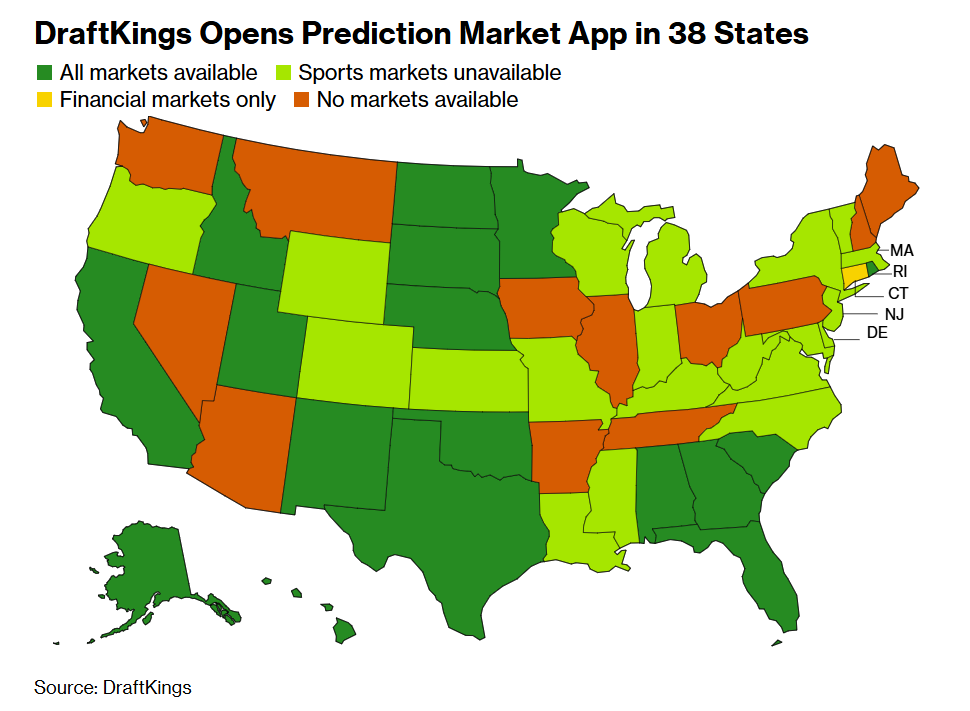
DraftKings’ growing national footprint. Source: Bloomberg

As a publicly traded US-based sports betting and entertainment company, DraftKings brings increased visibility and mainstream exposure to prediction markets and potentially crypto-linked contracts as regulated event trading gains traction in the United States.

In early November, DraftKings reported third-quarter revenue of $1.14 billion, up 4% year over year, alongside an adjusted loss of $127 million. The company said it expects to generate up to $6.1 billion in revenue this year, roughly triple the amount it generated in 2022.

Related: Polymarket shows stronger retention than most DeFi, wallets and exchanges

From Polymarket to Wall Street: Prediction markets go mainstream

While DraftKings’ prediction market offering is not built on blockchain or decentralized technology, the broader sector has gained momentum in recent years largely due to crypto-native platforms that redefined how prediction markets operate.

The most prominent example is Polymarket, which brought prediction markets onchain by using crypto rails to enable global participation and near-instant settlement.

The platform helped popularize prediction markets among crypto-native users, particularly during major political events and most notably the 2024 US presidential election. Its rise has coincided with growing interest in other event-based trading venues, including Kalshi, a US-regulated prediction market operating under the Commodity Futures Trading Commission (CFTC).

Beyond consumer-facing platforms, crypto-focused financial infrastructure providers are also expanding into the space. Bitnomial Clearinghouse, a derivatives clearing organization regulated by the CFTC, has signaled plans to support prediction markets tied to cryptocurrency and macroeconomic outcomes.

Crypto-native exchanges are also broadening their product suites to include prediction-style offerings. Coinbase recently announced plans to integrate stock trading and prediction markets into its long-term vision of becoming an “everything app.”
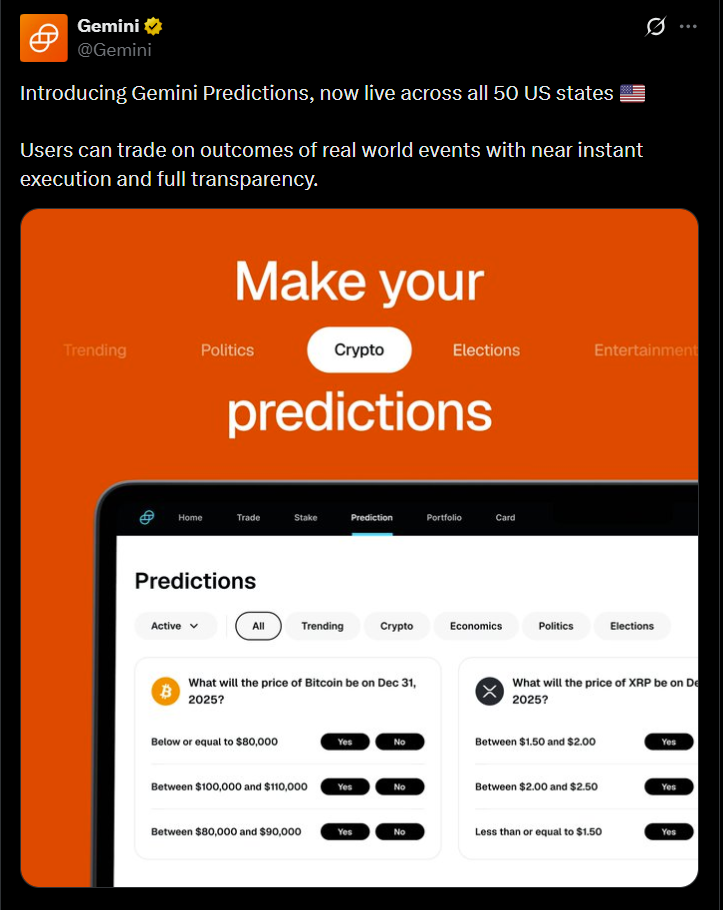
Source: Gemini

Meanwhile, the Winklevoss-led Gemini cryptocurrency exchange has launched prediction markets in the US, having secured the necessary regulatory approvals.

Related: Phantom taps Kalshi to offer regulated prediction markets in wallet

Câu hỏi Liên quan

QWhat new market is DraftKings expanding into, and what future offerings are they planning?

ADraftKings is expanding into prediction markets and is planning future crypto-linked contracts, as well as offerings related to entertainment and cultural events.

QThrough which regulated entity will DraftKings conduct its prediction market trading?

ADraftKings will conduct its trading through Railbird Exchange, a derivatives venue it acquired that is registered with the US Commodity Futures Trading Commission (CFTC).

QWhat is a key crypto-native platform that helped popularize onchain prediction markets?

APolymarket is the key crypto-native platform that helped popularize onchain prediction markets by using crypto rails for global participation and near-instant settlement.

QBesides DraftKings, name two other US-based companies or platforms mentioned that are involved in prediction markets.

ATwo other US-based companies involved in prediction markets are Kalshi, a CFTC-regulated prediction market, and the Gemini cryptocurrency exchange, which has launched its own prediction markets.

QWhat was DraftKings' reported third-quarter revenue and how does it compare to the previous year?

ADraftKings reported third-quarter revenue of $1.14 billion, which was up 4% year over year.

Nội dung Liên quan

Nỗi lo lắng 2026 của nhà đầu tư AI: Khi mô hình nuốt chửng mọi thứ, hào bảo vệ của các công ty khởi nghiệp còn lại gì?

Tác giả Sarah Guo phản bác quan điểm bi quan của các nhà đầu tư AI rằng chỉ có các công ty mô hình lớn (như Anthropic) và nhà cung cấp chip (như NVIDIA) là đáng đầu tư. Bà lập luận rằng khi mô hình AI ngày càng giỏi, giá trị thực sự không nằm ở những thứ có thể đo lường và tối ưu hóa bằng benchmark (như viết code), mà nằm ở những lĩnh vực "không thể huấn luyện". Các benchmark đo lường công việc có thể kiểm tra tự động, khiến chúng dần trở thành hàng hóa và bị các mô hình tổng quát "nuốt chửng". Giá trị bền vững thực sự tồn tại trong các ngóc ngách phức tạp của thực tế: tích hợp vào hệ thống riêng tư và lỗi thời của doanh nghiệp, xây dựng lòng tin với người dùng qua thời gian dài, hiểu sâu các quy trình nghiệp vụ đặc thù (như pháp lý, y tế), và chịu trách nhiệm pháp lý. Các công ty khởi nghiệp có thể xây dựng "hào bảo vệ" bằng cách trở thành chuyên gia trong một lĩnh vực cụ thể, sử dụng dữ liệu riêng để huấn luyện mô hình chuyên biệt, và quan trọng nhất là thực hiện công việc "dịch thuật" tẻ nhạt - kết nối trí thông minh của AI với thực tế hỗn độn của khách hàng. Họ giành quyền định nghĩa thế nào là "kết quả tốt" trong lĩnh vực đó. Trong khi trí thông minh ngày càng rẻ, giá trị dịch chuyển về những nơi mà vốn và thuật toán thuần túy không thể với tới.

marsbit27 phút trước

Nỗi lo lắng 2026 của nhà đầu tư AI: Khi mô hình nuốt chửng mọi thứ, hào bảo vệ của các công ty khởi nghiệp còn lại gì?

marsbit27 phút trước

Mức Cao Ba Năm Mới Đập Tan Giấc Mơ Giảm Lãi Suất, Ai Đang Mượn CPI Rửa Sạch Mã Thương?

Bài viết phân tích phản ứng của thị trường sau khi Mỹ công bố chỉ số CPI tháng 5/2026 tăng 4,2% so với cùng kỳ, mức cao nhất kể từ tháng 4/2023. Lạm phát tăng chủ yếu do giá năng lượng bởi xung đột địa chính trị, khiến kỳ vọng về việc Cục Dự trữ Liên bang (Fed) cắt giảm lãi suất trong năm nay gần như tan biến. Các công cụ theo dõi thị trường cho thấy xác suất Fed giữ nguyên lãi suất trong năm nay lên tới 72%. Thị trường chứng khoán và tiền mã hóa, với tư cách là tài sản rủi ro, chịu áp lực giảm điểm. Bitcoin dao động quanh ngưỡng 61.000-62.000 USD, các quỹ ETF bitcoin ghi nhận dòng tiền ròng rút liên tục. Dữ liệu từ Glassnode chỉ ra thị trường đang trong giai đoạn thanh lọc đòn bẩy và tâm lý bi quan, mặc dù các chỉ báo định giá đã ở vùng thấp lịch sử. Các chuyên gia như Olu Sonola (Fitch) và Seema Shah (Principal Asset Management) nhận định lạm phát cốt lõi vẫn được kiểm soát tương đối, cho Fed không gian tiếp tục quan sát. Họ cho rằng việc thị trường định giá khả năng tăng lãi suất là hơi cao. David Kelly từ JP Morgan Asset Management dự báo dữ liệu này có thể là đỉnh chu kỳ tạm thời và Fed nhiều khả năng sẽ duy trì lãi suất ở cuộc họp sắp tới.

Foresight News49 phút trước

Mức Cao Ba Năm Mới Đập Tan Giấc Mơ Giảm Lãi Suất, Ai Đang Mượn CPI Rửa Sạch Mã Thương?

Foresight News49 phút trước

Đế chế crypto của Trump: Một thử nghiệm chuyển dịch tài sản 2,3 tỷ USD

Vào tháng 6/2026, một cuộc điều tra của Reuters đã tiết lộ một hệ thống kinh doanh tiền mã hóa khổng lồ xoay quanh gia đình cựu Tổng thống Mỹ Donald Trump. Kể từ khi Trump trở lại Nhà Trắng, gia đình ông được ước tính đã thu về khoảng 2,3 tỷ USD từ bốn dự án cốt lõi: nền tảng tài chính phi tập trung World Liberty Financial (WLFI), meme coin $TRUMP, công ty khai thác bitcoin American Bitcoin, và công ty thanh toán ALT5 Sigma (sau đổi tên thành AI Financial). Một con số trùng hợp đáng chú ý là tổng thua lỗ của các nhà đầu tư vào các dự án này cũng xấp xỉ 2,3 tỷ USD. Điểm chung của tất cả các dự án này không phải là đổi mới công nghệ hay doanh thu ổn định, mà là việc khai thác sức ảnh hưởng chính trị toàn cầu và sức hút truyền thông của thương hiệu "Trump". Chúng đại diện cho một thí nghiệm về việc chuyển hóa ảnh hưởng chính trị thành tài sản tài chính. WLFI, với token quản trị WLFI và stablecoin USD1, là "cỗ máy in tiền" lớn nhất, mang về cho gia đình Trump khoảng 1,6 tỷ USD. Trong khi đó, meme coin $TRUMP là hình thức biến thương hiệu thành tiền mặt trực tiếp nhất, tạo ra lợi nhuận trên 600 triệu USD cho các thực thể liên quan nhưng sau đó lao dốc gần 97%. American Bitcoin và ALT5 Sigma/AI Financial hưởng lợi từ việc định giá thị trường tăng vọt nhờ gắn mác "cổ phiếu Trump", nhưng giá cổ phiếu sau đó đều điều chỉnh khi thị trường tỉnh táo lại. Báo cáo chỉ ra một khuôn mẫu chung: gia đình Trump sử dụng thương hiệu để thu hút sự chú ý và niềm tin, thổi bùng cảm xúc thị trường, thu hút vốn đầu tư thông qua phát hành token hoặc IPO, và cuối cùng kiếm lời thông qua cổ phần, phí cấp phép thương hiệu hoặc bán token. Trong khi đó, nhiều nhà đầu tư bình thường, đặc biệt là những người tham gia sau, đã phải gánh chịu rủi ro và tổn thất khi cơn sốt thị trường qua đi. Sự kiện này một lần nữa cảnh báo về rủi ro khi đưa ra quyết định đầu tư dựa trên cảm xúc, niềm tin hay hiệu ứng người nổi tiếng, thay vì phân tích cơ bản về dòng tiền và mô hình kinh doanh thực tế của tài sản.

marsbit1 giờ trước

Đế chế crypto của Trump: Một thử nghiệm chuyển dịch tài sản 2,3 tỷ USD

marsbit1 giờ trước

Giao dịch

Giao ngay
Hợp đồng Tương lai
活动图片