Original author: @Decentralisedco
Original compilation: AididiaoJP, Foresight News
In a previous article, we explored how HIP-4 brought structured products to Hyperliquid. Robinhood has a similar move, recently entering the prediction markets. The table below provides some background.
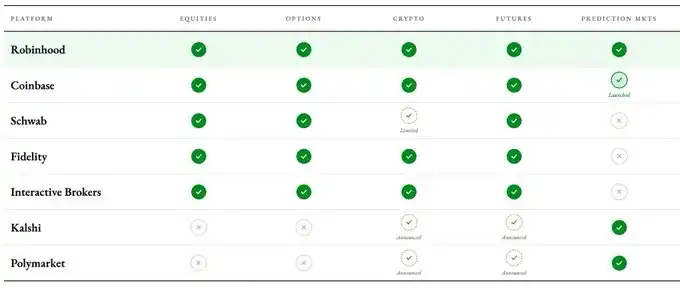
Fidelity, Schwab, and Interactive Brokers grew up in an era when prediction markets did not yet exist. Even spot cryptocurrency constitutes only a small part of their overall product offerings. In contrast, Robinhood serves a younger demographic who may want to bet on sports events, go long on semiconductor stocks, trade Solana frequently, while holding crude oil positions in futures markets. A generation raised on "monitoring the situation" would flock to platforms like Polymarket or Kalshi if Robinhood could not offer the same risky assets.
One way to mitigate this risk is to offer event contracts. These are binary instruments that settle on a "Yes" or "No" outcome. Each contract price ranges from $0 to $1, reflecting the market's real-time probability of the event occurring. If you are correct, the contract settles at $1; if wrong, at $0. The cost for a user to enter is the probability of the event happening. For example, a contract priced at $0.60 for the Strait of Hormuz opening by May 30th signals the market's conviction about it. If most people are convinced something will happen, the room for profit from that event is small.
On Robinhood, these instruments can serve as hedging tools. You could go long on the Strait of Hormuz opening while simultaneously going long on crude oil prices, assuming oil prices would remain high if the Strait does not open.
Robinhood first launched its prediction markets business in March 2025, offering routing services for its customers through KalshiEX. Within nine months, users had traded 12 billion contracts. Approximately 70% of the full-year trading volume was concentrated in the fourth quarter. In the first quarter of 2026, Robinhood had already recorded 8.8 billion event contracts.
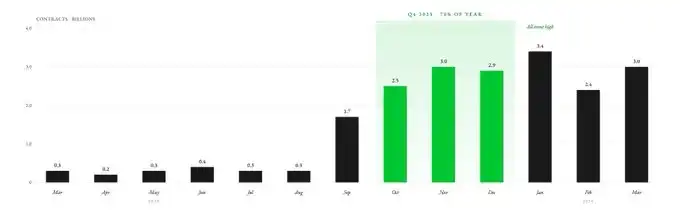
Over 1 million Robinhood customers traded event contracts in 2025. Robinhood did not launch these markets and build liquidity itself, but directly integrated Kalshi's prediction markets. Robinhood acts as a distribution layer by providing a dashboard for its customers. The entire infrastructure, at least for now, is still supported by Kalshi (more details later).
Kalshi and Polymarket dominate the market, accounting for over 90% of the total trading volume in prediction markets. Robinhood distributes Kalshi's contracts to its 27.4 million funded users, who invest across various asset classes including stocks, crypto, futures, and options. Kalshi is merely a prediction markets platform and cannot match this distribution power.
In fact, Robinhood contributed 50% of Kalshi's trading volume in Kalshi's first year.
While Coinbase allows users to trade stocks, crypto, futures, and options (via the acquisition of Deribit), it only launched prediction markets this January. In contrast, Robinhood's prediction markets business has been operational for over a year, with an annualized revenue already exceeding $415 million. Robinhood's monthly active users are also significantly higher than Coinbase's, at 13.5 million compared to Coinbase's 9.2 million.
Prediction markets can evolve further on Robinhood. Currently, they exist as a separate Hub within the app, isolated from the rest of the platform. But soon, they could be cross-linked with assets like stocks, options, and crypto—Robinhood's stock traders could also directly purchase prediction market event contracts.
Imagine opening Nvidia's stock page ahead of its earnings report. You would see the usual information: stock price and options chain. But now, you'd also see an event contract next to it: "Will Nvidia exceed Q2 revenue expectations?" The contract trades at $0.72, meaning the market assigns a 72% probability of it beating expectations. You believe the market is underestimating the demand for Nvidia's products.
In this scenario, Robinhood lets you buy the stock, buy a call option, or purchase 500 "Yes" contracts for $360—yielding a $140 profit if you are correct ($0.28 profit per contract × 500 contracts).
Robinhood places all three instruments on the same screen, eliminating the need to switch tabs.
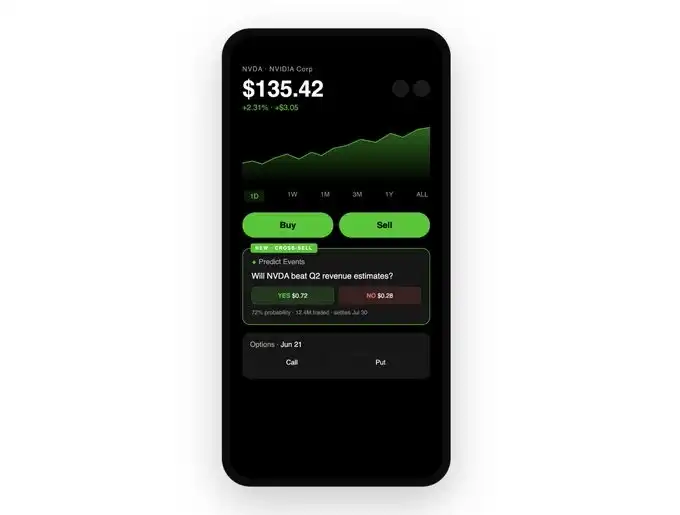
As illustrated earlier with crude oil, you could also use these instruments to hedge positions. You could bet on Nvidia beating expectations while simultaneously shorting the stock to hedge your prediction market bet. Thus, Robinhood allows you to construct cross-asset hedging strategies in less than a minute, all on the same screen.
So far, this integration into the stock trading page has worked well for Robinhood, but it is still leaving money on the table. This will soon change as Robinhood is about to take the next step.
A Richer Context for Pricing Information
Robinhood's moat lies in providing users with all relevant information at the time and place they need it most. The era of buying Bitcoin on Coinbase, trading options on Deribit, holding stocks on Robinhood, and trading crude oil futures on IBKR is over. Users want to avoid switching contexts and platforms.
Once Robinhood embeds prediction markets into all asset pages, it transitions from a passive broker to an information pricing platform. Beyond the price and analyst ratings, Robinhood will also offer real-time probability markets for events relevant to that stock. Event contracts reflect the real-time consensus of those with skin in the game. These contracts can help users make better decisions, even if they never trade a single prediction market contract.
Take Nvidia again. The stock price at any moment reflects the sentiment of those holding the underlying equity. With equity come legal rights, shareholder reports, analyst questions, and a framework developed over 400+ years to protect investors. But most of the time, traders likely don't care about that. The information they want to price might be "Will Nvidia beat revenue expectations?" In that case, prediction markets (arguably) could be a better source of pricing information than the stock price itself. Robinhood's attempt to bring all instruments—derivatives, event contracts, and equity—under one roof is precisely to capture value from every user who might want to trade that event.
But Polymarket and Kalshi have been doing this for years. Where is Robinhood's moat? Why not simply integrate third-party markets into its interface to boost revenue, rather than owning these markets itself? Cross-selling and trading volumes reveal the incentives more clearly.
Cross-Selling as a Regulatory Moat
In March 2026, two bipartisan bills were proposed aiming to federally ban event contracts related to sports. There are also legal hurdles at the state level. This is an existential crisis for platforms like Kalshi—89% of its fee revenue in 2025 came from sports-related event contracts. Approximately 60% of Polymarket's open interest also comes from sports-related event contracts.
If sports contracts face legal setbacks, Kalshi and Polymarket would be hit the hardest. Without this dominant category, they cannot sustain valuations above $20 billion. While Robinhood initially started with a heavy focus on sports markets, its cross-selling capabilities allow it to diversify revenue into stocks and macro events (like earnings, Fed decisions, CPI data, and employment reports).
For Robinhood, sports are just one revenue item. For Kalshi, the sports category is almost everything. Any regulatory crackdown on sports-related markets could undermine Kalshi's and Polymarket's claims to valuations above $20 billion. Robinhood now occupies a higher position in its value chain through a joint venture named Rothera.
In November 2025, Robinhood formed a joint venture called Rothera LLC. This JV subsequently acquired MIAXdx—a CFTC-licensed Designated Contract Market (DCM), Derivatives Clearing Organization (DCO), and Swap Execution Facility (SEF). This fundamentally changes the economics, control, ownership, and clearing & settlement processes for event contracts.
Relying on Kalshi to supply event markets limited the types of contracts Robinhood could list. Rothera allows Robinhood to list any event contract at any time.
From an economics perspective, this could mean Robinhood captures the one cent that currently goes to Kalshi and potentially doubles its event contract revenue. If Robinhood can direct half of this revenue flow to its own entity, its prediction market revenue could increase by 50% to $620 million at current event contract rates.
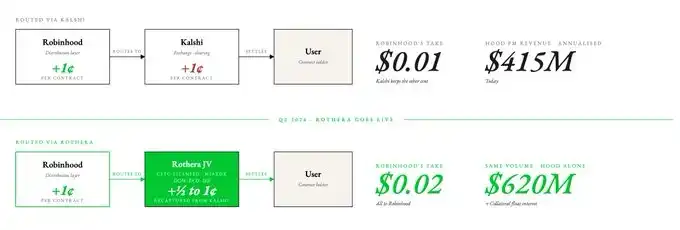
There is reason for optimism about this JV, as its latest quarterly results already show Robinhood beginning to invest in Rothera. The Q1 2026 results include $14 million in JV-related costs. There is also a small benefit: once prediction market contracts are routed through Rothera, the collateral backing open positions will be counted on Robinhood's balance sheet, adding interest income to its revenue. With collateral size corresponding to open interest reaching around $100 million, this could add an extra $4-5 million in annual income.
Every trading platform has a simple mission: make traders move money as frequently as possible and charge a small fee on each trade; or have them park large idle capital and keep the interest income. For Robinhood, it seems to be adopting the latter strategy.
The cross-selling moat Robinhood achieves through prediction markets is similar to the moat we previously argued Hyperliquid enjoys via HIP-4 event contracts. Hyperliquid's unified risk engine integrates primitives like spot, perps, deployment markets, and prediction markets, ensuring efficient capital utilization in a decentralized market. The same logic applies to Robinhood, just in a centralized market.
Kalshi does not have Robinhood's distribution moat across different asset classes. A standalone prediction market product is far less valuable than a prediction market embedded within every other trading product. Coinbase is just entering prediction markets, and Robinhood's advantage of a full asset stack integrated with event contracts on one screen gives it a head start over Coinbase in this arena.
The Numbers Speak
Any discussion placing Coinbase, Kalshi, and Robinhood together for valuation is essentially trying to answer the same question: What is the lifetime value of a user on each platform? Kalshi's users might be fewer, but they pay much higher fees. The same user, if Robinhood can match Kalshi's liquidity with lower fees, would trade entirely on Robinhood.
The market has seen this difference. Kalshi and Robinhood have similar valuation multiples (both around 15x), while Coinbase's multiple is lower at 7.5x. For Kalshi, prediction markets constitute its entire revenue. For Robinhood, it's only 7%. For Coinbase, this figure is negligible.
When Rothera goes live, Robinhood can price more competitively than any standalone prediction market platform. It can undercut Kalshi's fees, absorb a margin hit, but still grow because every prediction market user is also a potential customer for stocks, options, and crypto. Kalshi is not sitting idle and reportedly plans to launch crypto trading, starting with perpetual contracts. But transitioning from a prediction market to a multi-asset platform is much harder than integrating prediction markets into a multi-asset trading platform.
Robinhood has spent over a decade acquiring 27.4 million funded users and building deep liquidity, market makers, compliance infrastructure, and user trust. Kalshi would have to start from scratch.
One way to understand the value of this business is to hypothetically spin off Robinhood's prediction markets unit and take it public separately. If it had $415 million ARR and the same growth trajectory, what would it be worth? The simplest answer is Kalshi's 15x multiple, i.e., $6.2 billion. But all else equal, Kalshi with Robinhood's revenue lines would be valued much higher.
We built an estimation model for the next three years using the following assumptions:
- Contract Volume: 70 billion event contracts in 2028 under the base case. This assumes a ~40% CAGR over the next two years. Based on Robinhood recording 8.8 billion in Q1 this year (annualized ~35 billion).
- Rothera Economics: We expect effective revenue per contract to rise from $0.01 to $0.015 in a bear case, or $0.02 in base/bull cases (after three years).
- Cross-Selling Lift: 2026 multiplier 1.0x (cross-linking not yet live), 2027 1.1x (initial launch on stock pages), 2028 1.2x (mature adoption). This assumes cross-selling brings only 10-20% incremental trading volume on top of organic prediction market growth.
- Robinhood Total Revenue: Using consensus estimates, $5.4 billion in 2026, $6.4 billion in 2027, $7.2 billion in 2028.
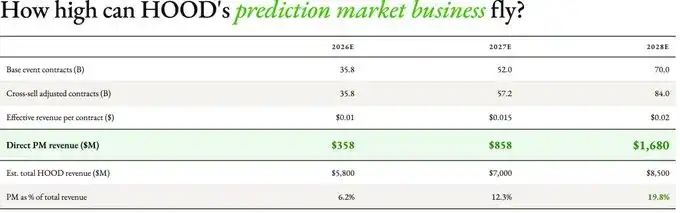
We then stress-tested three scenarios for 2028: Bear, Base, and Bull.
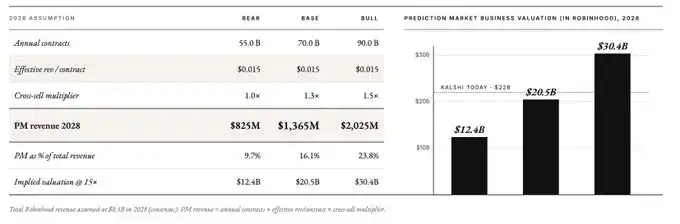
Even under the bear case, Robinhood's prediction markets business alone would generate $825 million in revenue by 2028, more than triple Kalshi's 2025 revenue ($260 million). Using Kalshi's current revenue multiple (15x), Robinhood's prediction markets business would be worth $12 billion in this scenario. In the most optimistic case, it could be worth up to $30 billion by 2028.
What we are likely witnessing is: a business with a distribution moat pioneering an entirely new market and keeping most of the value for itself. The pending question is whether Polymarket and Kalshi are a replay of OpenSea in 2021 or can successfully reinvent themselves as new threats emerge. Polymarket recently expanded into perpetual products, but its users are unlikely to switch to perpetuals just because prediction markets were their original intent. In contrast, Robinhood benefits from a core user base that is always there for its high-risk, zero-fee trading tools. The latter seems to have the upper hand over the former.
Today, the market views Robinhood as a traditional fintech broker with a prediction market product on the side, which is why prediction markets constitute only 7% of its revenue. But if Robinhood CEO Vladimir Tenev delivers on his stated direction, Robinhood will become a platform that provides trading services for assets driven by these views while pricing every financial opinion on earnings, interest rates, elections, and commodities in real-time.
A standalone prediction market only attracts those already trading event contracts. In contrast, a prediction market integrated into a retail broker becomes an information pricing machine for everyone else. The vertical integration of capital aggregators is visible everywhere.