Did the U.S. Marshals Service Violate Trump's Executive Order by Selling Confiscated Bitcoin?

marsbitXuất bản vào 2026-01-06Cập nhật gần nhất vào 2026-01-06

Tóm tắt

In a potential violation of Executive Order 14233, the U.S. Marshals Service (USMS) appears to have sold 57.5 Bitcoin, valued at $6.36 million, seized from Samourai Wallet developers Keonne Rodriguez and William Lonergan Hill as part of their plea agreement. The Bitcoin was transferred to a Coinbase Prime wallet on November 3, 2025, and the address has since been emptied, indicating a sale. The executive order, signed by President Trump, mandates that Bitcoin obtained through criminal forfeiture must be held in the U.S. Strategic Bitcoin Reserve and not sold. Legal analysis confirms the seized assets fall under the order's definition of "government bitcoin," and no statute requires such assets to be liquidated. This action by the U.S. District Court for the Southern District of New York (SDNY) continues a pattern of defying federal directives, including a Justice Department memo to end prosecutions against developers of non-custodial crypto tools. The article questions whether the Trump administration is truly ending the "war on crypto," suggesting that pardoning Rodriguez and investigating this sale would affirm its pro-crypto stance.

Written by: Frank Corva

Compiled by: Chopper, Foresight News

The U.S. Marshals Service (USMS) appears to have liquidated the Bitcoin paid by Samourai wallet developers Keonne Rodriguez and William Lonergan Hill as part of their plea agreement, with the Bitcoin valued at $6.3 million.

This action is suspected of violating Executive Order 14233. The order stipulates that Bitcoin obtained by the government through criminal or civil asset forfeiture procedures should be held in the U.S. Strategic Bitcoin Reserve, not liquidated.

If the U.S. District Court for the Southern District of New York, which is handling the Samourai case, did indeed violate Executive Order 14233, this would not be the first time its staff has defied federal government directives.

Where Did This Bitcoin Go?

Bitcoin Magazine obtained a previously undisclosed Asset Liquidation Agreement document. The document indicates that the Bitcoin confiscated from Rodriguez and Hill is either about to be sold or has already been liquidated.
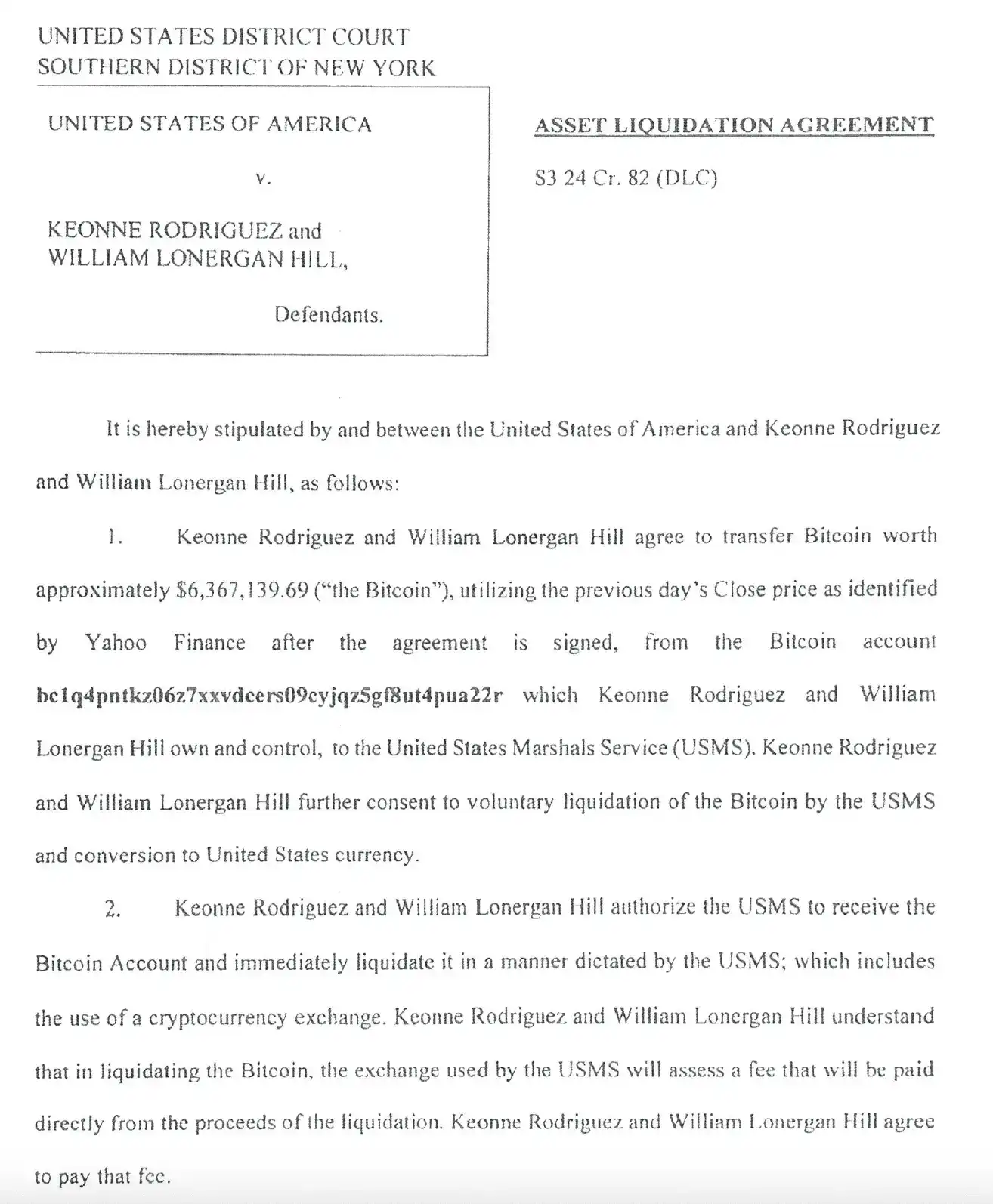
According to the agreement, the two defendants agreed to transfer 57.5 Bitcoin to the U.S. Marshals Service. On the final signing date of the agreement, November 3, 2025, this Bitcoin was worth approximately $6.36 million.

On November 3, 2025, this Bitcoin was transferred from the address bc1q4pntkz06z7xxvdcers09cyjqz5gf8ut4pua22r. However, it does not appear to have gone into a direct custodial account of the U.S. Marshals Service but was directly transferred to a Coinbase Prime wallet address, 3Lz5ULL7nG7vv6nwc8kNnbjDmSnawKS3n8, presumably for liquidation.

The balance of this Coinbase Prime address is now zero, meaning this Bitcoin has most likely been sold.

Violation of Executive Order 14233

If the U.S. Marshals Service confirms the sale of this confiscated Bitcoin, it constitutes a violation of Executive Order 14233. This order explicitly states that Bitcoin obtained by the government through criminal forfeiture procedures "shall not be sold" and must be incorporated into the U.S. Strategic Bitcoin Reserve.

The USMS's decision to sell the Bitcoin was based on its own discretion, not a legal requirement. This suggests that some personnel within the Department of Justice may still view Bitcoin as a "taboo asset" to be quickly liquidated, rather than a strategic asset that President Trump has mandated government agencies to hold.

It is worth noting that the investigation and prosecution of Samourai began during the previous administration, which held strong hostility towards non-custodial cryptocurrency tools and their developers. Therefore, the DOJ's decision to ignore Executive Order 14233 and insist on selling the Bitcoin continues the previous administration's practice of treating Bitcoin as an asset that should be removed from the government's balance sheet as soon as possible.

Legal Details Related to Forfeiture and Liquidation

According to a legal source familiar with the matter, the Bitcoin from the Samourai developers was forfeited under Title 18, Section 982(a)(1) of the U.S. Code. This section stipulates that any property involved in a violation of Title 18, Section 1960, which prohibits operating an unlicensed money transmitting business, must be forfeited to the U.S. government.

Combining Title 18, Section 982 with its reference to Title 21, Section 853(c) (a criminal forfeiture statute stating that "property transferred to a person other than the defendant may be subject to a special forfeiture order and subsequently ordered to be forfeited to the U.S. government"), the Bitcoin forfeited from Rodriguez and Hill fully meets the definition of "Government Bitcoin" under Executive Order 14233.

Neither Title 18, Section 982 nor the referenced Title 21, Section 853 mandates the liquidation of criminally forfeited property. Furthermore, the two forfeiture fund management statutes cited in Section 3 of Executive Order 14233—Title 31, Section 9705 and Title 28, Section 524(c)—only regulate the deposit accounts and usage of forfeited funds and do not require converting forfeited Bitcoin into fiat currency.

The executive order also clearly states that "Government Bitcoin" falls under the category of "Government Digital Asset" and mandates that "the head of each agency shall not sell or otherwise dispose of any Government Digital Asset," except under specific circumstances. The Rodriguez and Hill case does not meet any of these exceptions; and in all exceptional cases, the U.S. Attorney General must participate in the decision-making process regarding the disposition of forfeited digital assets.

The 'Sovereign District' of SDNY

Considering Executive Order 14233 and the various statutes cited in this article, the actions of the U.S. District Court for the Southern District of New York clearly violate the core requirement of the executive order to "transfer criminally forfeited Bitcoin to the U.S. Strategic Bitcoin Reserve."

And this is not the first time this court has exhibited such defiant behavior.

This judicial district, often jokingly called the "Sovereign District Court of New York," is notorious for its independent and arbitrary actions, often operating outside control even within the federal judicial system.

The court's insistence on proceeding with the cases against Rodriguez, Hill, and Tornado Cash developer Roman Storm is further proof of its willfulness.

On April 7, 2025, U.S. Deputy Attorney General Todd Blanche issued a memorandum titled "Ending Regulation by Enforcement,"明确指出 (clearly stating) "the Department of Justice will no longer bring charges against developers of virtual currency exchanges, mixing services, and offline wallets based on the actions of end-users..."

However, the Southern District of New York ignored this core spirit of the memorandum and continued to forcefully advance the trials related to Samourai Wallet and Tornado Cash.

More notably, Hill and Rodriguez's defense team, based on the Brady rule (which requires prosecutors to disclose exculpatory evidence to the defense), obtained documents showing that two senior officials from the U.S. Treasury's Financial Crimes Enforcement Network (FinCEN) had explicitly stated that, given Samourai Wallet's non-custodial nature, it did not constitute a money transmitting business. Despite this, the prosecution insisted on proceeding with the indictment.

In criminal cases tried in the U.S. federal court system, over 90% of defendants are ultimately convicted, with acquittal rates in some years as low as 0.4%. The prosecution team in the Southern District of New York is particularly famous for its conviction rate, which far exceeds the federal average.

Rodriguez was well aware of such data, and he also knew that Judge Denise Cote, presiding over his and Hill's case, is known for her harsh sentencing.

Just the morning before he pleaded guilty to "conspiracy to operate an unlicensed money transmitting business," Rodriguez confided all this to the author.

Is the Crypto War Really Over?

In the 2024 election, many Bitcoin and cryptocurrency supporters voted for President Trump, and the cryptocurrency industry also strongly supported his re-election campaign. Now, these supporters and industry figures are questioning: Does President Trump truly intend to end the war on cryptocurrency?

To achieve this, the Department of Justice under the Trump administration must strictly adhere to the requirements of Executive Order 14233 and follow the guidelines of Deputy Attorney General Blanche by stopping the prosecution of non-custodial cryptocurrency technology developers. Regarding the latter, President Trump recently stated that he is considering a pardon for Rodriguez.

Pardoning Rodriguez and ordering the DOJ to thoroughly investigate the sale of the confiscated Bitcoin from the Samourai developers would send a strong signal that the President is serious and committed to his pro-Bitcoin and cryptocurrency stance.


Câu hỏi Liên quan

QWhat is the US Marshals Service accused of doing with the confiscated Bitcoin from the Samourai wallet developers?

AThe US Marshals Service is accused of selling the confiscated Bitcoin, which is alleged to violate Executive Order 14233 that requires such assets to be held in the US Strategic Bitcoin Reserve.

QWhich specific executive order did the USMS's actions potentially violate?

AThe actions potentially violate Executive Order No. 14233, which mandates that Bitcoin obtained through criminal or civil asset forfeiture proceedings be held in the US Strategic Bitcoin Reserve and not sold.

QTo which platform was the confiscated Bitcoin transferred for the suspected purpose of liquidation?

AThe confiscated Bitcoin was transferred to a Coinbase Prime wallet address (3Lz5ULL7nG7vv6nwc8kNnbjDmSnawKS3n8) for the suspected purpose of liquidation.

QWhat is the reputation of the US District Court for the Southern District of New York in this context?

AThe court has a reputation for acting independently and defiantly, often operating outside of federal control, and is sometimes jokingly referred to as the 'Sovereign District Court of New York'.

QWhat did a memo from Deputy Attorney General Todd Blanche state regarding the prosecution of developers?

AThe memo, titled 'Ending the Regulation by Enforcement Model,' stated that the DOJ would no longer bring charges against developers of virtual currency exchanges, mixing services, and non-custodial wallets based on end-user conduct.

Nội dung Liên quan

Giao dịch

Giao ngay
Hợp đồng Tương lai

Bài viết Nổi bật

AGENT S là gì

Agent S: Tương Lai của Tương Tác Tự Động trong Web3 Giới thiệu Trong bối cảnh không ngừng phát triển của Web3 và tiền điện tử, các đổi mới đang liên tục định nghĩa lại cách mà cá nhân tương tác với các nền tảng kỹ thuật số. Một dự án tiên phong như vậy, Agent S, hứa hẹn sẽ cách mạng hóa tương tác giữa con người và máy tính thông qua khung tác nhân mở của nó. Bằng cách mở đường cho các tương tác tự động, Agent S nhằm đơn giản hóa các nhiệm vụ phức tạp, cung cấp các ứng dụng chuyển đổi trong trí tuệ nhân tạo (AI). Cuộc khám phá chi tiết này sẽ đi sâu vào những phức tạp của dự án, các tính năng độc đáo của nó và những tác động đối với lĩnh vực tiền điện tử. Agent S là gì? Agent S đứng vững như một khung tác nhân mở đột phá, được thiết kế đặc biệt để giải quyết ba thách thức cơ bản trong việc tự động hóa các nhiệm vụ máy tính: Thu thập Kiến thức Cụ thể theo Miền: Khung này học một cách thông minh từ nhiều nguồn kiến thức bên ngoài và kinh nghiệm nội bộ. Cách tiếp cận kép này giúp nó xây dựng một kho lưu trữ phong phú về kiến thức cụ thể theo miền, nâng cao hiệu suất của nó trong việc thực hiện nhiệm vụ. Lập Kế Hoạch Qua Các Tầm Nhìn Nhiệm Vụ Dài Hạn: Agent S sử dụng lập kế hoạch phân cấp tăng cường kinh nghiệm, một cách tiếp cận chiến lược giúp phân chia và thực hiện các nhiệm vụ phức tạp một cách hiệu quả. Tính năng này nâng cao đáng kể khả năng quản lý nhiều nhiệm vụ con một cách hiệu quả và hiệu suất. Xử Lý Các Giao Diện Động, Không Đều: Dự án giới thiệu Giao Diện Tác Nhân-Máy Tính (ACI), một giải pháp đổi mới giúp nâng cao tương tác giữa các tác nhân và người dùng. Sử dụng các Mô Hình Ngôn Ngữ Lớn Đa Phương Thức (MLLMs), Agent S có thể điều hướng và thao tác các giao diện người dùng đồ họa đa dạng một cách liền mạch. Thông qua những tính năng tiên phong này, Agent S cung cấp một khung vững chắc giải quyết các phức tạp liên quan đến việc tự động hóa tương tác giữa con người với máy móc, mở ra nhiều ứng dụng trong AI và hơn thế nữa. Ai là Người Tạo ra Agent S? Mặc dù khái niệm về Agent S là hoàn toàn đổi mới, thông tin cụ thể về người sáng lập vẫn còn mơ hồ. Người sáng lập hiện vẫn chưa được biết đến, điều này làm nổi bật giai đoạn sơ khai của dự án hoặc sự lựa chọn chiến lược để giữ kín các thành viên sáng lập. Bất chấp sự ẩn danh, sự chú ý vẫn tập trung vào khả năng và tiềm năng của khung này. Ai là Các Nhà Đầu Tư của Agent S? Vì Agent S còn tương đối mới trong hệ sinh thái mã hóa, thông tin chi tiết về các nhà đầu tư và những người tài trợ tài chính của nó không được ghi chép rõ ràng. Sự thiếu vắng thông tin công khai về các nền tảng đầu tư hoặc tổ chức hỗ trợ dự án dấy lên câu hỏi về cấu trúc tài trợ và lộ trình phát triển của nó. Hiểu biết về sự hỗ trợ là rất quan trọng để đánh giá tính bền vững và tác động tiềm năng của dự án. Agent S Hoạt Động Như Thế Nào? Tại cốt lõi của Agent S là công nghệ tiên tiến cho phép nó hoạt động hiệu quả trong nhiều bối cảnh khác nhau. Mô hình hoạt động của nó được xây dựng xung quanh một số tính năng chính: Tương Tác Giống Như Con Người: Khung này cung cấp lập kế hoạch AI tiên tiến, cố gắng làm cho các tương tác với máy tính trở nên trực quan hơn. Bằng cách bắt chước hành vi của con người trong việc thực hiện nhiệm vụ, nó hứa hẹn nâng cao trải nghiệm người dùng. Ký Ức Tường Thuật: Được sử dụng để tận dụng các trải nghiệm cấp cao, Agent S sử dụng ký ức tường thuật để theo dõi lịch sử nhiệm vụ, từ đó nâng cao quy trình ra quyết định của nó. Ký Ức Tình Huống: Tính năng này cung cấp cho người dùng hướng dẫn từng bước, cho phép khung này cung cấp hỗ trợ theo ngữ cảnh khi các nhiệm vụ diễn ra. Hỗ Trợ OpenACI: Với khả năng chạy cục bộ, Agent S cho phép người dùng duy trì quyền kiểm soát đối với các tương tác và quy trình làm việc của họ, phù hợp với tinh thần phi tập trung của Web3. Tích Hợp Dễ Dàng với Các API Bên Ngoài: Tính linh hoạt và khả năng tương thích với nhiều nền tảng AI khác nhau đảm bảo rằng Agent S có thể hòa nhập liền mạch vào các hệ sinh thái công nghệ hiện có, làm cho nó trở thành lựa chọn hấp dẫn cho các nhà phát triển và tổ chức. Những chức năng này cùng nhau góp phần vào vị trí độc đáo của Agent S trong không gian tiền điện tử, khi nó tự động hóa các nhiệm vụ phức tạp, nhiều bước với sự can thiệp tối thiểu của con người. Khi dự án phát triển, các ứng dụng tiềm năng của nó trong Web3 có thể định nghĩa lại cách mà các tương tác kỹ thuật số diễn ra. Thời Gian Phát Triển của Agent S Sự phát triển và các cột mốc của Agent S có thể được tóm tắt trong một dòng thời gian nêu bật các sự kiện quan trọng của nó: 27 tháng 9, 2024: Khái niệm về Agent S được ra mắt trong một bài nghiên cứu toàn diện mang tên “Một Khung Tác Nhân Mở Sử Dụng Máy Tính Như Một Con Người,” trình bày nền tảng cho dự án. 10 tháng 10, 2024: Bài nghiên cứu được công bố công khai trên arXiv, cung cấp một cái nhìn sâu sắc về khung và đánh giá hiệu suất của nó dựa trên tiêu chuẩn OSWorld. 12 tháng 10, 2024: Một video trình bày được phát hành, cung cấp cái nhìn trực quan về khả năng và tính năng của Agent S, thu hút thêm sự quan tâm từ người dùng và nhà đầu tư tiềm năng. Những dấu mốc trong dòng thời gian không chỉ minh họa sự tiến bộ của Agent S mà còn chỉ ra cam kết của nó đối với sự minh bạch và sự tham gia của cộng đồng. Những Điểm Chính Về Agent S Khi khung Agent S tiếp tục phát triển, một số thuộc tính chính nổi bật, nhấn mạnh tính đổi mới và tiềm năng của nó: Khung Đổi Mới: Được thiết kế để cung cấp cách sử dụng máy tính trực quan giống như tương tác của con người, Agent S mang đến một cách tiếp cận mới cho việc tự động hóa nhiệm vụ. Tương Tác Tự Động: Khả năng tương tác tự động với máy tính thông qua GUI đánh dấu một bước tiến tới các giải pháp tính toán thông minh và hiệu quả hơn. Tự Động Hóa Nhiệm Vụ Phức Tạp: Với phương pháp mạnh mẽ của nó, nó có thể tự động hóa các nhiệm vụ phức tạp, nhiều bước, làm cho các quy trình nhanh hơn và ít sai sót hơn. Cải Tiến Liên Tục: Các cơ chế học tập cho phép Agent S cải thiện từ các trải nghiệm trước đó, liên tục nâng cao hiệu suất và hiệu quả của nó. Tính Linh Hoạt: Khả năng thích ứng của nó trên các môi trường hoạt động khác nhau như OSWorld và WindowsAgentArena đảm bảo rằng nó có thể phục vụ một loạt các ứng dụng rộng rãi. Khi Agent S định vị mình trong bối cảnh Web3 và tiền điện tử, tiềm năng của nó để nâng cao khả năng tương tác và tự động hóa quy trình đánh dấu một bước tiến quan trọng trong công nghệ AI. Thông qua khung đổi mới của mình, Agent S minh họa cho tương lai của các tương tác kỹ thuật số, hứa hẹn một trải nghiệm liền mạch và hiệu quả hơn cho người dùng trên nhiều ngành công nghiệp khác nhau. Kết luận Agent S đại diện cho một bước nhảy vọt táo bạo trong sự kết hợp giữa AI và Web3, với khả năng định nghĩa lại cách chúng ta tương tác với công nghệ. Mặc dù vẫn còn ở giai đoạn đầu, những khả năng cho ứng dụng của nó là rộng lớn và hấp dẫn. Thông qua khung toàn diện của mình giải quyết các thách thức quan trọng, Agent S nhằm đưa các tương tác tự động lên hàng đầu trong trải nghiệm kỹ thuật số. Khi chúng ta tiến sâu hơn vào các lĩnh vực tiền điện tử và phi tập trung, các dự án như Agent S chắc chắn sẽ đóng một vai trò quan trọng trong việc định hình tương lai của công nghệ và sự hợp tác giữa con người với máy tính.

Tổng lượt xem 658Xuất bản vào 2025.01.14Cập nhật vào 2025.01.14

AGENT S là gì

Làm thế nào để Mua S

Chào mừng bạn đến với HTX.com! Chúng tôi đã làm cho mua Sonic (S) trở nên đơn giản và thuận tiện. Làm theo hướng dẫn từng bước của chúng tôi để bắt đầu hành trình tiền kỹ thuật số của bạn.Bước 1: Tạo Tài khoản HTX của BạnSử dụng email hoặc số điện thoại của bạn để đăng ký tài khoản miễn phí trên HTX. Trải nghiệm hành trình đăng ký không rắc rối và mở khóa tất cả tính năng. Nhận Tài khoản của tôiBước 2: Truy cập Mua Crypto và Chọn Phương thức Thanh toán của BạnThẻ Tín dụng/Ghi nợ: Sử dụng Visa hoặc Mastercard của bạn để mua Sonic (S) ngay lập tức.Số dư: Sử dụng tiền từ số dư tài khoản HTX của bạn để giao dịch liền mạch.Bên thứ ba: Chúng tôi đã thêm những phương thức thanh toán phổ biến như Google Pay và Apple Pay để nâng cao sự tiện lợi.P2P: Giao dịch trực tiếp với người dùng khác trên HTX.Thị trường mua bán phi tập trung (OTC): Chúng tôi cung cấp những dịch vụ được thiết kế riêng và tỷ giá hối đoái cạnh tranh cho nhà giao dịch.Bước 3: Lưu trữ Sonic (S) của BạnSau khi mua Sonic (S), lưu trữ trong tài khoản HTX của bạn. Ngoài ra, bạn có thể gửi đi nơi khác qua chuyển khoản blockchain hoặc sử dụng để giao dịch những tiền kỹ thuật số khác.Bước 4: Giao dịch Sonic (S)Giao dịch Sonic (S) dễ dàng trên thị trường giao ngay của HTX. Chỉ cần truy cập vào tài khoản của bạn, chọn cặp giao dịch, thực hiện giao dịch và theo dõi trong thời gian thực. Chúng tôi cung cấp trải nghiệm thân thiện với người dùng cho cả người mới bắt đầu và người giao dịch dày dạn kinh nghiệm.

Tổng lượt xem 1.3kXuất bản vào 2025.01.15Cập nhật vào 2025.03.21

Làm thế nào để Mua S

Thảo luận

Chào mừng đến với Cộng đồng HTX. Tại đây, bạn có thể được thông báo về những phát triển nền tảng mới nhất và có quyền truy cập vào thông tin chuyên sâu về thị trường. Ý kiến ​​của người dùng về giá của S (S) được trình bày dưới đây.

活动图片