Over the past year, Anthropic has likely been the most worthwhile company to study in the entire AI industry. At the beginning of this year, it achieved the most explosive growth rate in human commercial history: its ARR skyrocketed from 9B to 45B. If compute supply keeps up, its ARR will likely reach 100B by year-end and 200-300B next year, putting it on par with Meta in size. On the secondary market, its valuation has now touched 1 trillion USD, surpassing OpenAI's.
We spent considerable time researching how Anthropic managed to come from behind and catch up. Ultimately, to understand this company, the core is to grasp two points: its strategic judgment and its organizational culture.
People probably already have many fragmented understandings about this, but lack a complete picture. Therefore, this article attempts to provide a more detailed梳理 and还原. We hope to explain some questions the outside world is curious about from the perspectives of strategy and organization, such as:
- Why did Anthropic realize as early as 2021 that coding might be the most important direction?
- How did the personality differences between Dario and Sam shape the two companies' completely different strategic paths?
- Why is Anthropic's talent attrition rate so low?
- Why does almost every Anthropic employee praise its culture? How is this culture maintained during the company's rapid expansion?
The Importance of Focus is Underestimated
First, strategically speaking, OpenAI has always been more like a company that wants everything.
In terms of model capabilities, math, science, coding, reasoning, multimodality, architectural innovation, etc., OpenAI is pushing forward on all fronts. On the product side, Codex, browsers, robotics, enterprise platforms, intelligent hardware, chips, and data centers are also being advanced simultaneously. It's said that the number of internal projects at OpenAI once reached about 300. Anthropic, in contrast, is completely opposite. They are the only one among the top three who abandoned multimodality very early, never emphasized architectural innovation, reasoning models, RL, continual learning, and other concepts. They focused solely on scaling the language model and only prioritized one key direction: coding, aiming to achieve a breakthrough in the most critical capability first.
Regarding why coding is so important, the market is now clear: it boils down to three core points:
- Coding is the gateway to everything. The vast majority of tasks in the digital world can be expressed through code.
- Coding is the most suitable capability for model learning. Results are highly verifiable, the feedback loop is short, and user data can better feed back into model training.
- Coding is the core accelerator for AGI development. Top AI labs have now entered this acceleration cycle; the progress made by models in one quarter this year is faster than the progress of an entire year in the past.
The final result confirms that coding is indeed the most important direction, overshadowing all others. OpenAI didn't wake up to this until March, cutting off side businesses like Sora and elevating coding to the company's top priority.
How Did Anthropic Pinpoint Coding?
We have always been curious: how did Anthropic identify coding as the right focus from the start? Tracing it back reveals it was half foresight and half luck.
Early Anthropic fundraising was once very difficult. With less money, they had to move toward AGI in a more efficient way. They needed to first tell a vertical story, proving they could achieve a commercial closed loop. They seriously studied at the time: if they could only choose one direction, coding might be the best choice: first train a better coding model → provide it to customers → obtain customer usage data from real engineering environments → feed it back into model training. This had the potential to form a flywheel effect.
Anthropic's Head of Growth once mentioned seeing an internal document written by a company co-founder about why they should focus on the coding direction. The key point is, this document was dated 2021, far earlier than anyone knew what the actual market opportunity for this direction was. However, the later situation was that fundraising became smoother, the company gained more resources, and the coding track was no longer mentioned; they proceeded to work on a more general model foundation first. The turning point happened after ChatGPT went viral. Anthropic realized that the C-end had been preempted by OpenAI, so they somewhat regretfully (but in hindsight, exceptionally luckily) shifted the battlefield, moving their focus toward B2B.
This strategic pivot overall was still cautious and empirical, not a bold gamble.
When training Claude 3, Anthropic began consciously strengthening coding capabilities and received good market feedback with Sonnet 3.5. What followed was a process of doubling down while validating their judgments. Internally, they gradually solidified their belief in coding's potential, both in terms of commercial value and research acceleration. The team then began walking down this path with full focus. During this process, they not only completely abandoned the C-end but also didn't even disperse energy on multimodality. Beyond market focus, it's also worth mentioning their steadfastness in the technical path.
Over the past two years, there have been repeated claims from star researchers outside that scaling laws have hit a wall and the marginal returns of pretraining have peaked. Based on our exchanges with researchers from various labs, Anthropic has always been the lab that believed most in scaling laws and invested most solidly in pretraining and data, without dispersing energy on new paradigms. In hindsight, this was also correct. A significant part of Claude's capability leap came from solid investment in pretraining.
The Founder's Personality
But this raises another curiosity for us: Why is Anthropic always able to make decisive trade-offs at several critical junctures and maintain its resolve?
First, of course, is resource constraints. Anthropic's historical fundraising is roughly only one-third of OpenAI's. But looking deeper, the strategic differences between the two companies are also closely tied to the founder's personality and background.
Four of Anthropic's co-founders were core authors of the original scaling laws paper. Dario himself was the most crucial research lead for GPT-3. Before that, he had already been in the AI field for a decade, possessing first-hand intuition about AI's technological progress, making him more willing to make judgments. Moreover, Dario is someone completely unaffected by FOMO (fear of missing out). He has even been described as somewhat narcissistic and stubborn, rarely led by market consensus. In 2024, when Anthropic was far from achieving explosive growth, he said something I still consider crucial for understanding the company, roughly meaning:
"The deepest lesson I've learned over the past decade is that there is always a so-called consensus in the market. But after seeing the consensus flip overnight several times, I started focusing on my own bets. I don't know if we're necessarily right, but honestly, even being right only 50% of the time is already very valuable, because you're providing something others don't have."
This is very different from Sam Altman. From our exchanges with people close to Sam:
- Sam is recognized in Silicon Valley as one of the most ambitious founders, wanting everything from the start. Combined with his past experience in investing at YC, he is very familiar with the method of "sowing multiple seeds and placing parallel bets," which is why OpenAI spawned numerous side projects.
- Sam doesn't come from a technical background, so his judgment on technical directions isn't as strong as Anthropic's. He relies more on the team pushing forward bottom-up. Sam leverages his more adept skill of resource acquisition, delivering ammunition to various teams.
- His VC background makes Sam particularly favor breakthrough, fancy ideas. Therefore, OpenAI's culture highly values 0-to-1 paradigm innovation but doesn't equally emphasize the sustained grind from 1 to 10. Many product lines like Sora, Atlas browser, Voice Mode, etc., lack continuity; they are launched and then left unattended.
- Both Sam and Mark Chen (Chief Research Officer) have personalities that only say yes and won't say no. For side projects, as long as the team pushes hard, leadership will still provide resources.
As OpenAI's manpower kept getting diluted by various side projects, Anthropic could form an advantage on the most critical battlefields through a strategy of deploying their best resources against OpenAI's weaker ones.
The Brilliance of Strategy Lies in 'Choosing What to Omit'
Anthropic's strategic focus gives us an insight: the importance of focus is underestimated.
I recall a podcast episode I listened to last year where the guest was David Senra, host of the Founders podcast. For the past 8 years, he has done almost one thing: studying a great entrepreneur every week. When asked, if he compressed all the entrepreneurial lessons distilled from over 400 founder biographies he's read into just one thing, what would it be? His answer: Focus.
Great entrepreneurs are often not well-rounded overachievers but extreme fanatics. They identify the one or two variables most important to them—like Costco's price, Apple's design experience, ByteDance's recommendation algorithm & data flywheel—and push them to the extreme at all costs, even to a degree that seems absurd to competitors.
Here, it's important to clarify: many people think they are focused, but they don't truly understand the meaning and cost of focus.
True focus can essentially be broken down into two levels:
First, judgment: knowing what is most critical and having the courage to sacrifice everything else.
Second, intensity: being able to invest overwhelming resources to achieve a breakthrough in that key element.
The former is a cognitive problem, the latter a problem of will; both are indispensable.
For example, when Google was founded, the consensus in the entire internet industry was that the future belonged to "portals." Search giants like Yahoo were cramming their homepages fuller and fuller with news, weather, shopping, games, horoscopes... every feature was seen as a lever to "increase advertising value." But Google believed that information would proliferate, and users needed not a bigger portal but to find the most relevant answer immediately. So, while others wanted users to stay longer, Google wanted users to leave faster. Google's homepage was exceptionally clean at the time, featuring nothing but a search box.
The same went for the business model. Yahoo had dozens of monetization methods. Google concentrated all its energy on the single mechanism of "search keyword auctions" and did that for nearly a decade before seriously starting a second business line. To this day, one of Google's ten principles is "It's best to do one thing really, really well." The core of strategy isn't figuring out what you choose to do but what you choose to give up. I think most people don't say no enough times.
Culture is the Biggest Secret Sauce
The most special thing about Anthropic might not be its strategy but its organizational culture.
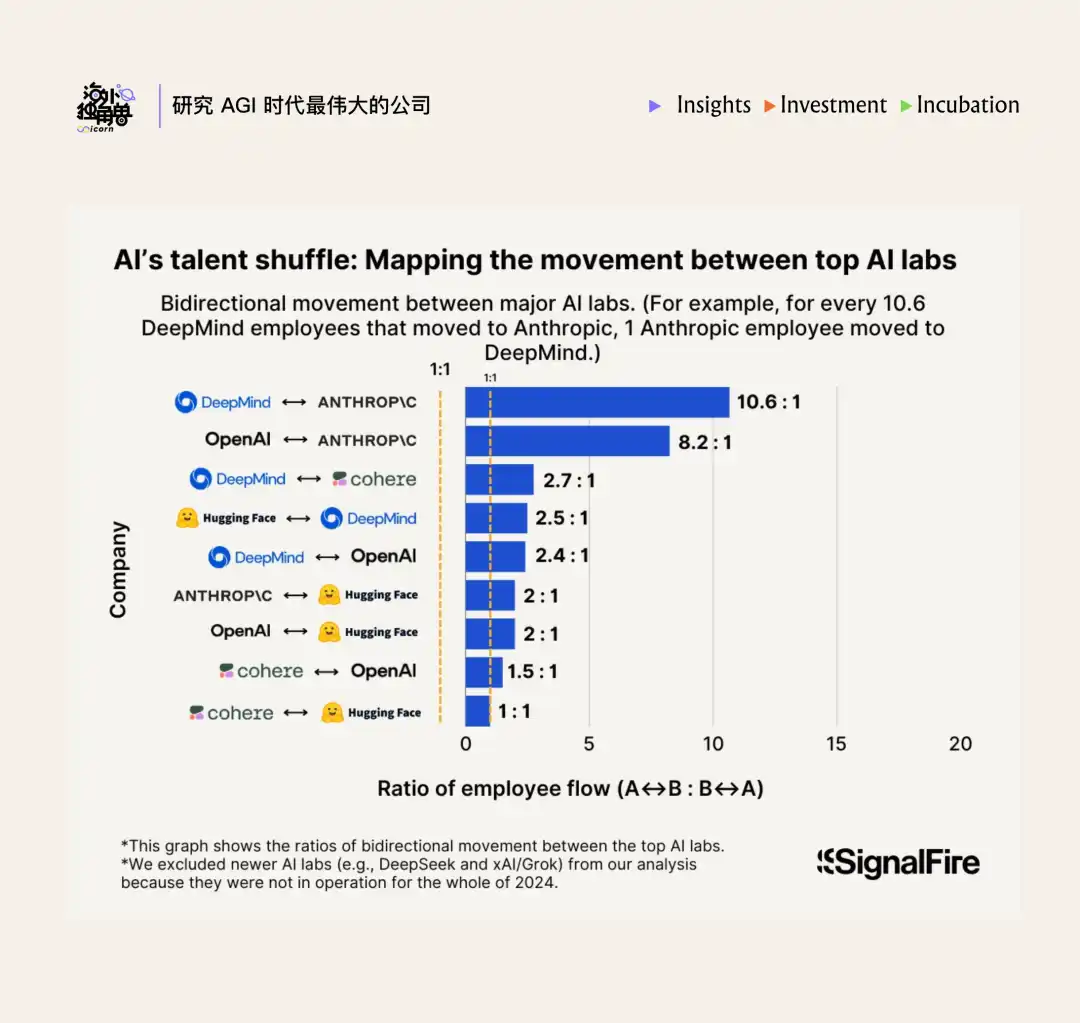
Over the past half-year, in the intense AI talent war, Anthropic's talent attrition rate has been far lower than other AI labs. The two charts below summarize talent movement data from 2021-2023.
The first chart shows the ratio of talent moving between various AI labs. We can see:
- For every 10.6 people moving from DeepMind to Anthropic, only 1 moves from Anthropic to DeepMind.
- For every 8.2 people moving from OpenAI to Anthropic, only 1 moves from Anthropic to OpenAI.
The second chart shows the proportion of employees remaining at the company two years after joining.
Anthropic's talent retention rate is 80%, the highest among top AI labs at the time, slightly higher than DeepMind's 78%. For a younger, rapidly changing company to achieve higher retention than the established DeepMind is not easy. In comparison, OpenAI's rate was only 67%.
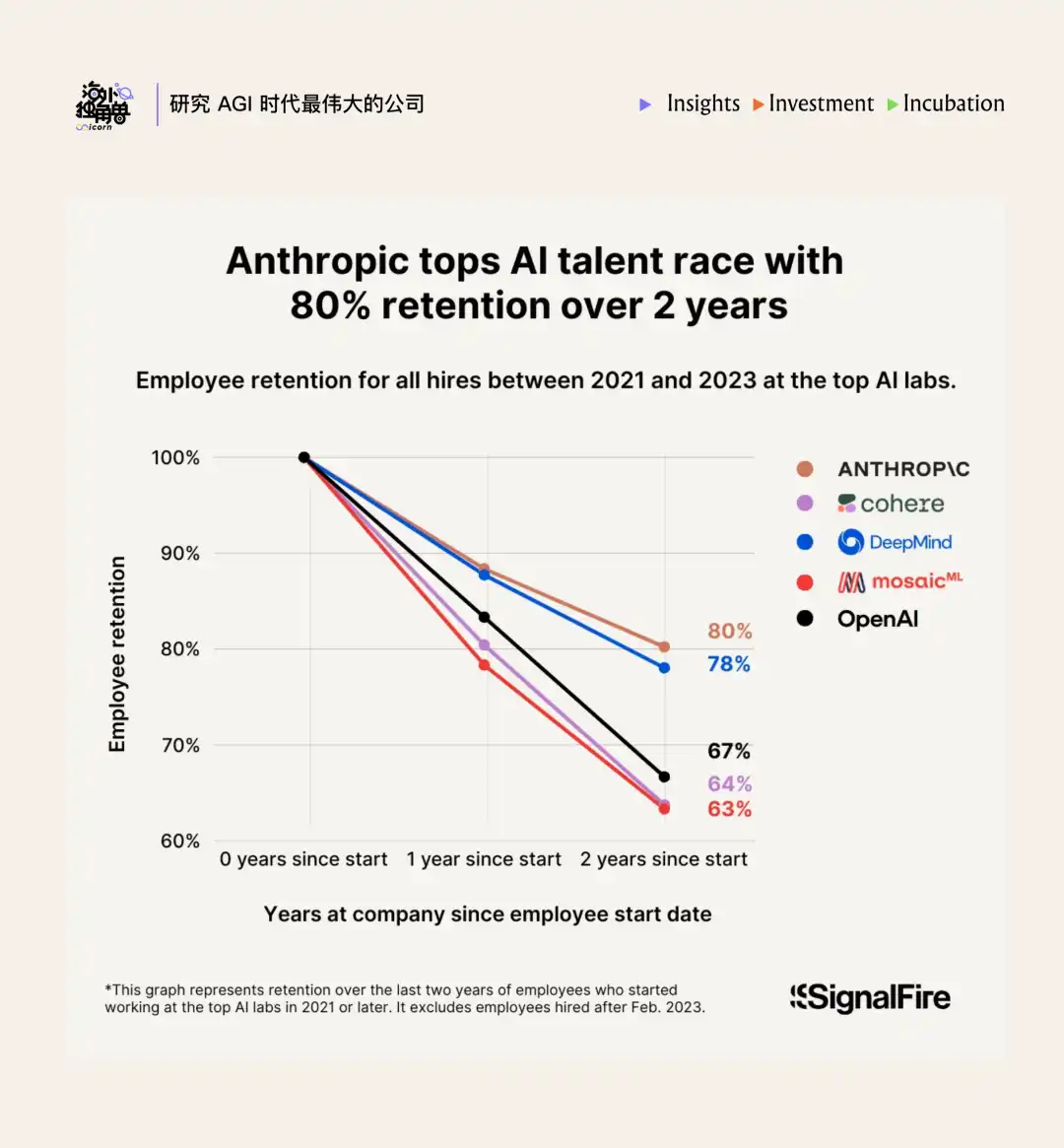
It's worth noting that this data was collected when OpenAI was at its peak and Anthropic hadn't yet made a significant mark.
Looking at news from the past two years, Anthropic's talent attraction and stability become even more evident. For example, a recent popular Twitter post mentioned CTOs from several prominent companies willingly jumping to Anthropic to become ordinary technical staff (MTS, member of technical staff):
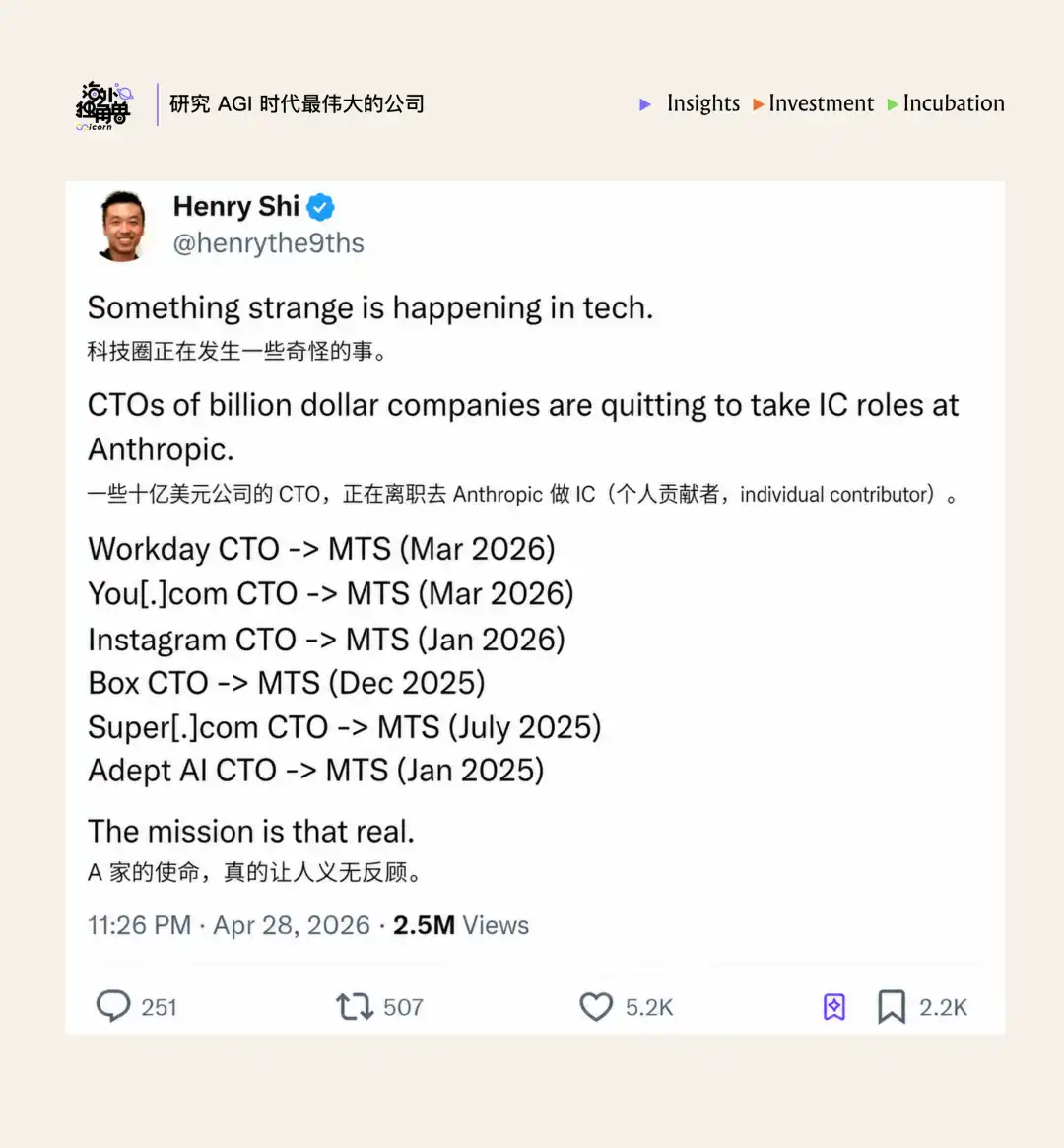
The biggest reason for this is often attributed to Anthropic's organizational culture.
If you listen to podcasts featuring Anthropic members, almost every person mentions Anthropic's culture. Some even regard this almost cult-like culture as Anthropic's biggest secret sauce.
"I truly believe culture is Anthropic's secret weapon, our most defensible thing that others cannot replicate. This didn't happen naturally; leadership invested tremendously in this." — Amol Avasare, Anthropic Head of Growth
If you don't specifically listen with this question in mind, you might not notice this point, because when people talk about culture or values, it often sounds abstract, assumed to be just a slogan. But when you layer all the first-hand information and public interviews together, it's quite striking.
Three Distinctive Traits of Anthropic
To break it down specifically, three traits that make Anthropic very different from other AI labs are:
1. Mission-oriented
Anthropic's mission is "to ensure the world can safely navigate the transition to transformative AI," meaning safety above all.
Many companies claim to be mission-driven, but Anthropic's seriousness about this borders on religious devotion. It's a frontier lab with a strong moral self-image: it genuinely believes AGI could save the world and also genuinely believes AGI could destroy it, and it's trying to lead everyone across that narrow tightrope between the two.
Claude Code lead Boris Cherny once said: "At Anthropic, if you ask anyone in the hallway 'why are you here,' the answer will be safety." Both he and product manager Cat Wu left Anthropic last year to join Cursor, only to return within two weeks because they deeply missed the cultural atmosphere inside Anthropic—the feeling of everyone working purely for a larger mission.
Some people were skeptical before joining Anthropic but found after joining, "Fuck, the atmosphere inside is even more serious than what's said outside."
There were even early employees saying at all-hands meetings—if Anthropic ultimately fulfills its mission but the company itself fails, that is still a good outcome. This statement explains many things about Anthropic.
In the logic of most businesses, commercial success is always paramount; the mission is just for decoration. But the most special thing about Anthropic is that there truly exists a group internally who prioritize the mission above the company's survival.
Examining what Anthropic actually does shows they walk the talk: their non-profit trust governance structure design, research on interpretability, various investments in safety, including recently sacrificing a $200 million US Department of Defense contract due to value conflicts, etc. We won't elaborate on all these here.
2. High trust, low ego
When we communicate with other frontier labs, we often hear about internal politics and factional problems. Only Anthropic doesn't have this. On the contrary, people are very united and willing to contribute to others' success.
The most magical part here is that Frontier AI is a field where star culture and resource struggles can easily emerge. AI researchers are almost the smartest, highest-ego people in the world. Their natural pursuit is to propose a different solution, establish their own faction, and gain fame. Yet resources are very limited, so departmental conflicts inevitably occur.
Daniel Freeman, who moved from Google to Anthropic, said other model companies internally feel like separate, secretly competing fiefdoms, but he "never had that feeling at Anthropic."
Stripe's former CTO Rahul Patil, who joined Anthropic last fall, also mentioned being most struck by the culture here. It's hard to imagine a group of such smart people could also be so humble at the same time. He gave a criterion: if the company told you tomorrow that the best position for you isn't continuing as an executive but becoming an IC (individual contributor) because that's your biggest contribution to the mission, would you be willing? He believes 100% of Anthropic people would do it, with no ego.
3. A Strong Humanistic Underpinning
A New Yorker author who did a months-long deep immersion inside Anthropic described its people with two interesting adjectives:
- Bookish misfits
- A disproportionate number of Anthropic employees seem to be the children of novelists or poets.
That is, the people here don't quite resemble typical Silicon Valley elites or the traditional image of technical geeks. They are more bookish, a bit nerdy, and somewhat idealistic. Many give the feeling of having grown up in families of writers and poets. This is somewhat evident in the naming of Claude models: Haiku, Sonnet, Opus, corresponding to concise haiku, Shakespearean sonnets, and hefty classical works. In contrast, OpenAI's GPT-4/4o/o1 are named with engineering codes, and Google's Gemini Ultra/Pro/Flash are classic product line names. This says something.
Claude Code lead Boris also shared an interesting detail in a podcast: at his first lunch at Anthropic, he casually mentioned a very obscure book by hard sci-fi writer Greg Egan. How niche was the book? He had never met anyone who had read it before. He casually made a reference to a trope from the book at the table, and everyone present got it. This shocked him greatly and made him feel he had come to the right place. Bookish nerds who like sci-fi often possess a certain grand humanistic concern and historical sense of responsibility and have better reasoning abilities regarding butterfly effects. This consensus based on reading interests made him more confident that this might be the best place to push the boundaries of AI.
How Culture is Institutionalized
The next question is, how is this pure, almost cult-like culture maintained? After all, Anthropic is no longer a small AI lab; it's a large company with 3000 people, and it's expanding at the fastest pace in history while trying to preserve its cultural density.
Regarding this, Dario directly said he spends about one-third to 40% of his time ensuring Anthropic's culture is good. Even though there are countless things to do in technology, product, fundraising, and government-business relations, he believes his higher-leverage work is making Anthropic a highly cohesive place where top talent enjoys working. In terms of concrete practices, there are several points:
- Special Hiring Criteria
Anthropic's hiring approach is different from many AI labs.
On one hand, regarding talent preference, unlike most companies scrambling for big names, Anthropic prefers hiring underdogs. More than external labels, they value direct evidence of ability, such as, "Have you done independent research, written truly insightful blogs, made substantive contributions to open-source communities," etc. On the other hand, Anthropic has very strict cultural screening. They have a dedicated Cultural interview round, asking 15-20 scenario questions in an hour.
Based on leaked interview questions online, they focus on assessing three points:
(1) Whether you truly prioritize the safety mission. The most typical screening question is: If Anthropic decides not to release a model because it cannot guarantee safety, are you willing to accept your stock options becoming worthless?
(2) Whether you are a nice person with low ego. Including kindness, empathy, people skills, and the ability to admit one's ignorance and mistakes.
(3) Whether you can handle complexity. Many problems handled internally at Anthropic are very complex and dynamic. They highly value whether a person has systematic thinking, can deeply reason about second-order effects, and consider how a decision might affect other aspects.
They spend a lot of time on "reverse screening" in hiring and have indeed given up on many of the top 10x developers because of this. Stripe's former CTO Rahul Patil mentioned that before joining Anthropic, he talked extensively with the then-Anthropic CTO. The CTO not only didn't persuade him to join but spent two to three weeks repeatedly discussing why he shouldn't join Anthropic, kindly discouraging him unless he was truly aligned with the culture and mission.
So Anthropic's hiring logic has never been to recruit as many of the strongest people as possible but to filter out unsuitable people as early as possible. "We are very good at filtering out people who come for money and fame." In contrast, OpenAI, after growing larger, no longer conducts dedicated culture interviews, reportedly causing some management issues.
This was evident during Meta's talent poaching spree last year. Facing Meta's sky-high packages, OpenAI's reaction was more like market convention: counter offers, retention bonuses, removing vesting cliffs for new hires to make stock vest faster. Anthropic's reaction was very Anthropic. They told employees: you came here primarily for the mission, not to keep raising your price in external bidding wars. We won't offer you ten times the salary of your equally excellent colleagues just because Mark Zuckerberg happens to target you; that's unfair. If you want to leave, then leave.
The outcome of this incident is telling. OpenAI reportedly lost dozens of people, while Anthropic lost only 2, both of whom were former Meta employees with 6 and 11 years of tenure there.
2. Culture of Context Sharing
Anthropic internally has very high information transparency.
First, Dario himself proactively, frequently, and repeatedly provides meaning and context. He often holds all-hands meetings to share with everyone in the company, as frequently as once every two weeks, called "Dario Vision Quest" (even Dario himself吐槽, saying the name's evangelical属性 is too obvious, sounding like he went into the mountains, inhaled something, and had an epiphany). He stands in front of the entire company speaking for an hour, usually with a three-to-four-page document covering everything from company direction, product strategy, to industry changes, and then directly answers questions on the spot.
Many internal employees say he speaks particularly directly and candidly. "Dario is the most straightforward person I've ever met. His speech isn't calculated; he truly says what he thinks." Besides all-hands, he frequently writes many things in his Slack channel during regular times, completely unadorned records of his musings: what's happening recently in the company, what he's worried about, and his views on issues everyone cares about.
This culture lets everyone in the company know how decisions are made and what should be prioritized. Thus, in a complex and changing situation, each individual can make relatively consistent distributed decisions.
Moreover, this transparency isn't one-way indoctrination; it can be challenged. Some people, after hearing Dario's sharing at All Hands, disagreed, went directly to Dario's notebook channel publicly saying "I disagree with your judgment," and then展开了一场辩论 on the spot. Publicly challenging leadership is encouraged. Going further, this writing culture doesn't belong only to Dario but is a thinking mechanism involving the entire team.
Many people at Anthropic have their own notebook channels, somewhat like personal Twitter feeds, recording what they are thinking, doing, and any progress at any time. Others can subscribe, observe, and join discussions. Many employees have commented on loving the company's writing culture; Slack is a huge treasure trove where many things unfold. So, Anthropic seems to have cultivated a good layer of alignment soil internally. Everyone's projects, viewpoints, and思路 are transparent and fluid enough. Some have even感叹 that financial data is transparent.
(In contrast, technical confidentiality is very strict. It's said some teams are even deliberately isolated and can't have lunch together. The result is, researchers from other companies lament that all critical know-how is scattered in different people's minds; it's impossible to piece together the full picture by poaching a few people.)
3. Seven Co-founders with Equal Equity: The Founding Structure Itself is a Cultural Mechanism
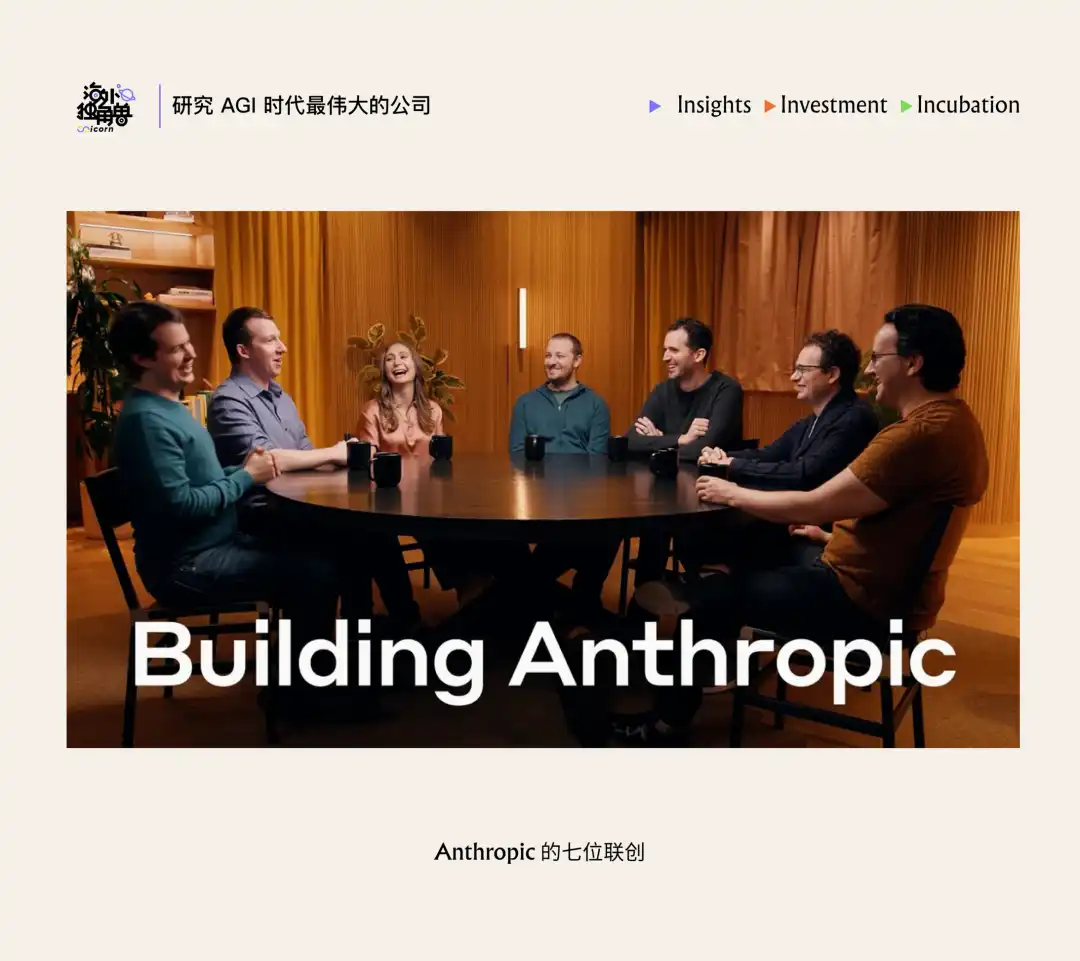
Anthropic's founding structure has a design that goes against commercial common sense: it has 7 co-founders, and Dario insisted at the time on giving everyone equal equity shares instead of taking more for himself.
At the time, everyone advised him this would be a disaster, leading to blurred leadership, misaligned incentives, and the company easily falling apart due to infighting. But Dario believed the company revolves around the mission, not a single founder. Equal equity is the most unforgeable evidence of this理念. They had already worked together for many years, with high trust in each other. Equal equity was essentially not a governance design but proof of commitment, a mechanism for cultural diffusion.
Seven co-founders are like seven nodes for cultural replication, able to project the values to broader groups across different lines. This way, even as the company expands, the initial culture is less likely to be diluted.
In contrast, OpenAI's executive layer has been very turbulent. Eleven founding team members left one after another, leaving only Sam Altman, Greg Brockman, and Wojciech Zaremba. The newly replaced executive layer is even more unstable: from the beginning of 2026 to now, the product head Fidji took leave, the marketing head left for health reasons, the communications head was ousted, the operations head was reassigned, and the finance head was sidelined...
4. Extreme Emphasis on 'One Team,' Avoiding Silos
Anthropic's CTO once said in a podcast that AI labs overall are very bottom-up compared to traditional companies; it's an inverted pyramid organizational style where power and creativity flow from bottom to top.
The most important work happens on the front lines. Because frontline people are closest to AI's emergent behaviors. They run experiments daily and have the most intuitive understanding of what models can do. The vast majority of product ideas are pushed by frontline people, not driven by executive roadmaps. But this also has a problem: when judgment is decentralized, each team easily guards its own problem awareness and value function, growing into silos pulling against each other.
Anthropic's specialness lies in realizing early: since judgment must be distributed, you must proactively create unity. Dario doesn't want the safety team only saying safety is most important and the product team only saying product is most important, then pushing all conflicts up to leadership for decisions. A core management理念 of his is distributing trade-offs to each individual, giving everyone a bit of the founder's perspective, where people in their respective positions are just participating in the same massive trade-off processing.
So they extremely emphasize 'one team' and also use various institutional designs to blur boundaries between roles. For example, below the executive level, there are no title distinctions; everyone is uniformly called 'member of technical staff,' deliberately弱化 distinctions like "researcher vs. engineer," "senior vs. junior," "architect vs. implementer."
This contrasts sharply with OpenAI. OpenAI has always had a stronger researcher culture, with a clear internal "pecking order": Researcher > Research Engineer > software engineer. So products are often overshadowed by research, lacking much voice. When conflicts arise, Research is unwilling to cooperate with Product.
In product innovation, OpenAI has a strong characteristic of being researcher-driven: often the research team produces a new result, and then the product team gets an email and starts looking for a nail to hit with that hammer.
At Anthropic, product and model teams are more tightly integrated; products can more inversely influence and define model capabilities. This is actually one reason OpenAI's product strength lags behind Anthropic's.
Two Origins of the Culture
The next question is, why did Anthropic develop this unique organizational culture?
Perhaps we can look at it from two aspects:
1. The inherent demands of the business
I remember listening to a分享 from an HR head at a top tech giant two years ago, which left a deep impression, making me first深入思考 what organizational culture truly means.
The essence of organizational culture is: a key element where employee behavior patterns can help the company succeed. So the first principle of organizational culture is actually that the nature of the business determines the organizational culture.
For example, ByteDance and Huawei are both companies with strong organizational capabilities. But if you exchanged their organizational systems, both would likely go bankrupt soon. They are at two extremes of the same spectrum: ByteDance's motto is "dare to be first," while Huawei's is "dare to be last." One values innovation more, the other efficiency more.
This isn't about value judgment but is determined by business nature. When making a new product, Huawei makes things like base stations and chips. Once problems arise, recall costs could swallow a whole year's profits. ByteDance is different; it's typical short-cycle, short-chain business, able to run dozens of versions in a week. If wrong, just fix and release again. So ByteDance can encourage innovation and choose "Context, not Control"; Huawei cannot. For Huawei, innovating too early might be a burden. What Huawei truly excels at is, after PMF (product-market fit) appears in the market, using its organizational capability and resources to gradually surpass and eventually crush opponents.
Now, back to Anthropic.
In AI competition, a core moat is enabling "smart people to do dirty work." Especially in the Coding and Agentic direction, on the surface it's model capability competition, but looking deeper, it's actually engineering capability competition. It's not the kind of problem solved by a few geniuses having flashes of insight but involves a lot of dirty, fragmented, detailed systems engineering. The most core barrier is data.
Past Chat data was just simple text data, but Coding and Agentic data is more complex. It's not just conversation records but includes the task itself, environment setup, execution轨迹, and the entire evaluation and verification system. These are all dirty, tedious tasks. Doing them well is critical, but unlike publishing a paper or launching a new product, they don't become personal highlights.
Based on feedback from our exchanges with some researchers, one of OpenAI's core problems today is its difficulty organizing hundreds of top people to diligently work on data and dirty work. OpenAI hires people from the very top of the talent hierarchy, with excellent backgrounds and high aspirations. They naturally prefer making their own bets, doing 0-to-1 work. As for cleaning up messes, supplementing data, few are willing to take that on.
OpenAI succeeded in the past this way; it indeed gained huge领先优势 through some core paradigm breakthroughs. But as Yao Shunyu said in a recent interview: "The era of individual英雄主义 is over," "AI isn't something that requires much brainpower... the most important trait is reliability, attention to detail."
At this point, you realize that Anthropic's low-ego, highly cohesive, mission-driven atmosphere has its advantages放大得非常明显. It's said Anthropic's co-founder Jared Kaplan also leads the team in personally reviewing data daily; data cleaning is done extremely meticulously. No other company can do this to the same extent.
(This also explains a phenomenon: OpenAI's models are strongest on competition-level coding problems because those tasks are more research problems, but often lag behind Anthropic on agentic tasks in daily work because the latter are more engineering problems, testing data, systems, and execution细节.)
2. The Background of the Founding Team
A company's values can be seen as an extension of the founder's values. For example, Jack Ma's martial arts风, Ma Huateng's gentle openness, Steve Jobs' aesthetic导向, Ren Zhengfei's military discipline.
To be more accurate, founders' values often come from two things: one is what the founder originally believes, and the other is what they deeply厌恶过. The former determines what you want to become; the latter determines what you absolutely do not want to become again.
Anthropic clearly has both, and the shaping power of the latter might be greater than the former. Briefly looking at Dario's experience:
Dario first接触 AI at Baidu's AI lab, where he first observed scaling laws and gradually became a firm believer in them. But after making breakthroughs at Baidu, internal struggles over control and resources quickly erupted, and the team eventually解散. Dario later辗转 joined OpenAI, deeply参与 the GPT series advancement here. OpenAI once allocated 50%-60% of the company's total compute to him, making him the lead for the GPT-3 project.
Since Dario is someone with鲜明价值观 and strong personal convictions, his organizational理念分歧 with others at OpenAI began to显现. For instance, Greg Brockman once proposed a惊人 idea: in the future, they could sell AGI to nuclear powers in the UN Security Council. Dario almost resigned on the spot. In his view, this was no longer a business disagreement but a底层价值观问题.
Greg and Dario were at odds for years, with Sam Altman夹在中间调和. Sam exercised a skill he's best at: making different factions feel he was actually on their side. Short-term, this is balancing术; long-term, it透支信任. Later, when people compared notes, they realized what Sam promised Dario and what he promised Greg were not the same thing. Gradually, Dario formed a tight同盟圈子 within the company. Some, because he liked pandas, called this small group "the pandas." Their disagreements with OpenAI leadership on路线选择, organizational governance, etc., grew larger, eventually evolving into serious political斗争.
There was even a severe face-to-face confrontation among executives. Sam accused Dario and Daniela (Dario's sister, later an Anthropic co-founder) of organizing negative feedback against him behind his back; they denied it and当场叫来 Sam's alleged source to对质. The source said they knew nothing about it. Then Sam turned around and denied he had just made that accusation.
This incident彻底失去信任 for Dario and his sister. They argued on the spot.
There were many similar internal dramas. In short, Dario escalated the conflict to a moral crisis of trust. He believed that a company wielding such powerful technology must have sincere, trustworthy leaders. If the people at the helm are dishonest, they are aiding a dangerous direction.
Thus, Dario eventually left OpenAI with some core colleagues from GPT-3 and founded Anthropic.
Therefore, Anthropic's culture today isn't just because Dario is naturally this way. More importantly, he personally experienced political斗争 at both Baidu and OpenAI. He knows how easily a group of smart, high-ego people can分裂 due to resource争夺 and value分歧. So they后来本能地 built Anthropic in the opposite direction:
Because they saw how balancing术透支信任, they emphasize authenticity and transparency more. Having seen激化的政治斗争, they encourage people to surface conflicts early and talk them out. Having seen组织瓦解 due to理念分歧, they set up strict cultural screening. Having seen超级明星的权力争夺, they emphasize low ego and avoid hiring big names.
Much of Anthropic's organizational culture today seems like a反作用力 from the experiences at Baidu and OpenAI.
Conclusion
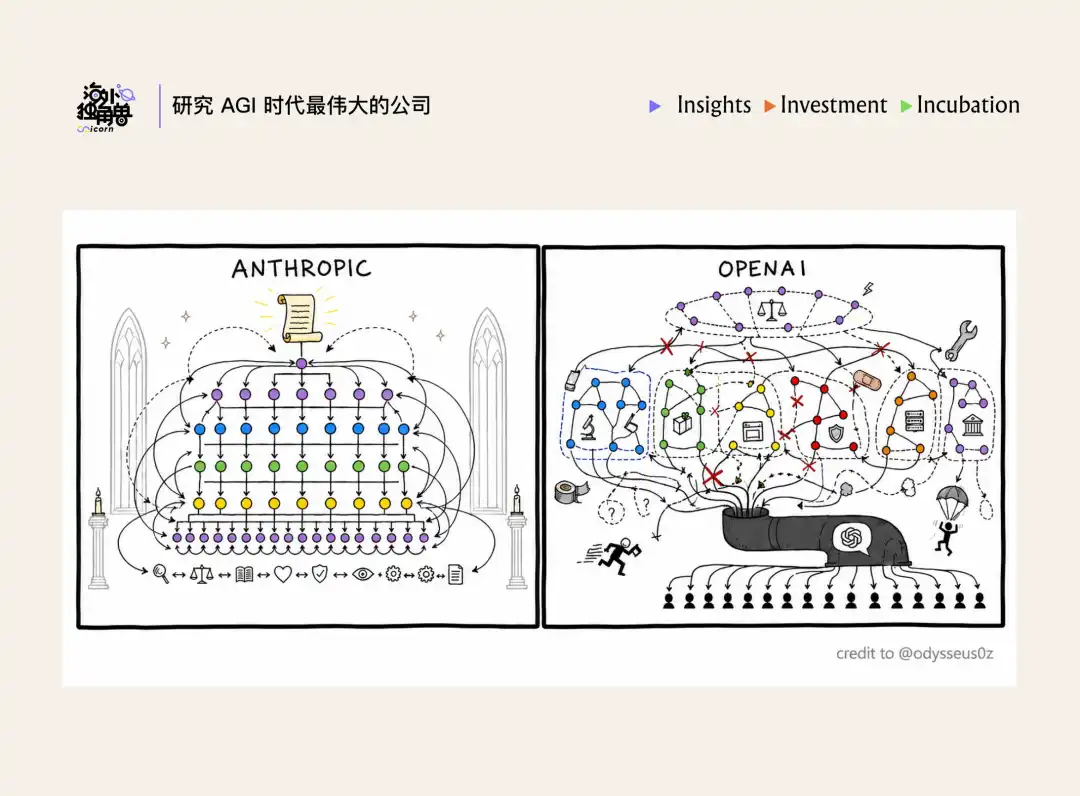
To summarize, Anthropic and OpenAI are two companies with quite different底色的. The former is an idealistic, mission-clear, highly cohesive cult-like organization; the latter is an ambition-driven, multi-line expanding super-platform constantly seeking the next big thing.
To see more clearly, we can juxtapose several core dimensions of both companies:
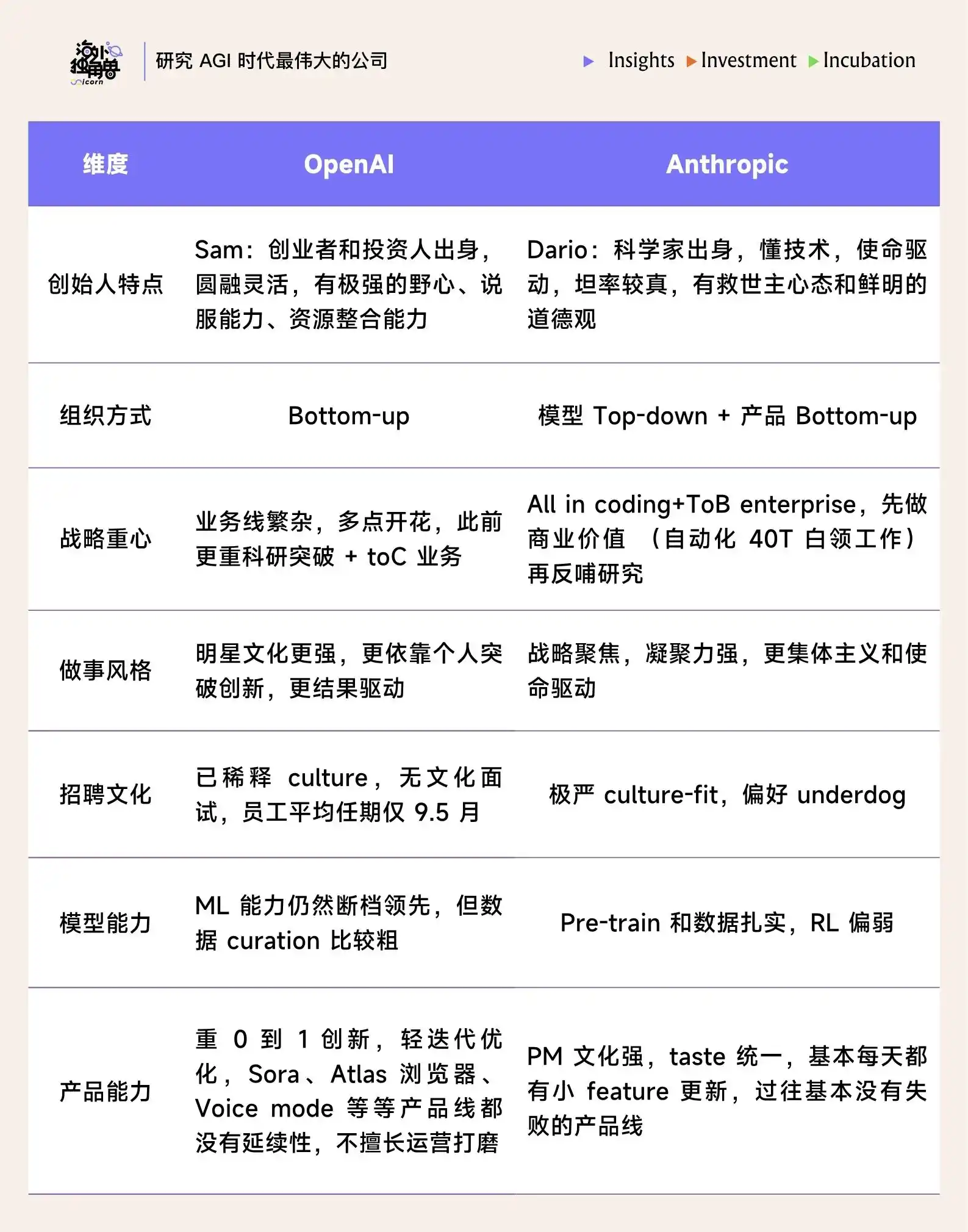
However, although we discussed many of Anthropic's strengths earlier, it's hard to conclude that one culture压倒 another, and it's hard to predict the landscape three months from now. The AI world changes too fast, and OpenAI is now being underestimated by the market in turn. For example:
- Coding is now an open secret, and OpenAI will likely catch up. A clear trend is developers migrating from Claude Code to Codex.
- Demand爆发 has far exceeded everyone's expectations; compute is becoming the new决定胜负的关键, and OpenAI secured far more compute resources than Anthropic very early.
- OpenAI's culture of open exploration has its own巨大优势. Meanwhile, OpenAI is also always more aggressively exploring and betting on new paradigms; the next leap could overturn the situation.
We can only say, looking back at the past three years from 2026, Anthropic indeed left the entire industry with a noteworthy case study: in the AI era, winning doesn't necessarily require greater ambition, more exploration, or stronger talent. Sometimes, winning can come from the opposite: fewer bets, lower ego, and a naive mission.







