Crypto nears its ‘Netscape moment’ as industry approaches inflection point

cointelegraphXuất bản vào 2025-12-09Cập nhật gần nhất vào 2025-12-09

Tóm tắt

The cryptocurrency industry is approaching its "Netscape moment," driven by advancements in blockchain infrastructure and the rise of regulated investment products, according to Paradigm co-founder Matt Huang. This inflection point mirrors the early internet's mass adoption phase, where ease of use and institutional accessibility became key catalysts. Onchain systems enable open, programmable finance, while regulated products like ETFs attract traditional investors by offering familiar, compliant access. Analysts note over 200 crypto ETPs may launch soon, broadening participation. Despite concerns about speculation and memecoin dominance on some networks, experts argue that centralized platforms and ETFs expand the onchain economy rather than threaten it. The true risk lies in slowed technological progress; continued innovation in functionality and market structures is essential for long-term value creation.

The cryptocurrency industry is approaching its “Netscape moment,” as steady progress in blockchain infrastructure and the rise of regulated investment products drive a new wave of institutional adoption, according to Paradigm co-founder Matt Huang.

The crypto sector is “facing its ‘Netscape’ or ‘iPhone’ moment,” Huang wrote Sunday in a post on X. “It’s working bigger than ever before, far beyond our wildest dreams. Both the institutional parts and the cypherpunk parts.”

Netscape launched the first easy-to-use web browser for mainstream users in 1994 before going public with a successful initial public offering (IPO) in August 1995, marking the first building block that triggered the internet’s mass adoption.

However, Microsoft saw the large-scale interest and capitalized on it on it by freely bundling Internet Explorer as a pre-installed component of the Windows operating system, outcompeting Netscape to become the most widely used internet browser.
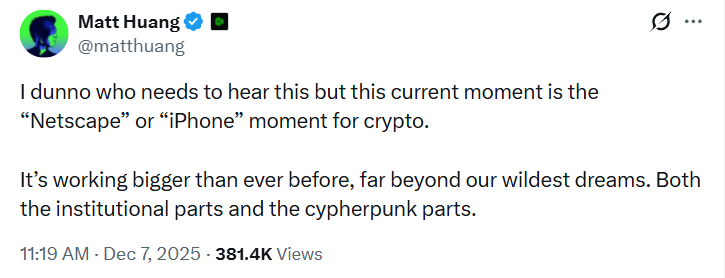
Source: Matt Huang

Onchain usability meets regulated access

In the crypto world, Bitcoin’s (BTC) peer-to-peer model and decentralized finance (DeFi) have enabled a new vision of an open, programmable financial system that cuts out intermediaries.

At the same time, centralized platforms and traditional investment vehicles are attracting a growing share of new capital because they are easier to use and fit within familiar regulatory frameworks.

About 200 crypto-based exchange-traded products (ETPs) could launch on the market in the next year, with 155 awaiting approval as of Oct. 22, according to Bloomberg’s senior ETF analyst, Eric Balchunas.

Crypto ETPs provide easier access to altcoins for traditional investors on brokerage platforms that don’t have an account on a centralized cryptocurrency exchange.
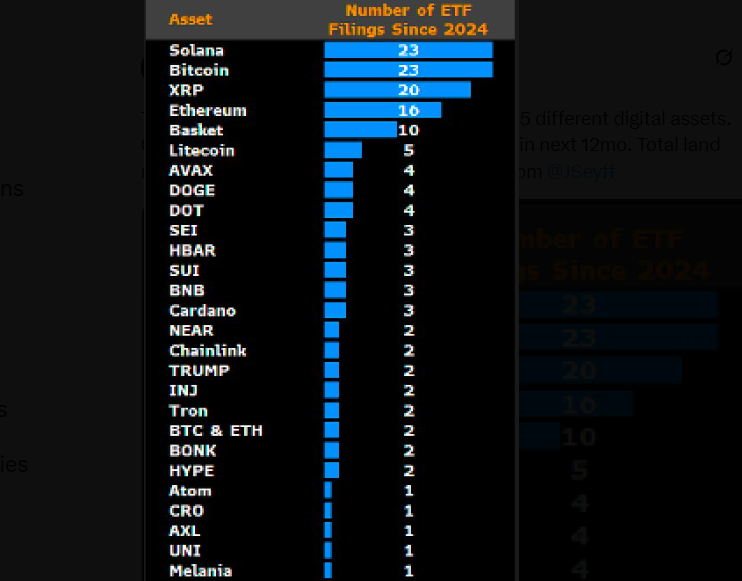
Source: Eric Balchunas

Related: Prediction markets emerge as speculative ‘arbitrage arena’ for crypto traders

Onchain products are becoming easier to use, while “regulated” investment vehicles are making crypto more accessible, signaling that the industry may be at the tipping point ahead of mass adoption, Lacie Zhang, market analyst at Bitget Wallet, told Cointelegraph.

“ETFs and similar products legitimize digital assets but don’t replace what onchain systems uniquely offer, such as direct ownership, programmable settlement, and real-time transfers.”

She added that regulated access points tend to pull more liquidity onto underlying networks by drawing in institutional capital and new participants, rather than “displacing onchain activity.”

Related: Bitcoin now settles Visa-scale volumes, but most is for wholesale, not coffee

Despite some concerns about centralization, the rise of centralized finance (CeFi) platforms and ETFs is an “expansion of the onchain economy,” not an inherent threat, according to Marcin Kazmierczak, co-founder of RedStone, a blockchain oracle solutions provider.

“The Netscape moment isn’t about onchain versus CeFi. It’s about the broader crypto ecosystem finally attracting capital that actually stays around long-term,” he told Cointelegraph, adding that the two ecosystems are “not adversarial.”

Netscape moment or dot-com bubble repeat?

However, the crypto industry may still risk a market crash akin to the dot-com bubble, considering that the majority of revenue is derived from speculative memecoin trading for some blockchain networks.

On Solana, memecoin trading accounted for 62% of the network’s decentralized app revenue in June, and the majority of its $1.6 billion in revenue for the first half of 2025.

To reach its true potential, the developers need to focus on advancing the industry’s real-world utility, as the only “real risk” to the industry is a “slowdown in technological development,” according to Edwin Mata, lawyer, co-founder and CEO of tokenization platform Brickken.

“What matters is that onchain environments continue creating functionality, automation, and new market structures, because that is where fundamental value is produced,” he told Cointelegraph.

Magazine: Solana vs Ethereum ETFs, Facebook’s influence on Bitwise — Hunter Horsley

Nội dung Liên quan

Sự bùng nổ gần đây của Bitcoin – Đây là bong bóng hay bong bóng lành mạnh?

Gần đây, giá Bitcoin (BTC) đã tăng mạnh từ khoảng 63.500 USD lên hơn 80.000 USD. Theo đánh giá từ QCP Capital, đợt tăng này có cấu trúc lành mạnh hơn so với các đợt bùng nổ trước, chủ yếu được thúc đẩy bởi nhu cầu giao ngay (spot) thực tế chứ không phải do giao dịch đòn bẩy. Cụ thể, đã có khoảng 2,8 tỷ USD dòng tiền ròng chảy vào các ETF Bitcoin spot trong khi khối lượng mở (open interest) trong thị trường tương lai lại giảm và phí tài trợ (funding rate) vẫn ở mức thấp. Điều này cho thấy sự tăng giá được hỗ trợ bởi mua giao ngay và việc đóng các vị thế bán khống, hạn chế tích lũy đòn bẩy quá mức. Về mặt vĩ mô, triển vọng vẫn còn một số yếu tố bất ổn. Dù lạm phát cốt lõi PCE của Mỹ trong tháng 7 duy trì ở mức 3.3%, thị trường vẫn dự đoán khả năng Cục Dự trữ Liên bang (Fed) tăng lãi suất. Một yếu tố hỗ trợ tích cực là Bộ Tài chính Mỹ thông báo mở rộng chương trình mua lại trái phiếu, giúp cải thiện thanh khoản cho trái phiếu dài hạn và góp phần làm giảm lợi suất trái phiếu, yếu đồng USD, đồng thời hỗ trợ giá vàng và Bitcoin. Hiệu suất tài chính vững mạnh của NVIDIA cũng góp phần cải thiện tâm lý ưa rủi ro trên thị trường toàn cầu. Tuy nhiên, cần lưu ý rằng chương trình mua lại trái phiếu này không phải là nới lỏng định lượng (QE) vì nó không làm tăng dự trữ của ngân hàng trung ương. Theo QCP, yếu tố then chốt đối với Bitcoin trong ngắn hạn là liệu nhu cầu mua giao ngay cao có được duy trì hay không.

cryptonews.ru2 giờ trước

Sự bùng nổ gần đây của Bitcoin – Đây là bong bóng hay bong bóng lành mạnh?

cryptonews.ru2 giờ trước

Giám đốc điều hành Strive: Tái hiểu về Bánh đà giá Bitcoin

Tác giả Joe Burnett, Phó Chủ tịch Chiến lược Bitcoin tại Strive, phân tích về việc giảm lợi nhuận và biến động của Bitcoin không phải là dấu hiệu của sự trưởng thành cuối cùng, mà là tiền đề cho một giai đoạn tăng tốc mới. Ông so sánh quá trình này với ba giai đoạn phát triển vết nứt trong khoa học vật liệu: Giai đoạn 1 (Khám phá) với biến động cực cao, Giai đo ạn 2 (Trưởng thành) với lợi nhuận và biến động thu hẹp dần, và Giai đoạn 3 (Tiền tệ hóa được hệ thống tài chính thúc đẩy). Biến động giảm cải thiện tỷ lệ Sharpe, cho phép các nhà đầu tư phân bổ vốn nhiều hơn và biến Bitcoin thành tài sản thế chấp hấp dẫn hơn. Chất lượng thế chấp tốt hơn cho phép mở rộng quy mô tín dụng bằng USD, chẳng hạn thông qua các khoản vay thế chấp bằng Bitcoin hoặc phát hành trái phiếu. Điều này tạo ra một vòng xoáy tự củng cố: vốn và tín dụng mới tranh giành nguồn cung Bitcoin cố định, đẩy giá lên, từ đó lại tăng giá trị thế chấp và giải phóng thêm không gian tài chính. Do đó, mô hình quy luật lũy thừa (power law) mô tả sự giảm lợi nhuận dần có thể chỉ áp dụng cho giai đoạn trung gian. Khi Bitcoin đủ trưởng thành, vòng xoáy kết hợp giữa dòng vốn tự có và tín dụng có thể đẩy giá vượt lên trên quỹ đạo quy luật lũy thừa đó, bước vào giai đoạn tăng tốc mới – tương tự "vùng thứ ba" nơi vết nứt phát triển nhanh chóng dẫn đến đứt gãy. Áp lực trong phép loại suy này là hệ thống tín dụng USD.

marsbit7 giờ trước

Giám đốc điều hành Strive: Tái hiểu về Bánh đà giá Bitcoin

marsbit7 giờ trước

Đã đọc trước bài phát biểu: Người nhắc chữ của Trump kiếm được 107 nghìn đô la từ cá cược

Ủy ban Giao dịch Hàng hóa Tương lai Hoa Kỳ (CFTC) đã giải quyết cáo buộc đối với cựu nhân viên Nhà Trắng Gabriel Perez, buộc anh ta hoàn lại lợi nhuận và nộp phạt vì giao dịch dựa trên thông tin nội bộ. Theo quyết định ngày 28/8/2026, Perez, khi làm người điều khiển teleprompter, đã sử dụng văn bản bài phát biểu của Tổng thống Trump để đặt cược trên thị trường dự đoán Kalshi. Từ tháng 12/2025 đến tháng 3/2026, Perez có quyền truy cập văn bản bài phát biểu trước một giờ. Anh ta mở tài khoản trên Kalshi và giao dịch các hợp đồng dự đoán xem Trump có nói từ/cụm từ cụ thể hay không, dựa trên việc từ đó có trong bản thảo hay không. Anh ta đã kiếm được 107.539,02 USD từ 43 hợp đồng. Theo lệnh của CFTC, Perez phải hoàn trả toàn bộ lợi nhuận, nộp phạt dân sự 65.000 USD, chấm dứt vi phạm và tuân thủ lệnh cấm giao dịch 3 năm. Sàn Kalshi hợp tác điều tra và cũng áp dụng hình phạt riêng. Vụ việc cho thấy các thị trường dự đoán chịu sự giám sát của CFTC. Đây là trường hợp công khai đầu tiên về việc lạm dụng quyền truy cập thông tin cấp nhà nước để giao dịch trên thị trường sự kiện. Một vụ tương tự liên quan đến nhân viên Google đang bị điều tra, và Quốc hội Mỹ đang xem xét các biện pháp giám sát các sàn giao dịch này.

cryptonews.ru7 giờ trước

Đã đọc trước bài phát biểu: Người nhắc chữ của Trump kiếm được 107 nghìn đô la từ cá cược

cryptonews.ru7 giờ trước

Giao dịch

Giao ngay
活动图片