Source: "When Shift Happens" Podcast
Compiled by: Felix, PANews
Bitwise advisor Jeff Park is a macro strategist and former Chief Investment Officer of ProCap Financial. In a recent podcast episode, he analyzed why real estate is actually a depreciating asset, why Bitcoin is the ultimate safe haven, and how AI will trigger a wave of Bitcoin adoption. Jeff Park believes that for the younger generation, from unaffordable housing to AI replacing an entire generation's jobs, the financial system has completely collapsed.
PANews has compiled the highlights of the conversation.
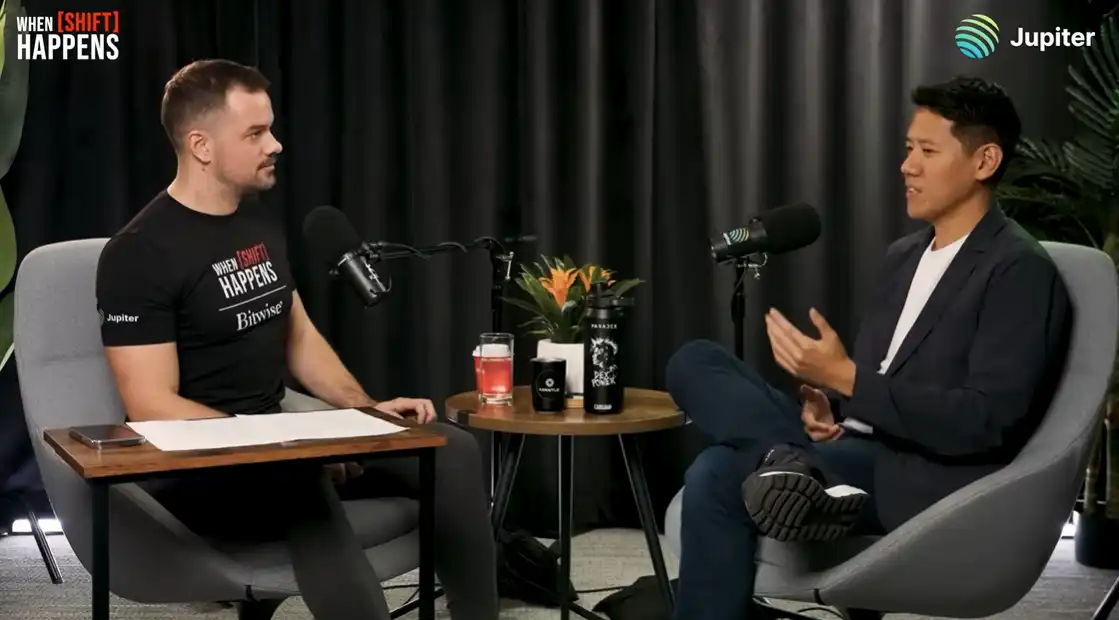
Host: You told me before that you were exposed to the concept of "currency devaluation" very early on. Can you talk more about that?
Jeff Park: Sure. I grew up in both the US and South Korea. I was in elementary school in South Korea and happened to be there during the 1997 Asian Financial Crisis. That crisis left a deep impression on me, just a second or third grader at the time, because I saw the absolute unity of a country when it couldn't control its own destiny. It was fascinating to see people upstairs and downstairs, on every street corner, bound together by a kind of patriotism directly linked to the value of the sovereign currency. The closest equivalent Americans might relate to is "9/11," an event that brought people together across left and right, across classes, to think about "what is America." In South Korea, the complete devaluation of the currency served that same unifying national purpose. I clearly remember the South Korean government calling on citizens to donate gold to replenish the national treasury to repay the IMF (International Monetary Fund) bailout loans, because the terms of those loans were extremely harsh. The IMF is seen with strong political overtones in emerging markets like South Korea, which perhaps also contributed to my entry into the crypto space 20 years later.
Host: You just mentioned that experiencing currency devaluation when young unites people. But that was in Asia, now in the US. What's happening in the US today? Can people really unite?
Jeff Park: I think the US's great strength is also its greatest weakness: its population diversity. Commentators in Asia often predict that "population diversity will destroy the US." In South Korea, it's easy to achieve national cohesion because everyone is Korean, bound by a shared history of resisting colonial oppression. But in the US, it's hard to find an obvious bond that can inspire a spirit of sacrifice across society. Sacrifice is the key word. For example, in South Korea, all men, regardless of class or education, must serve in the military, which creates a homogeneous social norm among men. But in the US, it's hard to pinpoint what the typical "American experience" is that can unite everyone. Politics often draws lines between left and right, upper and lower classes, young and old, but I think these are distractions. What's truly lacking and needs to be cherished is a sense of national identity and unity for the younger generation.
Host: You entered the workforce right around the 2008 crisis, and the following years saw accelerated money printing. Now we live in New York, this world financial center, where everything is outrageously expensive. I'm Swiss, live in Singapore now, and I'm used to high prices, but coming here it's unbelievable. How do ordinary people even survive? People can clearly feel inflation these past few years, what exactly happened?
Jeff Park: Yes, we are seeing a completely out-of-control, utterly broken financial system. The bottom of society is experiencing a "K-shaped economy." A "K-shaped economy" means one part of the population is enjoying economic prosperity from asset inflation, while another part is experiencing a recession—they can't find jobs, the wealth gap keeps widening—so it forms a K-shape, a two-track economy.
In New York, you can see this clearly through the asset class of real estate. Over the past 10 years, the average home price in New York City hasn't actually risen; it's been flat. Those "super luxury homes" that serve as stores of value are selling very well. They are not for living in; they are assets bought by the wealthy to hold on their balance sheets for preservation. If you bought a $20 million penthouse 7 years ago, you might sell it for $30 million now. But if you bought an ordinary home intended for real living, raising a family, making a real economic contribution to the city, the price has actually fallen or remained flat. For example, New York has a "mansion tax" on properties over $1 million. Decades ago, $1 million could indeed buy a mansion, but now in New York $1 million might only get you a studio apartment. The government intentionally doesn't index this tax to inflation, so they can collect more revenue. New York is a paradox, and all of this is a symptom caused by the lack of quality保值 assets (stores of value).
Host: Why has real estate become like this?
Jeff Park: Land is inherently scarce. The US enjoys the absolute privilege of running the world's financial system; the US dollar is its biggest export product. But this comes at a cost. Offshore funds ultimately must flow back and be invested in US assets to sustain the trade deficit. This creates an artificial, bubble-like market for US assets, where those overseas investors just need a place to park their money. This creates a serious problem: the pricing motivation in this market has nothing to do with those of us who actually live in New York and want to settle down and build a life.
Host: For someone aged 30 to 35 who has saved some money, how should they invest? I think $1 million is already a lot of money, but in New York it only buys an apartment, and you're telling me you have to buy a $20 million penthouse to make a good investment. How should our generation view the idea of "buying property as an investment" like the previous generation did?
Jeff Park: The rise in property prices isn't because the physical value of the house itself has increased; it's because the US dollar is constantly depreciating. If you think about it carefully, real estate is a capital expenditure that requires constant maintenance. Stone weathers, you need to pay property taxes, mortgage recording taxes, maintenance fees, and home insurance. A house is actually a depreciating asset; even US tax law allows real estate investors to write off depreciation over 20 to 30 years. People use home buying as their primary savings method because it's tightly bound to social functions, like paying high property taxes to qualify for public schools for your children. Real estate currently faces two huge problems: liquidity transformation and demographics. Did you know, the average age of Americans applying for a mortgage to buy a home today is 59. That's clearly not a first-time homebuyer; that's someone in their sixties buying their third or fourth property. This directly squeezes out those 25-year-olds who want to buy their first home to start a family life. The path to family formation for young people is basically blocked. Also, when New Yorkers move to Austin, Texas, due to high taxes and buy homes there, locals in Austin are angry because their housing prices are being driven up by New York capital. This is a problem of capital control; young people are completely priced out of the market.
Host: As a rational man in my 30s, I have a job, a girlfriend, plan to get married and have kids in the future, and need a house. But you tell me buying a house is even a bad investment. I only have $100,000 or $500,000 in savings. What should I do?
Jeff Park: Honestly, in core cities like New York, renting is absolutely the more economically sensible choice. When you own a house, various taxes, fees, maintenance fees, and insurance eat into your capital return, leaving you with less than 2%, or even less than 1%. You might as well put the money in a money market fund and earn 3.5% risk-free. Buying a house is purely a bet that prices will rise. Therefore, for young people without children yet, continuing to rent is the economically correct outcome. But once you have children, you need stability, you need to send your kids to school, and you are forced to pay a high "premium" for that peace of mind. It's no longer just an economic calculation. This is also why modern young people are reluctant to have children; because once you have children, you can't continue renting, the whole cycle is broken, the pressure is too great. In Asia, like Japan and South Korea, there's also a common phenomenon of young people苦等 (bitterly waiting) for the wealth transfer after the older generation passes away. But the older generation is living longer and longer, this time lag creates huge social friction between the two generations.
Host: Is the only option to wait despairingly until 60, hoping parents leave behind some property? Is there any other way out?
Jeff Park: Yes. There is now a better way to preserve wealth than real estate. This form of wealth doesn't require service, doesn't take up space, doesn't need maintenance, and isn't taxed every time—that's Bitcoin. Bitcoin will directly alleviate the pressure on the real estate market. That wealthy individual who wanted to transfer $50 million and went to New York to buy a $40 million penthouse can now just buy Bitcoin. You don't need to pay huge annual maintenance fees, and you don't have to worry about the government using "eminent domain" to arbitrarily confiscate property. Once this保值 (store-of-value) hot money stops flooding into real estate, the demand curve will reset, housing prices will come down, and young people will be able to afford homes. Although there will be short-term pain from falling real estate prices, it's a win-win for society overall. This is also why Michael Saylor calls Bitcoin "digital real estate," like Manhattan land 100 years ago. Capital naturally flows to places of higher efficiency. If you don't give it an outlet, society will eventually崩溃 (collapse).
Host: You mentioned the "Intelligent Investor" in an article. What is the "Intelligent Investor"? Why have they fallen out of favor?
Jeff Park: The "Intelligent Investor" refers to value investors like Warren Buffett or Benjamin Graham, looking for stocks that are extremely cheap relative to cash flow, with low P/E ratios. But I think that era is over. Because the best-performing assets now are not "cheap" things, but things that have "scarcity" and that people believe contain extra value. The entire framework of the "Intelligent Investor" is built on an assumption: everything must be priced relative to the "risk-free rate" (i.e., US Treasuries). But because the US government's creditworthiness is being challenged, the foundation of the risk-free rate is shaking. This is also why the traditional 60/40 (stock/bond) investment portfolio has failed, and the correlation between US Treasuries and US stocks is getting higher. Once you remove this valuation anchor of the risk-free rate, the market becomes a free-for-all.
Host: Then what is an "Ideological Investor"?
Jeff Park: Traditional value investors try to hedge out geopolitics, AI, and cultural influences to find so-called intrinsic value. "Ideological Investors" charge head-on into these difficulties. They spend a lot of time predicting the future, focusing on fund flows and paradigm shifts in liquidity. They understand that the US government is directly buying assets itself, so they will buy what the "White House Asset Management Company" would buy. They know how to identify asset manipulation and avoid traditional valuation traps.
Host: This sounds like the job of a Wall Street Chief Investment Officer (CIO). Can you explain it in plain terms that ordinary people can understand?
Jeff Park: Actually, ordinary people are very good at this. They know that truly valuable things aren't necessarily Apple stock in a securities account. The most valuable things might exist in the physical realm, like her unique jewelry, or the Hermès bag in her closet (which has outperformed the S&P 500 for 20 years). Or some great works of art. These things, not traditionally called financial assets, are the true wealth diversification tools.
Your financial advisor will only teach you to buy a 60/40 stock/bond portfolio, private equity, or venture capital, but these are essentially the same thing; they are all subject to the same "global carry trade" and risk-free rate. What you need are assets in another pool, things that the macro cycle can never touch; this is true de-correlated diversification. Cryptocurrencies, gold, Hermès bags, limited edition sneakers, Pokémon cards all fall into this category. I also believe a major asset class of the future is "data." Young people already realize they've been giving their data for free to Facebook. In the future, they will control and monetize their own data through decentralized technologies (like prediction markets). A Wall Street advisor would never teach you to play prediction markets, but this will be the trend because young people know the traditional financial game is rigged; they crave alternatives, which is also why Bitcoin, DeFi, sports betting, etc., are rising.
Host: Macro economist Raoul Pal says "Diversification is dead," that all asset performance is only related to money printing and fiat devaluation, so he's all-in on crypto. What do you think?
Jeff Park: I both agree and disagree. If you only look at traditional assets manipulated by the same global liquidity, then it is indeed meaningless. But if you broaden your perspective to focus on investment categories not manipulated by this flow of funds, diversification still has value. Last year I proposed the "Radical Portfolio Theory," listing 25 different non-correlated assets. For example, gold, in Asian culture, it is still the original, irreplaceable store of value. For example, great works of art; during the 2008 financial crisis, the best trades were actually in the art asset class. People also trade scarce fine wines. I am very bullish on "tokenization" in the crypto space, but my original intention wasn't to tokenize BlackRock's funds; I hope to tokenize long-tail alternative assets with extremely high barriers to entry, such as fine wine, superyachts. This way, ordinary people, even without millions, can spend $100 to buy a small fraction of this yacht, achieving a hedge portfolio like a billionaire.
Host: But this is still too complicated for ordinary people. For example, my 35-year-old sister is just an ordinary office worker. How should she accumulate wealth?
Jeff Park: Over the past 20 years, young people have become more financially literate. When you see many young people trading limited edition sneakers and Pokémon cards, don't laugh. This is precisely the diversified wealth thinking that young people need, not blindly chasing Nvidia stock highs. Young people are playing their own game. If they can succeed in it, it will be very powerful.
Host: Now there's something else that might even make people lose their jobs: AI. You wrote an article called "Occupy AI." Can you first explain what "Occupy Wall Street" was, and then talk about "Occupy AI"?
Jeff Park: The "Occupy Wall Street" movement happened in 2008. Angry people camped out in downtown New York demanding justice. Because during the subprime mortgage crisis, the banks were morally and legally at fault—they privatized the gains but socialized the losses (making taxpayers bail them out)—and faced no consequences. I believe AI will potentially trigger an even more exaggerated class struggle. We have never encountered a technology as disruptive as AI; it can completely replace labor while bringing record profits to corporate executives. We will see an even more extreme K-shaped economy. Corporate profits rise not because revenue increases, but because人力成本 (labor costs) are cut through layoffs. As I wrote in my article: "Amazon hitting new stock market highs while laying off 30,000 people illustrates the collapse of the free will price and the soaring value of self-determination."
Host: Can you explain what that means?
Jeff Park: People work not just to make money; they also desire to be productive, contribute to society, and set an example for their children. If a person doesn't generate value, psychological problems arise. Past technological advances (like electricity, cars, trains, email) amplified human capabilities, letting you work faster and better, but the key was you were always working. But certain aspects of AI are about彻底消除 (completely eliminating) work. Even more disturbing is that to support the construction of AI data centers, some are calling for government backing, packaging it as an existential crisis of "if we don't do it, other countries will." So the government uses funds to invest in technology that will恰恰 (precisely) replace the jobs of its own taxpayers. Do you think the public will support this self-funded plan for self-destruction? This is why "Occupy AI" is inevitable.
Unlike the clear enemy of Wall Street in suits and Hermès ties, AI is intangible. Tech giants will just say "we're just a platform." Today's young people graduate with huge student loan debt, can't find jobs, can't afford houses, and may never even have a job in the future. Meanwhile, tech giants are each other's customers; money circulates between Microsoft, OpenAI, Anthropic, Nvidia, creating new stock market highs. This is absolutely an extremely abnormal phenomenon.
Host: You wrote at the end of your article, "Occupy Wall Street turned millennials into hardcore Bitcoin supporters, and Occupy AI will turn Gen Z and Gen Alpha into Bitcoin supporters." Can you explain that in simple terms?
Jeff Park: Everyone needs an "awakening" or "aha" moment to discover Bitcoin. For many millennials, that moment was the 2008 financial crisis and the疯狂印钞 (crazy money printing) during the COVID pandemic, because we realized the existing monetary system is a scam. But for Gen Z and Gen Alpha, currency devaluation doesn't interest them anymore. Because they are already desperate and disillusioned; they deeply know the system is hopeless. And with institutions like BlackRock buying Bitcoin in large quantities, they even feel Bitcoin has become an "old person's game." But I think AI will be the trigger for their awakening. This generation comes out of school and has to compete with AI for jobs. This touches their most personal interests. They will discover that Bitcoin is the best hedge. Moreover, if they feel AI is having an extremely negative social impact, they will vote with their feet. Both AI and Bitcoin are extremely energy-intensive; they might choose to support Bitcoin.
More importantly, the core of AI is centralization; it collects your data and uses it to replace you. If your data is used to train smarter models, you must be compensated for it. The only theoretical way to achieve this ownership溯源 (tracing) and value distribution is through decentralized crypto technology. This might inspire the younger generation to rediscover the original intention of cryptocurrency: "decentralization." I am still optimistic that AI can benefit society, but only if the "data contribution compensation" problem is solved.
Host: Many people might think Bitcoin is too expensive now, fluctuating at $60k, $70k, or even over $100k, that they've missed the last chance to buy. What's your view on this?
Jeff Park: I think people need to consider more: what is the downside risk if you *don't* hold Bitcoin? If you don't hold Bitcoin, you are essentially shorting Bitcoin. Fiat currency is depreciating at an unprecedented speed. Looking back at history, when the US dollar's fiscal deficit reaches an uncontrollable escape velocity, you must allocate the "fastest horse" in your investment portfolio, which is Bitcoin, or assets resistant to the global carry cycle like Hermès, Rolex.
Host: As a CIO who advocates diversification, for those who hold a significant amount of Bitcoin in their portfolio as savings, do you recommend a defensive or offensive attitude?
Jeff Park: Many people in the circle adopt a "barbell strategy": half Bitcoin, half money market funds (cash), and nothing else. Personally, I still lean towards having more diversified asset allocation. But if I were really forced to keep only two assets in my portfolio, my choice would be: First, Bitcoin. Because it is the asset least correlated with the global capital market; Second, you still need interest-bearing assets within the dollar system. For example, I believe we will eventually return to a zero-interest-rate environment (cutting rates to keep the global leverage game running), so buying 30-year US Treasuries now is a great investment opportunity because bond prices rise when interest rates fall. This is actually a bet that American innovation will ultimately solve the problems.
Host: How do you use a Bitcoin mindset to educate your two children to face this AI-dominated world of the future?
Jeff Park: Bitcoin taught me one thing: always stay open and humble, because the world is bigger than any individual, any model. It's a living experiment. One thing I often tell my kids is, practice doesn't make perfect, practice makes progress. Bitcoin will never be absolutely perfect, nothing will be, but we can make constant progress in the pursuit of ideals.
Related reading: Conversation with former Google executive: AI is humanity's last innovation, accept it and seize the initiative







