Contract Audit Passed, Thermometer Did Not: Polymarket's 'Physical Vulnerability' Moment

marsbitXuất bản vào 2026-04-23Cập nhật gần nhất vào 2026-04-23

Tóm tắt

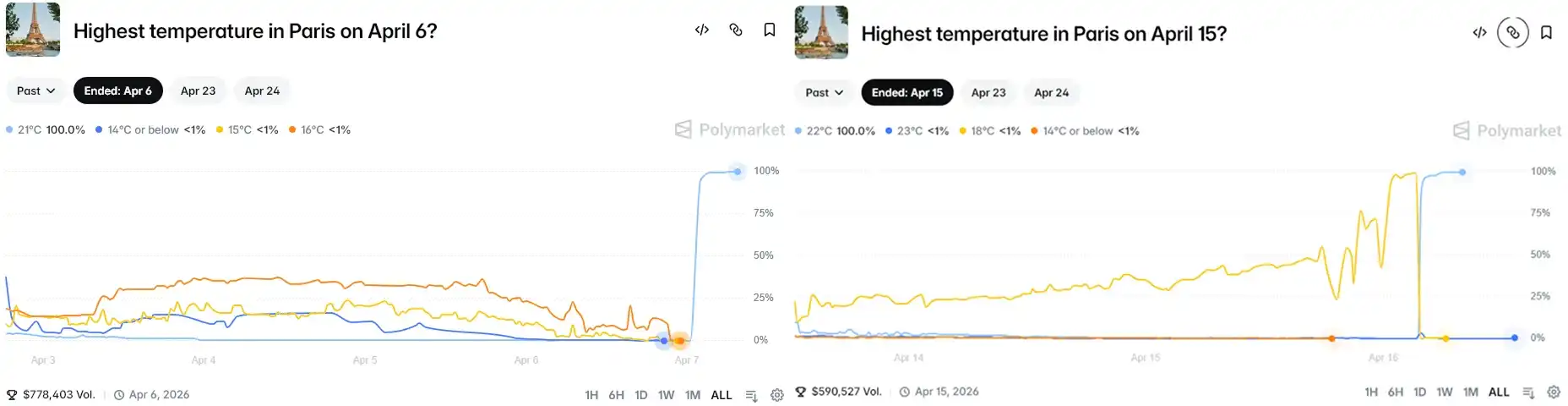
According to reports, an individual manipulated temperature sensors at Paris Charles de Gaulle Airport (LFPG) on April 6th and 15th, causing brief, anomalous spikes of over 3°C. These events were allegedly orchestrated to profit from corresponding low-probability bets on the prediction market Polymarket, turning a small investment into approximately $34,000. The French national meteorological service, Météo-France, filed a criminal lawsuit after discovering signs of physical tampering. The attack required minimal technical skill; the perpetrator reportedly used a battery-powered hairdryer to briefly heat the publicly accessible sensor. Polymarket’s market for Paris temperature settles based on the day's highest recorded temperature from a data chain that runs from the physical sensor to Météo-France, to Weather Underground, and finally to its smart contract. In response, Polymarket did not void the profits or make an official statement. It silently changed the data source for its Paris market from LFPG to Le Bourget Airport (LFPB), a location with similarly unprotected sensors. This incident highlights a critical vulnerability: while the smart contracts are audited and secure, the physical data sources feeding them remain exposed and easy to manipulate.

Original Author: Sanqing, Foresight News

According to French media Le Monde, on April 6th and 15th, the meteorological sensors at Paris Charles de Gaulle Airport experienced two anomalies. The temperature surged by more than 3°C within minutes before quickly returning to normal, as if nothing had happened. Behind each anomaly, someone had placed bets on the corresponding low-probability temperature range on Polymarket in advance. From a principal of just tens of dollars, they collectively walked away with approximately $34,000 from these two incidents. The account that placed the first bet was created just two days before the anomaly occurred.
Météo-France subsequently conducted a physical inspection of the sensors and found signs of human intervention. They filed a criminal complaint with the Charles de Gaulle Airport Gendarmerie, with the charge being "interfering with an automated data processing system." According to an analysis in an AR15 forum post, based on Article 323-2 of the French Penal Code, and because Météo-France is a public institution, the related charges could carry a maximum penalty of 7 years imprisonment and a fine of 300,000 euros.

The Technical Sophistication of This Scam Is Approximately Zero

The settlement chain for Polymarket's Paris temperature market is as follows: Physical Sensor → Météo-France → Weather Underground → Polymarket Contract.

On this chain, the smart contract part is audited, data transmission is automated, and Weather Underground's data scraping is real-time. The only weak point is at the very beginning: a thermometer standing by the airport roadside, without fencing, without cameras, accessible to anyone who walks by.

All the attacker needed was a battery-powered heat gun/hairdryer.

Polymarket bases its settlement on the day's maximum temperature. This means that creating one brief temperature peak is enough to rewrite the official record for the day.

Acting in the evening or at night is more ideal, as the daytime high has usually already passed, making subsequent readings more likely to become the new record. Therefore, the suspect chose 7 PM on April 6th and 9:30 PM on April 15th.

The operational procedure was likely: buy the low-probability option in advance, walk to the sensor at night, turn on the heat gun, wait for the reading to cross the target temperature, stop, leave, and wait for on-chain settlement.

The entire operation required no technical skill whatsoever, just some understanding of the settlement mechanism and a willingness to walk to the edge of the airport.

Polymarket's Response: Quietly Swapped the Thermometer

Polymarket has not issued any official statement regarding this incident. The only thing it did was change the settlement data source for the Paris temperature market from Charles de Gaulle Airport (LFPG) to Le Bourget Airport (LFPB).
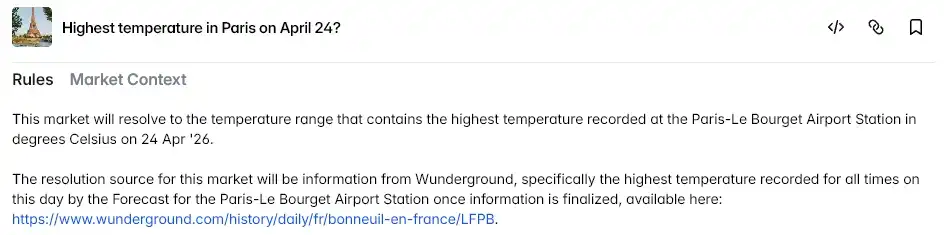
The profits from the two accounts were not revoked; the market settled normally according to the on-chain records.

The sensor at Le Bourget Airport is also placed outdoors, similarly without physical protection. They changed the address, but the problem remains entirely unchanged.

This is not Polymarket's first controversy. In October 2024, a French trader was accused of manipulating Trump election odds using 4 linked accounts, reportedly profiting $85 million; in March 2025, a whale used 5 million tokens to forcibly push through a UMA governance vote, settling a controversial market with a "Yes" outcome, involving $7 million; in January and March 2026, anomalous bets appeared in markets related to Venezuela and Iran respectively, with the latter already drawing attention from the US Congress...

Previous incidents at least required millions of dollars in capital or governance tokens; this time the cost was just a heat gun.

The Contract Was Audited, The Thermometer Was Not

This story has an absurd sense of humor. A prediction market running on the blockchain, touting decentralization and immutability, was thoroughly exploited twice by a battery-powered heat gun. Cryptography was of no help in this matter because it never verifies whether the input data is real.

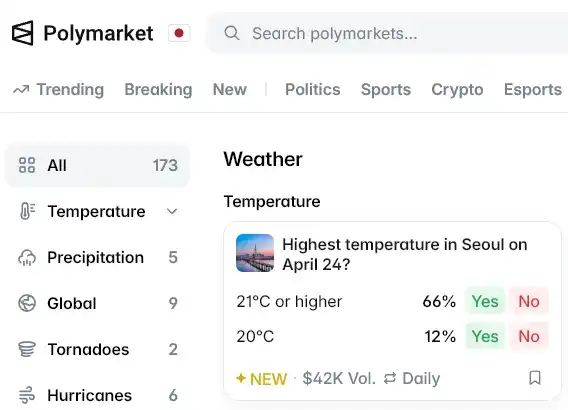
Polymarket currently has 173 active weather markets. The settlement basis for most of these markets is a single physical sensor in some location.
When a sensor is used as a meteorological tool, its credibility comes from the fact that no one has a motive to tamper with it. Polymarket gave it a new incentive structure but provided no new physical protection.

The Météo-France thermometer dutifully recorded the temperature it sensed. It just didn't know it had become a financial settlement terminal.

Câu hỏi Liên quan

QWhat was the key vulnerability exploited in the Polymarket Paris temperature market incident?

AThe physical vulnerability of the meteorological sensor at Charles de Gaulle Airport, which was unprotected and could be easily manipulated with a simple tool like a battery-powered hairdryer.

QHow did the attackers profit from manipulating the temperature sensor?

AThey placed bets on low-probability temperature ranges on Polymarket just before artificially spiking the temperature, turning a small investment of tens of dollars into approximately $34,000 in profits across two incidents.

QWhat was Polymarket's response to the temperature manipulation incidents?

APolymarket did not issue an official statement or reverse the profits. They silently changed the data source for the Paris temperature market from Charles de Gaulle Airport (LFPG) to Le Bourget Airport (LFPB), which had the same physical vulnerability.

QWhat legal consequences might the perpetrators face according to the article?

AUnder French law, specifically Article 323-2, and because Météo-France is a public institution, the charges for interfering with an automated data processing system could result in up to 7 years in prison and a €300,000 fine.

QWhat does the incident reveal about the limitations of blockchain-based prediction markets like Polymarket?

AIt highlights that while smart contracts are audited and the blockchain is secure, the system remains vulnerable if the real-world data inputs (oracles) are not physically secure and can be easily manipulated, undermining the integrity of the market.

Nội dung Liên quan

Đứng Trong Ánh Sáng, Một Bài Đọc Hiểu Toàn Bộ Về Chuỗi Cung Ứng Mô-đun Quang và CPO

**Tóm tắt tiếng Việt: Đứng trong ánh sáng, tìm hiểu chuỗi cung ứng mô-đun quang và CPO** Bài viết phân tích xu hướng cốt lõi trong cơ sở hạ tầng AI: truyền dẫn dữ liệu bằng ánh sáng. Với sự bùng nổ của AI, nhu cầu băng thông khổng lồ giữa các GPU đã phơi bày những hạn chế của cáp đồng truyền thống và cả mô-đun quang (pluggable optics) có thể tháo rời. Mô-đun quang đóng vai trò "phiên dịch", chuyển đổi tín hiệu điện từ chip sang tín hiệu quang để truyền qua sợi quang và ngược lại. Tuy nhiên, kiến trúc pluggable đang đạt đến giới hạn về công suất, băng thông và suy hao tín hiệu. CPO (Co-Packaged Optics - Quang học đồng đóng gói) được giới thiệu như giải pháp tiếp theo. CPO tích hợp "engine quang" trực tiếp vào cùng gói với chip chuyển mạch (ASIC), loại bỏ khoảng cách và tổn hao, giúp tiết kiệm điện năng đáng kể và mở rộng băng thông. Mặc dù hứa hẹn, CPO vẫn đối mặt với thách thức về công nghệ đóng gói tiên tiến, sửa chữa và quản lý nhiệt. Bài viết cũng điểm qua các công nghệ liên quan khác như NPO (gần đóng gói), LPO (quang học lái tuyến tính) và OCS (bộ chuyển mạch mạch quang). Phân tích chuỗi cung ứng CPO cho thấy sự chuyển dịch quyền lực: * **Kiến trúc sư:** NVIDIA, Broadcom nắm quyền định nghĩa kiến trúc. * **Đóng gói tiên tiến:** TSMC là trung tâm với công nghệ như COUPE/SoIC. * **Laser (nguồn sáng):** Là nút thắt cổ chai chiến lược. Lumentum và Coherent thống trị, trong khi các công ty Trung Quốc như Yuanguang Technology (源杰科技) đang đột phá với laser CW. * **Chip Silicon Photonics:** Là "bộ não" của engine quang, với sự tham gia của Broadcom, Intel, Cisco và các công ty Trung Quốc như Accelink. * **Linh kiện kết nối sợi quang:** FAU, PMF, MPO trở thành thị trường tăng trưởng mới, với các công ty như Tianfu Communication (天孚通信) nổi bật. * **Sợi quang & cáp quang:** Nhu cầu tăng mạnh, hưởng lợi các công ty như Changfei Optical Fiber. * **Nhà sản xuất mô-đun quang:** Từ vai trò chủ đạo chuyển sang nhà cung cấp engine quang cho CPO, trong khi vẫn hưởng lợi từ chu kỳ siêu tăng trưởng của mô-đun pluggable 800G/1.6T. Zhongji Innolight (中际旭创) và Eoptolink (新易盛) là những gương mặt tiêu biểu. Lộ trình đầu tư được vạch ra theo từng giai đoạn: giai đoạn ngắn hạn (2026-2027) là đỉnh cao của mô-đun pluggable và khởi đầu CPO; trung hạn (2027-2029) CPO mở rộng; dài hạn (2029+) CPO và OIO thay thế cáp đồng trong các cụm GPU. Bài viết kết luận rằng hệ thống kết nối quang là "hệ thần kinh" của AI, và các công ty thành công sẽ là những người nắm bắt được sự chuyển dịch công nghệ và chiếm giữ các vị trí then chốt trong chuỗi cung ứng.

marsbit22 phút trước

Đứng Trong Ánh Sáng, Một Bài Đọc Hiểu Toàn Bộ Về Chuỗi Cung Ứng Mô-đun Quang và CPO

marsbit22 phút trước

Giao dịch

Giao ngay
Hợp đồng Tương lai
活动图片




