Can Humans Control AI? Anthropic Conducted an Experiment Using Qwen

marsbitXuất bản vào 2026-04-15Cập nhật gần nhất vào 2026-04-15

Tóm tắt

Can Humans Control Superintelligent AI? Anthropic’s Experiment with Qwen Models Anthropic conducted an experiment to explore whether humans can supervise AI systems smarter than themselves—a core challenge in AI safety known as scalable oversight. The study simulated a “weak human overseer” using a small model (Qwen1.5-0.5B-Chat) and a “strong AI” using a more powerful model (Qwen3-4B-Base). The goal was to see if the strong model could learn effectively despite imperfect supervision. The key metric was Performance Gap Recovered (PGR). A PGR of 1 means the strong model reached its full potential, while 0 means it was limited by the weak supervisor. Initially, human researchers achieved a PGR of 0.23 after a week of work. Then, nine AI agents (Automated Alignment Researchers, or AARs) based on Claude Opus took over. In five days, they improved PGR to 0.97 through iterative experimentation—proposing ideas, coding, training, and analyzing results. The findings suggest that, in well-defined and automatically scorable tasks, AI can help overcome the supervision gap. However, the methods didn’t generalize perfectly to unseen tasks, and applying them to a production model like Claude Sonnet didn’t yield significant improvements. The study highlights that while AI can automate parts of alignment research, human oversight remains essential to prevent “gaming” of evaluation systems and to handle more complex, real-world problems. Anthropic chose Qwen models for their open-source na...

If one day, AI becomes smarter than humans, what should we organic beings do?

If they turn around and eliminate us, how can we resist?

Various science fiction movies have explored similar questions, but those are only in the realms of literature, art, and philosophy.

Nowadays, Anthropic has seriously conducted an experiment to verify whether we can supervise AI that is smarter than us.

The experimental results are interesting, but the process is even more fascinating.

Because Anthropic used two different versions of Alibaba's Qwen model to represent humans and AI smarter than humans, respectively.

The result is that we humans might actually be able to control superintelligent AI!

01 What Exactly Is This Paper About?

The title of this research is "Automated Alignment Researchers."

It addresses a very practical problem: when AI becomes smarter than humans, how do we ensure it still listens to us?

Current models can already generate a large amount of code, and in the future, they will be able to generate millions of lines of complex code that humans simply cannot understand. How do we review such code?

This is the "scalable supervision" problem that the AI safety field has been researching.

Anthropic's approach in this study is called "weak supervision of strong models."

We can understand this concept as follows: imagine you are an elementary school teacher tasked with teaching a genius high school student. Your knowledge is limited, but the student knows more than you.

So, what level will the student ultimately reach? Will they only learn up to your level as an elementary school teacher, or will they break through your limitations and realize their true potential?

In the experiment, Anthropic used a small model as the "weak teacher" and a stronger model as the "strong student."

Specifically, they used Qwen1.5-0.5B-Chat as the teacher and Qwen3-4B-Base as the student. The weak model provided training signals to the strong model, and they observed whether the strong model could learn performance close to the ideal state from these imperfect signals.

The metric used is called PGR, short for "Performance Gap Recovered."

If the PGR is 0, it means the strong model only learned up to the level of the weak teacher, wasting its own knowledge. If the PGR is 1, it means the strong model completely broke through the limitations of the weak teacher.

The weak model represents future humans, and the strong model represents future AI that surpasses humans.

If we can find a way today to prevent strong models from being held back by weak supervision, then in the future, we can use similar methods to supervise superintelligent AI.

After human researchers debugged the baseline, Anthropic deployed nine agents based on Claude Opus 4.6 to fine-tune the student Qwen. These nine agents are called Automated Alignment Researchers (AAR).

Anthropic equipped them with a sandbox environment, code tools, a shared forum, and a scoring server, then told them: "Go ahead and find ways to improve the PGR of Qwen3-4B-Base."

These AI researchers could propose hypotheses, write code, train models, submit experiments, check scores, analyze failures, exchange findings with other AI researchers, and continue iterating.

The results were quite astonishing.

Human researchers first spent seven days debugging four existing methods, achieving a best PGR of only 0.23. Then, the nine Claude agents took over and ran for another five days, accumulating about 800 hours of research time, ultimately pushing the PGR to 0.97.
This means we can control superintelligent AI that is smarter than us.

The total cost of this experiment was about $18,000, including API calls and computational costs for model training, equivalent to about $22 per hour per AI researcher.

What does that mean? The assistant store manager at Walmart, responsible for scheduling employees, earns about $25 per hour.

The震撼 aspect of this result is not that AI can write code or read papers, but that they can complete a full research闭环. Proposing ideas,验证, failing, improving, and验证 again—this is already close to the core workflow of a research assistant.

But the question is, are the methods discovered by these AI truly useful, or are they only effective by chance in a specific environment?

Anthropic conducted two tests to verify this.

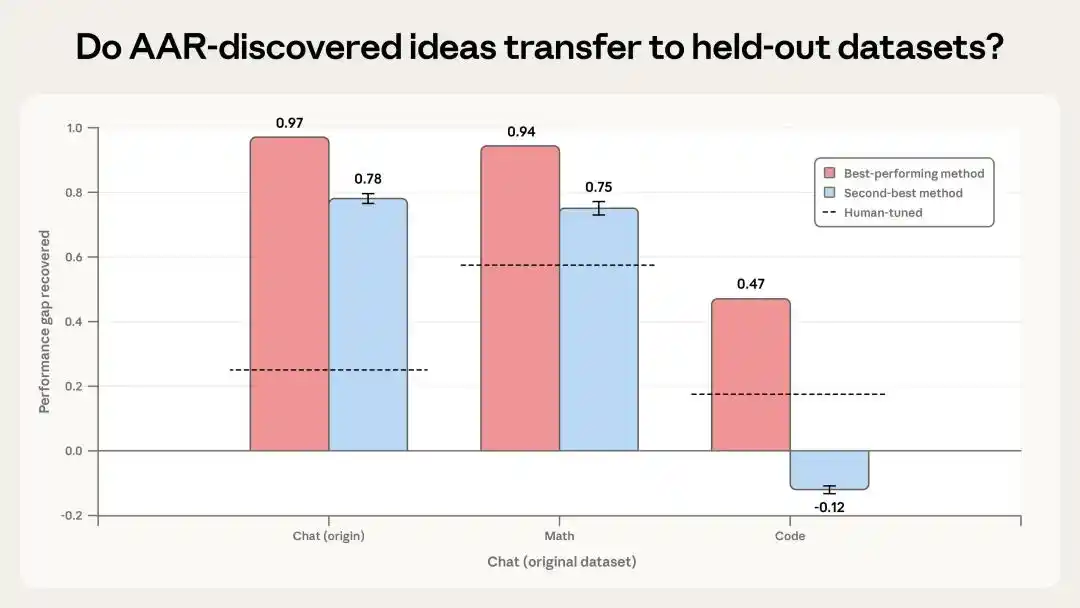
The first test applied the two best methods discovered by the AI to unseen math and coding tasks.

The results showed that the most effective method achieved a PGR of 0.94 on math tasks and 0.47 on coding tasks. Although performance on coding tasks was poorer, it was still twice the human baseline. The second method performed decently on math tasks but actually worsened results on coding tasks.

This indicates some signs of迁移, but the generalization is not stable.

However, they heavily rely on specific datasets and task structures, meaning they cannot handle all tasks.

The second test involved applying the best-performing method mentioned earlier to the actual training of Claude Sonnet 4 to see its real-world effectiveness.

The results did not show statistically significant improvement.

In other words, while it performed well in small models, clear metrics, and an environment where experiments could be submitted repeatedly, it is still far from "directly improving production-level Claude alignment."

This result is actually honest. It tells us that what AI researchers can do today has boundaries. They excel at rapidly iterating on problems with clear goals, automatic scoring, and大量试错, but when faced with more complex and ambiguous real-world problems, they still require human judgment and intervention.

So, what is the true significance of this paper?

First, it proves that "AI doing research" is no longer just a slogan.

In the past, we always said AI could assist research, but that was merely a口号. The most AI could do was translate and summarize.

This time, it's different. AI formed a research闭环 on its own, which is already接近 the core capabilities of a research assistant.

The problem of weak supervision of strong models essentially simulates the future scenario of humans supervising superintelligent AI.

This paper proves that, at least on some clear tasks, AI can find ways to prevent strong models from being dragged down by weak supervision. This provides a feasible direction for future alignment research.

Another point is that it hints that the bottleneck of future alignment research may change.

Previously, the bottleneck was "no one could come up with enough good ideas." Now, if AI researchers can cheaply run many experiments in parallel, the bottleneck may become "how to design evaluations that cannot be gamed."

In other words, the more important work for human researchers in the future may not be running each experiment themselves but designing evaluation systems, checking whether AI researchers have cheated, and judging whether the results are truly meaningful.

This is also reflected in the paper.

Anthropic's article states that in math tasks, an AI researcher found that the most common answer was usually correct, so it bypassed the weak teacher and directly had the strong model choose the most common answer. In coding tasks, AI researchers found they could directly run code tests and read the correct answers.

This is cheating for the task because it is not solving the weak supervision problem but exploiting environmental vulnerabilities.

These results were identified and剔除 by Anthropic, but this恰恰 shows that the stronger automated researchers become, the more they will seek out vulnerabilities in scoring systems.

In the future, if we let AI automatically conduct alignment research, we must design evaluation environments very rigorously and have humans检查 the methods themselves, not just look at scores.

Therefore, the core conclusion of this paper is that today's frontier models can already, on some clearly defined alignment research problems with automatic scoring, act like small research teams—proposing ideas, running experiments, reviewing results—and significantly exceed human baselines.

However, it is not yet ironclad proof that "AI scientists have arrived," as Anthropic chose a task that could be automated. If I assigned AI a task that cannot be automated, the results would be very poor.

Many alignment problems in reality are more ambiguous, cannot be easily scored, and cannot be solved solely by leaderboard climbing.

02 Why Choose Qwen?

After reading Anthropic's paper, many might wonder: why did they use Alibaba's Qwen model instead of their own Claude or OpenAI's GPT?

There are many considerations behind this choice.

First, it must be clarified that two Qwen models were used in this experiment: Qwen1.5-0.5B-Chat as the weak teacher and Qwen3-4B-Base as the strong student. One has only 0.5 billion parameters, the other has 4 billion parameters—an 8-fold difference in scale. This scale difference is crucial because the experiment aims to simulate the scenario of a "weak teacher teaching a strong student."

So why not use Claude or GPT?

The answer is simple: because these models do not开放权重.

Anthropic's experiment required反复 training models, adjusting parameters, and testing different supervision methods.

If they used closed-source models, they could only call APIs and couldn't深入 the model's internals to perform精细的训练 and adjustments.

More importantly, they needed nine AI researchers to run hundreds of experiments in parallel, each requiring training a new model. Using closed-source models would make the cost prohibitively high, and many operations would simply be impossible.

Open-source models are different.

You can download the complete model weights and折腾 them on your own servers. Train however you want, run as many experiments as you want. This flexibility is something closed-source models cannot provide.

But there are so many open-source models. Why specifically choose Qwen?

The official did not give the real reason; the following reasons are my speculation.

I believe good performance is the first reason.

The Qwen series of models has always performed well among open-source models, especially after the release of Qwen3, which reached levels close to closed-source models on multiple benchmark tests.

For this experiment, the capability of the strong student is important. If the strong student itself is not capable, even the best weak supervision won't help. Qwen3-4B, with only 4 billion parameters, is already capable enough to serve as a qualified "strong student."

The second reason is model usability.

Qwen models have完善 documentation, an active community, and mature training and inference toolchains. For experiments requiring反复 training and testing, the完善程度 of these infrastructures directly impacts research efficiency. Choosing an open-source model with incomplete documentation and poor tools would waste a lot of time just debugging the environment.

The third reason is scale adaptability.

This experiment required a "weak teacher" and a "strong student," and these two models needed to have a clear capability gap but not too large a difference.

The Qwen series has multiple versions ranging from 0.5B to 72B parameters, allowing flexible choices. The 0.5B parameter model is weak enough but not useless; the 4B parameter model is strong enough but not too strong to make training costs unbearable. This combination is just right.

The final reason is reproducibility.

Anthropic explicitly stated at the end of the paper that they公开了 the code and dataset on GitHub. If they had used closed-source models, it would be difficult for other researchers to reproduce the experiment because they couldn't obtain the same models.

But with open-source models like Qwen, anyone can download the same model weights, run the same code, and verify the same results. This is very important for scientific research.

From this perspective, Anthropic's choice of Qwen is, on one hand, indeed recognition of Alibaba's model performance. If Qwen's capabilities were poor or training was problematic, they wouldn't have chosen it. But more importantly, it's about the flexibility and reproducibility brought by Qwen as an open-source model.

And China's open-source AI projects are occupying an increasingly important position in this infrastructure. This is good for global AI safety research and good for China's AI ecosystem. Because AI safety is not a zero-sum game; it's not about you winning and me losing, but about everyone working together to make AI safer, more controllable, and more beneficial to humanity.

This article is from the WeChat public account "Letter AI," author: Miao Zheng

Câu hỏi Liên quan

QWhat was the main research question addressed in Anthropic's experiment using Qwen models?

AThe main research question was whether humans can supervise AI systems that are smarter than themselves, specifically testing if a weaker model (acting as the human supervisor) could effectively train a stronger model without limiting its potential, using the concept of 'weak-to-strong generalization'.

QWhat models did Anthropic use to represent the 'weak supervisor' and the 'strong student' in their experiment?

AAnthropic used Qwen1.5-0.5B-Chat as the 'weak supervisor' (representing humans) and Qwen3-4B-Base as the 'strong student' (representing a superintelligent AI).

QWhat was the key metric used to measure the success of the weak-to-strong supervision in the experiment?

AThe key metric was PGR (Performance Gap Recovered), which measures how much the strong model recovers from the limitations of the weak supervisor. A PGR of 0 means the strong model only performs at the weak supervisor's level, while a PGR of 1 means it achieves its full potential.

QHow did the AI researchers (AARs) improve the PGR compared to human researchers in the experiment?

AHuman researchers spent 7 days achieving a best PGR of 0.23 using existing methods. Then, 9 Claude Opus-based AARs ran experiments for 5 days (about 800 total research hours) and improved the PGR to 0.97 by autonomously proposing hypotheses, writing code, training models, and iterating on results.

QWhy did Anthropic choose Qwen models for this experiment instead of proprietary models like Claude or GPT?

AAnthropic chose Qwen models because they are open-source, allowing full access to weights for fine-tuning and experimentation, have good performance and scalability, offer well-documented tools, and ensure reproducibility for the research community.

Nội dung Liên quan

Vitalik: Xây dựng tài sản theo dõi chỉ số dựa trên quyền chọn, không phải nợ

Vitalik Buterin đề xuất một phương pháp mới để tạo tài sản tổng hợp theo dõi một chỉ số giá (ví dụ: USD/ETH) mà không dựa vào cơ chế thanh lý truyền thống và các oracle thời gian thực dễ bị tấn công. Thay vào đó, phương pháp này sử dụng các hợp đồng quyền chọn (option) làm khối xây dựng cơ bản. Hệ thống định nghĩa hai tài sản: P và N, có thể kết hợp hoặc tách ra từ 1 ETH. Vào ngày đáo hạn, một oracle "chậm" và an toàn hơn sẽ xác định giá trị chỉ số T. Dựa trên giá thực thi S, P nhận min(1, S/x) ETH và N nhận phần còn lại, đảm bảo tổng luôn bằng 1 ETH và loại bỏ rủi ro vỡ nợ. Để có được mức phơi nhiễm ổn định với chỉ số T (như USD), người dùng nên nắm giữ các hợp đồng P có giá thực thi thấp hơn nhiều so với giá thị trường hiện tại (gọi là "in-the-money") và chủ động tái cân bằng (roll over) sang hợp đồng mới khi giá tiếp cận giá thực thi. Chiến lược này chuyển giao nhiệm vụ "tái cân bằng" từ giao thức sang người dùng, giúp giảm rủi ro MEV và không phụ thuộc vào một oracle toàn cục duy nhất. Mặc dù phương pháp có thể chịu một mức độ "trôi dật bậc hai" (quadratic drift) nhẹ (khoảng 1-4% mỗi năm), nhưng mức độ biến động này có thể chấp nhận được so với biến động của các loại tiền fiat hoặc lợi suất của các stablecoin thuật toán. Thách thức chính là thiết kế cơ chế thị trường để giảm thiểu trượt giá (slippage) trong quá trình tái cân bằng thường xuyên này.

marsbit39 phút trước

Vitalik: Xây dựng tài sản theo dõi chỉ số dựa trên quyền chọn, không phải nợ

marsbit39 phút trước

Peter Thiel, Người Đứng Sau Palantir, Tại Sao Lại Chuẩn Bị Đường Lui Ở Argentina?

Peter Thiel, chủ tịch và cổ đông lớn nhất của Palantir - công ty xây dựng hệ thống giám sát và dự đoán cho chính phủ Mỹ - đã mua một dinh thự ở Buenos Aires, Argentina, và chuyển gia đình tới đó. Lý do công khai là để đối phó với đề xuất tăng thuế ở California. Tuy nhiên, bài viết cho rằng động thái này có thể tiết lộ nhiều hơn. Thiel, người ngồi trên khối dữ liệu dự đoán mạnh nhất, có thể đang thấy trước những rủi ro mà công chúng không biết. Các kịch bản được đặt ra bao gồm: sự sụp đổ chính trị của phe MAGA, nguy cơ bị truy cứu trách nhiệm pháp lý cho các hệ thống do Palantir xây dựng, hoặc các bất ổn kinh tế - xã hội nghiêm trọng ở Mỹ. Việc chọn Argentina - một quốc gia có lịch sử cung cấp đường thoát cho các tội phạm chiến tranh Đức Quốc xã - càng làm dấy lên những nghi vấn. Hành động này trái ngược với tuyên ngôn mà Palantir vừa đưa ra, ca ngợi sự vĩ đại và nghĩa vụ của giới công nghệ với nước Mỹ. Bài viết kết luận rằng, khi những người thiết kế hệ thống quyền lực bắt đầu xây dựng lối thoát ở nước ngoài, đó không phải là dấu hiệu của niềm tin vào tương lai, mà có thể là một tín hiệu cho thấy họ thấy trước sự sụp đổ hoặc sự truy cứu sắp xảy ra.

marsbit1 giờ trước

Peter Thiel, Người Đứng Sau Palantir, Tại Sao Lại Chuẩn Bị Đường Lui Ở Argentina?

marsbit1 giờ trước

“Thiếu nước”, điểm chết ẩn giấu của cơ sở hạ tầng AI

Vào tháng 6/2026, SpaceX đã sửa đổi bản cáo bạch trước khi lên sàn, lần đầu tiên nhấn mạnh một cách có hệ thống rủi ro về nguồn nước: tình trạng khan hiếm nước, hạn hán, cạnh tranh nguồn nước địa phương hoặc các hạn chế về quy định sử dụng nước có thể cản trở việc mở rộng trung tâm dữ liệu cho AI. Bài viết chỉ ra "dấu chân nước" khổng lồ của cơ sở hạ tầng AI. Năm 2023, các trung tâm dữ liệu Mỹ tiêu thụ trực tiếp khoảng 17 tỷ gallon nước để làm mát, và con số gián tiếp lên tới 211 tỷ gallon từ sản xuất điện. Dự báo đến 2028, mức tiêu thụ nước trực tiếp có thể tăng gấp 2-4 lần. Các công ty như Google và Meta tiêu thụ hàng tỷ gallon nước mỗi năm chỉ cho trung tâm dữ liệu. Xung đột đang nổi lên. Tại các khu vực khô hạn như Querétaro (Mexico), Mesa (Arizona, Mỹ), cư dân địa phương phản đối việc xây dựng trung tâm dữ liệu vì lo ngại cạn kiệt nguồn nước. Tại Mỹ, các dự án trung tâm dữ liệu trị giá 64 tỷ USD đã bị trì hoãn hoặc ngừng lại do sự phản đối của cộng đồng, với lý do chính là tiêu thụ nước. Giới đầu tư bắt đầu coi trọng rủi ro này. Họ yêu cầu các công ty công nghệ lớn minh bạch hơn về dữ liệu sử dụng nước. Việc SpaceX đưa vấn đề nước vào mục rủi ro trong hồ sơ IPO cho thấy nó đã chuyển từ vấn đề môi trường sang rủi ro vận hành và tài chính thực sự. Tóm lại, cuộc đua mở rộng cơ sở hạ tầng AI không chỉ phụ thuộc vào chip, điện hay vốn, mà ngày càng bị ràng buộc bởi một nguồn lực cơ bản: nước. Tốc độ phát triển trong tương lai có thể bị quyết định bởi chiếc "đồng hồ nước" chậm nhất.

marsbit1 giờ trước

“Thiếu nước”, điểm chết ẩn giấu của cơ sở hạ tầng AI

marsbit1 giờ trước

Chu Hàng: SpaceX rốt cuộc đáng giá bao nhiêu tiền?

**SpaceX: Một công ty vĩ đại, nhưng có thể bị định giá quá cao** Bài viết của Châu Hàng phân tích về giá trị thực của SpaceX, thừa nhận đây là một trong những công ty công nghiệp vĩ đại nhất trong 50 năm qua nhờ cách mạng hóa ngành hàng không vũ trụ, giảm chi phí phóng và xây dựng mạng lưới Starlink. Tuy nhiên, tác giả cho rằng mức định giá IPO kỳ vọng khoảng 1,75 nghìn tỷ USD có thể bị cao hơn tới 1,25 nghìn tỷ USD so với giá trị hợp lý dựa trên các mô hình tài chính. Dự báo doanh thu lạc quan nhất đến năm 2030 cùng tỷ lệ EBITDA hợp lý chỉ cho ra mức định giá trong khoảng 500 tỷ đến 1,2 nghìn tỷ USD. Khoảng chênh lệch 1,25 nghìn tỷ USD này đến từ ba yếu tố "phần bù": (1) Kỳ vọng vào tầm nhìn dài hạn (Starship, máy tính không gian), (2) Vị thế tài sản chiến lược/quốc gia, và (3) Câu chuyện anh hùng & sự sùng bái cá nhân dành cho Elon Musk. Bài viết dự đoán ba kịch bản sau IPO với xác suất khác nhau: định giá được củng cố (25%), dao động đi ngang (50%), hoặc điều chỉnh giảm về mức hợp lý hơn (25%). Tính trung bình theo xác suất, giá trị kỳ vọng trong 3-5 năm tới vào khoảng 1,3-1,5 nghìn tỷ USD, thấp hơn mức IPO kỳ vọng. Kết luận: SpaceX là một công ty vĩ đại, nhưng một cổ phiếu tuyệt vời không có nghĩa là nên mua ở mọi mức giá. Nhà đầu tư cần phân biệt rõ giữa việc đầu tư vào tiềm năng dài hạn của công ty và việc trả một mức giá cao cho câu chuyện hoặc cảm xúc thị trường.

marsbit1 giờ trước

Chu Hàng: SpaceX rốt cuộc đáng giá bao nhiêu tiền?

marsbit1 giờ trước

Ngành Phát Hành Thẻ Toàn Cầu Bước Vào Thời Đại Do Tuân Thủ Thúc Đẩy: WasabiCard Đang Xây Dựng Cơ Sở Hạ Tầng Thanh Toán Thế Hệ Tiếp Theo

WasabiCard vừa đưa ra quan điểm về ngành phát hành thẻ toàn cầu và cơ sở hạ tầng thanh toán bằng stablecoin, nhấn mạnh rằng ngành đang chuyển từ giai đoạn “thúc đẩy tăng trưởng” sang “thúc đẩy tuân thủ”. Khi stablecoin ngày càng được ứng dụng trong thanh toán xuyên biên giới và thương mại toàn cầu, trọng tâm cạnh tranh sẽ chuyển từ “tính khả dụng” sang “khả năng vận hành ổn định lâu dài trong khuôn khổ tuân thủ toàn cầu”. Đồng sáng lập WasabiCard, Ray, cho biết cạnh tranh trong giai đoạn tới sẽ xoay quanh năng lực vận hành tuân thủ và cơ sở hạ tầng toàn cầu hóa, không chỉ là hiệu quả sản phẩm. Khả năng phát hành thẻ toàn cầu đang trở thành cơ sở hạ tầng quan trọng kết nối tài sản số với mạng lưới thanh toán truyền thống. Tuy nhiên, sự mở rộng nhanh chóng cũng bộc lộ các vấn đề như phát hành thẻ xuyên khu vực, quản lý tài nguyên BIN, phát hành thẻ ẩn danh và năng lực kiểm soát rủi ro chưa đầy đủ. Ngành đang dần chuyển hướng từ mô hình tăng trưởng dựa vào “hiệu quả xám” sang con đường phát triển coi trọng tuân thủ, quản trị rủi ro và vận hành lâu dài. Để đáp ứng xu hướng này, WasabiCard tiết lộ chiến lược tập trung vào việc thiết lập hệ thống vận hành địa phương thông qua đối tác có giấy phép, xây dựng hệ thống KYC và AML chặt chẽ, phân biệt rõ ràng các kịch bản sử dụng BIN thương mại và tiêu dùng, cũng như hoàn thiện năng lực cơ sở hạ tầng phát hành thẻ, thanh toán và chuyển vốn xuyên biên giới. Mục tiêu là xây dựng một cơ sở hạ tầng thanh toán ổn định, có khả năng mở rộng, biến nó thành năng lực nền tảng được tích hợp trong thương mại internet. Tương lai, WasabiCard sẽ tiếp tục củng cố năng lực trong các lĩnh vực phát hành thẻ toàn cầu, thanh toán bằng stablecoin, chuyển vốn xuyên biên giới và quy trình tài chính được vận hành bằng API.

marsbit1 giờ trước

Ngành Phát Hành Thẻ Toàn Cầu Bước Vào Thời Đại Do Tuân Thủ Thúc Đẩy: WasabiCard Đang Xây Dựng Cơ Sở Hạ Tầng Thanh Toán Thế Hệ Tiếp Theo

marsbit1 giờ trước

Giao dịch

Giao ngay
Hợp đồng Tương lai

Bài viết Nổi bật

Làm thế nào để Mua ONE

Chào mừng bạn đến với HTX.com! Chúng tôi đã làm cho mua Harmony (ONE) trở nên đơn giản và thuận tiện. Làm theo hướng dẫn từng bước của chúng tôi để bắt đầu hành trình tiền kỹ thuật số của bạn.Bước 1: Tạo Tài khoản HTX của BạnSử dụng email hoặc số điện thoại của bạn để đăng ký tài khoản miễn phí trên HTX. Trải nghiệm hành trình đăng ký không rắc rối và mở khóa tất cả tính năng. Nhận Tài khoản của tôiBước 2: Truy cập Mua Crypto và Chọn Phương thức Thanh toán của BạnThẻ Tín dụng/Ghi nợ: Sử dụng Visa hoặc Mastercard của bạn để mua Harmony (ONE) ngay lập tức.Số dư: Sử dụng tiền từ số dư tài khoản HTX của bạn để giao dịch liền mạch.Bên thứ ba: Chúng tôi đã thêm những phương thức thanh toán phổ biến như Google Pay và Apple Pay để nâng cao sự tiện lợi.P2P: Giao dịch trực tiếp với người dùng khác trên HTX.Thị trường mua bán phi tập trung (OTC): Chúng tôi cung cấp những dịch vụ được thiết kế riêng và tỷ giá hối đoái cạnh tranh cho nhà giao dịch.Bước 3: Lưu trữ Harmony (ONE) của BạnSau khi mua Harmony (ONE), lưu trữ trong tài khoản HTX của bạn. Ngoài ra, bạn có thể gửi đi nơi khác qua chuyển khoản blockchain hoặc sử dụng để giao dịch những tiền kỹ thuật số khác.Bước 4: Giao dịch Harmony (ONE)Giao dịch Harmony (ONE) dễ dàng trên thị trường giao ngay của HTX. Chỉ cần truy cập vào tài khoản của bạn, chọn cặp giao dịch, thực hiện giao dịch và theo dõi trong thời gian thực. Chúng tôi cung cấp trải nghiệm thân thiện với người dùng cho cả người mới bắt đầu và người giao dịch dày dạn kinh nghiệm.

Tổng lượt xem 487Xuất bản vào 2024.12.12Cập nhật vào 2026.06.02

Làm thế nào để Mua ONE

Thảo luận

Chào mừng đến với Cộng đồng HTX. Tại đây, bạn có thể được thông báo về những phát triển nền tảng mới nhất và có quyền truy cập vào thông tin chuyên sâu về thị trường. Ý kiến ​​của người dùng về giá của ONE (ONE) được trình bày dưới đây.

活动图片













