Bittensor Goes Left, Virtuals Goes Right: Two Flywheel Paradigms of AI Crypto Projects

marsbitXuất bản vào 2026-03-26Cập nhật gần nhất vào 2026-03-26

Tóm tắt

The article compares two AI crypto project models: Bittensor's subnet ecosystem and Virtuals' agent-based system. Bittensor uses TAO emissions to incentivize subnets, which compete for daily TAO rewards. Subnets require significant capital to launch (e.g., 871 TAO for a subnet slot) and focus on infrastructure like decentralized computing and AI research. Its ecosystem has high entry barriers, complex onboarding, and targets technical users. Virtuals employs a pump.fun-like model where agent tokens gain value through trading volume, enabling rapid capital accumulation during speculative cycles. It has low entry costs for teams, supports quick iteration via a 60-day trial program, and excels at retail distribution due to its Base chain integration and consumer-friendly concepts. Both models share a liquidity flywheel: demand for subnet tokens boosts TAO, while demand for agent tokens boosts VIRTUAL. Bittensor is infrastructure-oriented with high funding potential, while Virtuals is application-focused, leveraging market momentum for consumer AI agents.

Original Author: 0xJeff

Original Compilation: AididiaoJP, Foresight News

This article aims to provide a brief comparison between Bittensor subnets and Virtuals agents to help understand their respective flywheel mechanisms, differences, and similarities.
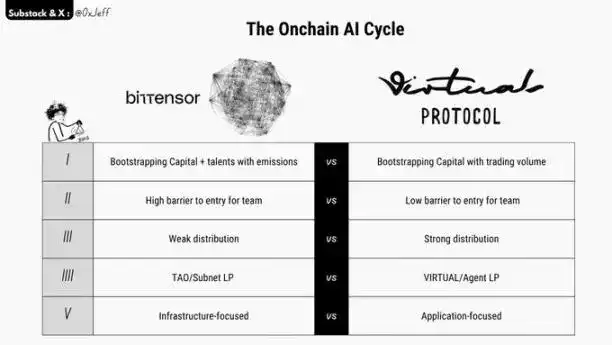
I. Guiding Capital and Talent Through Emissions Mechanism vs. Guiding Capital Through Trading Volume

Bittensor guides subnet development through its TAO emissions mechanism. Subnets are responsible for introducing the most innovative projects (or revenue-generating businesses) and compete for a share of the daily 3,600 TAO distribution.

Subnets also guide contributors (including miners performing tasks and validators verifying the miners' work) through their alpha token emissions mechanism. The emissions mechanism and the incentive coordination mechanism across stakeholders have been embedded since the project's inception.

Virtuals adopts a model similar to pump.fun, guiding development through trading volume. High trading activity translates into capital accumulation for the agent project. Agent teams can use their own emissions mechanisms to incentivize user participation.

In market cycles with high speculative token demand, this model has significant advantages—teams can quickly accumulate capital, gain product attention and market interest, thereby driving project launch and development.

II. High Entry Barrier vs. Low Entry Barrier (For Teams)

Launching a subnet on Bittensor requires substantial investment. Currently, acquiring a subnet slot requires 871 TAO (approximately $300,000), with the price fluctuating based on demand and the auction mechanism. This means subnet teams typically need mature ideas, clear plans, and solid execution capabilities.

To successfully operate a subnet, owners must ensure that the set tasks or objectives contribute to the R&D of their AI product/solution, prevent miner fraud, ensure validators effectively perform verification duties, generate revenue through business development and customer partnerships, and maintain investor confidence through buyback mechanisms.

The subnet token price needs to maintain an upward trend to attract more TAO inflow, increase the subnet's emission share, and thereby attract higher-level contributors to participate in mining.

In contrast, the barrier to launching an AI agent token on Virtuals is lower, requiring no initial cost, making it easier to test new ideas with less capital.

Virtuals also has a "60-day program" that allows founders to test new ideas and issue tokens during this period. If product-market fit is not found within 60 days, the relevant funds are reclaimed, and investors can retrieve a portion of their invested capital.

III. Weaker Distribution Capability vs. Stronger Distribution Capability

Bittensor operates independently on a blockchain built using the Polkadot Substrate framework. Cross-chain bridging is difficult, it lacks DeFi infrastructure components, and is not equipped with common infrastructure like the Ethereum Virtual Machine or Solana.

This results in a high entry barrier for the Bittensor ecosystem. Furthermore, relevant learning materials are filled with complex terminology, increasing the difficulty for new users to learn and understand. Consequently, its community members are mostly technical professionals willing to invest time in deep research, with relatively low retail participation.

In comparison, the understanding threshold for Virtuals is lower. Its team excels in marketing, branding, and distribution. Retail users can relatively intuitively understand concepts like AI agents, agent payments, and bots.

Since Virtuals is deployed on the Base chain, the process of purchasing AI agent tokens is convenient. The time from learning about a project, forming a bullish judgment, to making a purchase decision is short, which is a key reason for its rapid popularity from late 2024 to 2025 (earlier than Bittensor).

Currently, Bittensor is gradually entering the mainstream spotlight with pushes from Jason, Chamath, Barry Silbert (DCG & Yuma), and the community, leading to increased attention. However, the purchase process for subnet tokens remains relatively complex, and the issue has not been fundamentally resolved.

IV. TAO/Subnet Liquidity Pool vs. VIRTUAL/Agent Liquidity Pool

Bittensor and Virtuals share a key similarity in their liquidity pool flywheel mechanisms.

Investors wishing to purchase subnet alpha tokens need to hold TAO to do so. Therefore, rising demand for alpha tokens will drive up the price of TAO.

Similarly, within the Virtuals ecosystem, rising demand for AI agent tokens will drive up the price of VIRTUAL.

If the core tokens (TAO or VIRTUAL) can circulate within the ecosystem without outflow (e.g., through project teams trading goods and services to retain value), the advantages of this mechanism become more pronounced.

V. Infrastructure-Oriented vs. Application-Oriented

Bittensor subnets mostly focus on infrastructure or capital-intensive businesses, such as decentralized computing, inference, training, drug discovery, and quantum experiments.

Since Bittensor can provide over $10 million annually in funding for quality subnets and attract high-end talent, its model is suitable for driving ambitious, high-difficulty, high-investment ideas.

Virtuals agent teams, however, mostly focus on the application layer and consumer-facing agent products. Since agent tokens have a low initial price, if a team can launch a quality consumer product, it can leverage the token's market heat to quickly attract attention and drive project development.

Thanks to Virtuals' advantages in distribution, the flywheel effect of AI agent tokens demonstrated faster growth rates and higher price increases during periods of extreme market activity (such as late 2024 to early 2025).


Câu hỏi Liên quan

QWhat are the two main AI crypto projects compared in the article, and what are their core flywheel mechanisms?

AThe two main AI crypto projects compared are Bittensor and Virtuals. Bittensor's core flywheel mechanism is guided by TAO emissions to fund subnet development. Virtuals' core flywheel mechanism is guided by trading volume, similar to the pump.fun model, to accumulate capital for AI agent projects.

QHow does the entry barrier for launching a project differ between Bittensor and Virtuals?

ALaunching a subnet on Bittensor has a high entry barrier, currently requiring a significant investment (e.g., 871 TAO, ~$300k) to acquire a subnet slot. In contrast, launching an AI agent token on Virtuals has a low entry barrier, requiring no initial cost, allowing teams to test new ideas with minimal capital outlay.

QWhat is a key similarity in the liquidity pool flywheel mechanism between Bittensor and Virtuals?

AA key similarity is that demand for the ecosystem's project tokens drives the price of the core native token. In Bittensor, demand for subnet alpha tokens drives the price of TAO. In Virtuals, demand for AI agent tokens drives the price of VIRTUAL.

QAccording to the article, what is the primary focus of projects built on Bittensor versus those on Virtuals?

AProjects on Bittensor are primarily infrastructure-oriented, focusing on areas like decentralized computing, inference, training, drug discovery, and quantum experiments. Projects on Virtuals are primarily application-oriented, focusing on consumer-facing AI agent products.

QWhat advantage does Virtuals have over Bittensor in terms of distribution and user accessibility?

AVirtuals has a significant advantage in distribution and user accessibility. It has lower comprehension barriers, strong marketing, and is deployed on the Base chain, making the purchase process for AI agent tokens simple and intuitive for retail users. Bittensor has a higher learning curve, complex terminology, and a more difficult token purchase process, making it less accessible to the average retail participant.

Nội dung Liên quan

Dự đoán giá TON/GRAM – Thông báo ra mắt ví Gram của Telegram đẩy giá token tăng: Đợt tăng giá có thể tiếp tục?

Người sáng lập Telegram, Pavel Durov, đã công bố kế hoạch triển khai ví tiền mã hóa Gram không giám sát (non-custodial) bản địa trên tất cả các ứng dụng Telegram. Ông mô tả đây là "đợt ra mắt ví tiền mã hóa không giám sát lớn nhất trong lịch sử nhân loại", hứa hẹn giao dịch tức thì, miễn phí cho hơn một tỷ người dùng. Sau thông báo này, giá token TON (sắp được đổi tên thành GRAM) đã tăng hơn 7%, giao dịch quanh mức 1,53 USD. Tuy nhiên, đồng tiền này vẫn đối mặt với kháng cự quanh 1,60 USD và còn thấp hơn nhiều so với đỉnh tháng 5 (gần 2,80 USD), cho thấy xu hướng giảm tổng thể vẫn chưa đảo ngược. Chỉ số RSI hàng ngày ở khoảng 45 cho thấy động lực giảm đã giảm bớt nhưng vẫn trong vùng yếu. Việc triển khai ví Gram có thể giảm đáng kể rào cản sử dụng tiền mã hóa, đưa thanh toán blockchain vào trực tiếp một nền tảng nhắn tin hàng đầu. Thành công sẽ phụ thuộc vào mức độ tương tác của người dùng, nhưng quy mô người dùng hiện có của Telegram hứa hẹn một trong những đợt triển khai tiền mã hóa hướng đến người tiêu dùng lớn nhất từ trước đến nay.

ambcrypto16 phút trước

Dự đoán giá TON/GRAM – Thông báo ra mắt ví Gram của Telegram đẩy giá token tăng: Đợt tăng giá có thể tiếp tục?

ambcrypto16 phút trước

Làm thế nào 40.8 triệu ETH được stake có thể củng cố ưu thế của Ethereum so với Bitcoin

Hai con cá voi lớn đã tích lũy lần lượt hơn 74.000 ETH và 10.000 ETH, và đặc biệt, họ đã khóa 100% số ETH này vào staking ngay lập tức. Đây không phải là sự kiện riêng lẻ, mà phản ánh một xu hướng rộng lớn hơn: lượng ETH được staking đã đạt kỷ lục 40,8 triệu ETH, tương đương 33,5% tổng nguồn cung. Hàng đợi validator mới đang tăng lên 2,4 triệu ETH, trong khi hàng đợi rút về bằng 0, cho thấy nhu cầu staking mạnh mẽ và làm thắt chặt nguồn cung ETH lưu hành. Song song đó, hệ sinh thái DeFi của Ethereum cũng đang ghi nhận sự gia tăng mạnh mẽ về hoạt động. Số giao dịch cá voi lớn hơn 100.000 USD liên quan đến Wrapped Ethereum (WETH) đạt mức cao nhất kể từ tháng 5/2021, và tổng giá trị bị khóa (TVL) tăng hơn 5 tỷ USD trong chưa đầy mười ngày. Tác động kép từ việc thắt chặt nguồn cung nhờ staking và thanh khoản tăng trong DeFi đang bắt đầu thể hiện trên biểu đồ kỹ thuật. Tỷ lệ ETH/BTC đã phá vỡ mức kháng cự 0,025 và đang tiến gần đến vùng kháng cự quan trọng tiếp theo quanh 0,03, thiết lập nền tảng cho đợt tăng giá vượt trội tiếp theo của Ethereum so với Bitcoin.

ambcrypto48 phút trước

Làm thế nào 40.8 triệu ETH được stake có thể củng cố ưu thế của Ethereum so với Bitcoin

ambcrypto48 phút trước

Điểm bão trong thị trường chứng khoán toàn cầu: Việc giảm đòn bẩy của thị trường chứng khoán Hàn Quốc về cơ bản đã hoàn tất

Thị trường chứng khoán Hàn Quốc gần đây trải qua biến động mạnh, với chỉ số KOSPI giảm tới 32% từ mức đỉnh. Nguyên nhân chính được xác định là cơ cấu vốn vay (leverage) tập trung cao, đặc biệt là từ các quỹ ETF có đòn bẩy và các quỹ phòng hộ. Quy mô của các quỹ ETF có đòn bẩy đã giảm từ khoảng 500 tỷ USD xuống còn 260 tỷ USD, với tiến trình giảm đòn bẩy ước tính đạt khoảng 75%. Song song đó, các quỹ phòng hộ cũng đã giảm đòn bẩy hơn 50%. Trong khi đó, rủi ro từ khoản vay ký quỹ của nhà đầu tư cá nhân được đánh giá là có hạn, chiếm tỷ trọng nhỏ trong tổng vốn hóa thị trường và không có cơ chế bán ép tự động như ETF. Các nhà chức trách Hàn Quốc đã bắt đầu siết chặt quy định đối với các sản phẩm đòn bẩy để ngăn chặn rủi ro hệ thống. Với phần lớn quá trình giảm đòn bẩy cưỡng bức đã hoàn thành, thị trường được kỳ vọng sẽ chuyển từ giai đoạn điều chỉnh do thanh khoản sang định giá dựa trên cơ bản. Bài viết nhấn mạnh rằng xu hướng AI cơ bản vẫn không thay đổi, và sự điều chỉnh này giống như một đợt thanh lọc sau khi giao dịch quá mua hơn là sự kết thúc của làn sóng AI. Sự bất ổn chủ yếu bắt nguồn từ vị thế tập trung vào lĩnh vực chip bán dẫn - trung tâm của chuỗi cung ứng AI. Tác giả kết luận rằng nếu xu hướng AI là đúng đắn, thì những biến động hiện tại chỉ là chi phí phải trả trên con đường dài, tạo cơ hội để tham gia vào một cuộc cách mạng công nghệ mang tính thời đại.

链捕手56 phút trước

Điểm bão trong thị trường chứng khoán toàn cầu: Việc giảm đòn bẩy của thị trường chứng khoán Hàn Quốc về cơ bản đã hoàn tất

链捕手56 phút trước

92,9% token tiền điện tử ra mắt từ năm 2024 giao dịch dưới giá lúc TGE: CryptoRank

Theo dữ liệu mới từ CryptoRank, gần 93% token tiền điện tử được ra mắt từ năm 2024 hiện đang giao dịch dưới mức giá tại thời điểm phát hành token (TGE), cho thấy những thách thức lớn mà các dự án mới phải đối mặt trong việc duy trì định giá ban đầu. Nghiên cứu tập trung vào các token có vốn hóa thị trường trên 100 triệu USD, được ra mắt từ 2024 đến 2026. Kết quả cho thấy chỉ 7,1% (8/113 dự án) vẫn giao dịch trên giá TGE, trong khi 92,9% (105 dự án) đã giảm xuống dưới mức này. Lợi nhuận trung bình của toàn bộ mẫu là -95,7%. Một số ít dự án thành công nổi bật bao gồm Hyperliquid (HYPE) tăng 1.519%, Ondo Finance (ONDO) tăng 101,4%, EverValue Coin (EVA) tăng 20,32% và Midnight Network (NIGHT) tăng 16,50%. Phát hiện này phản ánh thị trường ngày càng trở nên kén chọn. Vốn tập trung vào nhóm nhỏ các dự án chứng minh được sự tăng trưởng sản phẩm, hệ sinh thái hoặc nhu cầu thị trường mạnh mẽ. Nhà đầu tư hiện quan tâm nhiều hơn đến tokenomics, nguồn cung lưu hành, lịch mở khóa và tiện ích dài hạn thay vì chỉ đà tăng ngày ra mắt. Xu hướng này có thể ảnh hưởng đến cách các dự án trong tương lai thực hiện đợt phát hành token, với sự chú trọng hơn vào các mô hình phân phối bền vững và tăng trưởng hệ sinh thái lâu dài, thay vì định giá ban đầu quá cao.

ambcrypto1 giờ trước

92,9% token tiền điện tử ra mắt từ năm 2024 giao dịch dưới giá lúc TGE: CryptoRank

ambcrypto1 giờ trước

Mảnh Vỡ Vĩnh Hằng Của Tiền Tệ: Thanh Toán Bên Thứ Ba Không Có Tính Nguyên Lý Đầu Tiên

Tác giả phân tích tình hình ngành thanh toán hiện tại và chiến lược của Stripe. Stripe, từng đạt định giá 100 tỷ USD, đã bỏ lỡ cơ hội IPO trong đại dịch và giờ đang tìm cách mua lại PayPal để bổ sung thị phần C2C, đồng thời bù đắp cho những nỗ lực chưa thành công trong việc mở rộng sang thị trường stablecoin (qua OUSD, Tempo) và kinh tế Agent. Bài viết chỉ ra hai đặc điểm cố hữu cản trở sự thống trị của ngành: tính phân mảnh cao (theo quốc gia, ngành) và bản chất phụ thuộc vào hệ thống ngân hàng. Các sáng kiến như stablecoin hay Agent vẫn cần đi qua các cổng ngân hàng truyền thống để pháp định hóa. Để thoát khỏi cuộc chiến tranh chiến hào không hồi kết và nâng trần định giá vốn bị giới hạn ở FinTech, Stripe và các công ty tương tự (như Circle) đang chuyển hướng chiến lược. Thay vì chỉ cạnh tranh trên phí giao dịch hay phân chia lợi nhuận từ stablecoin, họ nhắm đến mạng lưới thanh toán bù trừ (clearing network) dựa trên hiệu quả vốn của các blockchain riêng (như Tempo của Stripe). Với giấy phép ngân hàng OCC, họ kỳ vọng hệ thống thanh toán bù trừ hiệu suất cao này có thể cắt giảm sự phụ thuộc vào ngân hàng thương mại và giữ lại lợi nhuận. Tóm lại, tương lai của các công ty thanh toán không nằm ở việc trở thành "cổng vào" duy nhất, mà ở các dịch vụ gia tăng như mạng lưới thanh toán bù trừ dựa trên công nghệ mới, với kỳ vọng Agent và stablecoin sẽ là chất xúc tác cho sự chuyển đổi này.

链捕手1 giờ trước

Mảnh Vỡ Vĩnh Hằng Của Tiền Tệ: Thanh Toán Bên Thứ Ba Không Có Tính Nguyên Lý Đầu Tiên

链捕手1 giờ trước

Giao dịch

Giao ngay
活动图片