As the Yuan Breaks 7, Why Is the Dollar Stablecoin USDT Trading at a Deep Discount?

比推Xuất bản vào 2025-12-30Cập nhật gần nhất vào 2025-12-30

Tóm tắt

The Chinese yuan (CNH) broke through the key 7.0 per dollar level in late December 2025, reaching its strongest point since Q3 2024. Concurrently, the USDT stablecoin experienced a rare and significant discount in its over-the-counter (OTC) price in China, falling to around 6.83 yuan—a negative premium of approximately 2.48% against the official exchange rate. This divergence is attributed to two main factors. First, a major external driver is the weakening US dollar. The dollar index fell 9% in 2025, its worst performance in eight years, driven by expectations of a more dovish Federal Reserve under new leadership and a reassessment of the "US exceptionalism" trade. This provided room for non-US currencies like the yuan to appreciate. Second, and more critically for USDT, was a significant regulatory crackdown in China. In early December 2025, Chinese regulators explicitly brought stablecoins like USDT under supervision to combat illegal cross-border capital flows and money laundering. This caused OTC traders to pause operations and many holders to panic-sell their USDT for yuan, creating a surge in supply and a collapse in demand that severely depressed its local price. Analysts conclude that the era of a perpetually strong dollar providing one-way gains is over. Market participants are now advised to move away from betting on unilateral currency moves and instead adopt a risk-neutral stance in a new environment of heightened volatility.

Author: ChandlerZ, Foresight News

Original Title: What Does the Simultaneous Occurrence of the Yuan Breaking 7 and the Discount on the Dollar Stablecoin Mean?


At the end of 2025, the foreign exchange market is undergoing a quiet but intense asset repricing.

In late December, the offshore yuan (CNH) exchange rate against the US dollar broke through the 7.0 mark during intraday trading, reaching as high as the 6.99 range, hitting a new high since the third quarter of 2024. The onshore yuan against the US dollar also touched 7.0133.

While the official exchange rate was still fluctuating around the 7.0 mark, the OTC price of USDT had already fallen below 6.90 much earlier. As of the time of writing, data from multiple exchanges show that the USDT OTC price (Buy 1) is approximately 6.83 yuan, representing a negative premium rate of 2.48% relative to the current exchange rate of 7.0040.

This inversion was almost unimaginable during the strong dollar cycle of the past three years.

The Collapse of the Dollar 'High Ground'

The decline of the US dollar in 2025 is the most important external backdrop for the yuan's strength.

In 2025, the US dollar index plummeted by 9% for the year, marking its worst performance in eight years, reflecting, to some extent, a global reassessment of "US Exceptionalism".
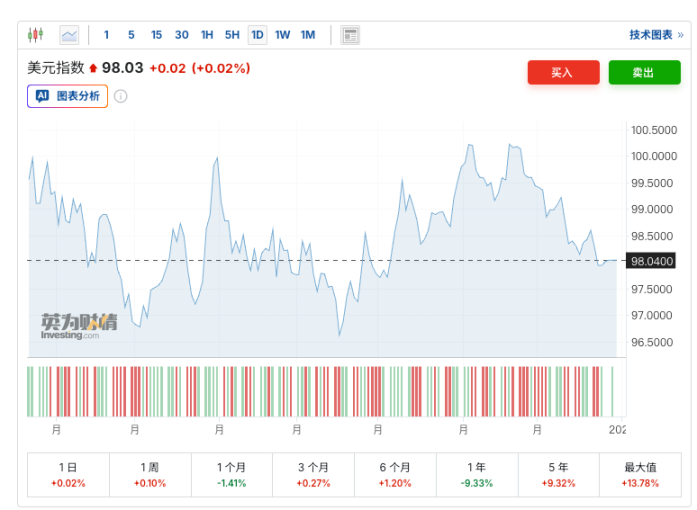
First is the gravitational pull of valuation regression. Although the dollar index has rebounded nearly 2% from its September low, from a fundamental perspective, the dollar is still outrageously "expensive." Data from the Bank for International Settlements (BIS) shows that as of October, the dollar's real broad effective exchange rate (REER), although down from its historical high of 115.1 in January to 108.7, remains at an absolute high. Karl Schamotta, Chief Market Strategist at global corporate payments company Corpay, stated bluntly: "From a fundamental perspective, the dollar is still overvalued."
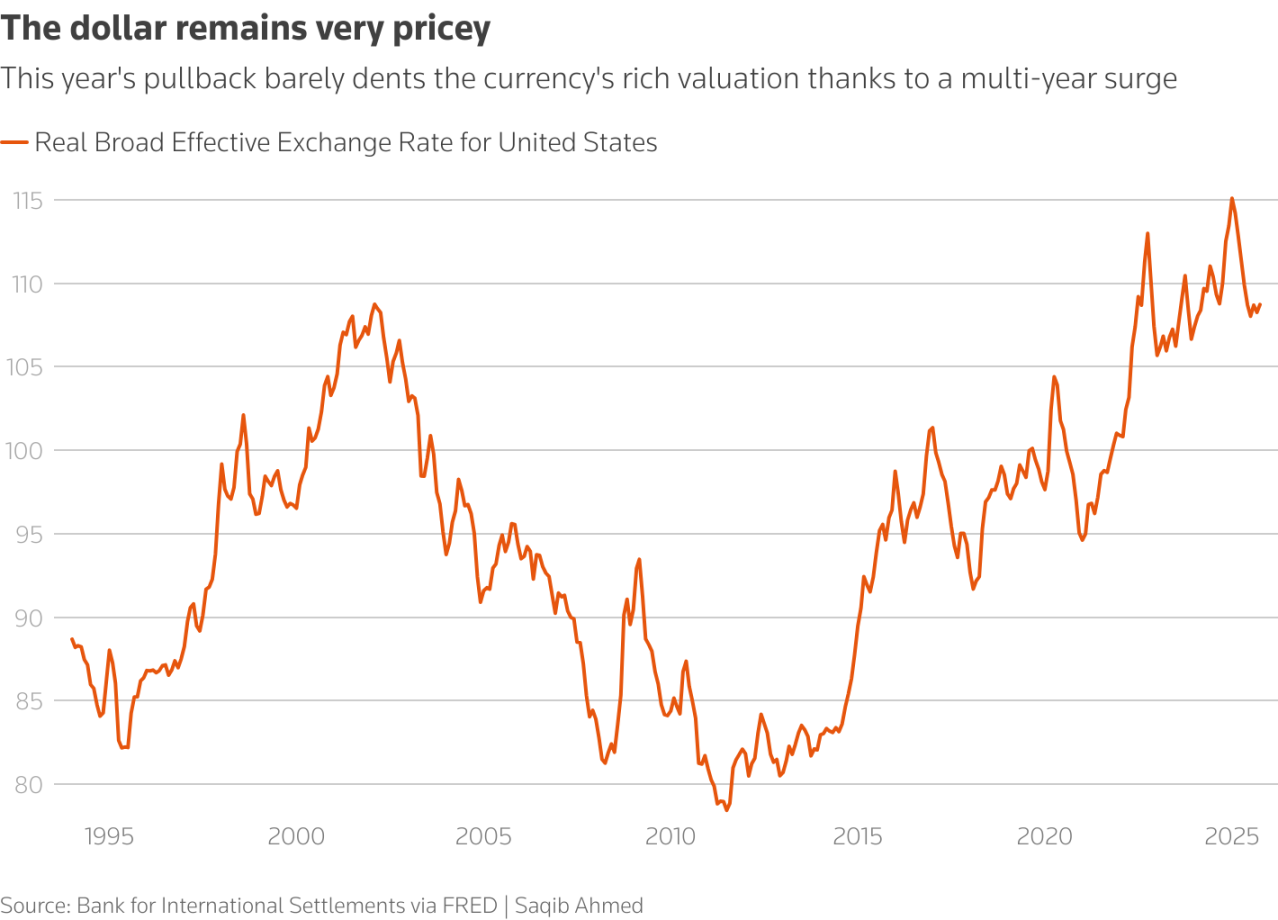
The line chart shows that due to years of sustained gains, this year's correction has barely impacted the dollar's high valuation.

Second is the dovish expectations for the new Fed. The market is pricing in a more accommodative 2025. With Powell set to step down and the Trump administration favoring low-interest-rate policies, leading candidates for his successor, including White House economic adviser Kevin Hassett and former Fed Governor Kevin Warsh, have all shown clear dovish tendencies.

Reuters noted in its year-end market report that the drop in the dollar index is driven more by expectations of Fed rate cuts, narrowing interest rate differentials with other economies, and changes in risk premiums due to the US fiscal deficit and political uncertainty.

And as the relative returns and safety premium of dollar assets are repriced, non-US currencies gain some upward room.

Institutional Consensus: Short-term Upward Momentum, Long-term Intensified Game

With the psychological barrier of 7.0 broken, the biggest question in the current market is whether this marks the start of a new long-term yuan appreciation cycle or is merely a short-term rebound driven by sentiment.

Standing on the threshold of 2026, the consensus among institutions is trending towards冷静 (calmness): short-term惯性向上 (inertia upward), long-term博弈加剧 (game intensifies).

Huachuang Securities believes that in terms of domestic supply and demand, the core factor behind it is foreign exchange settlement and sales. Although December's FX settlement and sales data have not yet been released, logical deduction suggests that the yuan's appreciation itself affects corporate expectations and behavior regarding FX settlement. Coupled with the typically strong seasonal characteristic of higher FX settlement at year-end, these two factors may have jointly driven the stronger performance of domestic supply and demand factors in the second phase of appreciation. On one hand, the continuous appreciation of the yuan exchange rate affects corporate expectations regarding FX settlement decisions; on the other hand, net FX settlement is usually strong at year-end.

However, the macro research team at Guotai Junan Securities also pointed out that the formation of yuan appreciation expectations is not without obstacles. Measuring domestic capital expectations using gold purchasing power parity, the volatility in 2025 was actually not low. Trade frictions in April once pushed domestic capital's depreciation expectations above 7.5, while the start of the Fed's rate cut cycle in September brought domestic capital's appreciation expectations to around 7.0. The reason is essentially that, in an environment where the internal economy has not yet shown significant elasticity, most investors remain somewhat hesitant about trend appreciation.

What Are the Reasons for USDT's Deep Discount?

Crypto market data analyst @Phyrex_Ni analyzed that the deep discount on USDT is mainly due to three reasons:

First: On a macro level, the Chinese yuan is currently strengthening significantly against the US dollar. Since the second half of 2025, the yuan has continued to strengthen. Reasons include the continuation of the Fed's rate-cutting cycle, the weakening US dollar index, and improved Chinese economic data. Holding USDT is equivalent to indirectly holding US dollar assets, which will incur exchange rate losses in the context of yuan appreciation. That is to say, the market itself, anticipating further yuan strength, has already priced in some exchange rate deviation, but this is not the main reason, only a very minor secondary factor.

Second: Chinese regulatory policies have tightened significantly. In early December 2025, the PBOC and twelve other departments jointly issued a document strengthening the crackdown on virtual currency trading speculation, explicitly bringing stablecoins (like USDT) into the regulatory scope, focusing on illegal cross-border capital flows, money laundering, and underground banks using USDT. This has led many OTC merchants and traders to suspend or reduce operations, causing market liquidity to tighten. Some holders, fearing account freezes or regulatory risks, are eager to sell USDT for yuan, increasing supply while demand plummets, directly depressing P2P prices. Historically, every regulatory upgrade in China (e.g., the 2021 ban) has led to negative OTC premiums for USDT. This time the力度 (force) is greater, so the deviation in USDT's exchange rate against the yuan is larger.

Third: The overall crypto market is volatile, and coupled with regulatory negative news, retail and institutional demand for USDT has decreased. Some investors based in mainland China, seeking to avoid risks, hope to offload their USDT as soon as possible, similar to the current negative premium cycle in China's real estate market.

Under the dual pressures of a turning macro cycle and tightening regulatory boundaries, the one-sided safe-haven logic of "holding US dollars means guaranteed gains" that prevailed over the past three years has completely失效 (failed).

For all market participants, the core task now is no longer to bet on whether the next point will be 6.8 or 7.0, but to告别 (bid farewell to) the path dependency on unilateral dollar appreciation. In a future where volatility is significantly elevated, the focus must回归风险中性 (return to risk neutrality).


Twitter:https://twitter.com/BitpushNewsCN

BitPush TG Discussion Group:https://t.me/BitPushCommunity

BitPush TG Subscription: https://t.me/bitpush

Original link:https://www.bitpush.news/articles/7599178

Tiền kỹ thuật số thịnh hành

Câu hỏi Liên quan

QWhy did the offshore Chinese yuan (CNH) break through the 7.0 mark against the US dollar in December 2025?

AThe offshore Chinese yuan broke through the 7.0 mark due to a significant decline in the US dollar, which fell 9% throughout 2025, marking its worst performance in eight years. This reflected a global reassessment of 'US Exceptionalism,' alongside expectations of a more dovish Federal Reserve under potential new leadership and narrowing interest rate differentials with other economies.

QWhat were the main reasons for the deep discount in USDT's over-the-counter price relative to the official USD/CNY exchange rate?

AThe deep discount in USDT's price was primarily caused by China's stringent regulatory crackdown on cryptocurrency transactions, including stablecoins like USDT, which reduced market liquidity and increased selling pressure. Additionally, the appreciation of the yuan against the dollar made holding USDT less attractive, and overall crypto market volatility further dampened demand.

QHow did market expectations for the Federal Reserve's policy in 2025 influence the US dollar's performance?

AMarket expectations for a more dovish Federal Reserve in 2025, driven by potential new leadership favoring low-interest policies under the Trump administration, contributed to the US dollar's decline. This led to reduced relative yields and safety premiums for dollar assets, encouraging capital flow into non-US currencies like the yuan.

QWhat role did China's regulatory policies play in affecting USDT's market dynamics?

AChina's regulatory policies, specifically a joint announcement by 13 departments in December 2025 targeting virtual currency transactions and stablecoins like USDT, significantly reduced market liquidity. This caused many traders to pause operations and led to increased selling of USDT as users sought to avoid regulatory risks, resulting in a supply-demand imbalance and deep discount.

QWhat is the consensus among major financial institutions regarding the future trend of the yuan's exchange rate?

AMajor financial institutions consensus is that the yuan may experience short-term upward momentum due to factors like seasonal year-end forex settlements and changing corporate expectations, but long-term trends will involve increased volatility and uncertainty, especially given internal economic challenges and fluctuating investor sentiment towards sustained appreciation.

Nội dung Liên quan

OpenAI không bán tiền dựa trên mô hình đắt nhất

OpenAI đã điều chỉnh giá, giảm 80% cho mô hình GPT-5.6 Luna và 20% cho Terra, đồng thời giới thiệu chế độ Fast cho mô hình mạnh nhất Sol. Động thái này, cùng với việc Anthropic giới thiệu Claude Opus 5 với giá bằng một nửa so với flagship Fable 5, đánh dấu sự thay đổi chiến lược quan trọng: các hãng không còn chỉ tập trung bán mô hình mạnh nhất. Thay vào đó, họ khuyến nghị người dùng kết hợp các mô hình theo nhiệm vụ: dùng Sol (đắt, mạnh) để phân tích và lập kế hoạch phức tạp, sau đó giao cho Luna (rẻ, hiệu quả) thực thi. Điều này cho thấy trọng tâm thương mại đang chuyển từ các mô hình flagship (chứng minh năng lực kỹ thuật) sang các mô hình tầm trung, phục vụ cho lượng truy vấn API khổng lồ hàng ngày của doanh nghiệp, nơi hiệu quả chi phí (ROI) và độ ổn định là yếu tố quyết định. Một yếu tố then chốt giúp giảm chi phí là việc chính các mô hình AI (như Sol) tham gia tối ưu hóa mã nguồn và quy trình vận hành của chính chúng, tạo ra một vòng lặp tự thúc đẩy giảm chi phí. Điều này có thể đẩy nhanh hơn nữa đà giảm giá trong tương lai. Cạnh tranh đang chuyển từ "mô hình thông minh nhất" sang "hệ sinh thái hiệu quả nhất". OpenAI muốn biến các mô hình như Luna thành lựa chọn mặc định cho các tác vụ thường ngày, từ đó gia tăng độ phụ thuộc và chi phí chuyển đổi cho doanh nghiệp. Tương tự như ngành điện hay điện toán đám mây, mục tiêu cuối cùng là AI trở thành một tiện ích phổ biến, hoạt động âm thầm và không thể thiếu trong mọi quy trình, thay vì chỉ là một sản phẩm công nghệ đình đám.

marsbit54 phút trước

OpenAI không bán tiền dựa trên mô hình đắt nhất

marsbit54 phút trước

Lương trăm nghìn đô la săn thợ điện, Meta vội vàng tự mở trường dạy nghề

Cuộc đua AI đang vấp phải nút thắt mới: thiếu hụt nghiêm trọng lao động lành nghề như thợ điện và công nhân xây dựng để xây dựng các trung tâm dữ liệu quy mô lớn. Tại Mỹ, dự báo cần thêm 130.000 thợ điện và 240.000 công nhân xây dựng từ 2023-2030 cho hạ tầng AI, trong khi mỗi năm có 80.000 vị trí thợ điện không thể lấp đầy. Các công ty AI sẵn sàng trả lương cao (thợ điện giỏi có thể kiếm 240.000-280.000 USD/năm), nhưng sự chậm trễ xây dựng vẫn gây thiệt hại hàng chục triệu USD. Độ phức tạp của các trung tâm dữ liệu AI, với công suất điện khổng lồ, hệ thống phân phối điện và làm mát phức tạp, đòi hỏi lao động có kỹ năng đặc biệt. Để giải quyết, các gã khổng lồ công nghệ như Meta và Google đang đầu tư hàng trăm triệu USD vào đào tạo. Meta mở trường dạy nghề miễn phí, cung cấp cả trợ cấp sinh hoạt, trong khi OpenAI hợp tác với công đoàn xây dựng. Chiến dịch tuyển dụng nhắm đến cả học sinh trung học, góp phần làm tăng mạnh tỷ lệ Gen Z theo học trường nghề. Tuy nhiên, nhu cầu điện cho AI tiếp tục bùng nổ, chiếm phần ngày càng lớn trong tổng tiêu thụ điện và đẩy giá điện lên cao. Một nghịch lý tồn tại: các dự án xây dựng cần hàng nghìn lao động cùng lúc, nhưng khi hoàn thành chỉ cần số ít vận hành, dẫn đến rủi ro dư thừa lao động lành nghề trong tương lai.

marsbit54 phút trước

Lương trăm nghìn đô la săn thợ điện, Meta vội vàng tự mở trường dạy nghề

marsbit54 phút trước

Cục Dự trữ Liên bang tháng 9 nhất định tăng lãi suất? Tiền mã hóa và chứng khoán Mỹ sẽ chịu áp lực thế nào?

Tỷ lệ thị trường kỳ vọng Fed tăng lãi suất vào tháng 9 đã tăng vọt từ dưới 50% lên hơn 80% chỉ trong một tuần, chủ yếu do lo ngại lạm phát trỗi dậy từ giá dầu leo thang sau các căng thẳng địa chính trị ở eo biển Hormuz. Cuộc bỏ phiếu 9-3 tại cuộc họp FOMC tháng 7, với 3 thành viên ủng hộ tăng lãi suất ngay lập tức, đã củng cố kỳ vọng này. Mốc then chốt tiếp theo là báo cáo CPI tháng 7 vào ngày 12/8. Đối với tài sản tiền mã hóa, kỳ vọng tăng lãi suất gây áp lực lên Bitcoin, vốn có mối tương quan cao với chu kỳ thanh khoản toàn cầu và thể hiện đặc tính tài sản rủi ro beta cao. Tuy nhiên, tác động có thể không kéo dài nếu thị trường coi đây là bước tăng cuối cùng trong chu kỳ thắt chặt. Trên thị trường chứng khoán Mỹ, các cổ phiếu liên quan đến tiền mã hóa như Coinbase có thể biến động mạnh hơn. Cổ phiếu công nghệ tăng trưởng nói chung phải đối mặt với áp lực định giá do lãi suất chiết khấu tăng. Báo cáo thu nhập quý 2 của các gã khổng lồ công nghệ cho thấy thị trường đang chuyển trọng tâm từ quy mô chi tiêu vốn sang khả năng tạo ra doanh thu và dòng tiền thực tế. Việc tăng lãi suất có thể làm gia tăng chi phí vốn, khiến thị trường khắt khe hơn với câu chuyện tăng trưởng dựa trên việc "đốt tiền" đầu tư.

marsbit1 giờ trước

Cục Dự trữ Liên bang tháng 9 nhất định tăng lãi suất? Tiền mã hóa và chứng khoán Mỹ sẽ chịu áp lực thế nào?

marsbit1 giờ trước

Thợ đào Bitcoin từ từ đầu hàng, nhưng cổ phiếu của họ lại tăng vọt

Tình trạng đầu hàng của thợ đào Bitcoin đang diễn ra, với hash rate và độ khó khai thác giảm mạnh trong nhiều tháng liên tục. Tuy nhiên, có một nghịch lý: trong khi hoạt động khai thác trở nên kém kinh tế và BTC giảm giá khoảng 46%, cổ phiếu của các công ty khai thác niêm yết lại tăng mạnh, thậm chí có mã tăng hơn 430%. Nguyên nhân chính được cho là nhờ câu chuyện về AI, khiến các cổ phiếu này thoát ly khỏi mối tương quan truyền thống với Bitcoin. Thu nhập từ phần thưởng khối (block reward) tính bằng BTC đã chạm mức thấp kỷ lục hàng ngày, phản ánh chu kỳ giảm nửa phần thưởng định kỳ. Hệ số Puell Multiple cho thấy thu nhập hiện tại của thợ đào chỉ bằng khoảng 3/4 mức trung bình năm. Trong khi đó, nguồn thu từ phí giao dịch vẫn rất thấp, chưa đủ để bù đắp cho phần thưởng khối đang teo lại. Sự phân kỳ lần này – thợ đào gặp khó khăn nhưng cổ phiếu ngành lại tăng – cho thấy một động lực mới. Các công ty có thể đang chuyển hướng sang các cơ hội khác như AI. Vấn đề cơ cấu lâu dài vẫn tồn tại: phần thưởng khối sẽ tiếp tục giảm, đặt ra câu hỏi về việc phí giao dịch trong tương lai sẽ đảm bảo an ninh mạng như thế nào. Những thách thức này thường được nhìn nhận nghiêm túc hơn trong thị trường giá xuống.

marsbit1 giờ trước

Thợ đào Bitcoin từ từ đầu hàng, nhưng cổ phiếu của họ lại tăng vọt

marsbit1 giờ trước

Giao dịch

Giao ngay

Bài viết Nổi bật

Làm thế nào để Mua O

Chào mừng bạn đến với HTX.com! Chúng tôi đã làm cho mua O1 exchange (O) trở nên đơn giản và thuận tiện. Làm theo hướng dẫn từng bước của chúng tôi để bắt đầu hành trình tiền kỹ thuật số của bạn.Bước 1: Tạo Tài khoản HTX của BạnSử dụng email hoặc số điện thoại của bạn để đăng ký tài khoản miễn phí trên HTX. Trải nghiệm hành trình đăng ký không rắc rối và mở khóa tất cả tính năng. Nhận Tài khoản của tôiBước 2: Truy cập Mua Crypto và Chọn Phương thức Thanh toán của BạnThẻ Tín dụng/Ghi nợ: Sử dụng Visa hoặc Mastercard của bạn để mua O1 exchange (O) ngay lập tức.Số dư: Sử dụng tiền từ số dư tài khoản HTX của bạn để giao dịch liền mạch.Bên thứ ba: Chúng tôi đã thêm những phương thức thanh toán phổ biến như Google Pay và Apple Pay để nâng cao sự tiện lợi.P2P: Giao dịch trực tiếp với người dùng khác trên HTX.Thị trường mua bán phi tập trung (OTC): Chúng tôi cung cấp những dịch vụ được thiết kế riêng và tỷ giá hối đoái cạnh tranh cho nhà giao dịch.Bước 3: Lưu trữ O1 exchange (O) của BạnSau khi mua O1 exchange (O), lưu trữ trong tài khoản HTX của bạn. Ngoài ra, bạn có thể gửi đi nơi khác qua chuyển khoản blockchain hoặc sử dụng để giao dịch những tiền kỹ thuật số khác.Bước 4: Giao dịch O1 exchange (O)Giao dịch O1 exchange (O) dễ dàng trên thị trường giao ngay của HTX. Chỉ cần truy cập vào tài khoản của bạn, chọn cặp giao dịch, thực hiện giao dịch và theo dõi trong thời gian thực. Chúng tôi cung cấp trải nghiệm thân thiện với người dùng cho cả người mới bắt đầu và người giao dịch dày dạn kinh nghiệm.

Tổng lượt xem 660Xuất bản vào 2026.06.19Cập nhật vào 2026.06.29

Làm thế nào để Mua O

Làm thế nào để Mua PROS

Chào mừng bạn đến với HTX.com! Chúng tôi đã làm cho mua Pharos (PROS) trở nên đơn giản và thuận tiện. Làm theo hướng dẫn từng bước của chúng tôi để bắt đầu hành trình tiền kỹ thuật số của bạn.Bước 1: Tạo Tài khoản HTX của BạnSử dụng email hoặc số điện thoại của bạn để đăng ký tài khoản miễn phí trên HTX. Trải nghiệm hành trình đăng ký không rắc rối và mở khóa tất cả tính năng. Nhận Tài khoản của tôiBước 2: Truy cập Mua Crypto và Chọn Phương thức Thanh toán của BạnThẻ Tín dụng/Ghi nợ: Sử dụng Visa hoặc Mastercard của bạn để mua Pharos (PROS) ngay lập tức.Số dư: Sử dụng tiền từ số dư tài khoản HTX của bạn để giao dịch liền mạch.Bên thứ ba: Chúng tôi đã thêm những phương thức thanh toán phổ biến như Google Pay và Apple Pay để nâng cao sự tiện lợi.P2P: Giao dịch trực tiếp với người dùng khác trên HTX.Thị trường mua bán phi tập trung (OTC): Chúng tôi cung cấp những dịch vụ được thiết kế riêng và tỷ giá hối đoái cạnh tranh cho nhà giao dịch.Bước 3: Lưu trữ Pharos (PROS) của BạnSau khi mua Pharos (PROS), lưu trữ trong tài khoản HTX của bạn. Ngoài ra, bạn có thể gửi đi nơi khác qua chuyển khoản blockchain hoặc sử dụng để giao dịch những tiền kỹ thuật số khác.Bước 4: Giao dịch Pharos (PROS)Giao dịch Pharos (PROS) dễ dàng trên thị trường giao ngay của HTX. Chỉ cần truy cập vào tài khoản của bạn, chọn cặp giao dịch, thực hiện giao dịch và theo dõi trong thời gian thực. Chúng tôi cung cấp trải nghiệm thân thiện với người dùng cho cả người mới bắt đầu và người giao dịch dày dạn kinh nghiệm.

Tổng lượt xem 676Xuất bản vào 2026.06.22Cập nhật vào 2026.06.29

Làm thế nào để Mua PROS

VERONA là gì

I. Giới thiệu Dự án VERONA là một blockchain được xây dựng cho mọi người, ở mọi nơi thông qua việc trừu tượng hóa chuỗi. Sử dụng lớp Trừu tượng Hóa Tổng quát, VERONA tự phân biệt mình bằng cách tích hợp các chức năng blockchain phức tạp, chẳng hạn như tài khoản, chữ ký và khả năng tương tác, trực tiếp ở cấp độ giao thức. Cách tiếp cận này cho phép tham gia vào các ứng dụng blockchain mà không cần phải hiểu các công nghệ cơ bản.1) Thông tin cơ bản Tên: VERONA (VERONA)III. Liên kết liên quan Liên kết trang web chính thức: https://xion.burnt.com/ Tài liệu trắng: https://xion.burnt.com/whitepaper.pdf Các trình khám phá: https://explorer.burnt.com/ Mạng xã hội: https://x.com/burnt_xion Lưu ý: Giới thiệu dự án đến từ các tài liệu được công bố hoặc cung cấp bởi đội ngũ dự án chính thức, chỉ để tham khảo và không cấu thành lời khuyên đầu tư. HTX không chịu trách nhiệm cho bất kỳ tổn thất trực tiếp hoặc gián tiếp nào phát sinh.

Tổng lượt xem 662Xuất bản vào 2026.06.22Cập nhật vào 2026.06.22

VERONA là gì

Thảo luận

Chào mừng đến với Cộng đồng HTX. Tại đây, bạn có thể được thông báo về những phát triển nền tảng mới nhất và có quyền truy cập vào thông tin chuyên sâu về thị trường. Ý kiến ​​của người dùng về giá của A (A) được trình bày dưới đây.

活动图片














