As Circle, the First Stablecoin Stock, Resolves to Shed Its Label

链捕手Xuất bản vào 2026-05-12Cập nhật gần nhất vào 2026-05-12

Tóm tắt

Circle, the "stablecoin stock," reported its Q1 2026 results, showing a 20% YoY revenue increase to $694M despite a 15% drop in net profit due to post-IPO stock-based compensation and operational investments. The company's USDC stablecoin hit a record $770B in circulation with on-chain transaction volume soaring 263% YoY. However, market share slightly declined amid competition. The key market catalyst was the announcement of a $222M pre-sale for the ARC token of Circle's new institutional-focused Layer 1 blockchain, Arc, valuing the network at $30B. Led by a16z, the round included major investors like BlackRock and Apollo. CEO Jeremy Allaire positioned this as a strategic pivot from a stablecoin issuer to a broader internet platform and "financial OS" company. Circle also launched "Agent Stack" products for AI agent payments using USDC. While reaffirming its full-year 2026 guidance, the company noted the financial impact of Arc is not yet included, leaving room for future upside. Following the report, CRCL's stock surged nearly 16%. Wall Street analysts remain largely bullish on the long-term narrative, though some caution about near-term execution risks and the current immaterial contribution of new initiatives like Arc. The focus is now on Arc's mainnet launch, ARC token adoption, and evolving U.S. crypto regulation.

Author: Chloe, ChainCatcher

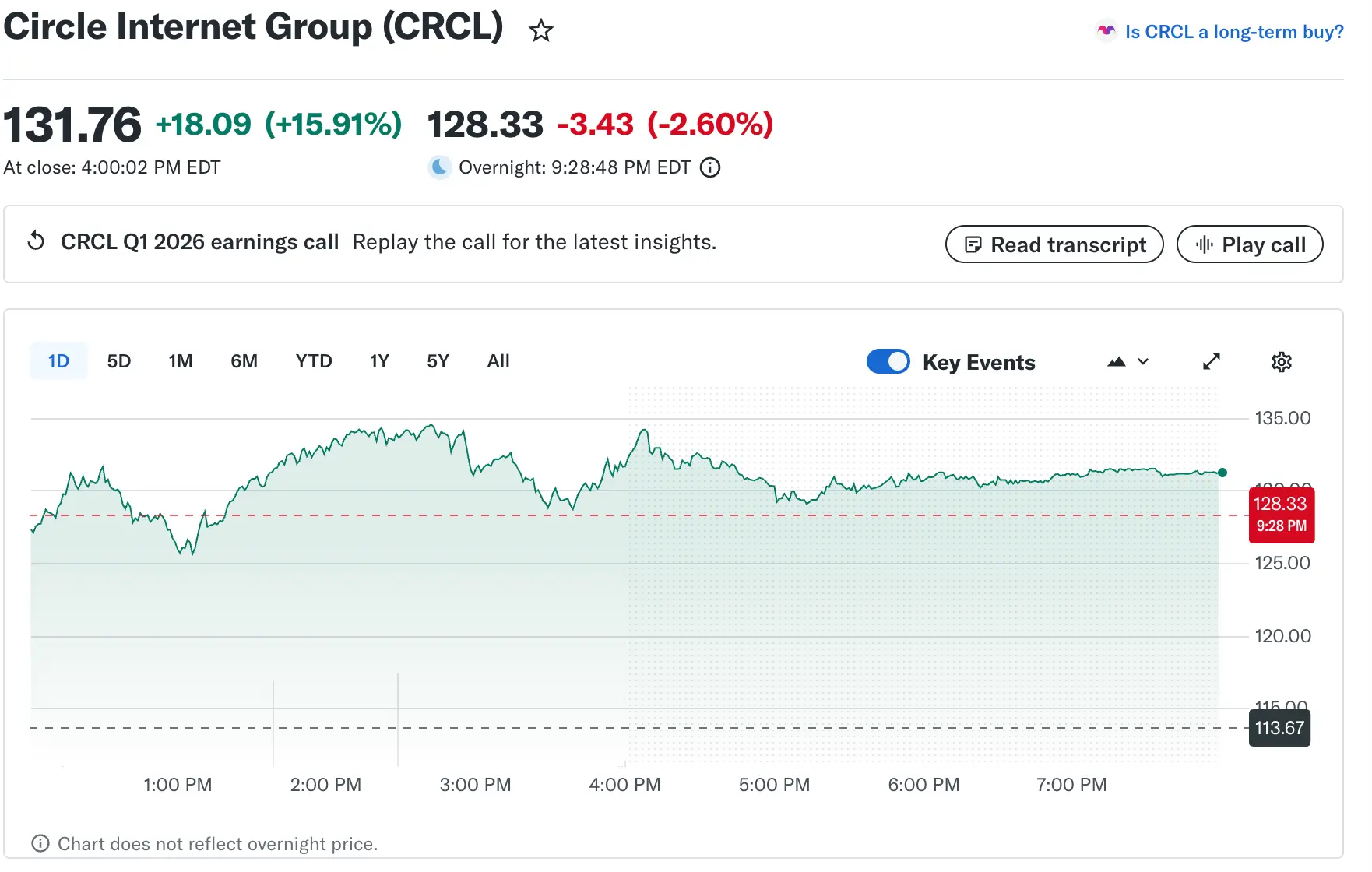
Circle released its first-quarter earnings for 2026 before the market opened yesterday, posting double-digit year-over-year revenue growth and simultaneously disclosing that its new public chain Arc's native token completed a pre-sale of $222 million at a $3 billion valuation. Although net profit declined 15% year-over-year due to increased stock-based compensation and operational investments, market focus remained centered on the long-term narrative of Arc and AI agent payments. CRCL's stock price surged nearly 16% that day, closing at $131.76, hitting a new high since mid-March.
USDC Scale Hits New Record, On-chain Transaction Volume Up 263% YoY

Circle's first-quarter total revenue and reserve income reached $694 million, a 20% increase year-over-year. Breakdown:

  • Reserve Income: $653 million, up 17% YoY, primarily benefiting from a 39% YoY increase in average USDC circulation, partially offset by a 66 basis point decrease in reserve yield (down to 3.5%).

  • Other Revenue: $42 million, roughly doubling YoY, reflecting strong growth in subscription, service, and transaction revenues.

  • Net Income from Continuing Operations: $55 million, down 15% YoY, mainly due to stock-based compensation and related payroll taxes post-IPO, as well as increased investment in products, distribution, and operational infrastructure.

  • Adjusted EBITDA: $151 million, up 24% YoY; Adjusted EBITDA margin was 53%.

Notably, both revenue and net income fell short of Wall Street analysts' expectations prior to the earnings release. According to Bloomberg, sell-side analysts had forecast revenue around $720.8 million and a reserve yield of 3.56%, neither of which were met. However, the adjusted EBITDA of $151 million exceeded the market expectation of $137.9 million, providing some support. This also indicates that the interest rate environment will be one of the most critical external variables for Circle moving forward.

On the operational front, USDC circulation reached $77 billion, up 28% YoY. First-quarter USDC on-chain transaction volume reached $21.5 trillion, a 263% YoY increase, reflecting a significant rise in stablecoin usage density as a payment and settlement medium.

According to Visa Onchain Analytics data, USDC accounted for 63% of stablecoin transaction volume in Q1. Meanwhile, Circle's USYC has become the world's largest tokenized money market fund as of May 7. Other key operational metrics include a USDC "platform retention" balance of $13.7 billion at quarter-end, up 254% YoY; 7.2 million "active wallets" holding over $10 in USDC, up 47% YoY; and a stablecoin market share of 28%, down 62 basis points YoY, directly reflecting competitive pressure from Tether and other rivals.

Public Chain Arc Completes $222 Million Token Financing with Star-Studded Investor Lineup

Circle also announced that the native token ARC for Arc, its institutionally-focused Layer 1 public chain, has completed a $222 million pre-sale, with a fully diluted network valuation of $3 billion. According to crypto asset data platform RootData, the financing was led by a16z with a $75 million investment. Other participating investors include BlackRock, Apollo Funds, Intercontinental Exchange (ICE), Standard Chartered Ventures, ARK Invest, Bullish, and over ten other institutions.
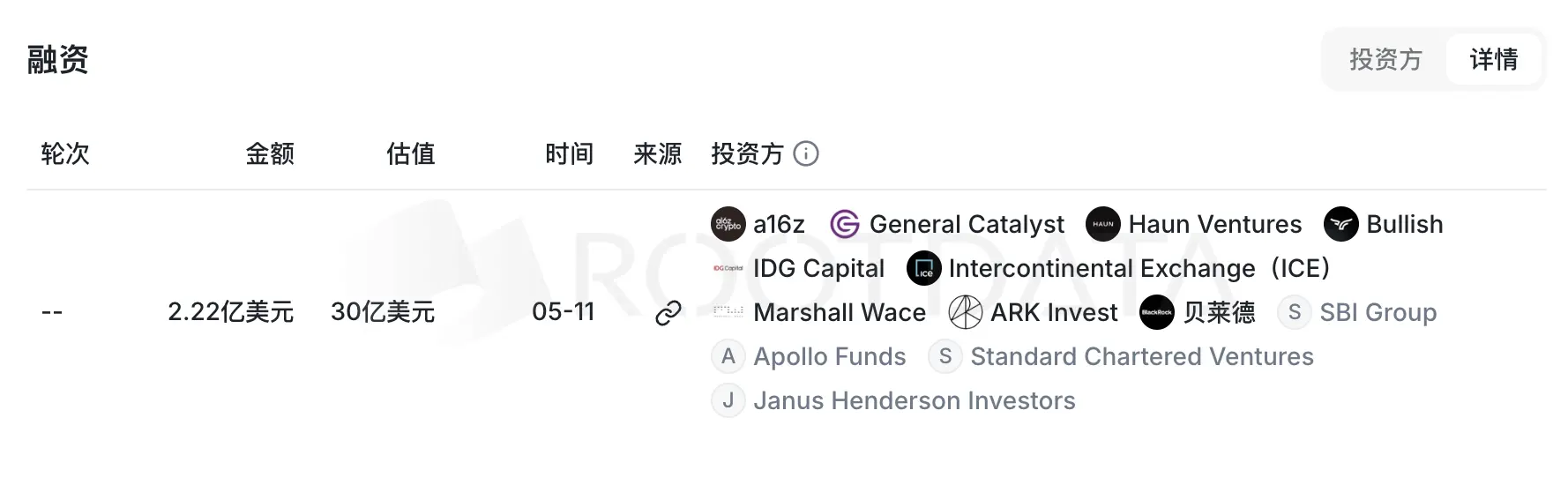
Circle CEO Jeremy Allaire stated that the company is transitioning from a stablecoin issuer to a broader internet platform company, entering the operating system and application business. Regarding token distribution, Circle holds 25% of the initial 10 billion token supply, 60% is allocated to network builders and participants, and 15% is reserved as long-term reserves.

Notably, Circle stated that this financial forecast does not incorporate the financial impact of the ARC token pre-sale, Arc incentive programs, or future Arc-related revenues.

Reaffirms Previously Announced Full-Year Guidance, No Adjustments

Additionally, Circle simultaneously launched a series of "Agent Stack" products, including Circle CLI (Command Line Tool), Agent Wallets, and Agent Marketplace, enabling developers and merchants to create, fund, and monetize AI agent-driven activities using USDC across multiple public chains and payment protocols.

The earnings report also revealed that, in terms of payment business, the Circle Payments Network (CPN) processed an annualized transaction volume of $8.3 billion as of March 31, based on the past 30 days of activity. Managed Payments, launched in April, allows financial institutions to offer stablecoin payment services without managing digital assets themselves.

New enterprise use cases for USDC include: Kyriba embedding USDC into its corporate treasury system, and Polymarket expanding its use of USDC as a core collateral and settlement asset.

Finally, regarding the outlook for the full year 2026, Circle chose to reiterate its previously announced performance guidance without any upward or downward revisions. Specifically, USDC circulation is still expected to maintain a 40% compound annual growth rate (CAGR) over multi-year cycles. FY2026 other revenue is projected between $150 million and $170 million; RLDC margin is expected between 38% and 40%; and adjusted operating expenses are forecast at $570 million to $585 million.

Similarly, this set of guidance does not incorporate the financial impact of the ARC token pre-sale, Arc incentive programs, or future Arc-related revenues, meaning there is room for upward revision once the Arc ecosystem successfully launches.

Majority of Wall Street Analysts Issue Bullish Ratings

Following the earnings release, CRCL surged approximately 16% that day, closing at $131.76, reaching its highest level since March 18. The stock has gained 66% year-to-date, with market capitalization rebounding to around $35 billion.

Wall Street analysts are generally optimistic about Circle's stock price performance over the next 12 months and beyond. According to TipRanks statistics, the consensus target price is $138.50. Among them, Peter Christiansen of Citi gave a 12-month target of $243, while Gautam Chhugani of Bernstein set a target of $190. Along with ten other analysts, all issued "Buy" ratings.

However, analysts still retain some reservations about short-term execution risks. Clear Street analyst Owen Lau pointed out that while the narratives of Arc and Agent Stack are eye-catching, they are "not yet a material business." John Todaro of Needham & Co. noted that recent DeFi protocol hacks could indirectly affect USDC use cases: "If capital leaves DeFi, how does that impact Circle's business?" Andrew Jeffrey of William Blair believes that CRCL stock price volatility will remain high in the short term, but Circle holds a significant advantage in "stablecoin commerce" with multiple catalysts progressing simultaneously.

It can be seen that Circle's earnings report presents a dual structure: the stablecoin business is still scaling rapidly, but unit economics are being compressed by interest rates and distribution costs. The market's willingness to award a 16% single-day gain is more of a bet that the Arc public chain, ARC tokenomics, and AI agent payments can reposition Circle from a stablecoin issuer to a "network financial operating system" in the medium to long term, opening up second and third growth curves beyond the existing USDC spread model.

Perhaps the market's focus going forward will be on the Arc mainnet launch timeline, market acceptance of the ARC token after public circulation, and the impact of subsequent U.S. GENIUS Act and Clarity Act implementations on the overall stablecoin competitive landscape.


Câu hỏi Liên quan

QWhat was Circle's stock price performance after the release of its Q1 2026 earnings report?

AFollowing the release of its Q1 2026 earnings report, Circle's stock (CRCL) rose nearly 16% on the day, closing at $131.76, which was a new high since mid-March.

QWhat major development did Circle announce alongside its earnings?

AAlongside its earnings, Circle announced that the native token ARC of its new institutional finance-focused Layer 1 blockchain, Arc, completed a pre-sale of $222 million at a fully diluted network valuation of $30 billion.

QWhat were the key financial results for Circle in Q1 2026?

AIn Q1 2026, Circle's total revenue and reserve income was $694 million, a 20% year-over-year increase. However, net income from continuing operations was $55 million, down 15% YoY. Adjusted EBITDA was $151 million, a 24% YoY increase.

QWho led the funding round for the ARC token?

AThe funding round for the ARC token was led by the venture capital firm Andreessen Horowitz (a16z), which invested $75 million.

QAccording to the article, what is the main transformation that Circle's CEO Jeremy Allaire described for the company?

ACircle's CEO Jeremy Allaire stated that the company is transforming from a stablecoin issuer into a broader internet platform company, entering the operating system and application businesses.

Nội dung Liên quan

Giải phóng 100 triệu USD thanh khoản? Chính sách mới của Pump.fun thử nghiệm chiến thuật bơm giá trong 5 phút

Bài viết thảo luận về cơ chế BOOST mới được Pump.fun công bố vào ngày 21/7, trở thành cơ chế phát hành mặc định cho các token mới. Cơ chế này nhắm giải quyết vấn đề "thanh khoản chết" - khoảng 20% vốn bị khóa vĩnh viễn trong nhóm thanh khoản (LP) sau khi token di chuyển từ bonding curve, gây lãng phí ước tính hơn 100 triệu USD mỗi năm. Thay vì khóa số vốn này, BOOST sẽ dùng nó (khoảng 17,6 SOL hoặc 2516 USDC) để mua token ngay trong 5 phút đầu sau khi di chuyển lên PumpSwap, thông qua cơ chế TWAP, và ngay lập tức đốt số token mua được. Điều này tạo áp lực mua tức thời và giảm nguồn cung vĩnh viễn. Mục tiêu của Pump.fun là tạo ra "pháo hoa" trong 5 phút đầu, kích thích giao dịch và cải thiện trải nghiệm cho nhà giao dịch meme - đối tượng thường quan tâm đến đợt "bứt phá" ngay khi token ra mắt. Cách tiếp cận này nhằm tăng tỷ lệ token tạo ra khối lượng giao dịch bền vững, từ đó củng cố doanh thu nền tảng và tính bền vững của việc mua lại token PUMP. Tuy nhiên, bài viết cũng nêu lo ngại: cơ chế có thể khiến các token chất lượng thấp dễ thành công hơn về mặt hình thức và làm tăng rủi ro sau 5 phút, khi áp lực mua biến mất và token có thể lao dốc nhanh hơn nếu gặp bán tháo.

Foresight News11 phút trước

Giải phóng 100 triệu USD thanh khoản? Chính sách mới của Pump.fun thử nghiệm chiến thuật bơm giá trong 5 phút

Foresight News11 phút trước

Đơn vị quản lý tài sản lớn nhất Ấn Độ SBI lên sàn, số liệu giao dịch hé lộ tín hiệu gì?

SBI Funds Management, công ty quản lý quỹ lớn nhất Ấn Độ, đã niêm yết vào ngày 21/7. Đợt IPO trị giá khoảng 10,3 tỷ USD được định giá kỷ lục gấp 42 lần, cho thấy nhu cầu mạnh mẽ từ các nhà đầu tư tổ chức và bán lẻ đối với tài sản tài chính cốt lõi. Tuy nhiên, giá đóng cửa ngày đầu tiên chỉ tăng khoảng 6,3%, thấp hơn nhiều so với kỳ vọng chênh lệch 16% trên thị trường chợ đen, cho thấy vốn sẵn sàng nhưng không chấp nhận trả giá quá cao. Sự thành công thận trọng của SBI đặt ra một cột mốc định giá mới cho thị trường IPO Ấn Độ: cửa sổ IPO vẫn mở, nhưng ưu tiên cho các công ty có thương hiệu mạnh, dòng tiền ổn định và câu chuyện tăng trưởng thâm nhập dài hạn rõ ràng. Một tín hiệu đáng chú ý khác là phí bảo lãnh phát hành cực thấp (khoảng 0,01%), khiến một số ngân hàng quốc tế rút lui. Điều này phản ánh quyền định giá đang nghiêng về phía các tổ chức phát hành mạnh như SBI, những người có thể dựa vào kênh phân phối nội địa và thương hiệu, làm giảm giá trị cận biên mà các ngân hàng đầu tư quốc tế mang lại. Tăng trưởng ổn định của ngành quản lý quỹ Ấn Độ (dự báo CAGR 16-18%) hỗ trợ định giá, nhưng thị trường vẫn cân nhắc các yếu tố chu kỳ. Bài kiểm tra thực sự cho cửa sổ IPO sẽ là các đợt chào bán lớn tiếp theo như Reliance Jio và Sở giao dịch chứng khoán quốc gia (NSE). Thành công của họ ở mức định giá hợp lý sẽ khẳng định xu hướng mới; nếu bị trì hoãn, SBI sẽ chỉ là một thành công đơn lẻ.

marsbit30 phút trước

Đơn vị quản lý tài sản lớn nhất Ấn Độ SBI lên sàn, số liệu giao dịch hé lộ tín hiệu gì?

marsbit30 phút trước

Nhật Bản muốn dùng AI để mua tăng trưởng, thị trường trái phiếu có tin không?

Nội các Nhật Bản đã thông qua "Phương hướng cơ bản về vận hành và cải cách tài chính kinh tế 2026", chuyển trọng tâm mục tiêu tài chính từ cân bằng thu chi ngân sách cơ bản sang ổn định và giảm tỷ lệ nợ/GDP. Động thái này nhằm tạo không gian đầu tư vào các lĩnh vực chiến lược như AI, bán dẫn để thúc đẩy tăng trưởng, giải quyết vấn đề lão hóa và thiếu lao động. Tuy nhiên, thị trường trái phiếu tỏ ra hoài nghi. Việc làm suy yếu "mỏ neo" tài chính truyền thống có thể bị coi là nới lỏng kỷ luật ngân sách. Lợi tức trái phiếu chính phủ Nhật kỳ hạn 10 năm đã tăng, phản ánh lo ngại về tính tín nhiệm tài chính. Kế hoạch đầu tư 370 nghìn tỷ Yên đến năm 2040 không phải là ngân sách mới tập trung chỉ cho AI, mà là tổng đầu tư công-tư vào nhiều lĩnh vực. Thành bại của khung chính sách mới phụ thuộc vào việc liệu tốc độ tăng trưởng kinh tế danh nghĩa có vượt quá lãi suất dài hạn hay không, và liệu các khoản đầu tư chiến lược có thực sự cải thiện năng suất và thu ngân sách. Thị trường sẽ tiếp tục định giá dựa trên khả năng chính phủ chứng minh được hiệu quả đầu tư và con đường giảm nợ bền vững.

marsbit39 phút trước

Nhật Bản muốn dùng AI để mua tăng trưởng, thị trường trái phiếu có tin không?

marsbit39 phút trước

Cổ phiếu A bị tổn thương nhầm: Sự kiên cường, kỳ vọng và bản lĩnh

Cổ phiếu A-shares bị ảnh hưởng bởi các cú sốc ngoại vi vào tháng 7, nhưng đã thể hiện sức chống chịu mạnh mẽ. Các cổ phiếu công nghệ giảm giá chủ yếu do ảnh hưởng từ việc giảm đòn bẩy tại thị trường Hàn Quốc, trong khi cơ bản ngành vẫn vững chắc với lợi nhuận cao, đặc biệt trong lĩnh vực module quang, sợi quang, với cấu trúc đa ngành và hai câu chuyện nội địa hóa cùng chuỗi cung ứng toàn cầu. Lực lượng "đội tuyển quốc gia" đã mạnh mẽ can thiệp để ổn định thị trường, với các khoản mua vào và tái mua cổ phiếu trị giá hàng trăm tỷ từ các tập đoàn nhà nước, công ty bảo hiểm và quỹ. Hành động này không chỉ cung cấp thanh khoản mà còn gửi tín hiệu mạnh mẽ về điểm đáy, tạo hiệu ứng dẫn dắt cho các định chế dài hạn. Động lực phục hồi nội sinh còn đến từ ba nhóm chính: (1) Tiêu dùng, với CPI tăng và dấu hiệu phục hồi trong ngành rượu bia; (2) Chu kỳ, đặc biệt là nhôm, với lợi nhuận cao, kỳ vọng tăng giá và định giá thấp; (3) Tài chính, với tài sản cổ tức ổn định và định giá hấp dẫn. Sự kết hợp của các yếu tố này cùng với nền tảng công nghệ vững chắc cho thấy A-shares có đủ sức chống chịu và khả năng sớm trở lại trạng thái ổn định.

marsbit1 giờ trước

Cổ phiếu A bị tổn thương nhầm: Sự kiên cường, kỳ vọng và bản lĩnh

marsbit1 giờ trước

Máy tính lượng tử chưa tới, 1,1 triệu Bitcoin của Satoshi Nakamoto đã trở thành vấn đề trước

Một công cụ chứng minh không tri thức (Project Eleven) có thể giúp ví Bitcoin hiện đại di chuyển tài sản trước các cuộc tấn công lượng tử trong vòng 243 mili giây. Tuy nhiên, khoảng 1,1 triệu BTC được Satoshi Nakamoto khai thác trước năm 2012 (nằm trong khoảng 22.000 địa chỉ P2PK cũ) không thể được cứu bằng công cụ này vì thiếu đường dẫn khóa phân cấp (HD wallet), tạo ra một ngõ cụt mật mã. Vấn đề này đã đẩy cộng đồng Bitcoin vào một cuộc khủng hoảng chính trị hơn là kỹ thuật. Có bốn giải pháp được tranh luận, mỗi giải pháp đều có rủi ro lớn: 1) Bất động, để tiền bị đánh cắp; 2) Đóng băng cưỡng chế các địa chỉ dễ bị tổn thương; 3) Giới hạn dòng tiền rút từ địa chỉ cũ; 4) Phân phối lại tài sản "không chủ". Tất cả đều đe dọa các nguyên tắc cốt lõi của Bitcoin như quyền sở hữu, tính bất biến của sổ cái hay tính lưu trữ giá trị. Thị trường đã bắt đầu định giá rủi ro quản trị này. Một số tổ chức như Jefferies đã giảm nắm giữ Bitcoin do lo ngại về sự không chắc chắn trong việc xử lý các đồng tiền dễ bị tổn thương. Cuộc khủng hoảng niềm tin đã xuất hiện ngay cả trước khi máy tính lượng tử thực tế ra đời, đặt ra câu hỏi cấp bách: Làm thế nào Bitcoin có thể giải quyết gánh nặng của một sự đứt gãy công nghệ lịch sử mà không phá vỡ chính các nguyên tắc sáng lập của nó?

marsbit1 giờ trước

Máy tính lượng tử chưa tới, 1,1 triệu Bitcoin của Satoshi Nakamoto đã trở thành vấn đề trước

marsbit1 giờ trước

Giao dịch

Giao ngay
活动图片




