Original Author: Sleepy.txt, Insight Beating
In 2017, Heyi Capital first invested in Pop Mart and continued to invest in the following years. In December 2020, Pop Mart went public in Hong Kong, with its market value exceeding 100 billion Hong Kong dollars on the first day. Heyi Capital achieved a return of over 100 times on the books, becoming a classic case in China's consumer investment field.
In 2010, Sequoia Capital China invested in Meituan. After multiple rounds of follow-up investments, it eventually obtained a return of over 100 times when Meituan went public. This investment made Sequoia China one of the most successful institutions in the history of Chinese internet investment.
In the world of venture capital, a 10x return is excellent, and a 100x return is legendary.
However, in Europe, a venture capital firm achieved a return of nearly 1400 times on an investment.
This institution is called Balderton Capital. In 2015, they led the seed round of "European Alipay" Revolut, investing 1 million pounds. Over the next 10 years, they continued to follow up with multiple rounds of investment, with a total investment of about 3 million pounds.
In 11 years, Revolut grew from a grassroots project rejected by Y Combinator to a financial technology giant with a valuation of 75 billion US dollars, known as the most valuable financial technology company in Europe. Today, Revolut has over 65 million users worldwide, with annual revenue exceeding 4 billion US dollars, annual profit exceeding 1 billion US dollars, and processes tens of billions of dollars in transactions every day.
In 2025, Balderton Capital cashed out about 2 billion US dollars by continuously selling part of its shares in Revolut. The remaining shares in their hands, calculated according to the latest valuation, are still worth more than 4 billion US dollars. This means that Balderton's total return on Revolut exceeds 6 billion US dollars, nearly 1400 times its investment.
What is even more shocking is that the fund that holds Revolut's shares - Balderton Capital Fund V, established in 2014, had a total fundraising scale of only 305 million US dollars. In 2025, this fund has returned over 20 times the return to investors by selling part of Revolut's shares. This means that even if all other projects invested by this fund return to zero, its return multiple still far exceeds the industry's top fund average of 3~5 times.
This story tells the essence of venture capital. In a business world where certainty has long disappeared, how should we face uncertainty? When everyone sees risks, where are the opportunities hidden?
Two Different Worlds
The starting point of this story is the meeting of two completely different people in early 2015.
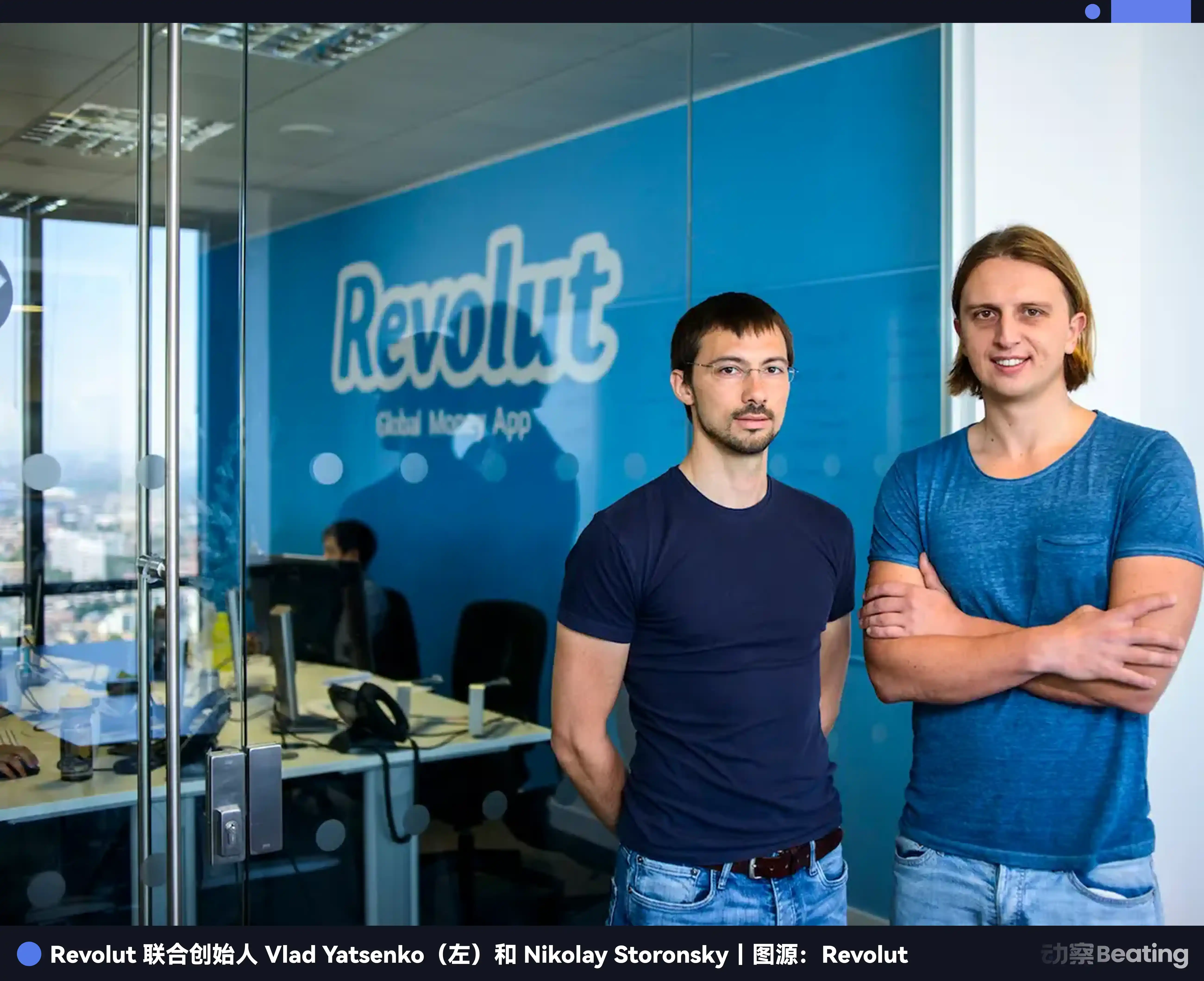
The first person is Nikolay Storonsky, a Russian who is restless to the bone. His father is a senior executive of Gazprom, and his family is well-off. He holds dual master's degrees in physics from the Moscow Institute of Physics and Technology and economics from the New Economic School. He is also a sports fanatic, having been a national swimming champion, and is passionate about boxing and surfing.
In 2006, he came to London and became a derivatives trader at Lehman Brothers, dealing with transactions worth billions of dollars every day. In 2008, after Lehman Brothers collapsed, he moved to Credit Suisse. During frequent global business trips, he spent thousands of dollars on foreign exchange losses every year. He found this unreasonable and unfair.
So, he found Vlad Yatsenko, a software engineer who had worked at Credit Suisse and Deutsche Bank for 10 years, and decided to solve this problem himself.
In 2014, they founded Revolut at the Level39 incubator in London's Canary Wharf. Storonsky took out all his savings, 300,000 pounds, and bet on his future.
The second person who was about to meet him, Tim Bunting, came from another world.
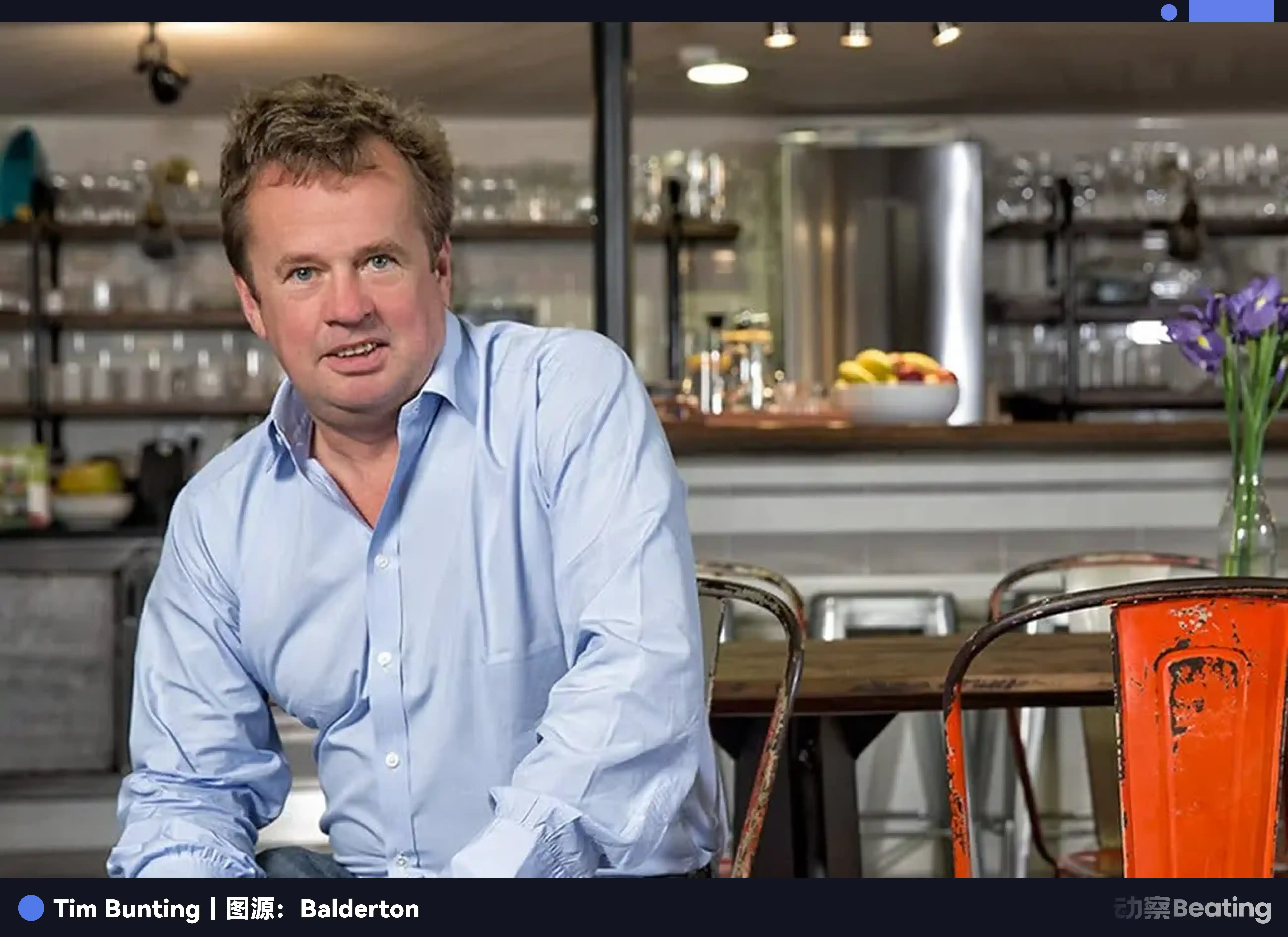
In 2007, 43-year-old Bunting decided to leave Goldman Sachs.
He worked at Goldman Sachs for 18 years, eventually becoming the global head of equity capital markets and international vice chairman, and was one of Goldman's partners. He stood at the top of the world of certainty, where every transaction had precise models, every decision was supported by massive data, risks were quantified, and the future was predicted.
But he chose to leave and jump into a completely different world - venture capital.
He joined Balderton Capital. The essence of venture capital is to find possibilities in uncertainty. There are no perfect models here, only vague vision and judgment of people.
When they met in February 2015, Revolut's situation was very bleak. Their product demo could not run properly at that time, and they had just been rejected by Silicon Valley's most famous incubator, Y Combinator. In any normal investment decision process, this would be a project that would be immediately rejected.
But Bunting saw something different.
He later recalled that he saw in Storonsky's eyes an ambition and momentum to overturn the entire European banking industry. At the same time, he saw steadiness and reliability in the technical partner Yatsenko. One understands finance, one understands technology, one has drive, one has determination - this is the perfect combination of founders.
When everyone sees risks, great investors can see opportunities. Consensus often only brings mediocre returns; only non-consensus can bring excess returns.
In July 2015, Balderton officially led Revolut's seed round, investing 1 million pounds, with a post-investment valuation of 6.7 million pounds.
However, is having excellent founders and brave investors enough? Is there a greater force behind a 1400x return miracle?
Timing, Location, and People
Behind Revolut's success are timing, location, and people.
First, the aftershocks of the 2008 financial crisis, which almost destroyed public trust in traditional banks.
According to a Eurobarometer survey, after the crisis, European public trust in banks fell to a historical low. The banks themselves were also deeply mired, with profitability plummeting. Data shows that the average return on equity (ROE) of the European banking industry fell from about 11% before the crisis to 4%-5% around 2015, far lower than that of American counterparts.
To survive, banks began large-scale layoffs. From 2012 to 2015, European banks closed over 10,000 branches and laid off tens of thousands of employees. This led to a sharp decline in bank service quality,糟糕透顶的客户体验, leaving a huge market vacuum for new challengers.
At the same time, the wave of technology was reshaping the market. In 2015, the penetration rate of smartphones in Europe began to increase significantly, and the adoption rate of mobile banking also grew rapidly. The shift of financial services from offline branches to mobile apps became an irreversible trend.
The regulatory east wind also came at the right time. At the end of 2015, the European Union passed the second Payment Services Directive (PSD2). The core of this bill is "open banking." It broke the bank's monopoly on customer data, allowing third-party financial technology companies to access their bank account data with user authorization to provide innovative financial services. This paved the way for the development of the entire financial technology industry.
A new generation of consumers was also growing up rapidly. As digital natives, they strongly dislike the cumbersome processes and poor experience of traditional banks. A 2015 survey showed that 80% of consumers under 45 believed that they should be able to complete any financial business through a mobile app.
The fragmented nature of the European market itself also became a booster for Revolut. Europe consists of dozens of countries, languages, and currencies. The inconvenience and high cost of cross-border transactions have always been a huge pain point.
It was against this background that around 2015, gunshots were fired simultaneously on Europe's financial technology track. Germany's N26, Britain's Monzo and Starling, and cross-border remittance-focused TransferWise (now Wise) emerged almost at the same time. They each occupied a山头, with N26 focusing on design and Monzo emphasizing social features. The industry consensus at the time was: conquer one market or one product category at a time.
But Revolut was an outlier from the beginning.
Its core insight was that banking could be built like a global software product, full-stack and borderless from day one. While competitors were still carefully cultivating a certain experimental field, Revolut was already expanding globally. This bold strategy, which was highly controversial at the time, eventually allowed it to leave all opponents behind.
However, from a grand vision to a great company, there is a journey of near-death experiences. Revolut was not一帆风顺.
Sprinting Amid Controversy
One of Revolut's company values is "Never Settle." This value is deeply ingrained in the company's DNA, driving it to sprint amid controversy over the past 11 years.
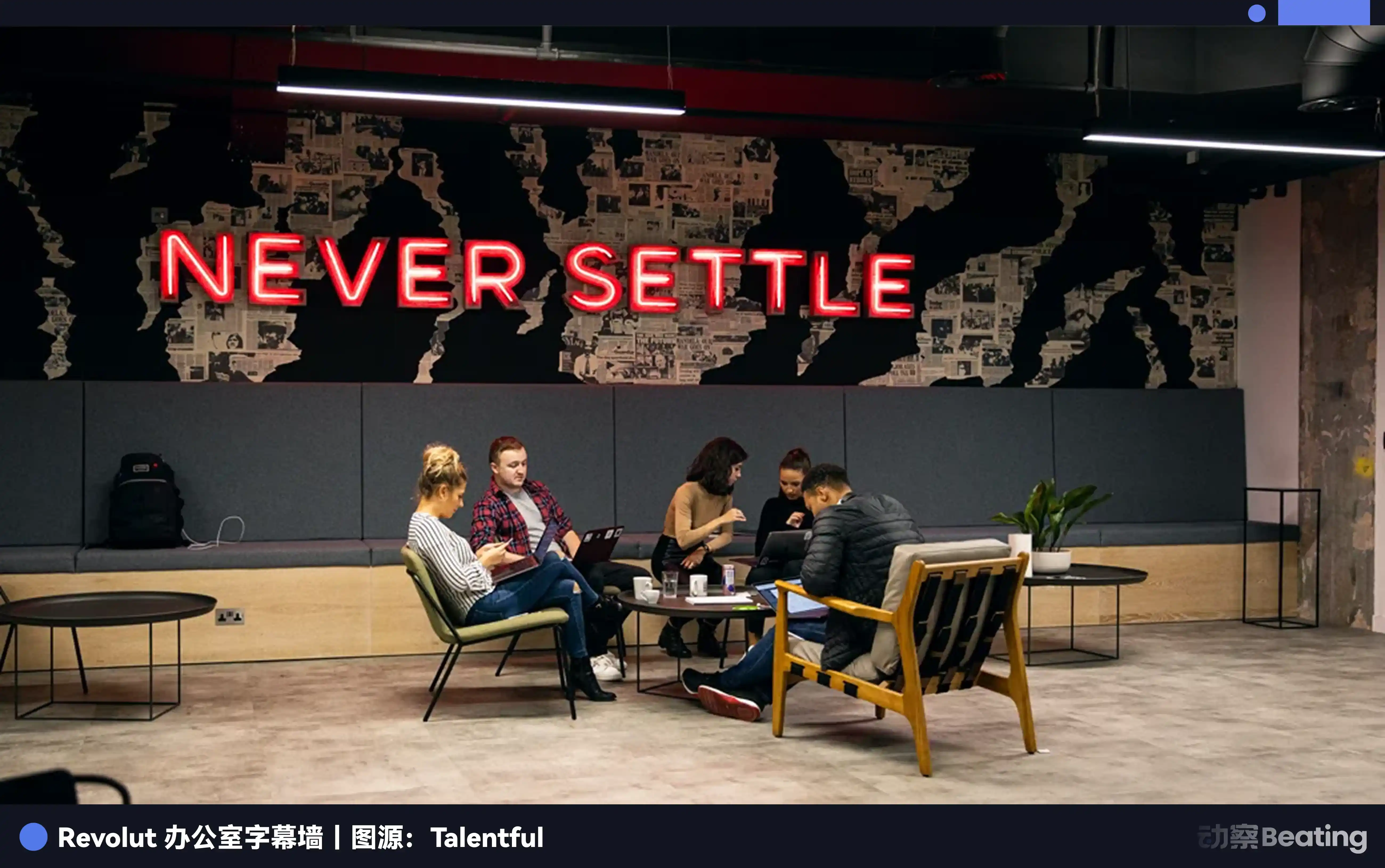
This never-settling attitude is first reflected in the speed of product expansion.
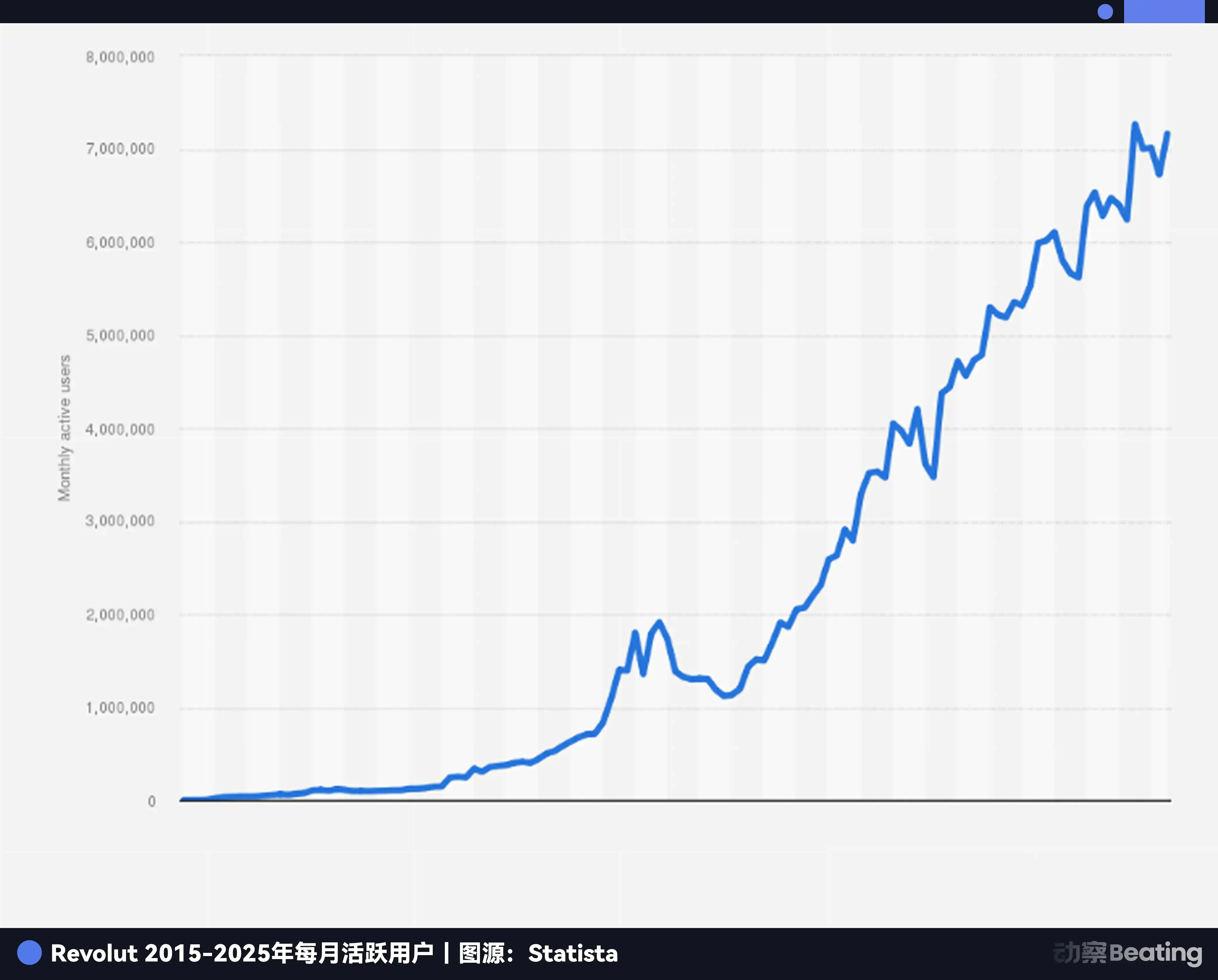
In July 2015, Revolut officially launched its product, processing over 500 million US dollars in transactions in its first year. By the end of 2016, the number of users exceeded 300,000, processing nearly 1 billion pounds in transaction volume. In November 2017, Revolut announced that the number of users had exceeded 1 million, reaching this milestone in just over two years.
Storonsky's creed is "Releasing and iterating faster gives you more chances to win." After launching the core product, the low-fee foreign exchange card, Revolut quickly launched many new features: cryptocurrency trading in 2017, followed by stock trading, savings vaults, budgeting tools, insurance, P2P payments, business accounts... It built itself into an all-encompassing financial super app, while its competitors were still carefully guarding their own acre of land.
This aggressive expansion strategy brought astonishing growth. In 2017, Revolut's user base grew 3 times, and revenue increased nearly 5 times. In 2018, the number of users grew from 1.5 million to 3.5 million, and revenue grew by 354%. By April 2018, Revolut completed a Series C financing of 250 million US dollars, with a post-investment valuation of 1.7 billion US dollars, officially becoming a unicorn.
The reason why Revolut can quickly launch new features is that they adopt a VC-like product strategy internally.
They are not superstitious about elite "top-level design." Internally, there are usually many new products and new features being tested simultaneously. But only a small part of them can eventually "graduate" and become real business lines. Those that don't work are cut off, and those that are successfully verified receive加倍 resource investment from the company.
None of Revolut's core revenue products today come from top-level strategic planning; they all grow from this internal horse racing and trial-and-error culture.
But this also comes at a huge cost. In these 11 years, Revolut has experienced at least three life-and-death tests.
The first test came from trust.
In 2016, the company needed more funds for expansion, but traditional financing channels were not smooth. Storonsky proposed a bold idea: raising funds from the public through the crowdfunding platform Crowdcube. This was a very unconventional move at the time, and many investors opposed it.
But Balderton overruled the objections and supported this decision. They believed that this could not only solve the funding problem but also be an excellent marketing opportunity to test the public's trust in Revolut. In the end, 433 ordinary people participated in this crowdfunding, with an average investment of about 2152 pounds per person. They believed in Revolut's vision and voted for this startup with real money.
Now, these early supporters have also received amazing returns. The price of an iPhone back then, after 10 years, became the down payment for a house in the suburbs of London. The initial investment of 2152 pounds is now worth more than 380,000 pounds, a return of over 170 times.
The second test came from culture.
In February 2019, the British magazine Wired published a重磅 report, exposing serious problems in Revolut's corporate culture. The report accused the company of doing whatever it takes for growth,疯狂压榨员工, leading to a very high employee turnover rate. For a time, the company fell into a huge public opinion crisis.
At this time, Revolut was in a period of rapid growth. In 2019, the number of company users exceeded 10 million, and it began to expand to Australia and Singapore. But the outbreak of this crisis severely damaged the company's reputation.
As a board member, Bunting immediately had an in-depth communication with Storonsky. He shared his experience of managing a team of thousands of people at Goldman Sachs, helping Storonsky realize that when a company develops to a certain stage, it must establish a more mature and humane management system. With the help of Balderton, Revolut introduced more experienced managers and began to systematically improve the corporate culture.
The third test came from compliance.
Starting in 2021, Revolut applied for a UK banking license from the Financial Conduct Authority (FCA), but it was not approved for three full years. Regulatory agencies raised serious questions about its anti-money laundering system and corporate governance. This was a fatal blow for a financial technology company.
While waiting for the UK license, Revolut did not stop expanding. In 2020, the company completed a Series D financing of 580 million US dollars, the number of users reached 14.5 million, and it entered the US and Japanese markets. In 2021, the company completed another Series E financing of 800 million US dollars, with a valuation of 33 billion US dollars. By 2022, the number of users had grown to 26 million.
At the critical moment, Bunting used his industry network again. He personally invited Martin Gilbert, the chairman of Aberdeen Standard Investments and a titan of the UK investment industry, to serve as chairman of Revolut. This move greatly enhanced the regulatory agency's trust in Revolut. In July 2024, Revolut finally obtained the precious UK banking license.
While obtaining the UK license, Revolut also delivered a dazzling report card. In 2024, the number of company users exceeded 50 million, annual revenue reached 4 billion US dollars, a growth of 72%, annual profit exceeded 1 billion US dollars for the first time, and the total customer transaction volume processed exceeded 1 trillion US dollars. The company became the highest-downloaded financial application in 19 countries.
During these 11 years of风雨兼程, Balderton Capital始终坚定地 stood behind Revolut. Bunting has been a board member of Revolut all along, providing indispensable support at every key node of Revolut's development and continuously following up with investments in subsequent rounds of financing.
European VC's "American Dream"
Revolut's deified battle brought Balderton, which had long been behind the scenes, completely into the spotlight. The underlying logic of this London VC capturing miracles did not stem from偶然的运气, but from the blood of Silicon Valley's豪门 Benchmark Capital flowing in its veins.
In 1999, Benchmark's partners decided to set up a European branch in London, Benchmark Capital Europe. They brought not only funds but also a unique organizational structure - Equal Partnership.
In traditional VC funds, there are usually a few General Partners who hold the vast majority of power and收益, while other partners are in relatively次要的地位. This pyramid structure can easily lead to internal competition and conflict of interest.
The equal partnership system is completely different. At Balderton, all partners equally own the company, have equal say in any decision, and enjoy the same economic returns, regardless of who found or led the deal. This system ensures that the interests of all partners are highly aligned, allowing them to work together like a pack of wolves.
The advantages of this system were fully demonstrated in the process of investing in Revolut.
First, better due diligence. When Bunting first met Storonsky, although he knew the financial market inside out, he did not fully understand the technical implementation behind it. So, he immediately brought in partner Suranga Chandratillake, who has an engineering background, to evaluate together. There was no worry about抢功劳 among partners, only a common goal, which was to invest in the best companies.
Second, because the interests of all partners are completely tied, they can truly make the most beneficial decisions from the company's perspective. In Revolut's multiple rounds of financing, Balderton provided firm support and never hesitated due to internal interest disputes.
Finally, more comprehensive post-investment support. Startups encounter different problems at different stages. The equal partnership system means that entrepreneurs can随时调用 the resources of the entire partner team.
In 2007, the European team became independent from Benchmark and was officially renamed Balderton Capital, named after the street where their first office was located. The core system of equal partnership was also completely保留了下来 and became the key for Balderton to stand out in the European VC jungle.
However, a good system does not guarantee the success of every investment. In the world of venture capital, what ultimately determines victory or defeat?
Power Law
This law, simply put, is an extreme version of the 80/20 rule.
In the world of venture capital, it means that a small portion of investments will contribute the vast majority of the entire fund's returns. And the vast majority of investments will eventually return to mediocrity or even be lost entirely.
According to PitchBook data, in the venture capital industry, the top 10% of investments contribute 60% to 80% of the industry's total returns. The daily work of VCs is to find that 1% possibility among countless seemingly unreliable projects. They need to cast a wide net, but more importantly, they need to make heavy bets on the very few projects that have the potential to become super winners at critical moments.
In Balderton Capital's 25-year history, it has invested in over 275 companies and has also invested in a number of star companies such as Darktrace, Depop, and GoCardless. Without Revolut, Balderton might still be an excellent European VC, but it would never be the legend it is today.
This also determines that the essence of venture capital is a game of non-consensus. If a project's prospects have become everyone's consensus, then its valuation will inevitably rise, and the future return will be extremely limited. Only those non-consensus projects that are not favored early on and are full of controversy can bring disruptive excess returns.
For venture capital, success is not a matter of命中率, but a matter of return magnitude. It doesn't matter if you invest in nine wrong projects, as long as you hit one that can increase 1000 times, it is enough to achieve success and fame. This sounds like gambling, but top VCs use a rigorous philosophy and discipline to increase the probability of winning the bet.
So, behind this 1400x return miracle, is there a replicable formula?
The Formula for a Thousandfold Return
Excess return = (Non-consensus founder x Structural era opportunity) ^ Patience through cycles
First, the non-consensus founder.
In the world of venture capital, judgment of people is always the first. Especially in the seed stage, when products, markets, and data do not yet exist, the founder is almost the only indicator. A top founder must be a paranoid optimist. He must have unrealistic fantasies about the future and be able to脚踏实地 solve immediate problems.
Second, the structural era opportunity. Revolut's success is inseparable from the unique historical window period in Europe in 2015. The sequelae of the financial crisis, the popularization of mobile Internet, the opening of regulatory policies, and the generational change of consumers. Great companies are all companies of the era. They can敏锐地捕捉到 structural changes and become the pronoun of that change with their products and services.
Finally, and most importantly, is the patience to穿越 cycles. From 2015 to 2026, Revolut experienced cultural crises, regulatory difficulties, and market competition重重考验. In these 11 years, Balderton has always been its firm supporter, not only continuing to follow up with investments but also providing valuable advice and resources at critical moments. This long-term holding, patience to overcome difficulties with the founders, is a necessary condition for achieving excess returns.
In the world of capital, time is the best friend and the worst enemy. Only those investors who can resist short-term temptations and adhere to long-term value can eventually wait for the compound interest of time.
1 million pounds变成 6 billion US dollars is not just a wealth myth, but also a story about cognition, courage, and patience. It tells us that in this rapidly changing era, real opportunities are always reserved for those long-termists who can洞察 the times, embrace change, and are willing to穿越 cycles with great entrepreneurs.
Original link







