Airdrop of $675 Million Sparks Distribution Controversy, Lighter Faces User Retention Post-Token Launch

marsbitXuất bản vào 2025-12-31Cập nhật gần nhất vào 2025-12-31

Tóm tắt

Lighter, a zk-rollup-based perpetual DEX, airdropped $675 million worth of LIT tokens to early users on December 30, sparking mixed reactions. While the airdrop was generous—25% of total supply with no lock-up—some users felt rewards were only on par with fees paid. Tokenomics drew criticism, with 50% allocated to the team and investors (3-year linear unlock), raising concerns over community dilution and sell pressure. Founded by ex-Citadel quant Vladimir Novakovski, Lighter raised $68 million at a $1.5 billion valuation, backed by investors like Founders Fund and Robinhood. Its tech stack features a high-performance CLOB model with custom ZK circuits, enabling 15,000+ TPS, sub-10ms latency, and verifiable trustlessness. Key innovations include zero trading fees for retail users, universal cross-margin support using L1 yield-bearing assets as collateral, and isolated risk pools. However, Lighter faces challenges: an unusually high OI/volume ratio (~0.2) suggests wash trading, and system outages have raised stability concerns. Post-airdrop, retaining organic users and sustaining revenue—currently ~$200k daily—will be critical as it competes in the crowded Perp DEX space.

Author: Jae, PANews

The final airdrop suspense of the year concluded last night (December 30). Perp DEX (decentralized perpetual contract exchange) Lighter announced the completion of its airdrop distribution, granting early participants a total of $675 million, bringing a glimmer of warmth to the chilly market at the end of 2025.

Although the winter market is somewhat bleak, competition in the Perp DEX arena for liquidity and trading experience is intensifying. The industry is witnessing the gradual replacement of early automated market makers (AMMs) by high-performance central limit order books (CLOBs). Lighter, built on zk-rollup, quickly stands out with its zero-fee strategy and customized ZK circuit technical approach, attempting to redefine the standard for on-chain derivatives trading.

Airdrops have always been hard to please everyone, and Lighter undoubtedly faces the same issues encountered by other airdrop projects: dissatisfaction with the airdrop and user retention in the post-airdrop era.

Polarized Reactions to Airdrop, Token Distribution Sparks Controversy

Lighter completed its TGE yesterday, and the protocol token LIT showed significant volatility in its early listing. In pre-market trading on several centralized exchanges, LIT once reached a high of $3.9. After the TGE officially began, the price briefly surged to $7.8 before falling back and stabilizing in the range of $2.6 to $3.

According to Bubblemaps monitoring, the total airdrop amount distributed to early participants on the first day of LIT's listing reached $675 million. Since the airdrop distribution began, approximately $30 million has flowed out of Lighter.

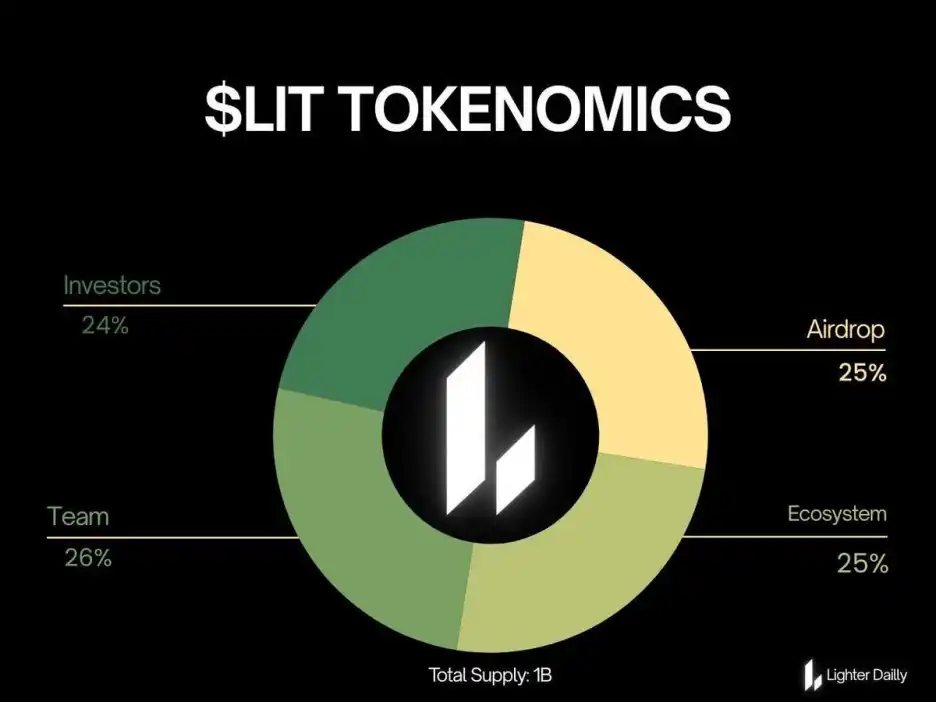
While Lighter's airdrop was relatively generous, community evaluations are polarized. Supporters believe that the initial airdrop accounted for 25% of the total supply, equivalent to approximately $690 million directly distributed to Season 1 and Season 2 points holders, with no lock-up restrictions, contrasting sharply with the lower token allocations at TGE for many other projects; opponents argue that the points conversion rate for Season 1 and Season 2 was about 20 to 28 LIT tokens per point. For some users with higher trading frequency, this is roughly equivalent to the fees they paid, failing to deliver the expected "big win"回报.

The biggest controversy surrounding this TGE lies in Lighter's tokenomics. The total token supply is 1 billion, with 50% allocated to the ecosystem and the other 50% to the team and investors, subject to a 3-year linear unlock. This plan has been criticized by the community as "team-dominated": although investor lock-ups are strict, the overall proportion is too high, potentially diluting community interests. The 25% unlocked airdrop tokens might create short-term selling pressure, while the 50% locked portion could lead to long-term potential selling pressure,不利于 the steady growth of LIT's market capitalization.
From a valuation perspective, Lighter's pricing directly benchmarks Hyperliquid and Aster. Although its trading volume once surpassed these two major rivals, the market still has doubts about the rationality of its valuation.

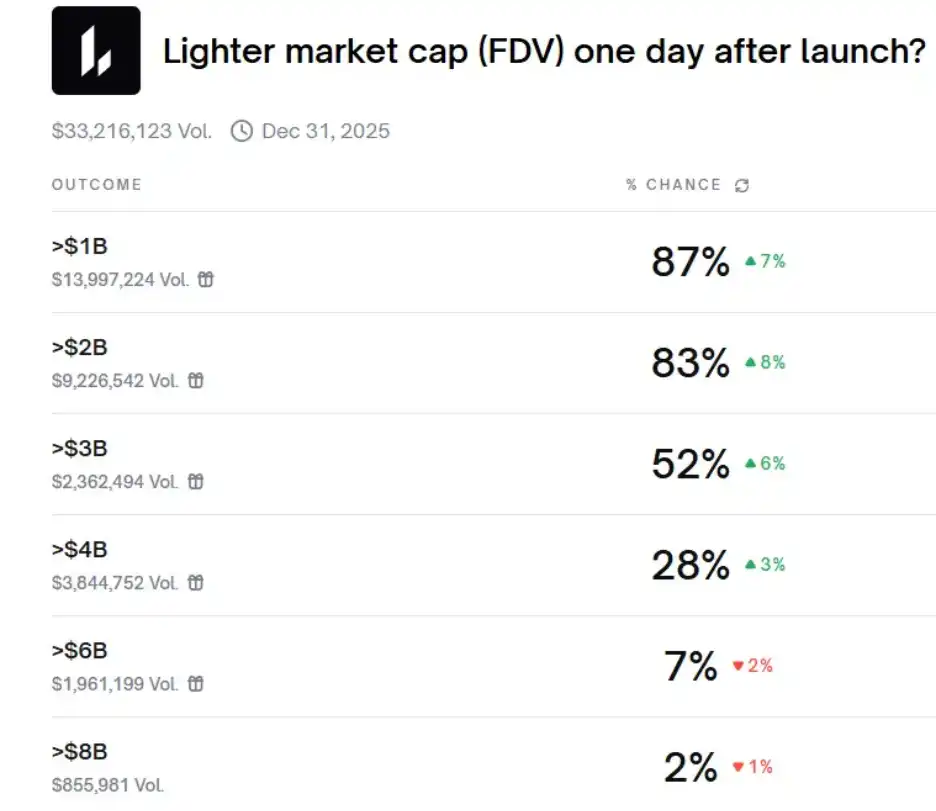
CoinGecko data shows that LIT's current market capitalization is approximately $680 million, with an FDV (fully diluted valuation) exceeding $2.7 billion. A week ago, Polymarket's prediction market showed an 83% probability that "Lighter's market cap will exceed $2 billion the day after listing".

Lighter CEO Vladimir Novakovski stated in a podcast interview: the token won't skyrocket immediately upon listing, realistic expectations are to start from a relatively healthy position. Andy, founder of The Rollup, also tweeted: if LIT's FDV is around $2 billion, he would choose to buy.

Overall, Lighter's TGE performance was largely in line with expectations but lacked surprises. Coupled with the overall market downturn, the community's overall response to the protocol has been muted.
Top-Tier Capital Bets on Harvard Prodigy Building Lighter

Lighter's story begins with its founder, Vladimir Novakovski, a mix of the typical "overachiever next door" and Wall Street elite. He entered Harvard at 16 and graduated early, later personally recruited by Ken Griffin, founder of the global market-making giant Citadel Securities. This experience in a top quantitative fund gave him deep insights into the microstructure of traditional financial markets and the essence of liquidity management.

However, this prodigy's ambition did not stop at Wall Street. He previously successfully founded Lunchclub, an AI social platform valued at over $100 million in Web2. In 2023, he敏锐地捕捉到 the gap in on-chain financial infrastructure, leading 80% of his team members to transition and All in Crypto, fully dedicating themselves to Lighter's development.

"We invested in Lighter, mostly because of Vladimir and his team's engineering capabilities." This statement by Joey Krug, partner at top Wall Street VC Founders Fund, reveals the underlying logic of the capital bet: on extremely complex technical tracks, top talent density is the main moat.

In November 2025, Lighter announced the completion of a $68 million funding round, with a post-money valuation reaching $1.5 billion.
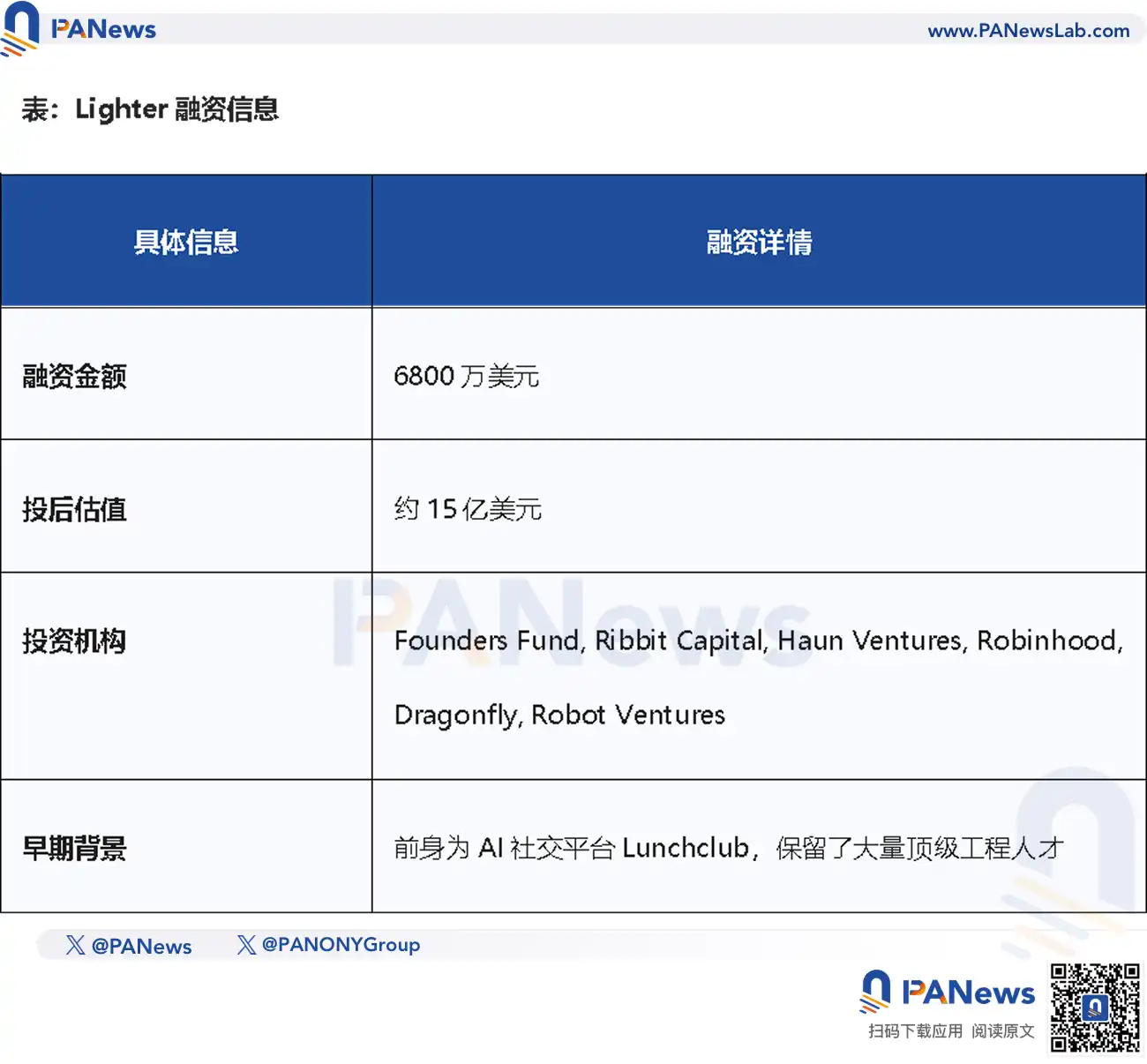
The participation of知名券商 Robinhood in this round perhaps signals an important trend: traditional financial giants are seeking Perp DEX infrastructure capable of truly handling institutional-grade trading volumes. This will not only bring funds to Lighter but also potentially导入 traditional financial institution user bases.

ZK Empowers Lighter to Achieve 15K+ TPS While Ensuring Verifiability

2025 is a watershed year for the Perp DEX赛道. Although early protocols like dYdX and GMX validated the feasibility of on-chain derivatives trading, they始终无法 match CEXs (centralized exchanges) in execution speed, slippage control, oracle latency, and liquidity depth. Lighter, however, achieves sub-second execution and higher capital efficiency by adopting a CLOB model and a high-performance Layer 2 architecture.

The core logic behind this evolution is verification equals trust. Lighter does not require users to trust the matching engine; instead, it uses customized ZK circuits to generate verifiable cryptographic proofs for every order match, every risk check, and every liquidation event. This architecture ensures that even if the sequencer attempts to act maliciously or is attacked, the underlying Ethereum mainnet contract can safeguard assets.

Lighter's technical moat is built on a seemingly contradictory combination: decentralized trust (ZK) and centralized efficiency (CLOB). Its architectural design pursues not only high performance but also transparency and non-custodianship, giving it a strong "Ethereum-native" attribute in its technical narrative.

Unlike many general-purpose ZK virtual machine protocols, Lighter chose a harder path: tailoring ZK circuits (zkLighter) specifically for trading logic. This allows the protocol to generate proofs with extremely high efficiency, achieving throughput of over 15,000 TPS (transactions per second) and soft finality below 10 milliseconds, sufficient to meet the demanding requirements of high-frequency traders.

It is worth mentioning that Lighter's underlying data structure uses a "hyper-tree" architecture to ensure that even under extremely high concurrency, the execution price of every order is the optimal available at that time.

To prevent extreme risks like sequencer offline or denial-of-service, Lighter also designed an "escape hatch" mode. Since all account balances and position data are published as Blob data on Ethereum, users can generate their own account value proofs based on the public data history and directly withdraw funds on the mainnet, without authorization from the sequencer. This mechanism also makes Lighter superior in terms of censorship resistance and asset sovereignty compared to Perp DEX protocols that build their own L1 consensus.

Zero-Fee Model Reshapes Protocol User Acquisition Logic

The reason Lighter has attracted such dense capital and user attention lies not only in its high performance and verifiability but also in its triple innovation in fee structure, capital efficiency, and liquidation logic.

In the context of Perp DEXs普遍 relying on trading fees for profit, Lighter dropped a bombshell on the market: "zero trading fees".

The protocol designed a clever dual-account model to balance商业可持续性.

  • Retail Account (Standard): No maker or taker fees for ordinary users. Although this introduces a slight delay of around 300ms, this cost saving is highly attractive for most non-high-frequency users.

  • Premium Account (Premium): Offers a zero-delay channel for institutions and high-frequency traders but charges very low fees (Maker 0.002%, Taker 0.02%).

Currently, Lighter's revenue mainly comes from premium account fees and liquidation fees, with daily revenue around $200,000,初步验证了其获客模式的可行性.
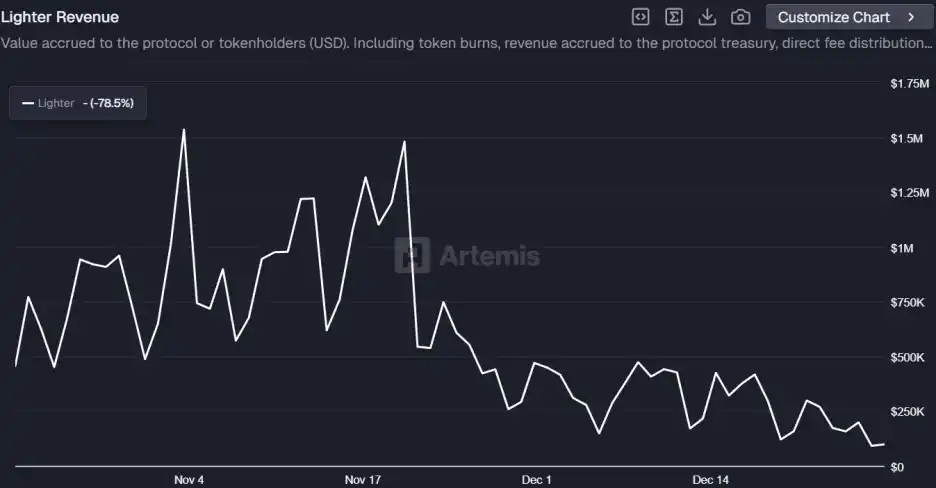
However, possibly due to the market downturn, Lighter's revenue level has declined slightly in the past week. With the airdrop expectation realized, the protocol's true revenue generation capability remains to be observed.

If the zero-fee is the hook for user acquisition, then the Universal Cross Margin (UCM) is the killer feature for retaining professional capital.

Traditional Perp DEXs typically require users to deposit stablecoins like USDC as margin, resulting in lower capital efficiency. Addressing this, Lighter introduced the UCM system, which allows traders to directly use yield-bearing assets stored on Ethereum L1 (such as stETH, LP tokens, or even Aave deposit positions) as collateral for L2 leveraged trading.

The cleverness of this design is that users' collateral assets do not need to be moved cross-chain; instead, they are mapped to L2 via ZK proofs. This means users can earn L1 staking yields while opening positions on L2.

If liquidation occurs, the system generates a cryptographic proof submitted to the L1 contract, automatically deducting the corresponding assets. This model of "assets stay put, credit extends" significantly improves capital efficiency, eliminating the difficult trade-off for users between yield assets and trading capital.

The liquidation mechanism has always been the most dispute-prone环节 in Perp DEXs. Lighter ensures liquidation behavior is fully verifiable through ZK circuits, reducing the probability of platform price manipulation (malicious wicking) or forced liquidation.

Additionally, Lighter has launched risk-tiered liquidity pools:

  • LLP (Lighter Liquidity Provider): This is the main protocol pool, acting as the counterparty and liquidation executor. It not only profits from losing traders but also captures funding rates and liquidation fees. Currently, LLP's annualized yield remains around 30%.
  • XLP (Experimental Liquidity Provider): An isolated pool specifically designed for experimental assets (like pre-listing tokens, RWA, and low-liquidity altcoins). XLP does not participate in forced liquidations, and its risk exposure is isolated from the main protocol, suitable for liquidity providers with higher risk appetite.

OI/Vol Ratio Lingers Around 0.2 Long-Term, Post-Airdrop Data May See Significant "Dehydration"

The rapidly advancing Lighter is not without its shadows.

The protocol's exaggerated OI/Vol (Open Interest/Volume) ratio has sparked widespread market skepticism. Although the ratio has recovered somewhat recently, Lighter maintained a ratio around 0.2 for a long time, meaning that on average, every $1 of open interest was traded back and forth about 5 times within 24 hours. This significantly deviates from a healthy organic holding pattern (OI/Vol < 0.33), showing明显的刷量特征 (obvious wash trading characteristics).
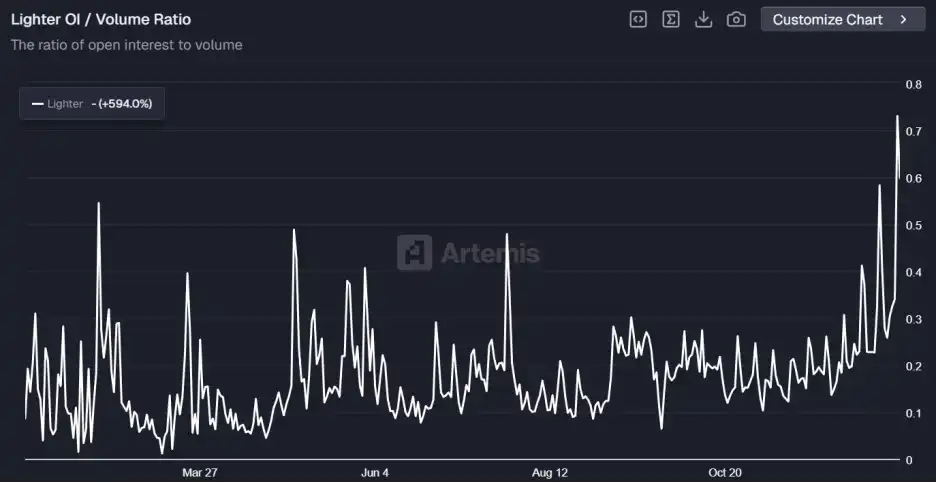
This phenomenon mainly stems from Lighter's aggressive points incentive program. Although the protocol defended against this by making invitation codes scarce and weighting holding duration, the TGE has concluded. The retention or departure of these high-frequency flows will also affect Lighter's true market share.

Frequent outages at Lighter also expose its insufficient system stability. On October 9, the protocol experienced a宕机事故 (downtime incident) lasting 4.5 hours. On December 30, Lighter again encountered issues with prover stagnation preventing users from正常提现 (withdrawing normally). For a derivatives platform handling billions of dollars, stability is the lifeline.

Lighter's emergence represents a new stage in the evolution of Perp DEXs: from decentralization to verifiable high performance. The protocol addresses the trust challenge through Ethereum mainnet security and ZK technology, and enters the Perp DEX battlefield with a zero-fee strategy.

However, competition in the Perp DEX赛道 is no longer just a technical contest but a comprehensive game of liquidity, community ecology, and product quality. Whether Lighter can grow from a technical dark horse into a top player in the赛道 depends on its ability to continuously attract and retain genuine trading demand in the post-airdrop era.


Tiền kỹ thuật số thịnh hành

Câu hỏi Liên quan

QWhat was the total value of the airdrop distributed by Lighter and why did it cause controversy?

ALighter distributed an airdrop with a total value of $675 million. The controversy stemmed from the tokenomics, where 50% of the total supply was allocated to the team and investors with a 3-year linear unlock, which the community criticized as being 'team-dominated'. This structure, combined with a 25% unlocked airdrop, was seen as potentially creating both short-term and long-term selling pressure, diluting community interests.

QWhat is the core technological innovation that enables Lighter to achieve high performance and verifiability?

ALighter's core technological innovation is its use of a customized ZK circuit (zkLighter) on a zk-rollup. This allows the protocol to generate verifiable cryptographic proofs for every order matching, risk check, and liquidation event. This architecture combines the efficiency of a centralized limit order book (CLOB) with the trustlessness of zero-knowledge proofs, enabling high throughput (15,000+ TPS) and sub-second finality while ensuring security backed by the Ethereum mainnet.

QHow does Lighter's 'zero-fee' business model work and what are its two account types?

ALighter employs a dual-account model to offer zero fees while maintaining sustainability. The 'Standard' account offers zero maker and taker fees for retail users but introduces a slight delay (~300ms). The 'Premium' account provides zero-latency trading for institutions and high-frequency traders but charges very low fees (Maker 0.002%, Taker 0.02%). Protocol revenue is generated from these premium fees and liquidation penalties.

QWhat is the Universal Cross-Margin (UCM) system and how does it improve capital efficiency for traders?

AThe Universal Cross-Margin (UCM) system allows traders to use yield-bearing assets stored on Ethereum L1 (such as stETH, LP tokens, or Aave deposit positions) as collateral for leveraged trading on Lighter's L2. The collateral does not need to be moved cross-chain; instead, it is mapped to L2 via ZK proof. This lets users earn yield on their L1 assets while simultaneously using them as margin for trading on L2, significantly improving capital efficiency.

QWhat major operational challenges has Lighter faced, as mentioned in the article?

ALighter has faced two major operational challenges: a high OI/Vol (Open Interest to Volume) ratio, which suggested significant wash trading was occurring to farm airdrop points, and system stability issues. The protocol experienced a 4.5-hour outage in October and another incident on December 30th where the prover stalled, preventing users from withdrawing funds, highlighting concerns about the reliability of its infrastructure.

Nội dung Liên quan

Bên phát hành ETF DRAM: Samsung, SK Hynix, Micron đều vượt ngưỡng nghìn tỷ, thời đại AI của chip nhớ mới chỉ bắt đầu

Bài viết này trình bày quan điểm của Roundhill Investments (đơn vị phát hành DRAM ETF) nhằm phản bác các lo ngại của Morningstar về việc các cổ phiếu chip nhớ (Samsung, SK Hynix, Micron) đang ở trong một bong bóng định giá sau khi vốn hóa thị trường của cả ba đều vượt 1 nghìn tỷ USD. Roundhill lập luận rằng kỷ nguyên AI đã thay đổi cấu trúc cơ bản của ngành bộ nhớ, làm cho các chu kỳ bùng nổ-sụp đổ trong lịch sử không còn phù hợp. Nhu cầu hiện tại chủ yếu đến từ cơ sở hạ tầng AI, với sự phát triển của bộ nhớ băng thông cao (HBM) - một sản phẩm có rào cản sản xuất kỹ thuật cực cao, ngăn cản sự gia nhập của đối thủ mới và tạo ra sự khan hiếm nguồn cung có thể kéo dài đến năm 2030. Các hợp đồng cung cấp dài hạn với các khách hàng lớn hiện nay ràng buộc chặt chẽ hơn. Về cơ bản, dự báo lợi nhuận hợp nhất của ba công ty vào năm 2027 lên tới 704 tỷ USD, đưa họ vào top các công ty sinh lời nhất toàn cầu, với biên lợi nhuận đạt mức kỷ lục. Roundhill kết luận rằng đợt tăng giá hiện tại phản ánh sự định giá lại căn bản dựa trên triển vọng tăng trưởng lợi nhuận mạnh mẽ và bền vững chứ không phải là bong bóng, đánh dấu sự chuyển đổi sang một kỷ nguyên mới cho ngành công nghiệp bán dẫn bộ nhớ.

marsbit11 phút trước

Bên phát hành ETF DRAM: Samsung, SK Hynix, Micron đều vượt ngưỡng nghìn tỷ, thời đại AI của chip nhớ mới chỉ bắt đầu

marsbit11 phút trước

EF Tái cấu trúc ở cấp độ Sử thi: Cắt giảm 20% nhân sự, cắt ngân sách một nửa, Liệu Ethereum sẽ nhẹ gánh tiến bước?

Quỹ Ethereum (EF) vừa công bố cơ cấu tổ chức lại lớn nhất trong những năm gần đây, bao gồm cắt giảm 20% nhân sự (khoảng 54 người) và chia thành các cụm chức năng: giao thức, truy cập, người dùng, cộng đồng và thể chế. Đồng sáng lập Vitalik Buterin tiết lộ thêm: EF sẽ giảm dần quy mô chi tiêu, cắt ngân sách khoảng 40% và dự kiến giảm tỷ lệ chi tiêu hàng năm từ ~15% xuống còn ~5% sau năm 2030, chuyển sang mô hình vận hành dựa vào quỹ tài trợ. Động thái này được xem là sự điều chỉnh vị trí cần thiết trước những tranh cãi kéo dài về hiệu suất ETH, lộ trình mở rộng quy mô và sự rời đi của các thành viên chủ chốt. EF từ lâu đối mặt với chỉ trích về việc bán ETH, tập trung quá mức vào nghiên cứu dài hạn, và thiếu chiến lược rõ ràng trong môi trường cạnh tranh. Qua cuộc tái cấu trúc, EF xác định lại ranh giới, rút về các chức năng cốt lõi: nghiên cứu giao thức, hỗ trợ hàng hóa công cộng và điều phối sinh thái. Nhiều công việc xây dựng cụ thể sẽ được chuyển giao cho các lực lượng thị trường và đội ngũ độc lập trong hệ sinh thái. Sự xuất hiện của Ethlabs (do các cựu nghiên cứu viên EF sáng lập) và các tổ chức độc lập khác như Argot Collective cho thấy năng lực và nguồn lực đang được phân tán, giảm bớt sự phụ thuộc vào một tổ chức duy nhất. Ngay cả đối thủ Solana cũng đánh giá tích cực, cho rằng EF tinh gọn hơn sẽ quyết đoán và linh hoạt hơn. Tóm lại, đây là bước đi quan trọng để EF thích ứng với giai đoạn phát triển mới của Ethereum, nơi hệ sinh thái đã đủ trưởng thành để chia sẻ trách nhiệm.

Odaily星球日报52 phút trước

EF Tái cấu trúc ở cấp độ Sử thi: Cắt giảm 20% nhân sự, cắt ngân sách một nửa, Liệu Ethereum sẽ nhẹ gánh tiến bước?

Odaily星球日报52 phút trước

Đối tác Dragonfly Haseeb: Những công ty tăng trưởng nhanh nhất tương lai có thể sẽ bị chặn ở mốc 149 người

Bài viết phân tích chính sách giá token AI của Anthropic, chỉ ra sự khác biệt lớn về chi phí giữa doanh nghiệp nhỏ và lớn. Các công ty dưới 150 người dùng có thể đăng ký gói "Team" với giá cố định, tạo ra chi phí biên bằng 0 cho mỗi token và hoạt động như một khoản trợ cấp đổi mới. Ngược lại, doanh nghiệp trên 150 người phải chuyển sang gói "Enterprise" với phí theo token và biên lợi nhuận ước tính 75%, giống như một mức thuế đánh vào lao động AI. Điều này tạo ra hai hệ quả. Thứ nhất, nó khuyến khích startup tối đa hóa việc sử dụng AI trong khi khiến các tập đoàn thận trọng hơn, có thể dẫn đến việc thay thế lao động gián tiếp thông qua cạnh tranh thị trường thay vì sa thải trực tiếp. Thứ hai, ngưỡng 150 người tạo ra một "vách đá quy định", khuyến khích các công ty giữ quy mô dưới 149 nhân sự để duy trì mức giá ưu đãi, từ đó thúc đẩy một triết lý quản lý ưu tiên AI và tự động hóa tối đa. Tác giả so sánh cơ chế định giá token với chính sách thuế, có khả năng định hình cấu trúc doanh nghiệp trong tương lai.

marsbit1 giờ trước

Đối tác Dragonfly Haseeb: Những công ty tăng trưởng nhanh nhất tương lai có thể sẽ bị chặn ở mốc 149 người

marsbit1 giờ trước

xBubble Làm Thế Nào Để Phá Thế Trong Nền Kinh Tế OPC Được VC Đổ Tiền Mạnh

Khái niệm OPC (One Person Company - Công ty Một Người) đang trở thành một chủ đề mới đáng chú ý trong ngành AI, không còn chỉ là ý tưởng trên bàn ăn mà là một thị trường tiềm năng, được củng cố bởi những dự đoán từ các nhà lãnh đạo như Sam Altman và Dario Amodei. Bài viết phân tích sự dịch chuyển trong AI: từ việc tăng hiệu suất nhân viên sang giúp thiết lập và vận hành toàn bộ doanh nghiệp với rất ít người. Các công cụ AI coding như Replit và Lovable đã chứng minh nhu cầu từ người dùng không chuyên về kỹ thuật là có thật. Tuy nhiên, vẫn tồn tại khoảng trống: các công cụ hiện tại giúp tạo demo nhanh chóng nhưng khó đảm bảo để một ứng dụng trở thành một doanh nghiệp có thể vận hành ổn định và thích ứng lâu dài. xBubble của DAPPOS tiếp cận vấn đề này bằng cách thay đổi đơn vị cung cấp, chuyển từ "Prompt-to-Code" sang "SOP-to-Business". Thay vì yêu cầu người dùng tự quản lý quy trình phát triển, xBubble sử dụng hệ thống SOP (Quy trình thao tác chuẩn) để biến mục tiêu kinh doanh thành một lộ trình thực thi hoàn chỉnh, bao gồm xây dựng phần mềm, tích hợp thanh toán và quản lý đơn hàng. Đồng thời, mạng lưới nhà cung cấp dịch vụ bên thứ ba của xBubble giải quyết các nhu cầu về cơ sở hạ tầng như triển khai và hosting, giúp người dùng không chuyên về kỹ thuật có thể dễ dàng đưa doanh nghiệp vào hoạt động. Lợi thế cạnh tranh của xBubble nằm ở việc nhắm mục tiêu rõ ràng vào các OPC đã có sản phẩm, dịch vụ và khách hàng nhưng thiếu nguồn lực kỹ thuật. Hệ thống SOP có khả năng tích lũy kinh nghiệm từ nhiều trường hợp, giúp quá trình khởi nghiệp trở nên thân thiện và ổn định hơn. Hỗ trợ thanh toán bằng tiền mã hóa cũng phù hợp với các doanh nghiệp nhỏ hướng tới khách hàng toàn cầu. Tóm lại, trong khi thị trường AI coding đã chứng minh khả năng trao quyền sáng tạo phần mềm cho số đông, xBubble tìm cách lấp đầy khoảng trống quan trọng tiếp theo: biến khả năng đó thành một hệ thống khởi nghiệp thực sự, giúp những người không có đội ngũ kỹ thuật có thể bắt đầu và duy trì hoạt động kinh doanh của mình.

链捕手1 giờ trước

xBubble Làm Thế Nào Để Phá Thế Trong Nền Kinh Tế OPC Được VC Đổ Tiền Mạnh

链捕手1 giờ trước

Đối tác Dragonfly Haseeb: Tại sao các công ty phát triển nhanh nhất trong tương lai có thể sẽ mắc kẹt ở mốc 149 người

Tác giả Haseeb (Dragonfly) phân tích hiện tượng định giá token AI của các công ty như Anthropic tạo ra một "chính sách thuế" ảnh hưởng sâu sắc đến cấu trúc doanh nghiệp. Công ty nhỏ (dưới 150 nhân viên) được hưởng gói đăng ký (subscription) với chi phí cận biên cho mỗi token gần như bằng 0, khuyến khích họ sử dụng AI tối đa như một khoản trợ cấp đổi mới. Ngược lại, doanh nghiệp lớn (trên 150 chỗ ngồi) buộc phải chuyển sang gói "Enterprise" với phí API tính theo token và biên lợi nhuận ước tính 75% – giống như một mức thuế cao đánh vào lao động AI. Sự chênh lệch này tạo ra hai hệ quả chính: 1. **Thay thế lao động di chuyển:** Việc thay thế việc làm không xảy ra trực tiếp trong các tập đoàn lớn do "thuế" AI cao, mà thông qua sự phát triển của các startup AI-native có chi phí thấp, lấy thị phần và khiến các công ty cũ thu hẹp. 2. **Vách đá 150 người:** Ngưỡng 150 nhân viên trở thành một "điểm gãy" quy định mạnh mẽ, khuyến khích các công ty giữ quy mô nhỏ (dưới 149 người) để duy trì lợi thế định giá AI. Điều này có thể định hình một triết lý quản lý mới: tối ưu hóa cực đoan bằng AI, thuê ngoài và giữ đội ngũ tinh gọn để tránh mức thuế cao. Tác giả so sánh điều này với các ngưỡng quy định như luật lao động Pháp ở 50 nhân viên, và kết luận rằng định giá token – một quyết định thương mại – có thể trở thành chính sách thuế có ảnh hưởng lớn nhất trong thập kỷ tới, định hình cách các công ty được xây dựng và phát triển.

链捕手1 giờ trước

Đối tác Dragonfly Haseeb: Tại sao các công ty phát triển nhanh nhất trong tương lai có thể sẽ mắc kẹt ở mốc 149 người

链捕手1 giờ trước

Giao dịch

Giao ngay
Hợp đồng Tương lai

Bài viết Nổi bật

Làm thế nào để Mua NIGHT

Chào mừng bạn đến với HTX.com! Chúng tôi đã làm cho mua Midnight (NIGHT) trở nên đơn giản và thuận tiện. Làm theo hướng dẫn từng bước của chúng tôi để bắt đầu hành trình tiền kỹ thuật số của bạn.Bước 1: Tạo Tài khoản HTX của BạnSử dụng email hoặc số điện thoại của bạn để đăng ký tài khoản miễn phí trên HTX. Trải nghiệm hành trình đăng ký không rắc rối và mở khóa tất cả tính năng. Nhận Tài khoản của tôiBước 2: Truy cập Mua Crypto và Chọn Phương thức Thanh toán của BạnThẻ Tín dụng/Ghi nợ: Sử dụng Visa hoặc Mastercard của bạn để mua Midnight (NIGHT) ngay lập tức.Số dư: Sử dụng tiền từ số dư tài khoản HTX của bạn để giao dịch liền mạch.Bên thứ ba: Chúng tôi đã thêm những phương thức thanh toán phổ biến như Google Pay và Apple Pay để nâng cao sự tiện lợi.P2P: Giao dịch trực tiếp với người dùng khác trên HTX.Thị trường mua bán phi tập trung (OTC): Chúng tôi cung cấp những dịch vụ được thiết kế riêng và tỷ giá hối đoái cạnh tranh cho nhà giao dịch.Bước 3: Lưu trữ Midnight (NIGHT) của BạnSau khi mua Midnight (NIGHT), lưu trữ trong tài khoản HTX của bạn. Ngoài ra, bạn có thể gửi đi nơi khác qua chuyển khoản blockchain hoặc sử dụng để giao dịch những tiền kỹ thuật số khác.Bước 4: Giao dịch Midnight (NIGHT)Giao dịch Midnight (NIGHT) dễ dàng trên thị trường giao ngay của HTX. Chỉ cần truy cập vào tài khoản của bạn, chọn cặp giao dịch, thực hiện giao dịch và theo dõi trong thời gian thực. Chúng tôi cung cấp trải nghiệm thân thiện với người dùng cho cả người mới bắt đầu và người giao dịch dày dạn kinh nghiệm.

Tổng lượt xem 398Xuất bản vào 2025.12.08Cập nhật vào 2026.06.02

Làm thế nào để Mua NIGHT

Thảo luận

Chào mừng đến với Cộng đồng HTX. Tại đây, bạn có thể được thông báo về những phát triển nền tảng mới nhất và có quyền truy cập vào thông tin chuyên sâu về thị trường. Ý kiến ​​của người dùng về giá của NIGHT (NIGHT) được trình bày dưới đây.

活动图片