After the Great NFT Collapse: Speculation is Dead, Utility Reigns?

marsbitXuất bản vào 2026-01-06Cập nhật gần nhất vào 2026-01-06

Tóm tắt

The NFT market has experienced a dramatic collapse, marked by the cancellation of NFT Paris 2025 due to severe financial strain. Over five years, NFTs transitioned from a speculative frenzy—epitomized by Beeple’s $69.3 million sale—to a period of severe contraction. Data reveals a 35% increase in supply in 2025, while sales plummeted by 37%, and the total market capitalization fell 86% from its 2022 peak. Average sale prices dropped to $96, down 75% from the bull market highs. Even blue-chip projects like CryptoPunks and Bored Ape Yacht Club saw floor prices crash by over 78%. Major platforms struggled: OpenSea’s monthly revenue fell from up to $120 million to under $1 million, prompting a pivot to a broader “Trade Everything” model. Blur and Magic Eden saw token prices drop over 98%, while older platforms like X2Y2 shut down entirely. Amid the downturn, Pudgy Penguins emerged as a success story by leveraging its IP into physical consumer goods, generating an estimated $50 million annually through retail partnerships and brand campaigns—avoiding crypto terminology to appeal to mainstream audiences. Similarly, Yuga Labs transferred CryptoPunks to a non-profit to focus on cultural preservation rather than speculation. NFTs are increasingly functioning as utility tools: Courtyard.io tokenizes physical Pokémon cards, facilitating over $12.7 million in sales in a month, while FIFA uses NFTs for World Cup ticket verification to combat scalping. The speculative NFT era i...

Original Author: Sanqing, Foresight News

On January 5th, the NFT Paris developer conference, originally scheduled for February, was abruptly canceled. The banks of the Seine, once home to all-night parties, are now left with only a cold official announcement tweet: "The market crash has hit us hard. Even with aggressive cost-cutting measures, we are still unable to sustain it."

Five years ago, digital artist Beeple's work "Everydays: The First 5000 Days" sold for a staggering $69.3 million at Christie's auction house. Subsequently, from CryptoPunks selling for tens of millions to countless digital collectibles backed by mainstream institutions, that was the golden age of NFTs.

From a record-breaking, historic auction sale to a forced industry conference cancellation, NFTs have completed a full cycle from frenzy to清算 (liquidation/reckoning) in just five years.

Image - Everydays: The First 5000 Days NFT

NFT Market Supply and Demand Imbalance

Supply Explosion. According to CryptoSlam data, the supply in 2025 increased by 35% compared to 1 billion in 2024. Over the past four years, the total number of NFTs has skyrocketed from 38 million to 1.34 billion, an increase of approximately 3,400%.

Sales Shrinkage. According to CryptoSlam data, the total NFT sales in 2025 were approximately $5.63 billion, a 37% decrease from $8.9 billion in 2024. According to CoinGecko data, the total NFT market capitalization fell from a peak of about $17 billion in April 2022 to about $2.4 billion by the end of 2025, a drop of about 86%. In 2025 alone, the total NFT market capitalization shrank from about $9.2 billion in January to its year-end size, a staggering annual decline of 68%.

Liquidity Dilution. As the minting threshold lowered, the market entered a "high-frequency, low-price" mode. According to CryptoSlam data, the average transaction price has fallen from $124 in 2024 to $96 by the end of 2025. Compared to the average transaction price of over $400 during the peak of the 2021-2022 bubble, it has fallen by three-quarters.
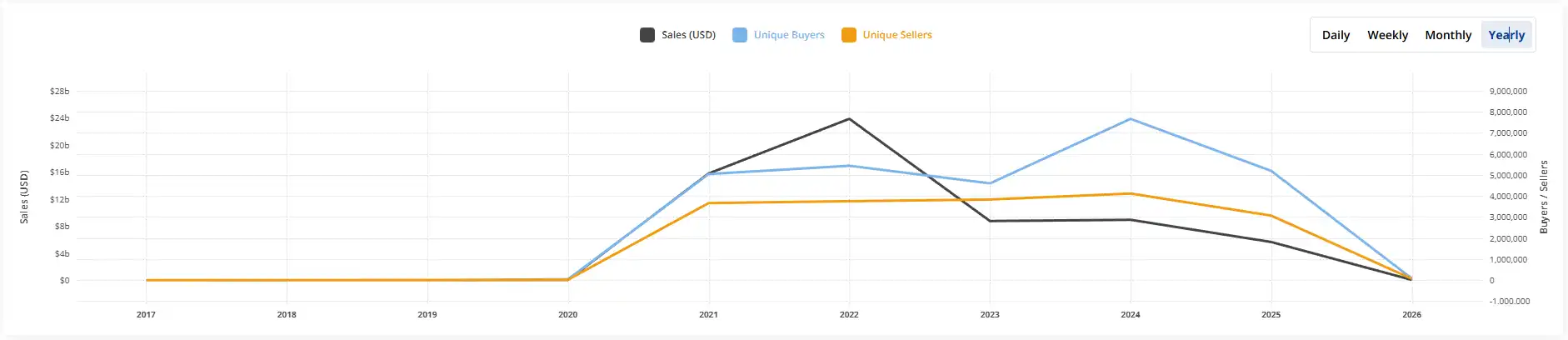
Image Source: CryptoSlam

Even former top-tier NFT projects and blue-chip NFTs could not escape the fate. Taking CryptoPunks as an example, the floor price has fallen to about 30 ETH, down 78% from its peak of 125 ETH in 2021; Bored Ape Yacht Club (BAYC) fell about 83% from around 30 ETH to about 5 ETH; Azuki fell about 93% from around 12 ETH to 0.8 ETH.

Collective "Flight" and Evolution of Platforms

The movements of industry leaders mark the end of this cycle.

OpenSea, which once firmly held the top spot in the NFT market, saw its platform revenue drop from $50 million to $120 million per month during the NFT golden age to less than one million.

Therefore, OpenSea announced a transformation. The platform will shift from a单纯的 "NFT marketplace" to a universal on-chain trading center for "Trade Everything", covering physical collectibles and digital assets like tokens, and confirmed it will issue a token.

Blur, which had a meteoric rise, saw its TVL continuously hit new lows, and its token price also fell 99% from its high.

Then there's Magic Eden, which started on Solana. After a year of operation, it issued a token. Affected by the NFT market conditions and the落地 (materialization) of short-selling expectations, the platform's trading volume began to shrink, and its token price also fell over 98% from its high.

Even projects that couldn't keep up with the changing times, like the older NFT marketplace X2Y2, have been淘汰 (eliminated), completely shutting down, with the team having pivoted to the AI field.

From "Token" to "Brand"

Amid the widespread despair, Pudgy Penguins successfully broke through against the trend, becoming an industry outlier. Its success does not rely on complex innovation in token technology or short-term speculative hype, but rather on transforming digital IP into physical consumer goods, gradually building a sustainable brand ecosystem that spans Web3 and traditional retail.

Through the dual revenue model推行 (implemented) by CEO Luca Netz, Pudgy Penguins deeply integrates IP licensing with physical goods. Its physical toys have entered over 10,000 retail channels globally, including Walmart, Target, and Walgreens. According to an AInvest report, this transformation has brought the project approximately $50 million in annual revenue, effectively offsetting the impact of the overall crypto market contraction.
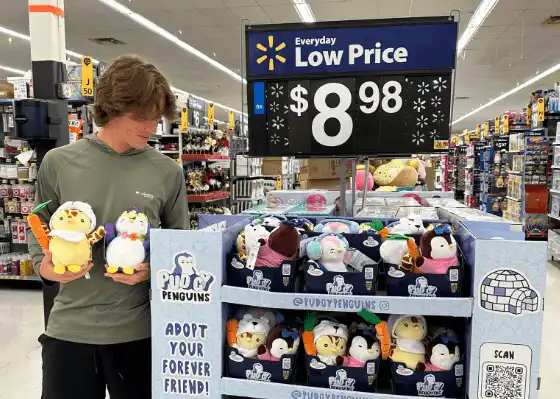
Image - Pudgy Penguins toy shelf in a US Walmart

During the 2025 Christmas period, Pudgy Penguins spent approximately $500,000 to project a giant animation on the Las Vegas landmark Sphere.

Image - Pudgy Penguins image on the Sphere

This advertisement, aimed at millions of tourists, avoided crypto jargon and the term NFT, presenting only a family-friendly IP image. It stimulated secondary market liquidity through brand exposure. In the past 14 days, the floor price of this NFT rose 25%, and trading volume increased by about 33%.

This shift in thinking from speculation to cultural operation seems to be becoming a consensus among industry survivors. Last May, Bored Ape Yacht Club (BAYC) issuer Yuga Labs transferred the IP rights of the top NFT project CryptoPunks to the non-profit organization Infinite Node Foundation, aiming to剥离 (strip) it from its speculative nature of price fluctuations and seek longer-term art preservation and cultural operation.

Physical Backing and Functional Return

Beyond IP branding, NFTs are becoming the underlying tool for connecting real-world assets (RWA).

Physical Card Trading. The platform Courtyard.io is changing the game. They deposit real Pokémon cards into certified vaults and tokenize them as NFTs. In the 30 days leading up to the end of 2025, the platform processed over 230,000 transactions, generating approximately $12.7 million in sales, proving strong market demand for this type of highly liquid, physically-backed asset.

Functional Tickets. FIFA (Fédération Internationale de Football Association) has also joined this camp, introducing "priority purchase right" NFTs in the ticket sales for the 2026 World Cup. These NFTs are not for speculation but serve as a verification tool to prevent scalper premiums and price fraud in the secondary market.

What Died in NFTs, and What Remains

NFTs have not "completely died out," but they have indeed died once.

What died is the fantasy of viewing NFTs as a financial asset that could脱离 (detach from) real-world value and be continuously minted and traded based solely on narrative. In the face of the reality of infinite supply and limited demand, this path was destined to be unsustainable.

What remains is the role of NFTs as a "credential layer." They are no longer required to create value alone but are embedded within IP brands, physical assets, and functional scenarios,承担 (undertaking) the basic functions of rights confirmation, transfer, participation, and verification.

From Pudgy Penguins' toy shelves, to the on-chain circulation of physical cards, to the anti-scalping mechanism for World Cup tickets, NFTs are stepping down from the stage of speculation and returning to the toolbox.

For the NFT speculative market, this is undoubtedly a winter. But for NFTs themselves, this is more like a rebirth after disenchantment.


Nội dung Liên quan

Kinh doanh không gian khối đã chết: Các blockchain công khai phải tìm ra hướng đi mới

Tác giả: Castle Labs Biên dịch: Deep Tide TechFlow Trong hai năm qua, chỉ có một blockchain công khai (Hyperliquid) nằm trong số 14 công ty tiền mã hóa có doanh thu hàng năm trên 200 triệu USD. Khoảng cách là rất lớn: Doanh thu 30 ngày của Arbitrum chỉ là 430 nghìn USD, trong khi Hyperliquid đạt khoảng 58 triệu USD (gấp hơn 100 lần). Điều này cho thấy mô hình kinh doanh dựa trên việc "bán không gian khối" đã lỗi thời. Các blockchain cần tìm hướng đi mới: hoặc chuyển đổi thành studio sản phẩm, nhà phân phối ứng dụng, hoặc tập trung vào các ngành dọc cụ thể như một nhà cung cấp SaaS. Thời đại của cơ sở hạ tầng trung lập đang kết thúc. Bài viết cũng thảo luận về vụ tấn công vào kho bạc LP của Ostium, gây thiệt hại hơn 40% TVL, nguyên nhân do kẻ tấn công đưa giá ảo vào hệ thống định giá ngoài chuỗi. Sự cố này nhấn mạnh rủi ro và nhu cầu về các biện pháp kiểm soát chặt chẽ hơn đối với các giao thức tích hợp thị trường truyền thống vào chuỗi. Một chủ đề khác là tương lai của quyền chọn trên chuỗi. Các chuyên gia cho rằng để đạt được sự chấp nhận rộng rãi, quyền chọn cần được "trừu tượng hóa" – không được bán dưới dạng sản phẩm phức tạp với các thuật ngữ Hy Lạp, mà nên đóng gói lợi nhuận thành các sản phẩm dễ hiểu hơn như kho bạc tạo thu nhập, quyền chọn nhị phân ngắn hạn, sản phẩm có cấu trúc hoặc thị trường dự đoán. Lợi ích của quyền chọn mới là sản phẩm thực sự. Cuối cùng, bài viết điểm qua một số dự án đáng chú ý như Flex của Yearn (thị trường vay với lãi suất cố định), những thay đổi trong chiến lược của Base, Plether (hợp đồng vĩnh viễn chỉ số USD trên chuỗi) và trọng tâm an ninh của Starknet về quyền riêng tư và khả năng chống lại các mối đe dọa lượng tử.

marsbit3 phút trước

Kinh doanh không gian khối đã chết: Các blockchain công khai phải tìm ra hướng đi mới

marsbit3 phút trước

Ghi chú podcast | Trò chuyện với Giám đốc quản lý tài sản của GSR: Đợt tăng giá tiền mã hóa này là thật hay giả, hãy theo dõi lãi suất cho vay trên Aave là biết ngay

**Tóm tắt podcast với Andy Baehr (GSR): Cách phân biệt đợt tăng giá thật hay giả trong crypto** Andy Baehr, Giám đốc điều hành Quản lý tài sản tại GSR, chia sẻ quan điểm về thị trường crypto hiện tại thông qua khung lý thuyết "dao động" (ambivalence) và "niềm tin vững chắc" (conviction). Ông cho rằng thị trường đang mắc kẹt ở trạng thái dao động, với các đợt phục hồi giống như tên lửa một tầng, thiếu sức bền. Ông đề xuất ba tín hiệu cần theo dõi: 1. **Lãi suất cho vay trên DeFi, đặc biệt trên Aave:** Lãi suất cho vay USDC hiện chỉ khoảng 3.75%, gần bằng lợi suất trái phiếu kho bạc Mỹ, phản ánh nhu cầu đòn bẩy thấp và thiếu năng lượng thị trường thực sự. Một đợt tăng giá bền vững cần lãi suất này tăng vọt do nhu cầu vay tăng cao. 2. **Sự đồng thuận về "đỉnh diều hâu" của Cục Dự trữ Liên bang Mỹ (Fed):** Thị trường cần xác định rõ điểm kết thúc của chu kỳ thắt chặt chính sách tiền tệ ("Ngày chí của Fed") để có thể tin tưởng vào một xu hướng tăng bền vững. 3. **Khả năng thông qua Đạo luật CLARITY:** Dự luật này, hiện có xác suất thông qua dưới 40% trên Polymarket, có thể trở thành một yếu tố bất ngờ thúc đẩy thị trường nếu được thông qua. Baehr cũng chỉ ra các yếu tố cản trở đà tăng: dòng tiền ETF không ổn định, các công ty kho bạc (DAT) như Strategy chưa mua vào, và sự thu hút vốn sang các cơ hội khác như IPO SpaceX hay cổ phiếu AI. Tóm lại, theo Baehr, để xác nhận một đợt tăng giá thực sự, nhà đầu tư nên theo dõi chặt chẽ lãi suất cho vay trên Aave như một thước đo trực tiếp về nhu cầu đòn bẩy và sức khỏe tổng thể của thị trường crypto.

marsbit13 phút trước

Ghi chú podcast | Trò chuyện với Giám đốc quản lý tài sản của GSR: Đợt tăng giá tiền mã hóa này là thật hay giả, hãy theo dõi lãi suất cho vay trên Aave là biết ngay

marsbit13 phút trước

Đề xuất HIP-4 của Hyperliquid tiếp sức cho HYPE staking khi niềm tin dài hạn gia tăng

Hyperliquid đã đề xuất nâng cấp HIP-4 nhằm mở rộng giao thức vượt ra ngoài thị trường hợp đồng tương lai vĩnh viễn để trở thành một lớp cơ sở hạ tầng cho các ứng dụng trên chuỗi. Theo đề xuất, các nhà triển khai phải stake 500,000 token HYPE để tạo thị trường mới, với các biện pháp kiểm soát nhằm đảm bảo chất lượng. Sự tự tin của nhà đầu tư đang tăng lên, được phản ánh qua việc lượng HYPE được stake đã đạt khoảng 438.7 triệu token, chiếm 43.9% tổng nguồn cung. Một trader lớn cũng chọn stake số HYPE trị giá 15.5 triệu USD thay vì chốt lời. Điều này cho thấy sự tin tưởng dài hạn vào mạng lưới. Cấu trúc thị trường cũng cho thấy động lực tích cực, với lãi suất tài trợ cân bằng và thanh lý hạn chế, cho thấy cách tiếp cận đầu tư có đo lường. Tổng giá trị bị khóa (TVL) và doanh thu giao thức đang tăng, củng cố triển vọng tăng trưởng cơ bản. Tóm lại, việc mở rộng cơ sở hạ tầng, sự tham gia stake mạnh mẽ và cấu trúc thị trường lành mạnh đang củng cố vị thế của Hyperliquid như một nền tảng cho tài chính kỹ thuật số trong tương lai, phụ thuộc vào việc áp dụng của người dùng và triển khai thành công các bản nâng cấp sắp tới.

ambcrypto1 giờ trước

Đề xuất HIP-4 của Hyperliquid tiếp sức cho HYPE staking khi niềm tin dài hạn gia tăng

ambcrypto1 giờ trước

7 tháng sau sự sụp đổ của Huiwang, thị trường nền tảng ký quỹ Đông Nam Á đại phẫu thuật

Sau 7 tháng sụp đổ của Huiwang, một nền tảng bảo đảm thanh toán được mệnh danh là "Alipay Đông Nam Á", thị trường bảo đảm trong khu vực đang trải qua một cuộc đại tái cấu trúc. Sự sụp đổ của tập đoàn Thái Tử ở Campuchia và việc tịch thu 12.7 vạn Bitcoin (trị giá khoảng 150 tỷ USD) của Mỹ đã chặt đứt nguồn cung thanh khoản, khiến Huiwang phá sản, 90 vạn người dùng mất trắng. Tuy nhiên, khoảng trống quyền lực nhanh chóng bị lấp đầy bởi các nền tảng bảo đảm mới nổi, thường hoạt động trong bóng tối và gắn liền với các hoạt động bất hợp pháp. Các cái tên nổi bật bao gồm: * **Tân Tệ (XinBi/Newpay):** Thu hút lượng lớn người dùng từ Huiwang, tổng doanh thu đã vượt quá 1.6 tỷ USDT. * **Lĩnh Hàng/Tiger Bảo đảm:** Chuyên cung cấp dịch vụ bảo đảm cho các giao dịch liên quan đến buôn bán người và lao động cưỡng bức. * **Kim Bối/Kim Bác:** Ban đầu liên kết với tập đoàn Thái Tử và các sòng bạc, chuyên phục vụ ngành cờ bạc trực tuyến. * **Đạt Lợi/Thiên Thành:** Kế thừa nhiều nhóm giao dịch công khai từ Huiwang, có mức tăng trưởng người dùng đáng kể. * **Phúc Lợi Lai:** Gắn liền với tập đoàn tội phạm gia đình họ Lưu ở miền Bắc Myanmar, chủ yếu phục vụ các khu công viên lừa đảo. Báo cáo từ Elliptic cho thấy thị trường bảo đảm Huiwang đã xử lý hơn 31 tỷ USD, trở thành thị trường bất hợp pháp trực tuyến lớn nhất từ trước đến nay. Các nền tảng bảo đảm này, thường được ngụy trang dưới vỏ bọc dịch vụ tài chính, trên thực tế đã trở thành trung gian quan trọng cho mạng lưới tội phạm bao gồm lừa đảo, rửa tiền, cờ bạc và buôn bán người tại Đông Nam Á. Danh hiệu "Alipay Đông Nam Á" chỉ là cái cớ, che đậy cho một hệ sinh thái tài chính ngầm đầy rủi ro và nguy hiểm.

Odaily星球日报1 giờ trước

7 tháng sau sự sụp đổ của Huiwang, thị trường nền tảng ký quỹ Đông Nam Á đại phẫu thuật

Odaily星球日报1 giờ trước

Giao dịch

Giao ngay
活动图片



