After the Fed Hits the Brakes, the Market Experiences 'Icy and Fiery Extremes'!

比推Xuất bản vào 2026-01-29Cập nhật gần nhất vào 2026-01-29

Tóm tắt

The Federal Reserve paused its rate-cutting cycle in its first 2026 meeting, keeping the benchmark rate unchanged at 3.5%–3.75%, a move widely anticipated by the market. However, two dissenting votes highlighted internal divisions. The central bank signaled a shift from active policy adjustment to a more cautious, data-dependent stance. Gold emerged as the standout performer, surging past $5,500/oz with a 10% weekly gain, driven by persistent inflation, geopolitical risks, and easing real-rate pressures. In contrast, other major assets—including U.S. stocks, the dollar, Treasuries, and cryptocurrencies like Bitcoin—showed limited movement, reflecting market uncertainty. Attention is now turning to potential leadership changes at the Fed, with market-based predictions favoring Rick Rieder (34%), Kevin Warsh (28%), and Christopher Waller (20%) as top contenders to shape future policy. Bitcoin faces caution as on-chain data indicates a rising share of supply in loss, suggesting structural softening though not yet full bearish momentum. The market remains in a wait-and-see mode, balancing macro uncertainty against evolving cycle signals.

After three consecutive interest rate cuts, the Federal Reserve finally pressed the "pause button" at its first policy meeting of 2026.

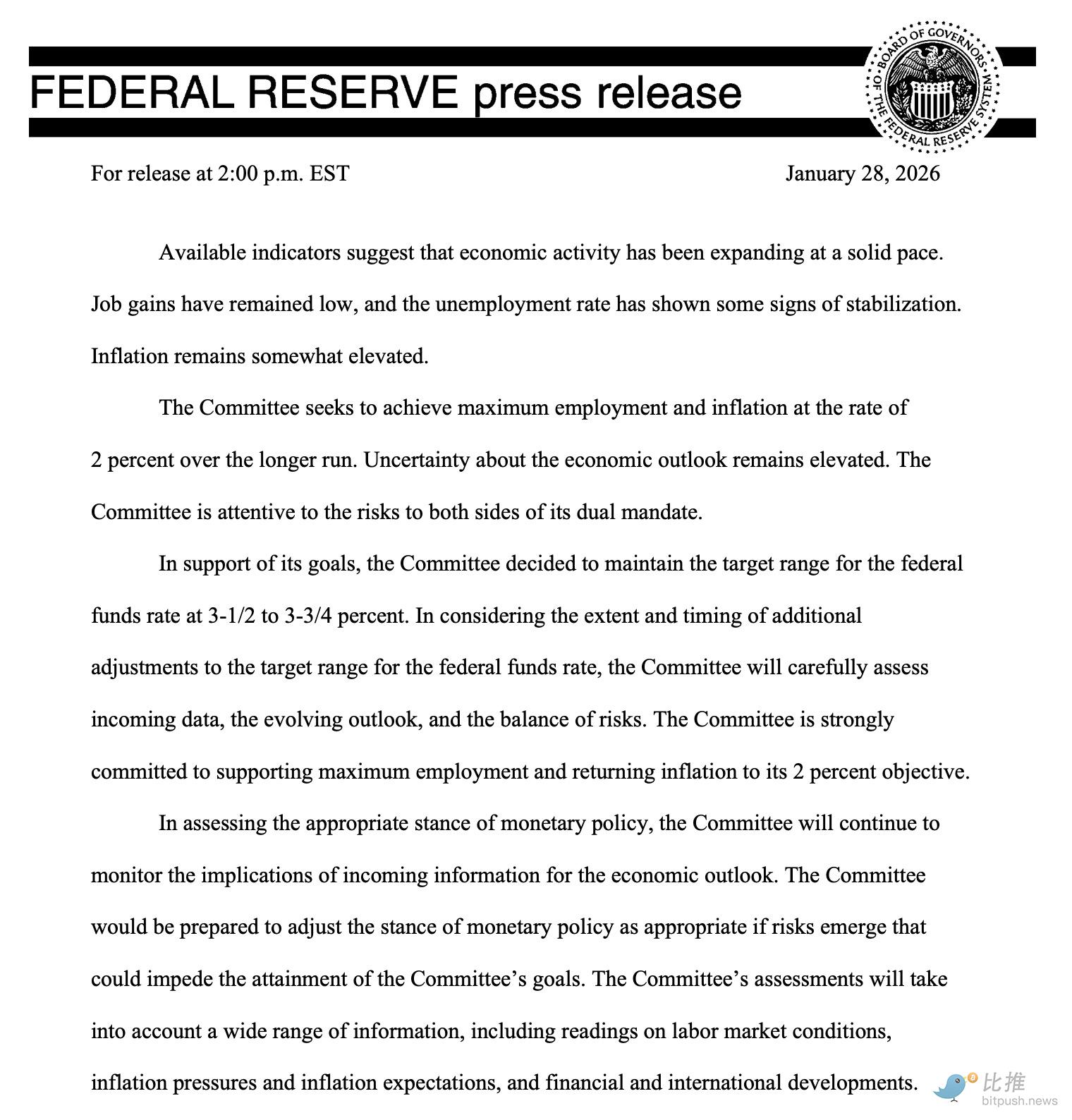
In the early hours of Thursday Beijing time, the Federal Reserve announced it would keep the benchmark interest rate unchanged in the range of 3.5% to 3.75%. This somewhat "uneventful" decision was in line with market expectations of over 97%, but it also revealed subtle internal policy cracks: two Fed governors voted against the decision, supporting a further 25 basis point rate cut.
The Shoe Has Dropped, But the Direction Remains Unclear

In its policy statement, the Fed maintained a relatively cautious tone: the economy is still "expanding robustly," inflation has "eased somewhat but remains above target," the labor market shows signs of cooling but does not yet constitute a systemic risk. The core message is very clear—monetary policy has transitioned from the "active adjustment" phase to the "observation and verification" phase.

It is worth noting that the Federal Open Market Committee (FOMC) is not monolithic. Two members voted in favor of continuing rate cuts, showing that policy preferences still diverge between falling inflation and a slowing economy. Overall, however, the Fed is unwilling to make new policy commitments in the current environment, instead choosing to hand the decision-making power back to subsequent data.

This stance sets the tone for the market: there will be no clear directional guidance in the short term, and asset pricing will revolve more around "changes in expectations" rather than "changes in policy."

Current federal funds rate market pricing shows that investors generally expect rates to remain unchanged this quarter, with the first rate cut now re-pointed to June of this year, and the market further expects a possible pause in the rate-cutting cycle by 2027.

However, regarding the interest rate path beyond this quarter, there are still significant differences among institutions: Morgan Stanley, Citigroup, and Goldman Sachs predict successive rate cuts in June and September; Barclays believes cuts are possible in June and December; while JPMorgan maintains its expectation for unchanged rates throughout the year.

Macro Markets: Gold Steals the Spotlight, Other Assets Remain Unfazed

If the Fed's decision itself did not cause waves, then the divergence in asset performance is the signal truly worth watching.

After the interest rate decision was announced, the spot gold price soared, breaking through the $5,500 per ounce mark for the first time. In just four trading days, the gold price rose from just below $5,000, breaking through multiple hundred-dollar thresholds, accumulating a gain of over $500, with a weekly increase of 10%. This speed and magnitude have made gold the undisputed protagonist of the current global market.
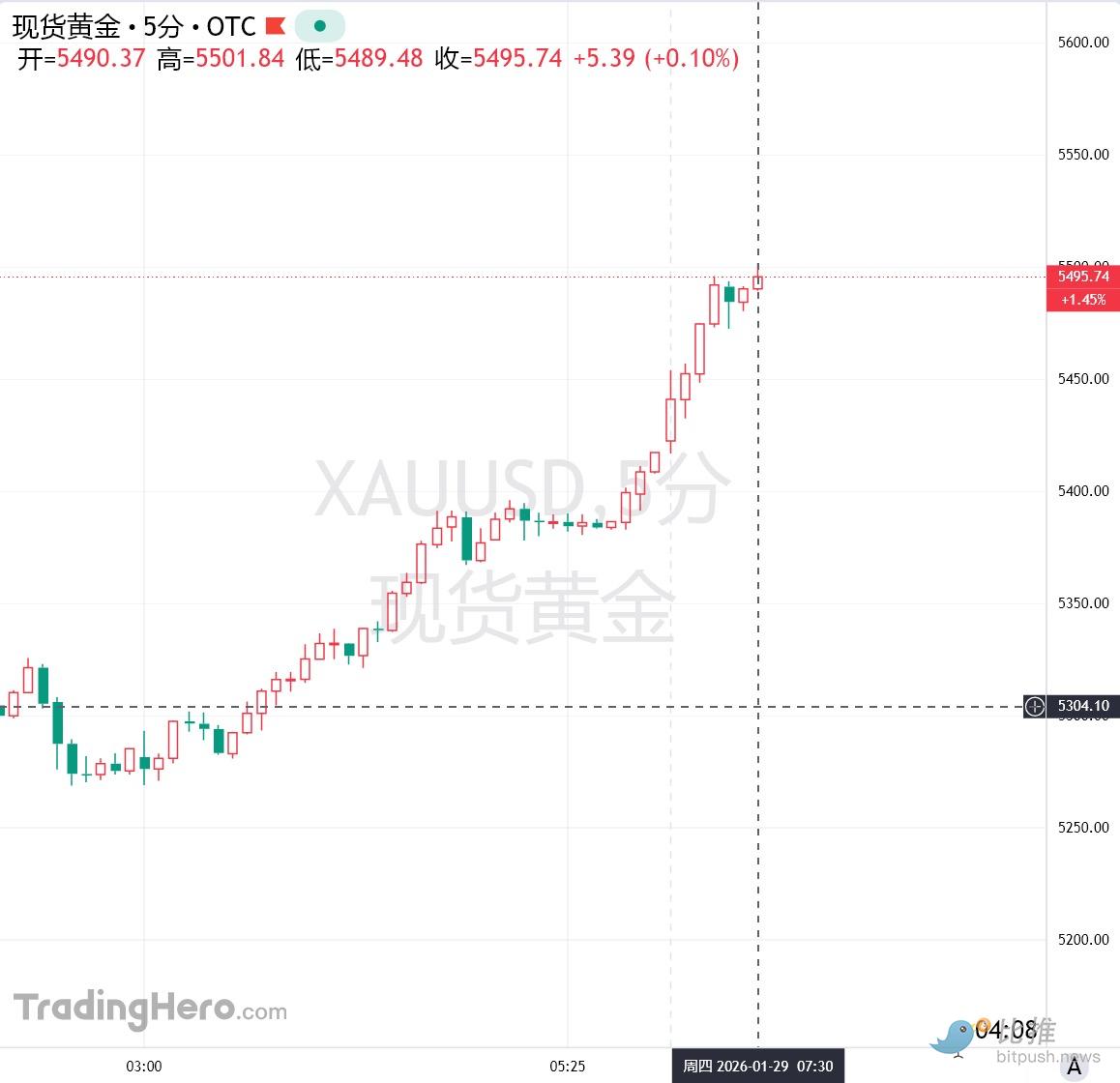
Gold's strength is not simply a matter of interest rate trading logic. Although the Fed has paused rate cuts, after successive rounds of easing, policy is nearing the neutral range, and the marginal constraint of real interest rates has eased somewhat; at the same time, resilient inflation, trade frictions, political uncertainty, and global policy games are intertwining, continuously amplifying safe-haven demand. Under the overlay of multiple uncertainties, capital has chosen the most traditional and consensus safe-haven asset.

In stark contrast to gold, other major assets overall reacted with restraint. US stocks maintained narrow fluctuations after the decision, showing no trend breakthrough; the US dollar index had limited volatility; US Treasury yields adjusted slightly but did not evolve into a systemic risk-off rally.

The same goes for crypto assets. After the news was announced, the Bitcoin price briefly dipped from $89,600 to the $89,000 level, then quickly pulling back to around $89,300. The fluctuation was less than 1%. Ethereum (ETH) hovered around the $3,000 mark, and mainstream altcoins like Solana and XRP also remained within their previous consolidation ranges.
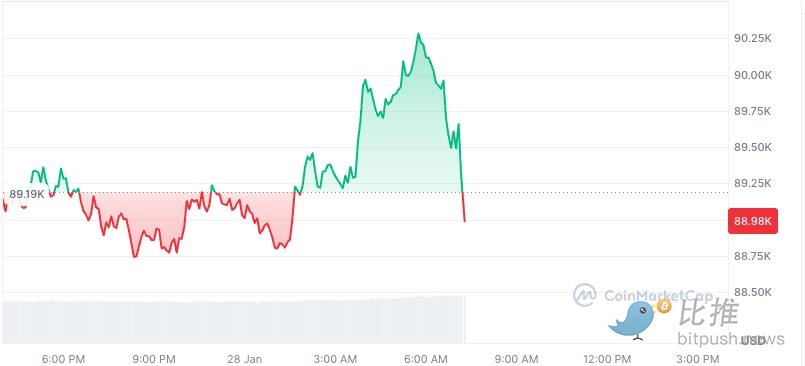
The market gave the most intuitive answer: when the direction is unclear, gold is pushed back to the center of the stage, while other assets enter a waiting state.

A Question More Important Than Rate Cuts: Who Will Shape the Next Phase of the Fed?

After the interest rate decision landed, the market's focus quickly shifted. Compared to "whether there will be another rate cut," investors began to discuss another question more frequently: who will lead the next phase of the Federal Reserve?
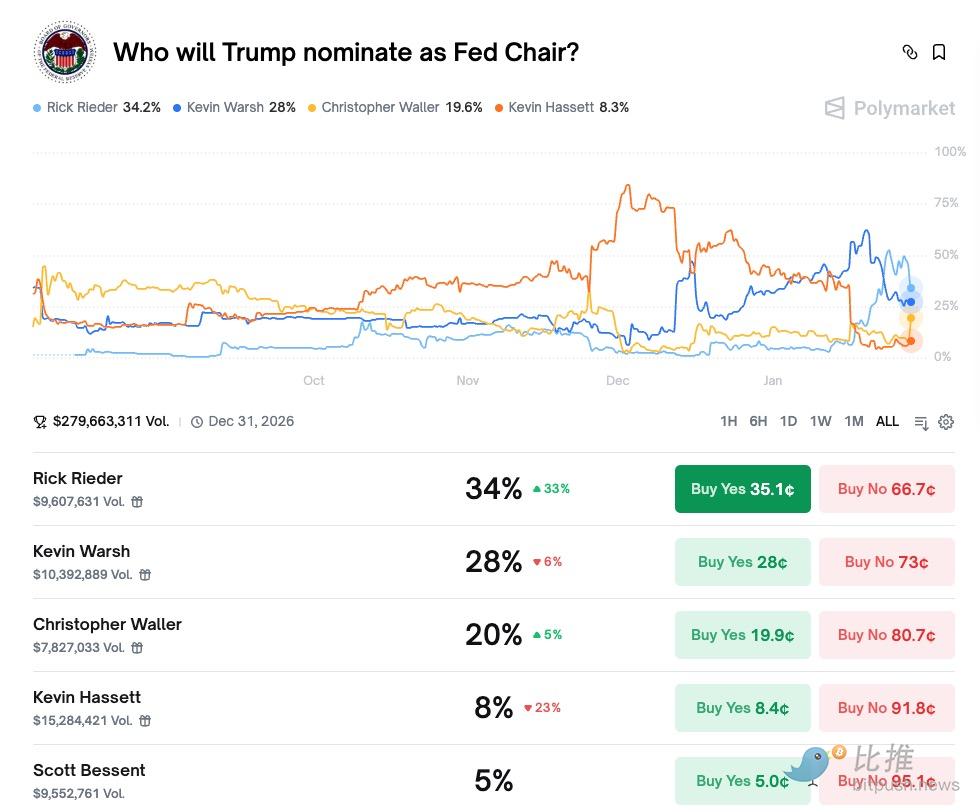
After the dust settled on the interest rate decision, the market's focus quickly shifted from "whether there will be another rate cut" to a question with longer-term implications—who will become the next Federal Reserve Chair.

This change is not accidental. As monetary policy gradually enters a sensitive range "close to neutral," the policy style for the next few years will largely depend on the leadership's understanding of inflation tolerance, financial stability, and market volatility. Against this backdrop, prediction markets provide a valuable window of reference.

According to the latest data from Polymarket, in the betting on "Who will Trump nominate as Fed Chair," the winning probabilities of several candidates have already formed a hierarchy:

Rick Rieder: The Market's Favorite "Pragmatist" (~34%)

Currently, the highest betting probability is for Rick Rieder, with a support rate of about 34%, which has risen significantly recently.

Rieder is currently BlackRock's Chief Investment Officer of Global Fixed Income, deeply involved in long-term bond market and macro asset allocation decisions, and is seen as one of the very few figures who truly straddles "policy-market-capital structure." His public views often emphasize financial market stability, policy transmission efficiency, and avoiding unnecessary systemic shocks.

From the market's perspective, if Rieder becomes Fed Chair, it would mean that central bank decisions would place greater importance on financial conditions and asset price signals, maintaining policy flexibility within the allowable range of inflation. This expectation explains why he is gaining increasing financial support in prediction markets—it is a bet on "predictability" and "market friendliness."

Kevin Warsh: Representative of Discipline and Credibility (~28%)

Ranked second is former Fed Governor Kevin Warsh, with a current betting probability of about 28%.

Warsh has always been known for his clear stance and tough style, emphasizing central bank credibility and long-term discipline on inflation issues. He has repeatedly expressed concerns about excessively loose policies and is also seen as an important representative of the traditional hawkish camp.

If Warsh ultimately wins, the market generally expects the Fed to be more cautious in its rate-cutting pace, tolerance for asset prices, and policy communication. This style typically helps suppress inflation expectations but also means risk assets need to adapt to a stricter financial environment.

Christopher Waller: The Academic Fed Governor (~20%)

The betting probability for current Fed Governor Christopher Waller is about 20%, placing him third.

Waller has a strong academic background and clear policy logic, and has long been regarded as the most influential "hawk" within the Fed (advocating high interest rates to suppress inflation). However, in this FOMC meeting, he cast a dissenting vote, supporting a continued rate cut, which means he either believes inflation is no longer the main threat or is feeling significant political/economic pressure.

If Waller takes over, the Fed may give more weight to employment and growth targets, with a relatively flexible policy pace, but whether he can maintain central bank independence in a highly politicized environment remains a focus of market attention.

Will Bitcoin Continue Its Bearish Trend?

While macro uncertainties intensify, on-chain data is beginning to release signals worth警惕 (being cautious about).

The latest analysis from CryptoQuant shows that the 365-day moving average of Bitcoin's "Supply in Loss" is starting to rise again. This metric measures the percentage of Bitcoin whose current price is below the price of its last on-chain transfer and is an important tool for observing changes in market structure.
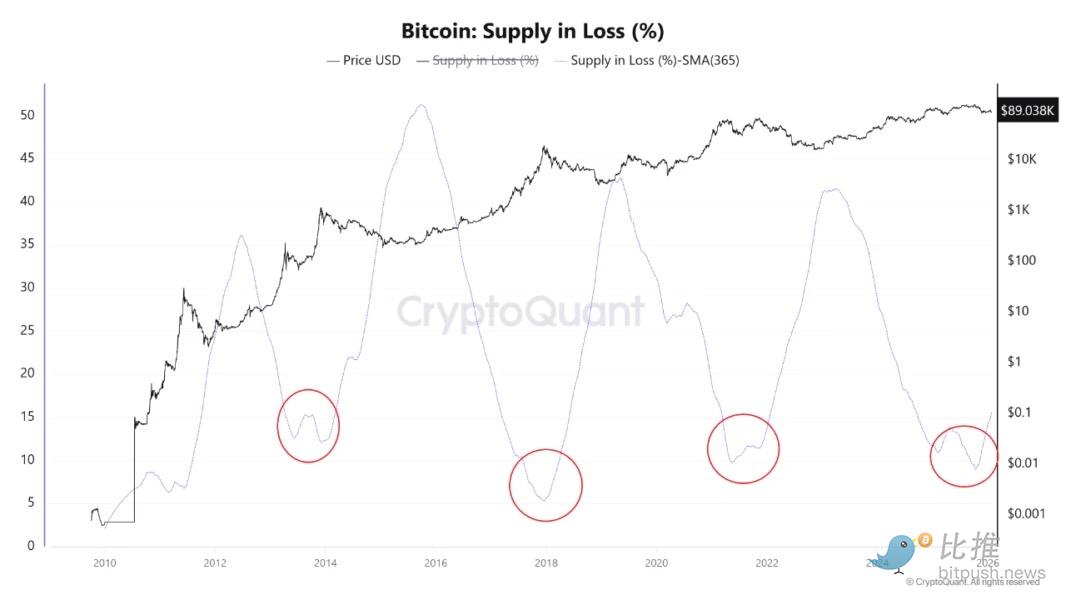
When Bitcoin hit its historical high of $126,000 last October, this indicator once fell to its lowest point this cycle, reflecting a market in a state of high profitability. But as the price fell, Supply in Loss began to rise continuously, showing that losses are gradually spreading from short-term traders to longer-term holders.

Historical experience shows that this directional change often appears in the early stages of bull-to-bear transitions. However, it is important to emphasize that this indicator has not yet reached the typical "capitulation zone"; it is more like a risk signal than a trend confirmation.

This means that Bitcoin's current state is closer to high-level digestion and structural reorganization rather than having already entered a clear main bear market decline phase. Whether it evolves into a deeper adjustment still highly depends on macro liquidity and subsequent capital flows. Gabe Selby, Research Head at CF Benchmarks, said: "Short-term bullish catalysts for Bitcoin still exist, but they are increasingly偏向 (leaning towards) political factors rather than monetary factors."

Summary: Macro Uncertainty, Structural Changes, the Market is Waiting for Answers

Overall, this round of market changes is not driven by a single event but is the result of multiple factors acting together. The Fed's choice to pause sends a signal of "caution rather than a pivot"; capital embraces gold amidst uncertainty, pushing risk aversion to the forefront; Bitcoin, while fluctuating at high levels, gradually reveals structural characteristics of the latter half of the cycle.

Before the direction becomes clear, the market seems more like it is conducting a patience test. Gold has already made its choice, while Bitcoin's next step still needs to wait for further convergence of macro and cyclical signals.

Author: seed.eth


Twitter:https://twitter.com/BitpushNewsCN

Bitpush TG Discussion Group:https://t.me/BitPushCommunity

Bitpush TG Subscription: https://t.me/bitpush

Original link:https://www.bitpush.news/articles/7606809

Câu hỏi Liên quan

QWhat did the Federal Reserve decide regarding interest rates in its first meeting of 2026?

AThe Federal Reserve decided to maintain the benchmark interest rate unchanged in the range of 3.5% to 3.75%.

QWhich asset experienced a significant price surge following the Fed's decision, and what was its performance?

ASpot gold prices broke through the $5,500 per ounce mark, rising over $500 in just four trading days with a weekly gain of 10%.

QAccording to the Polymarket betting data, who is the current frontrunner to be nominated as the next Fed Chair, and what is their perceived policy style?

ARick Rieder is the current frontrunner with approximately 34% probability, and he is viewed as a 'pragmatist' whose decisions would place greater emphasis on financial market stability and policy transmission efficiency.

QWhat concerning signal is the Bitcoin on-chain metric 'Supply in Loss' (365-day moving average) currently indicating?

AThe 365-day moving average of Bitcoin 'Supply in Loss' is trending upwards again, signaling that losses are spreading from short-term traders to longer-term holders, which often occurs in the early stages of a bull-to-bear transition.

QHow did other major assets like U.S. stocks, the U.S. dollar, and cryptocurrencies generally react to the Fed's announcement?

AOther major assets reacted with restraint. U.S. stocks traded in a narrow range without a breakout, the U.S. Dollar Index saw limited movement, and major cryptocurrencies like Bitcoin and Ethereum experienced minimal volatility, staying within their previous trading ranges.

Nội dung Liên quan

Robot 'Teletubbies' Đến Nhà Làm Vệ Sinh, 200 Nghìn Đồng/Giờ, Trí Tuệ Nhân Tạo 'Thuần Khiết'

Ở San Francisco, một công ty khởi nghiệp robot có tên Tau Robotics đã ra mắt dịch vụ dọn dẹp nhà cửa bằng robot hình người với giá 30 USD/giờ. Tuy nhiên, điểm đáng chú ý là các robot này hiện hoạt động dựa trên điều khiển từ xa (teleoperation) hơn là trí tuệ nhân tạo tự chủ hoàn toàn. Công ty, thành lập năm 2024 với khoảng 10 nhân viên, giới thiệu ba robot "nhân viên": Chelsea chuyên dọn dẹp nhà bếp và phòng tắm, Elon phụ trách dọn dẹp định kỳ và ghi nhớ vị trí đồ đạc, và Tony tập trung vào việc vệ sinh chuyên sâu. Lý do chọn thiết kế hình người, theo bài viết, là để tạo điều kiện thuận lợi cho việc điều khiển từ xa, vì người vận hành có thể ánh xạ trực quan các cử động của mình lên robot. Cách tiếp cận "gian lận thông minh" này nhằm mục đích thu thập dữ liệu từ môi trường thực tế để huấn luyện AI trong tương lai, tương tự mô hình "chế độ bóng" trong xe tự lái. Bài viết so sánh với thị trường Trung Quốc, nơi trọng tâm chính của robot hình người vẫn là trong môi trường công nghiệp có kiểm soát, và đề cập đến một công ty Mỹ khác là 1X Neo cũng theo đuổi hướng đi tương tự. Mặc dù hiệu quả về mặt kỹ thuật, nhưng việc người tiêu dùng có sẵn sàng trả tiền cho một robot được điều khiển từ xa với camera trong nhà mình hay không vẫn là một câu hỏi mở. Dịch vụ của Tau Robotics hiện đang trong chế độ mời thử nghiệm tại San Francisco.

marsbit2 phút trước

Robot 'Teletubbies' Đến Nhà Làm Vệ Sinh, 200 Nghìn Đồng/Giờ, Trí Tuệ Nhân Tạo 'Thuần Khiết'

marsbit2 phút trước

Từ Hàn Quốc đến Mỹ: Nhờ AI, Lao Động Chân Tay Ngày Càng 'Lên Ngôi'

Trí tuệ nhân tạo (AI) đang định hình lại thị trường lao động. Bằng đại học 4 năm không còn là "tấm vé an toàn", trong khi các nghề kỹ thuật như thợ điện, thợ hàn, thợ sửa ống nước đang có nhu cầu cao và mức lương hấp dẫn chưa từng thấy. Thanh niên từ Mỹ đến Hàn Quốc đang thay đổi quan điểm về giáo dục và nghề nghiệp. Số liệu cho thấy sự chuyển dịch rõ rệt: doanh thu trường dạy nghề ở Mỹ tăng mạnh 11.4%, trong khi các đợt sa thải nhân viên văn phòng do AI cũng lên mức cao kỷ lục. Áp lực AI thay thế lao động trí thức, cộng với nhu cầu mở rộng cơ sở hạ tầng và trung tâm dữ liệu, đang đẩy cung-cầu nghiêng về lao động kỹ thuật. Khảo sát cho thấy 60% thế hệ Z có kế hoạch làm nghề lao động kỹ thuật vào năm 2026, vì tin rằng những nghề này có tính an toàn nghề nghiệp cao hơn trước AI. Nhiều nghề kỹ thuật hiện có mức lương trung bình ngang bằng hoặc vượt các nghề yêu cầu bằng đại học. Mô hình học việc "vừa học vừa làm" hấp dẫn, và công việc này khó bị AI thay thế hoặc gia công ra nước ngoài. Tại Hàn Quốc, học sinh tốt nghiệp trung học bán dẫn có tỷ lệ có việc làm ngay lên tới 96.4%. Tuy nhiên, ngành này đang đối mặt với khoảng trống kép: làn sóng nghỉ hưu ồ ạt và nhu cầu mở rộng cơ sở hạ tầng. Dự báo Mỹ sẽ thiếu hụt hàng triệu lao động có kỹ năng. Nhiều tập đoàn lớn như Meta, Lowe's đã đầu tư hàng trăm triệu USD vào các chương trình đào tạo. Dù nhu cầu thị trường rõ ràng, định kiến xã hội coi trọng bằng đại học hơn học nghề vẫn tồn tại. Các chuyên gia nhấn mạnh cần có những nỗ lực chủ động từ ngành công nghiệp để thu hẹp khoảng cách nhận thức này, thông qua các chương trình trải nghiệm thực tế cho giới trẻ, nhằm giải quyết tận gốc tình trạng thiếu hụt lao động kỹ thuật.

marsbit46 phút trước

Từ Hàn Quốc đến Mỹ: Nhờ AI, Lao Động Chân Tay Ngày Càng 'Lên Ngôi'

marsbit46 phút trước

Từ TPU đến Agent Tự Tiến Hóa: Jeff Dean Nhìn Nhận Bước Tiếp Theo của AI Như Thế Nào?

Trong buổi phỏng vấn tại YC Startup School 2026, Jeff Dean chia sẻ tầm nhìn về tương lai của AI. Ông nhấn mạnh rằng cuộc cạnh tranh AI không còn là ai có mô hình lớn hơn, mà là ai có thể tổ chức trí thông minh hiệu quả hơn. Điểm then chốt là sự chuyển dịch từ việc huấn luyện các mô hình đơn thuần sang xây dựng các hệ thống "Agent" có khả năng làm việc lâu dài, tự động thử nghiệm, xác minh và tích lũy kinh nghiệm. Các Agent này cần được trang bị công cụ, bộ nhớ, môi trường thực thi và cơ chế phản hồi rõ ràng. Jeff Dean cho rằng cơ hội cho các startup nằm ở những lĩnh vực chuyên biệt nơi các mô hình phổ thông hiện có tỷ lệ thành công rất thấp (gần 0-1%), nhờ vào dữ liệu độc quyền, công cụ đánh giá chuyên môn hoặc mô hình chuyên sâu. Ông cũng dự đoán phần cứng chuyên dụng cho suy luận (inference) với độ trễ thấp và tiêu thụ năng lượng thấp sẽ là chìa khóa. Khi chi phí tạo mã trở nên rẻ hơn, giá trị thực sự sẽ nằm ở khả năng xác định vấn đề đáng giải quyết, thiết kế thông số kỹ thuật rõ ràng và có "khiếu" thẩm định. Tương lai của AI là xây dựng các hệ thống có thể tự động hóa phương pháp khoa học, chạy các vòng lặp thử nghiệm với tốc độ cao để khám phá và cải tiến không ngừng.

marsbit48 phút trước

Từ TPU đến Agent Tự Tiến Hóa: Jeff Dean Nhìn Nhận Bước Tiếp Theo của AI Như Thế Nào?

marsbit48 phút trước

Qualcomm: Cơn sốt AI dịu dần, khi nào điện thoại mới thoát khỏi 'bóng mây'?

Qualcomm (QCOM.O) công bố báo cáo tài chính quý III năm tài chính 2026 (kết thúc tháng 6/2026) với doanh thu 9,95 tỷ USD, giảm 4% so với cùng kỳ, vượt kỳ vọng thị trường. Tuy nhiên, lợi nhuận gộp giảm 2,5 điểm phần trăm xuống 53,1% do chi phí sản xuất và lưu trữ tăng. Mảng kinh doanh bán dẫn (QCT) chịu ảnh hưởng nặng từ smartphone, doanh thu giảm 19,6% xuống 5,09 tỷ USD. Nguyên nhân do sản lượng điện thoại Android (trừ Apple) giảm 11% và xu hướng các hãng sử dụng nền tảng cũ để tiết kiệm chi phí. Trong khi đó, mảng ô tô tăng trưởng mạnh 61% lên 1,59 tỷ USD nhờ Snapdragon Digital Chassis, và IoT tăng 9% lên 1,83 tỷ USD. Lợi nhuận hoạt động cốt lõi giảm 41% do áp lực biên lợi nhuận và chi phí hoạt động tăng. Dự báo quý tới, doanh thu dự kiến 9,7-10,5 tỷ USD, phù hợp với kỳ vọng, nhưng EPS (Non-GAAP) dự báo thấp hơn. Trong bối cảnh thị trường điện thoại trì trệ, Qualcomm đang tìm kiếm tăng trưởng từ AI, bao gồm AI trên thiết bị (AI Phone, AI PC) và đặc biệt là trung tâm dữ liệu AI với bốn hướng: bộ tăng tốc AI, CPU thương mại, chip tùy chỉnh và sản phẩm kết nối. Công ty đặt mục tiêu doanh thu 15 tỷ USD cho mảng trung tâm dữ liệu vào năm tài chính 2029, nhưng hiện tại thị trường vẫn đang thận trọng. Giá cổ phiếu đã giảm từ đỉnh 250 USD xuống dưới 160 USD, phản ánh lo ngại về chi tiêu AI và hiệu suất cơ bản hiện tại.

marsbit50 phút trước

Qualcomm: Cơn sốt AI dịu dần, khi nào điện thoại mới thoát khỏi 'bóng mây'?

marsbit50 phút trước

Sự cố Coldcard kích hoạt làn sóng Bitcoin, củng cố tiền điện tử 'tăng giá': Hodler's Digest, 2 tháng 8

Sự kiện khai thác lỗ hổng trên ví cứng Coldcard đã dẫn đến việc mất khoảng 90 triệu USD Bitcoin, khiến nhiều nhà đầu tư nhỏ chuyển tiền gấp sang các sàn tập trung. Dữ liệu cho thấy khối lượng giao dịch Bitcoin dưới 1 BTC đạt mức cao nhất hàng ngày kể từ năm 2022. Trong bối cảnh đó, ngành công nghiệp tiền mã hóa được cho là đang bước vào giai đoạn củng cố lớn nhất, với doanh thu ngày càng tập trung vào một số ít giao thức hàng đầu như Hyperliquid và Pump.fun. Nhà phân tích Lorenzo Valente của ARK Invest nhận định xu hướng này là "cực kỳ tích cực" cho không gian crypto, dù nó có thể đi kèm với nhiều vụ sáp nhập, phá sản và đóng cửa dự án. Mặt khác, báo cáo thu nhập quý II của các công ty lớn như Coinbase và MicroStrategy cho thấy kết quả ảm đạm, với thua lỗ gia tăng. Đồng thời, những bất ổn về mặt pháp lý vẫn tiếp diễn, như sự bế tắc của Dự luật Clarity Act tại Mỹ hay các cáo buộc nhắm vào nhà sáng lập Telegram Pavel Durov từ Nga và Australia. Cuối tuần, thị trường chung đi xuống, với Bitcoin giảm 3%. Grayscale đưa ra dự báo lạc quan rằng Bitcoin có thể đã chạm đáy sớm hơn chu kỳ truyền thống, mặc dù nhiều tín hiệu tương tự trước đó vẫn chưa ứng nghiệm.

cointelegraph1 giờ trước

Sự cố Coldcard kích hoạt làn sóng Bitcoin, củng cố tiền điện tử 'tăng giá': Hodler's Digest, 2 tháng 8

cointelegraph1 giờ trước

Giao dịch

Giao ngay
活动图片





