After National Intervention: The Reshaping of the 2025 Cryptocurrency Crime Landscape

比推Xuất bản vào 2026-01-12Cập nhật gần nhất vào 2026-01-12

Tóm tắt

State-level actors significantly increased cryptocurrency-related activities in 2025, marking a new phase of maturity for illegal on-chain ecosystems. Illicit addresses received at least $154 billion, a 162% year-over-year increase, largely driven by a 694% surge in transactions involving sanctioned entities. Stablecoins dominated illegal transactions, accounting for 84% of the total. North Korean hackers stole a record $2 billion, including a historic $1.5 billion attack on Bybit. Russia launched the rubleksandrovich (A7A5) token to evade sanctions, processing over $93.3 billion in transactions within a year. Iranian proxy networks and China-based money laundering groups also expanded operations, offering specialized criminal services like fraud, terror financing, and sanctions evasion. Illegal infrastructure providers now offer full-stack services—domain registration, hosting, and technical support—enabling both cybercriminals and state actors to scale malicious activities. Cryptocurrency is increasingly linked to real-world violence, including human trafficking and coerced asset transfers. Despite illicit activity growing, it remains below 1% of all traceable cryptocurrency transactions. Collaboration among law enforcement, regulators, and crypto firms is critical to address these evolving threats.

Written by: Chainalysis

Compiled by: Chopper, Foresight News

Original Title: National-Level Players Enter the Scene, Deciphering the Loss of Control and Transformation of Cryptocurrency Crime in 2025


In 2025, we observed a significant increase in cryptocurrency-related activities at the national level, marking a new mature phase in the development of the illegal on-chain ecosystem. Over the past few years, the professionalization within the cryptocurrency crime sphere has deepened; illegal organizations have now established large-scale on-chain infrastructure to support transnational criminal networks in procuring goods and services and laundering proceeds from crypto crimes. Against this backdrop, national governments have also begun to venture into this domain. On one hand, they leverage these mature professional service providers, and on the other, they are building customized, exclusive infrastructure to evade sanctions on a large scale. As governments tap into this illicit cryptocurrency supply chain originally created for cybercriminals and organized crime groups, government agencies, compliance, and security teams now face severe challenges in terms of consumer rights protection and national security.
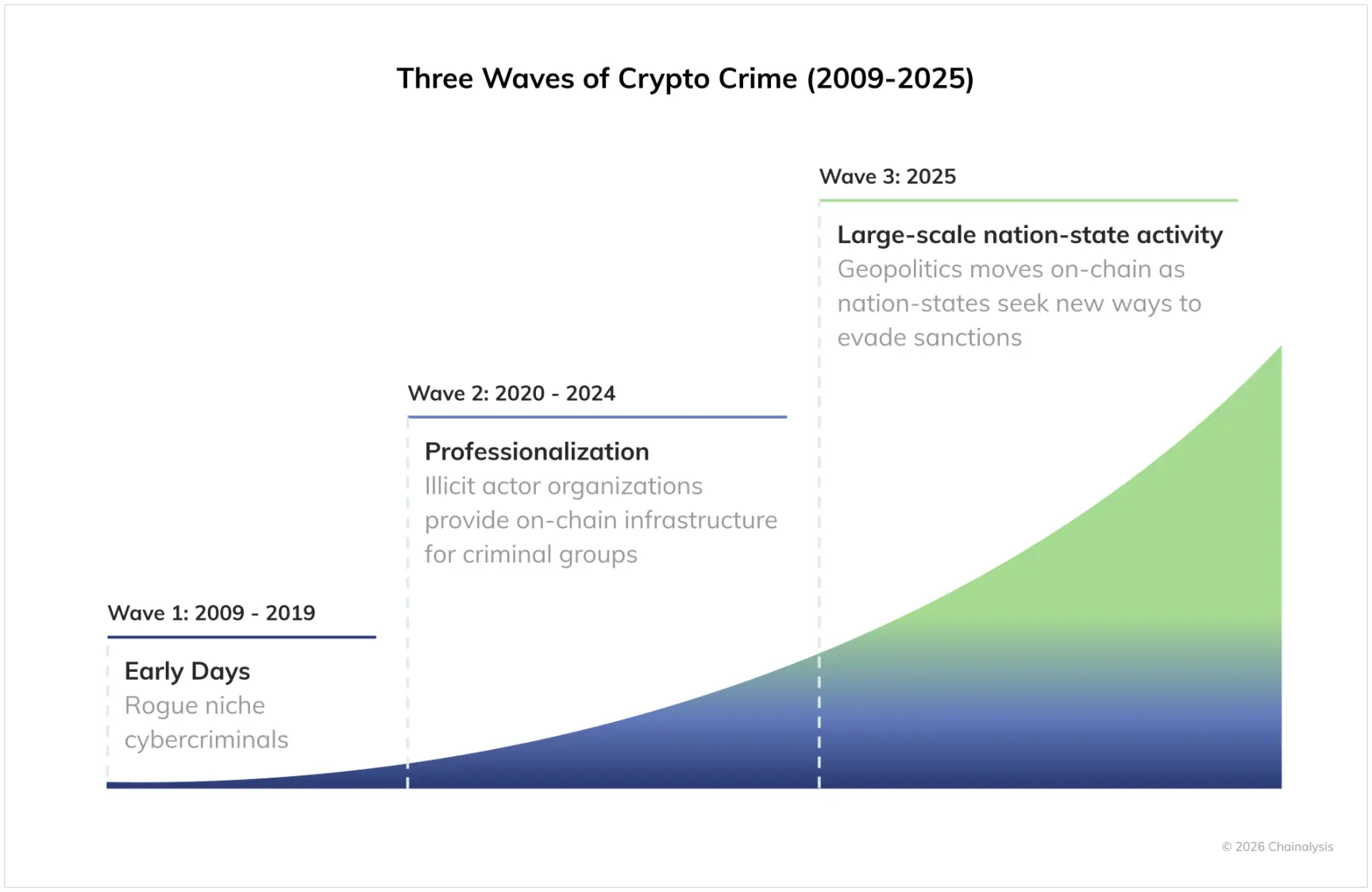
What are the specific on-chain manifestations of these developments and other industry changes? Next, we will analyze them by combining data with macro trends.
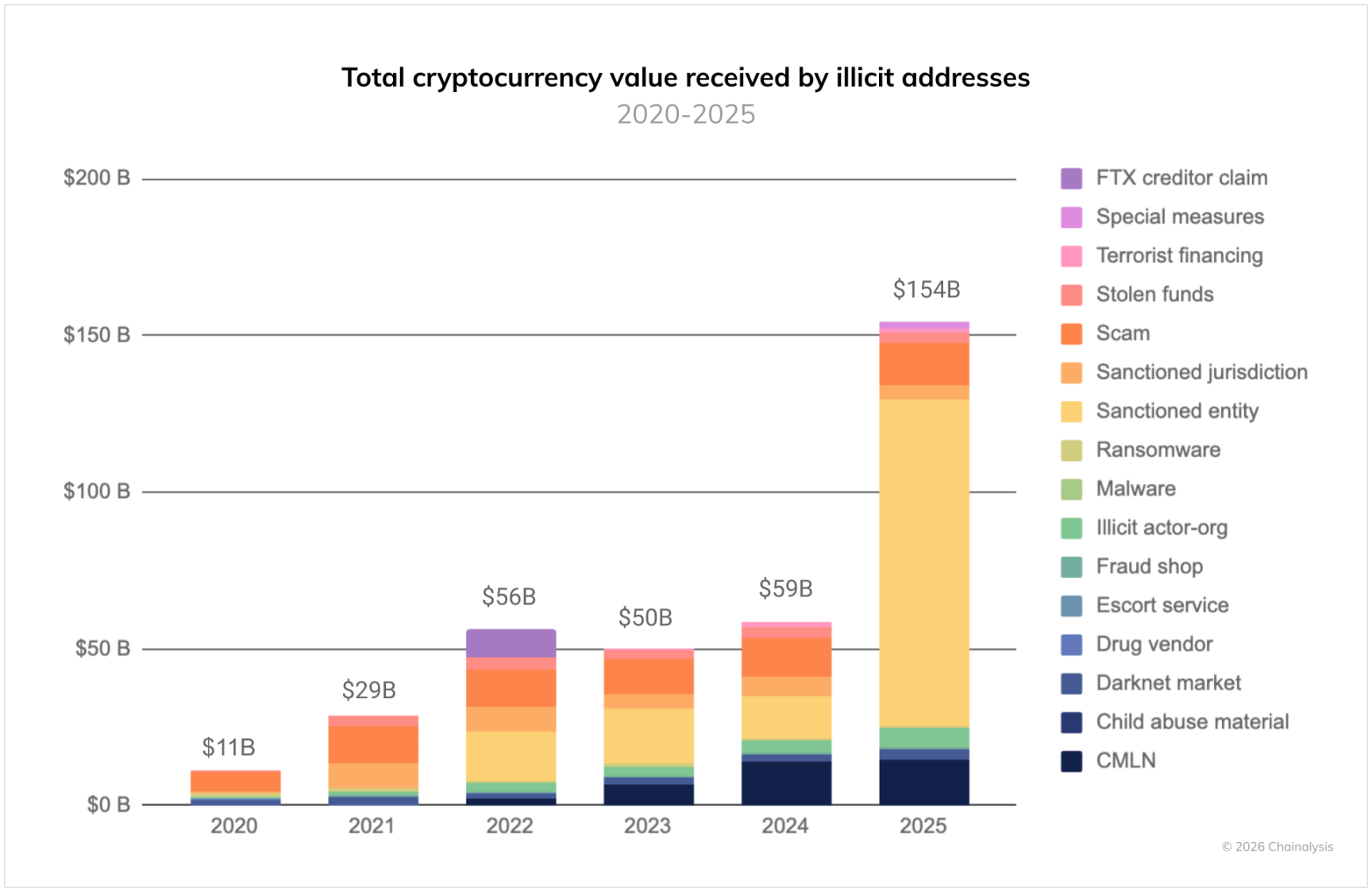
According to our monitoring data, the scale of funds flowing into illegal cryptocurrency addresses in 2025 reached at least $154 billion, a sharp increase of 162% year-on-year. This growth was primarily driven by a surge in fund inflows to sanctioned entities, which skyrocketed by 694% year-on-year. However, even after excluding the growth from sanctioned entities, 2025 still stands as a record year for cryptocurrency crime, as the scale of most illegal activity categories saw growth.

Nevertheless, the scale of these illegal transactions still pales in comparison to the overall cryptocurrency economy, where the main body of transactions remains legitimate. We estimate that although the proportion of illegal transactions in the total traceable cryptocurrency transaction volume in 2025 increased slightly compared to 2024, it remains below 1%.

As shown in the figure below, we also observed a continuous shift in the types of assets involved in cryptocurrency crimes.
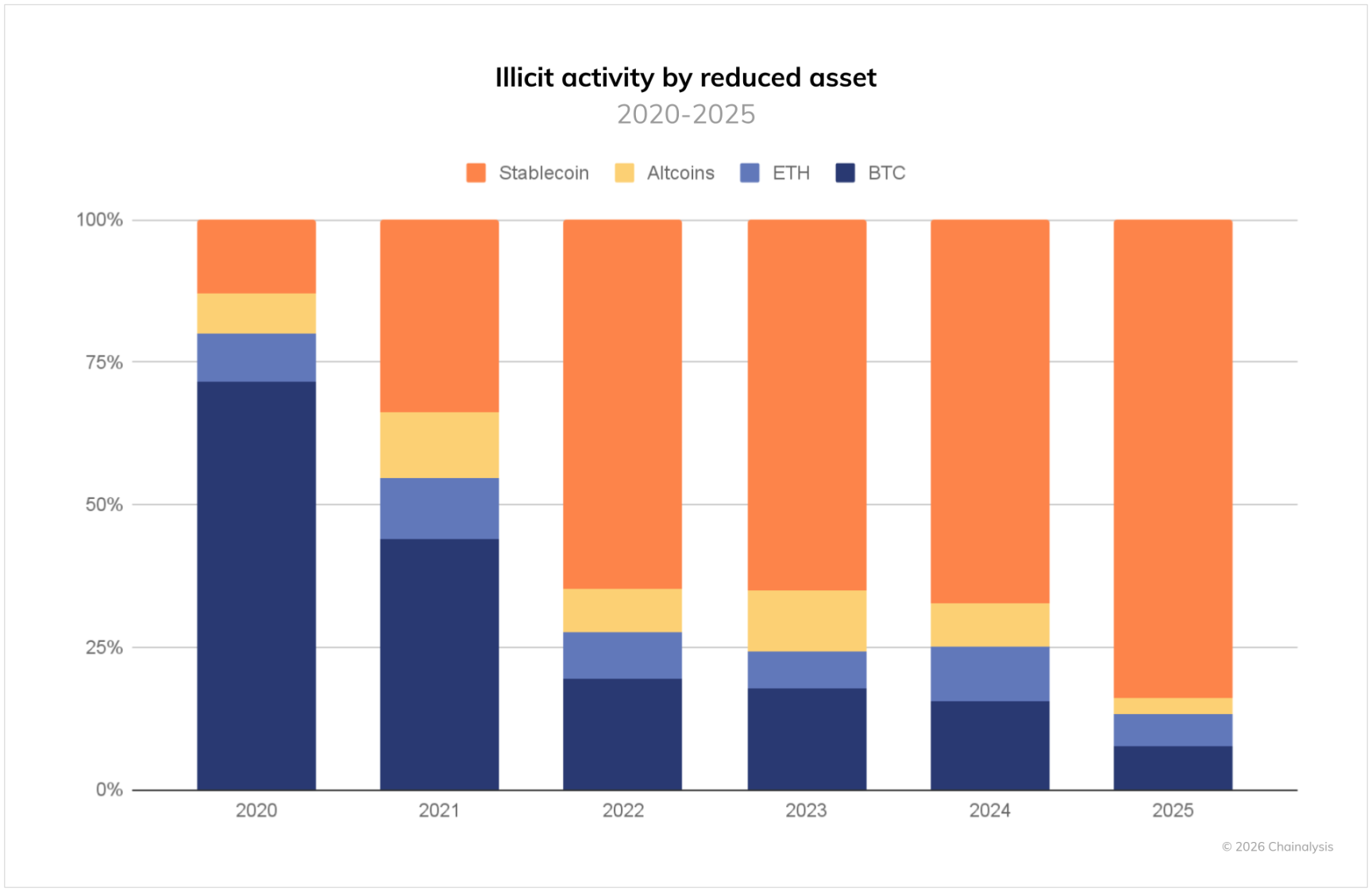
Over the past few years, stablecoins have gradually become the dominant asset in illegal transactions, currently accounting for 84% of the total illegal transaction volume. This trend aligns with the overall development characteristics of the cryptocurrency ecosystem: with advantages such as convenience for cross-border transfers, low volatility, and wide application scenarios, the share of stablecoins in the entire cryptocurrency transaction volume continues to expand.

The following sections will delve into the core trends that defined the 2025 cryptocurrency crime landscape, trends that will remain important to focus on in the future.

National-Level Threats Drive Transaction Volume: North Korean Thefts Hit Record High, Russia's A7A5 Token Facilitates Large-Scale Sanction Evasion

In 2025, stolen funds remained a major threat to the cryptocurrency ecosystem, with hacking groups linked to North Korea alone stealing $2 billion. This figure was primarily driven by several highly destructive large-scale hacking incidents, the most notable being the attack on the Bybit exchange in February. This incident involved nearly $1.5 billion, making it the largest digital asset theft in the history of cryptocurrency. Although North Korean hackers have long been a major force threatening the cryptocurrency ecosystem, the past year saw record highs both in the amount stolen and in the sophistication of their intrusion and money laundering methods.

Particularly noteworthy is that the scale of on-chain activities reached unprecedented levels in 2025. Russia introduced relevant legislation in 2024 to use cryptocurrency to evade sanctions, and this measure was formally implemented in February 2025. The country launched the ruble-backed token A7A5, which saw its transaction volume exceed $93.3 billion in less than a year since its launch.

Meanwhile, over the past few years, Iran's proxy networks have conducted money laundering, illegal oil trading, and bulk commodity procurement for weapons on-chain through verifiable wallet addresses that have been placed on sanctions lists, with a cumulative transaction volume exceeding $2 billion. Despite suffering multiple military strikes, terrorist groups supported by Iran, such as Hezbollah, Hamas, and the Houthis, continue to use cryptocurrency on an unprecedented scale.

In 2025, Chinese money laundering networks emerged as a dominant force in the illegal on-chain ecosystem. These organizations operate with sophisticated models, greatly promoting the diversification and professionalization of cryptocurrency crime, offering various specialized criminal services including "money laundering services." Building upon early illegal operation models like "Huiyin Guarantee," these networks have established full-service criminal enterprises, covering businesses in multiple areas such as fraud, scams, laundering proceeds from North Korean hacker thefts, sanction evasion, and terrorism financing.

Full-Stack Illegal Infrastructure Providers Fuel Malicious Cyber Activities

While governments increase their use of cryptocurrency, traditional cybercrime activities remain rampant: ransomware operators, child sexual abuse and cybercrime platforms, malware distributors, scammers, and illegal marketplaces still rely on vast support networks to maintain operations. Illicit actors and national governments are increasingly dependent on on-chain infrastructure providers that offer full-stack services, including domain registrars, secure and reliable hosting services, and other technical infrastructure that can be used to carry out malicious cyber activities.

These infrastructure providers have evolved into comprehensive infrastructure platforms capable of resisting platform takedowns, abuse complaints, and sanction enforcement. As the scale of these services continues to expand, they may become a key force driving economic crime and state-supported entities to expand the scope of malicious cyber activities.

Growing Correlation Between Cryptocurrency and Violent Crime

In the perception of many, cryptocurrency crime is still confined to the virtual world. The masterminds are merely anonymous figures hiding behind keyboards, not posing a threat in the real world. But in fact, the connection between on-chain activities and violent crime is deepening. Human trafficking gangs are using cryptocurrency for transactions more and more; at the same time, disturbingly, the number of violent coercion attack cases has risen significantly, where criminals use violent means to force victims to transfer crypto assets, and such assaults often occur during peak cryptocurrency price periods.

Looking ahead, collaboration between law enforcement agencies, regulatory bodies, and cryptocurrency companies will be key to addressing these complex, evolving, and interconnected threats. Although the proportion of illegal transactions in the legitimate cryptocurrency transaction volume remains limited, maintaining the integrity and security of the cryptocurrency ecosystem has never been more important.


Twitter:https://twitter.com/BitpushNewsCN

Bitpush TG Discussion Group:https://t.me/BitPushCommunity

Bitpush TG Subscription: https://t.me/bitpush

Original link:https://www.bitpush.news/articles/7601752

Câu hỏi Liên quan

QWhat was the total value of illicit cryptocurrency transactions in 2025, and what was the primary driver of this growth?

AThe total value of illicit cryptocurrency transactions in 2025 reached at least $154 billion, a 162% year-over-year increase. This growth was primarily driven by a 694% surge in inflows to sanctioned entities.

QWhich asset has become the dominant currency for illicit transactions, and what percentage of the total illicit volume does it represent?

AStablecoins have become the dominant asset for illicit transactions, representing 84% of the total illicit transaction volume.

QWhich country's state-sponsored groups set a new record for cryptocurrency theft in 2025, and what was the most notable attack?

ANorth Korean hacking groups set a new high for cryptocurrency theft in 2025, stealing $2 billion. The most notable attack was the February hack of the Bybit exchange, which resulted in a loss of nearly $1.5 billion, making it the largest digital asset theft in cryptocurrency history.

QWhat new token did Russia launch in 2025 to facilitate large-scale sanctions evasion, and what was its trading volume?

ARussia launched the ruble-backed token A7A5 in 2025 to facilitate large-scale sanctions evasion. Its trading volume surpassed $93.3 billion in less than a year.

QAccording to the article, what is an emerging and concerning trend regarding the link between cryptocurrency and real-world crime?

AAn emerging and concerning trend is the increasing link between on-chain activity and violent crime. This includes human trafficking networks using crypto for transactions and a significant rise in violent coercion attacks, where victims are forced under duress to transfer crypto assets, often during periods of peak cryptocurrency prices.

Nội dung Liên quan

Quan điểm KOL: Tại sao SOL sẽ tăng giá tại điểm này?

Tác giả Gum (biên dịch bởi Deep Tide TechFlow) đưa ra quan điểm rằng SOL đang ở vị trí sẵn sàng tăng giá, dựa trên các lý do sau: SOL vừa phá vỡ khỏi giai đoạn tích lũy kéo dài 4 tháng, đánh dấu sự trở lại của tâm lý chấp nhận rủi ro trên thị trường tiền điện tử, mà SOL là đại diện cho xu hướng này. Lượng nắm giữ đang chuyển từ các nhà giao dịch ngắn hạn sang các nhà tích lũy dài hạn mạnh tay, trong khi khối lượng giao dịch ở mức thấp. Bất kỳ sự gia tăng khối lượng hợp lý nào cũng có thể thúc đẩy đà tăng. Solana được hưởng lợi từ sự hỗ trợ thể chế mạnh mẽ, tích hợp DeFi & Tài sản thực (RWA), và Đạo luật Clarity. Đây là một trong số ít mã thông báo đạt ATH mới trong chu kỳ trước và có hệ sinh thái ứng dụng, người dùng, giao thức mạnh mẽ. Các yếu tố tăng trưởng trong tương lai bao gồm: sự tập trung phát triển AI trên Solana sau hội nghị Accelerate tại Miami, và việc memecoins tiếp tục phát triển mạnh trên nền tảng này, thúc đẩy nhu cầu cho các sản phẩm liên quan như Axiom hay bot giao dịch. Tóm lại, sự chuyển đổi quyền sở hữu, cơ sở hạ tầng vững chắc và các động lực phát triển mới khiến tác giả tin rằng SOL đang ở điểm khởi đầu cho một đợt tăng giá.

marsbit9 phút trước

Quan điểm KOL: Tại sao SOL sẽ tăng giá tại điểm này?

marsbit9 phút trước

Những Giao Thức PoW Trước Bitcoin Đã Được Làm Lại Gần Đây

**Tóm tắt:** Trong 5 ngày đầu tháng 5 năm 2026, một nhóm các nhà phát triển trong hệ sinh thái Bitcoin đã cùng nhau tái hiện lại các giao thức Proof-of-Work tiền Bitcoin (cypherpunk), mở đầu bằng RPOW của Hal Finney (2004). Fred Krueger (rpow2.com) triển khai phiên bản trung tâm trung thành với thiết kế gốc, thay thế phần cứng tin cậy IBM 4758 bằng chữ ký Ed25519. Sau đó, anh ta thêm các đặc trưng của Bitcoin như giới hạn nguồn cung 21 triệu và điều chỉnh độ khó, đồng thời dành riêng 5.24% cho nhà sáng lập. Các nhà phát triển khác nhanh chóng tham gia: cryptonaut420 (rpow4.com) sao chép toàn bộ thông số Bitcoin, ImMike tạo thị trường dự đoán (rpowmarket.com), Adam McBride xây sàn giao dịch (rpow2swap.com). Mike In Space (người sáng lập Bitcoin Stamps) thậm chí đã tạo một nguyên mẫu cho b-money của Wei Dai (1998) - một đề xuất còn sớm hơn RPOW. Các dự án này đều mang tính chất thử nghiệm, tôn vinh và không có giá trị đầu tư. Chúng nổi bật lên một sự quan tâm tập thể từ một nhóm văn hóa phụ (Bitcoin cổ, Counterparty, Ordinals) trong việc khảo cổ và tái hiện lịch sử ý tưởng tiền điện tử phi tập trung trước khi Satoshi tổng hợp chúng thành Bitcoin. Một dự án khác tên HASH trên Ethereum cũng được đề cập, sử dụng cơ chế hook để đảm bảo fair launch hoàn toàn cho một token PoW mô phỏng Bitcoin.

marsbit10 phút trước

Những Giao Thức PoW Trước Bitcoin Đã Được Làm Lại Gần Đây

marsbit10 phút trước

Báo cáo tài chính, Đạo luật CLARITY, Warsh tới tay, CRCL đón ba cuộc kiểm tra liên tiếp trong tuần này

Tác giả Azuma phân tích ba sự kiện quan trọng ảnh hưởng tới Circle (CRCL) trong tuần này. 1. **Báo cáo tài chính Q1/2026 (11/5):** Báo cáo tập trung vào doanh thu, lợi nhuận (dự kiến doanh thu 715 triệu USD, EPS 0.178 USD), tỷ lệ chi phí phân phối cho Coinbase và thu nhập phi lãi suất. Điểm đáng chú ý là hợp đồng phân phối USDC giữa Circle và Coinbase hết hạn vào tháng 8. Việc đàm phán điều khoản gia hạn sẽ rất quan trọng, với lợi thế có thể thuộc về Circle do Coinbase đang phụ thuộc nhiều. 2. **Dự luật CLARITY tại Thượng viện (14/5):** Ủy ban Ngân hàng Thượng viện Mỹ sẽ bỏ phiếu thông qua dự luật thiết lập khuôn khổ pháp lý rõ ràng cho tài sản số. Sau khi vượt qua Hạ viện năm ngoái, dự luật gần đây đã đạt được thỏa hiệp về việc cấm trả lãi cho stablecoin dự trữ tĩnh nhưng cho phép với stablecoin hoạt động. Thị trường lạc quan (76% cơ hội thông qua), và nếu thành luật, đây sẽ là tin tích cực lớn cho Circle và toàn ngành. 3. **Chủ tịch Cục Dự trữ Liên bang (Fed) đổi nhiệm (15/5):** Kevin Warsh sẽ thay thế Jerome Powell. Ông ủng hộ kết hợp "thu hồi nợ (QT) + cắt giảm lãi suất". Về ngắn hạn, điều này có thể gây áp lực giảm giá cho CRCL do lợi nhuận từ trái phiếu kho bạc Mỹ bị ảnh hưởng bởi lãi suất thấp hơn. Tuy nhiên, về dài hạn, Warsh - một người nắm giữ tiền mã hóa và ủng hộ nâng cấp số hóa năng lực cạnh tranh tài chính Mỹ - có thể tạo thuận lợi về chính sách cho Circle, như việc ông muốn đưa các stablecoin tư nhân như USDC vào hệ thống giám sát của Fed.

marsbit1 giờ trước

Báo cáo tài chính, Đạo luật CLARITY, Warsh tới tay, CRCL đón ba cuộc kiểm tra liên tiếp trong tuần này

marsbit1 giờ trước

Những Tỷ Phú Đằng Sau Cuộc Bầu Cử Giữa Kỳ Đắt Giá Nhất Lịch Sử

Cuộc bầu cử giữa kỳ năm 2026 được dự báo là cuộc bầu cử đắt đỏ nhất trong lịch sử, với tổng chi tiêu cho quảng cáo chính trị ước tính lên tới 10,8 tỷ USD. Các tỷ phú đang đổ hàng chục triệu USD để tác động đến cuộc đua giành quyền kiểm soát Quốc hội và các chính sách then chốt. Theo phân tích của Bloomberg, hơn 4,7 tỷ USD đã được huy động cho các ủy ban chính trị liên bang trong chu kỳ này. Phần lớn nguồn tiền lớn đang chảy về phe Cộng hòa. Các nhà tài trợ cá nhân hàng đầu bao gồm George Soros (102,6 triệu USD), Elon Musk (84,8 triệu USD) và Jeff Yass (81,8 triệu USD). Yass là nhà tài trợ cá nhân lớn cho MAGA Inc. của ông Trump và ủng hộ mạnh mẽ quyền lựa chọn trường học. Các tỷ phú công nghệ cũng tham gia sâu rộng, với những khoản đóng góp lớn nhằm định hình quy định về trí tuệ nhân tạo và tiền mã hóa, hoặc chống lại các đề xuất thuế tỷ phú. Greg Brockman (OpenAI) và Marc Andreessen là những nhà tài trợ chính cho ủy ban hành động chính trị (PAC) về AI "Leading the Future". Các tỷ phú khác như Miriam Adelson và Paul Singer tiếp tục ủng hộ mạnh mẽ các ứng viên thân Israel. Bài viết nêu bật xu hướng "tiền đen" ẩn danh ngày càng tăng và dự báo sẽ có thêm các nhà tài trợ tỷ phú xuất hiện khi ngày bầu cử 3/11 đến gần.

marsbit1 giờ trước

Những Tỷ Phú Đằng Sau Cuộc Bầu Cử Giữa Kỳ Đắt Giá Nhất Lịch Sử

marsbit1 giờ trước

Sau khi lưu trữ tăng 50 lần, Sun Yuchen luôn hướng tới thập kỷ tiếp theo

Đa số người Trung Quốc biết đến Sun Yuchen (Tôn Vũ Thần) qua những câu chuyện gây tranh cãi và hành động thu hút sự chú ý. Tuy nhiên, ẩn sau hình ảnh đó là một nhà đầu tư có tầm nhìn xa trong thập kỷ qua. Năm 2016, ông khuyên giới trẻ không nên mua nhà mà đầu tư vào Bitcoin, NVIDIA, Tesla và Tencent. Đến năm 2026, những đề xuất này mang lại lợi nhuận khổng lồ, với NVIDIA tăng gần 24000%. Gần đây, tuyên bố "Mua ổ cứng" của ông vào tháng 11/2025 đã thúc đẩy cơn sốt cổ phiếu lưu trữ, như Western Digital (tách ra thành Sandisk) tăng gần 50 lần. Khi mọi người còn đang đuổi theo xu hướng này, Sun Yuchen đã chuyển sự chú ý sang bốn lĩnh vực mới nổi cho thập kỷ tới: Trí tuệ thể hiện (Robot hình người), Máy bay không người lái, Điện toán không gian và Khám phá vũ trụ. Ông nhấn mạnh rằng đây là những hướng đi then chốt mà AI vật lý sẽ định hình lại thế giới thực, từ nhà máy, chiến trường đến không gian. Triết lý đầu tư của ông là xác định các lĩnh vực có triển vọng và đặt cược vào cả "cơ thể" lẫn "bộ não" của ngành, không dựa vào một công ty duy nhất. Ví dụ, trong robot, ông tin vào khả năng sản xuất của Tesla (Optimus) và nền tảng AI của NVIDIA (GR00T). Năm 2025, Sun Yuchen đã tự mình bay qua đường Kármán trên chuyến bay của Blue Origin, củng cố niềm tin vào tương lai kinh tế vũ trụ. Ông kêu gọi giới trẻ tập trung vào công nghệ và đổi mới. Trong khi nhiều người vẫn chờ đợi cơ hội trong các lĩnh vực cũ, Sun Yuchen đã nhìn về một tương lai nơi AI vật lý thay đổi cách vận hành cơ bản của thế giới.

marsbit1 giờ trước

Sau khi lưu trữ tăng 50 lần, Sun Yuchen luôn hướng tới thập kỷ tiếp theo

marsbit1 giờ trước

Giao dịch

Giao ngay
Hợp đồng Tương lai
活动图片