After Half a Year as a Token Broker, She Has Fallen into Every Pitfall of the Relay Station Business

marsbitXuất bản vào 2026-05-09Cập nhật gần nhất vào 2026-05-09

Tóm tắt

Sukie, who operated an AI API "middle station" service for six months, recently open-sourced her entire setup process. Her story reveals the harsh realities of this once-lucrative but now hyper-competitive market. The core challenge is cost. Legitimate, compliant API accounts are expensive. To compete, many players resort to cheaper, high-risk sources like stolen accounts. The market has seen prices plummet from 70-80% of official rates down to 30-50%, a level unsustainable for compliant operators. Sukie believes a 70-80% price point is the minimum for healthy margins using legitimate methods. A major mistake was targeting the Chinese market while incurring USD costs. She found Chinese developers extremely price-sensitive compared to Western clients, leading to thin margins compounded by currency and payment hurdles. Operational burdens are heavy: maintaining a pool of hundreds of accounts against rising platform bans, handling detailed technical support, and managing cross-border payments and invoices for different client types. Marketing channels like X (Twitter) and referrals work best, while platforms like Douyin (TikTok) and Xianyu have poor ROI due to low intent or pricing mismatches. The landscape shifted dramatically with high-profile entrants like Justin Sun, Fu Sheng, and the Trump family. For them, the middle station is a loss leader to attract users to their primary businesses—crypto ecosystems, corporate narratives, or token promotions. This makes competing o...

"Considering the time cost, the return on investment for running a relay station is lower than going out and getting a job."

A few days ago, Sukie open-sourced the entire process of building her relay station, from server procurement and technical configuration to marketing and customer acquisition, writing it all into a tutorial. This post brought her dozens of new users on social media in a single day. We reached out to Sukie, hoping to talk with her about what things look like from the inside after actually having run this business.

The relay station industry has gone through a full cycle over the past year, from quietly making profits to cutthroat competition in a red ocean, and then to big players entering to reap the rewards. Beating previously reported on a station owner Mo who only served B2B clients ("After Claude Required Real-Name Verification, a Relay Station Owner's Reflections"). Her story revealed the daily operations of this business and the global disparity in AI access it touches. This time, the storyteller Sukie offers another perspective: Why didn't she make money even after someone with sound business acumen had successfully implemented technology, marketing, and compliance?

When the barrier to entry for a business is low enough for anyone to join, and profits are destined to be positive only through gray-area operations or ecosystem arbitrage, where exactly is the space left for independently operating, compliant relay stations?

Here is Sukie's account.

Accounts from Compliant Sources Are Just Expensive

Our account pool mainly comes from two sources: a partner provides some from Singapore, and we register some ourselves.

The ones we register ourselves follow the compliant path, using real payment methods and identity information. This type of account is costly and slow to acquire, but offers the best stability.

There are also accounts of questionable origin within the industry—some people buy stolen accounts, use fake identities, or even employ bots for bulk registration. They're cheap, but high-risk; once tracked and linked by the upstream platform, the entire account pool can be wiped out.

This is also why our costs can't come down—accounts from compliant sources are inherently expensive. This is a core contradiction in the relay station industry: either cheap but with compliance risks, or expensive but able to run long-term. We chose the latter.
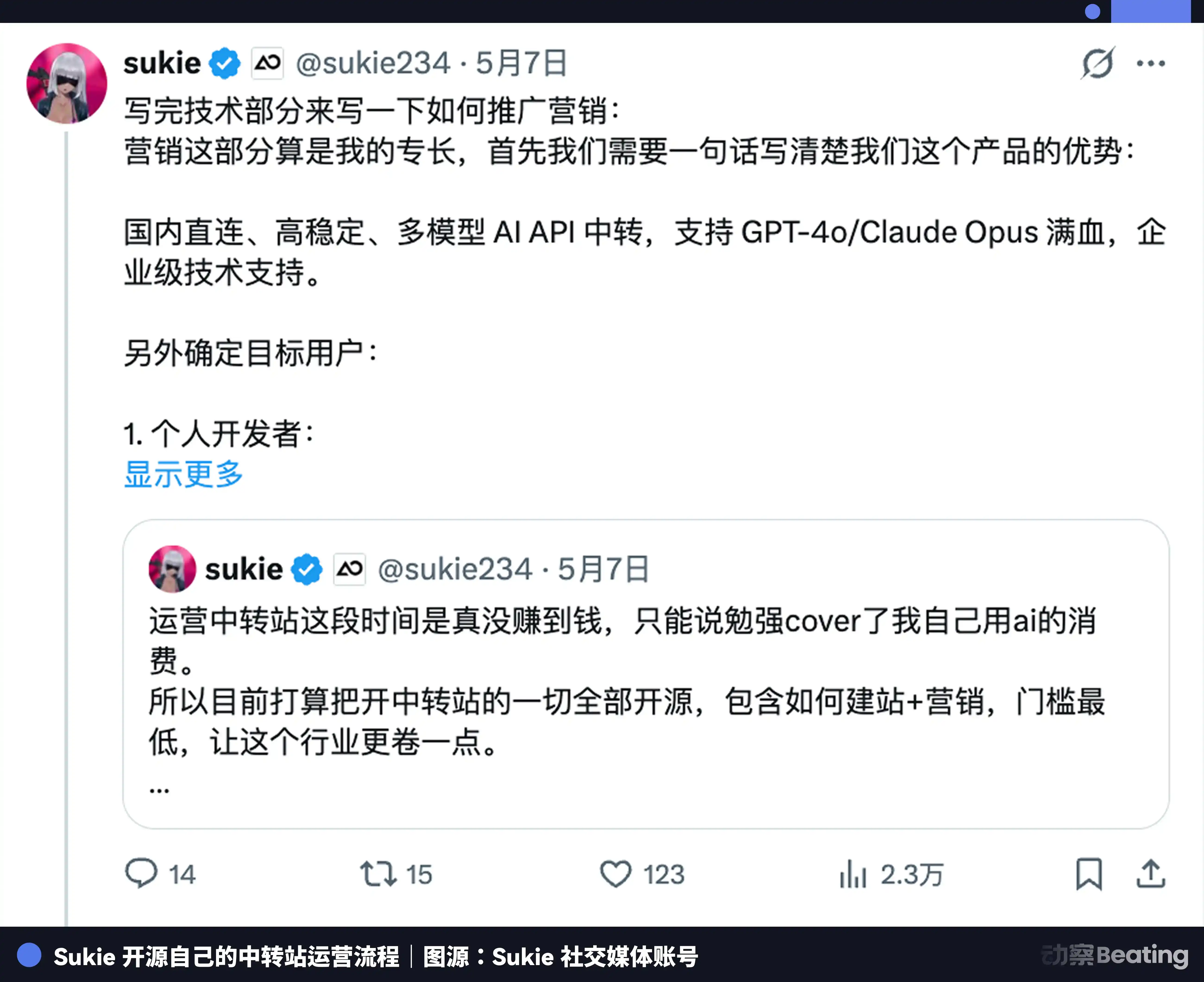
In 2024, the industry still had a gross profit margin of 30% to 40%. The top 20 scaled relay stations were basically all profitable. Competition was based on stability and customer service experience, not price.

The turning point came in the second half of 2025. Wave after wave of new players entered the market, each undercutting the previous price. First 20% off, then 30% off, 40% off, and by early 2026, some were offering 50% or even 70% off the official price.

The current state is that players willing to price with a healthy margin can't survive because users flee; those offering ultra-low prices also can't survive because costs can't be compressed to that level, relying on gray-area operations to sustain.

From an industry perspective, using an account pool from compliant sources, plus labor and server costs, the minimum pricing for profitability is roughly 70% to 80% of the official price. Below that range, either the account pool's origin is problematic, or they are burning through investor money.

10% of the official price—profitability through compliant means is impossible because the upstream account fees alone exceed 10%.

Word spreads in developer communities. Users attracted short-term by ultra-low prices, who discover issues with service quality, token count discrepancies, or inconsistent model outputs, will churn quickly. But when they leave, they take with them a distrust of the entire industry, harming the whole sector.

Earning RMB is Really Hard

My biggest mistake was choosing to earn RMB while being based in the US.

Our costs are settled in USD—account pools, servers, payment channels are all in USD—but our revenue is in RMB, coming from the most price-sensitive developer group in the Chinese market. Chinese users are extremely price-sensitive; their willingness and ability to pay are not on the same level as European or American clients.

Being in the US, I should have directly targeted European and American businesses, earning USD. Selling relay stations to the Chinese market neutralizes all the advantages of geographic location, instead suffering from both exchange rate and payment drawbacks.

There are issues with the payment chain, and pricing competition is fierce, but the fundamental reason is the low payment ceiling of the customer base itself.

The money earned is hard-earned. From buying servers to getting the relay station running, someone with basic technical knowledge can figure it out in a week or two. What truly consumes energy and money are the operational aspects.

The biggest drain is account pool maintenance. Accounts get banned, frozen; status needs monitoring daily, and new accounts need periodic replenishment. Typically, a medium-sized relay station has a pool of hundreds to thousands of accounts.

Upstream platforms' risk control policies, whether request patterns appear human, and the quality of account sources all influence ban rates. Combined, the overall account suspension rate is continuously rising. Some accounts survive for months, others get flagged by risk control on the day of registration.

The second drain is customer service. Relay station users are mostly developers with very specific questions, like why token counts don't match? Why is the response slow? Why is this model throwing errors today? Each has to be answered, or reputation will collapse.

Small and medium enterprises contribute the highest average order value, AI shelling entrepreneurs contribute the highest active usage volume, and individual developers contribute the largest user base but the lowest unit price.

The most difficult to serve are AI shelling entrepreneurs: extremely price-sensitive, comparing and migrating monthly with the lowest retention rates; request volume fluctuates wildly—a product suddenly trending can cause request volume to spike 100x in a day, crashing the account pool. Feedback is also swift; one "doesn't work well" in a developer community spreads much faster than with B2B clients.

The easiest to serve are actually SMEs with dedicated technical contacts: stable traffic, timely payments, requiring invoices and contracts; a few interactions can establish long-term cooperation.

Looking at channels, earning RMB is also harder. This time, I open-sourced the relay station methodology on X, pulling in dozens of new orders. Overseas developers' willingness to pay and decision speed are an order of magnitude higher than domestic. Community referrals and agent distribution have the best conversion because trust costs for relay stations are extremely high; recommendations from acquaintances are ten times more efficient than cold traffic.

SEO and Xiaohongshu (Little Red Book) are slow but steady channels. SEO users have the strongest purchase intent, but traffic is small, growth is slow, taking three to six months to show results. Xiaohongshu has high traffic, moderate conversion; users are mainly AI application-layer developers and early-stage entrepreneurs.

The worst return on investment comes from Douyin (TikTok) and Xianyu (Idle Fish). Douyin's algorithm is unfriendly to technical content; paying for ads yields less than organic growth. Xianyu users expect solutions for a few dozen RMB, but our cost structure doesn't allow such pricing—many inquire but few place orders, each inquiry consuming time.

The third is compliance and payments; cross-border collection requires careful handling of each transaction. For example, our academic clients require contracts, overseas clients use USD channels, domestic clients using RMB need entity and invoice solutions. Each client type has its own compliance process.

Another aspect is preventing free-riding (anti-fraud). Once open source or free trials are offered, scripts for bulk registration to harvest free tokens appear immediately, requiring weekly updates to defense strategies.

Newcomers most easily underestimate the details of these operational aspects. Low barriers mean rapid competition; rapid competition means no moat.

Let the Market Compete More Fiercely

Two weeks ago, Brother Sun (Justin Sun), Fu Sheng, and even the Trump family entered the relay station business. This business has reached an inflection point. Brother Sun focuses on privacy/anonymity plus the lowest prices online. Fu Sheng promotes an 15% discount across the board. The Trump family directly cuts 35%, with the most expensive package at $9,999 including a ticket to Mar-a-Lago.
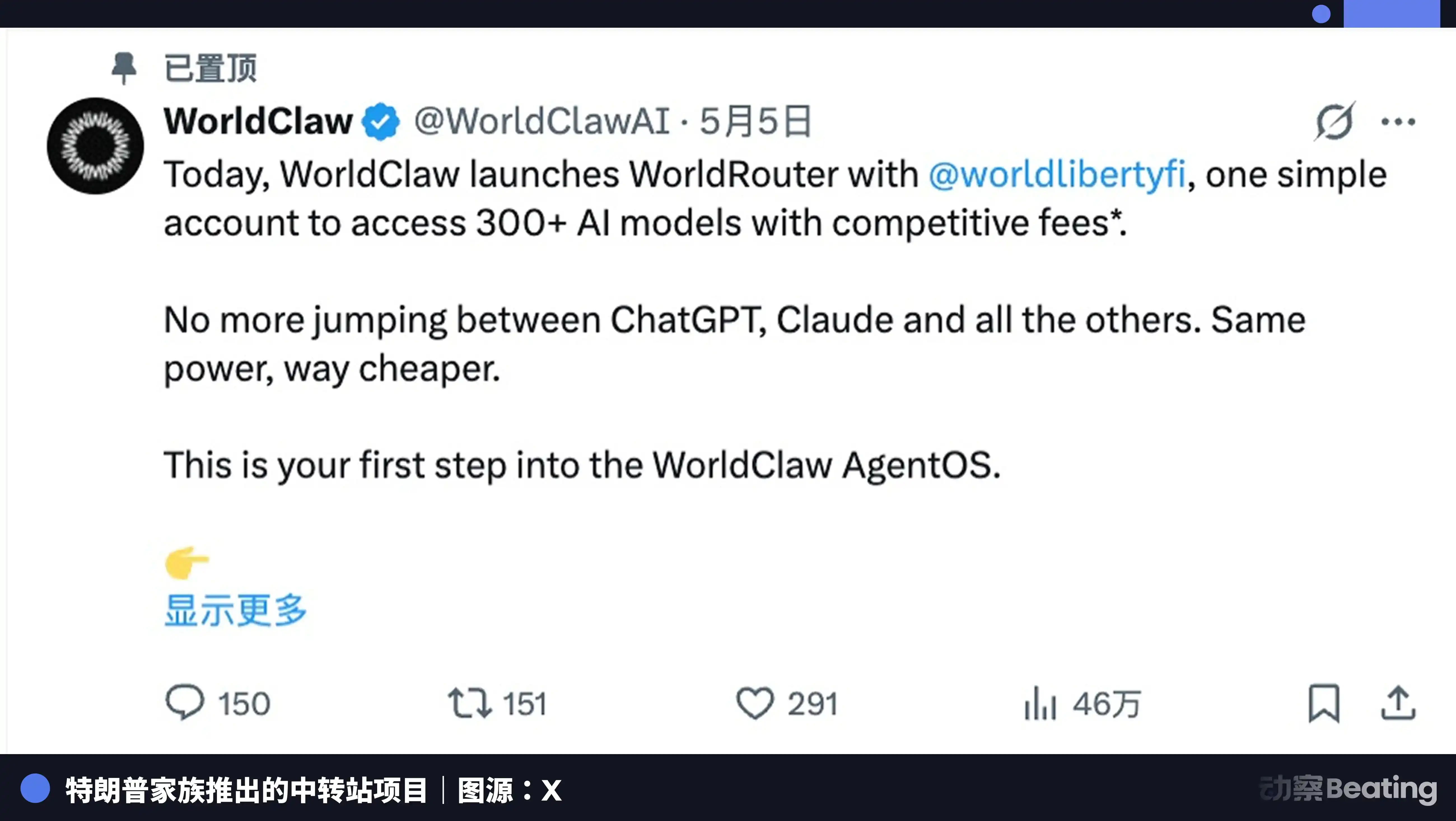
The three target completely different customer segments, but their essence is repackaging upstream model APIs and reselling them. None truly rely on the relay station price difference to survive.

Brother Sun's main dish is on-chain payment settlement; money collected through the relay station is settled via blockchain, essentially generating transaction volume for Tron. Fu Sheng's main dish is the story of Cheetah Mobile's business transformation, telling an AI story to the capital markets. The Trump family's main dish is WLFI tokens and the USD1 stablecoin; the relay station is just a traffic acquisition tool.

For these three parties, the relay station price difference is not the profit source at all. They can use the relay station at a loss to acquire users, then make money from the users through the ecosystem, tokens, and branding.

That's why this business is unfriendly to individuals. People making money in the industry are either exploiting information asymmetry through gray-area operations, or using the relay station to feed a larger business. We fit into neither category.

This is also why I chose to make the relay station business public. On one hand, it serves as marketing; the open-source post's reach these past couple of days far exceeds previous ad posts.

The second reason is industry contribution. Relay stations are heavily demonized; outsiders think they're all gray market, borderline, scams. But there are people doing this compliantly. By making the setup process public, we let more people know the technology isn't a black box.

The moat of this business was already thin, but maintained by high margins through information asymmetry by some black-box operators. After open-sourcing, even amateurs can build their own, eliminating the technical barrier premium of black-box players. What remains are real capabilities: account pool stability, customer service experience, compliance ability.

So the real meaning of "letting the industry compete more fiercely" is shifting the competition from price to service quality. For us, this moves the battlefield to a direction favorable to us.

Continuing to compete on price in the C2C retail battlefield is meaningless. We open-source the tools, letting small players build their own, allowing us to focus on high-margin clients in niche markets.

However, I advise friends still wanting to enter this field: don't jump in lightly.

If you just want to earn some extra cash, find it useful for yourself, and can sell to a few friends around you, you can give it a try. The technical barrier isn't high; running one for personal convenience can also cover server costs.

If you want to treat this as a full-time startup project, don't do it. High-end players have their own ecosystems behind them; ultra-low-price players use gray methods. You can't compete on price if you're doing it compliantly.

If you're already in the game, then focus on niche markets, like B2B, academic institutions, or overseas markets.

There are so many more worthwhile directions to invest in within the AI industry; no need to bet on a track with no moat.

A relay station is just an entry ticket, not the destination.

Câu hỏi Liên quan

QWhat is the core contradiction in the source of accounts for AI API relay station businesses, according to Sukie?

AAccording to Sukie, the core contradiction is between using cheap accounts with high compliance risks (e.g., stolen or bulk-registered accounts) that can be shut down, and using expensive, compliantly sourced accounts with real identities and payment methods that are stable for long-term operation. Her company chose the latter, which keeps their costs high.

QWhat was Sukie's biggest strategic mistake when running her relay station business?

AHer biggest mistake was being based in the US but choosing to earn Chinese Yuan (RMB). Her costs (account pools, servers, payment channels) were in USD, but her revenue was in RMB from price-sensitive Chinese developers. This negated her geographical advantage and created losses from currency exchange and payment complexities.

QWhy does Sukie believe it's difficult for compliant individual operators to survive in the current relay station market?

AShe believes compliant individual operators struggle because high-profile players (like those mentioned: Sun Ge, Fu Sheng, the Trump family) use their relay stations not for profit from the API markup, but as a loss leader to feed larger ecosystems (e.g., blockchain transactions, capital market stories, token promotion). These players can afford to price extremely low, while grey-area operators use non-compliant accounts. Compliant operators cannot match these prices and lack a similar 'bigger business' to subsidize their operations.

QWhat are the main operational challenges or 'consumptions' Sukie identifies in running a relay station?

AThe main operational challenges are: 1) Account pool maintenance (monitoring for bans/freezes, replenishing accounts). 2) Customer service, as developer users ask highly specific technical questions. 3) Compliance and cross-border payment processing for different client types. 4) Defending against users who abuse free trials or open-source offers with scripts to harvest free tokens.

QWhat is Sukie's goal in open-sourcing her relay station's setup methodology?

AHer goals are twofold: 1) Marketing - the open-source post brought in dozens of new users. 2) Industry contribution - to demystify the technology, reduce the information asymmetry that allows some players to maintain high profits through 'black box' operations, and shift competition from just cutting prices to competing on service quality, stability, and compliance—areas where her company can excel.

Nội dung Liên quan

Đợt Thanh Lọc Thanh Khoản Bitcoin Khiến Nhà Giao Dịch Dõi Theo Kháng Cự 66K USD Và Hỗ Trợ 61K USD

Bài viết phân tích tình hình Bitcoin sau một đợt biến động mạnh, khi giá giảm từ vùng giữa 64.000 USD xuống gần 60.700 USD rồi phục hồi trên 63.000 USD, kích hoạt lượng thanh lý lên tới khoảng 980 triệu USD trong vòng chưa đầy 24 giờ. Các chuyên gia chỉ ra các vùng thanh khoản (liquidity zones) chính hiện nằm ở hai phía: vùng kháng cự tăng giá từ 63.500 USD đến 66.000 USD và vùng hỗ trợ giảm giá lớn hơn từ 58.500 USD đến 61.000 USD. Phân tích kỹ thuật từ Trade Nation xác định mức kháng cự trục chính tại 66.247 USD. Nếu không vượt qua được, Bitcoin có thể kiểm tra các hỗ trợ ở 59.150 USD, 56.900 USD và 54.920 USD. Một phân tích khác từ virDeStatera trên TradingView tập trung vào việc giá cần tái chiếm mức cao bị quét (swept high) tại 64.234 USD, với kháng cự tiếp theo tại 65.890 USD và hỗ trợ trong ngày quanh 63.127-63.354 USD. Tóm lại, thị trường đang trong trạng thái cân bằng giữa hai nhóm thanh khoản sau đợt xả đòn bẩy lớn. Lộ trình rõ ràng nhất là: kháng cự ở các mức 64.234 USD, 65.890 USD và 66.247 USD; trong khi rủi ro giảm giá tập trung quanh 63.127-63.354 USD, sau đó là 62.459 USD và vùng rộng hơn 59.150-60.171 USD. Quản lý rủi ro là ưu tiên hàng đầu cho đến khi giá phá vỡ rõ ràng một trong hai phía.

bitcoinist10 phút trước

Đợt Thanh Lọc Thanh Khoản Bitcoin Khiến Nhà Giao Dịch Dõi Theo Kháng Cự 66K USD Và Hỗ Trợ 61K USD

bitcoinist10 phút trước

Chính phủ Mỹ cấm người nước ngoài sử dụng Fable 5, Anthropic lên tiếng bác bỏ

Vào ngày 12 tháng 6, chính phủ Mỹ đã ban hành lệnh kiểm soát xuất khẩu, yêu cầu Anthropic ngay lập tức tạm dừng quyền truy cập của tất cả chủ thể nước ngoài vào hai mô hình AI Fable 5 và Mythos 5 vì lý do an ninh quốc gia. Lệnh này áp dụng rộng rãi, buộc Anthropic phải đóng cổng truy cập cả hai mô hình cho mọi người dùng, vì họ không thể phân biệt kỹ thuật giữa người dùng Mỹ và nước ngoài. Người dùng sẽ được chuyển về dùng Claude Opus 4.8. Fable 5 là phiên bản cao cấp nhất của Anthropic từng được công bố rộng rãi, trong khi Mythos 5 là phiên bản có ít biện pháp bảo vệ hơn, chỉ dành cho các tổ chức đặc biệt. Động thái của chính phủ được cho là xuất phát từ lo ngại về một phương pháp "vượt rào" (jailbreak) tiềm năng có thể khai thác lỗ hổng trong mô hình. Trong một tuyên bố hiếm thấy với ngôn từ cứng rắn, Anthropic đã phản bác lập luận của chính phủ. Công ty cho rằng bằng chứng "vượt rào" mà chính phủ nêu ra chỉ là một phương thức tấn công hẹp, không phổ biến, và khả năng tương tự cũng tồn tại ở các mô hình AI công khai khác như GPT-5.5 của OpenAI. Anthropic tuyên bố lệnh này không tuân theo một quy trình minh bạch và dựa trên thực tế kỹ thuật, đồng thời cảnh báo rằng nếu áp dụng tiêu chuẩn này, việc triển khai tất cả mô hình AI tiên tiến mới trong ngành sẽ bị đình trệ. Công ty khẳng định sẽ tuân thủ lệnh nhưng đang nỗ lực làm việc với chính phủ để sớm khôi phục quyền truy cập, đồng thời xin lỗi người dùng vì sự bất tiện này.

链捕手11 phút trước

Chính phủ Mỹ cấm người nước ngoài sử dụng Fable 5, Anthropic lên tiếng bác bỏ

链捕手11 phút trước

Đã có “người bạn robot” rồi, 10 ngày đã đặt trước 3.800 máy, phiên bản nam mặc vest ôm sát, phiên bản nữ có thể trang điểm, tích hợp mô hình cảm xúc ‘nuôi dưỡng’, chỉ dành cho người trưởng thành, chuyên gia trong ngành: Cần lưu ý nguy cơ về đạo đức

Công ty Ubtech (Youbixuan) đã ra mắt robot hình người cấp người tiêu dùng đầu tiên có tên U1, nhấn mạnh vào khả năng đồng hành và kết nối cảm xúc. Chỉ sau 10 ngày mở bán trước, sản phẩm đã nhận được gần 4.000 đơn đặt cọc, tương ứng với số tiền cọc hơn 10 triệu nhân dân tệ. Robot U1 có phiên bản nam và nữ, với chiều cao 183cm và 168cm tương ứng, trang bị 88 khớp chuyển động, kết nối Wi-Fi và pin hoạt động từ 2-4 giờ. Điểm nổi bật là việc tích hợp mô hình AI cảm xúc "nuôi dưỡng", có khả năng lưu trữ ký ức cục bộ được mã hóa và hỗ trợ tùy chỉnh ngoại hình đa chiều. Hình ảnh robot nam mặc vest ôm, đeo kính và robot nữ được trang điểm đầy đủ đã thu hút sự chú ý lớn trên mạng xã hội. Chuyên gia phân tích cho rằng nhóm khách hàng mục tiêu không chỉ là những người đơn thân, sống một mình mà còn bao gồm nhóm người tiêu dùng có thu nhập cao ở độ tuổi trung niên và những người trẻ trong văn hóa "thứ cấp nguyên" (secondary), sẵn sàng chi trả cho việc "nuôi dưỡng" nhân vật. Tuy nhiên, sản phẩm cũng đối mặt với những thách thức về kiểm soát chuỗi cung ứng, độ tự nhiên của thuật toán cảm xúc và đặc biệt là các vấn đề về đạo đức như phụ thuộc tình cảm không lành mạnh, suy giảm tương tác thực và rủi ro về bản quyền khi tùy chỉnh ngoại hình. Sản phẩm hiện chỉ dành cho người trưởng thành mua và sử dụng.

marsbit1 giờ trước

Đã có “người bạn robot” rồi, 10 ngày đã đặt trước 3.800 máy, phiên bản nam mặc vest ôm sát, phiên bản nữ có thể trang điểm, tích hợp mô hình cảm xúc ‘nuôi dưỡng’, chỉ dành cho người trưởng thành, chuyên gia trong ngành: Cần lưu ý nguy cơ về đạo đức

marsbit1 giờ trước

Sự kiện Raydium bị đánh cắp gợi mở: Mối nguy mới trong DeFi, ẩn giấu trong các hợp đồng cũ bị lãng quên

Bài viết cảnh báo về một rủi ro bảo mật mới nổi trong lĩnh vực DeFi: các hợp đồng thông minh cũ đã ngừng hoạt động nhưng vẫn tồn tại trên chuỗi. Sự kiện Raydium mất 1.34 triệu USD gần đây là một ví dụ, khi hacker khai thác lỗ hổng trong nhóm thanh khoát AMM V3 cũ của giao thức, vốn đã bị bỏ quên sau khi Serum đóng cửa. Bài báo chỉ ra rằng đây không phải là trường hợp cá biệt. Từ tháng 3/2025, đã có ít nhất 8 vụ tấn công tương tự nhắm vào các hợp đồng cũ bị bỏ quên, gây tổng thiệt hại khoảng 22.5 triệu USD. Vấn đề cốt lõi nằm ở việc quản lý vòng đời hợp đồng kém: các dự án thường chỉ tuyên bố ngừng hỗ trợ một phiên bản trên tài liệu mà không thực sự vô hiệu hóa hợp đồng, chuyển tài sản còn sót lại, hoặc liên tục giám sát chúng. Những "nghĩa trang hợp đồng" này trở thành mục tiêu dễ dàng cho hacker. Để giải quyết, bài viết đề xuất cần phân loại "hợp đồng ma" (zombie contract) thành một nhóm rủi ro riêng biệt trong thống kê an ninh và thiết lập quy trình tiêu chuẩn gồm 7 bước để tắt hợp đồng an toàn, bao gồm thu hồi ủy quyền, chuyển tài sản, vô hiệu hóa chức năng chính và giám sát liên tục. Việc này phải được coi trọng ngang với kiểm tra mã nguồn.

Foresight News2 giờ trước

Sự kiện Raydium bị đánh cắp gợi mở: Mối nguy mới trong DeFi, ẩn giấu trong các hợp đồng cũ bị lãng quên

Foresight News2 giờ trước

Solayer Ra Mắt Giao Dịch Ký Quỹ Nhằm Củng Cố Giao Dịch Đa Tài Sản Vĩnh Cửu Trên Mainnet

Solayer - mạng lưới blockchain Lớp 1 tương thích với Solana Virtual Machine (SVM) - đã chính thức triển khai mainnet cho Margin Trade, một nền tảng giao dịch perpetual đa tài sản thống nhất, kết nối tài chính truyền thống và số. Được xây dựng bởi Solayer Labs với sự đóng góp từ các nhà giao dịch dày dạn kinh nghiệm, Margin Trade được thiết kế để cạnh tranh trong lĩnh vực tài chính phi tập trung (DeFi). Nền tảng này nổi bật nhờ tính bao trùm thị trường, cho phép giao dịch song song cả tài sản truyền thống (như vàng, bạc, dầu, chỉ số chứng khoán MT500) và tiền điện tử trên chuỗi. Margin Trade hỗ trợ giao dịch ký quỹ chéo (cross-margin) và khớp lệnh thời gian thực trong một môi trường được tối ưu thanh khoản, giúp cải thiện hiệu quả sử dụng vốn. Người dùng được hưởng lợi từ tính minh bạch và quyền sở hữu phi lưu ký, với mọi giao dịch từ ký quỹ, mở vị thế đến thanh lý đều được xử lý trên chuỗi. Trong đợt ra mắt, nền tảng đã giới thiệu giao dịch perpetual cho dự án Pearl Research ($PRL). Kế hoạch tương lai bao gồm mở rộng danh sách tài sản và bổ sung tính năng ký quỹ riêng lẻ (isolated margin). Được xây dựng trên giao thức Solayer với tốc độ 330,000 giao dịch/giây, Margin Trade hướng tới việc thống nhất thị trường vốn truyền thống và tiền điện tử trên chuỗi với quy mô thể chế.

TheNewsCrypto2 giờ trước

Solayer Ra Mắt Giao Dịch Ký Quỹ Nhằm Củng Cố Giao Dịch Đa Tài Sản Vĩnh Cửu Trên Mainnet

TheNewsCrypto2 giờ trước

Giao dịch

Giao ngay
Hợp đồng Tương lai
活动图片