Abandoning Token Issuance, Abolishing veBAL: Can Balancer's 'All-or-Nothing Gamble' Bring Renewal?

marsbitXuất bản vào 2026-03-24Cập nhật gần nhất vào 2026-03-24

Tóm tắt

Balancer, a veteran DeFi protocol, is undergoing a radical transformation following a major $120M security breach in November 2025 that accelerated its existing financial decline. With annual revenue of just $290K against a $2.87M operational budget, its DAO treasury was on track to be depleted within four years. TVL plummeted from a peak of $3B to under $160M. On March 23, 2026, the core team proposed two major overhauls: a tokenomics reform and an operational restructuring. The key strategy shifts from token emission-driven growth to a sustainable, fee-based model. Operational changes include dissolving Balancer Labs, reducing the team from 25 to 12.5 full-time equivalents, and cutting the annual budget by 34% to $1.9M. The protocol will focus solely on its core products: Boosted Pools, a revamped reCLAMM, and LBPs, while maintaining deployments only on Ethereum, Gnosis, Arbitrum, and Base. Tokenomics reforms are more drastic: BAL token emissions will stop immediately, and the veBAL governance system will be abolished. All protocol fees will now go entirely to the DAO treasury, and V3 protocol fees are reduced from 50% to 25% to attract LPs. A $500K compensation fund is allocated for veBAL holders. A crucial exit mechanism is proposed: a 12-week window, opening one year after the vote, allowing BAL holders to burn their tokens for stablecoins at a Net Asset Value (NAV) of $0.16 per BAL. If fully utilized, this could burn 35% of the circulating supply. The team projects...

Original Author: KarenZ, Foresight News

On November 3, 2025, a security incident resulting in losses exceeding $120 million largely shattered the growth illusion of the veteran DeFi protocol, Balancer.

This was the largest security incident in Balancer's history. But the deeper wound lies not in that astronomical figure.

Looking at the financial data attached to Balancer's latest proposal, its fundamentals are already grim: the protocol's annualized fees are approximately $1.65 million, while the DAO's estimated annualized revenue is only $290,000, accounting for 17.5%.

The remaining funds flow to veBAL holders, core pools, the Balancer Alliance plan, and other parties. The entire system appears to be a continuously running "money printer," but it's actually "leaking" on both sides: on one hand, fees are split and lost through multiple layers; on the other hand, the BAL token has an annual inflationary release of approximately 3.78 million tokens, creating continuous selling pressure of about $580,000 at current prices — note that BAL's current fully diluted valuation (FDV) is only $11 million.

The annual operating budget is as high as $2.87 million, while the annualized revenue is only $290,000, resulting in a deficit of $2.58 million.

The DAO treasury (excluding BAL) holds only $10.3 million. At this rate, the treasury has less than 4 years left.

After the security incident, Balancer's TVL took a further hit. It dropped from $800 million to approximately $300 million, and then continued to decrease. The current TVL is less than $160 million. Recall that at its peak in 2021, Balancer's TVL had reached over $3 billion.
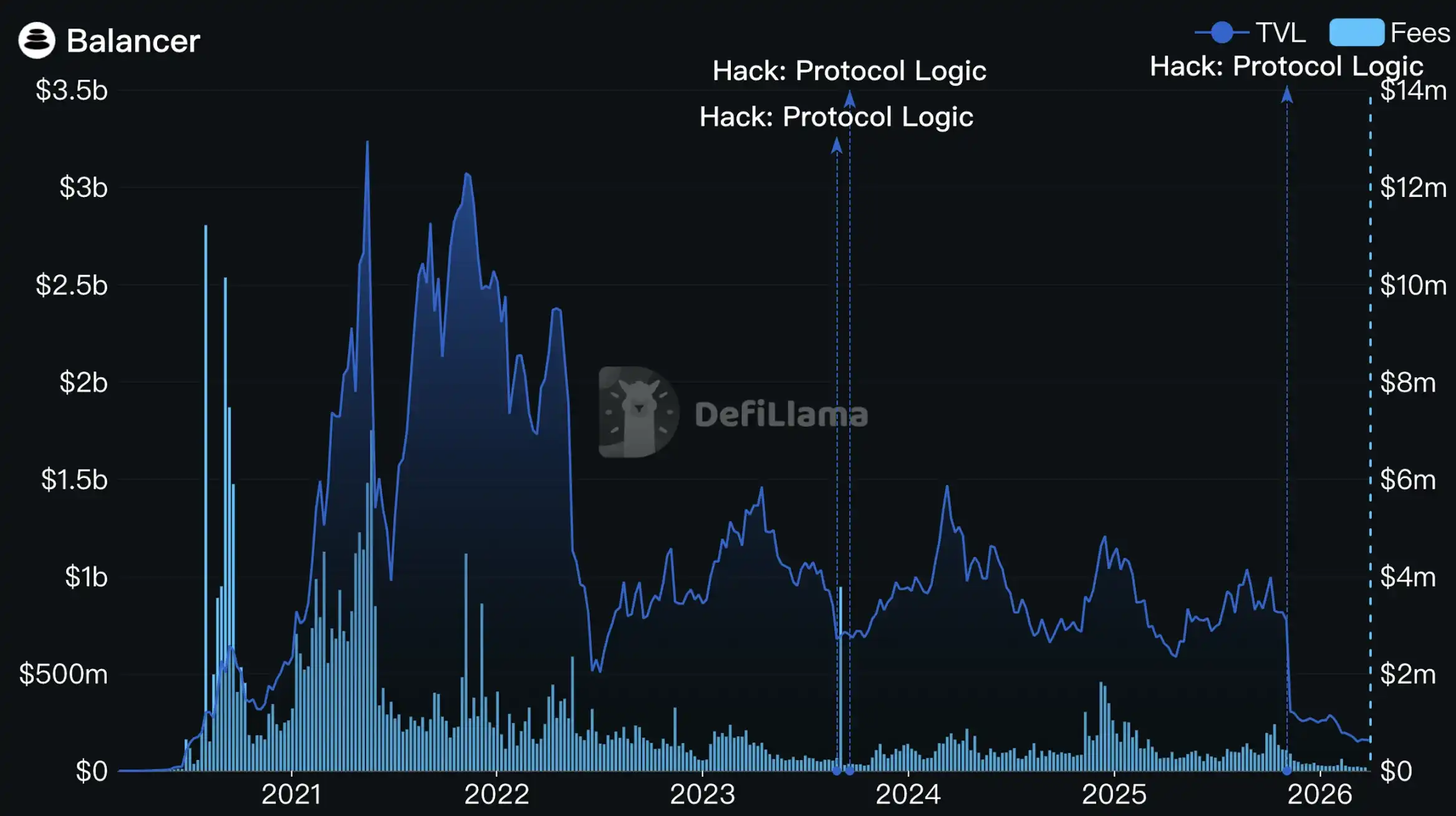
Source: DefiLlama

Balancer has officially reached a crossroads. On March 23, 2026, the Balancer core team simultaneously released two important governance proposals: a comprehensive overhaul of BAL tokenomics and an operational restructuring.

The core logic of these two documents combined can be summarized in one sentence: Abandon the growth model driven by token releases and shift towards sustainable operation driven by revenue.

Operational Restructuring: Team "Slimming Down," Annual Budget Reduced by 34%

The proposal suggests formally dissolving Balancer Labs, with its core technical personnel transitioning to contractor roles and merging into Balancer OpCo Limited, which will continue to operate as the DAO's legal proxy entity.

The team size will be compressed from about 25 people to 12.5 full-time equivalents (including dedicated service providers like Beets, MAXYZ, etc.), and the annual operating budget will be reduced from $2.87 million to $1.9 million, a 34% cut.
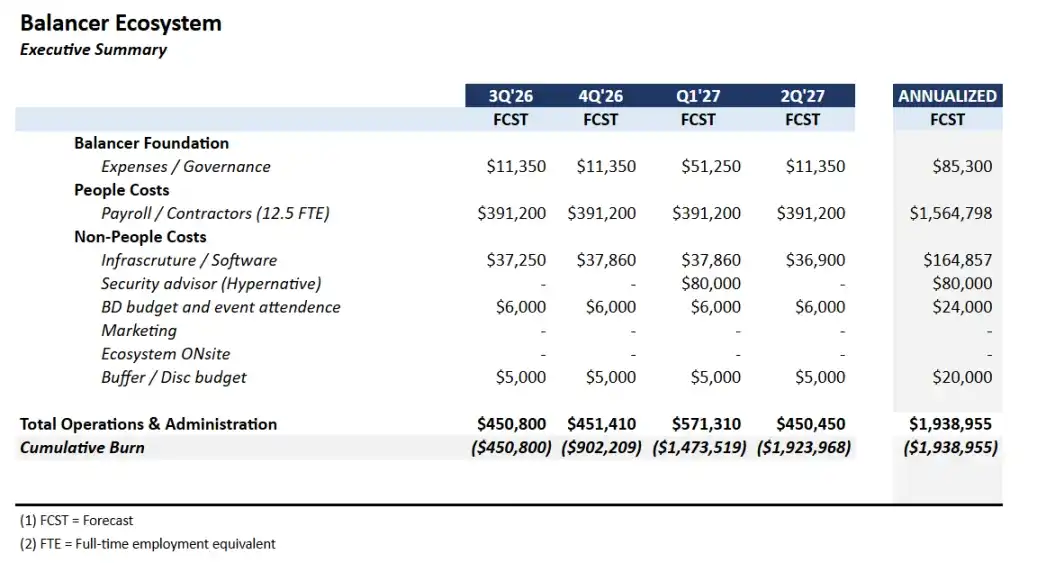
The product lines are also being drastically narrowed. The team will focus resources on three products with validated commercial viability: Boosted Pools (flagship product), reCLAMM (to be relaunched after fixing vulnerabilities, possibly renamed), and LBP (token launch pools, operated opportunistically).

Other exploratory directions, such as ETF structured products, yield optimizers, and AI-driven liquidity tools, will only proceed subject to meeting "core KPIs".

On-chain deployments are also being scaled back. The current model of maintaining V2 and V3 on over 9 chains is unsustainable. The team explicitly retains four core chains: Ethereum, Gnosis, Arbitrum, and Base. Other deployments will be reviewed individually based on fee revenue and operational costs, and terminated if they do not meet standards.

Tokenomics Reform: A Complete Overhaul, Not Minor Tweaks

Stop BAL Emissions, Abolish veBAL

If the proposal passes, Balancer will terminate BAL token incentive emissions, with no transition period.

Simultaneously, the veBAL governance mechanism will be formally abolished. Holders will stop receiving any economic rewards after the final bi-weekly fee distribution. Their locked veBAL will become purely governance credentials, waiting to expire at the end of the lock-up period.

This is a painful decision, but the logic behind it is clear: the veBAL mechanism had a structural flaw from the start, being prone to oligopolistic control. Currently, Aura Finance (a veBAL meta-governance protocol) and whales hold significant voting power, making genuine community voices increasingly faint in governance. This mechanism not only failed to promote the protocol's healthy development but became a vehicle for circular economic games — protocol money flows to middlemen via incentives, and the middlemen's votes direct more incentives towards themselves.

If veBAL was once an experiment by Balancer borrowing from Curve's design, the team now frankly admits: the experiment is over, and the results did not meet expectations.

Regarding the termination of veBAL economic rights, Balancer stated it will provide a $500,000 compensation activity, distributed directly to veBAL holders as pure cash compensation.

All Fees Go to DAO Treasury, Reduce V3 Protocol Take Rate

All protocol fees — V2 swap fees, V3 swap fees, Yield fees, LBP fees — will thereafter flow 100% to the DAO treasury, abandoning the previous multi-party split mechanism.

Simultaneously, the V3 protocol fee take rate will be reduced from 50% to 25%. This means for the same transaction, liquidity providers (LPs) previously received 50%, but will now receive 75%.

These two moves seem opposite in direction but share the same underlying logic: the former eliminates the circular economy, allowing the treasury to obtain real usable funds; the latter increases LP attractiveness, trading lower platform fees for more organic liquidity and real trading volume.

The proposal estimates that post-reform, the DAO's annualized revenue could reach approximately $1.22 million, more than 4 times the current $290,000.

Exit Option: Burn BAL for Stablecoins at $0.16 per Token

The treasury will also allocate 35% of its assets (currently about $3.6 million) to a dedicated pool. This is not for actively buying BAL on the secondary market, but to open a "burn for stablecoins" channel: BAL holders can voluntarily send their tokens to a contract to be burned, receiving stablecoins of equivalent value at the NAV price (Net Asset Value, approximately $0.16 per token).

The window will open 12 months after the proposal passes and last for 12 weeks. Any unused stablecoins after the window closes will return to the treasury. The 12-month waiting period is designed specifically to allow holders whose veBAL unlocks gradually to participate.

At the time of writing, the BAL price is $0.1548, below the NAV price. Offering an exit at the NAV price provides a more dignified option for those wanting to leave than a secondary market stampede.

If this channel is fully utilized, it would burn approximately 22.7 million BAL tokens, about 35% of the circulating supply, which is 6 times the current annual inflation emission.

9-Year "Runway": Is It Enough?

If both proposals pass, the team's projected financial model is as follows:

DAO annualized revenue ~$1.22 million (assuming TVL recovers somewhat after V3 fee reduction), annual operating expenses $1.9 million, buyback expenditure ~$3.6 million, plus the $500,000 veBAL compensation.

After completing the buyback and compensation, the treasury would still have approximately $6.2 million remaining. The annual funding gap would narrow from about $2.6 million to $700,000, giving a theoretical survival period of nearly 9 years.

For a DeFi protocol, 9 years is enough to span a full industry cycle.

But this model is built on optimistic assumptions: that reducing the V3 protocol take rate will indeed attract more organic TVL; that the slimmed-down team can truly support daily protocol operations, security maintenance, etc.; and that core products (especially reCLAMM) can successfully attract the market again after repairs.

If any link underperforms expectations, the 9-year survival period will shorten rapidly. The team itself explicitly states that if DAO monthly revenue falls below $60,000 for 3 consecutive months, a revised plan must be submitted to the community.

For Balancer, this is a nearly all-or-nothing reform. Abandoning the once-proud veBAL mechanism, abandoning the complex multi-party split structure, and returning to an extremely simplified origin: let real transaction fees drive protocol survival, not newly minted tokens maintaining false prosperity.

Whether this desperate reform will work ultimately depends on the market and time, awaiting long-term observation.


Câu hỏi Liên quan

QWhat were the main reasons behind Balancer's decision to abandon the veBAL mechanism and stop BAL token emissions?

ABalancer decided to abandon veBAL and stop BAL emissions because the veBAL mechanism was structurally flawed, leading to oligopolistic control by entities like Aura Finance and large holders, which stifled genuine community governance. The token-based growth model created a circular economy where incentives flowed to middlemen instead of supporting protocol health. Additionally, the annual inflation of 3.78 million BAL tokens created significant sell pressure, exacerbating financial unsustainability.

QHow does Balancer plan to address its financial sustainability issues after the proposed changes?

ABalancer aims to achieve financial sustainability by shifting to a revenue-driven model. Key measures include redirecting 100% of protocol fees to the DAO treasury, reducing operational budget by 34% to $1.9 million annually, and lowering the V3 protocol fee take rate to 25% to attract more organic liquidity. These changes are projected to increase DAO annualized revenue to approximately $1.22 million, extending the treasury's runway to nearly 9 years.

QWhat compensation is Balancer offering to veBAL holders, and how will it be funded?

ABalancer is offering a $500,000 compensation package to veBAL holders, funded directly from the DAO treasury. This is a cash compensation for the termination of their economic rights, as veBAL will become a governance-only credential with no further financial benefits after the final fee allocation.

QWhat is the purpose of the 'burn-for-stablecoin' mechanism, and how does it work?

AThe 'burn-for-stablecoin' mechanism allows BAL holders to voluntarily burn their tokens in exchange for stablecoins at a fixed Net Asset Value (NAV) price of $0.16 per BAL. It is designed to provide an orderly exit for holders wishing to leave, reducing sell pressure on the secondary market. The DAO will allocate 35% of its treasury (about $3.6 million) for this purpose, with the window opening 12 months after proposal approval and lasting for 12 weeks.

QWhich product lines and chains will Balancer focus on after the operational restructuring?

APost-restructuring, Balancer will concentrate resources on three commercially validated product lines: Boosted Pools (flagship product), reCLAMM (to be relaunched after bug fixes and possible rebranding), and LBPs (opportunistic operation). Deployment will be limited to core chains: Ethereum, Gnosis, Arbitrum, and Base, with other chains subject to review based on fee revenue and operational costs.

Nội dung Liên quan

Khi Sự Đồng Thuận Diễn Ra Ngày Càng Nhanh, Các Nhà Đầu Tư Trẻ Đang Đánh Cược Vào Điều Gì?

Khi sự đồng thuận thị trường ngày càng nhanh, các nhà đầu tư trẻ đang tập trung vào đâu? Đầu tư công nghệ hiện nay đang trải qua sự chuyển dịch rõ rệt, với bốn xu hướng chính được các nhà đầu tư trẻ hàng đầu quan tâm. **Xu hướng 1: AI rời màn hình, bước vào thế giới vật lý.** Trọng tâm đầu tư đang chuyển từ mô hình lớn và ứng dụng sinh dữ liệu sang robot, thiết bị AI, xe tự lái và hệ thống công nghiệp. Thách thức lớn không còn là khả năng của mô hình, mà là năng lực triển khai, độ tin cậy và hiệu quả chi phí khi tích hợp vào môi trường vật lý. Ngành giao hàng tự động (ví dụ: Bạch Tê Ngưu với hơn 2000 xe) là minh chứng cho xu hướng này. **Xu hướng 2: Lợi nhuận từ mô hình lớn chưa hết, cạnh tranh chuyển sang "Bánh xe thông minh".** Thay vì chỉ tìm kiếm kiến trúc kế tiếp, các nhà đầu tư tập trung vào các công ty có thể nhúng khả năng AI hiện có vào quy trình làm việc thực tế, tạo ra vòng lặp phản hồi "bánh xe thông minh": dữ liệu người dùng -> cải thiện mô hình -> trải nghiệm tốt hơn -> nhiều người dùng hơn. Sự thành công của Zhipu AI và Kling AI của Kuaishou cho thấy giá trị của việc xây dựng hệ thống tự củng cố này. **Xu hướng 3: Nghẽn dữ liệu thúc đẩy công nghệ nền tảng mới, mô hình cơ bản khoa học trở thành hướng đi không đồng thuận.** Khi dữ liệu chất lượng cao từ internet trở nên khan hiếm, việc đào tạo AI cần các nguồn kiến thức mới. Các phương pháp như học tăng cường, tự đối kháng và đặc biệt là **Mô hình Cơ bản Khoa học** (Scientific Foundation Models) hứa hẹn sử dụng dữ liệu và quy luật từ các lĩnh vực chuyên sâu (sinh học, vật liệu) để mở rộng biên giới của AI, mặc dù đây vẫn là một lĩnh vực đầy thách thức. **Xu hướng 4: Càng tiến vào vùng nước sâu của công nghệ cứng, càng cần vốn kiên nhẫn.** Trong các lĩnh vực như hàng không vũ trụ thương mại, máy tính lượng tử và năng lượng tiên tiến, chu kỳ xác minh dài hơn và con đường thương mại hóa không rõ ràng. Các nhà đầu tư cần xây dựng phán đoán sớm, tập trung vào năng lực nghiên cứu cốt lõi, khả năng kỹ thuật và sự kiên cường của đội ngũ, thay vì kỳ vọng lợi nhuận ngắn hạn. Sự quan tâm đến robot không gian, điện toán không gian và vật liệu năng lượng không gian phản ánh tầm nhìn dài hạn này. Tóm lại, các nhà đầu tư trẻ ngày nay không chỉ theo đuổi các khái niệm nóng, mà đang chuyển sang phân tích sâu sắc con đường tích hợp công nghệ vào ngành công nghiệp, tìm kiếm các hệ thống tạo ra vòng lặp phản hồi bền vững và sẵn sàng đồng hành cùng các dự án công nghệ cứng trong hành trình dài hạn.

marsbit23 phút trước

Khi Sự Đồng Thuận Diễn Ra Ngày Càng Nhanh, Các Nhà Đầu Tư Trẻ Đang Đánh Cược Vào Điều Gì?

marsbit23 phút trước

Giải phóng 100 triệu USD thanh khoản? Chính sách mới của Pump.fun thử nghiệm chiến thuật bơm giá trong 5 phút

Bài viết thảo luận về cơ chế BOOST mới được Pump.fun công bố vào ngày 21/7, trở thành cơ chế phát hành mặc định cho các token mới. Cơ chế này nhắm giải quyết vấn đề "thanh khoản chết" - khoảng 20% vốn bị khóa vĩnh viễn trong nhóm thanh khoản (LP) sau khi token di chuyển từ bonding curve, gây lãng phí ước tính hơn 100 triệu USD mỗi năm. Thay vì khóa số vốn này, BOOST sẽ dùng nó (khoảng 17,6 SOL hoặc 2516 USDC) để mua token ngay trong 5 phút đầu sau khi di chuyển lên PumpSwap, thông qua cơ chế TWAP, và ngay lập tức đốt số token mua được. Điều này tạo áp lực mua tức thời và giảm nguồn cung vĩnh viễn. Mục tiêu của Pump.fun là tạo ra "pháo hoa" trong 5 phút đầu, kích thích giao dịch và cải thiện trải nghiệm cho nhà giao dịch meme - đối tượng thường quan tâm đến đợt "bứt phá" ngay khi token ra mắt. Cách tiếp cận này nhằm tăng tỷ lệ token tạo ra khối lượng giao dịch bền vững, từ đó củng cố doanh thu nền tảng và tính bền vững của việc mua lại token PUMP. Tuy nhiên, bài viết cũng nêu lo ngại: cơ chế có thể khiến các token chất lượng thấp dễ thành công hơn về mặt hình thức và làm tăng rủi ro sau 5 phút, khi áp lực mua biến mất và token có thể lao dốc nhanh hơn nếu gặp bán tháo.

Foresight News34 phút trước

Giải phóng 100 triệu USD thanh khoản? Chính sách mới của Pump.fun thử nghiệm chiến thuật bơm giá trong 5 phút

Foresight News34 phút trước

Đơn vị quản lý tài sản lớn nhất Ấn Độ SBI lên sàn, số liệu giao dịch hé lộ tín hiệu gì?

SBI Funds Management, công ty quản lý quỹ lớn nhất Ấn Độ, đã niêm yết vào ngày 21/7. Đợt IPO trị giá khoảng 10,3 tỷ USD được định giá kỷ lục gấp 42 lần, cho thấy nhu cầu mạnh mẽ từ các nhà đầu tư tổ chức và bán lẻ đối với tài sản tài chính cốt lõi. Tuy nhiên, giá đóng cửa ngày đầu tiên chỉ tăng khoảng 6,3%, thấp hơn nhiều so với kỳ vọng chênh lệch 16% trên thị trường chợ đen, cho thấy vốn sẵn sàng nhưng không chấp nhận trả giá quá cao. Sự thành công thận trọng của SBI đặt ra một cột mốc định giá mới cho thị trường IPO Ấn Độ: cửa sổ IPO vẫn mở, nhưng ưu tiên cho các công ty có thương hiệu mạnh, dòng tiền ổn định và câu chuyện tăng trưởng thâm nhập dài hạn rõ ràng. Một tín hiệu đáng chú ý khác là phí bảo lãnh phát hành cực thấp (khoảng 0,01%), khiến một số ngân hàng quốc tế rút lui. Điều này phản ánh quyền định giá đang nghiêng về phía các tổ chức phát hành mạnh như SBI, những người có thể dựa vào kênh phân phối nội địa và thương hiệu, làm giảm giá trị cận biên mà các ngân hàng đầu tư quốc tế mang lại. Tăng trưởng ổn định của ngành quản lý quỹ Ấn Độ (dự báo CAGR 16-18%) hỗ trợ định giá, nhưng thị trường vẫn cân nhắc các yếu tố chu kỳ. Bài kiểm tra thực sự cho cửa sổ IPO sẽ là các đợt chào bán lớn tiếp theo như Reliance Jio và Sở giao dịch chứng khoán quốc gia (NSE). Thành công của họ ở mức định giá hợp lý sẽ khẳng định xu hướng mới; nếu bị trì hoãn, SBI sẽ chỉ là một thành công đơn lẻ.

marsbit52 phút trước

Đơn vị quản lý tài sản lớn nhất Ấn Độ SBI lên sàn, số liệu giao dịch hé lộ tín hiệu gì?

marsbit52 phút trước

Nhật Bản muốn dùng AI để mua tăng trưởng, thị trường trái phiếu có tin không?

Nội các Nhật Bản đã thông qua "Phương hướng cơ bản về vận hành và cải cách tài chính kinh tế 2026", chuyển trọng tâm mục tiêu tài chính từ cân bằng thu chi ngân sách cơ bản sang ổn định và giảm tỷ lệ nợ/GDP. Động thái này nhằm tạo không gian đầu tư vào các lĩnh vực chiến lược như AI, bán dẫn để thúc đẩy tăng trưởng, giải quyết vấn đề lão hóa và thiếu lao động. Tuy nhiên, thị trường trái phiếu tỏ ra hoài nghi. Việc làm suy yếu "mỏ neo" tài chính truyền thống có thể bị coi là nới lỏng kỷ luật ngân sách. Lợi tức trái phiếu chính phủ Nhật kỳ hạn 10 năm đã tăng, phản ánh lo ngại về tính tín nhiệm tài chính. Kế hoạch đầu tư 370 nghìn tỷ Yên đến năm 2040 không phải là ngân sách mới tập trung chỉ cho AI, mà là tổng đầu tư công-tư vào nhiều lĩnh vực. Thành bại của khung chính sách mới phụ thuộc vào việc liệu tốc độ tăng trưởng kinh tế danh nghĩa có vượt quá lãi suất dài hạn hay không, và liệu các khoản đầu tư chiến lược có thực sự cải thiện năng suất và thu ngân sách. Thị trường sẽ tiếp tục định giá dựa trên khả năng chính phủ chứng minh được hiệu quả đầu tư và con đường giảm nợ bền vững.

marsbit1 giờ trước

Nhật Bản muốn dùng AI để mua tăng trưởng, thị trường trái phiếu có tin không?

marsbit1 giờ trước

Cổ phiếu A bị tổn thương nhầm: Sự kiên cường, kỳ vọng và bản lĩnh

Cổ phiếu A-shares bị ảnh hưởng bởi các cú sốc ngoại vi vào tháng 7, nhưng đã thể hiện sức chống chịu mạnh mẽ. Các cổ phiếu công nghệ giảm giá chủ yếu do ảnh hưởng từ việc giảm đòn bẩy tại thị trường Hàn Quốc, trong khi cơ bản ngành vẫn vững chắc với lợi nhuận cao, đặc biệt trong lĩnh vực module quang, sợi quang, với cấu trúc đa ngành và hai câu chuyện nội địa hóa cùng chuỗi cung ứng toàn cầu. Lực lượng "đội tuyển quốc gia" đã mạnh mẽ can thiệp để ổn định thị trường, với các khoản mua vào và tái mua cổ phiếu trị giá hàng trăm tỷ từ các tập đoàn nhà nước, công ty bảo hiểm và quỹ. Hành động này không chỉ cung cấp thanh khoản mà còn gửi tín hiệu mạnh mẽ về điểm đáy, tạo hiệu ứng dẫn dắt cho các định chế dài hạn. Động lực phục hồi nội sinh còn đến từ ba nhóm chính: (1) Tiêu dùng, với CPI tăng và dấu hiệu phục hồi trong ngành rượu bia; (2) Chu kỳ, đặc biệt là nhôm, với lợi nhuận cao, kỳ vọng tăng giá và định giá thấp; (3) Tài chính, với tài sản cổ tức ổn định và định giá hấp dẫn. Sự kết hợp của các yếu tố này cùng với nền tảng công nghệ vững chắc cho thấy A-shares có đủ sức chống chịu và khả năng sớm trở lại trạng thái ổn định.

marsbit1 giờ trước

Cổ phiếu A bị tổn thương nhầm: Sự kiên cường, kỳ vọng và bản lĩnh

marsbit1 giờ trước

Giao dịch

Giao ngay
活动图片




