A Less 'Hawkish' 'Hawkish Rate Cut' and Balance Sheet Expansion Buying Bonds That 'Is Not QE'

深潮Xuất bản vào 2025-12-11Cập nhật gần nhất vào 2025-12-11

Tóm tắt

The Federal Reserve cut interest rates by 25 basis points for the third consecutive time in 2024, lowering the target range to 3.50%-3.75%. The decision revealed the largest internal dissent in six years, with three officials opposing the move. The updated dot plot continues to project only one more rate cut in 2025, signaling a significant slowdown in the pace of easing. Chair Jerome Powell emphasized that the current policy stance allows the Fed to be patient and data-dependent, noting that no one is assuming the next move will be a hike. Simultaneously, the Fed announced it would begin purchasing short-term Treasury bills to maintain ample reserves in the banking system, with an initial $40 billion in purchases planned for the next month. Powell stressed that these operations are for reserve management purposes and do not represent a change in monetary policy stance. The economic projections were slightly revised, with upgrades to GDP growth and minor downgrades to inflation expectations. The labor market is showing signs of cooling, with the unemployment rate rising and job growth slowing.

Source: Wall Street Journal

The Federal Reserve cut interest rates again at the conventional pace as the market expected, but it exposed the largest divergence among voting policymakers in six years, signaling a slowdown in the pace of action next year and a potential pause in the near term. The Fed also, as expected by Wall Street, initiated reserve management operations, deciding to buy short-term Treasury bonds by year-end to address pressures in the money markets.

On Wednesday, December 10, Eastern Time, the Federal Reserve announced after its FOMC monetary policy meeting that the target range for the federal funds rate was lowered from 3.75%-4.00% to 3.50%-3.75%. This marks the third 25-basis-point rate cut this year, bringing the total reduction for the year to 75 basis points. Since September of last year, this easing cycle has cumulatively cut rates by 175 basis points.

It is worth noting that the Fed's interest rate decision faced three dissenting votes for the first time since 2019. Governor Milan, appointed by Trump, continued to advocate for a 50-basis-point cut, while two regional Fed presidents and four non-voting members supported holding rates steady. In effect, seven officials opposed the decision, reportedly the largest divergence in 37 years.

The dot plot released after the meeting showed that the interest rate path forecast by Fed policymakers remained consistent with the one published three months ago, still projecting one 25-basis-point rate cut next year. This implies that the pace of rate cuts next year will slow significantly compared to this year.

As of Tuesday's close, CME Group's FedWatch Tool showed that the futures market priced in an approximately 88% probability of a 25-basis-point cut this week, while the probability of at least another 25-basis-point cut did not reach 71% until next June. The probabilities for such a cut at the January, March, and April meetings next year all remained below 50%.

The predictions reflected by the CME tool can be summarized by the recently popular term "hawkish cut." It refers to the Fed cutting rates this time while simultaneously signaling a potential pause in action, with no further cuts in the near term.

Nick Timiraos, a veteran Fed reporter known as the "new Fed whisperer," stated bluntly after the meeting that the Fed "signaled it may pause on rate cuts for now" due to "rare" internal disagreements over whether to worry more about inflation or the job market.

Timiraos pointed out that three officials dissented from the 25-basis-point cut at this meeting, and the stalled decline in inflation and cooling labor market made this meeting the most divisive in recent years.

Powell emphasized at the post-meeting press conference that he did not believe "a rate hike at the next meeting" was anyone's base case. The current level of rates allows the Fed to be patient and observe how the economy evolves. He also stated that the available data so far does not indicate a change in the economic outlook, and the scale of Treasury purchases may remain high in the coming months.

01 Fed Cuts Rates by 25 Basis Points as Expected, Still Projects One Cut Next Year, Initiates RMP Buying $40B in Short-Term Bonds

On Wednesday, December 10, Eastern Time, the Federal Reserve announced after its FOMC monetary policy meeting that the target range for the federal funds rate was lowered from 3.75%-4.00% to 3.50%-3.75%. This marks the third consecutive FOMC meeting with a rate cut, each by 25 basis points, bringing the total reduction for the year to 75 basis points. Since September last year, this easing cycle has cumulatively cut rates by 175 basis points.

It is worth noting that the Fed's interest rate decision faced three dissenting votes for the first time since 2019. Trump-appointed Governor Milan continued to advocate for a 50-basis-point cut, while two regional Fed presidents and four non-voting members supported holding rates steady. In effect, seven officials opposed the decision, reportedly the largest divergence in 37 years.

A key change in this meeting's statement compared to the previous one was in the interest rate guidance. Although the decision was to cut rates, the statement no longer broadly said that, when considering further rate cuts, the FOMC would assess incoming data, the evolving outlook, and the balance of risks. Instead, it more explicitly referred to considering the "extent and timing" of future adjustments. The statement now reads:

"In considering the extent and timing of any adjustments to the target range for the federal funds rate, the Committee will carefully assess incoming data, the evolving outlook, and the balance of risks."

The meeting statement reiterated that inflation remains somewhat elevated and that the downside risks to employment have increased in recent months. It removed the phrase "remains low" regarding the unemployment rate, noting it had risen slightly to 4.4% as of September.

The addition of "extent and timing" regarding further rate cuts is seen as signaling a higher bar for future cuts.

Another important change in this meeting's statement compared to the last was the addition of a new paragraph specifically noting the intention to purchase short-term bonds to maintain ample reserve balances in the banking system. The statement wrote:

"The Committee views reserve balances as having declined to ample levels and will begin purchases of Treasury bills, as needed, to maintain ample reserve balances over time."

This amounts to announcing the start of so-called reserve management operations, rebuilding liquidity buffers in the money markets. Year-end often sees market disruptions as banks typically reduce activity in the repo market to support their balance sheets for regulatory and tax settlements.

The statement said reserves have declined to ample levels and, to maintain ample reserves, will begin buying short-term bills this Friday. The New York Fed plans to buy $40 billion in short-term bills over the next 30 days and expects Reserve Management Purchases (RMP) of short-term bills to remain high in the first quarter of next year.

The median projection of Fed officials' interest rate forecasts released after Wednesday's meeting showed that their expectations this time were exactly the same as the previous ones published in September.

Fed officials currently also project that, after three rate cuts this year, there will likely be one 25-basis-point cut each in the next two years.
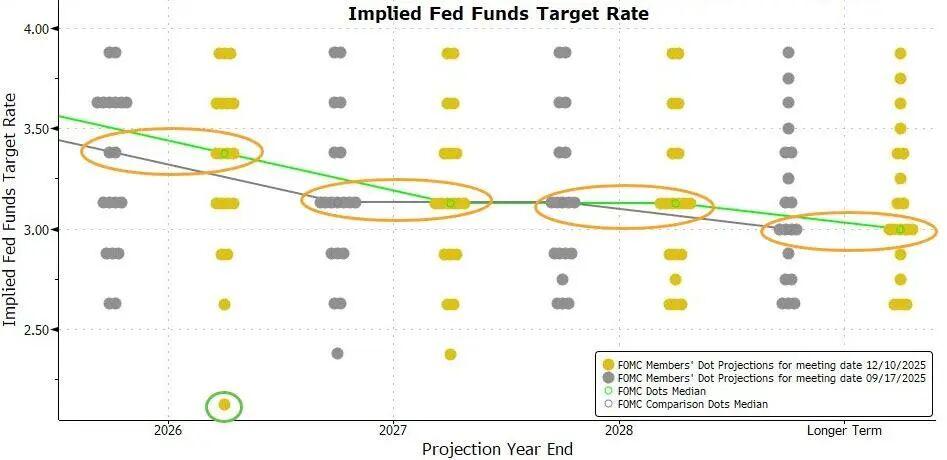
Many had expected that the dot plot reflecting future interest rate movements would show Fed policymakers leaning more hawkish. This dot plot did not show such a tendency; instead, it was slightly more dovish compared to the previous one.

Among the 19 Fed officials providing forecasts, seven now project the interest rate next year to be between 3.5% and 4.0%, compared to eight who projected this last time. This means that the number of officials expecting no rate cuts next year decreased by one.

The economic projections released after the meeting showed that Fed officials raised their GDP growth forecasts for this year and the subsequent three years, and slightly lowered the unemployment rate forecast for 2027, i.e., the year after next, by 0.1 percentage point, while leaving the forecasts for other years unchanged. This adjustment indicates that the Fed views the labor market as more resilient.

Simultaneously, Fed officials slightly lowered their forecasts for PCE inflation and core PCE inflation for this year and next year by 0.1 percentage point each. This reflects a slightly stronger confidence in inflation slowing over the coming period.

02 Powell: Current Rates Allow for Patience, Does Not Believe 'Next Move is a Hike' is Anyone's Base Case

With today's cut, the Fed has lowered the policy rate by a total of 75 basis points over the past three meetings. Powell said this will help gradually return inflation to 2% after the effects of tariffs fade.

He said the adjustments made to the policy stance since September have brought the policy rate into the range of various estimates of "neutral interest rates." The median projection of FOMC members shows the appropriate level for the federal funds rate at the end of 2026 is 3.4% and 3.1% at the end of 2027, unchanged from September.

Powell stated that currently, inflation risks are tilted to the upside, while employment risks are tilted to the downside, presenting a challenging situation.

A reasonable baseline is that the impact of tariffs on inflation will be relatively short-lived, essentially a one-time shift in the price level. Our job is to ensure this one-time price increase does not evolve into a persistent inflation problem. But at the same time, downside risks to employment have increased in recent months, and the overall balance of risks has changed. Our policy framework requires balance between the two aspects of our dual mandate. Therefore, we believe a 25-basis-point cut at this meeting was appropriate.

Given the stalled progress in bringing inflation down, Fed officials had hinted before this week's decision that further cuts might require evidence of labor market weakness. Powell said at the press conference:

"Where we are right now allows us to be patient and watch how the economy evolves."

In the Q&A session, regarding the question of whether the next policy adjustment is necessarily downward now that rates are closer to neutral, or if policy risks have truly turned two-way, Powell responded that no one has rate hikes as their base case currently, and he hasn't heard such views. There are differing views within the Committee: some members believe the current policy stance is appropriate and advocate maintaining the status quo for further observation; others believe another cut may be needed this year or next, perhaps even more than one.

When members write down their judgments on the policy path and appropriate interest rate levels, expectations are mainly concentrated on a few scenarios: either maintaining the current level, implementing a small cut, or a slightly larger cut. Powell emphasized that the current mainstream expectations do not include a rate hike scenario.

Powell stated that as a separate decision, the Fed also decided to initiate purchases of short-term U.S. Treasury bills, with the sole purpose of maintaining ample reserve supplies over time, thereby ensuring the Fed can control the policy rate effectively. He stressed that these issues are separate from the monetary policy stance itself and do not represent a change in policy orientation.

He said the scale of short-term bill purchases may remain high in the coming months, and the Fed isn't strictly "worried" about money market tensions, just that this situation came a bit sooner than expected.

Powell also stated that, according to the New York Fed's announcement, the initial scale of asset purchases will reach $40 billion in the first month and may remain high in the following months to alleviate anticipated short-term money market pressures. Afterwards, the scale of purchases is expected to decline, with the specific pace depending on market conditions.

Regarding the labor market, Powell said that although official October and November employment data are not yet available, existing evidence suggests that both layoffs and hiring remain at low levels. Simultaneously, households' perceptions of job availability and businesses' sense of hiring difficulty continue to decline. The unemployment rate continues to rise slightly, reaching 4.4%, and employment growth has slowed noticeably compared to earlier this year. The Fed also removed the phrase "the unemployment rate has remained low" from the statement.

Powell said in the subsequent Q&A that after adjusting for overestimation in the employment data, job growth may have turned slightly negative since April.


Tiền kỹ thuật số thịnh hành

Câu hỏi Liên quan

QWhat was the outcome of the December 10th FOMC meeting regarding the federal funds rate?

AThe Federal Reserve lowered the target range for the federal funds rate from 3.75%-4.00% to 3.50%-3.75%, marking the third 25 basis point cut of the year.

QWhat does the term 'hawkish cut' refer to in the context of this article?

AA 'hawkish cut' refers to the Fed's decision to cut interest rates while simultaneously signaling that it may pause and not cut rates again in the near future.

QWhat new policy did the Fed announce alongside the rate cut to address money market pressures?

AThe Fed announced it would begin purchasing short-term Treasury bills to maintain an ample supply of reserves in the banking system, starting with a plan to buy $40 billion over the next 30 days.

QAccording to the dot plot, how many rate cuts do Fed officials project for the year 2025?

AFed officials' median projection, as shown in the dot plot, indicates one 25 basis point rate cut for the year 2025.

QWhat was Chairman Powell's stance on the possibility of the next policy move being a rate increase?

AChairman Powell stated that he does not believe a rate hike is anyone's base case assumption for the next policy move and that the mainstream expectations were for either holding rates steady or for small cuts.

Nội dung Liên quan

Máy tính lượng tử chưa tới, 1,1 triệu Bitcoin của Satoshi Nakamoto đã trở thành vấn đề trước

Một công cụ chứng minh không tri thức (Project Eleven) có thể giúp ví Bitcoin hiện đại di chuyển tài sản trước các cuộc tấn công lượng tử trong vòng 243 mili giây. Tuy nhiên, khoảng 1,1 triệu BTC được Satoshi Nakamoto khai thác trước năm 2012 (nằm trong khoảng 22.000 địa chỉ P2PK cũ) không thể được cứu bằng công cụ này vì thiếu đường dẫn khóa phân cấp (HD wallet), tạo ra một ngõ cụt mật mã. Vấn đề này đã đẩy cộng đồng Bitcoin vào một cuộc khủng hoảng chính trị hơn là kỹ thuật. Có bốn giải pháp được tranh luận, mỗi giải pháp đều có rủi ro lớn: 1) Bất động, để tiền bị đánh cắp; 2) Đóng băng cưỡng chế các địa chỉ dễ bị tổn thương; 3) Giới hạn dòng tiền rút từ địa chỉ cũ; 4) Phân phối lại tài sản "không chủ". Tất cả đều đe dọa các nguyên tắc cốt lõi của Bitcoin như quyền sở hữu, tính bất biến của sổ cái hay tính lưu trữ giá trị. Thị trường đã bắt đầu định giá rủi ro quản trị này. Một số tổ chức như Jefferies đã giảm nắm giữ Bitcoin do lo ngại về sự không chắc chắn trong việc xử lý các đồng tiền dễ bị tổn thương. Cuộc khủng hoảng niềm tin đã xuất hiện ngay cả trước khi máy tính lượng tử thực tế ra đời, đặt ra câu hỏi cấp bách: Làm thế nào Bitcoin có thể giải quyết gánh nặng của một sự đứt gãy công nghệ lịch sử mà không phá vỡ chính các nguyên tắc sáng lập của nó?

marsbit4 phút trước

Máy tính lượng tử chưa tới, 1,1 triệu Bitcoin của Satoshi Nakamoto đã trở thành vấn đề trước

marsbit4 phút trước

Mặt trận chính của thị trường tăng giá tiếp theo nằm ở đâu? Câu trả lời ẩn giấu trong hai loại tài sản này

Thị trường tiền điện tử đang cho thấy dấu hiệu chạm đáy, và câu hỏi đặt ra là tài sản nào sẽ dẫn dắt đợt tăng giá tiếp theo. Theo phân tích, chủ đề cốt lõi của chu kỳ bull market mới sẽ là sự hội tụ giữa tài chính truyền thống và tài chính trên chuỗi (on-chain), tập trung vào stablecoin, token hóa tài sản, giao dịch 24/7 và thanh toán tức thì. Bài viết chỉ ra hai xu hướng đầu tư chính: 1. **Các ứng dụng tài chính tiền điện tử gốc** (đại diện là Hyperliquid - HYPE): Các nền tảng có doanh thu thực tế, mô hình kinh tế token mạnh (như mua lại và đốt token), đang mở rộng từ giao dịch tiền điện tử sang các tài sản truyền thống như chỉ số chứng khoán và hàng hóa. 2. **Các doanh nghiệp truyền thống trưởng thành áp dụng cơ sở hạ tầng tiền điện tử** (đại diện là Robinhood - HOOD): Các công ty đang tích cực xây dựng và triển khai blockchain (như Robinhood Chain) để cung cấp dịch vụ tài chính mới, như giao dịch cổ phiếu được token hóa, cho thị trường toàn cầu. Sự hội tụ này, với tiềm năng định hình lại hệ thống tài chính toàn cầu, được kỳ vọng sẽ tạo ra chu kỳ tăng giá lớn nhất từ trước đến nay, dựa trên giá trị ứng dụng thực tế và nhắm vào một thị trường rộng lớn hơn. Cơ hội đầu tư nằm ở việc nhận diện và định vị trước vào các dự án và công ty đang thực sự thúc đẩy xu hướng chuyển đổi này.

Foresight News8 phút trước

Mặt trận chính của thị trường tăng giá tiếp theo nằm ở đâu? Câu trả lời ẩn giấu trong hai loại tài sản này

Foresight News8 phút trước

Hành trình vượt qua dự luật Clarity về tiền mã hóa: Con đường thỏa hiệp giữa hai đảng tại Mỹ gai góc khôn lường

Dự luật Clarity về cấu trúc thị trường tiền mã hóa đang trên đường tới Quốc hội Mỹ, nhưng con đường thông qua đầy chông gai do bất đồng giữa hai đảng về các điều khoản đạo đức và quy định "lợi nhuận" (yield). Mặc dù đã đạt được một số thỏa hiệp lưỡng đảng vào tháng 5, sự ủng hộ của đảng Dân chủ vẫn phụ thuộc vào việc giải quyết các điều khoản đạo đức mạnh mẽ cho các quan chức được bầu. Đến tháng 7, vấn đề này càng trở nên cấp thiết, với sự phản đối từ cả một số thành viên đảng Cộng hòa và các cơ quan thực thi pháp luật. Các nhà lập pháp như Thượng nghị sĩ Cynthia Lummis (Cộng hòa) nhấn mạnh các biện pháp bảo vệ người tiêu dùng trong dự luật, trong khi Thượng nghị sĩ Mark Warner (Dân chủ) bày tỏ lo ngại về rủi ro. Nỗ lực hòa giải giữa các ủy ban Thượng viện đang được tiến hành, nhưng triển vọng về một thỏa thuận đạo đức được cả hai bên chấp nhận vẫn chưa chắc chắn. Mục tiêu ngắn hạn của ngành công nghiệp có thể bao gồm một cuộc bỏ phiếu mang tính biểu tượng tại Thượng viện trước kỳ nghỉ tháng 8, với mục tiêu dài hạn là thông qua thành luật vào năm 2026. Dù gặp nhiều trở ngại, quá trình vận động hành lang kiên trì và đàm phán từng phiếu bầu vẫn là chiến thuật then chốt để tiến tới sự đồng thuận lưỡng đạng cần thiết.

marsbit16 phút trước

Hành trình vượt qua dự luật Clarity về tiền mã hóa: Con đường thỏa hiệp giữa hai đảng tại Mỹ gai góc khôn lường

marsbit16 phút trước

Sáng lập Kalshi và Polymarket thù địch sâu sắc? Cuộc chiến thương mại này còn khốc liệt hơn tưởng tượng

Vào tháng 11/2024, FBI đã đột kích căn hộ của Shayne Coplan, nhà sáng lập Polymarket, trong một cuộc điều tra cáo buộc nền tảng này tổ chức đặt cược bất hợp pháp. Phía sau vụ việc là mối thù địch sâu sắc giữa Polymarket và đối thủ cạnh tranh trực tiếp Kalshi, do Tarek Mansour điều hành. Theo bài báo, mối bất hòa không chỉ là cạnh tranh thị phần mà còn là xung đột về đạo đức kinh doanh và triết lý tuân thủ. Kalshii tập trung vào việc xin giấy phép đầy đủ tại Mỹ trước khi hoạt động, trong khi Polymarket ban đầu vận hành ngoài khơi và cho phép người dùng Mỹ truy cập qua VPN. Mansour công khai chỉ trích mô hình của Polymarket là "bất hợp pháp và vô đạo đức". Cuộc chiến đã leo thang trong nhiều năm, lan rộng từ việc tranh giành nhân tài, hợp đồng thương mại (như với Sàn giao dịch Liên lục địa - ICE và Madison Square Garden) đến các cuộc tấn công trên phương tiện truyền thông. Kalshi nhiều lần báo cáo Polymarket với các cơ quan quản lý như CFTC. Mặc dù Polymarket gần đây đã mua lại một công ty có giấy phép Mỹ (QCX) để trở lại thị trường nội địa, nhưng họ vẫn phải đối mặt với sự giám sát chặt chẽ hơn. Đến nửa đầu năm 2025, Kalshi tạm thời dẫn đầu về khối lượng giao dịch và định giá. Tuy nhiên, cuộc cạnh tranh khốc liệt giữa hai gã khổng lồ, được thúc đẩy bởi sự thù ghét cá nhân giữa hai nhà sáng lập, đã định hình ngành công nghiệp thị trường dự đoán non trẻ và thu hút sự chú ý ngày càng lớn từ các nhà quản lý.

marsbit23 phút trước

Sáng lập Kalshi và Polymarket thù địch sâu sắc? Cuộc chiến thương mại này còn khốc liệt hơn tưởng tượng

marsbit23 phút trước

Để mua thuốc giảm cân còn đang nghiên cứu, một nhóm người Mỹ học cách thanh toán bằng Bitcoin

Một giám đốc tiếp thị 49 tuổi ở Mỹ, trước đây coi Bitcoin là tài sản đầu cơ thuần túy, đã tự học cách mua và chuyển Bitcoin để mua 20 lọ thuốc giảm cân thử nghiệm từ một người bán Trung Quốc với giá chỉ 240 USD/năm, rẻ hơn rất nhiều so với giá từ các nhà cung cấp trong nước. Câu chuyện này phản ánh một thị trường ngách đang phát triển: những người tiêu dùng bình thường sử dụng tiền điện tử, chủ yếu là Bitcoin, để mua các peptide chưa được FDA phê duyệt (như Retatrutide của Eli Lilly) từ các phòng thí nghiệm nước ngoài. Do các ngân hàng và mạng lưới thẻ tín dụng từ chối phục vụ những giao dịch có rủi ro pháp lý cao này, thanh toán bằng tiền mã hóa đã trở thành lựa chọn bắt buộc. Dữ liệu từ Chainalysis cho thấy lượng thanh toán bằng tiền mã hóa cho các peptide "xám" trong quý I/2026 đạt 32 triệu USD, tăng trưởng mạnh. Tuy nhiên, so với ước tính quy mô thị trường chợ đen tổng thể từ 1-3 tỷ USD, đây vẫn là một phần nhỏ. Mối liên hệ sâu hơn nằm ở sự chồng lấn giữa cộng đồng tiền mã hóa, giới "biohacker" và những người đam mê khoa học/decentralized science (DeSci), những người thường xuyên thảo luận và thử nghiệm các hợp chất này. Trong khi đó, FDA Mỹ đang xem xét việc hợp pháp hóa sản xuất một số peptide trong nước để đưa nhu cầu ra khỏi thị trường chợ đen. Nếu điều này xảy ra, nhu cầu về thanh toán bằng tiền điện tử trong lĩnh vực này có thể sẽ giảm đi đáng kể.

marsbit26 phút trước

Để mua thuốc giảm cân còn đang nghiên cứu, một nhóm người Mỹ học cách thanh toán bằng Bitcoin

marsbit26 phút trước

Giao dịch

Giao ngay

Bài viết Nổi bật

Làm thế nào để Mua O

Chào mừng bạn đến với HTX.com! Chúng tôi đã làm cho mua O1 exchange (O) trở nên đơn giản và thuận tiện. Làm theo hướng dẫn từng bước của chúng tôi để bắt đầu hành trình tiền kỹ thuật số của bạn.Bước 1: Tạo Tài khoản HTX của BạnSử dụng email hoặc số điện thoại của bạn để đăng ký tài khoản miễn phí trên HTX. Trải nghiệm hành trình đăng ký không rắc rối và mở khóa tất cả tính năng. Nhận Tài khoản của tôiBước 2: Truy cập Mua Crypto và Chọn Phương thức Thanh toán của BạnThẻ Tín dụng/Ghi nợ: Sử dụng Visa hoặc Mastercard của bạn để mua O1 exchange (O) ngay lập tức.Số dư: Sử dụng tiền từ số dư tài khoản HTX của bạn để giao dịch liền mạch.Bên thứ ba: Chúng tôi đã thêm những phương thức thanh toán phổ biến như Google Pay và Apple Pay để nâng cao sự tiện lợi.P2P: Giao dịch trực tiếp với người dùng khác trên HTX.Thị trường mua bán phi tập trung (OTC): Chúng tôi cung cấp những dịch vụ được thiết kế riêng và tỷ giá hối đoái cạnh tranh cho nhà giao dịch.Bước 3: Lưu trữ O1 exchange (O) của BạnSau khi mua O1 exchange (O), lưu trữ trong tài khoản HTX của bạn. Ngoài ra, bạn có thể gửi đi nơi khác qua chuyển khoản blockchain hoặc sử dụng để giao dịch những tiền kỹ thuật số khác.Bước 4: Giao dịch O1 exchange (O)Giao dịch O1 exchange (O) dễ dàng trên thị trường giao ngay của HTX. Chỉ cần truy cập vào tài khoản của bạn, chọn cặp giao dịch, thực hiện giao dịch và theo dõi trong thời gian thực. Chúng tôi cung cấp trải nghiệm thân thiện với người dùng cho cả người mới bắt đầu và người giao dịch dày dạn kinh nghiệm.

Tổng lượt xem 223Xuất bản vào 2026.06.19Cập nhật vào 2026.06.29

Làm thế nào để Mua O

Làm thế nào để Mua PROS

Chào mừng bạn đến với HTX.com! Chúng tôi đã làm cho mua Pharos (PROS) trở nên đơn giản và thuận tiện. Làm theo hướng dẫn từng bước của chúng tôi để bắt đầu hành trình tiền kỹ thuật số của bạn.Bước 1: Tạo Tài khoản HTX của BạnSử dụng email hoặc số điện thoại của bạn để đăng ký tài khoản miễn phí trên HTX. Trải nghiệm hành trình đăng ký không rắc rối và mở khóa tất cả tính năng. Nhận Tài khoản của tôiBước 2: Truy cập Mua Crypto và Chọn Phương thức Thanh toán của BạnThẻ Tín dụng/Ghi nợ: Sử dụng Visa hoặc Mastercard của bạn để mua Pharos (PROS) ngay lập tức.Số dư: Sử dụng tiền từ số dư tài khoản HTX của bạn để giao dịch liền mạch.Bên thứ ba: Chúng tôi đã thêm những phương thức thanh toán phổ biến như Google Pay và Apple Pay để nâng cao sự tiện lợi.P2P: Giao dịch trực tiếp với người dùng khác trên HTX.Thị trường mua bán phi tập trung (OTC): Chúng tôi cung cấp những dịch vụ được thiết kế riêng và tỷ giá hối đoái cạnh tranh cho nhà giao dịch.Bước 3: Lưu trữ Pharos (PROS) của BạnSau khi mua Pharos (PROS), lưu trữ trong tài khoản HTX của bạn. Ngoài ra, bạn có thể gửi đi nơi khác qua chuyển khoản blockchain hoặc sử dụng để giao dịch những tiền kỹ thuật số khác.Bước 4: Giao dịch Pharos (PROS)Giao dịch Pharos (PROS) dễ dàng trên thị trường giao ngay của HTX. Chỉ cần truy cập vào tài khoản của bạn, chọn cặp giao dịch, thực hiện giao dịch và theo dõi trong thời gian thực. Chúng tôi cung cấp trải nghiệm thân thiện với người dùng cho cả người mới bắt đầu và người giao dịch dày dạn kinh nghiệm.

Tổng lượt xem 245Xuất bản vào 2026.06.22Cập nhật vào 2026.06.29

Làm thế nào để Mua PROS

VERONA là gì

I. Giới thiệu Dự án VERONA là một blockchain được xây dựng cho mọi người, ở mọi nơi thông qua việc trừu tượng hóa chuỗi. Sử dụng lớp Trừu tượng Hóa Tổng quát, VERONA tự phân biệt mình bằng cách tích hợp các chức năng blockchain phức tạp, chẳng hạn như tài khoản, chữ ký và khả năng tương tác, trực tiếp ở cấp độ giao thức. Cách tiếp cận này cho phép tham gia vào các ứng dụng blockchain mà không cần phải hiểu các công nghệ cơ bản.1) Thông tin cơ bản Tên: VERONA (VERONA)III. Liên kết liên quan Liên kết trang web chính thức: https://xion.burnt.com/ Tài liệu trắng: https://xion.burnt.com/whitepaper.pdf Các trình khám phá: https://explorer.burnt.com/ Mạng xã hội: https://x.com/burnt_xion Lưu ý: Giới thiệu dự án đến từ các tài liệu được công bố hoặc cung cấp bởi đội ngũ dự án chính thức, chỉ để tham khảo và không cấu thành lời khuyên đầu tư. HTX không chịu trách nhiệm cho bất kỳ tổn thất trực tiếp hoặc gián tiếp nào phát sinh.

Tổng lượt xem 242Xuất bản vào 2026.06.22Cập nhật vào 2026.06.22

VERONA là gì

Thảo luận

Chào mừng đến với Cộng đồng HTX. Tại đây, bạn có thể được thông báo về những phát triển nền tảng mới nhất và có quyền truy cập vào thông tin chuyên sâu về thị trường. Ý kiến ​​của người dùng về giá của A (A) được trình bày dưới đây.

活动图片