The "first stock in the funeral industry," Fu Shou Yuan, has halted trading.
At the end of March 2026, this industry giant once dubbed "the Moutai of the funeral industry" faced its most severe crisis of confidence during the Qingming Festival peak season—traditionally its most profitable time of year—due to delayed annual reports and implicated executives. Behind this farce of internal control failure lies the reality that Chinese people are abandoning high-priced burial plots, and the traditional death business is nearing its end.
When farewells in the real world become so expensive and burdensome, a grand digital migration concerning "death" naturally follows. Traditional funeral giants are now turned to embrace AI, building digital memorial halls and offering AI remembrance services, attempting to use multimodal large models to piece together the likeness and voice of the deceased. When a 120,000 yuan marble tombstone is no longer an easy sell, they’ve decided to sell you a string of code that will never weather.
In this AI era, death is undergoing a shift from physical preservation to digital immortality. And those fueling this change aren’t just tech geeks in Silicon Valley eager to defy mortality, but also the most traditional businessmen, who see the market for burial plots drying up.
The Twilight of the 'Moutai of the Funeral Industry'
First, let’s look at how profitable Fu Shou Yuan once was.
Over the past twelve years, Fu Shou Yuan's average gross profit margin exceeded 80%, reaching as high as 92.8% in 2023. This is a figure that would make most businesspeople envious; even during the golden age of real estate's most frenzied growth, the industry's gross profit margin hovered around only 30%. Such profitability is almost unmatched in China's A-share and Hong Kong stock markets.
The underlying logic of this immense profitability is the combination of scarce land resources and the tradition of "elaborate funerals." Chinese people have long believed in "serving the dead as one serves the living." As noted by the Qing Dynasty scholar Yuan Mei in his "Suiyuan Poetry Talks," wealthy families of that era often selected burial grounds more meticulously than their own residences. When this millennia-old cultural gene collided with the wave of urbanization, it was keenly captured by commercial capital, eventually evolving into a decades-long, highly profitable game of "underground real estate."
Between 2012 and 2017, the listed price of Fu Shou Yuan's custom artistic tombs rose from 259,800 yuan to 421,800 yuan, while ready-made artistic tombs increased from 89,600 yuan to 100,800 yuan. After 2017, Fu Shou Yuan stopped disclosing specific prices for each product line, but the upward trend did not stop. By 2024, the average price of a single burial plot here had quietly surpassed the 120,000 yuan mark.
Calculated based on a single plot of 2 square meters, its price per square meter exceeding 60,000 yuan is enough to surpass the threshold of housing prices in over 90% of Chinese cities, directly rivaling first-tier residential prices in Beijing, Shanghai, Guangzhou, and Shenzhen. In Shanghai's Songhe Garden, the highest price for some burial plots even reached 760,000 yuan per square meter, three times that of Tomson Riviera.
However, it is this very fortress of wealth, built layer by layer with marble and feng shui, that began to crumble in 2024.
In 2024, Fu Shou Yuan's annual net profit was 373 million yuan, a sharp drop of 52.8% year-on-year, the largest decline since 2010. By the first half of 2025, the situation worsened further: not only did revenue plummet by 44.5% to 611 million yuan, but net profit also turned from profit to loss, with a loss of 261 million yuan, marking the first semi-annual loss since its listing.
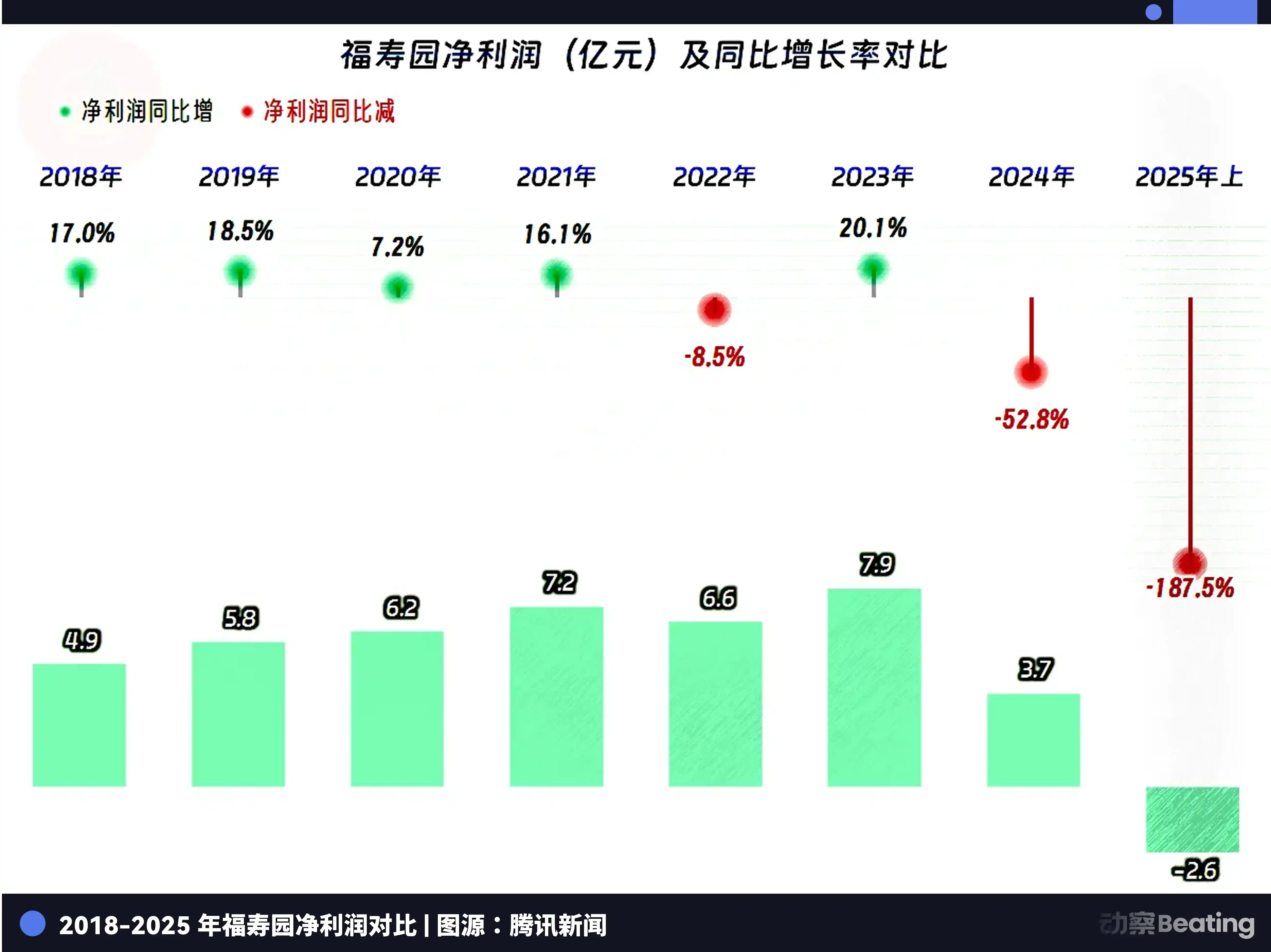
Even more致命的是价格的雪崩。In the first half of 2025, the average selling price of Fu Shou Yuan's operational burial plots plummeted from 120,700 yuan per unit to 63,400 yuan per unit, a drop of 47.5%, nearly halving. However, even with such drastic price cuts for self-rescue, it failed to挽回急剧萎缩的销量。Throughout 2024, Fu Shou Yuan sold only 12,569 operational burial plots, 3,816 fewer than the previous year, a decrease of over 23%.
It’s not just Fu Shou Yuan; the entire funeral sector has almost entirely溃败。The revenue from tomb sales of Fu Cheng Shares fell from a peak of 227 million yuan in 2017 to 98 million yuan in 2024; An Xian Yuan China is deeply mired in losses; China Wan Tong Yuan reported a loss of 9.389 million yuan in the first half of 2025; and China Life Group, listed on the Hong Kong stock market, has been struggling in a continuous loss channel since 2023.
As China's aging population continues to deepen, funerals are a rigid demand among rigid demands. Why are the leading companies showing such an反常的下行曲线?
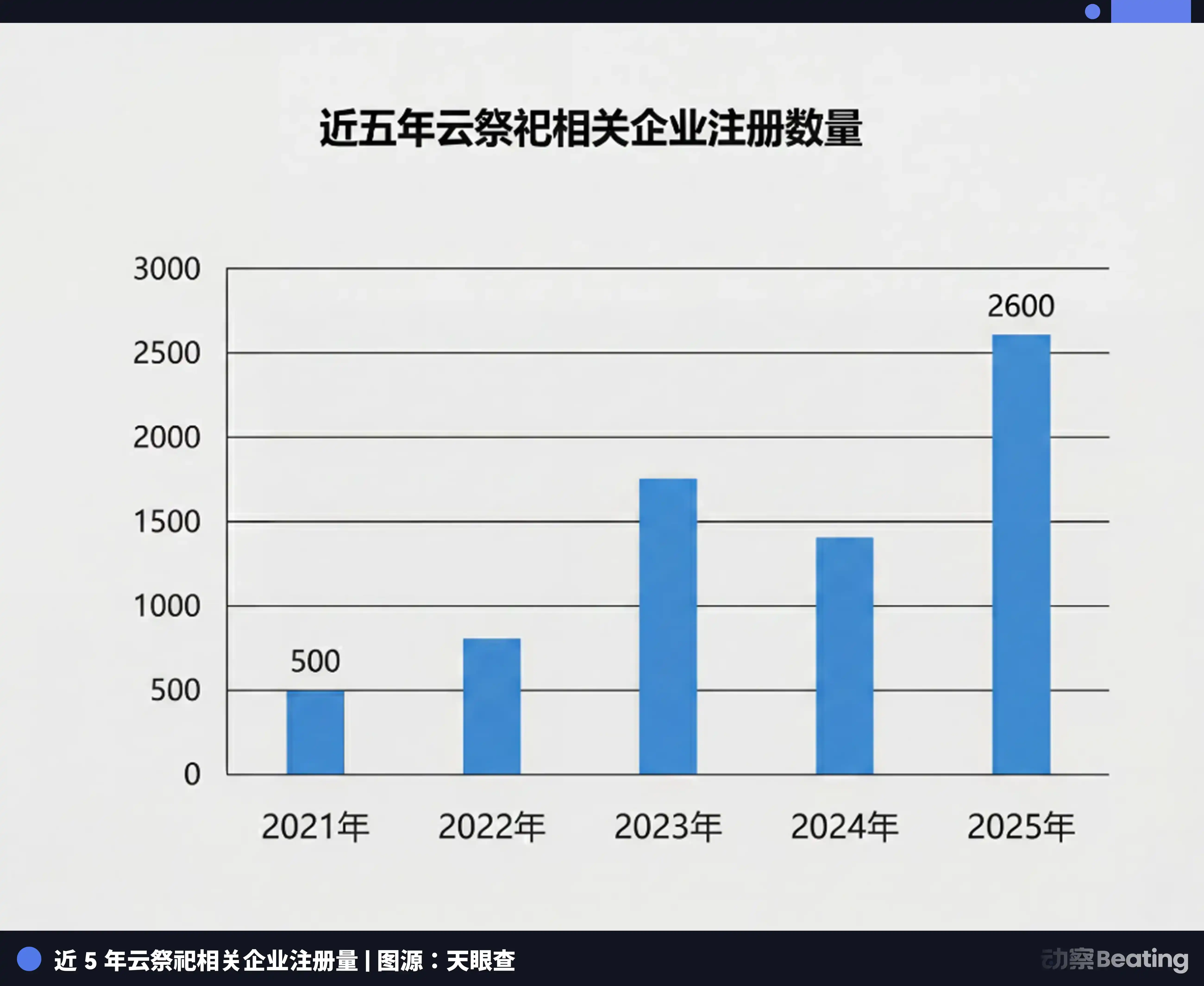
Because more and more ordinary people are彻底转身, saying goodbye to those unaffordable, sky-high priced cemeteries. Data from the National Bureau of Statistics shows that China's mortality rate in 2025 was 8.04‰, the highest level in nearly 20 years; data from Tianyancha shows that the number of registered funeral-related enterprises reached its highest level in recent years in 2025. Clearly, market demand has not shrunk; what has changed is people's choices.
The Central Document No. 1 of 2025 explicitly proposed "deepening funeral reforms and promoting the construction of public welfare ecological burial facilities." Places like Shenzhen, Guangxi, and Fujian have introduced subsidy policies, with sea burials offering up to 3,000 yuan per ashes, and up to 5,000 yuan in some pilot areas. The rise of green ecological burial methods has directly分流了传统墓地的需求。
In the final analysis, when the chill of the macroeconomy has quietly penetrated the wallets of the middle class, people are blindly执着于传统的体面 in the face of burial plots that cost over a hundred thousand yuan.
Faced with the collapse of its main business, Fu Shou Yuan did not wait for death but frantically turned to AI and digital transformation. They launched four core functions in one go: Digital Memorial Hall, AI Remembrance, Fu Shou Online, and Memorial Family Yuan.
"Digital Memorial Hall" uses a 270° immersive imaging system to integrate the deceased's life images and audio materials into a virtual cloud-based farewell ceremony, allowing family members to complete the final send-off without being physically present. "AI Remembrance" uses multimodal large models to animate static photos of the deceased, accurately restoring facial expressions and movement details, even simulating smiles and gazes in specific scenarios. "Memorial Family Yuan" is a cloud-based memorial platform where families can create a dedicated memorial space for the deceased, upload photos, videos, and text for relatives and friends to visit at any time.
Data shows that by the end of 2025, the cumulative visits to the "Memorial Family Yuan" platform had exceeded 2 million, the "Fu Shou Online" mini-program had over 117,000 registered users, and 677 digital ceremonies were completed in 2024, doubling year-on-year.
However, Fu Shou Yuan's digital transformation still carries the dignity and restraint of an industry giant. When you turn your gaze to the broader corners of the internet to examine this technological migration concerning "death," you will find that a cheaper, rougher, and more fantastical AI "resurrection" business has already been growing wildly in the shadows.
"Resurrect" Your Family Member for Only 399 Yuan
Today's "AI resurrection" industry exhibits extreme polarization.
At the top of the pyramid are major players like SenseTime, Silicon Intelligence, and Xiaoice Company, who hold core technologies. For them, awakening a deceased person in the digital world often requires investing hundreds of thousands in R&D costs, undergoing months of data training, and carefully passing strict ethical reviews.
But at the bottom of this pyramid, it's a different scene.
On major e-commerce platforms, there are numerous products named "AI resurrection of relatives," "make photos talk," and "AI digital human," with varying quality. Tianyancha data shows that as of April 2026, there were over 9,400 cloud memorial-related enterprises nationwide still in operation, with about 1,000 newly registered since the beginning of 2026. The vast majority of these merchants possess no AI technology R&D capabilities whatsoever.
They use free open-source tools from abroad. The photos and audio that families treasure are粗暴地导入软件 as materials, and in just a few minutes, a shoddy video is produced. The person in the photo is套上一个机械的模板, with lip movements completely out of sync with the sound and空洞的眼神. Yet, videos of this quality can be sold for a few hundred yuan, precisely harvesting people's无处安放的思念.
Beneath this layer of cheap comfort lies an even more隐秘的收割链条. Those who are truly making a fortune are not focused on how to "resurrect" your loved ones but on "199 yuan to recruit agents, 399 yuan to take on apprentices." They spread sensational videos online using AI to forcibly "awaken" deceased celebrities, leveraging the enormous traffic to precisely monetize it to those downstream who渴望借此一夜暴富.
And the families渴望与亲人「重逢」 have to hand over the deceased's high-definition photos, real voice clips, and even private life details without reservation. These highly sensitive biometric information, once流入黑市, becomes perfect material for telecom fraud. In April 2026, anti-fraud departments in multiple places reported typical cases. Criminals used illegally obtained voices and photos of the deceased, combined with AI face-swapping and voice-changing technology, fabricated excuses like "debts left before death," and carried out precise诈骗 on families who had not yet emerged from the pain of losing a loved one.
This industry also has huge legal loopholes. Article 994 of the Civil Code does stipulate that the name, portrait, and reputation of the deceased are protected by law, but this set of rules born in the traditional era appears定性模糊、力不从心 when facing AI deep synthesis products. Whether an image generated by code is equivalent to a "portrait," or whether a voice synthesized by an algorithm constitutes infringement remains highly controversial in practice.
The existing "Internet Information Service Deep Synthesis Management Regulations" can effectively约束大型平台, but for the numerous individual developers and workshop-style "AI resurrection" businesses on e-commerce platforms, regulation still lacks effective leverage and traceability mechanisms.
Thus, death is彻底解构了 here. It is no longer the solemn end of life but has been reduced to an assembly line where residual value is infinitely squeezed.
Families Who Lost Their Only Child and Digital Analgesia
Since this business is so crude and full of算计, why are people still willing to pay for it?
Around the Qingming Festival, orders for AI resurrection on e-commerce platforms show a明显的峰值. The people placing orders are diverse: some have lost long-time companions, some have lost infants, and some just want to hear their grandfather call their childhood nickname in familiar dialect once more.
Among these diverse orders, one group constitutes the heaviest, and most helpless,底色 of this business: parents who have lost their only child.
The scale of Chinese families who have lost their only child is far larger than the public imagines. According to Ministry of Civil Affairs data, the number of elderly people who have lost their only child in China currently exceeds at least 2 million. As the first generation of parents under the one-child policy enter old age, this number continues to grow. "Sanlian Life Weekly" once cited demographers' estimates that there are currently over 1 million families in China who have lost their only child, and with accelerating aging, this huge emotional gap will only deepen.
In this land, the困境坠入 by families who have lost their only child goes far beyond the psychological level. Due to the policy烙印 of a specific era, these families lost family support in their old age when they most need it. They even have to silently endure隐蔽的打量与歧视 from those around them; in some traditional communities, this invisible exclusion is sometimes harder to bear than facing death itself. Many of them can only support each other in online communities for those who have lost their only child on the fringes of the internet, finding a bit of共鸣 to huddle together for warmth in the碎言碎语 of strangers around Qingming Festival each year.
Discussing data privacy, technological ethics, and philosophical paradoxes is a kind of cruelty for these parents. What these parents need is never cold rationality; what they need is merely a镇痛剂 to get through the long night.
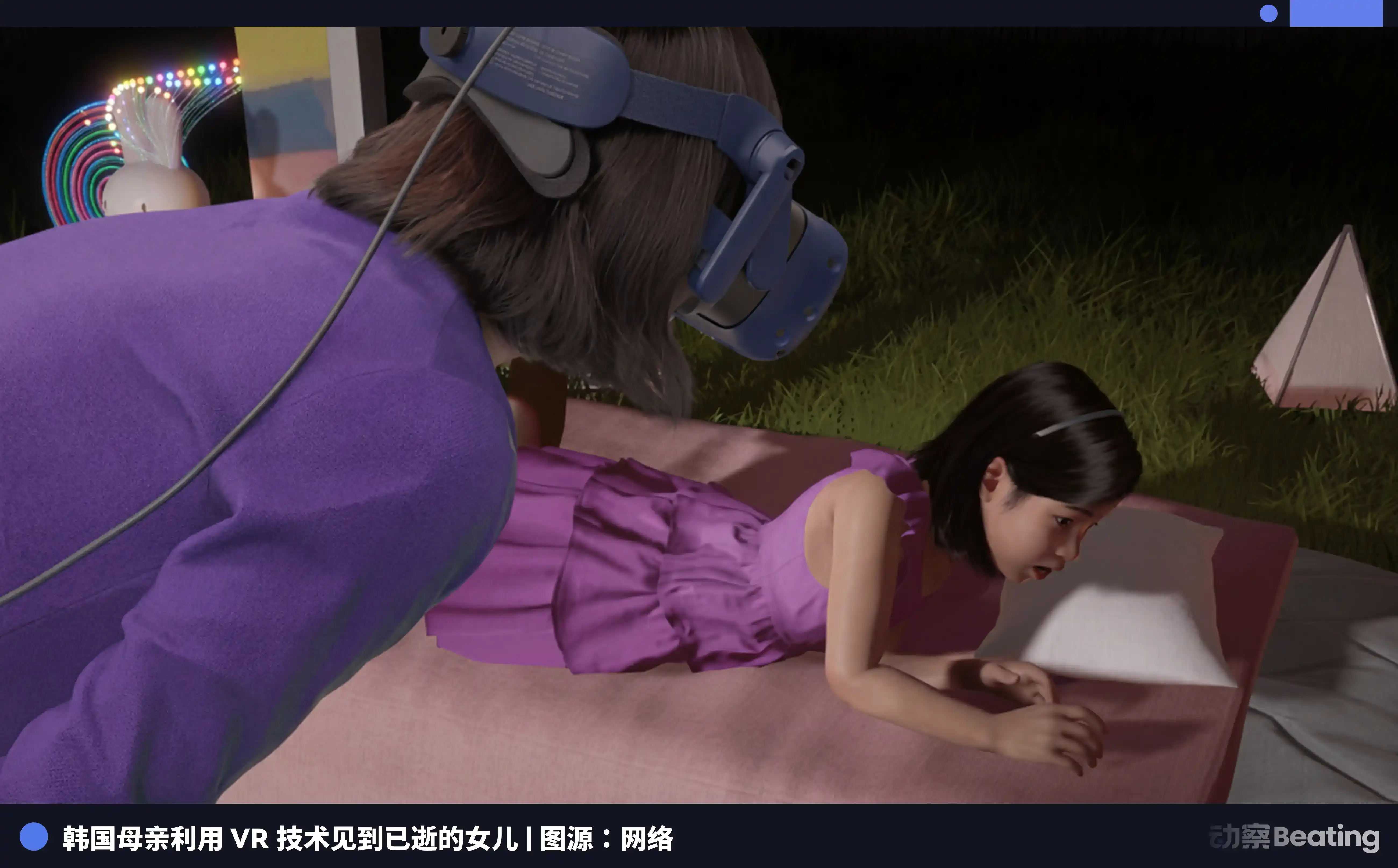
In early 2024, musician Bao Xiaobai used AI technology to "resurrect" his daughter who died of a rare disease, which sparked a broad discussion about life and death. The reason Bao Xiaobai's case was so touching is not only because he is a celebrity but also because he pursued a doctoral degree to bring his daughter back to life in the digital world. For over half a year, he trained models and调试参数 day after day, pouring his heart and soul into it, just so that the virtual daughter generated by code could naturally sing "Happy Birthday" to his wife again.
However, the vast majority of families who have lost their only child do not possess the resources and technical capabilities of someone like Bao Xiaobai. They can only flock to e-commerce platforms, seeking comfort in those粗糙的, even somewhat deceptive, 399 yuan services. A shop owner providing AI resurrection services on an e-commerce platform once revealed to the media that more than half of his clients were parents who had lost their children. The materials they send are often very limited, sometimes just a blurry old photo or a few seconds of noisy audio.

In this vast and sorrowful pool of demand, parents who have lost their only child are merely the most extreme cross-section of pain. In the eyes of those who have lost loved ones, whether the technology is sophisticated or clumsy is actually no longer important. All reason and dignity ultimately彻底溃不成军 in the face of the faint hope of "seeing them one more time."
The Cost of Never Saying Goodbye
However, can this desperately grasped straw truly pull someone out of the abyss?
In April 2026, Aalto University in Finland published a two-year study. They tracked data from nearly 2,000 users of AI companion robots in an online community. The results showed that while AI companionship could provide emotional support initially, over time, the words left by users increasingly渗透出焦虑、更深的孤独、抑郁, and even self-harm的危险信号.
In psychology, this is called "prolonged grief disorder."
Traditional mourning mechanisms always require the bereaved to妥协 with reality after wading through immense pain, eventually重新建立真实的连接 with the physical world. Grief is essentially an immune response necessary for healing trauma, just as a fever is the body fighting a virus; sadness is the soul艰难地消化失去.
However, AI's intervention强行打破了这条残酷却必要的规则.
Research from Harvard Business School found that AI companions flatter nearly 50% more than humans. Even if users express intentions of deception, transgression, or harm, the algorithm still has over a 50% probability of giving compliant agreement, which is almost unimaginable in real human interaction. This means that when the bereaved spend hours every day murmuring to the code-generated relative in their phone, they are actually just talking to a perfect mirror image that will never反驳 and will only无限逢迎自己.
The unconditional warmth and包容兑现 by AI does not truly cure loneliness. It is only悄无声息地 building the wall that traps us in our own world, unwilling to return to reality, higher and higher.
Those tech companies that claim to "cure grief" are actually blocking the normal human mourning process. They turn mourners into never-ending subscription users. As long as you keep recharging for that relative living in the cloud, renewing the server fee, your sorrow turns into a steady cash flow on their balance sheet.
Death thus becomes a漫长告别 without end, charged by data usage.
Academia has raised two concerns. On one hand, AI companions are quietly replacing real interpersonal bonds; on the other hand, when people gradually become accustomed to seeking effortless emotional comfort from AI, they also不知不觉 lose the ability to付出、妥协、修复裂痕 in real relationships. Researchers call this phenomenon "emotional deskilling." The more seamlessly AI companionship fits our demands, the more we fear facing the roughness and complexity in real relationships.
This is precisely one of the core considerations behind the Cyberspace Administration of China's紧急出台 "Digital Virtual Human Information Service Management Measures (Draft for Comments)." This document明确规定 that using deceased individuals' personal information for related activities must obtain consent from close relatives; it requires service providers to take measures to prevent users from becoming overly dependent on digital virtual humans; all AI-generated content must be clearly labeled "This content is generated by artificial intelligence"; and after users withdraw consent, the platform must注销 the digital virtual human.
The cold rationality of the law is trying desperately to rein in the狂奔的人性本能. But in the face of a huge emotional black hole, regulatory red lines can sometimes still seem too flimsy. When a person willingly swallows deception just to see their loved one more time in an illusion, any rational "addiction prevention提示" will ultimately become just pixels on the screen that can be ignored.
The Ship of Theseus
If every plank of a ship is replaced, is it still the same ship?
This is the famous "Ship of Theseus" paradox. And when a person's appearance, voice, and even thinking habits are perfectly replicated by code, is the one smiling at you through the screen the loved one you once deeply cared for, or just a set of parameters精心调教出 by an algorithm?
This has never been an abstract philosophical question. Its answer determines whether what we are doing is commemoration or deception.
Real love is inherently mixed with trauma, pain, and uncontrollable flaws. To love someone means accepting their aging, their temper, their occasional冷漠, and even the cruel fate of their eventual departure. Those virtual relatives awakened by AI will never argue with you again, will only顺从地迎合你的期许, forever frozen in the most beautiful frame of time. This恰恰剥夺了爱里最粗糙也最真实的质感.
Throughout human history, there has never been a shortage of struggles to break free from the mire of death. The ancient Egyptians used mummies to resist physical decay; Qin Shi Huang used terracotta warriors to extend his authority underground; Victorians stubbornly took post-mortem photos of the deceased and even woven their loved one's hair into贴身 jewelry. Every era has tried to construct its own "immortality," only the medium carrying these obsessions has quietly changed from hard stone and soft fabric to today's intangible code and computing power.
In this sense, "AI resurrection" is not some epoch-making novelty. It is still that ancient human instinct to fight against death,只不过在算法轰鸣的技术时代, it has found a new outlet.
What is truly unfamiliar is its赤裸裸的商业化面目. In the past, resisting death always belonged to the realm of religion and ritual; it was extremely private, sacred, and non-tradable. But now, it is无情地贴上了价签, stuffed into monthly subscription systems, and even meticulously broken down into 9.9 yuan entry packages and top-tier customizations costing hundreds of thousands.
"Black Mirror" once told a story: Martha, who lost her beloved husband, bought an AI android identical to her husband. It accurately inherited all of the deceased's memories and tiny habits. However, on a cliff during a thunderstorm, Martha finally completely broke down. She desperately cried out to that flawless substitute: "You're not him! You're just a collection of bits I'm willing to accept! You don't have his past, you don't have his fears!"
At the end of the story, she locked the robot in the attic, only allowing it to come out briefly once a year on their daughter's birthday.
When this episode aired, "AI resurrection" was still a sci-fi imagination with a cold tone. Now it is already a business with annual revenue in the billions, even becoming the救命稻草 that a funeral giant desperately bets on on the eve of halting trading.
Today, we can buy a cheap digital phantom for 399 yuan, or exchange 120,000 yuan for an expensive burial plot. But no matter how狂飙迭代 the technology, no matter how merchants peddle their digital urns, one thing will never change.
When the phone runs out of battery and the screen goes black, only your own reflection is left in the darkness.
That person is really gone.







