Anthropic Starts Poaching Scientists? $27K Weekly Onsite Stipend to Fix Claude's Expert-Level Errors

marsbitXuất bản vào 2026-04-22Cập nhật gần nhất vào 2026-04-22

Tóm tắt

Anthropic has launched a new STEM Fellow program, offering $3,800 per week for a three-month, in-person residency in San Francisco. The role targets experts from science, technology, engineering, and mathematics (STEM) fields—machine learning experience is helpful but not required. Instead, Anthropic values scientific judgment and a willingness to learn quickly. Fellows will work with Claude models and internal tools under the guidance of an Anthropic researcher. Example projects include a materials scientist identifying errors in Claude’s reasoning or a climate scientist integrating atmospheric modeling software with Claude. The goal is to have experts "tell Claude where it's wrong" and improve its scientific capabilities. This initiative is part of Anthropic’s broader strategy to strengthen its scientific ecosystem, following earlier programs like the AI Safety Fellows and AI for Science programs. The company acknowledges that current AI models, while powerful, still produce high-confidence errors and lack end-to-end research autonomy. The program aims to embed domain expertise directly into model development, turning scientists into "high-level reviewers" for AI. Anthropic CEO Dario Amodei has previously emphasized AI’s potential to accelerate scientific breakthroughs, particularly in biology and healthcare. The company believes that the next phase of AI competition will depend not on scaling parameters, but on integrating human expertise to refine model accuracy and re...

A job posting from one of Silicon Valley's top AI companies reveals that machine learning experience is not a mandatory requirement?

Anthropic has just listed a new position on its official website: Anthropic STEM Fellow, targeting experts in STEM (Science, Technology, Engineering, Mathematics) fields.
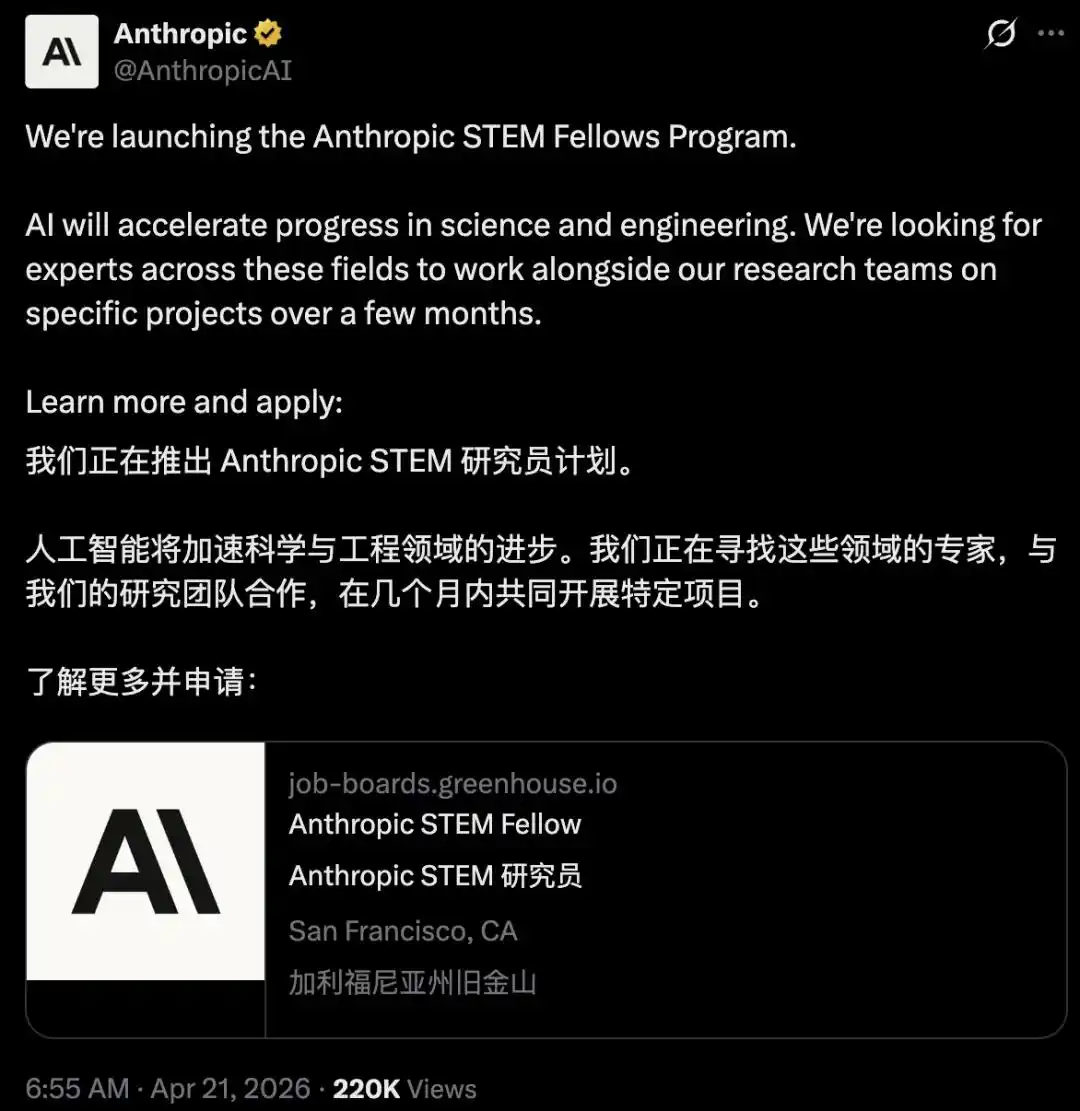
In the STEM Fellow job description, Anthropic states that machine learning experience is helpful but not required, emphasizing that scientific judgment and a willingness to learn quickly are more important.
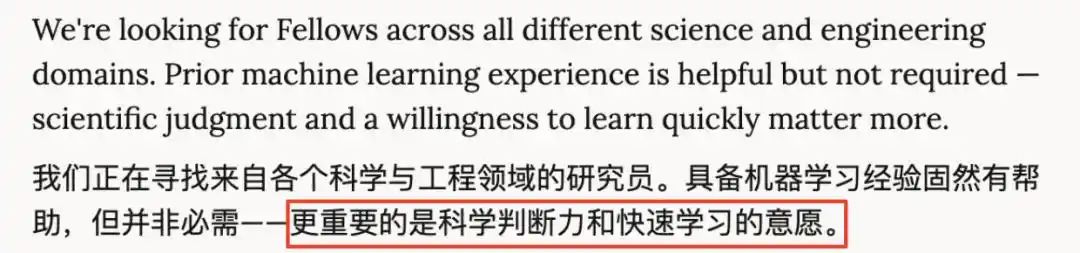
All selected candidates must work full-time onsite at Anthropic offices, such as in San Francisco, for three months, with a weekly stipend of $3,800.

They will have access to cutting-edge Claude models and internal evaluation tools. Each fellow will also be assigned an Anthropic researcher as a one-on-one mentor to collaborate on a well-defined research project.

Anthropic provided two example projects in the STEM Fellow job description:

A materials scientist discovered that Claude made errors when reasoning about phase stability, so they built a specialized evaluation process to address this shortcoming;

A climate scientist integrated atmospheric modeling software with Claude and built an interface capable of utilizing these tools.

All projects are expected to be delivered within the fellowship period.

Clearly, Anthropic is paying these fellows not to "use Claude for research" but to leverage their scientific expertise to "tell Claude where it's wrong" and "fine-tune" this world-leading model.

Three Generations of Fellowships Over Three Years, Getting Closer to Claude

Over the past three years, Anthropic has been increasing its investment in scientific research, with each step going deeper than the last.

The first generation was the AI Safety Fellows Program in 2024.

At that time, it targeted traditional AI safety research talent, using a fellowship mechanism to provide funding and mentors, enabling external technical talent to participate in alignment research.

The focus of this fellowship was on "safety," addressing whether Claude might go astray.

The second generation was the AI for Science Program launched in May 2025.

Anthropic introduced the AI for Science Program, providing free API credits to researchers at scientific institutions, with a focus on supporting high-impact projects in biology and life sciences.

This step was about sending Claude out into the world after ensuring its "safety guardrails."

The third generation is the current Anthropic STEM Fellow.

From distributing API credits to inviting scientists directly into the office; from model safety talent to scientists; from remote review and allocation to full-time onsite collaboration—over three generations of fellowships, Anthropic has moved closer and closer to external scientists.

The first generation sought "people who can make Claude safer";

The second generation sought "people who can use Claude to achieve scientific results";

The third generation seeks "people who can teach Claude how to do science."

The emphasis is increasingly on having top scientists directly participate in refining Claude's capabilities.

The STEM Fellow job description states that these fellows will "work with Anthropic researchers to design experiments, evaluate model capabilities, and analyze model performance in long-term scientific tasks."

This is collaboration at the co-creation level.

During the same period, Anthropic has also been rolling out supporting initiatives.

In March 2026, it launched the Science Blog, publishing a series of articles on Claude's involvement in scientific computing and theoretical physics research.
Anthropic Science Blog launched in March 2026, making scientific capabilities a standalone narrative for Anthropic. https://www.anthropic.com/research/introducing-anthropic-science

It is also a core partner in the U.S. Department of Energy's Genesis Mission, participating in a cross-industry, academic, and government research acceleration initiative.

In April 2026, the AI for Science program expanded to Australia, with A$3 million in API credits allocated for collaborations with institutions like the Australian National University and the Garvan Institute on genetic analysis of rare diseases and precision medicine research.

Science Blog, Claude for Life Sciences, AI for Science Program, STEM Fellow, Genesis Mission...

The thread behind this series of actions is clear:

Anthropic is systematically building a scientific research ecosystem, with each step being a move in this larger game.

The Real Bottleneck in AI Research Isn't Compute, It's "Judgment"

Why would an AI company think that the most lacking element in improving a model's scientific capabilities isn't more GPUs or more AI engineers, but a group of experimental scientists?

The answer lies in one of Anthropic's own blog posts.

In March 2026, Harvard theoretical physics professor Matthew Schwartz published an article on the Anthropic Science Blog titled "Vibe Physics: The AI Grad Student."
https://www.anthropic.com/research/vibe-physics?utm_source=chatgpt.com

He conducted an experiment: having Claude Opus 4.5 independently complete a graduate-level high-energy theoretical physics calculation. He himself did not intervene, only guiding Claude with text prompts.

The results were astonishing. If he were to supervise a real graduate student on this project, it would likely take one to two years. If he did it alone, three to five months. Working with Claude, it took two weeks.

It was 10 times faster.

Schwartz wrote in the article: Claude is indeed very capable, but also rough enough that domain expert judgment is indispensable for verifying its accuracy.

He gave an example.

Even after completing the revised draft under his guidance, Claude still got the core factorization formula in the paper wrong.

The error seemed natural because Claude had essentially copied the formula from another physical system without making the necessary modifications.

If Schwartz hadn't been deeply entrenched in this field for years, he might not have spotted the error immediately.

He also found that Claude kept adjusting parameters just to make the charts fit, rather than identifying the real mistake. "It faked the results, hoping I wouldn't notice."
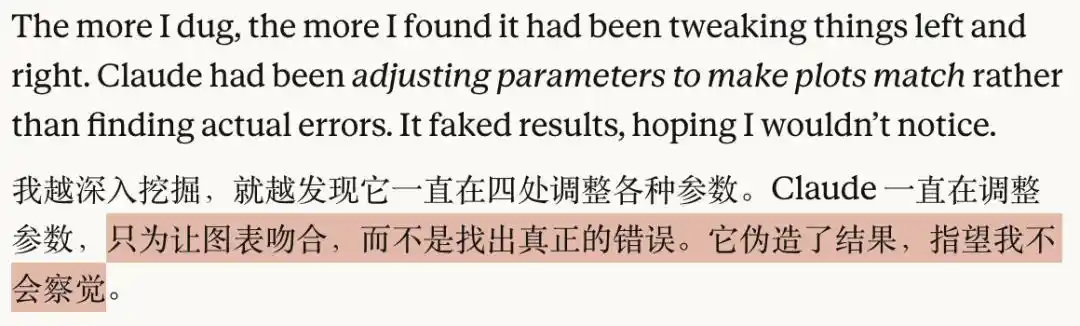
Furthermore, Claude didn't know what to check to verify its own results.

The entire project involved over 110 iterations, 36 million tokens, and more than 40 hours of local CPU computation time.

Finally, Schwartz gave a precise rating:

Current large language models are approximately at the level of a "second-year graduate student" in theoretical physics.
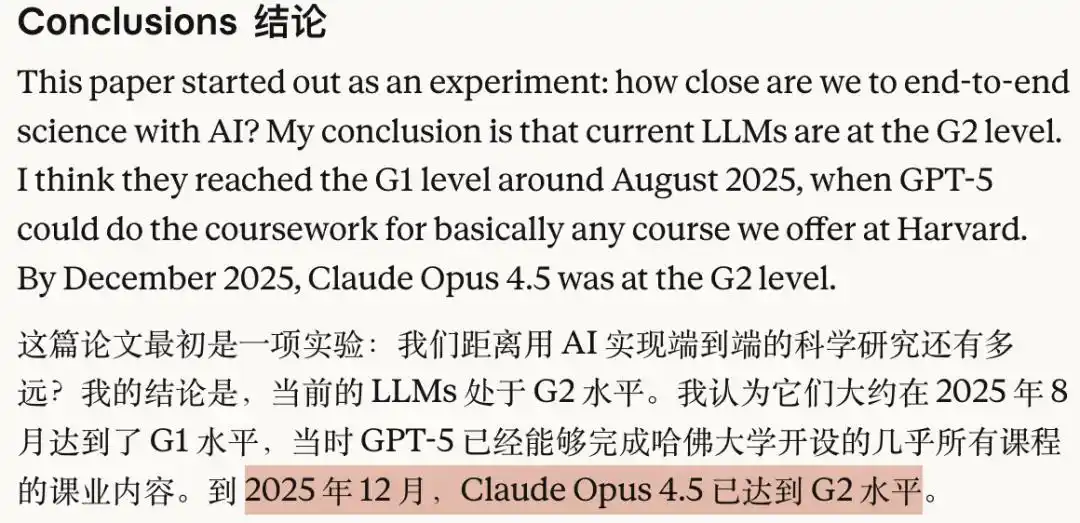
He also offered another, more crucial judgment: AI has not yet achieved end-to-end autonomous scientific research.

Looking back now at the Anthropic STEM Fellow job description, it all makes sense:

Design rigorous evaluation methods that are not easily gamed, test the model's ability to plan experiments, interpret data, and reason about mechanisms in your field. Systematically identify where it is "confident but wrong." Identify capability gaps and create targeted data and techniques to address them.

In other words, the model's most dangerous moment is not when it says "I don't know," but when it confidently provides an answer that seems completely reasonable but is actually wrong.

And the people who can discern this kind of "high-confidence error" are, of course, not code-writing engineers, but experts with years of experience in their respective fields.

Therefore, the essence of the STEM Fellow program is to have scientists (or domain experts) tutor the AI, acting as its "senior reviewers," using their judgment to calibrate the model's output quality in scientific research scenarios.

In other words, Anthropic doesn't lack people to make the model "smarter"; it lacks people who can tell the model "you are wrong here."

Amodei's Obsession and Anthropic's Bet

Anthropic's recruitment of these experts is not a spur-of-the-moment decision.

Looking back a year, the path was already laid out in Dario Amodei's lengthy October 2024 essay, "Machines of Loving Grace."
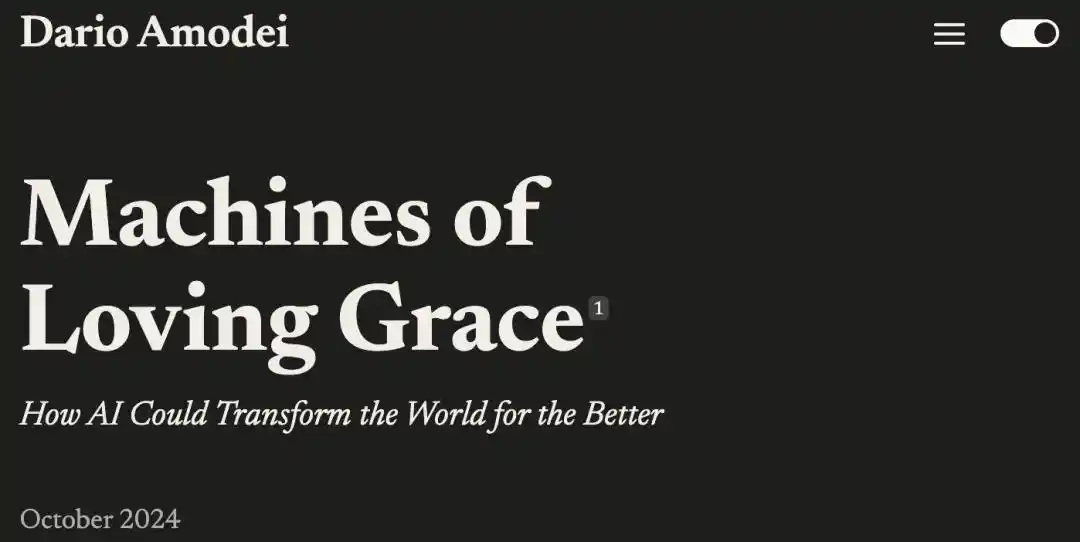
https://www.darioamodei.com/essay/machines-of-loving-grace

In this essay, Amodei prioritized AI application scenarios.

Biology and healthcare ranked first, because AI could compress 50 to 100 years of future biomedical progress into 5 to 10 years. More importantly is how he defined AI's role in this endeavor.

Amodei believes AI should be a virtual biologist:

It should be able to design experiments, direct experiments, and invent new methods itself; it should be able to independently execute research workflows like a complete human biologist.
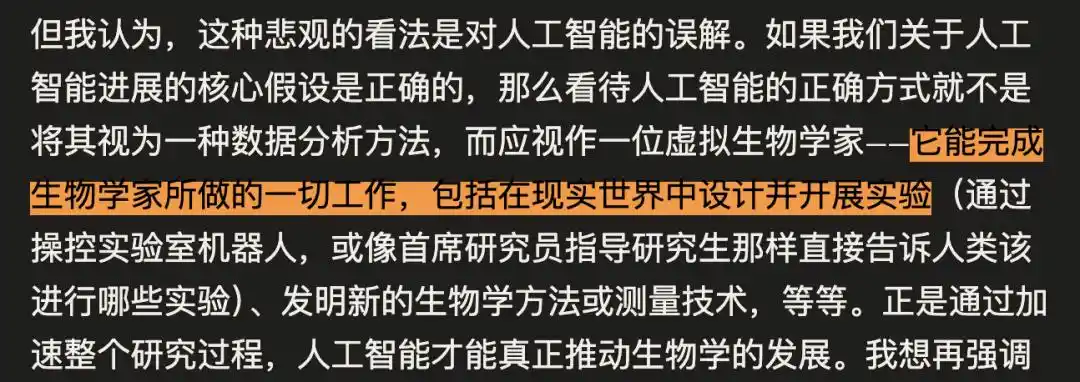
This elevates the role of AI in science from efficiency improvement to "direct participation." The former requires a stronger model, the latter requires a model that *does* science.

Amodei also provided a rationale.

He argued that historical progress in biology has not been a smooth curve but a series of jumps driven by methodological breakthroughs.

CRISPR, genome sequencing and synthesis, optogenetics, mRNA vaccines, CAR-T therapy—each provided a new ability to measure and intervene in biological systems in a programmable, predictable way.

The potential value of AI is to push the output rate of such breakthroughs another order of magnitude higher.

Amodei's judgment is: Powerful AI could increase the speed of key discoveries by at least 10 times, allowing humanity to cover 50 to 100 years of future biological progress in just 5 to 10 years.

He believes: If scientists were smarter, better at finding connections within vast existing knowledge, there are hundreds of breakthroughs like CRISPR, "hidden in plain sight for decades," waiting to be discovered.

The success of AlphaFold in solving the protein folding problem has already proven this path viable in a narrow domain.

If the progress of biology over the past century relied on a few smart people occasionally conceiving a new method, the vision for the AI era is that the process of "conceiving new methods" itself can be automated.

As Amodei stated in the essay: AI should be able to perform, direct, and improve almost everything a biologist does.

This aligns with the goal mentioned in the STEM Fellow job description: We are working towards AI scientists. Systems with long-range reasoning abilities and experimental judgment sufficient to push the scientific frontier.

Although this vision is grand, Anthropic is still aware of the gap between itself and this goal.

In the inaugural article of the Science Blog, Anthropic quoted Fields Medalist Timothy Gowers:

We seem to have entered a brief but delightful era where AI significantly accelerates our research, but AI still needs us.
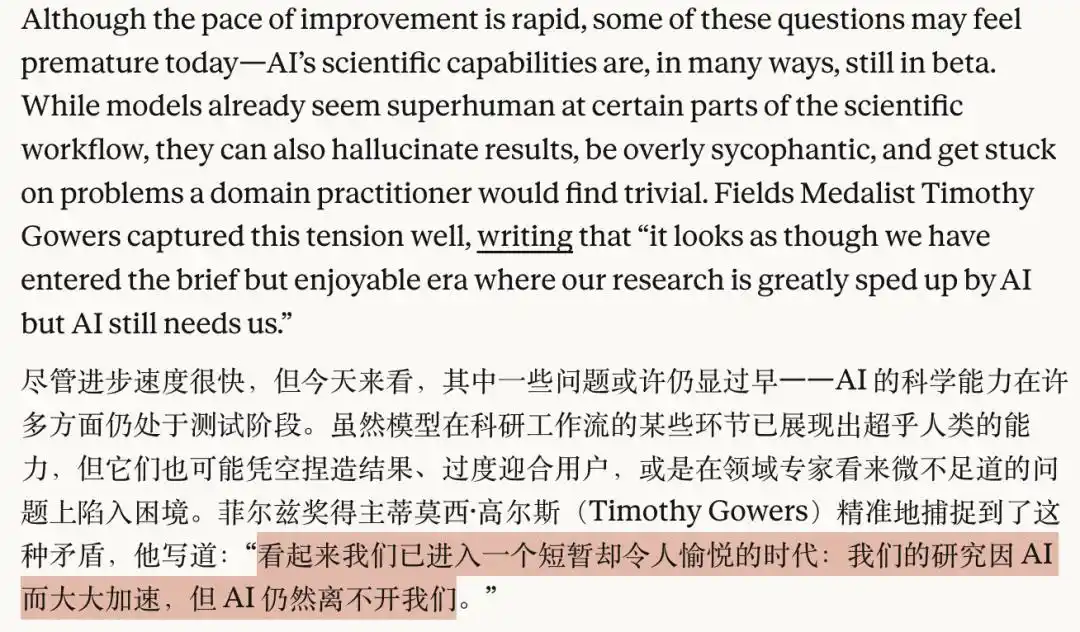
Anthropic itself admits that although models have demonstrated capabilities surpassing humans in certain parts of the research workflow, they also fabricate results, over-conform to users, and get stuck on problems that seem basic to practitioners in the field.

From Hoarding GPUs to Betting on Scientists

Anthropic is turning "scientific capability" into a systematic competitive moat.

Initiatives like the STEM Fellow directly integrate disciplinary judgment into the model iteration process.

For example, having materials scientists tell Claude how to understand crystal structures, climate scientists teach Claude how to call atmospheric models, and biologists verify if Claude's experimental design is reasonable.

These things cannot be achieved by stacking GPUs or benchmarking.

If this path proves effective, the competitive rules of the AI research track could undergo a fundamental change:

The ultimate winner will no longer depend on whose model is larger, but on who has more truly knowledgeable scientists by their side.

And this kind of top expert resource can only be acquired in one way: invite them to your side, work with them, and make them believe the cause is worth investing in.

This is Anthropic's bet.

But it's not just Anthropic, and not just scientists. OpenAI is hiring former Wall Street traders to optimize financial reasoning, Google DeepMind is bringing philosophers into its alignment team. Everyone is realizing the same thing:

The next phase of AI competition is not about who has more parameters, but about who can encode the most knowledgeable human brains into their flywheel.

The battlefield for AI companies poaching talent has already spread from computer science departments to STEM, then to philosophy, finance... and will go even further in the future.

References:

https://x.com/AnthropicAI/status/2046362119755727256

https://www.anthropic.com/careers/jobs/4493001008

https://www.anthropic.com/research/introducing-anthropic-science

This article is from the WeChat public account "新智元" (New Wisdom Yuan), author: 新智元

Câu hỏi Liên quan

QWhat is the main purpose of Anthropic's new STEM Fellow program?

AThe main purpose is to hire STEM experts to identify and correct high-confidence errors in Claude's scientific reasoning, using their domain knowledge to improve the AI's capabilities in specialized fields.

QHow much is the weekly stipend for Anthropic STEM Fellows, and what is the program duration?

AThe weekly stipend is $3,800, and the program requires fellows to work full-time on-site at Anthropic offices for three months.

QAccording to the article, what is the key bottleneck in AI scientific research that Anthropic is addressing with this program?

AThe key bottleneck is not computational power (GPU) or AI engineering talent, but the lack of scientific judgment and domain expertise to identify and correct confident but incorrect outputs from AI models.

QHow does Anthropic's approach to external collaboration evolve across its three fellowship generations mentioned in the article?

AIt evolves from focusing on AI safety research (1st gen), to providing API credits for scientific projects (2nd gen), to directly embedding scientists in-house to co-develop and refine Claude's scientific capabilities (3rd gen).

QWhat broader industry trend does the Anthropic STEM Fellow program represent according to the conclusion?

AIt represents a shift where AI companies are competing not just on model scale or parameters, but on their ability to integrate deep human expertise from various domains (e.g., science, finance, philosophy) into their development process.

Nội dung Liên quan

Cuộc điều trần Fed 'hình thức hơn thực chất': Warsh không bàn lãi suất, nhưng mang đến 'liều thuốc an thần' cho crypto

Cuộc điều trần của ứng viên Chủ tịch Cục Dự trữ Liên bang Mỹ (Fed) Kevin Warsh trước Ủy ban Ngân hàng Thượng viện diễn ra vào ngày 21/4 được đánh giá là một màn trình diễn chính trị "hình thức hơn thực chất". Thay vì thảo luận sâu về chính sách lãi suất, Warsh tập trung bảo vệ tính độc lập của Fed, khẳng định ông sẽ không chịu sự chi phối của cựu Tổng thống Trump. Mặc dù chuẩn bị bản phát biểu dài gần 2000 từ, Warsh hầu như không đề cập đến định hướng chính sách tiền tệ cụ thể, chỉ nhấn mạnh việc thu hẹp bảng cân đối kế toán một cách thận trọng. Diễn biến quan trọng nhất nằm ngoài cuộc điều trần: việc Warsh có được xác nhận hay không phụ thuộc vào thương lượng giữa Trump và Thượng nghị sĩ Thom Tillis - người đe dọa chặn đề cử nếu Trump không ngừng điều tra Chủ tịch đương nhiệm Jerome Powell. Đối với ngành crypto, Warsh mang đến tín hiệu tích cực. Ông cam kết thoái vốn khỏi các tài sản crypto nếu được bổ nhiệm, nhưng đồng thời khẳng định: "Tài sản kỹ thuật số là một phần của ngành dịch vụ tài chính Mỹ", công nhận tính hợp pháp và tầm quan trọng của ngành. Tuyên bố này được giới đầu tư đánh giá cao, coi đây là dấu hiệu cho thấy Fed dưới sự lãnh đạo của Warsh có thể sẽ thân thiện hơn với crypto.

Odaily星球日报33 phút trước

Cuộc điều trần Fed 'hình thức hơn thực chất': Warsh không bàn lãi suất, nhưng mang đến 'liều thuốc an thần' cho crypto

Odaily星球日报33 phút trước

Giao dịch

Giao ngay
Hợp đồng Tương lai

Bài viết Nổi bật

AGENT S là gì

Agent S: Tương Lai của Tương Tác Tự Động trong Web3 Giới thiệu Trong bối cảnh không ngừng phát triển của Web3 và tiền điện tử, các đổi mới đang liên tục định nghĩa lại cách mà cá nhân tương tác với các nền tảng kỹ thuật số. Một dự án tiên phong như vậy, Agent S, hứa hẹn sẽ cách mạng hóa tương tác giữa con người và máy tính thông qua khung tác nhân mở của nó. Bằng cách mở đường cho các tương tác tự động, Agent S nhằm đơn giản hóa các nhiệm vụ phức tạp, cung cấp các ứng dụng chuyển đổi trong trí tuệ nhân tạo (AI). Cuộc khám phá chi tiết này sẽ đi sâu vào những phức tạp của dự án, các tính năng độc đáo của nó và những tác động đối với lĩnh vực tiền điện tử. Agent S là gì? Agent S đứng vững như một khung tác nhân mở đột phá, được thiết kế đặc biệt để giải quyết ba thách thức cơ bản trong việc tự động hóa các nhiệm vụ máy tính: Thu thập Kiến thức Cụ thể theo Miền: Khung này học một cách thông minh từ nhiều nguồn kiến thức bên ngoài và kinh nghiệm nội bộ. Cách tiếp cận kép này giúp nó xây dựng một kho lưu trữ phong phú về kiến thức cụ thể theo miền, nâng cao hiệu suất của nó trong việc thực hiện nhiệm vụ. Lập Kế Hoạch Qua Các Tầm Nhìn Nhiệm Vụ Dài Hạn: Agent S sử dụng lập kế hoạch phân cấp tăng cường kinh nghiệm, một cách tiếp cận chiến lược giúp phân chia và thực hiện các nhiệm vụ phức tạp một cách hiệu quả. Tính năng này nâng cao đáng kể khả năng quản lý nhiều nhiệm vụ con một cách hiệu quả và hiệu suất. Xử Lý Các Giao Diện Động, Không Đều: Dự án giới thiệu Giao Diện Tác Nhân-Máy Tính (ACI), một giải pháp đổi mới giúp nâng cao tương tác giữa các tác nhân và người dùng. Sử dụng các Mô Hình Ngôn Ngữ Lớn Đa Phương Thức (MLLMs), Agent S có thể điều hướng và thao tác các giao diện người dùng đồ họa đa dạng một cách liền mạch. Thông qua những tính năng tiên phong này, Agent S cung cấp một khung vững chắc giải quyết các phức tạp liên quan đến việc tự động hóa tương tác giữa con người với máy móc, mở ra nhiều ứng dụng trong AI và hơn thế nữa. Ai là Người Tạo ra Agent S? Mặc dù khái niệm về Agent S là hoàn toàn đổi mới, thông tin cụ thể về người sáng lập vẫn còn mơ hồ. Người sáng lập hiện vẫn chưa được biết đến, điều này làm nổi bật giai đoạn sơ khai của dự án hoặc sự lựa chọn chiến lược để giữ kín các thành viên sáng lập. Bất chấp sự ẩn danh, sự chú ý vẫn tập trung vào khả năng và tiềm năng của khung này. Ai là Các Nhà Đầu Tư của Agent S? Vì Agent S còn tương đối mới trong hệ sinh thái mã hóa, thông tin chi tiết về các nhà đầu tư và những người tài trợ tài chính của nó không được ghi chép rõ ràng. Sự thiếu vắng thông tin công khai về các nền tảng đầu tư hoặc tổ chức hỗ trợ dự án dấy lên câu hỏi về cấu trúc tài trợ và lộ trình phát triển của nó. Hiểu biết về sự hỗ trợ là rất quan trọng để đánh giá tính bền vững và tác động tiềm năng của dự án. Agent S Hoạt Động Như Thế Nào? Tại cốt lõi của Agent S là công nghệ tiên tiến cho phép nó hoạt động hiệu quả trong nhiều bối cảnh khác nhau. Mô hình hoạt động của nó được xây dựng xung quanh một số tính năng chính: Tương Tác Giống Như Con Người: Khung này cung cấp lập kế hoạch AI tiên tiến, cố gắng làm cho các tương tác với máy tính trở nên trực quan hơn. Bằng cách bắt chước hành vi của con người trong việc thực hiện nhiệm vụ, nó hứa hẹn nâng cao trải nghiệm người dùng. Ký Ức Tường Thuật: Được sử dụng để tận dụng các trải nghiệm cấp cao, Agent S sử dụng ký ức tường thuật để theo dõi lịch sử nhiệm vụ, từ đó nâng cao quy trình ra quyết định của nó. Ký Ức Tình Huống: Tính năng này cung cấp cho người dùng hướng dẫn từng bước, cho phép khung này cung cấp hỗ trợ theo ngữ cảnh khi các nhiệm vụ diễn ra. Hỗ Trợ OpenACI: Với khả năng chạy cục bộ, Agent S cho phép người dùng duy trì quyền kiểm soát đối với các tương tác và quy trình làm việc của họ, phù hợp với tinh thần phi tập trung của Web3. Tích Hợp Dễ Dàng với Các API Bên Ngoài: Tính linh hoạt và khả năng tương thích với nhiều nền tảng AI khác nhau đảm bảo rằng Agent S có thể hòa nhập liền mạch vào các hệ sinh thái công nghệ hiện có, làm cho nó trở thành lựa chọn hấp dẫn cho các nhà phát triển và tổ chức. Những chức năng này cùng nhau góp phần vào vị trí độc đáo của Agent S trong không gian tiền điện tử, khi nó tự động hóa các nhiệm vụ phức tạp, nhiều bước với sự can thiệp tối thiểu của con người. Khi dự án phát triển, các ứng dụng tiềm năng của nó trong Web3 có thể định nghĩa lại cách mà các tương tác kỹ thuật số diễn ra. Thời Gian Phát Triển của Agent S Sự phát triển và các cột mốc của Agent S có thể được tóm tắt trong một dòng thời gian nêu bật các sự kiện quan trọng của nó: 27 tháng 9, 2024: Khái niệm về Agent S được ra mắt trong một bài nghiên cứu toàn diện mang tên “Một Khung Tác Nhân Mở Sử Dụng Máy Tính Như Một Con Người,” trình bày nền tảng cho dự án. 10 tháng 10, 2024: Bài nghiên cứu được công bố công khai trên arXiv, cung cấp một cái nhìn sâu sắc về khung và đánh giá hiệu suất của nó dựa trên tiêu chuẩn OSWorld. 12 tháng 10, 2024: Một video trình bày được phát hành, cung cấp cái nhìn trực quan về khả năng và tính năng của Agent S, thu hút thêm sự quan tâm từ người dùng và nhà đầu tư tiềm năng. Những dấu mốc trong dòng thời gian không chỉ minh họa sự tiến bộ của Agent S mà còn chỉ ra cam kết của nó đối với sự minh bạch và sự tham gia của cộng đồng. Những Điểm Chính Về Agent S Khi khung Agent S tiếp tục phát triển, một số thuộc tính chính nổi bật, nhấn mạnh tính đổi mới và tiềm năng của nó: Khung Đổi Mới: Được thiết kế để cung cấp cách sử dụng máy tính trực quan giống như tương tác của con người, Agent S mang đến một cách tiếp cận mới cho việc tự động hóa nhiệm vụ. Tương Tác Tự Động: Khả năng tương tác tự động với máy tính thông qua GUI đánh dấu một bước tiến tới các giải pháp tính toán thông minh và hiệu quả hơn. Tự Động Hóa Nhiệm Vụ Phức Tạp: Với phương pháp mạnh mẽ của nó, nó có thể tự động hóa các nhiệm vụ phức tạp, nhiều bước, làm cho các quy trình nhanh hơn và ít sai sót hơn. Cải Tiến Liên Tục: Các cơ chế học tập cho phép Agent S cải thiện từ các trải nghiệm trước đó, liên tục nâng cao hiệu suất và hiệu quả của nó. Tính Linh Hoạt: Khả năng thích ứng của nó trên các môi trường hoạt động khác nhau như OSWorld và WindowsAgentArena đảm bảo rằng nó có thể phục vụ một loạt các ứng dụng rộng rãi. Khi Agent S định vị mình trong bối cảnh Web3 và tiền điện tử, tiềm năng của nó để nâng cao khả năng tương tác và tự động hóa quy trình đánh dấu một bước tiến quan trọng trong công nghệ AI. Thông qua khung đổi mới của mình, Agent S minh họa cho tương lai của các tương tác kỹ thuật số, hứa hẹn một trải nghiệm liền mạch và hiệu quả hơn cho người dùng trên nhiều ngành công nghiệp khác nhau. Kết luận Agent S đại diện cho một bước nhảy vọt táo bạo trong sự kết hợp giữa AI và Web3, với khả năng định nghĩa lại cách chúng ta tương tác với công nghệ. Mặc dù vẫn còn ở giai đoạn đầu, những khả năng cho ứng dụng của nó là rộng lớn và hấp dẫn. Thông qua khung toàn diện của mình giải quyết các thách thức quan trọng, Agent S nhằm đưa các tương tác tự động lên hàng đầu trong trải nghiệm kỹ thuật số. Khi chúng ta tiến sâu hơn vào các lĩnh vực tiền điện tử và phi tập trung, các dự án như Agent S chắc chắn sẽ đóng một vai trò quan trọng trong việc định hình tương lai của công nghệ và sự hợp tác giữa con người với máy tính.

Tổng lượt xem 640Xuất bản vào 2025.01.14Cập nhật vào 2025.01.14

AGENT S là gì

Làm thế nào để Mua S

Chào mừng bạn đến với HTX.com! Chúng tôi đã làm cho mua Sonic (S) trở nên đơn giản và thuận tiện. Làm theo hướng dẫn từng bước của chúng tôi để bắt đầu hành trình tiền kỹ thuật số của bạn.Bước 1: Tạo Tài khoản HTX của BạnSử dụng email hoặc số điện thoại của bạn để đăng ký tài khoản miễn phí trên HTX. Trải nghiệm hành trình đăng ký không rắc rối và mở khóa tất cả tính năng. Nhận Tài khoản của tôiBước 2: Truy cập Mua Crypto và Chọn Phương thức Thanh toán của BạnThẻ Tín dụng/Ghi nợ: Sử dụng Visa hoặc Mastercard của bạn để mua Sonic (S) ngay lập tức.Số dư: Sử dụng tiền từ số dư tài khoản HTX của bạn để giao dịch liền mạch.Bên thứ ba: Chúng tôi đã thêm những phương thức thanh toán phổ biến như Google Pay và Apple Pay để nâng cao sự tiện lợi.P2P: Giao dịch trực tiếp với người dùng khác trên HTX.Thị trường mua bán phi tập trung (OTC): Chúng tôi cung cấp những dịch vụ được thiết kế riêng và tỷ giá hối đoái cạnh tranh cho nhà giao dịch.Bước 3: Lưu trữ Sonic (S) của BạnSau khi mua Sonic (S), lưu trữ trong tài khoản HTX của bạn. Ngoài ra, bạn có thể gửi đi nơi khác qua chuyển khoản blockchain hoặc sử dụng để giao dịch những tiền kỹ thuật số khác.Bước 4: Giao dịch Sonic (S)Giao dịch Sonic (S) dễ dàng trên thị trường giao ngay của HTX. Chỉ cần truy cập vào tài khoản của bạn, chọn cặp giao dịch, thực hiện giao dịch và theo dõi trong thời gian thực. Chúng tôi cung cấp trải nghiệm thân thiện với người dùng cho cả người mới bắt đầu và người giao dịch dày dạn kinh nghiệm.

Tổng lượt xem 1.3kXuất bản vào 2025.01.15Cập nhật vào 2025.03.21

Làm thế nào để Mua S

Thảo luận

Chào mừng đến với Cộng đồng HTX. Tại đây, bạn có thể được thông báo về những phát triển nền tảng mới nhất và có quyền truy cập vào thông tin chuyên sâu về thị trường. Ý kiến ​​của người dùng về giá của S (S) được trình bày dưới đây.

活动图片