Why 'AI Service Subscription' Is Destined to Die Out?

marsbitXuất bản vào 2026-06-15Cập nhật gần nhất vào 2026-06-15

Tóm tắt

"Why 'AI Service Subscription Models' Are Doomed to Disappear" The article argues that the flat-rate subscription model for AI services is fundamentally unsustainable. It points to recent industry shifts, such as Anthropic limiting access to its flagship Claude Fable 5 model for subscribers after just 14 days, and GitHub and OpenAI moving towards credit-based or usage-based billing. The core problem is that subscription models rely on a capped human consumption limit—like watching videos or listening to music—which keeps costs predictable. However, the rise of autonomous AI agents shatters this premise. Agents can consume 5 to 30 times more computing resources (tokens) than a human chatting, and they operate continuously without user presence. This removes the natural usage cap, making fixed-price plans financially unviable as heavy users incur massive costs. Attempts to patch the model with higher tiers or usage caps have failed, often leading to "adverse selection" where only the heaviest users subscribe. The industry's solution is to hollow out subscriptions, replacing "unlimited" access with prepaid credits charged per token, akin to a utility meter. While chat-based subscriptions may linger, the real value and revenue are shifting to pay-as-you-go models. The current period represents a final, heavily subsidized phase for users. The conclusion is that the soul of subscription—a fixed price for worry-free use—is dying, soon to be replaced by pure usage-based pricing wher...

Subscription models will be hollowed out. Use it while you still can.

On June 9, Anthropic released its most powerful public model to date, Claude Fable 5. As per tradition, this should have been a celebration for paying subscribers—your monthly fee finally granting you first dibs on the flagship model.

But a single line in the announcement sparked immediate and widespread controversy: After June 22, Fable 5 will be removed from all subscription plans, requiring separate purchases of usage credits for continued access.

In other words, even if you're a paying member, the flagship model is only yours to use for 14 days.

A model arriving with its own 'eviction notice' on launch day is unprecedented in the AI industry.

Many view this as a misstep or an act of arrogance by Anthropic. My take is the opposite: This is not a mistake; it's a preview.

The AI subscription model is heading toward an inevitable demise—not because any company is greedy, but because the very premise on which subscriptions are built is being dismantled, by AI itself.

01 A Flagship Model with a 14-Day Countdown

Let's lay out the facts first. According to Anthropic's official schedule (June 9, 2026), Fable 5 will be included for free in Pro, Max, Team, and seat-based Enterprise plans from launch until June 22. Starting June 23, it will be removed from these plans, with every subsequent token charged against prepaid usage credits at the same rate as the API.

This rate isn't cheap: $10 per million input tokens and $50 per million output tokens, exactly double the rate of the previous flagship, Opus 4.8. More subtly, even during the free window, Fable 5 consumption counts roughly double against subscription limits—doing the same work burns through your allowance twice as fast.

The user reaction was predictable. On Hacker News, someone bluntly called this 'give-then-take' move unsettling, suspecting Anthropic aimed to nudge subscribers toward pay-as-you-go. Another developer reported that on the $100/month Max plan, a single agent programming session consumed nearly $100 worth of tokens.
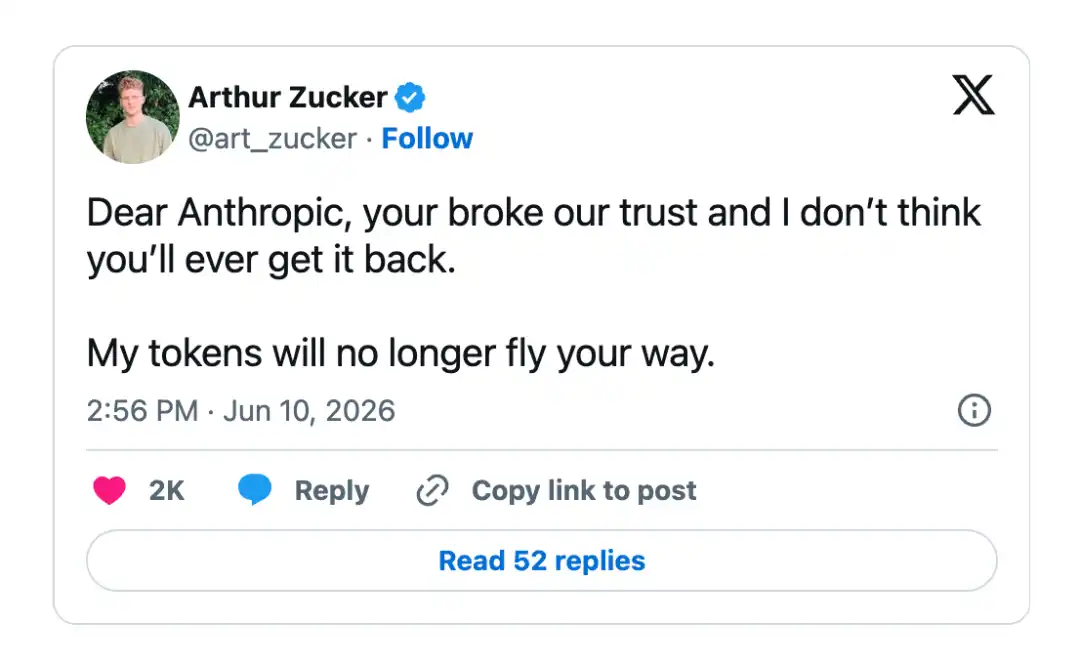
And this isn't an isolated move by Anthropic. Over the past eight weeks, the entire industry has been doing the same thing. On April 2, OpenAI switched Codex from per-message billing to per-token billing aligned with its API, later extending this to all existing enterprise customers.

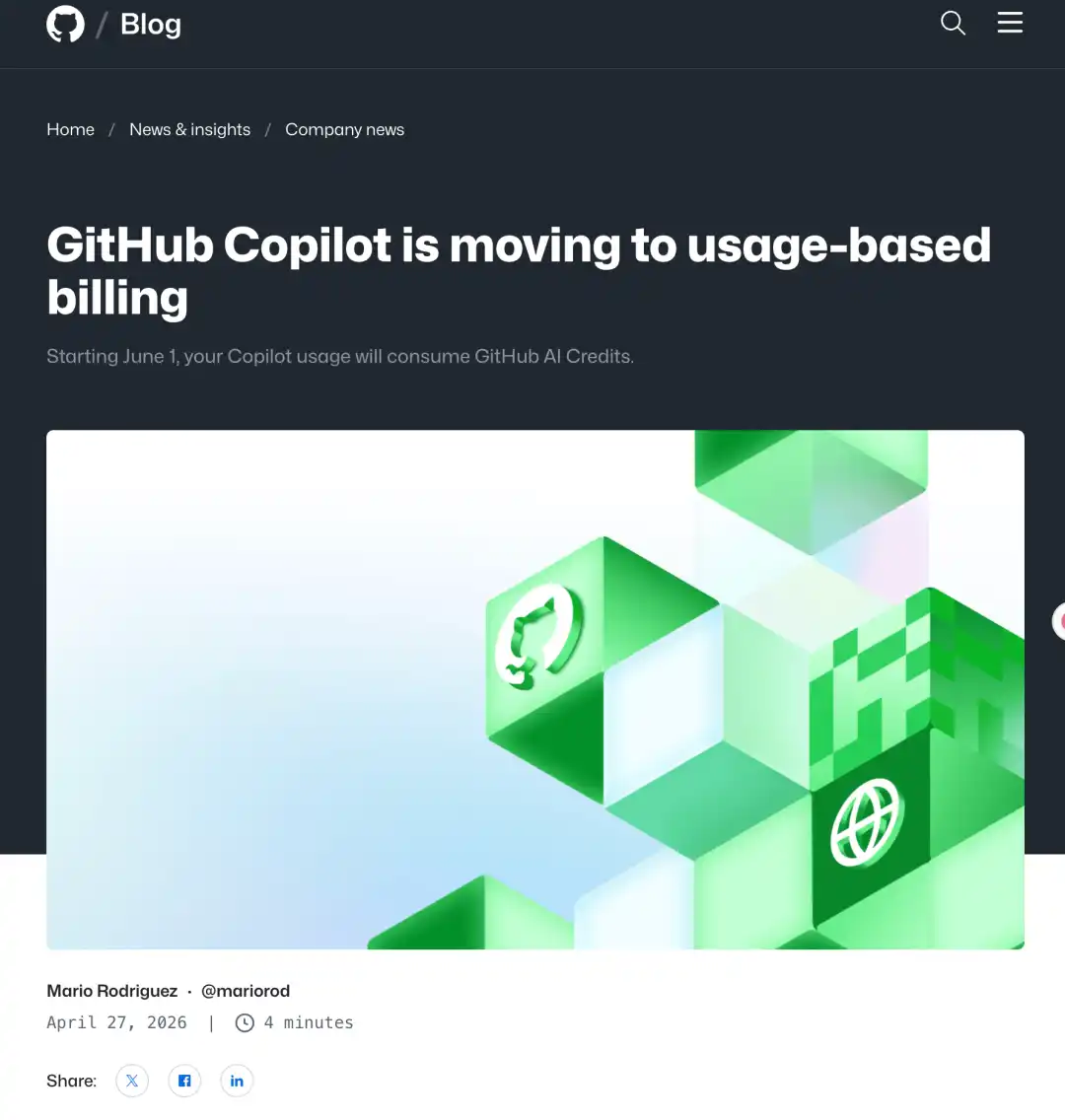
GitHub froze new personal Copilot registrations on April 20, announced a full shift to AI Credits billing a week later, and completed the transition by June 1—the $10/month Pro tier now comes with a $10 credit.

Anthropic's own moves have been the most frequent. Starting April 4, it banned third-party agent frameworks like OpenClaw from using subscription allowances, forcing them onto pay-as-you-go. On April 21, a red 'X' mysteriously appeared next to Claude Code on the Pro plan pricing page, causing an uproar and retracted within 24 hours with an official 'small test for about 2% of new users' explanation. On May 14, it was formally announced that starting June 15, the Agent SDK and headless usage would be removed from subscription pools, becoming independent credits charged at API rates.

Three companies, eight weeks, the same direction—this isn't a coincidence; it's the entire industry turning in the same answer sheet to the same math problem.

What does that math problem look like?

02 What's Being Priced Is Never Compute

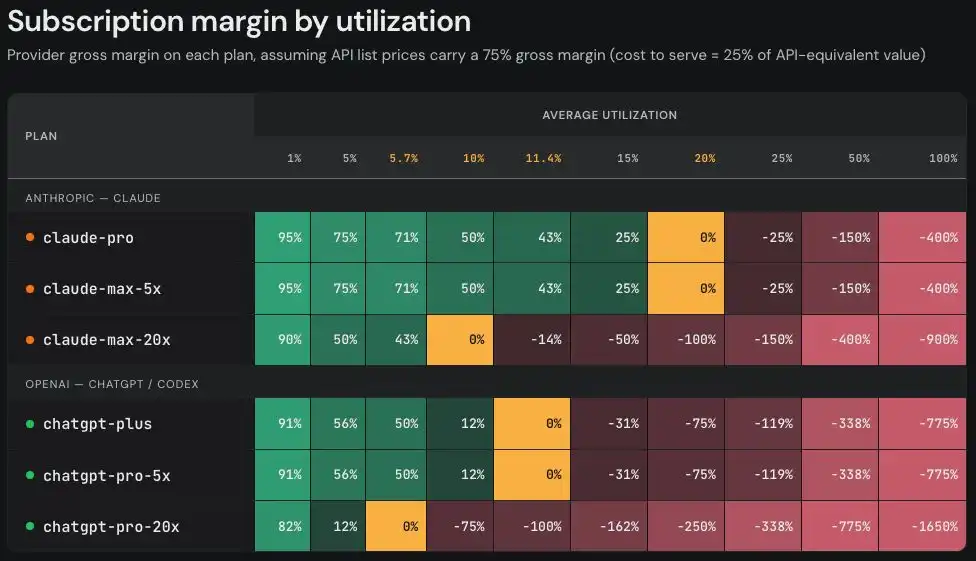
Research firm SemiAnalysis recently put this math problem on the table. They purchased one of each subscription tier from Anthropic and OpenAI, ran long programming tasks until exhausting the weekly limits, and then converted that usage into dollar values based on API list prices.

The prevailing industry belief was that a $200/month plan could, at most, generate around $2000 worth of tokens. The actual results far exceeded this: The $20 Claude Pro had an upper limit of about $400; the $200 Max 20x, about $8000.

OpenAI's numbers were even more staggering—the $20 ChatGPT Plus could yield about $700 worth, and the $200 Pro 20x, about $14,000.
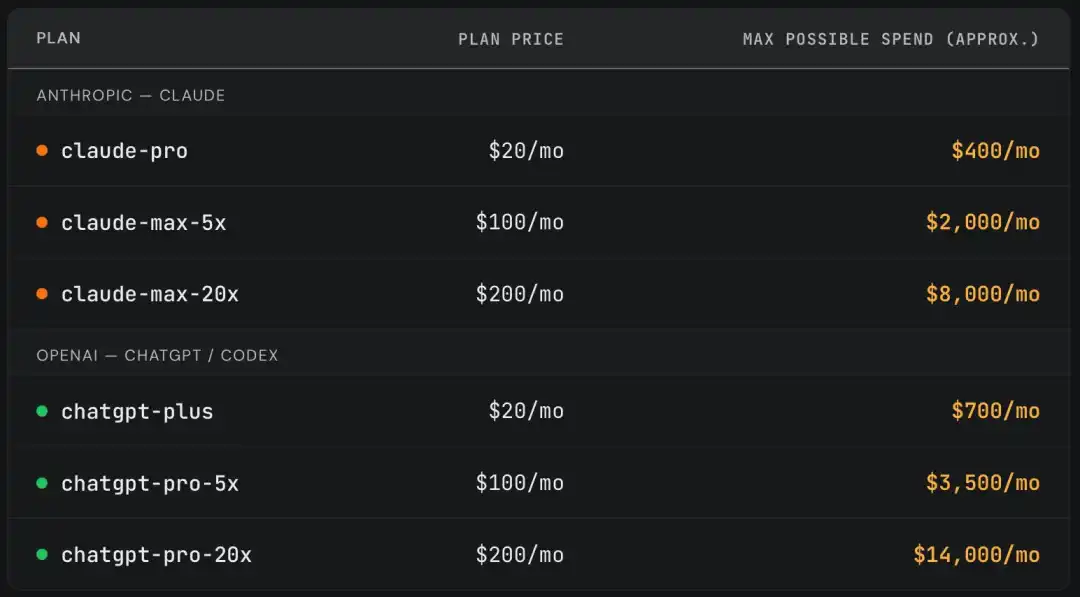
Two fair points must be made upfront: These are 'maxed-out limit' upper bounds, not typical daily usage levels for average users; API list prices include a margin, so the conversion numbers don't equal real compute costs.

But pricing must account for the upper bound—an insurance company cannot assume no one will file a claim.

Subsidies themselves aren't fatal. Streaming services have subsidized, ride-hailing apps have subsidized; burning cash for growth is the internet's ancestral craft. What's truly fatal is that AI subscriptions have a fundamental difference from those models.


Netflix dares to sell subscriptions based on two things: the marginal cost of adding one more show approaches zero, and a person has at most 24 hours a day to watch. Spotify is the same. The implied premise of flat-rate subscriptions is that consumption is capped by human physiological limits—what's truly being priced is never the content, but a person's time.

AI in the chatbot era barely fit this premise. Even the chattiest person has a limit to how much they can type in a day; the unused allowances of light users could cover the overconsumption of heavy users.

Then, Agents arrived.

What does a single agent task look like? It reads 20 files, makes plans, modifies code, runs tests, reads errors, and iterates—one round consumes 5 to 30 times the tokens of a normal conversation. Worse yet, it doesn't require your presence.

I've experienced this myself: I recently had an agent organize flight data for two airports. I went to take a shower, came back to find the task completed, and my allowance nearly depleted. You're asleep, the meter's running.

What agents eliminate isn't the price ceiling, it's the consumption ceiling. And every evolutionary direction in the AI industry—longer tasks, greater autonomy, parallel instances—is sprinting toward the same endpoint:

Removing humans from the consumption loop entirely.

GitHub's announcement put it bluntly: agent usage 'is becoming the default.' This means the only scenario where subscriptions could still barely hold—people sitting at their screens chatting one line at a time—will only constitute a shrinking portion of AI's value map.

At this point, some might ask: The subsidy is too deep, so why not just raise prices?

They tried, and got an even worse result. Looking back at the SemiAnalysis table, there's a counterintuitive detail: the higher the tier, the greater the subsidy multiplier.

On Claude's side, the $20 tier is a 20x multiplier, while the $200 tier is 40x; on OpenAI's side, it jumps from 35x to 70x. Half is by pricing design—higher tiers multiply allowances, effectively giving bulk discounts to big customers. The other half is user behavior—those willing to spend $200 on a 20x plan are doing so specifically to max it out; light users wouldn't even appear in this tier.

In the insurance industry, this has a name: adverse selection. When a policy's price attracts only the highest-risk applicants, that policy has no actuarial path to viability. Any fixed price will precisely filter in the users whose usage exceeds it—this isn't an operational issue, it's structural. Adjusting prices only makes the filter finer.

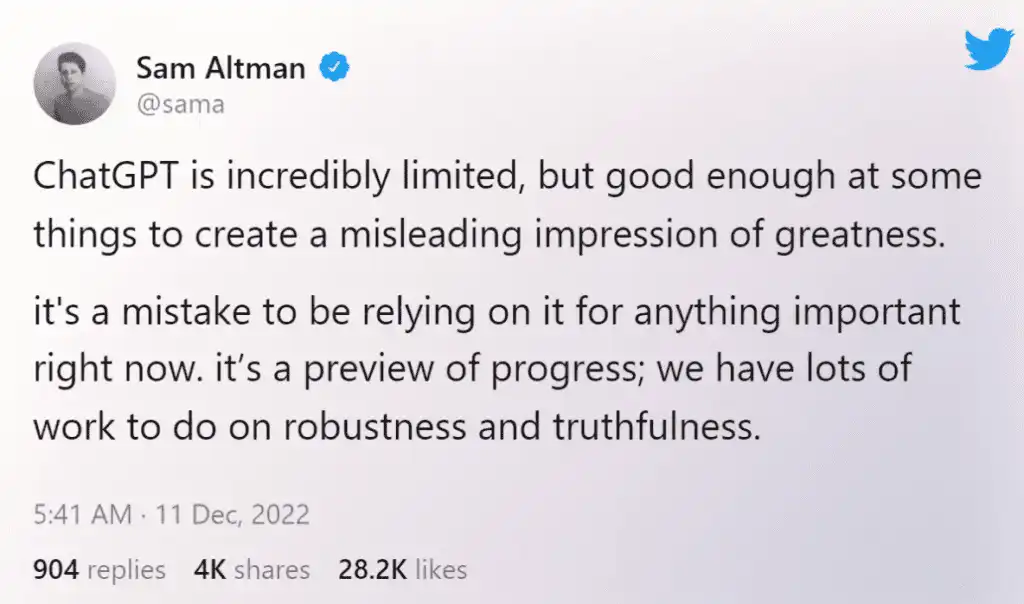
Throughout all of 2025, the industry essentially tried every patch. In January, Sam Altman admitted on X that the $200/month ChatGPT Pro was losing money due to usage far exceeding expectations—the price hike tier failed.
Mid-year, Cursor changed from per-request to per-compute billing, triggering massive cancellations and a public apology from the CEO—midstream rule changes failed. In the summer, Anthropic added weekly limits to Claude Code, citing users running agents 24/7 with individual compute costs in the tens of thousands of dollars—throttling only attracted fury.

After all patches failed, we got the collective showdown of these past eight weeks. OpenAI's ChatGPT lead, Nick Turley, spelled it out on the BG2 podcast: 'In this current era, offering unlimited plans might be like offering unlimited electricity plans.'

03 The Shell Remains, the Core Is Already Dead

Of course, there's a seemingly strong counterargument: Subscription models are clearly still alive and well. ChatGPT Plus is still $20/month, Claude Pro is still for sale, GitHub's code completion even retains flat-rate pricing. Is talk of demise just alarmism?

This counterargument deserves serious consideration because the phenomenon it describes is real. But it misidentifies what is dying.

The soul of a subscription was never the form of 'charging once a month,' but the promise of 'fixed price, use with peace of mind'—you don't have to calculate the cost of each use. That was the entire reason it triumphed over pay-per-use in the first place.

What's happening now is: The billing cycle remains, but the promise is being pulled away.

GitHub Pro's $10 monthly fee now contains a $10 credit, used up and done—this isn't a subscription; it's a prepaid card disguised in subscription clothing. Anthropic's credits are deducted at API rates; OpenAI's credits support auto-replenishment. Subscription models won't be canceled; they will be hollowed out. The shell remains, but the core is already dead.
There remains one true enclave: pure chat. It can still have flat-rate pricing because it's the last AI scenario where consumption is still capped by human time. But a moat cannot protect an enclave—every dollar of R&D in this industry pushes AI from 'you ask, it answers' toward 'it proactively helps you complete.'

Chat subscriptions won't be killed; they will be marginalized: left behind, watching real value and real revenue gradually migrate into the world of pay-as-you-go.

Another coincidental timing is hard to ignore. According to a TechCrunch report (June 2026), as Fable 5 launched, Anthropic was preparing for an IPO alongside OpenAI. Over the past three years, subsidies have been funded by venture capital; public market investors will not accept a P&L statement that 'loses more money with every heavy user.' The capital exit schedule dictates that the showdown cannot be postponed indefinitely.

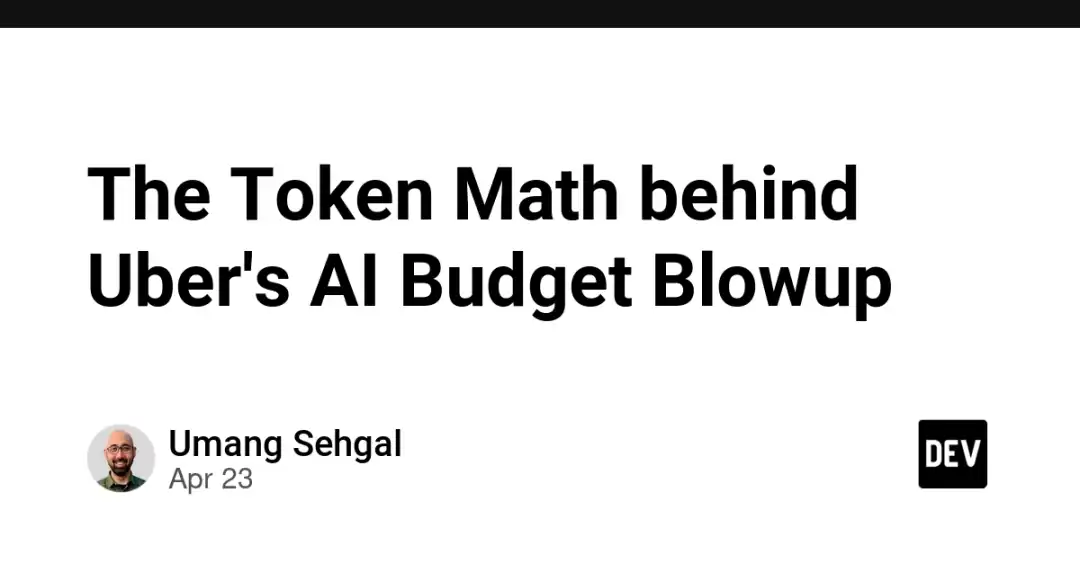
This means different things for different parties. For enterprises, AI spending must now be managed like cloud spending—The Information reported that Uber's CTO stated in an internal memo the company burned through its entire 2026 AI budget in just four months. Budgeting, installing monitoring, and routing models per task will become required skills for every team.

For individual users, the past saw light users subsidizing heavy users. Now, everyone pays for their own meter.
To be honest, this might not be all bad. With the return of price signals, 'Is this task worth running an AI on?' becomes a real question for the first time—and when an industry starts seriously answering that question, it's often the beginning of its move away from the cash-burn narrative toward a normal business.

Writing this, I want to interject one sentence: Before the meter is installed, the current subscription model is likely the most generous moment this industry will ever offer users—use it while you still can, and cherish it.

The logic is hidden in that SemiAnalysis table. Read from the user's perspective, it's not a death sentence at all, but a still-active benefit list: You pay $200 a month, and the platform lets you burn up to $14,000 worth of compute.

The last time we saw subsidies of this magnitude was during the ride-hailing and food delivery wars—and we all remember how those ended. After the subsidies faded, prices never went back.

So run those heavy tasks now, while you can. For instance, Fable 5's window in subscriptions only lasts until June 22. Instead of carefully budgeting when the credit era arrives, better to schedule those long-running tasks you've always wanted to run but found too expensive. This isn't about gaming the system—it's about being a clear-eyed beneficiary of a pricing error that is destined to be corrected.

Turley's metaphor may run deeper than he intended. The true sign of electricity becoming infrastructure isn't that it reached every household, but that every household installed a meter—from that moment on, no one debated 'should electricity be flat-rate?', they only debated the electricity rate.

There will be no obituary for the subscription model. It will simply become a small line item on your expense report labeled 'admission fee' on some quiet billing day.

Until then—use it while you still can, and cherish it.

Câu hỏi Liên quan

QAccording to the article, why is the AI subscription model doomed to disappear?

AThe AI subscription model is doomed because its fundamental premise—fixed pricing for unlimited use—is being dismantled by AI itself, specifically the rise of autonomous agents. Agents consume vastly more computational resources (tokens) than human-driven chat, effectively removing the human consumption limit that made fixed-price subscriptions viable. This creates unsustainable financial subsidies from providers and leads to 'adverse selection,' where the heaviest users are disproportionately attracted to the plans.

QWhat is the key difference between AI subscription models and successful ones like Netflix or Spotify, as stated in the article?

AThe key difference is the existence of a natural consumption limit. Netflix and Spotify subscription models work because the marginal cost of serving more content is near-zero, and a user's consumption is capped by the physical limit of human time (e.g., 24 hours in a day). In contrast, AI agents operate autonomously, removing the human from the consumption loop. An agent can run tasks continuously, consuming tokens at 5 to 30 times the rate of a chat, with no upper bound tied to user time, making a fixed-price, all-you-can-eat model financially unsustainable.

QWhat does the article suggest is the 'soul' of a subscription model, and what is happening to it?

AThe 'soul' of a subscription model is the promise of 'fixed price, worry-free use.' The article argues that while the billing cycle (the 'shell') of subscriptions remains, this core promise is being hollowed out. Services are replacing true unlimited access with prepaid credits or usage allowances tied to API rates (like GitHub's $10 monthly fee for $10 in credits). The subscription form persists, but its essential value proposition is dead.

QWhat event involving Anthropic's Claude Fable 5 model does the article use to illustrate the shift away from subscriptions?

AThe article cites Anthropic's release of the Claude Fable 5 model on June 9th, which was initially available to subscription users but was scheduled to be removed from all subscription plans on June 22nd, just 14 days later. After that date, users would need to purchase separate usage credits to access it. The author argues this immediate 'eviction notice' for a flagship model is not a mistake but a预告 (advance notice) of the industry's move away from including high-cost models in flat-rate subscriptions.

QWhat final advice does the author give to users regarding the current state of AI subscriptions?

AThe author advises users to 'use it while you can, and cherish it.' They characterize the current subscription period as potentially the most generous moment from the industry, where users can run heavy, expensive tasks at a heavily subsidized flat rate. The recommendation is to run those long, resource-intensive tasks they've been postponing before the pricing model fully shifts to pure pay-per-use (the 'electric meter' era), as prices are unlikely to return to such subsidized levels after the transition.

Nội dung Liên quan

Mô hình AI tiên tiến nhất bắt đầu được kiểm soát xuất khẩu như uranium làm giàu

Tuần trước, lệnh cấm xuất khẩu của Bộ Thương mại Mỹ đã khiến hai mô hình AI mạnh nhất thế giới là Fable 5 và Mythos 5 của Anthropic ngừng hoạt động toàn cầu. Đây là lần đầu tiên một thực thể thông minh tồn tại dưới dạng bit bị đưa vào khung kiểm soát xuất khẩu tương tự như uranium làm giàu. Lịch sử kiểm soát uranium làm giàu đang được tái hiện. Trước đây, kiểm soát xuất khẩu chỉ áp dụng cho phần cứng và công thức có tính khan hiếm vật lý. Nhưng Fable 5 là một tập hợp tham số có thể sao chép vô hạn. Đối tượng bị kiểm soát thực sự là "mật độ năng lực" được tích hợp trong nó, như khả năng tạo mã, lập luận và tri thức đa lĩnh vực. Khi các khả năng riêng lẻ được "làm giàu" vào một điểm gọi duy nhất, nó vượt qua ngưỡng và bị đóng lại, giống như uranium khi đạt đến độ tinh khiết nhất định. Tương lai mười năm tới có thể chứng kiến ba điều. Thứ nhất, việc đánh giá năng lực mô hình sẽ trở thành chế độ hóa, với các ngưỡng kích hoạt kiểm soát dựa trên "độ giàu" của mô hình. Thứ hai, ranh giới pháp lý sẽ mờ đi, khi lệnh của Mỹ có thể áp dụng cho mọi công dân nước ngoài bất kể vị trí, buộc các doanh nghiệp toàn cầu phải xem xét lại chuỗi cung ứng AI. Thứ ba, con đường công nghệ sẽ phân liệt thành hai hướng: mô hình tiên phong độc quyền của Mỹ (dễ bị ngắt) và mô hình nguồn mở/triển khai cục bộ (kém tiên tiến hơn nhưng đáng tin cậy hơn). Vết nứt sâu nhất nằm ở chế độ sở hữu. Các doanh nghiệp có thể phụ thuộc sâu vào một mô hình như tư liệu sản xuất, nhưng về mặt pháp lý, họ chỉ mua dịch vụ có thể bị thu hồi bất cứ lúc nào mà không được bồi thường thỏa đáng. Hệ thống pháp luật hiện tại về tài sản chưa thể giải quyết hình thức tước đoạt mới này: tước quyền sử dụng mà không tước quyền sở hữu. Trong một thế giới số bị chia cắt, mô hình khôn ngoan nhất có thể không phải là mô hình dùng được. Mô hình dùng được sẽ là mô hình có quyền sở hữu rõ ràng nhất. Ở một số thời điểm, không bị tước đoạt quan trọng hơn việc dẫn trước tạm thời.

marsbit5 phút trước

Mô hình AI tiên tiến nhất bắt đầu được kiểm soát xuất khẩu như uranium làm giàu

marsbit5 phút trước

ETF Bitcoin Ghi Nhận Dòng Vốn Thoát Liên Tục 4.4 Tỷ USD, Lần Đầu Tiên Sau 3 Tuần Dòng Tiền Quay Trở Lại

**Tóm tắt: Bitcoin ETF ghi nhận dòng tiền rút kỷ lục** Các quỹ ETF Bitcoin trực tiếp tại Mỹ vừa trải qua đợt rút vốn tồi tệ nhất kể từ khi ra mắt. Trong 13 phiên liên tiếp từ 15/5 đến 3/6, các quỹ này đã chứng kiến dòng tiền ròng rút ra lên tới 44 tỷ USD, gấp đôi kỷ lục cũ thiết lập vào tháng 2/2025. Đáng chú ý, quỹ IBIT của BlackRock chiếm tới 3/4 tổng lượng rút tiền này. Dòng tiền rút mạnh kết hợp với việc giá Bitcoin giảm khoảng 21% (từ trên 80.000 USD xuống khoảng 63.000 USD) đã khiến tổng tài sản quản lý (AUM) của toàn bộ các ETF Bitcoin Mỹ giảm mạnh 215 tỷ USD, từ 1.042,9 tỷ USD xuống còn 828,3 tỷ USD chỉ trong ba tuần. Tuy nhiên, một tín hiệu tích cực đã xuất hiện. Ngày 12/6, dòng tiền đã quay trở lại với mức ròng dương 85,84 triệu USD. Đặc biệt, đây là ngày không có quỹ ETF nào ghi nhận dòng tiền rút ra ròng. Geoff Kendrick, Giám đốc nghiên cứu tài sản số tại Ngân hàng Standard Chartered, coi đây là một trong những dấu hiệu cho thấy Bitcoin đã chạm đáy của chu kỳ này, và nhận định: "Mùa đông đã kết thúc, chào mừng trở lại với mùa xuân của tiền mã hóa." Mặc dù một ngày tích cực chưa đảo ngược được đợt rút tiền 44 tỷ USD, nhưng nó được xem như điểm khởi đầu cho thấy áp lực bán có thể đã giảm bớt. Tổng dòng tiền ròng tích lũy của các ETF Bitcoin kể từ khi ra mắt vẫn ở mức trên 550 tỷ USD.

marsbit19 phút trước

ETF Bitcoin Ghi Nhận Dòng Vốn Thoát Liên Tục 4.4 Tỷ USD, Lần Đầu Tiên Sau 3 Tuần Dòng Tiền Quay Trở Lại

marsbit19 phút trước

CEO Microsoft viết bài dài: Trong tương lai sẽ có hai loại vốn, Vốn Nhân lực + Vốn Token

Tối qua, CEO Microsoft Satya Nadella đã đăng một bài luận dài trên X với tiêu đề "Một biên giới không có hệ sinh thái thì không ổn định", thu hút hơn 28 triệu lượt xem. Trong bài viết, ông thảo luận về tương lai của doanh nghiệp trong kỷ nguyên AI, đồng thời đề xuất hai khái niệm: "Vốn nhân lực" và "Vốn Token". Theo Nadella, AI đang thay đổi logic cạnh tranh cơ bản của doanh nghiệp. Trước đây, công cụ kỹ thuật số được sử dụng để nâng cao hiệu quả con người; nhưng ngày nay, bản thân mô hình AI có khả năng hấp thụ kiến thức chuyên môn và "hàng hóa hóa" nó. Điều này có thể dẫn đến viễn cảnh một vài mô hình AI mạnh mẽ "nuốt chửng" giá trị của toàn ngành, mà ông cảnh báo: "Chúng ta không thể để một vài hệ thống AI chiếm đoạt tất cả lợi nhuận kinh tế." Để phát triển bền vững, mỗi doanh nghiệp cần xây dựng cả "Vốn nhân lực" (kiến thức, phán đoán, sáng tạo của nhân viên) và "Vốn Token" (khả năng AI do doanh nghiệp sở hữu). Ông nhấn mạnh giá trị của vốn nhân lực không giảm mà còn tăng lên cùng với vốn Token, và chính sự chủ động của con người sẽ thúc đẩy sự phát triển của vốn Token. Chìa khóa thành công là thiết lập một "vòng lặp học tập" tích hợp giữa con người và AI, cho phép cả hai nguồn vốn tạo ra hiệu ứng lãi kép. Doanh nghiệp cần chuyển đổi quy trình làm việc, kiến thức và khả năng phán đoán thành hệ thống AI có thể tự cải thiện. Vòng lặp này sẽ trở thành tài sản trí tuệ mới và là lợi thế cạnh tranh khó sao chép. Cuối cùng, Nadella kêu gọi xây dựng một "hệ sinh thái biên giới" lành mạnh, nơi giá trị được phân phối rộng rãi giữa mọi công ty, ngành và quốc gia, thay vì bị tập trung vào một số ít mô hình. Đây là cách để đảm bảo sự ổn định và thịnh vượng chung trong kỷ nguyên AI.

marsbit33 phút trước

CEO Microsoft viết bài dài: Trong tương lai sẽ có hai loại vốn, Vốn Nhân lực + Vốn Token

marsbit33 phút trước

Từ định giá 3 tỷ USD đến 'bán rẻ' chỉ còn vài chục triệu, Messari đã trải qua những gì?

Ngày 12/6, nền tảng dẫn đầu về dữ liệu và thị trường vốn Blockworks đã thông báo mua lại đối thủ lâu năm Messari với giá hơn 10 triệu USD. Đây là mức giảm giá đáng kể so với định giá 300 triệu USD mà Messari đạt được vào năm 2022, phản ánh áp lực sinh tồn của các startup định giá cao trong thị trường crypto bear market và làn sóng hợp nhất trong lĩnh vực cơ sở hạ tầng dữ liệu. Theo Blockworks, API và nền tảng dữ liệu cốt lõi của Messari sẽ được tích hợp, kết hợp điểm mạnh về phạm vi dữ liệu của Messari với thế mạnh của Blockworks trong tiết lộ thông tin, quan hệ nhà đầu tư và quy trình tuân thủ, nhằm xây dựng một "hệ thống ghi chép duy nhất" cho thị trường on-chain. Blockworks, thành lập năm 2018, đã chuyển đổi từ một công ty truyền thông sang nền tảng tình báo thị trường vốn on-chain. Messari, cũng thành lập năm 2018, từng là nền tảng nghiên cứu và dữ liệu crypto uy tín. Tuy nhiên, sau đợt gọi vốn Series B năm 2022 và sự suy giảm của thị trường, công ty đã đối mặt với thách thức. Việc sáng lập viên kiêm cựu CEO Ryan Selkis rời đi năm 2024 và tinh giảm nhân sự cho thấy áp lực ngày càng lớn. Giao dịch này nằm trong bối cảnh ngành công nghiệp crypto đang chứng kiến sự hợp nhất mạnh mẽ, với 144 thương vụ M&A trong năm 2026 tính đến nay. Các công ty cần dữ liệu chất lượng, có cấu trúc cao để đáp ứng nhu cầu ngày càng tăng từ các tổ chức và làm nền tảng cho các AI agent on-chain. Việc hợp nhất giữa Blockworks và Messari được kỳ vọng sẽ tạo ra một cơ sở hạ tầng dữ liệu toàn diện, mô phỏng theo mô hình của các gã khổng lồ như Bloomberg trong thị trường tài chính truyền thống, nhằm xây dựng lợi thế cạnh tranh lâu dài trong một thị trường đầy biến động.

marsbit34 phút trước

Từ định giá 3 tỷ USD đến 'bán rẻ' chỉ còn vài chục triệu, Messari đã trải qua những gì?

marsbit34 phút trước

Nếu bong bóng AI đã vỡ, ai sẽ thực sự ở lại?

Bong bóng AI rõ ràng đang tồn tại, nhưng như lịch sử bong bóng dot-com những năm 2000 cho thấy, nó không chỉ là sự hủy diệt. Bong bóng xảy ra khi đầu tư vốn quá mức chạy trước sự phát triển của cơ sở hạ tầng thực tế và doanh thu ứng dụng. Tuy nhiên, chính những khoản đầu tư "thừa" này lại xây dựng nền tảng vật chất (như cáp quang, trung tâm dữ liệu) cho kỷ nguyên tiếp theo. Hiện tại, ngành AI đang trong tình trạng tương tự: các gã khổng lồ công nghệ đổ hàng nghìn tỷ USD vào cơ sở hạ tầng (GPU, điện, làm mát), trong khi doanh thu từ các công ty AI thuần túy còn thấp. Sự chênh lệch này là bong bóng. Nhưng đồng thời, chi phí triển khai AI (giá token) đã giảm hơn 99.7% trong hai năm, giống như "Nghịch lý Jevons": chi phí giảm không làm giảm chi tiêu, mà mở ra lượng nhu cầu mới khổng lồ, khiến tổng chi tiêu của doanh nghiệp cho AI tăng vọt. AI không còn là công cụ trò chuyện. Với chi phí cực thấp, nó đang xâm nhập vào quy trình làm việc thực tế: viết mã, nghiên cứu y sinh, phân tích pháp lý, giao dịch tài chính và sản xuất. Thị trường đang tự thanh lọc, loại bỏ các công ty "bọc vỏ" (wrap-around) chỉ dựa trên API. Giá trị đang chuyển dần từ lớp cơ sở hạ tầng (CapEx - như NVIDIA) sang lớp ứng dụng (OpEx) - những công ty AI bản địa thực sự giải quyết vấn đề cho ngành dọc. Tóm lại, bong bóng có thể vỡ, các công ty đầu cơ sẽ biến mất, nhưng xu hướng AI+ là không thể đảo ngược. Giống như internet sau năm 2000, năng lực sản xuất cốt lõi do AI mang lại là có thật và sẽ định hình lại mọi ngành công nghiệp. Bong bóng ồn ào, nhưng động năng của lực lượng sản xuất mới ở bên dưới không hề có nước.

marsbit1 giờ trước

Nếu bong bóng AI đã vỡ, ai sẽ thực sự ở lại?

marsbit1 giờ trước

Giao dịch

Giao ngay
Hợp đồng Tương lai
活动图片