Why Coinbase Will Be the Biggest Winner in the AI Financial Era?

链捕手Xuất bản vào 2026-05-08Cập nhật gần nhất vào 2026-05-08

Tóm tắt

Coinbase is poised to be a major winner in the AI finance era, transforming from a cyclical crypto exchange into a foundational layer for AI-native finance. The market undervalues its exposure to two key secular trends: the rise of stablecoins and the emergence of agentic commerce. Firstly, with the global stablecoin supply projected to reach $3 trillion by 2030, Coinbase benefits as the dominant, most compliant distributor of USDC. Its revenue-sharing agreement with Circle is structurally advantageous and durable, positioning Coinbase to capture significant value from stablecoin growth independent of crypto trading volumes. Secondly, in agentic commerce—where AI agents autonomously transact—Coinbase's technology stack is already dominant. Over 92% of real agent payments occur on its Base network, settled primarily in USDC via the x402 protocol it helped develop. This stack creates a powerful, self-reinforcing ecosystem across four layers: USDC for settlement, Base for execution, developer tools (CDP/AgentKit), and service discovery (Agentic.Market). Key revenue streams include USDC reserve interest, Base sequencer fees, and platform fees from its infrastructure and marketplace. By 2030, agent-related revenue could contribute billions annually. Supported by favorable regulatory tailwinds like the CLARITY Act, Coinbase's valuation should reflect its role as critical financial infrastructure, not just a brokerage, with a clear path to becoming a $300 billion company.

Compiled by: Zhou, ChainCatcher

Introduction

As the convergence of crypto and AI accelerates, Coinbase will no longer be just a crypto exchange; it is evolving into the settlement layer, distribution layer, and commercial layer of AI-native finance.

Most people still view Coinbase as a cyclical crypto brokerage, believing its performance is tightly linked to crypto trading volumes.

This is understandable, as Coinbase's valuation multiples are closely correlated with traditional brokers like IBKR, Robinhood, and Schwab. In contrast, Circle, as a pure-play bet on stablecoin growth, commands a high NTM P/E ratio of 103.9x.

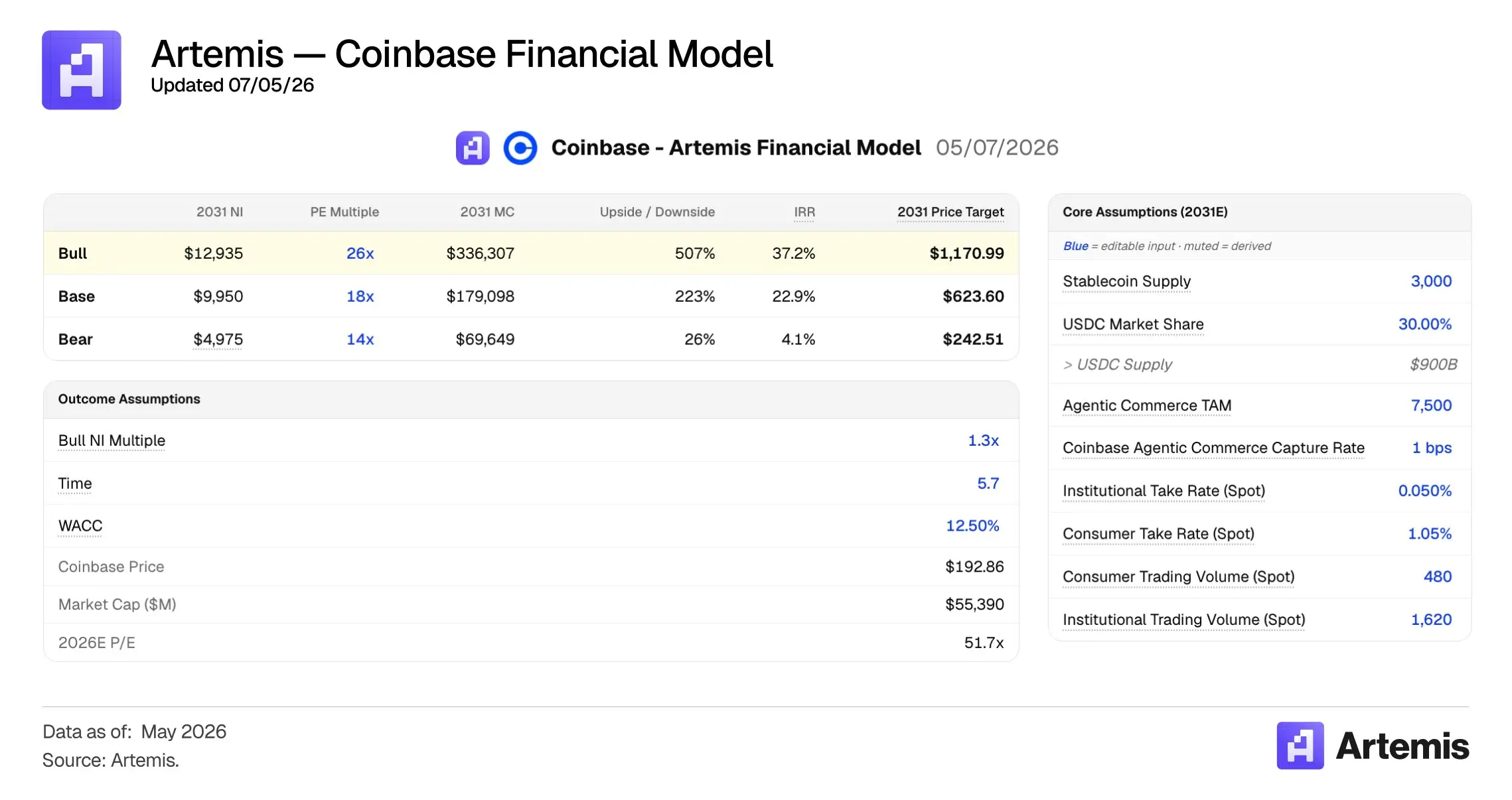
However, Coinbase has a full opportunity to grow into a $300 billion company by 2031 (approximately 6x from current levels, corresponding to a 35% annualized growth rate). The driving force is not just its exchange business, but its position as the top winner in the stablecoin and agent-based commerce fields.

Our core assumptions are as follows:

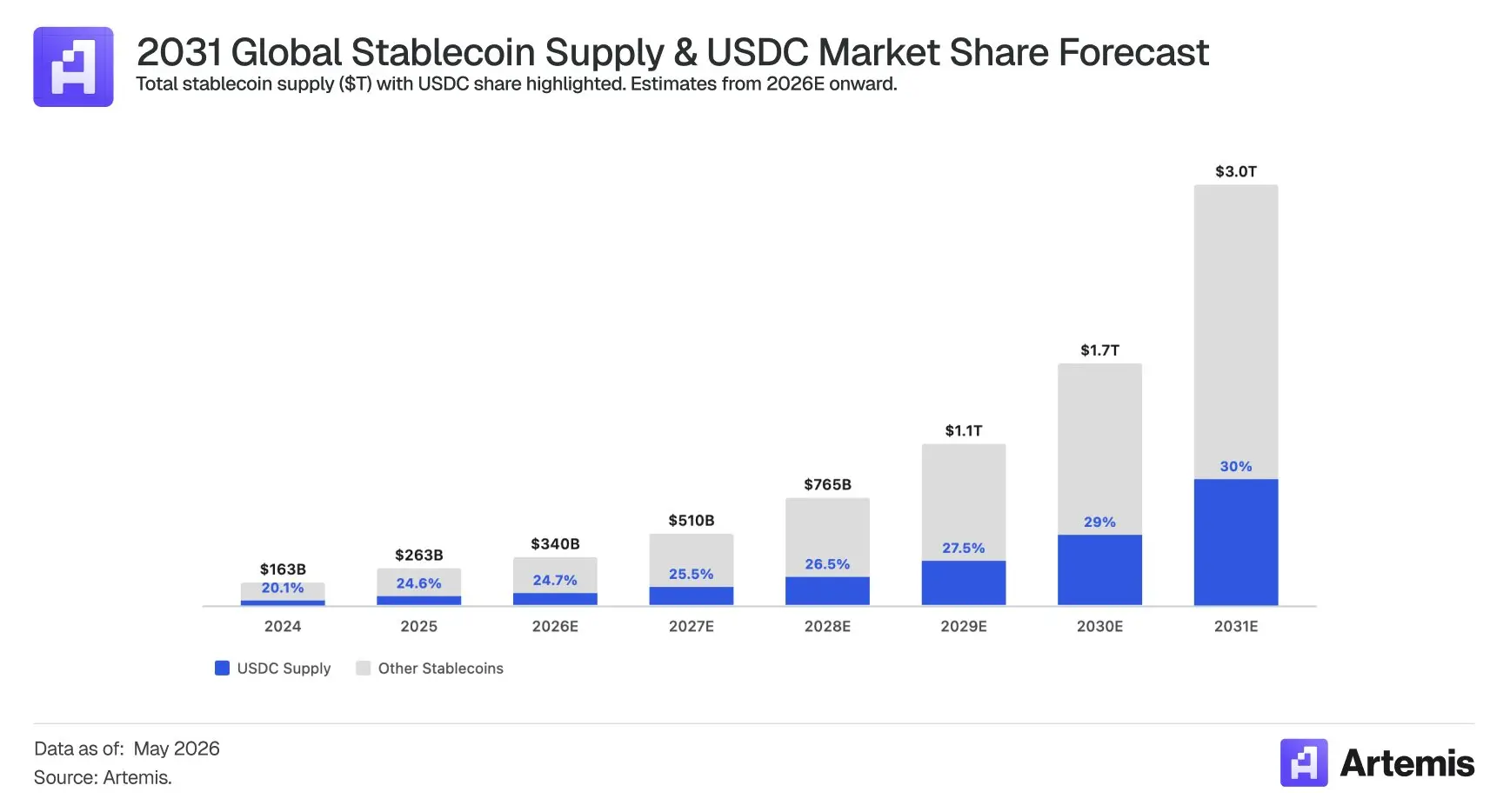
Stablecoin supply reaches $3 trillion by 2031

Agent-based commerce volume reaches $7.5 trillion by 2031

Core exchange business aligns with market consensus: trading revenue of approximately $6 billion by 2028
What the market overlooks is that Coinbase is simultaneously benefiting from two epochal tailwinds:

1. The Rise of Stablecoins and Global Demand for a Digital Dollar

US Treasury Secretary Scott Bessent predicts stablecoin supply will reach $3 trillion by 2030 (a 10x increase from current levels). Bain & Company estimates the supply will expand 12x, reaching approximately $3.8 trillion by then.
2. The Rise of Agent-Based Commerce

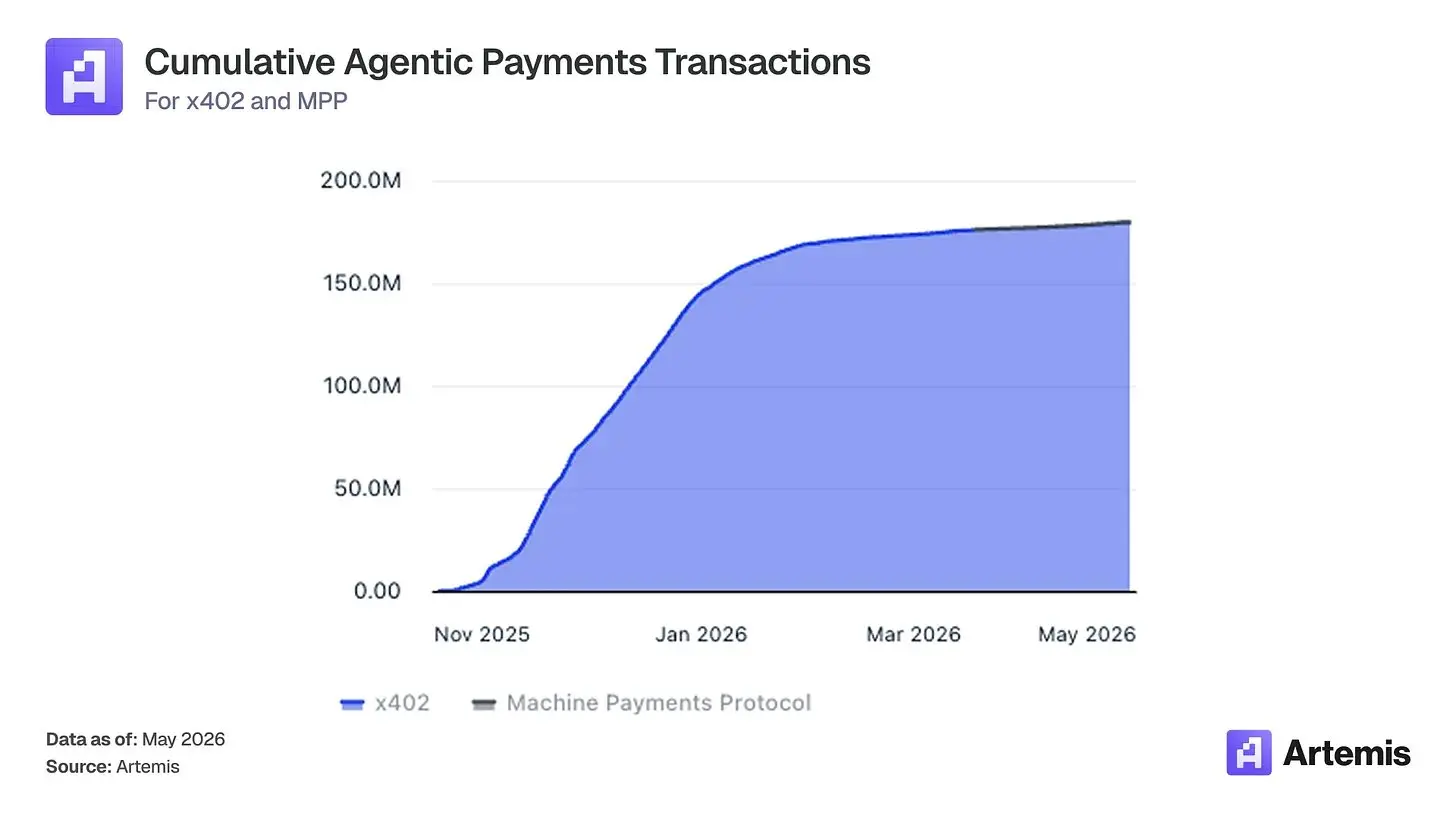
McKinsey predicts global agent-based commerce will reach $3 to $5 trillion by 2030; we further predict that one-third of this volume will be completed on-chain and settled via agent-based payment protocols like x402 and MPP. We are already observing rapid growth of agent-based payments on-chain.
Coinbase is a clear beneficiary of both trends, continuously accumulating value through its position as the largest and most compliant distributor of USDC and the top network in agent-based payments.
Even if institutional investors are skeptical of DeFi or believe the crypto market is "dead," Coinbase's success will not rely on crypto asset or exchange trading volumes, but on its role as the most trusted, dominant stablecoin platform and AI agent payment infrastructure.

Why Coinbase is the Winner in the Stablecoin Race

The market fails to realize that Coinbase is a clear winner from stablecoin growth. Even as crypto trading volumes decline, stablecoin usage has historically continued to rise.
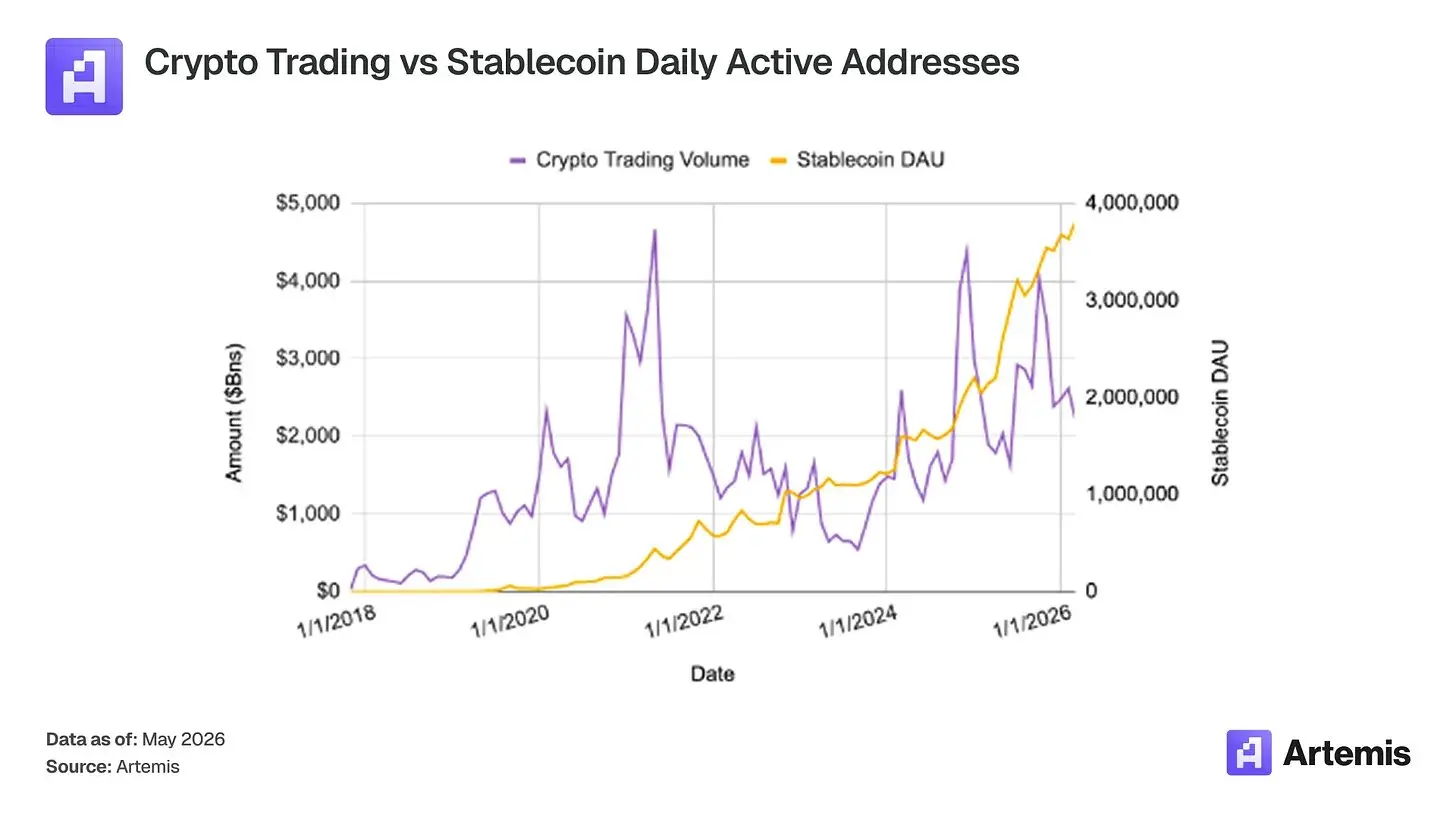
The USDC distribution agreement is an asset of Coinbase, not Circle's. The revenue share Circle pays to Coinbase has risen from 32% in 2022 to about 50% in recent years.

The structural reason is straightforward: USDC held within Coinbase products can earn approximately 100% of the interest income, and it receives a substantial share of off-platform balances under the Payment Base waterfall distribution mechanism.

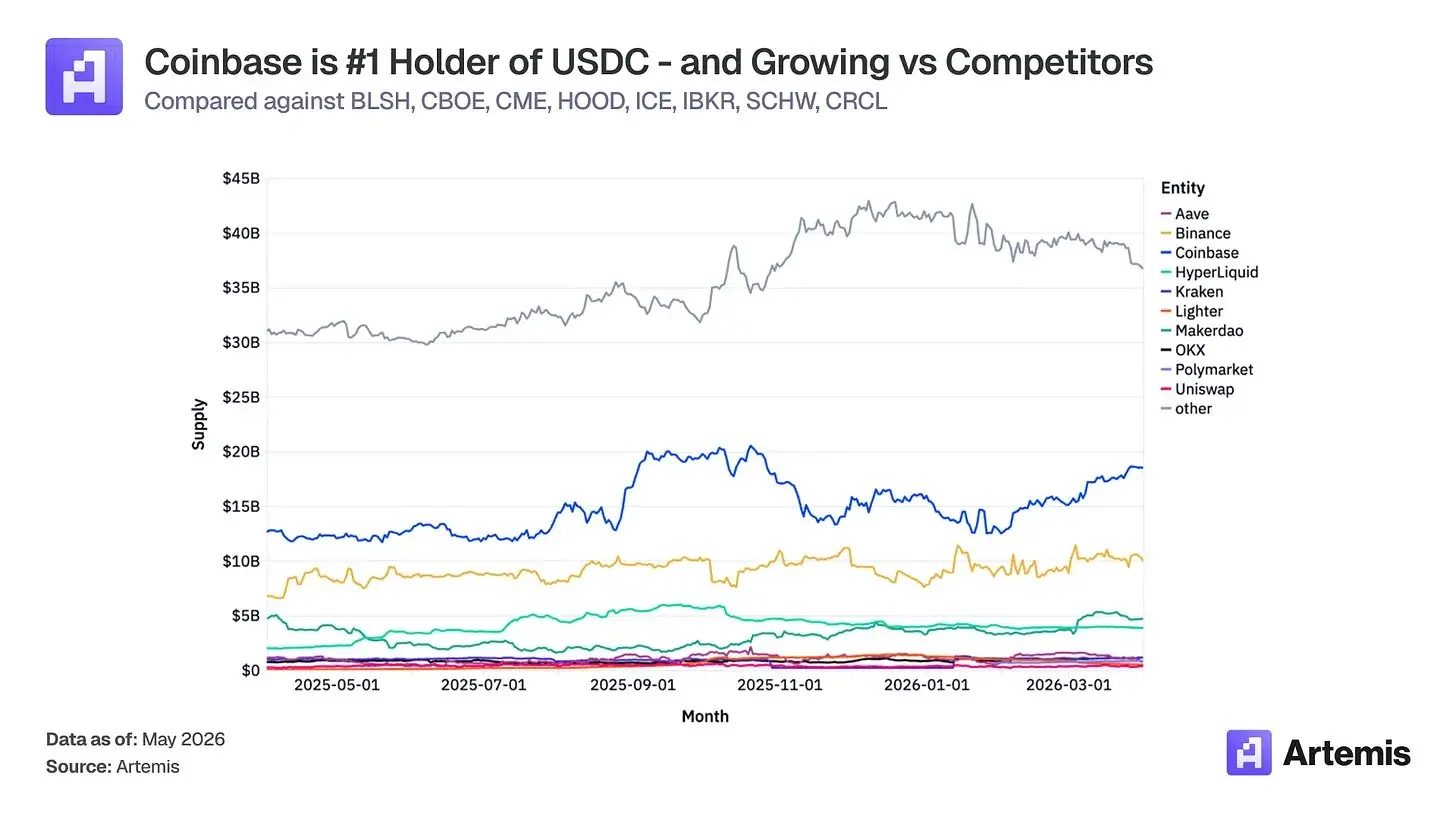
As Coinbase's distribution scale expands (with USDC average balances held in Coinbase products reaching a record $17.8 billion in Q4 2025), its share in the waterfall also increases.

From an investor's perspective, this agreement is more akin to Coinbase outsourcing compliance and reserve management to Circle, rather than Circle paying Coinbase for distribution access.

The cooperation agreement automatically renews every 3 years, subject to three threshold conditions (product, company, distributor). Public filings indicate that once these conditions are met, "the Circle agreement may not be terminated." The renewal mechanism is not a renegotiation cliff, but a continuous lock-in.

For Circle, exiting means cutting off USDC's largest single distribution channel. For Coinbase, the benefits in an upside scenario (scaled stablecoin payments due to regulatory clarity, significant USDC market cap expansion) will flow directly through the same contractual terms. The structure of this contract continuously strengthens Coinbase's market position, regardless of who leads Circle.

Future Growth of USDC

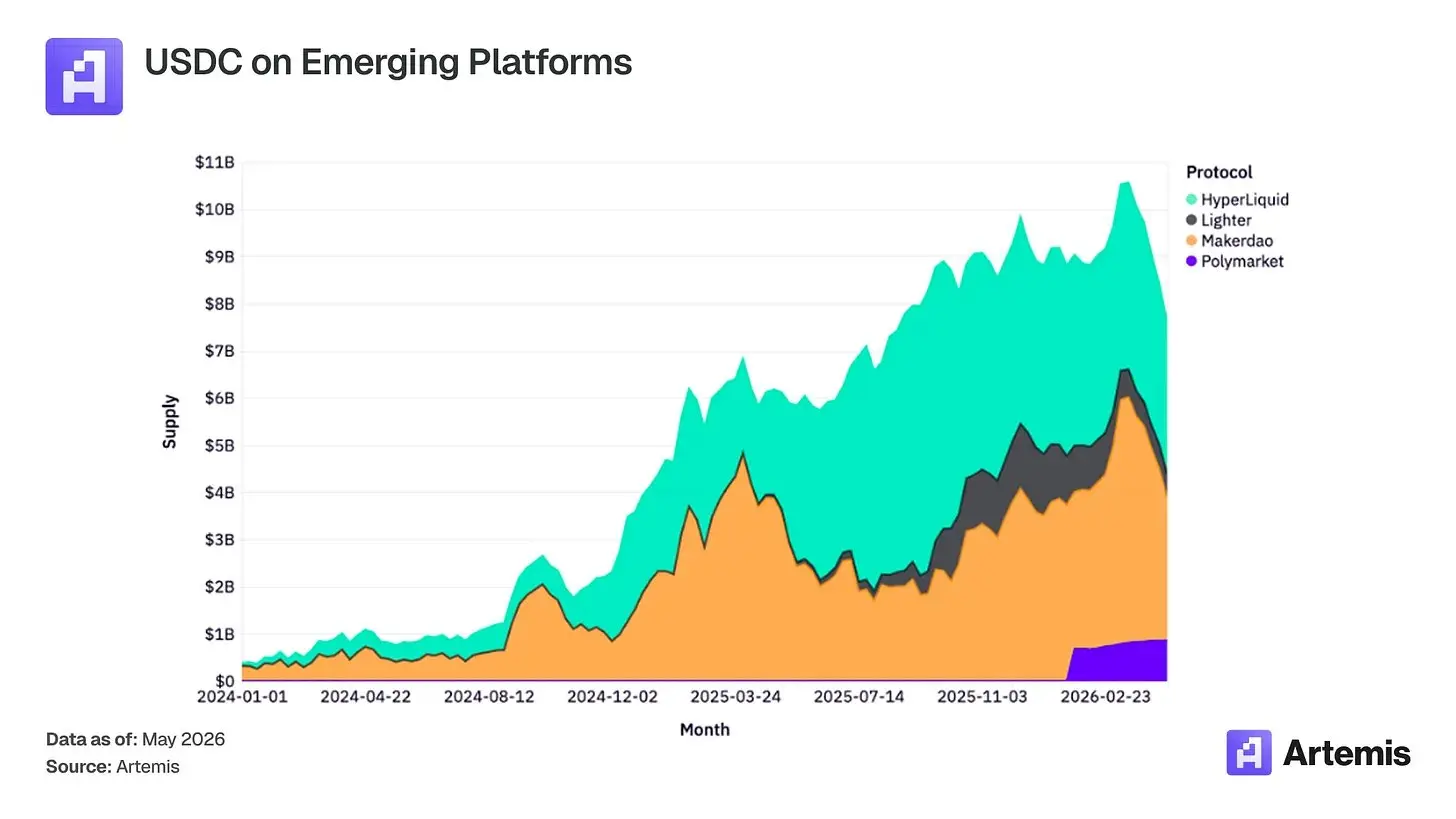
Beyond Coinbase, we also see rich use cases for USDC across numerous emerging protocols. Over the past two years, USDC supply has grown significantly within protocols like Polymarket, Hyperliquid, and MakerDAO. As new financial use cases continue to emerge on blockchain platforms, USDC usage in these protocols will deepen.
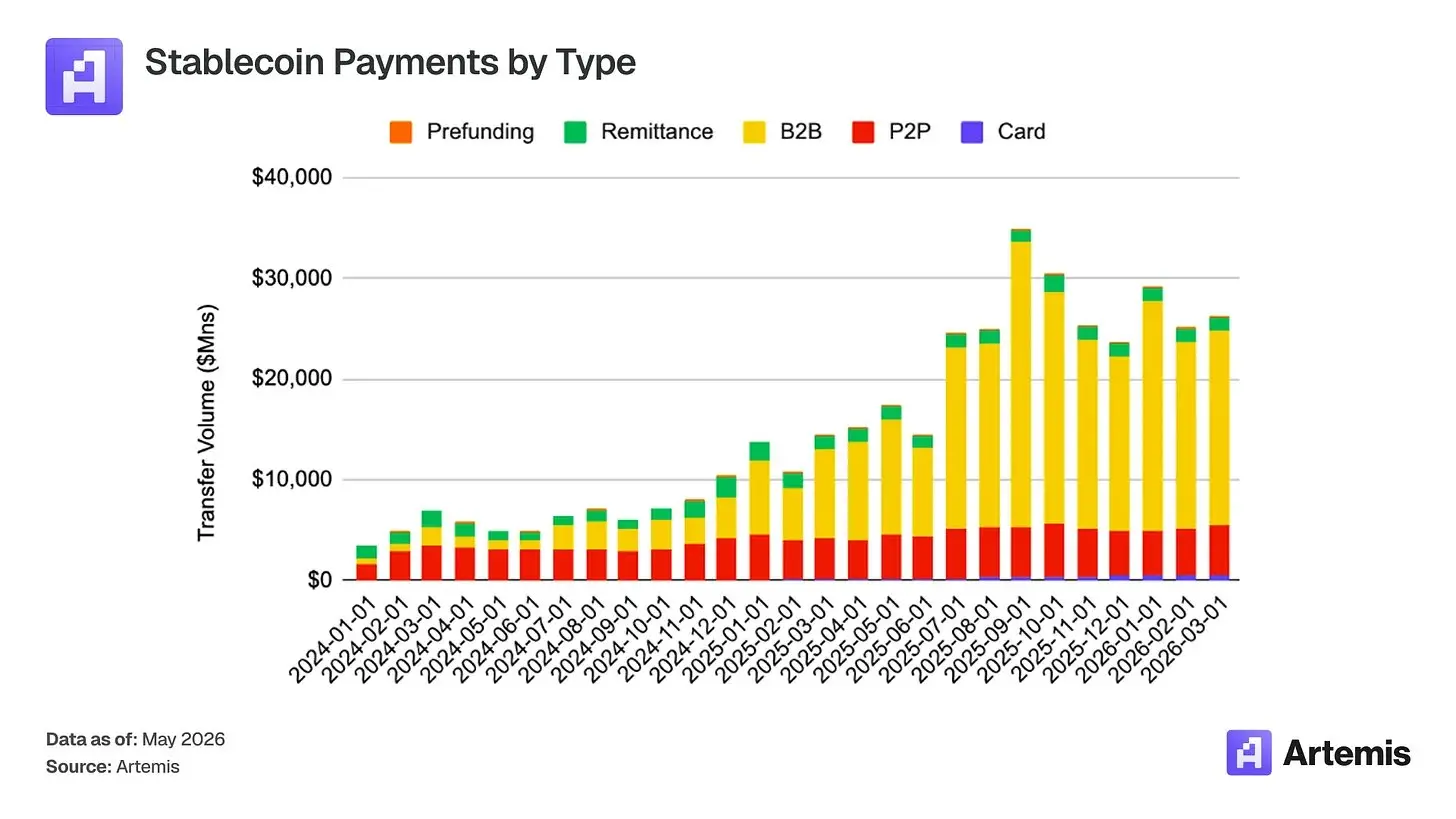
Coinbase is well-positioned to capture the next wave of stablecoin applications (payments). Over the past year, various transaction types based on card payment rails (B2B, B2C) have grown significantly, and USDC's share in such transactions has continued to increase.
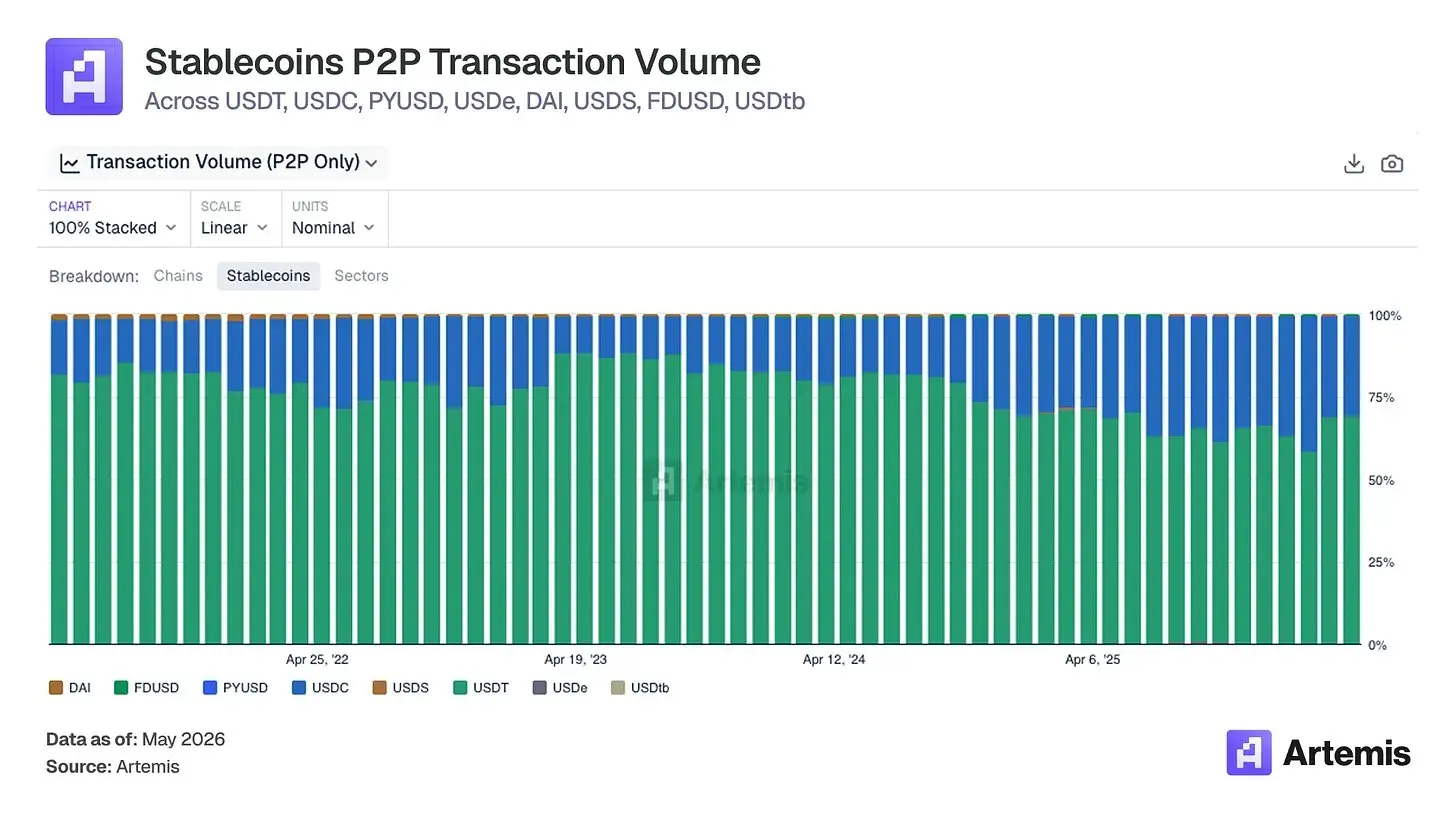
Looking at inter-address USDC transfer data (which can serve as a proxy for the transaction types above), USDC is steadily gaining market share from USDT.
Has the Market Misinterpreted the CLARITY Act?

The Digital Asset Market Clarity Act (H.R. 3633, known as the CLARITY Act) passed the US House of Representatives with bipartisan votes of 294 to 134 on July 17, 2025. The bill aims to establish a comprehensive regulatory framework for digital assets beyond payment stablecoins.

For Coinbase, the CLARITY Act is the most impactful piece of pending US legislation for its regulatory environment, building a largely complete federal regulatory architecture for the digital asset ecosystem in which Coinbase operates.

The CLARITY Act's impact on Coinbase's stablecoin business is also far more profound than commonly perceived by the market.

The revenue generated under current interest rate assumptions from Coinbase's distribution and reserve income-sharing arrangement with Circle is already on par with the economic benefits Circle itself receives as the issuer. Meanwhile, Coinbase's USDC Rewards program contributes another revenue stream, the ultimate size of which depends on the final wording of the Tillis-Alsobrooks compromise.

The market underestimates the scale and durability of these stablecoin-related revenues, viewing them as ancillary to the exchange business rather than independent infrastructure economics.

The CLARITY Act further strengthens this thesis by formally establishing the broader regulatory framework upon which stablecoins rely for clearing, settlement, and circulation, and explicitly defining the registered intermediaries through which institutional stablecoin flows pass. It reframes Coinbase's stablecoin business as the application layer of a regulated, rapidly institutionalizing system, rather than a consumer product line that fluctuates with retail token trading volumes.

Why Coinbase is the Winner in the Agent-Based Payments Race

Most investors view Stripe (valued at $159 billion in February 2026) and Tempo as the clear winners in agent-based commerce, but on-chain data tells a different story: 92.8% of real agent-based payment volume occurs on Base, and 99.8% is settled in USDC.
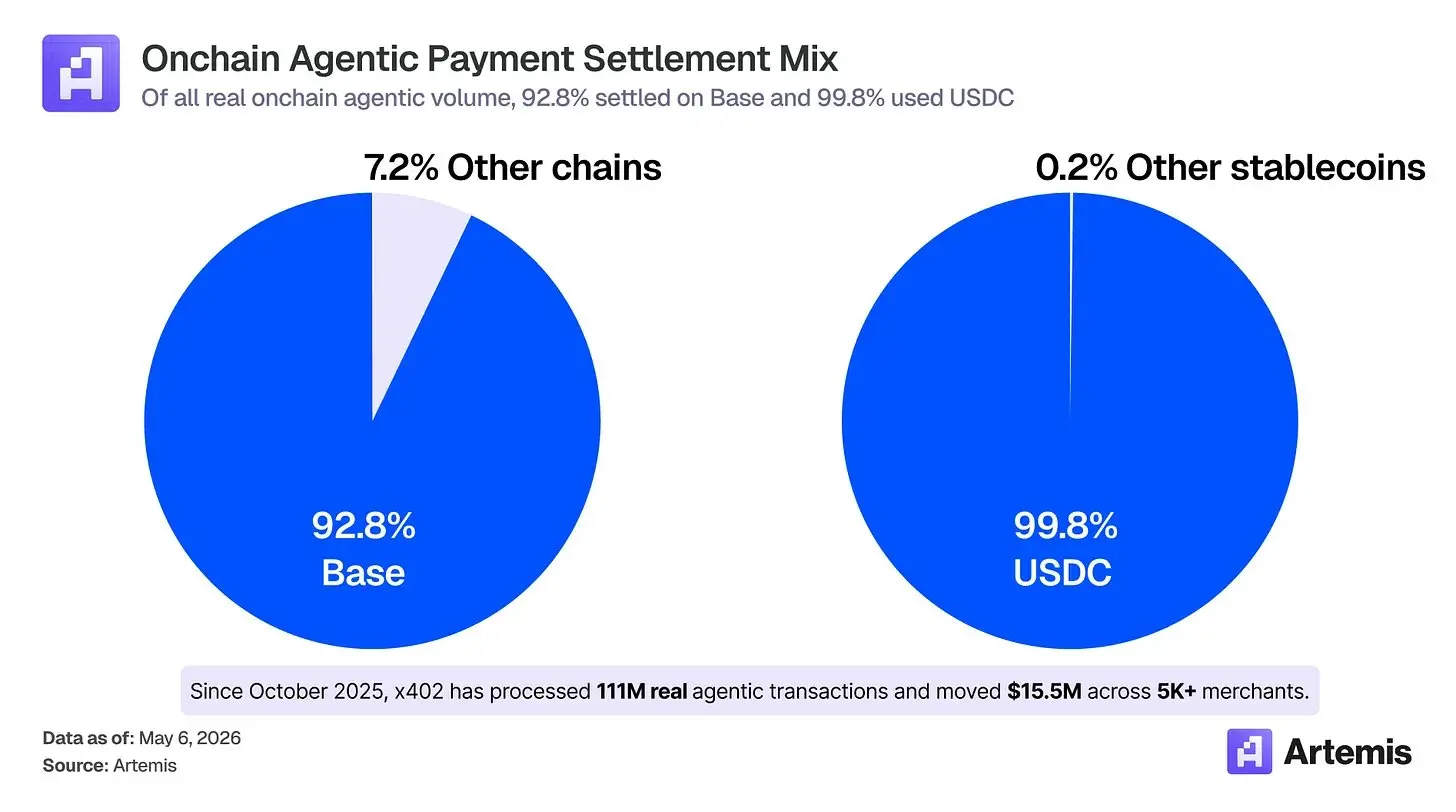
And of all agent-based payment volume, over 99.8% is completed via x402, an open payment protocol spearheaded by Coinbase.
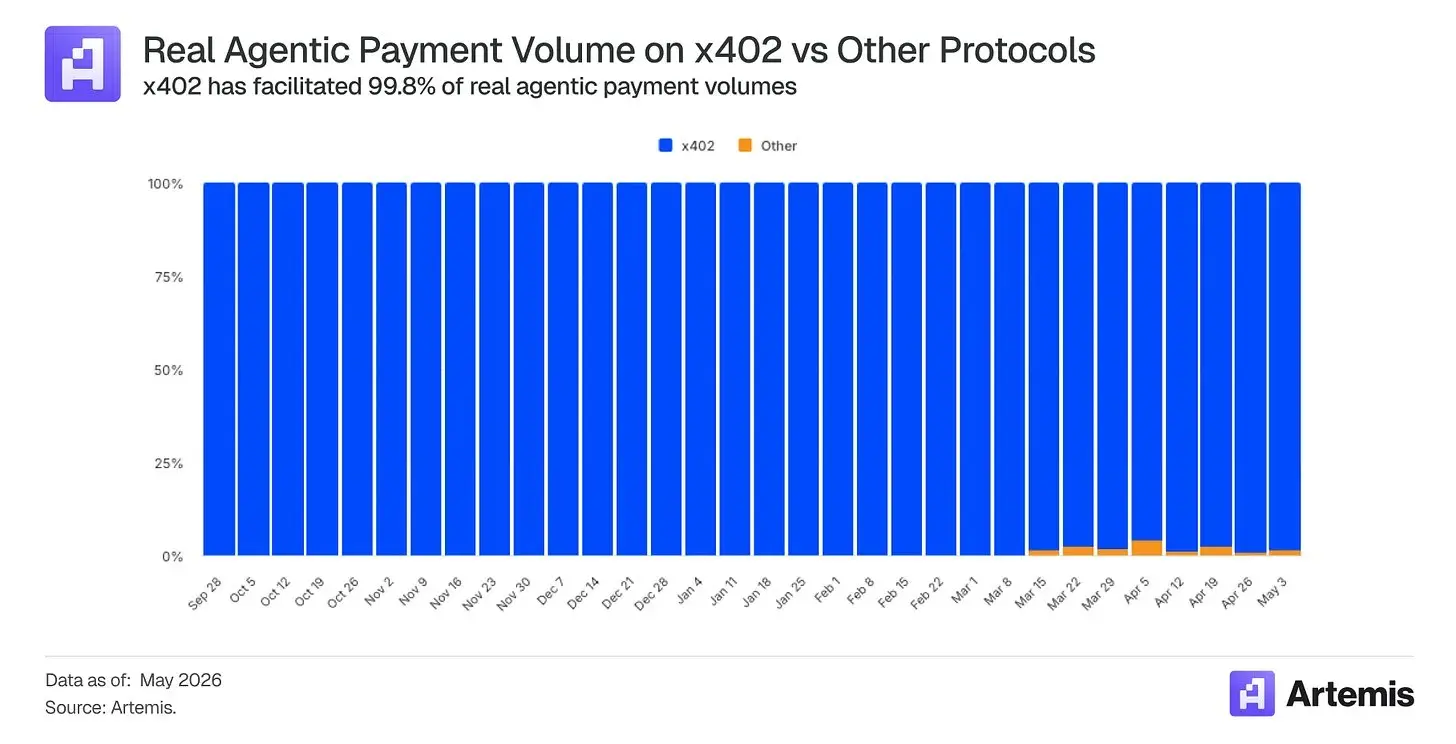
AI agents are evolving from assistants that answer questions into autonomous systems that execute transactions on behalf of users, purchasing APIs, data endpoints, compute, inference services, and various resources at sub-cent pricing and machine speed.

Existing card payment rails are simply not designed for this. A typical card transaction has fixed costs of approximately $0.03 to $0.04 even before interchange fees, making a $0.003 API call economically unfeasible—a full two orders of magnitude difference.

In contrast, settling with stablecoins on a high-throughput L2 costs fractions of a cent, takes seconds, and requires no human intervention to set up billing relationships.

McKinsey predicts global agent-based commerce sales will reach $3 to $5 trillion by 2030. Gartner estimates that by 2028, AI agents will be involved in over $15 trillion of B2B procurement decisions.

These numbers have directional significance and should be taken as trend indicators; however, it is certain that if these scales materialize, stablecoin payment rails will be structurally prioritized, and USDC is already the default asset on this rail, from which Coinbase will directly benefit.

Current Track Record

The x402 standard, an HTTP-native micropayment protocol co-developed by Coinbase (now managed by the Linux Foundation), has become the mainstream open protocol for agent-initiated payments.

Since October 2025, x402 has processed over 180 million agent-based payments, circulating $47.5 million in agent spending across more than 5,000 agent-facing merchants.
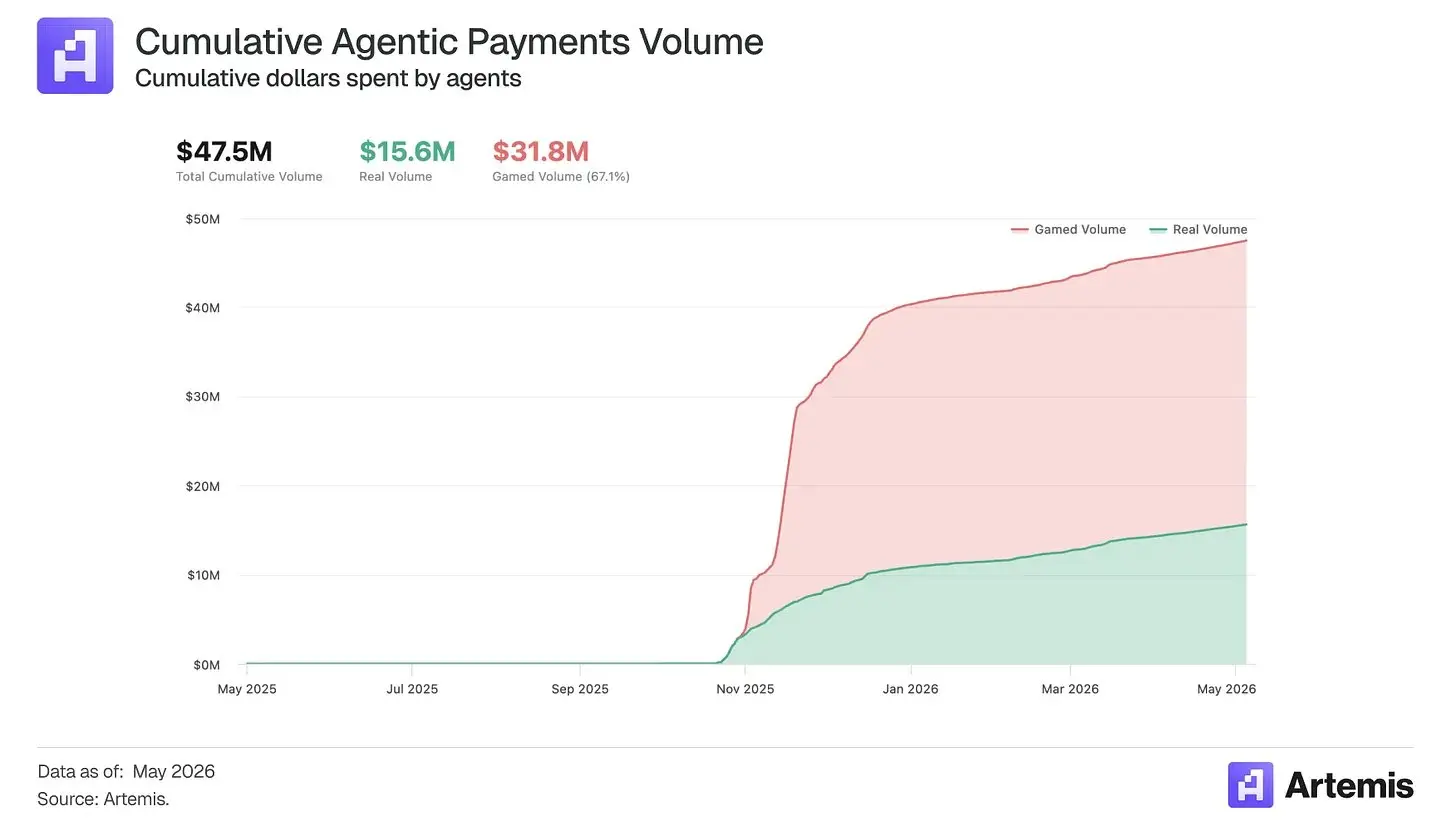
When merchants open their services for agent invocation, Coinbase's L2 and USDC are already the default payment rails.

Furthermore, Agentic.Market provides Coinbase a path to control the resource discovery layer. If agents use it to discover, evaluate, and route x402 services, then value accumulates not only through Base settlement and USDC transaction volume, but also in Coinbase's role as the transaction coordination platform between agents and services.

How Coinbase Monetizes

Coinbase captures the economic value of agent-based payments through four revenue lines that are mutually reinforcing and built around the stablecoin core: USDC float interest, Base settlement revenue, CDP/AgentKit monetization, and Agentic.Market distribution revenue.

1. USDC Reserve Earnings

Coinbase's most significant upside revenue source is not trading fees, but float interest. Agent wallets need prefilled balances to authorize autonomous spending, pay API fees, cover usage-based services, and settle machine-to-machine commerce in real-time.

As agents become economic actors, USDC balances held in wallets controlled by Coinbase become deposits that generate continuous income. Every dollar of USDC held by an agent, regardless of turnover frequency, generates reserve earnings.

2. Base Sequencer Revenue

Every x402 or MPP-type transaction settled on Base becomes a sequencer transaction that can generate priority fees. This revenue line scales with the number of transactions, not payment amounts—a key point, as agent-based commerce is likely characterized by high frequency and low value, distinct from human commercial behavior.

However, as transaction costs tend to decline long-term, sequencer fees may have the smallest upside potential.

3. CDP, AgentKit & Facilitator Monetization

Coinbase can monetize at the developer level—the layer that enables agents to hold wallets, manage permissions, sponsor gas fees, complete x402 payments, and interact with paid services. This includes facilitator fees for x402 transactions, wallet infrastructure, gasless transactions, key management, policy control, and enterprise-grade developer tools.

If CDP becomes the default infrastructure stack for agent-based payments, Coinbase gains platform revenue even if individual payment amounts are low.

Scale Modeling

We assume annual agent-based commerce volume reaches $5 trillion by 2030. A majority of this will still flow through traditional rails like cards, ACH, and bank transfers, especially for large consumer and enterprise purchases.

However, machine-native, high-frequency, cross-border, API-based commerce will disproportionately adopt stablecoins and payment standards like x402 and MPP.

In an optimistic scenario, about 20% of agent-based commerce settles via stablecoin rails, corresponding to annual stablecoin agent-based payment volume of approximately $1 to $1.5 trillion. The optimistic scenario revenue breakdown is as follows:

USDC Float Interest: $200 billion average agent USDC balance × 4% reserve yield × 50% Coinbase attribution share = $4 billion

CDP/AgentKit/Facilitator/Agentic.Market: Developer subscriptions, wallet infrastructure, x402 facilitator fees, market routing, service provider analytics, and distribution fees = $750 million

Base Sequencer: $250 to $300 billion agent-based payment volume processed on Base, tens of billions of transactions, low economic gain per transaction = $250 million
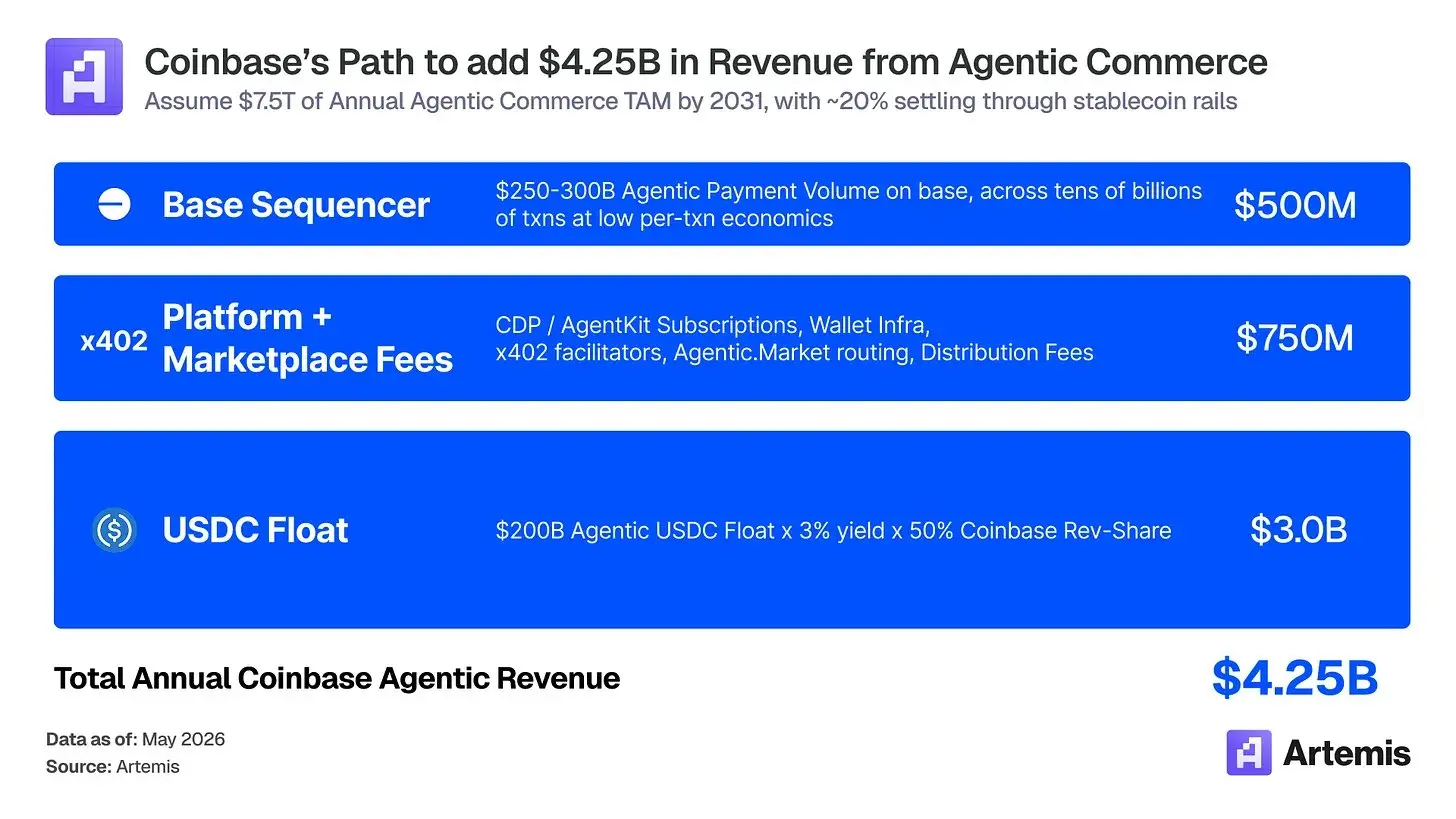
Total approximate $4.25 billion Coinbase-attributed agent revenue. The key takeaway: Once Coinbase becomes the operating account, developer platform, discovery layer, and settlement rail for autonomous commerce, real value accumulates continuously—and over the past few months, they have taken solid steps on this path.

Why Coinbase and USDC Will Prevail

Coinbase's advantage lies in controlling four mutually reinforcing layers of the agent-based payment stack: USDC float interest, Base settlement, CDP/AgentKit infrastructure, and the Agentic.Market discovery layer.

USDC is already the default settlement asset, meaning developers prioritize integrating it because it has the best tooling, deepest liquidity, and broadest developer support.

Base benefits from this, becoming the natural settlement chain for USDC-native agent-based payments, with low developer friction and growing facilitator coverage.

CDP and AgentKit sit a layer above, providing developers with wallets, key management, gas sponsorship, and payment infrastructure, giving agents genuine economic agency.

Finally, Agentic.Market has the potential to become the discovery and routing layer where agents find, compare, and invoke x402 services.

Competitors wanting to enter this market must simultaneously replicate liquidity, settlement capabilities, developer infrastructure, and distribution channels. And with every new agent, merchant, or service added, the existing Coinbase tech stack becomes increasingly difficult to dislodge.

Conclusion

The market views Coinbase as a crypto exchange, overlooking that it is building the underlying platform for AI-native finance.

Global leaders predict stablecoin supply reaching $3 trillion and agent-based commerce reaching $5 trillion by 2030. Stablecoin momentum has decoupled from crypto asset prices.

Coinbase has positioned itself as a core winner in this world and is already showing early leadership. x402, USDC, and Base have become the de facto tech stack for agent-based commerce, with each layer holding over a 90% share advantage against competitors.

Coinbase's unique position stems from developing Base, incubating x402, and holding a favorable position in the USDC economic split.

The market mispricing logic rests on three pillars.

The structure of the Circle agreement is a continuous lock-in, not a renewable contract, meaning the stablecoin revenue line has durability, not cliff risk.

The CLARITY Act formally codifies the regulated infrastructure layer Coinbase already operates, re-basing its valuation benchmark from a consumer product to a core market utility.

The flywheel effect of the four-layer agent tech stack (USDC, Base, CDP, Agentic.Market) is self-reinforcing; with every new agent and merchant added, the moat becomes harder to breach.

Coinbase's valuation benchmark should be closer to infrastructure companies than brokers.

We believe, riding these two epochal tailwinds, Coinbase will grow into a $300 billion company, with the majority of its revenue coming from subscription and service business lines like stablecoins and agent-based commerce.


Câu hỏi Liên quan

QWhy is Coinbase considered a key beneficiary in the stablecoin sector, and how does its agreement with Circle contribute to this?

ACoinbase is the largest and most compliant distributor of USDC. Its agreement with Circle is structured so that as USDC distribution scales (like the $17.8B average balance in Q4 2025), Coinbase receives a greater share of the interest income from reserves, with its share rising from 32% in 2022 to around 50% recently. The contract is designed to auto-renew and is difficult for Circle to terminate, making Coinbase's revenue stream from stablecoins persistent and locked-in.

QAccording to the article, what are the two major megatrends that will drive Coinbase's growth beyond its core exchange business?

AThe two major megatrends are: 1) The rise of stablecoins and global demand for a digital dollar, with supply projected to reach $3 trillion by 2030. 2) The rise of agentic commerce, where AI agents autonomously conduct transactions, with a projected market size of $3-5 trillion by 2030. Coinbase is positioned to be a primary beneficiary in both areas.

QHow does Coinbase capture value from the agentic commerce trend, and what are its four key revenue streams in this area?

ACoinbase captures value through a four-layer tech stack that reinforces itself: 1) USDC float interest from agent wallets. 2) Base sequencer fees from settlement transactions. 3) Revenue from developer tools like CDP/AgentKit and facilitator fees. 4) Potential revenue from the Agentic.Market discovery and routing layer. This integrated stack makes it difficult for competitors to replicate.

QWhat is the x402 protocol, and why is it significant for Coinbase's position in AI-native finance?

Ax402 is an HTTP-native micropayment protocol co-developed by Coinbase (now managed by the Linux Foundation). It has become the dominant open standard for agent-initiated payments, processing over 99.8% of real agent payment volume. Its significance is that it enables low-cost, high-speed machine-to-machine transactions, for which traditional card networks are ill-suited. As the default protocol settled in USDC on Base, it solidifies Coinbase's role as the infrastructure layer for AI agent commerce.

QHow does the CLARITY Act potentially change the investment thesis for Coinbase, according to the article?

AThe CLARITY Act establishes a comprehensive federal regulatory framework for digital assets. The article argues the market underestimates its impact on Coinbase. It formally recognizes the regulated infrastructure layer that Coinbase operates within for stablecoin circulation. This should help re-rate Coinbase's valuation from being viewed as a cyclical consumer brokerage to being valued more like a core, regulated market infrastructure utility company.

Nội dung Liên quan

Tôi đã làm luật sư ly hôn 26 năm: Tiền mã hóa đã trở thành công cụ mới để người giàu che giấu tài sản như thế nào?

Luật sư ly hôn James Sexton với 26 năm kinh nghiệm chia sẻ về vai trò của tiền bạc và sự mất kết nối trong hôn nhân. Ông nhận định, vấn đề tài chính thường là triệu chứng, nguyên nhân sâu xa là sự xa cách. Khoảng 70% các cặp vợ chồng không đạt đến trạng thái hài lòng. Về quản lý tài chính, không có công thức chung, nhưng sự trung thực và minh bạch là chìa khóa. Ông đề xuất mô hình "của tôi, của bạn và của chúng ta" để cân bằng giữa sự chia sẻ và riêng tư. Thỏa thuận tiền hôn ngày càng phổ biến và được coi là thực tế. Đặc biệt, Sexton nhấn mạnh sự nổi lên của tiền điện tử như một công cụ mới để giấu tài sản trong ly hôn. Ông kể lại các vụ việc khi một bên khai mất mật khẩu ví cứng hoặc hưởng lợi từ biến động giá. Ông chỉ ra rằng nhiều luật sư và tòa án chưa hiểu rõ về loại tài sản này, và mãi đến năm 2026, New York mới đưa tiền điện tử vào mẫu khai báo tài sản bắt buộc. Để hàn gắn mối quan hệ, ông khuyên nên thực hiện những "hành động kết nối nhỏ bé" như lời khen, tin nhắn yêu thương. Cách thể hiện tích cực và sự dễ tổn thường có thể tạo ra thay đổi lớn, giúp vượt qua vòng xoáy tiêu cực và củng cố tình cảm.

marsbit25 phút trước

Tôi đã làm luật sư ly hôn 26 năm: Tiền mã hóa đã trở thành công cụ mới để người giàu che giấu tài sản như thế nào?

marsbit25 phút trước

Nhà đạt giải Turing Sutton và tác phẩm mới: Sử dụng một công thức từ năm 1967 để giải quyết một khuyết điểm lớn trong học tăng cường dạng luồng

Vào cuối năm 2024, một nhóm nghiên cứu tại Đại học Alberta đã chỉ ra một nghịch lý: học tăng cường (RL) vốn được thiết kế để học “trên đường chạy” (streaming), lại gần như không thể hoạt động trong môi trường deep learning nếu không có bộ đệm dữ liệu (replay buffer) hoặc batch size lớn. Hiện tượng này được gọi là “stream barrier”. Một năm rưỡi sau, nghiên cứu mới với sự tham gia của Richard Sutton (Giải Turing 2024) đã đưa ra giải pháp cốt lõi: nguyên nhân không phải do thiếu dữ liệu, mà do **đơn vị của learning rate (bước học) đã bị chọn sai**. Các phương pháp truyền thống quy định tham số thay đổi bao nhiêu, dẫn đến đầu ra hàm mục tiêu thay đổi không kiểm soát, gây ra hiện tượng dao động mạnh và sụp đổ khi học online (batch size=1). Nghiên cứu đề xuất **“Cập nhật Có Chủ Đích” (Intentional Updates)**, lấy ý tưởng từ thuật toán NLMS năm 1967. Thay vì định trước kích thước bước cho tham số, họ xác định trước **lượng thay đổi mong muốn ở đầu ra** (ví dụ: giảm 5% sai số dự đoán giá trị), rồi tính ngược ra learning rate phù hợp. Cách tiếp cận này đảm bảo mỗi bước cập nhật tác động một cách nhất quán lên hàm mục tiêu. Phương pháp được áp dụng cho học giá trị (Intentional TD) và học chính sách (Intentional Policy Gradient), kết hợp với RMSProp và eligibility traces. Kết quả thử nghiệm trên các nhiệm vụ MuJoCo và Atari cho thấy, trong chế độ streaming, các thuật toán mới đạt hiệu suất ngang bằng với các phương pháp tiêu chuẩn như SAC hay DQN (vốn dùng replay buffer lớn), trong khi yêu cầu tính toán ít hơn đáng kể (chỉ khoảng 1/140 so với SAC). Ưu điểm chính là tính ổn định và độc lập với nhiều kỹ thuật ổn định hóa phức tạp. Tuy nhiên, nghiên cứu cũng chỉ ra một hạn chế tiềm ẩn: trong học chính sách, learning rate phụ thuộc vào hành động được lấy mẫu, có thể gây ra sai lệch nhỏ trong hướng kỳ vọng của gradient. Tóm lại, “Cập nhật Có Chủ Đích” đưa học tăng cường dòng chảy tiến gần hơn tới mục tiêu học liên tục, thích ứng và hiệu quả như cách sinh vật học, mở ra tiềm năng cho các ứng dụng robot hoặc thiết bị biên cần hoạt động trực tuyến lâu dài với tài nguyên hạn chế.

marsbit32 phút trước

Nhà đạt giải Turing Sutton và tác phẩm mới: Sử dụng một công thức từ năm 1967 để giải quyết một khuyết điểm lớn trong học tăng cường dạng luồng

marsbit32 phút trước

Bảng xếp hạng tỷ phú tiền mã hóa lộ diện: Satoshi Nakamoto đứng đầu với 89 tỷ USD, nhưng có người không thể rút được một xu nào

Tác giả: Climber, CryptoPulse Labs Trong thế giới tài chính truyền thống, các bảng xếp hạng người giàu thường dựa trên cổ phiếu niêm yết, bất động sản và danh mục đầu tư. Nhưng trong thế giới crypto, mọi thứ minh bạch hơn và cũng kịch tính hơn. Gần đây, Arkham đã công bố Bảng xếp hạng 10 cá nhân giàu nhất trên chuỗi năm 2026. Điểm đáng tin cậy của bảng xếp hạng này là nó chỉ thống kê tài sản cá nhân có thể theo dõi được trên chuỗi. Đằng sau bảng xếp hạng này là những huyền thoại làm giàu nhanh chóng, cũng như những bi kịch đáng tiếc. 1. **Satoshi Nakamoto: Huyền thoại bất động.** Người tạo ra Bitcoin đứng đầu danh sách với khoảng 89 tỷ USD BTC, phần lớn được khai thác từ năm 2009-2010 và chưa bao giờ di chuyển. Sự giàu có và danh tính bí ẩn của Satoshi vẫn là một huyền thoại. 2. **Justin Sun (Tôn Vũ Trần): Người chơi năng động.** Người sáng lập TRON đứng thứ hai với tài sản trên chuỗi khoảng 1.5 tỷ USD, nổi tiếng với các hoạt động giao dịch và danh mục đa dạng. 3. **James Howells & Stefan Thomas: Bi kịch mất khóa riêng tư.** Howells vô tình vứt ổ cứng chứa khóa riêng tư của 8,000 BTC (trị giá ~650 triệu USD) vào bãi rác. Thomas thì chỉ còn 2 lần thử mật khẩu cuối cùng để mở ví cứng chứa 7,002 BTC (~569 triệu USD) trước khi dữ liệu bị xóa vĩnh viễn. 4. **Rain Lohmus: Đầu tư thành công nhưng mất trắng.** Nhà ngân hàng Estonia này mua 250,000 ETH với giá rẻ trong đợt ICO năm 2014 (nay trị giá ~589 triệu USD) nhưng đã làm mất khóa riêng tư. 5. **Vitalik Buterin: Triệu phú lý tưởng.** Đồng sáng lập Ethereum có tài sản khoảng 533 triệu USD, chủ yếu từ ETH thời kỳ đầu. Ông thường bán các meme coin được airdrop để quyên góp. 6. **Clifton Collins: Câu chuyện ly kỳ.** Mua 6,000 BTC giá rẻ, giấu khóa riêng tư trong cần câu rồi làm mất, sau đó bị bắt vì tội buôn ma túy. Đến năm 2026, một ví của anh ta bất ngờ hoạt động và cảnh sát thu hồi được 35 triệu USD. 7. **DiscusFish (Thần Ngư): Người khai thác kỳ cựu.** Một trong những người chơi Bitcoin sớm nhất ở Trung Quốc, tài sản trên chuỗi khoảng 213 triệu USD, đã trải qua nhiều chu kỳ thị trường. 8. **Patricio Worthalter: Tỷ phú từ sản phẩm.** Người sáng lập POAP (Proof of Attendance Protocol - Giao thức Chứng nhận Tham dự), có tài sản khoảng 149 triệu USD từ một dự án tập trung vào danh tính số. 9. **James Fickel: Nhà giao dịch dày dạn.** Mua một lượng lớn ETH từ năm 2016, hiện nắm giữ ~49,000 ETH, nhưng cũng từng thua lỗ 43 triệu USD trong một lần giao dịch, cho thấy sự biến động khốc liệt của thị trường. Bảng xếp hạng này phản ánh lịch sử crypto: của cải lớn thường đến từ việc nắm giữ sớm, khóa riêng tư là thứ quý giá nhất, và sự giàu có trong thời đại trên chuỗi ngày càng minh bạch. Trong thế giới crypto, ranh giới giữa tự do tài chính và mất trắng vĩnh viễn đôi khi chỉ là một chuỗi khóa riêng tư.

marsbit1 giờ trước

Bảng xếp hạng tỷ phú tiền mã hóa lộ diện: Satoshi Nakamoto đứng đầu với 89 tỷ USD, nhưng có người không thể rút được một xu nào

marsbit1 giờ trước

Thanh toán thế hệ tiếp theo không nằm trong tầng thanh toán

Đây là phần tóm tắt (thứ 2.5) trong loạt bài phân tích chiến lược AI của Stripe. Bài viết thảo luận về nền tảng kinh tế cho Kỷ nguyên AI Agent, tập trung vào KYA (Know Your Agent). Tác giả, từ kinh nghiệm tại Ant Group, lập luận rằng các hình thức thanh toán mới không được thiết kế từ tầng thanh toán, mà "mọc lên" từ cơ sở hạ tầng của các kịch bản giao dịch mới. AI Agent chính là kịch bản đó, và KYA là lớp cơ sở hạ tầng mới đang hình thành cho nền kinh tế Agent. KYA không phải là một sản phẩm cấp thanh toán hay sự nâng cấp hệ thống hiện có. Nó là một lớp cơ sở hạ tầng với năm thành phần: danh tính Agent, phạm vi ủy quyền, chữ ký ý định, chuỗi trách nhiệm kiểm toán và xếp hạng tín dụng. Chỉ hai trong số này liên quan trực tiếp đến chuỗi thanh toán. Do đó, thanh toán nên được coi là một hệ thống con của KYA, chứ không phải ngược lại. Các động thái của Stripe (như giao thức ACP với OpenAI, Shared Payment Token, mua lại Bridge và Privy, xây dựng blockchain Tempo) cho thấy họ đang đặt cược vào vị trí nền tảng kinh tế cho AI, vượt ra khỏi khuôn khổ một công ty thanh toán. Dữ liệu về lạm dụng bản dùng thử miễn phí trong các công ty AI chứng minh rằng rủi ro và quyết định giao dịch giờ đây xảy ra ở giai đoạn đầu hơn trong vòng đời người dùng/Agent. Về mặt pháp lý, trách nhiệm cuối cùng vẫn thuộc về con người. Tuy nhiên, trong mạng lưới Agent phức tạp, trách nhiệm được phân phối. Vai trò của KYA là sử dụng mật mã học để ghi lại và xác minh hành động của mọi thực thể, biến việc "không thể truy nguyên" thành "có thể truy nguyên". Đây là sự thay đổi về khả năng truy xuất trách nhiệm, không chỉ là cải thiện hiệu quả thanh toán. Tóm lại, hình thức thanh toán tiếp theo sẽ không được thiết kế ở tầng thanh toán. Nó sẽ xuất hiện từ các kịch bản của nền kinh tế Agent, sau khi lớp cơ sở hạ tầng KYA được thiết lập.

marsbit3 giờ trước

Thanh toán thế hệ tiếp theo không nằm trong tầng thanh toán

marsbit3 giờ trước

Giao dịch

Giao ngay
Hợp đồng Tương lai

Bài viết Nổi bật

Làm thế nào để Mua ERA

Chào mừng bạn đến với HTX.com! Chúng tôi đã làm cho mua Caldera (ERA) trở nên đơn giản và thuận tiện. Làm theo hướng dẫn từng bước của chúng tôi để bắt đầu hành trình tiền kỹ thuật số của bạn.Bước 1: Tạo Tài khoản HTX của BạnSử dụng email hoặc số điện thoại của bạn để đăng ký tài khoản miễn phí trên HTX. Trải nghiệm hành trình đăng ký không rắc rối và mở khóa tất cả tính năng. Nhận Tài khoản của tôiBước 2: Truy cập Mua Crypto và Chọn Phương thức Thanh toán của BạnThẻ Tín dụng/Ghi nợ: Sử dụng Visa hoặc Mastercard của bạn để mua Caldera (ERA) ngay lập tức.Số dư: Sử dụng tiền từ số dư tài khoản HTX của bạn để giao dịch liền mạch.Bên thứ ba: Chúng tôi đã thêm những phương thức thanh toán phổ biến như Google Pay và Apple Pay để nâng cao sự tiện lợi.P2P: Giao dịch trực tiếp với người dùng khác trên HTX.Thị trường mua bán phi tập trung (OTC): Chúng tôi cung cấp những dịch vụ được thiết kế riêng và tỷ giá hối đoái cạnh tranh cho nhà giao dịch.Bước 3: Lưu trữ Caldera (ERA) của BạnSau khi mua Caldera (ERA), lưu trữ trong tài khoản HTX của bạn. Ngoài ra, bạn có thể gửi đi nơi khác qua chuyển khoản blockchain hoặc sử dụng để giao dịch những tiền kỹ thuật số khác.Bước 4: Giao dịch Caldera (ERA)Giao dịch Caldera (ERA) dễ dàng trên thị trường giao ngay của HTX. Chỉ cần truy cập vào tài khoản của bạn, chọn cặp giao dịch, thực hiện giao dịch và theo dõi trong thời gian thực. Chúng tôi cung cấp trải nghiệm thân thiện với người dùng cho cả người mới bắt đầu và người giao dịch dày dạn kinh nghiệm.

Tổng lượt xem 482Xuất bản vào 2025.07.17Cập nhật vào 2025.07.17

Làm thế nào để Mua ERA

Thảo luận

Chào mừng đến với Cộng đồng HTX. Tại đây, bạn có thể được thông báo về những phát triển nền tảng mới nhất và có quyền truy cập vào thông tin chuyên sâu về thị trường. Ý kiến ​​của người dùng về giá của ERA (ERA) được trình bày dưới đây.

活动图片