OpenAI Accelerates at a Blazing 16x Speed, GPT-5.6 Multi-Agent V2 Goes Live, 741-Round Monster Conversation Opens in 1 Second

marsbitXuất bản vào 2026-08-17Cập nhật gần nhất vào 2026-08-17

Tóm tắt

OpenAI has unveiled a pair of major performance and capability upgrades for ChatGPT and its underlying systems, delivering dramatic speed improvements and launching a new multi-agent architecture. The first breakthrough is a massive front-end optimization for handling extremely long conversations. Using a test case of a 741-round "monster" conversation (231MB in size), OpenAI achieved: * Application load speed increased by 94% (from 27.62 seconds down to 1.66 seconds). * Memory growth reduced by 87.8%. * Overall memory usage cut by 41.2%. * Network requests dropped by 98.2% (from 894 to 16). * Session items loaded decreased by 99.6% (from 15,529 to 64). This overhaul means lengthy chat histories and complex, tool-heavy Codex sessions will load significantly faster and with much lower memory overhead. Simultaneously, OpenAI has fully launched the "Multi-Agent v2" system for GPT-5.6. This architecture allows a primary "Agent" to automatically break down complex tasks and delegate subtasks to different specialized models—such as GPT-5.6 Sol (for complex coding), Terra (daily programming), Luna (fastest/cheapest), and Daybreak (cybersecurity)—each with configurable reasoning strength. The goal, as stated by OpenAI president Greg Brockman, is to move "towards saying goodbye to manually picking models." This intelligent distribution allows costly, powerful models to be reserved for only the most complex steps (~20% of a task), dramatically reducing inference costs and acceleratin...

OpenAI unleashes big moves one after another!

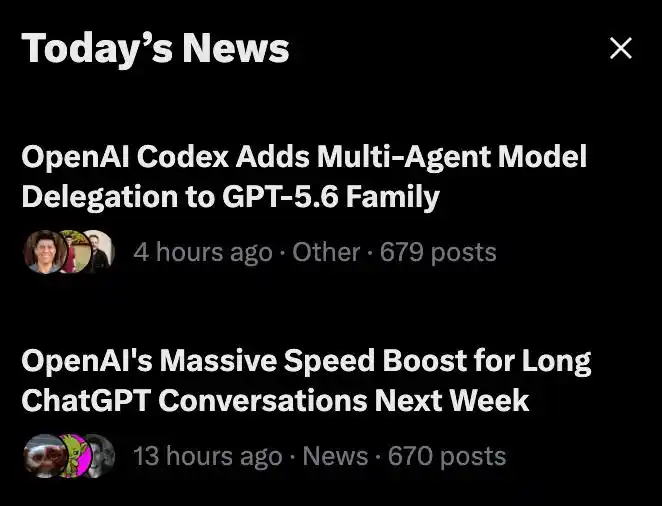
Today (the 16th), a leaked internal Slack message revealed that ChatGPT is about to undergo an 'epic' performance overhaul.
Judging from the hardcore test data, the optimization of ChatGPT's frontend performance this time is so dramatic it's almost 'unbelievable':

Application loading speed directly skyrocketed by 94%, heap memory growth reduced by 87.8%, and overall memory footprint slashed by 41.2%.

Network requests plummeted by 98.2%, and conversation history loading was cut by a full 99.6%.
Almost simultaneously, Codex launched the GPT-5.6 'Multi-Agent v2' version.

The main Agent can now automatically delegate different subtasks to different models, and each sub-Agent can be individually configured with reasoning intensity.

OpenAI President Greg Brockman stated, 'Moving towards bidding farewell to manual model selection.'

It must be said, with this wave of 'two-pronged approach' from OpenAI—

It directly eliminates the tedious 'waiting' and 'choosing' for users, enabling ChatGPT to truly achieve a seamless and ultra-fast, fluid interactive experience.

ChatGPT Major Overhaul, Loading Speed Soars 94%

What many don't know is that this major performance upgrade for ChatGPT is actually a crucial battle after the departure of 'Programming King' Scott Gray.

When using ChatGPT, what people have always dreaded is that long conversations become slower and more sluggish, with the web page even crashing directly.

On the official OpenAI forum, someone even posted asking, 'Is the new Codex slower?', with many agreeing in the comments.

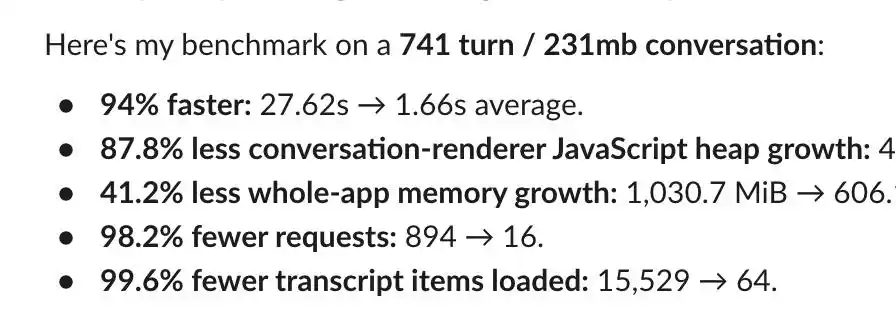
This time, Codex lead Andrew Ambrosino's shared internal Slack screenshot laid it all out:

What they used for internal testing was a 'monster-level' conversation with a full 741 rounds and a size of 231MB!

This might sound like an extreme case, but it's the norm in the Agent era.

In the past, conversations were chat histories, maybe a few dozen rounds at most; now, a slightly complex task involving reading code, running tests, making changes, and verifying again can easily reach hundreds of rounds.

It's this kind of high-intensity conversation that now opens in an average time reduced from 27.62 seconds to 1.66 seconds.

Total application memory growth was compressed from 1030.7 MiB to 606 MiB;

The network requests needed to open it once went from 894 down to 16; the number of session entries that needed loading dropped from 15,529 to 64.

This is a major frontend optimization by OpenAI targeting ChatGPT's ultra-long conversations.

In two words, smooth.

What difference will it actually make?

Simply put, those chat logs spanning months will open much faster.

Developers who frequently run heavy Codex sessions with hundreds of tool calls will find the interface noticeably snappier, and their device's memory usage will drop accordingly.

Switching back to an ultra-long old conversation will no longer feel like 'loading a save file from a nearly-dead PS3'.

The clever part is that ChatGPT no longer needs to load and render the entire history just because you opened a conversation.

It can store most of the content and only load the small portion people actually need at the moment.

The same conversation, but with a huge amount of unnecessary work eliminated.

For those accustomed to living in ultra-long AI conversations, this is the kind of seemingly boring infrastructure upgrade that can dramatically improve the product experience.

Multi-Agent v2 Fully Launched, No Need to Manually Select GPTs Anymore

Just this week, OpenAI quietly updated ChatGPT.

It wasn't until today that OpenAI engineer Eric Provencher officially announced: Multi-Agent v2 is now fully live.

The focus is on intelligent task division.

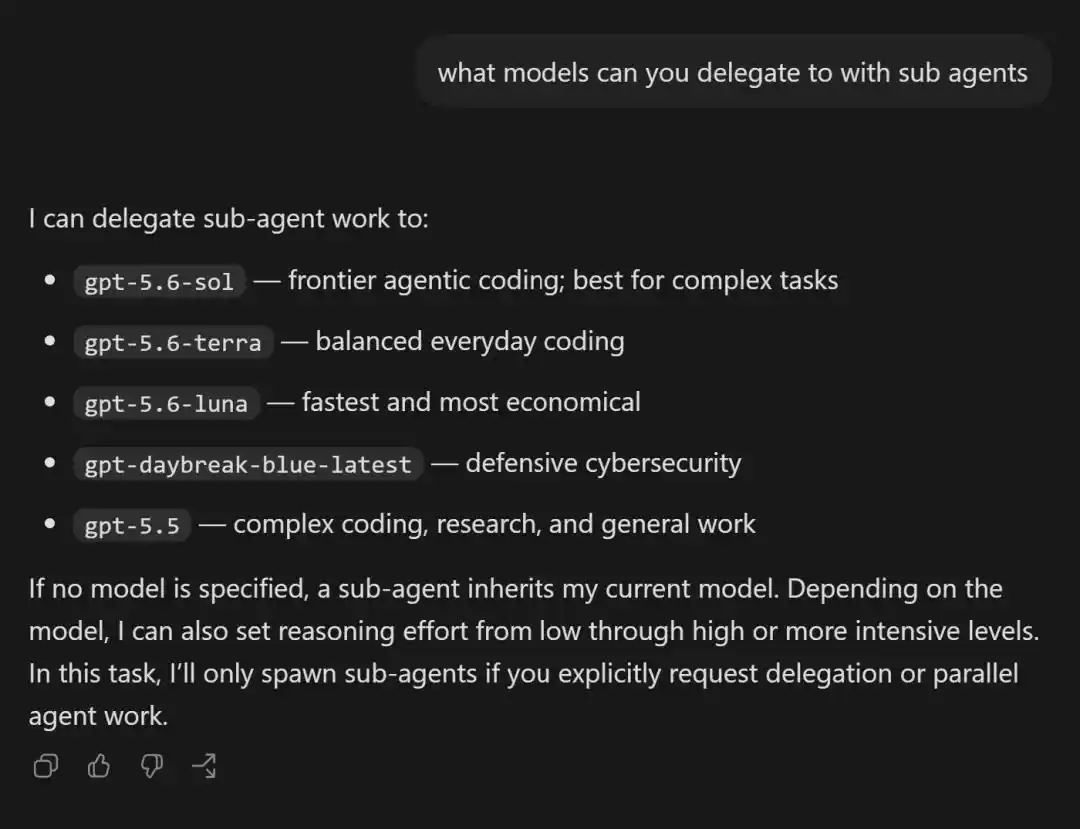
The main Agent can automatically delegate subtasks to any supported model, including Luna, with each sub-Agent supporting independent reasoning intensity settings.

Now the hand ChatGPT/Codex holds looks like this—

GPT-5.6 Sol: The strongest, for complex Agentic coding

GPT-5.6 Terra: The daily programming workhorse

GPT-5.6 Luna: The fastest, cheapest

Daybreak: Specialized for cybersecurity

GPT-5.5: Complex programming, research, general tasks
Actually, three weeks ago, in Codex's model list, Sol and Terra were marked as multi_agent_v2, while the cheapest Luna was marked as v1.

The result was that when the main Agent tried to delegate work to Luna, the system would directly reply with 'unknown model'.

On GitHub, developers opened at least two issues about this.

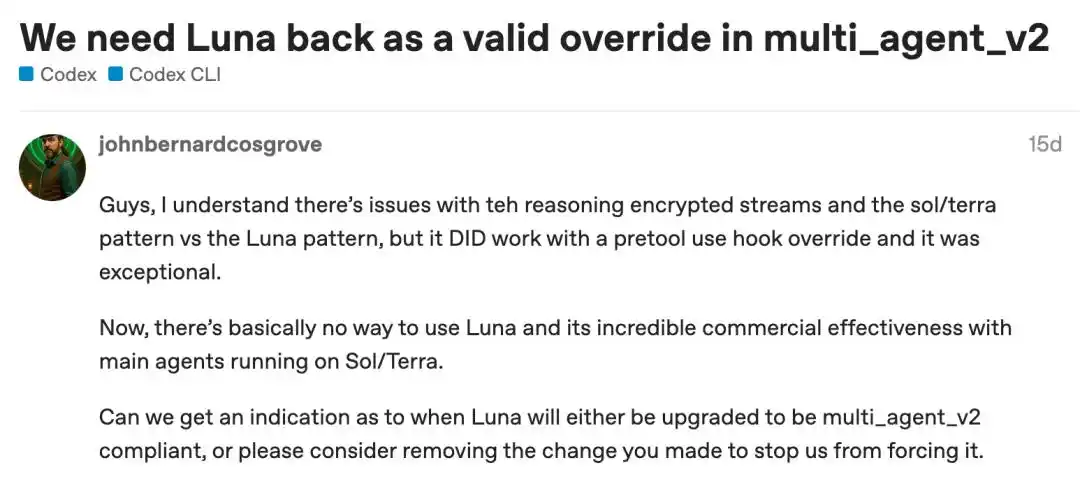
There's a post on the official OpenAI forum titled 'Give us Luna back', where the poster said they previously used a hook to force using Luna with amazing results, and now that path is blocked.
Previously, people needed to manually choose models; in the future, the Agent system will automatically split tasks, execute them in parallel, and summarize results, turning models into internal computational resources.

For complex tasks, only 20% of the steps might need the strongest model, while the rest can be handed off to cheaper models.

This way, reasoning costs can be significantly reduced, accelerating ChatGPT's transformation from a chat tool to a workflow platform.

ChatGPT Evolves On the Spot, The Fully Automated Monster is Here

The frontend has cleared away the 'historical baggage', and the backend has enabled 'intelligent distribution'.

This underlying 'one-two punch' from OpenAI not only makes ChatGPT completely bid farewell to the era of lag but also announces to the entire industry:

Large models are accelerating their evolution from 'chat tools' to true 'fully automated workflow platforms'.

No more worrying about which model to choose to balance costs, no more painfully waiting for monster-level hundreds-of-rounds conversations to slowly unfold.

Just throw the complex task over, and leave the automatic decomposition, model scheduling, and ultra-fast rendering to the system.

The era of ultimate smoothness for Agents has truly arrived.

Faced with such a 'seamless' and powerful ChatGPT, is your productivity ready for takeoff?

References:

https://x.com/Ananth7e/status/2088490421676863782?s=20

https://x.com/ajambrosino/status/2088401536057827344?s=20

https://x.com/gdb/status/2088658133971509640

This article is from WeChat Official Account 'New Zhiyuan', author: Taozi

Câu hỏi Liên quan

QWhat are the key performance improvements mentioned for ChatGPT in the article?

AThe key performance improvements for ChatGPT include a 94% increase in application load speed, an 87.8% reduction in heap memory growth, a 41.2% reduction in overall memory usage, a 98.2% decrease in network requests, and a 99.6% reduction in conversation history loading time.

QWhat is the GPT-5.6 Multi-Agent v2 and what is its main feature?

AGPT-5.6 Multi-Agent v2 is a new version of the multi-agent system. Its main feature is that the main Agent can automatically delegate sub-tasks to different specialized models (like Luna) and each sub-Agent can have its own independent reasoning strength setting, moving towards eliminating the need for manual model selection.

QAccording to the article, what was the size and length of the 'monster-level' conversation used for testing, and what was the result?

AThe 'monster-level' conversation used for testing was 231 MB in size and consisted of 741 rounds. The result was that the average time to open it decreased from 27.62 seconds to 1.66 seconds after the optimization.

QHow does the article describe the future role of ChatGPT according to OpenAI's recent updates?

AThe article describes that with the recent foundational updates (front-end optimization and intelligent task distribution), ChatGPT is evolving from a 'chat tool' into a true 'fully automated workflow platform', where complex tasks are automatically decomposed, scheduled to appropriate models, and rendered at high speed.

QWhich specific models are mentioned as part of the ChatGPT/Codex lineup for different tasks?

AThe mentioned models in the ChatGPT/Codex lineup are: GPT-5.6 Sol (for complex Agentic coding), GPT-5.6 Terra (for daily programming), GPT-5.6 Luna (fastest and cheapest), Daybreak (for cybersecurity), and GPT-5.5 (for complex programming, research, and general tasks).

Nội dung Liên quan

Chủ Sở Hữu XRP Có Thể Giao Dịch Quyền Chọn Trên Nền Tảng Derive Bằng Cách Sử Dụng FXRP Làm Tài Sản Thế Chấp

Flare thông báo từ ngày 12/8, các nhà nắm giữ XRP giờ đây có thể sử dụng FXRP (một phiên bản XRP được đảm bảo trên mạng lưới Flare) làm tài sản thế chấp để giao dịch quyền chọn (options), hợp đồng tương lai vĩnh viễn (perpetuals) và giao dịch giao ngay (spot) trên nền tảng Derive. FXRP cho phép người dùng mở các vị thế trực tiếp từ ví tự lưu trữ trong khi XRP cơ bản vẫn được giữ trên XRP Ledger. Theo thông báo, việc tích hợp này đáp ứng nhu cầu của cộng đồng nắm giữ XRP lâu dài về một thị trường quyền chọn không cần cấp phép để tạo lợi nhuận hoặc phòng ngừa rủi ro. Derive kết hợp tính toán giao thức với sổ lệnh do Derive Trading Co. quản lý, cho phép người dùng kiểm soát tài sản trong khi các nhà tạo lịch sự chuyên nghiệp cung cấp thanh khoản. Các hợp đồng quyền chọn XRP trên Derive được thanh toán bằng USDC (tiền mặt), và lợi nhuận/thua lỗ khi đáo hạn sẽ được phản ánh trên số dư USDC của nhà giao dịch. Hệ thống ký quỹ danh mục (Portfolio Margin V2) được sử dụng để đánh giá rủi ro và giảm yêu cầu ký quỹ cho các vị thế phòng ngừa lẫn nhau. Tuy nhiên, các vị thế không đủ ký quỹ vẫn có thể bị thanh lý. FXRP là một phần trong hệ sinh thái XRPFi mở rộng của Flare, cho phép XRP tương tác với hợp đồng thông minh. Ngoài Derive, FXRP cũng đã được tích hợp vào các nền tảng giao ngay và thị trường cho vay phi tập trung (như Morpho), mở rộng các trường hợp sử dụng. Trước đó, quyền chọn XRP cũng đã xuất hiện trên thị trường phái sinh được quy định như CME Group, nhưng Derive nhắm đến người dùng phi tập trung với quy trình thanh toán bằng USDC và truy cập trực tiếp qua ví. Bên cạnh quyền chọn, nền tảng cũng cung cấp hợp đồng tương lai vĩnh viễn.

cryptonews.ru8 phút trước

Chủ Sở Hữu XRP Có Thể Giao Dịch Quyền Chọn Trên Nền Tảng Derive Bằng Cách Sử Dụng FXRP Làm Tài Sản Thế Chấp

cryptonews.ru8 phút trước

Nhà giao dịch đầu tư 120 USD vào memecoin NiuLai và thu về lợi nhuận 205.000 USD

Một nhà giao dịch tiền điện tử đã biến khoản đầu tư 120 USD thành 205.000 USD nhờ vào đồng memecoin NiuLai trên chuỗi BNB. Ông đã mua 19,1 triệu token NiuLai chỉ với 120 USD trước khi giá token tăng mạnh. Nhà đầu tư may mắn này đã bán 9,1 triệu token để thu về 25.900 USD, trong khi vẫn giữ lại 10 triệu token trị giá khoảng 180.200 USD, theo dữ liệu từ Lookonchain. Tổng lợi nhuận đã thực hiện và chưa thực hiện là 205.800 USD, tương đương lợi nhuận gấp 822 lần số vốn ban đầu. Dữ liệu chuỗi khối cho thấy nhà giao dịch đã mở vị thế khi vốn hóa thị trường của token chỉ là 6.270 USD. Sự quan tâm đến tài sản này sau đó đã đẩy vốn hóa thị trường của NiuLai lên hàng chục triệu USD. NiuLai, có nghĩa là "Con bò đang tới", là một memecoin lấy cảm hứng từ một bộ phim hoạt hình Trung Quốc cùng tên. Bộ phim ngân sách thấp ban đầu ít được chú ý nhưng sau đó trở nên viral trên các nền tảng mạng xã hội Trung Quốc, tạo ra nhiều meme và thu hút sự chú ý. Cơn sốt trên mạng nhanh chóng lan sang thị trường tiền điện tử, dẫn đến sự ra mắt của tài sản đầu cơ này. Những người mua NiuLai đầu tiên đã thu được lợi nhuận khổng lồ khi vốn hóa thị trường tăng từ vài nghìn USD lên 18-20 triệu USD, nhờ hoạt động giao dịch sôi nổi trên PancakeSwap và các sàn giao dịch phi tập trung khác. Vốn hóa thị trường từng đạt đỉnh 29 triệu USD trước khi giảm mạnh.

cryptonews.ru10 phút trước

Nhà giao dịch đầu tư 120 USD vào memecoin NiuLai và thu về lợi nhuận 205.000 USD

cryptonews.ru10 phút trước

Chainalysis kiện chính phủ Mỹ về hợp đồng trị giá 95 triệu đô la của ICE với TRM Labs

Công ty phân tích blockchain Chainalysis đã đệ đơn kiện chính phủ Hoa Kỳ liên quan đến quyết định của Cơ quan Thực thi Di trú và Hải quan (ICE) trao hợp đồng trị giá khoảng 94,6 triệu USD cho đối thủ cạnh tranh TRM Labs mà không thông qua đấu thầu. Chainalysis cho rằng quyết định này của ICE là "tùy tiện, thất thường và không hợp lý". Họ đã gửi thông tin về khả năng của mình để đáp lại thông báo của ICE về việc dự định mua phần mềm phân tích pháp y và dịch vụ hỗ trợ từ TRM Labs. Hợp đồng kéo dài một năm, từ tháng 7/2026 đến tháng 6/2027. Cả hai công ty đều cung cấp các công cụ phân tích blockchain mà các cơ quan chính phủ sử dụng để theo dõi giao dịch tiền mã hóa và điều tra tội phạm. Đơn khiếu nại hiện vẫn được niêm phong vì chứa thông tin độc quyền và bí mật thương mại của Chainalysis. Tòa án đã cho phép giữ bí mật vào ngày 31/7. TRM Labs đã nộp đơn tham gia vụ kiện, và tòa án đã lên lịch cho các phiên họp vào tháng 9. Các chi tiết cụ thể về khiếu nại hoặc biện pháp khắc phục mà Chainalysis yêu cầu chưa được tiết lộ trong các tài liệu công khai.

cryptonews.ru12 phút trước

Chainalysis kiện chính phủ Mỹ về hợp đồng trị giá 95 triệu đô la của ICE với TRM Labs

cryptonews.ru12 phút trước

Giao dịch

Giao ngay
活动图片