Abstract
This week, we focus on the following events: 1) BNB Chain Halts After 'Potential Exploit' Drained Estimated $100M in Crypto; 2) Crypto Exchange Huobi Global Will Sell Its Entire Stake to About Capital; 3) Dapper Labs Restricts Services to Russia Amid EU Sanctions.
Project Analysis: After the Stepn, many X2earn projects are created during that period, especially the sports area. SWEAT is a very competitive one among these projects. In the report, we will analyze the SWEAT from several aspects and let you know it better.
Table of Contents
1. Industry overview 3
I. Overall market trend 3
II.NFT 5
III.DeFi 7
IV.Layer 2 8
2. Market news (Source: Coindesk, Bitcoinist, CNBC) 9
I. Industry news 9
II. Investment and Financing 9
III. Supervision 11
3. Project Analysis 13
I. Introduction 13
II. Token Information 16
III. Investors 19
IV. Opportunities 19
1. Industry overview
I. Overall market trend
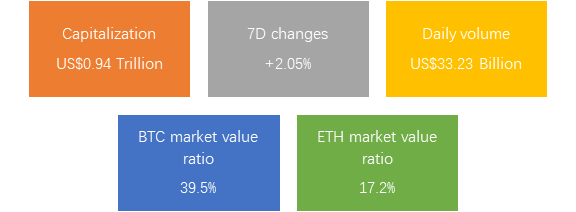
Figure 1. Overall market data
Source: CoinMarketCap
The global cryptocurrency market’s market cap this week changed slightly, currently with a market. Bitcoin is currently trading at US$19,444, continuing weeks below $20,000. Meanwhile, Ethereum, the second largest cryptocurrency, is currently trading at US$1,323, still haven’t recover to the point before the Merge. Most of the other top 10 tokens, including Terra Classic, Cardano, STEPN(GMT), all have a 30-day change of over 15% decrease, as this can potentially be seen as the bottom of crypto market or near.
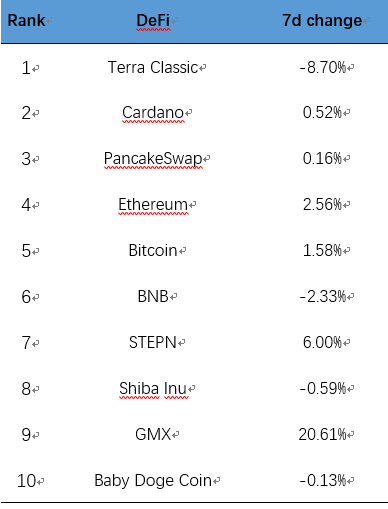
Table 1. Last week's hot currencies
Source: CoinMarketCap
II.NFT
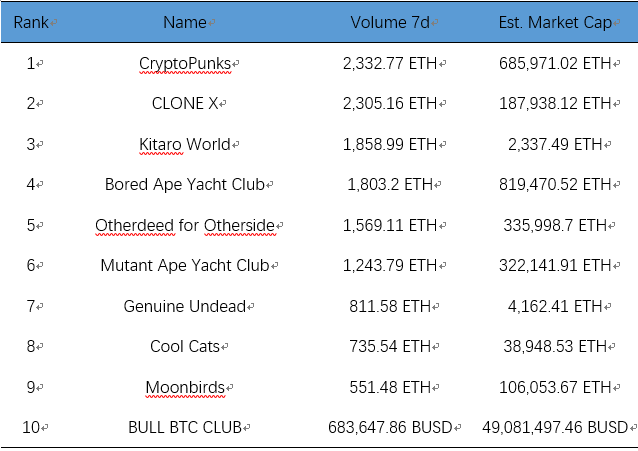
Table 2. NFT Collections Listed By Sales Volume (7d)
Source: CoinMarketCap
The NFT market last week saw a decrease of 3.15%, with a market cap of US$2,346,114,382.62 this week. This is not a lot compared to last month, with weekly fluctuations over 10% or even 20%. The 7-day sales volume changed by 0.27% to $29,313,287.79 and total sales did not change very much at 2.77%, to 52,341. Overall, the NFT market maintained a stable market last week. While the majority of the other top 10 are familiar brands, the only outlier was BULL BTC CLUB based on BSC chain, with a 140.10% increase in 7-day volume and got the 10th place in top 10 NFT brands on Coinmarketcap. Apart from Genuine Undead and Cool Cats, which has respectively 0.25% and 0.34% increase in volume, all the other brands saw a volume change of less than 0.1%.
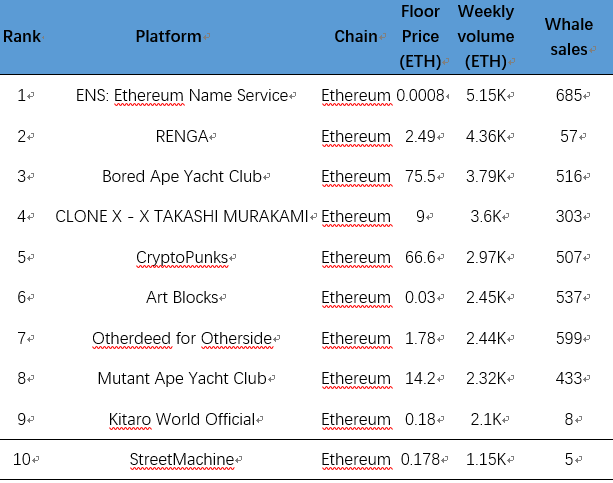
Table 3. Top trending collections on NFTGO (by weekly volume)
Source: NFTGO
III.DeFi
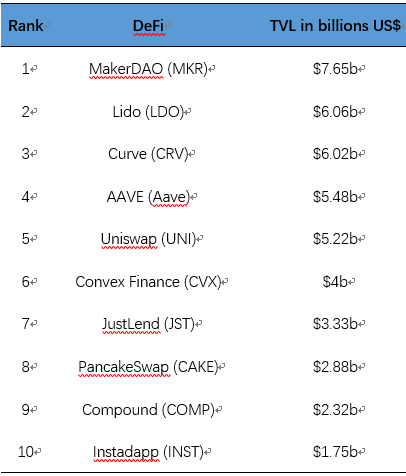
Table 4. DeFi market TVL ranking
Source: DefiLlama
IV.Layer 2
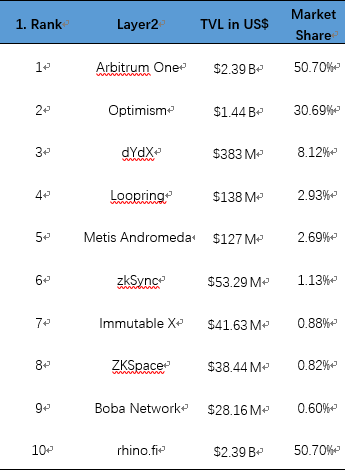
Table 5. Layer2 protocols ranking and market share
Source: l2beat
2. Market news (Source: Coindesk, Bitcoinist, CNBC)
I. Industry news
BNB Chain Halts After 'Potential Exploit' Drained Estimated $100M in Crypto
BNB Chain was forced to hit the brakes on Thursday after the blockchain with ties to the world's largest crypto exchange by volume suffered what it called a "potential exploit" that on-chain evidence suggested could have targeted hundreds of millions of dollars in crypto.
BNB Chain is composed of BNB Beacon Chain and BNB Smart Chain (BSC).
"Due to irregular activity we're temporarily pausing BSC," BNB Chain tweeted from its official account, later confirming that the activity was a "potential exploit" that it characterized as contained.
Visa partners with FTX in a bet that shoppers still want to spend cryptocurrencies in a bear market
Visa is betting that crypto investors still want to spend their digital currencies, even as prices plummet this year.
The payments giant is teaming up with global exchange FTX to offer debit cards in 40 countries with a focus on Latin America, Asia and Europe. The cards, which are already available in the U.S., will link directly to a user’s FTX cryptocurrency investing account. The move allows customers to spend digital currencies without moving those off an exchange, “like you would with any bank account,” according to Visa’s CFO.
“Even though values have come down there’s still steady interest in crypto,” Visa CFO Vasant Prabhu told CNBC in a phone interview. “We don’t have a position as a company on what the value of cryptocurrency should be, or whether it’s a good thing in the long run -- as long as people have things they want to buy, we want to facilitate it.”
II. Investment and Financing
Crypto Exchange Huobi Global Will Sell Its Entire Stake to About Capital
Huobi Global, which has been China’s top crypto exchange, has mentioned that its founder is now planning to sell his controlling stake to buyout firm About Capital Management (HK) Co. Huobi has been altering itself ever since its exit from the home market after China banned crypto. At the current moment, the company is headed towards a takeover by an investment firm, About Capital. According to the statement, after the completion of the transaction, the buyout vehicle of About Capital will control the majority stake of Houbi founder Leon Li. The company announced today that the transaction has been completed and that the entire stake has been sold to About Capital.
Citi Ventures Backs Its First Digital Asset Manager, Co-Leading a $6M Round in Xalts
Citi Ventures and venture capital firm Accel co-led a $6 million funding round for xalts, an institutional-grade digital asset management startup founded by a former trader at banking giant HSBC and a former Meta Asia executive. The funding comes as institutional investors continue to move into the cryptocurrency industry despite the crypto bear market.
“With xalts, we are building innovative, institutional-grade investment products and solutions which focus on high compliance and control standards – things institutional investors care about," said xalts Chief Investment Officer Ashutosh Goel, formerly of HSBC, in the press release. "The next leg of growth in digital assets will be driven by institutional participation in the asset class. We are starting to see the early signs of that with a lot of new initiatives coming from banks and asset managers."
Founded by Ashutosh Goel and Supreet Kaur, Hong-Kong based xalts expects to launch multiple digital asset-related investment products, including mutual funds and exchange-traded funds on several global exchanges. The development pipeline includes partnerships with asset management firms and staking infrastructure providers to launch and manage other financial products.
Restaurant Industry Veteran Ben Leventhal Raises $11M for Web3 Startup Blackbird
Blackbird, a new Web3 hospitality platform, has raised $11 million in a seed funding round that was co-led by Union Square Ventures, Shine Capital and Multicoin Capital, a company representative confirmed to CoinDesk in an email.
The startup was founded by Ben Leventhal, who previously co-founded food publication Eater and online restaurant platform Resy, which was acquired by American Express (AXP) in 2019.
The Blackbird platform will be a Web3-backed way for restaurants to connect with guests through loyalty and membership. An initial version of the product is expected to launch in the first half of 2023.
As part of the investment, Union Square Ventures partner Fred Wilson will join the Blackbird board. Other investors in the round included investment firm Variant, the venture-capital arm of USDC issuer Circle and digital product conglomerate IAC.
III. Supervision
Dapper Labs Restricts Services to Russia Amid EU Sanctions
NFT powerhouse Dapper Labs has cut off payment services for non-fungible token owners with links to Russia, citing European Union sanctions in a Thursday blog post.
Dapper, the company behind popular NFT collections such as NBA Top Shot, said, “It is now prohibited to provide crypto-asset wallet, account or custody services of any value to accounts with connections to Russia.”
Impacted users can still look at their NFTs, but they cannot move funds, gift tokens, sell NFTs or buy new ones, Dapper said in the post, citing its payment processor.
On Thursday, the European Union confirmed its ban on transferring money to and from Russian crypto wallets, accounts and custody providers after proposals of the restrictions the week prior. This is a tightening of the EU’s limitations of Russian crypto wallet payments, which previously capped the amount at 10,000 Euros in April. As of Thursday, Russian users cannot transfer any funds, including crypto funds, to or from the EU.
Bitcoin Advocate Ziya Sadr Arrested by Iranian Security Forces
Ziya Sadr, an Iranian Bitcoin advocate, was arrested by Iranian security forces last month, according to multiple sources.
Nima Yazdanmehr, who said he is a friend of Sadr, told CoinDesk the arrest took place on the streets of Tehran on Sep. 19 and that Sadr has not been released. The arrest came amid widespread anti-government protests over the state killing of 22-year-old Mahsa Amini.
Sadr is a popular Bitcoin educator and Youtuber, as well as an advocate for the technology. He’s translated Bitcoin content into Farsi and promoted privacy-focused ways to use Bitcoin for personal transactions.
Sadr is currently being held in Fashafouyeh Prison and remains in contact with his family and close friends, according to Yazdanmehr.
Sadr is just one of thousands of Iranian citizens and activists to be detained by the Iranian government in the weeks following the protests. It is not known if the Iranian government’s interest in Sadr is related to his Bitcoin advocacy.
Multiple sources told CoinDesk Sadr was not participating in a protest at the time of his arrest.
Sadr was set to be released on bail Sunday, but mass arrests from the protests have caused bail requests across Iran to be delayed, according to Yazdanmerh.
3. Project Analysis
I. Introduction
What is SWEAT?
Sweatcoin is a health and fitness app that previously rewarded in-app SWEAT tokens that could be redeemed for branded products, digital services and charitable donations. Its developer is Sweat Economy and founded in 2015. Sweat Economy was founded in 2015 with a mission to promote healthier lives by encouraging people to exercise more. Now Sweat Economy is focused on combining the numerous opportunities of blockchain and Web3 to bring more rewards to its users, releasing the SWEAT token and accompanying Sweat wallet app in 2022.
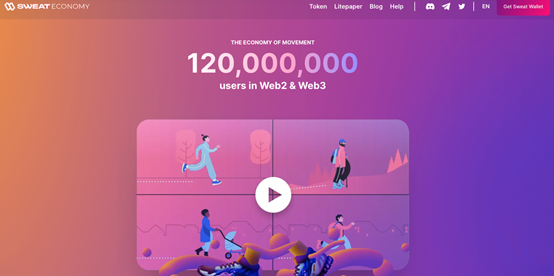
Figure 2: SWEAT economy website
Source: https://sweateconomy.com/
Functions
In the Sweatcoin app, users can change the steps to SWEAT tokens, and use the token to redeem branded products & vouchers, donate to charity, and bid for products.
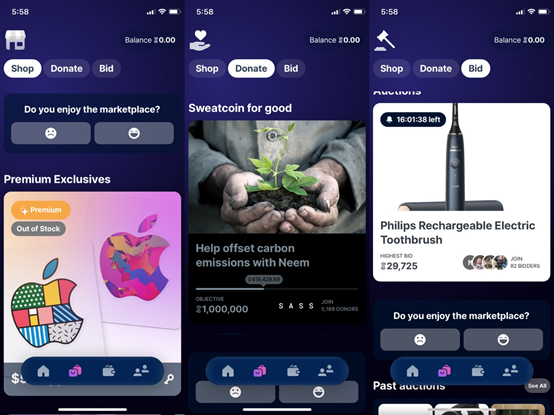
Figure 3: SWEAT app
Source: SWEATCOIN App
The functions and usage of the app are very simple and easy to understand and do not require complicated operations. There is also a membership mechanism in the app, and the annual fee for new users is 25 USD. Some of the better coupons and products can only be purchased by Premium members, and users can get a higher mining limit after purchasing Premium. Users can earn without paying any upfront fees.
App Data
In Apple App Store, Its name is Sweatcoin Walking Step Counter. It ranks highly in Health & Fitness area across countries, as shown in Figure 4.
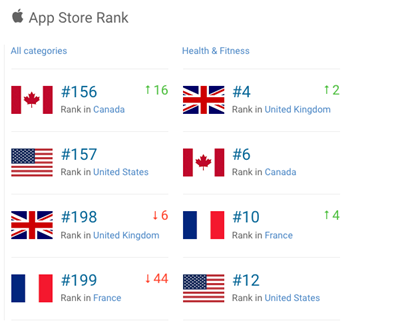
Figure 4: SWEAT app ranking
Source: https://www.similarweb.com/app/app-store/971023427/statistics/#ranking
In the Google Play Rank, It also has very good statics.
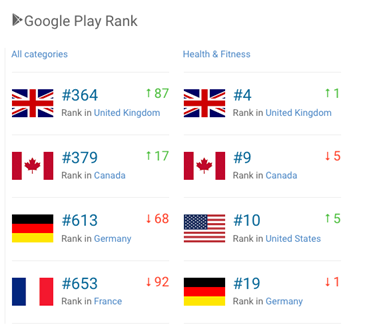
Figure 5: SWEAT app ranking
Source: https://www.similarweb.com/app/google-play/in.sweatco.app/statistics/#ranking
So far, the total downloads of SWEAT app have exceeded 120 million, and the creation of SWEATcoin wallet has also exceeded 13 million. According to official data, global downloads of Sweatcoin have tripled since the first half of 2022; at the beginning of June 2022, its total number of users reached 100 million. Walking more than 20% after downloading, and 600 partners providing, in Q1 of 2022 alone, $70M worth of goods and services in exchange for steps.
There is no doubt that it has been a very successful application in web2. SWEAT has cooperated with many brands for a win-win situation, and users can also use the number of steps to exchange for valuable things. Every character can benefit here.
II. Token Information
Token Distribution
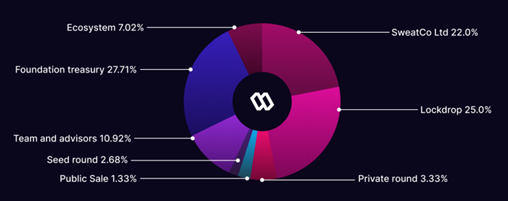
Figure 5: SWEAT token distribution
Source: https://drive.google.com/file/d/1IPklRcEQvgJkCaeYvGh43yjWl-Dj5_6i/view
SWEAT minting difficulty
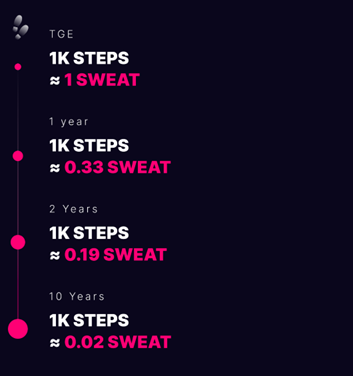
Figure 6: SWEAT minting difficulty
Source: https://drive.google.com/file/d/1IPklRcEQvgJkCaeYvGh43yjWl-Dj5_6i/view
To analyze it, we just consider the first period, 1k steps can change 1 SWEAT. An office worker can walk about 5,000 steps a day and 10,000 steps a day on weekends. That's 45,000 steps a week. Converted to SWEAT is about 45. For the current SWEAT price, the weekly gain is less than 1USD. The project party greatly reduced the minting income in order to prevent the overdraft of the project due to excessive selling pressure in the market. However, due to the low revenue, the ability to attract new users has also weakened. This problem may be a serious problem on other X2earns, because those products do not have a large initial user base. For SWEAT, the number of original users is already huge. The transition from Web2 to Web3 only adds an option for users to exchange SWEAT tokens for other assets on the chain, or buy SWEAT for investment.
Token Utility
● NFTs. 1) Third party NFT providers will have to pay SWEAT to sell NFTs to users. 2) Users will be able to purchase and upgrade NFTs with SWEAT, or else by staking considerable amounts of SWEAT.
● DeFi functions. The Sweat Wallet will generate fees by enabling a suite of DeFi functions: buying and selling crypto, the exchange of SWEAT into other crypto, liquidity provision, staking, and more. With the volume of users we have, the accumulated fees will be significant.
● Access to the audience. Projects who wish to market their tokens or NFTs to the Sweat community will have to pay a fee in SWEAT, and/or give free/heavily-discounted products to our users.
● Advertising. With 110M users and counting, the apps (Sweatcoin and Sweat Wallet app) offer valuable advertising space. Any advertiser must pay in SWEAT to access this customer base.
● Alternative Movement Validators will have to stake a considerable amount of SWEAT to operate as a Movement Validator (for which they will receive a % fee as per the current SweatCo Ltd validator).
●Data analytics. The Sweat DAO will give individuals ownership of their data, and offer them the opportunity to monetize that data. As such, any institution, investor, healthcare provider or insurer can buy an individual’s SWEAT to gain access to data analytics.
● Premium subscription services. The premium services, such as those already on the Sweatcoin app, will include many benefits, such as access to exclusive markets, NFTs, social channels, and more. Users must pay in SWEAT to access the premium subscription.
III. Investors
Sweatcoin is built on the Near chain, and the NEAR Foundation has invested in the project. On July 28, Sweatcoin developer Sweat Economy raised $13 million. The financing was led by Spartan Capital, with participation from Electric Capital, OKX Blockdream Ventures, Goodwater Capital and GSR Capital. On September 4th, the public offering platform Daomaker launched the Sweatcoin public sale round with a total quota of 2 million US dollars.
IV. Opportunities
First, we analyze from the X 2 earn track. At present, the situation on this track is not optimistic. Stepn's statistics, as the heat subsided, got poor. Most of the other X 2 earn projects also died due to unsustainable economic models. Most of the X 2 earn projects, which attract new users through 'earn', are not usable and playable by themselves, and generally have a Punzi structure. As the income decreases, most people will choose to quit, which will lead to an accelerated decline in income and the demise of the project.
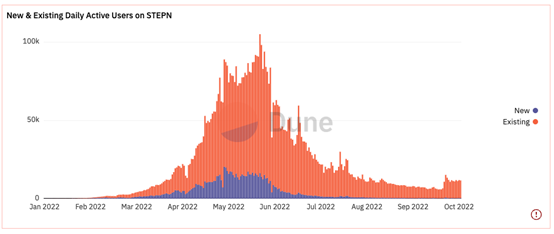
Figure 7: Stepn Daily Active Users
Source: https://dune.com/nguyentoan/STEPN-(GMT-GST)-Core-Metrics
But for the SWEATcoin, I think it's different from others.
1. It has a vast user amount.
2. Most of these users are cumulated from 2015, not from web3 or just for earning tokens.
3. Whole projects can run very well without tokens at first, and now it just adds one more choice for users and itself to join in web3.
The real value of the X 2 earn program is not in 'earn', but in X. It is very important whether the project can continue to gain user support after it is separated from earn. For most X 2 earn projects, the vast majority of users come for 'earn', and eventually leave because they can't continue to earn. For SWEAT, from 2015 to the first half of this year, there were no tokens that could be distributed, but the project still flourished and became a very popular health app. This also fully illustrates the value of SWEAT's 'X', and in the absence of 'earn', the project can still run smoothly.
SWEAT is an app that was launched in 2015. From the perspective of user experience and anti-cheating design, it has been tested by the market and adjusted by the team, which is very beneficial to the development of the project.
But I think, SWEAT is not suitable for investment at present, but suitable for long-term observation. The time to join the token is still very early stage. The entire X 2 earn track is not optimistic, and the overall cryptocurrency market is in a bear market. Everyone has very low expectations for new projects, and the opening performance will not be very good. For SWEAT, the current market value in circulation is high, and the selling pressure of users' steps to convert tokens has not been verified. Most of the token applications have not been implemented, but will be carried out one by one at a later time. SWEAT can not only be circulated, but also redeemable for gifts and coupons. The team has carefully designed that items of different values require different SWEATcoins. I think this will also have a certain reference value for future SWEAT pricing.
About Huobi Research Institute
Huobi Blockchain Application Research Institute (referred to as "Huobi Research Institute") was established in April 2016. Since March 2018, it has been committed to comprehensively expanding the research and exploration of various fields of blockchain. As the research object, the research goal is to accelerate the research and development of blockchain technology, promote the application of the blockchain industry, and promote the ecological optimization of the blockchain industry. The main research content includes industry trends, technology paths, application innovations in the blockchain field, Model exploration, etc. Based on the principles of public welfare, rigor and innovation, Huobi Research Institute will carry out extensive and in-depth cooperation with governments, enterprises, universities and other institutions through various forms to build a research platform covering the complete industrial chain of the blockchain. Industry professionals provide a solid theoretical basis and trend judgments to promote the healthy and sustainable development of the entire blockchain industry.
Contact us:
Website: http://research.huobi.com
Email: research@huobi.com
Twitter https://twitter.com/Huobi_Research
Telegram: https://t.me/HuobiResearchOfficial
Medium: https://medium.com/huobi-research
Disclaimer
1. The author of this report and his organization do not have any relationship that affects the objectivity, independence, and fairness of the report with other third parties involved in this report.
2. The information and data cited in this report are from compliance channels. The sources of the information and data are considered reliable by the author, and necessary verifications have been made for their authenticity, accuracy and completeness, but the author makes no guarantee for their authenticity, accuracy or completeness.
3. The content of the report is for reference only, and the facts and opinions in the report do not constitute business, investment and other related recommendations. The author does not assume any responsibility for the losses caused by the use of the contents of this report, unless clearly stipulated by laws and regulations. Readers should not only make business and investment decisions based on this report, nor should they lose their ability to make independent judgments based on this report.
4. The information, opinions and inferences contained in this report only reflect the judgments of the researchers on the date of finalizing this report. In the future, based on industry changes and data and information updates, there is the possibility of updates of opinions and judgments.
5. The copyright of this report is only owned by Huobi Blockchain Research Institute. If you need to quote the content of this report, please indicate the source. If you need a large amount of references, please inform in advance (see "About Huobi Blockchain Research Institute" for contact information) and use it within the allowed scope. Under no circumstances shall this report be quoted, deleted or modified contrary to the original intent.