From Speculation to Risk Management: Predictive Markets Are Filling the Gap in Commercial Insurance

marsbitXuất bản vào 2026-08-17Cập nhật gần nhất vào 2026-08-17

Tóm tắt

From Speculation to Risk Management: Predictive Markets Filling the Commercial Insurance Gap The emergence of AI risk management tools like Blanket is exploring the potential of predictive markets as a genuine insurance tool for businesses. These markets, with their simple contract structure—paying $1 if an event occurs, $0 if not—allow the real-time market price to reflect collective probability assessments. Businesses can use them to hedge against operational risks (e.g., abnormal weather, energy price fluctuations) that are often not covered by traditional business interruption insurance, which typically requires physical damage. A key question is whether these markets are genuinely used for hedging or remain primarily speculative. Analysis of Kalshi markets from August 2025 to August 2026 compared weather contracts (a potential hedge instrument) against sports contracts (largely speculative) and traditional CME grain futures. Three behavioral metrics were examined: 1. **Daily Turnover Rate:** Weather contracts showed the lowest rate (0.210), lower than corn futures (0.266) and significantly lower than sports contracts (0.315), suggesting longer holding periods. 2. **Hold-to-Expiry Ratio:** Weather contracts had a much higher ratio (over 0.5) compared to near-zero ratios for sports contracts, indicating a stronger tendency to hold positions until settlement, consistent with hedging behavior. 3. **Position Buildup Timing:** Weather market positions reached 50% of their...

Written by: G_Gyeomm

Compiled by: AIdidiaoJP, Foresight News

I. A New Type of Insurance Directly Priced by the Market

The recently launched AI risk management tool Blanket is attempting to turn predictive markets into a genuine insurance tool usable by businesses. The logic is straightforward: a business inputs its operational information, the system automatically diagnoses its main risk exposures, and then recommends corresponding Kalshi event contracts to help the business hedge against these risks.

The hedging mechanism itself is not complex. The contract structure of a predictive market is extremely clear — it pays $1 if an event occurs and $0 if it doesn't. The contract's real-time price represents the market's collective judgment on the probability of that event occurring.

It is precisely this simple structure that gives predictive markets the potential to become real hedging tools. Businesses can preemptively purchase contracts for events that could impact their operations, such as abnormal weather, energy price volatility, or tariff policy changes. If these risks materialize, the contract payouts can partially or fully offset the operational losses.

A specific example: an ice cream shop that would lose about $20,000 in revenue if the summer is unusually cool.

The hedging operation is as follows: buy 20,000 temperature contracts at $0.30 each. If the average summer temperature falls below a preset threshold, each contract pays out $1. The total cost is $6,000.

There are only two possible outcomes:

  • Cool Summer: The temperature is below the threshold, revenue is down $20,000, but the contracts pay out $20,000 in total. The net loss is locked at $6,000 — exactly the initial cost of buying the contracts.
  • Hot Summer: The temperature is above the threshold, revenue is unaffected, but the contracts expire worthless, and the $6,000 cost is completely lost.

Regardless of the outcome, the final loss is firmly locked at $6,000. This $6,000 is essentially the insurance premium. And the rate for this premium is not set by an insurance company's actuary or any traditional underwriting institution, but by the market itself — the price quoted in real-time by countless buyers and sellers with real money.

II. Is the Hedging Market Really Functioning?

Predictive markets have already accumulated enough speculative demand. They first gained fame through election predictions, then smoothly expanded into the sports arena, largely solving the volume problem. The industry generally believes the next growth space lies in expanding more practical use cases, with hedging needs repeatedly mentioned as one of the most promising directions.

In principle, its value is indeed significant. The gaps not covered by existing hedging tools are quite broad. Traditional business interruption insurance in commercial insurance typically requires physical damage as a precondition. A ski shop losing revenue because there was hardly any snow all winter — this kind of pure "operational risk" — is almost impossible to find suitable insurance products to cover on the market.

There are mature hedging tools in the futures market, but the barriers are high: requiring an ISDA agreement, opening a specialized futures account, posting margin, and minimum contract size limits. These are not issues for large institutions, but are almost unattainable for ordinary small and medium-sized enterprises. Goldman Sachs can maintain a professional derivatives trading team, but the cafe on the corner obviously cannot.

The problem is, there has always been a clear chasm between theoretical rationality and actual use. Predictive markets have long carried the label of "gambling," and whether they can truly operate as an independent hedging market — rather than just a speculative tool — has never been systematically verified.

The real question that needs answering is: Are predictive markets actually being used for hedging? Does real hedging demand exist? Trading behavior itself can provide clues. We selected three sets of data for comparison.

The first set is CME grain futures — a typical traditional hedging market, primarily used to mitigate losses from price fluctuations in agricultural and livestock products.

The second set is the Kalshi sports market — where hedging demand is extremely limited, and trading is almost entirely driven by speculation.

The third set is the Kalshi weather market — it handles weather risk in a manner similar to CME weather futures, while sharing the exact same event contract structure and trading environment with the Kalshi sports market. This makes it an excellent test sample — to see which side its trading behavior is closer to.

Hedging and speculation typically exhibit different trading characteristics. Hedgers tend to establish positions well before the actual risk window arrives and hold them until expiration; speculators move in and out more frequently, chasing prices, with noticeably higher turnover rates.

If the Kalshi weather market's turnover rate and holding behavior are closer to traditional hedging markets than to the sports market, then hedging demand is real.

Conversely, if it's not much different from the sports market, then actual usage is closer to pure speculation. In that case, tools like Blanket might be responding to a nice industry hypothesis, not a real demand confirmed by data.

The dataset for this analysis covers 1,265 Kalshi markets settled between August 2025 and August 2026. The screening criteria were: cumulative trading volume of at least 500 contracts, and trading lasting at least three days.

III. Data Point 1: Average Daily Turnover Rate

First, look at how frequently positions are traded in each market. Turnover rate is defined as daily trading volume divided by open interest (OI) for that day. We calculated the daily turnover rate for each contract in each market and then took the median for the entire trading cycle.

The results are clear: Kalshi weather contracts have the lowest turnover rate, only 0.210. The traditional hedging product corn futures is 0.266, and Kalshi sports contracts are the highest at 0.315.
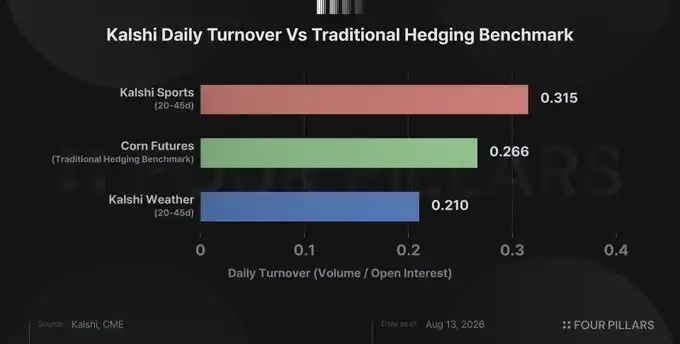
Sports contracts turn over about 1.5 times faster than weather contracts. This indicates a relatively longer holding tendency for weather contracts, initially suggesting the possible existence of real hedging demand.

However, a caveat: Corn futures' turnover rate sits in the middle, and the differences among the three data sets are not particularly stark. Based on turnover rate alone, we cannot fully confirm the existence of hedging demand in the weather market. What this data can definitively tell us so far is only that weather contract turnover is significantly lower than sports contract turnover.

IV. Data Point 2: Hold-to-Expiration Ratio

The second key metric is the hold-to-expiration ratio — measuring how many positions remain untouched in the market at settlement. It is calculated as the final open interest for each contract divided by the cumulative trading volume. A higher value indicates more positions were firmly held until the expiration date.
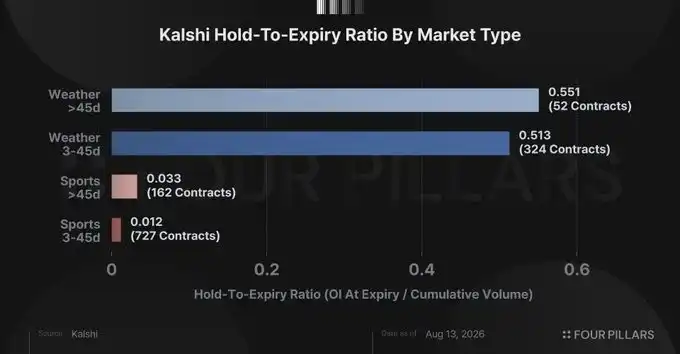
The difference in results is very striking: regardless of trading duration, the hold-to-expiration ratio for weather contracts exceeds 0.5. In contrast, sports contracts are only 0.012 and 0.033 respectively. In the 3 to 45-day trading interval, weather is 42.8 times that of sports; in the over 45-day interval, the gap is still 16.7 times.

This clearly shows: Weather contracts are far more inclined to "buy and hold" than sports contracts. Hedgers hold contracts to receive payouts if the risk materializes, not to chase price differences. Therefore, a high hold-to-expiration ratio strongly supports the judgment that there is real hedging demand in the weather market.

Of course, this cannot be directly interpreted as the entire weather market being used for hedging. This data does not track the identities of individual position buyers and sellers, so it cannot be simply equated with the proportion of original buyers holding to expiration. What can be confirmed at present is that the holding behavior of weather contracts is distinctly different from that of sports contracts.

V. Data Point 3: When Were Positions Established?

The final question is: When were these positions established? We divided the daily open interest for each contract by that contract's peak open interest, converted the time from launch to expiration into a progress bar from 0% to 100%, and then plotted the median curve.

The criterion for judgment is the point at which half of the peak open interest is reached. If half is reached when there is still more time until expiration, it means positions were built earlier — which is more in line with the behavior pattern of hedgers.
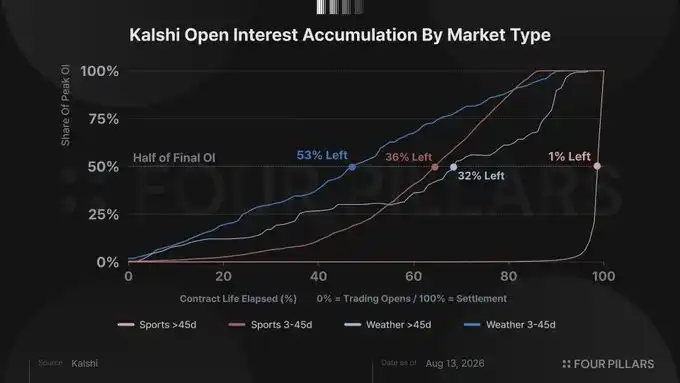
For weather contracts trading for 3 to 45 days, they had already reached half their peak open interest when their lifecycle was at 47%, leaving 53% of the time until expiration. Sports contracts in the same interval didn't reach half until 65%, with only 36% of the time remaining.

For contracts over 45 days, the difference is even more astonishing. Weather contracts reached half when there was still 32% until expiration, while sports contracts had only 1.3% left. Regardless of the interval, weather positions were established much earlier than sports positions.
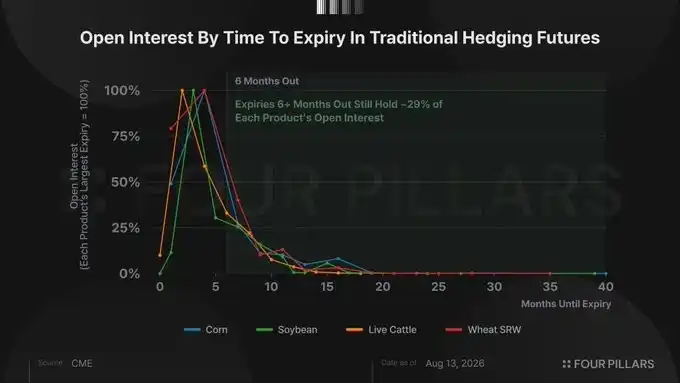
This behavior of "early positioning" is precisely a typical characteristic of traditional hedging markets. As of August 11, 2026, CME grain and livestock futures contracts expiring in six months had already accumulated massive open interest. Corn futures even held 65,127 positions on contracts expiring 16 months later.

This reflects the tendency to act well before the risk actually materializes. And the behavioral pattern of Kalshi weather contracts is clearly closer to traditional hedging markets than to sports markets.

VI. Hedging Relies on Liquidity Built by Speculation

Conclusion first: The Kalshi weather market is neither a purely hedging market nor a purely speculative one like sports. Speculative demand still contributes a significant portion of the liquidity, but on top of that, hedging demand has also emerged relatively clearly.

The three indicators point in the same direction: weather contracts trade less frequently, retain more positions at settlement, and positions are established earlier. No single indicator can confirm trading intent with 100% certainty, but the high consistency of these behaviors collectively supports a judgment — there indeed exists a holding demand in the Kalshi weather market distinct from sports, and a considerable part of it is likely real hedging demand.

More importantly, speculative demand is not so much a weakness of predictive markets as it is a prerequisite for the hedging function to exist. A market with only hedgers and no speculators would struggle to find sufficient counterparties and continuous liquidity.

In predictive markets, speculators are responsible for pricing and providing liquidity, while hedgers transfer the risks they do not wish to bear on this foundation. The risk is no longer directly underwritten by an insurance company but is naturally dispersed among market participants through trading.

Therefore, the next phase of growth for predictive markets is not about "squeezing out" speculation and shifting entirely to hedging. What truly matters is: How much real corporate hedging demand can be layered on top of the liquidity base already built by speculation? This is the core variable that determines whether it can upgrade from an "interesting speculative tool" to a "usable risk management infrastructure."


Tiền kỹ thuật số thịnh hành

Câu hỏi Liên quan

QWhat is the main difference between using a prediction market and traditional insurance for business risk management?

AThe main difference is that in prediction markets, the insurance premium (price of the contract) is determined collectively by market participants based on their assessment of the event's probability, whereas in traditional insurance, the premium is calculated by the insurer's actuaries.

QWhat are the three data points used to analyze whether the Kalshi weather market is used for hedging?

AThe three data points are: 1) Average daily turnover rate, 2) Hold-to-expiration ratio, and 3) The timing of when positions are established (measured by the time it takes to reach 50% of peak open interest).

QAccording to the analysis, how does the trading behavior of Kalshi weather contracts compare to its sports contracts?

AThe analysis shows that Kalshi weather contracts have a lower turnover rate, a significantly higher hold-to-expiration ratio, and positions are established much earlier compared to Kalshi sports contracts. This suggests behavior more consistent with hedging.

QWhat is the primary role of speculators in a prediction market that aims to serve hedging purposes?

ASpeculators provide the necessary liquidity and price discovery in the prediction market, which creates a functional trading environment that allows hedgers to enter and exit positions to transfer their risks.

QWhat example is given to illustrate how a business could use a prediction market contract to hedge against operational risk?

AThe example given is an ice cream shop that could hedge against a cool summer. It could buy 20,000 temperature contracts at $0.30 each (total cost $6,000). If the summer is cool and average temperature falls below a threshold, each contract pays $1, offsetting the estimated $20,000 revenue loss, thereby locking the net loss at the initial $6,000 cost. If the summer is hot, the contracts expire worthless, and the shop loses the $6,000 premium but enjoys full revenue.

Nội dung Liên quan

Bộ trưởng Tài chính Mỹ đè nén lợi suất trái phiếu Mỹ khơi mào 'giao dịch phá giá tiền tệ'! Vàng lập đỉnh 3 tháng, Bitcoin tăng hơn 25% trong tuần

Bộ trưởng Tài chính Mỹ Janet Yellen đã nỗ lực kiềm chế lợi suất trái phiếu dài hạn, nhưng tác động chỉ tồn tại trong thời gian ngắn. Hành động này làm suy yếu đồng USD, đồng thời thúc đẩy vàng và Bitcoin tăng mạnh - củng cố logic giao dịch "phá giá tiền tệ". Động lực chính đến từ thâm hụt ngân sách Mỹ khổng lồ và lo ngại sâu sắc về chính sách kinh tế. Lợi suất trái phiếu nhanh chóng hồi phục sau khi giảm nhẹ, trong khi Bitcoin tăng hơn 25% trong tuần, vượt 78.000 USD và vàng đạt mức cao nhất trong ba tháng. Các nhà phân tích cho rằng đây là "van xả áp lực" khi lo ngại thị trường chuyển hướng sang các tài sản khác. Mối tương quan giữa Bitcoin và vàng ở mức cao nhất kể từ đại dịch, tăng cường nhận định về tiền mã hóa như một công cụ phòng ngừa mất giá. Tuy nhiên, áp lực cơ bản lên lãi suất vẫn tồn tại: thâm hụt ngân sách lớn, nhu cầu vay mượn cho quốc phòng và chuyển đổi năng lượng, cùng làn sóng phát hành trái phiếu doanh nghiệp - đặc biệt từ các công ty công nghệ để tài trợ cho AI. Bộ Tài chính có thể điều chỉnh cung trái phiếu nhưng không thể loại bỏ nhu cầu vốn toàn cầu. Ray Dalio cảnh báo nhà đầu tư nên giảm nắm giữ trái phiếu, chuyển sang vàng và Bitcoin để phòng ngừa rủi ro nợ công. Dù vậy, một số chuyên gia nghi ngờ động thái của Bộ trưởng Yellen sẽ tạo ra đà tăng bền vững cho các tài sản này, vì chủ đề cơ cấu không mới và thiếu chất xúc tác mạnh. Căng thẳng giữa Bộ Tài chính (muốn chi phí vay thấp) và Fed (thận trọng với lạm phát) trong bối cảnh kinh tế vững vàng sẽ tiếp tục là điểm then chốt được theo dõi.

华尔街日报1 giờ trước

Bộ trưởng Tài chính Mỹ đè nén lợi suất trái phiếu Mỹ khơi mào 'giao dịch phá giá tiền tệ'! Vàng lập đỉnh 3 tháng, Bitcoin tăng hơn 25% trong tuần

华尔街日报1 giờ trước

Alexander Shokhin: Giới kinh doanh cần lãi suất dưới 10% và đồng đô la ở mức 90–95 rúp

Alexander Shokhin, Chủ tịch Liên minh Công nghiệp và Doanh nhân Nga (RSPP), cho rằng có thể sử dụng các công cụ "phi thị trường" để giữ đồng rúp trong một biên độ nhất định nhằm tránh biến động quá mức, dù ông thừa nhận đây là một chủ đề phức tạp cần thảo luận riêng. Ông Shokhin trước đó đã nhiều lần đề cập đến ý tưởng về một biên độ tỷ giá cho đồng rúp, lý do là thị trường ngoại hối hiện tại bị hạn chế về khối lượng và nhu cầu ngoại tệ giảm, khiến tỷ giá khó có thể coi là hoàn toàn theo cơ chế thị trường. Nhiều doanh nghiệp ủng hộ việc cố định biên độ, dù bằng các biện pháp không hoàn toàn thị trường, để tạo ra sự ổn định và dự báo được. Về các mục tiêu kinh tế, từ cuối năm 2025, Shokhin đã nêu ra những kỳ vọng của giới doanh nghiệp cho cuối năm 2026: lãi suất chính sách chính ở mức 12%, lạm phát trong khoảng 4-5% và tỷ giá USD/RUB ở mức 90-95. Tuy nhiên, ông cho biết mức lãi suất thực sự thoải mái cho hoạt động kinh doanh phải thấp hơn 10%. Ông nhấn mạnh tầm quan trọng của việc có một đồng tiền quốc gia ổn định và dự báo được đối với các quyết định đầu tư. Phân tích từ góc độ dữ liệu cho thấy, cơ chế biên độ tỷ giá không phải là mới đối với Nga. Cơ chế tương tự đã được áp dụng từ năm 1995 đến 1998, khi Ngân hàng Trung ương Nga (CBR) cố định tỷ giá USD trong một biên độ hẹp thông qua các can thiệp thường xuyên. Chế độ này kéo dài ba năm và sụp đổ sau cuộc khủng hoảng nợ tháng 8/1998, minh chứng cho tính mong manh của các mục tiêu cố định cứng nhắc khi đối mặt với các cú sốc bên ngoài. Mối liên hệ kinh tế vĩ mô ở đây rất rõ ràng: biên độ càng cứng nhắc thì càng cần nhiều dự trữ để bảo vệ nó khi đồng tiền chịu áp lực. Một khía cạnh kỹ thuật chưa được làm rõ là nguồn lực và quy mô can thiệp cụ thể trong điều kiện thanh khoản thị trường ngoại hối còn hạn chế. Liệu cuộc thảo luận hiện tại sẽ chỉ dừng lại ở lý thuyết hay sẽ chuyển thành các thông số biên độ cụ thể vẫn cần được theo dõi trong những tháng tới.

cryptonews.ru3 giờ trước

Alexander Shokhin: Giới kinh doanh cần lãi suất dưới 10% và đồng đô la ở mức 90–95 rúp

cryptonews.ru3 giờ trước

Chuyến tàu đến Bitcoin đã rời ga? Chỉ báo của người dùng không còn phát tín hiệu!

Giá Bitcoin tăng đã đưa chỉ báo AHR999, được các nhà đầu tư dài hạn theo dõi, ra khỏi vùng "mua khi đáy". Chỉ báo này đã trở lại phạm vi mua sắm bình thường sau khoảng 82 ngày. Theo dữ liệu từ các nguồn bên thứ ba, chỉ báo Ahr999 đạt mức 0,5073 sau đợt tăng giá gần đây của Bitcoin. Điều này đưa chỉ báo ra khỏi vùng "mua đáy" dưới 0,45 và chuyển nó vào vùng trung bình chi phí đô la (DCA) trong khoảng từ 0,45 đến 1,20. Trong chu kỳ hiện tại, khoảng thời gian chỉ báo Ahr999 duy trì dưới 0,45 bắt đầu từ ngày 29 tháng 5 và kết thúc vào ngày 19 tháng 8. Theo chỉ báo này, cửa sổ để mua Bitcoin ở mức thấp nhất kéo dài khoảng 82 ngày. Chỉ báo AHR999 đánh giá cả lợi nhuận ngắn hạn, ổn định từ việc mua Bitcoin và mức độ chênh lệch giữa giá hiện tại với định giá ước tính. Chỉ báo này đặc biệt hữu ích cho các nhà đầu tư sử dụng chiến lược mua dần dài hạn, giúp xác định các giai đoạn thị trường tương đối rẻ hoặc đắt. Theo lịch sử, chỉ số dưới 0,45 được hiểu là "mua khi đáy", trong khoảng 0,45 đến 1,20 là mua ổn định, và trên 1,20 là khu vực giá có thể tương đối cao. Tuy nhiên, bản thân chỉ báo này không được coi là tín hiệu mua hoặc bán rõ ràng. *Đây không phải là khuyến nghị đầu tư.

cryptonews.ru3 giờ trước

Chuyến tàu đến Bitcoin đã rời ga? Chỉ báo của người dùng không còn phát tín hiệu!

cryptonews.ru3 giờ trước

Vương quốc Bhutan chuyển 490 BTC trị giá 32,7 triệu USD sang các ví mới

Theo dữ liệu từ Onchain Lens, trong vòng 24 giờ qua, chính quyền Vương quốc Bhutan đã chuyển 490,87 Bitcoin, trị giá khoảng 32,74 triệu USD, sang các ví mới. Giao dịch lớn nhất là 485 BTC, tương đương gần 32,31 triệu USD, các giao dịch còn lại có giá trị nhỏ hơn. Trước đây, chính phủ Bhutan từng chuyển Bitcoin đến các địa chỉ không rõ hoặc ví liên quan đến các công ty giao dịch, nên mục đích thường khá rõ ràng. Tuy nhiên, lần này, các nhà phân tích chưa xác định được chủ sở hữu của các ví mới và cũng chưa thể khẳng định liệu các giao dịch này có liên quan đến việc bán coin hay không. Vào ngày 18 tháng 8, Vương quốc này đã chuyển 300 Bitcoin (trị giá 19,28 triệu USD) sang một địa chỉ khác để bán, tiếp tục làm giảm dự trữ tiền mã hóa hàng đầu của họ. Theo Arkham, vào tháng 10/2024, Bhutan nắm giữ hơn 13.000 BTC, nhưng đến tháng 3/2026, con số này chỉ còn 4.453 coin và đang tiếp tục giảm. Dự trữ Bitcoin quốc gia của Bhutan chủ yếu được tích lũy thông qua hoạt động khai thác (mining), nhờ nguồn điện giá rẻ từ các nhà máy thủy điện. Các giao dịch mới nhất diễn ra trong bối cảnh Bitcoin đang phục hồi, giao dịch quanh mức 77.600 USD tại thời điểm viết bài, tăng 7,8% trong ngày và 24% trong tuần theo số liệu từ CoinGecko.

cryptonews.ru5 giờ trước

Vương quốc Bhutan chuyển 490 BTC trị giá 32,7 triệu USD sang các ví mới

cryptonews.ru5 giờ trước

Giao dịch

Giao ngay

Bài viết Nổi bật

MRNA là gì

MRNA tham chiếu 1 cổ phiếu của Moderna, Inc. cổ phiếu phổ thông (Nasdaq: MRNA), được báo giá bằng USD. Moderna phát triển các loại thuốc RNA thông tin (mRNA), bao gồm vắc xin bệnh truyền nhiễm và liệu pháp ung thư.

Tổng lượt xem 43Xuất bản vào 2026.08.20Cập nhật vào 2026.08.20

MRNA là gì

SOFTBANK là gì

Tập đoàn SoftBank, có trụ sở tại Tokyo, Nhật Bản, là một tập đoàn toàn cầu cung cấp một loạt các dịch vụ, với trọng tâm chính là viễn thông cả trong nước và quốc tế. Các hoạt động rộng lớn của nó được tổ chức một cách chiến lược thành năm phân khúc riêng biệt: Kinh doanh Đầu tư của Các Công ty Cầm cố, Quỹ Tầm nhìn SoftBank, SoftBank, Arm và Quỹ Mỹ Latinh. Ngoài các dịch vụ viễn thông di động, băng thông rộng và cố định truyền thống cũng như việc bán thiết bị di động, công ty còn tham gia sâu vào lĩnh vực kỹ thuật số. Điều này bao gồm quảng cáo trên internet, phân phối quảng cáo trực tuyến và cung cấp nội dung kỹ thuật số như sách điện tử và phân phối video, giọng nói và dữ liệu. 

Tổng lượt xem 49Xuất bản vào 2026.08.20Cập nhật vào 2026.08.20

SOFTBANK là gì

ANET là gì

Mạng lưới Arista (NYSE: ANET), được thành lập vào năm 2004 và có trụ sở tại Santa Clara, CA, phát triển các giải pháp mạng đám mây tập trung vào các công tắc Ethernet hiệu suất cao và hệ điều hành EOS độc quyền của mình. Công ty phục vụ các trung tâm dữ liệu quy mô lớn, nhà cung cấp đám mây và các doanh nghiệp, với các khách hàng lớn bao gồm Microsoft và Meta. Arista là một trong những bên hưởng lợi trực tiếp từ việc xây dựng cơ sở hạ tầng AI, nắm giữ thị phần hàng đầu trong chuyển mạch trung tâm dữ liệu 400G/800G.

Tổng lượt xem 23Xuất bản vào 2026.08.21Cập nhật vào 2026.08.21

ANET là gì

Thảo luận

Chào mừng đến với Cộng đồng HTX. Tại đây, bạn có thể được thông báo về những phát triển nền tảng mới nhất và có quyền truy cập vào thông tin chuyên sâu về thị trường. Ý kiến ​​của người dùng về giá của G (G) được trình bày dưới đây.

活动图片