A PPT Dismissed as 'Nonsense' by MIT Professors 5 Years Ago Predicted the Core Ideas of OpenAI o1 and o3

marsbitXuất bản vào 2026-08-17Cập nhật gần nhất vào 2026-08-17

Tóm tắt

In 2020, AI researcher Giambattista Parascandolo presented his vision for neural network reasoning at an MIT faculty interview, only to have the committee dismiss the direction as "nonsense." He later posted the details online. His talk centered on enabling artificial neural networks to generalize and plan beyond their training data, closer to human capabilities. Parascandolo proposed three key research directions. First was "open-ended reasoning," where models could dedicate more computation time to harder problems, continuously refining answers—a precursor to today's compute-adaptive reasoning models. He noted that simply adding steps (e.g., in RNNs) wasn't enough without learning to use them effectively. Second, he advocated using language as a medium for reasoning within reinforcement learning. By leveraging the world knowledge in models like GPT, agents could better describe environments, decompose tasks, and plan—foreshadowing concepts like chain-of-thought and agent workflows. His third direction involved giving AI systems the ability to manipulate their own learning process: resetting to past states, creating counterfactual scenarios, and even editing their own activations or weights to facilitate deliberate practice. Parascandolo, who earned his PhD focusing on out-of-distribution generalization and had internships at Google X and DeepMind, joined OpenAI in 2021. He contributed to GPT-4 and later became integral to the foundational research behind the reasoning mod...

The AI community never runs short of gossip.

This time, the protagonist is Giambattista Parascandolo, an important researcher in the direction of reasoning models at OpenAI.

In 2020, he went to MIT to interview for a professorship, giving a presentation on using GPT for reasoning. As a result, most professors on the interview committee dismissed this direction as "nonsense."
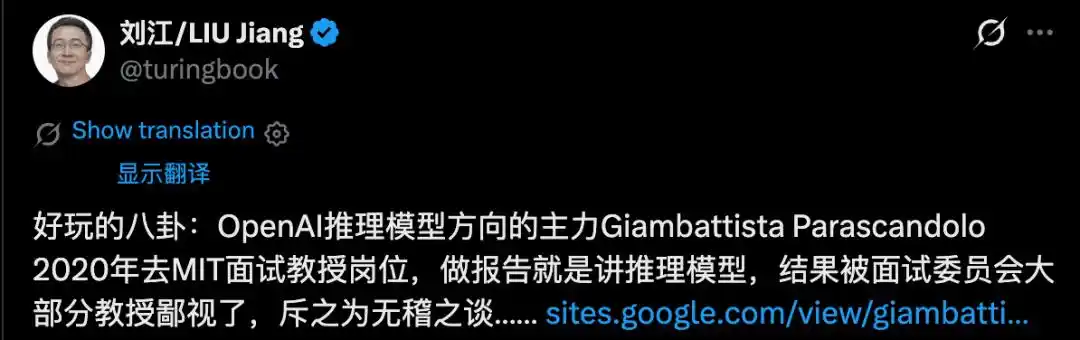
https://x.com/turingbook/status/2084003612687249836?s=20

This guy went all out, directly putting this experience on his personal homepage and attaching the description and slide link from that year's presentation.
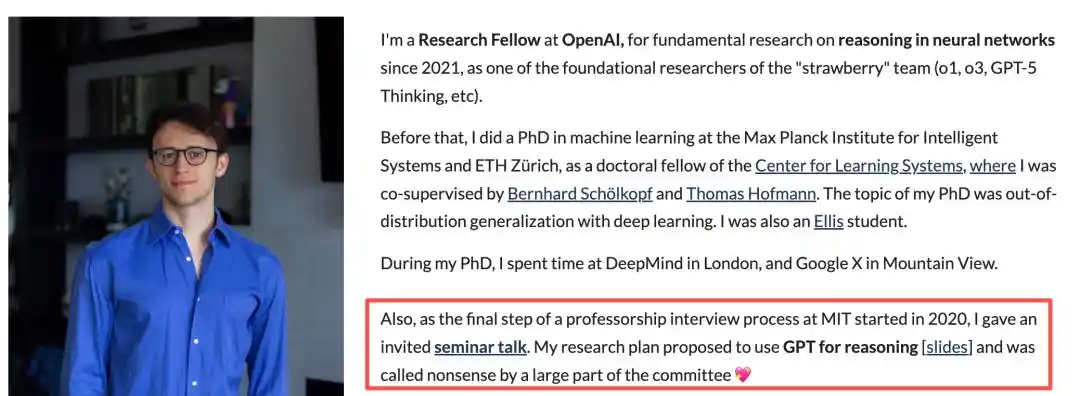
https://sites.google.com/view/giambattista-parascandolo/home

What was in that report dismissed as "nonsense"?

The MIT website shows that the topic of this presentation was how to enable artificial neural networks to break through the training distribution and achieve generalization and planning capabilities closer to humans.
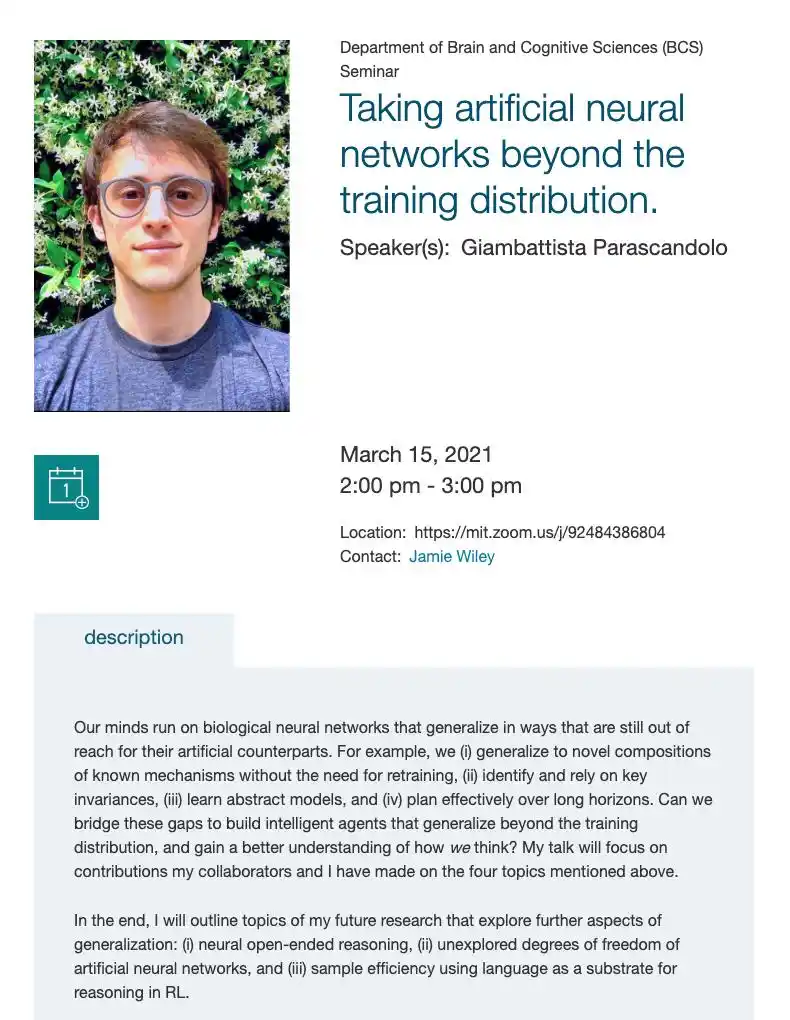
Parascandolo believed that humans can recombine existing knowledge, identify key invariants, build abstract models, and perform long-horizon planning. Artificial neural networks still have much room for improvement in these aspects.

At the end of the presentation, he proposed three future research directions: open-ended reasoning in neural networks, unexplored degrees of freedom in artificial neural networks, and using language as a reasoning substrate in reinforcement learning to improve sample efficiency.

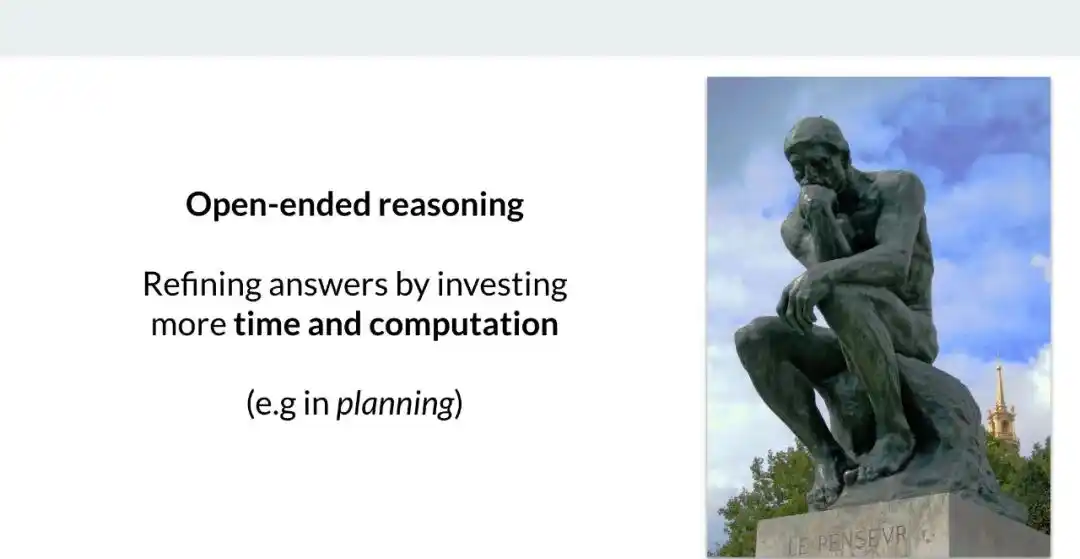
The most crucial concept among these was "open-ended reasoning."

Parascandolo defined it as: the model can invest more time and computation to continuously refine its answer. The harder the problem, the more steps the model should think, and the extra computation should translate into better results.

This already sounds very much like today's inference-time compute scaling.
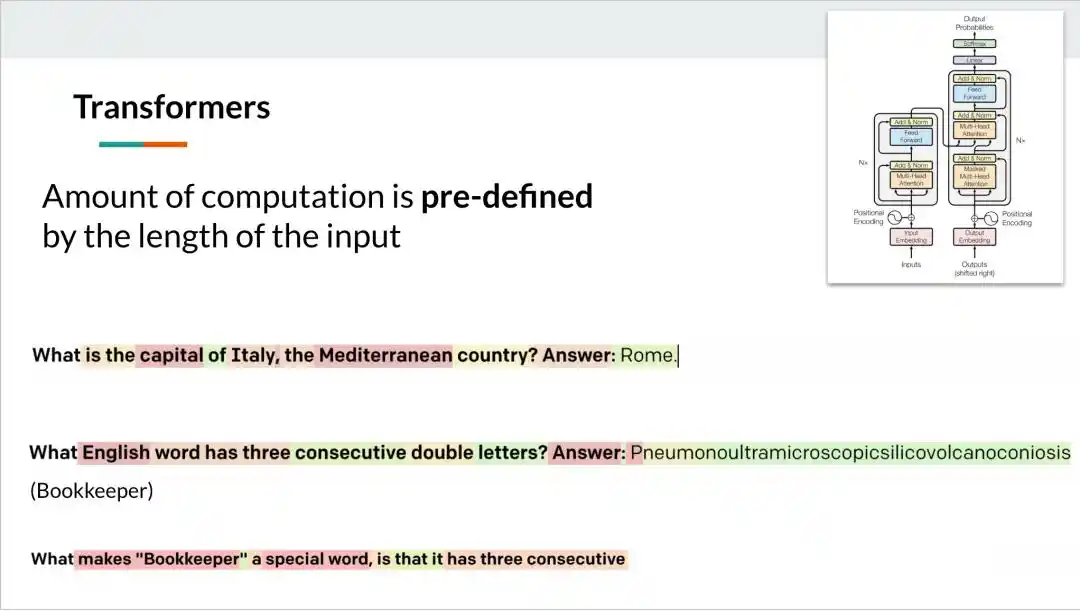
At that time, standard Transformers had a fixed network depth, and the forward compute each token experienced was basically predetermined. However, problem difficulty has no stable relationship with input length. A problem could be very long but have a simple answer. Another problem might be a single sentence but require multiple rounds of decomposition and verification.
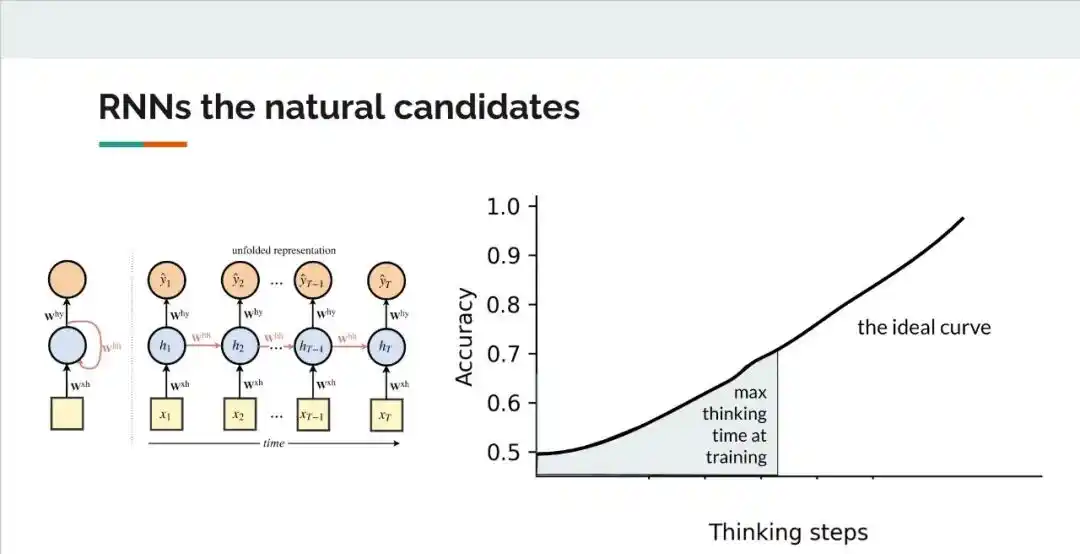
RNNs seemed more suitable for such tasks. They could run repeatedly and theoretically obtain arbitrary amounts of thinking time. However, the curve Parascandolo showed in his PPT indicated that RNNs typically performed best only around the number of reasoning steps they had seen during training. Continuing to increase the number of iterations could actually decrease accuracy.
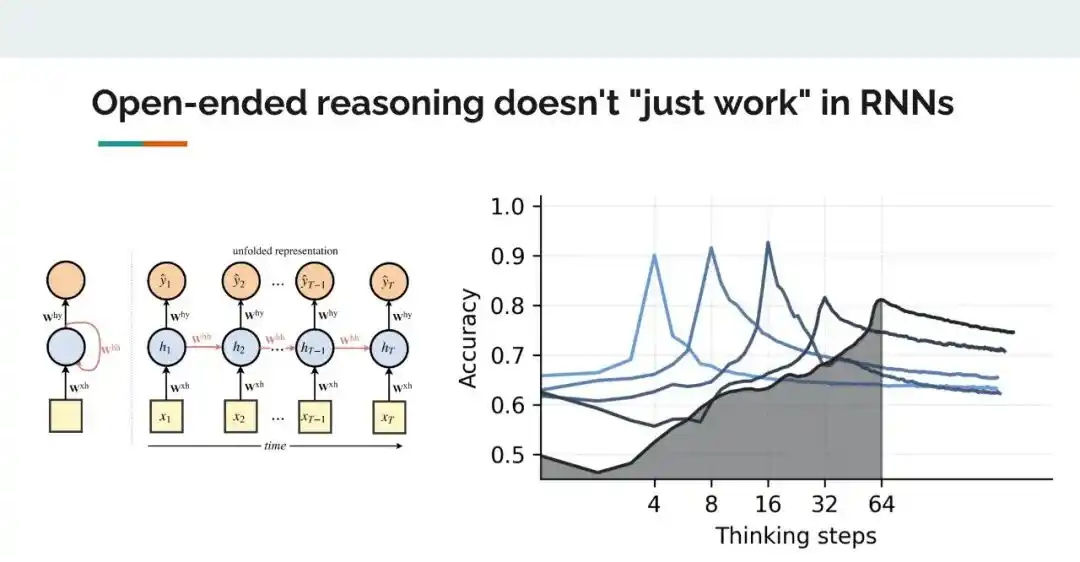
This meant that increasing compute was only the first step; the model also needed to learn how to utilize this compute.

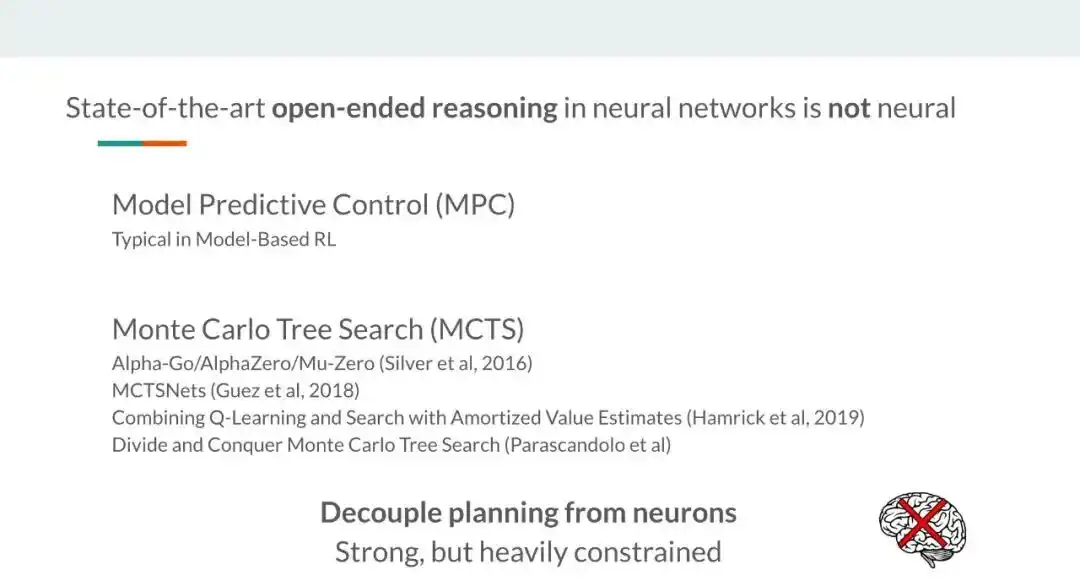
At the time, the most effective multi-step planning heavily relied on model-predictive control and Monte Carlo tree search. Neural networks were responsible for predicting the environment or evaluating value, while external search algorithms were responsible for expanding future paths. Parascandolo hoped to further integrate long-horizon reasoning capabilities into neural networks themselves.
His second vision was to make language the substrate for reasoning.

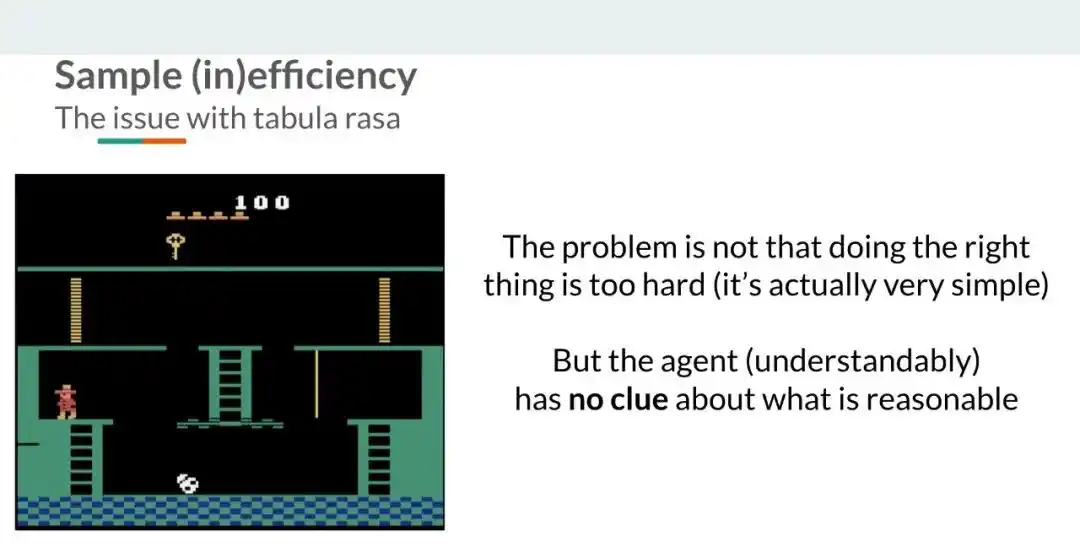
Parascandolo used the classic game *Montezuma's Revenge* as an example. A reinforcement learning Agent trained from scratch needed to try a huge number of state and action combinations. Many correct actions themselves were not complex; what the Agent truly lacked was a judgment of "which behaviors are more reasonable."
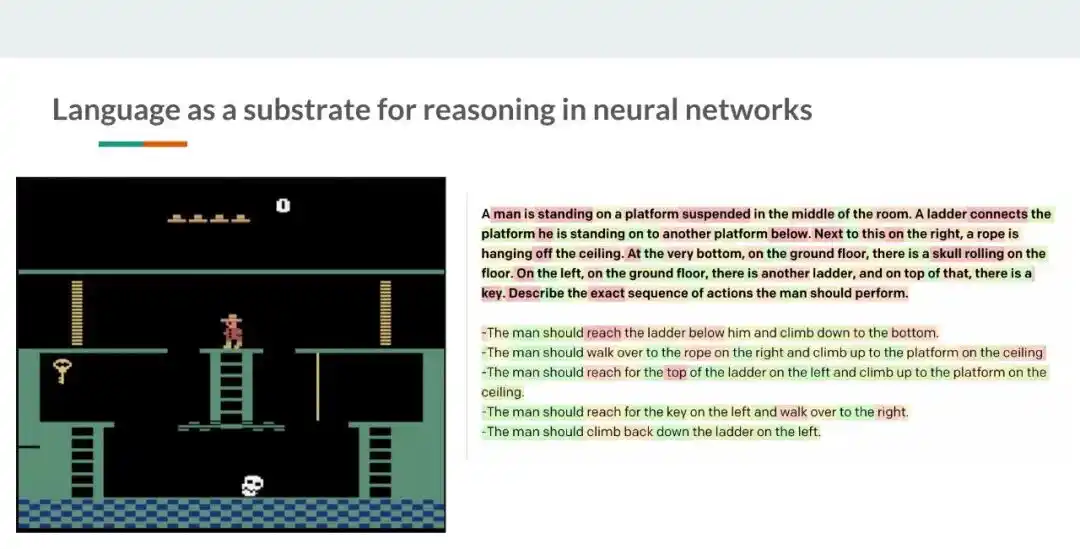
GPT had already absorbed vast amounts of world knowledge from text. Language could help models describe environments, understand goals, decompose tasks, and generate high-level plans, also significantly narrowing the search space.

Today, this line of thinking easily brings to mind chain-of-thought, language planning, and Agent workflows.

The third direction Parascandolo proposed was that AI systems could reset tasks, return to any remembered state, construct counterfactual scenarios, and even adjust time, gravity, and observations within the simulator. Systems could also directly read, copy, and modify their own activation values and neural network weights.
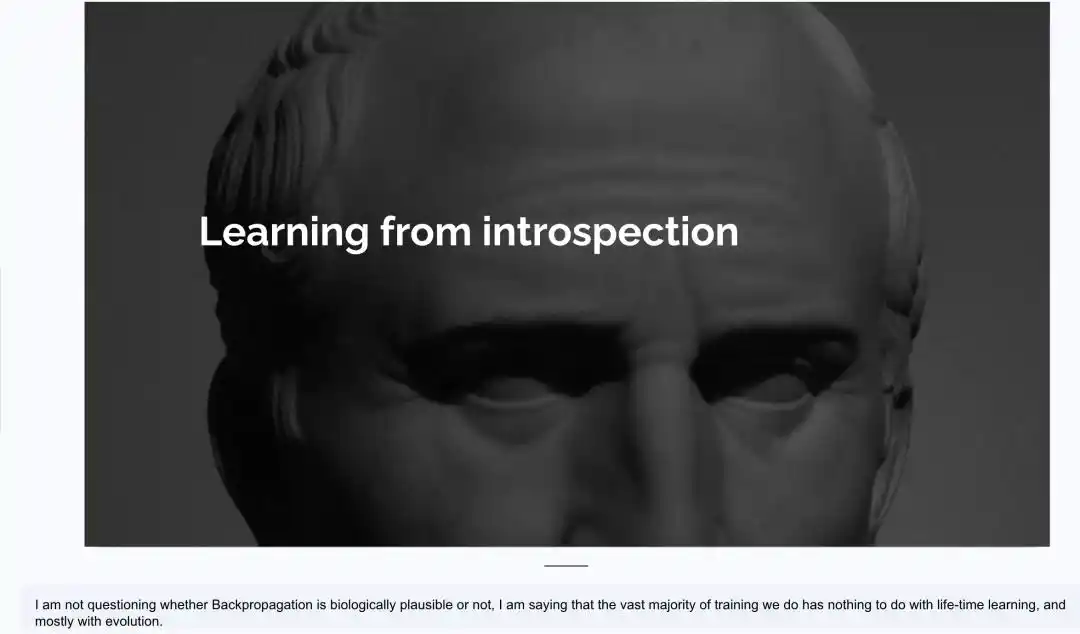
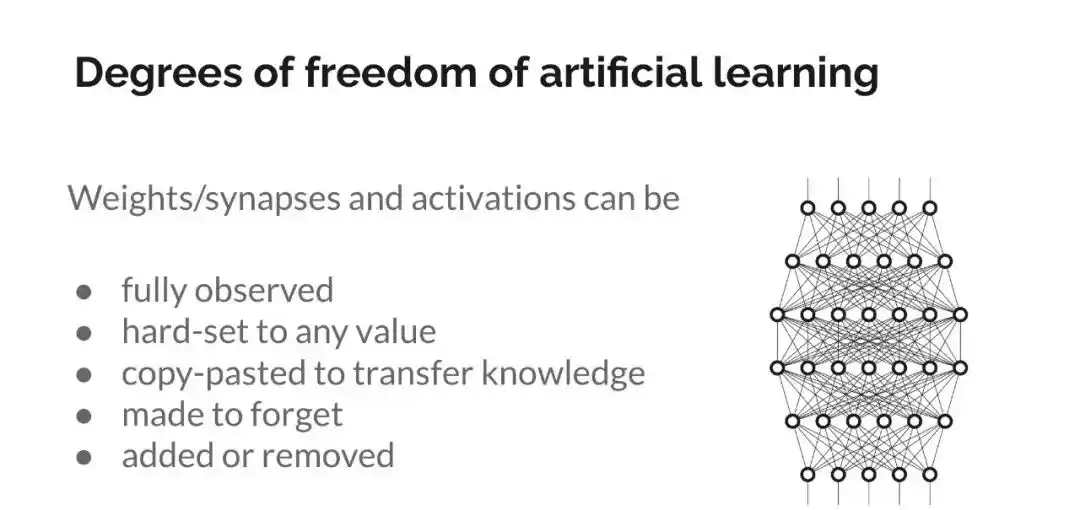
This was equivalent to incorporating the learning process itself into the Agent's operational space. It could engage in deliberate practice, generate special training scenarios, transfer existing knowledge, and relearn from failure trajectories.
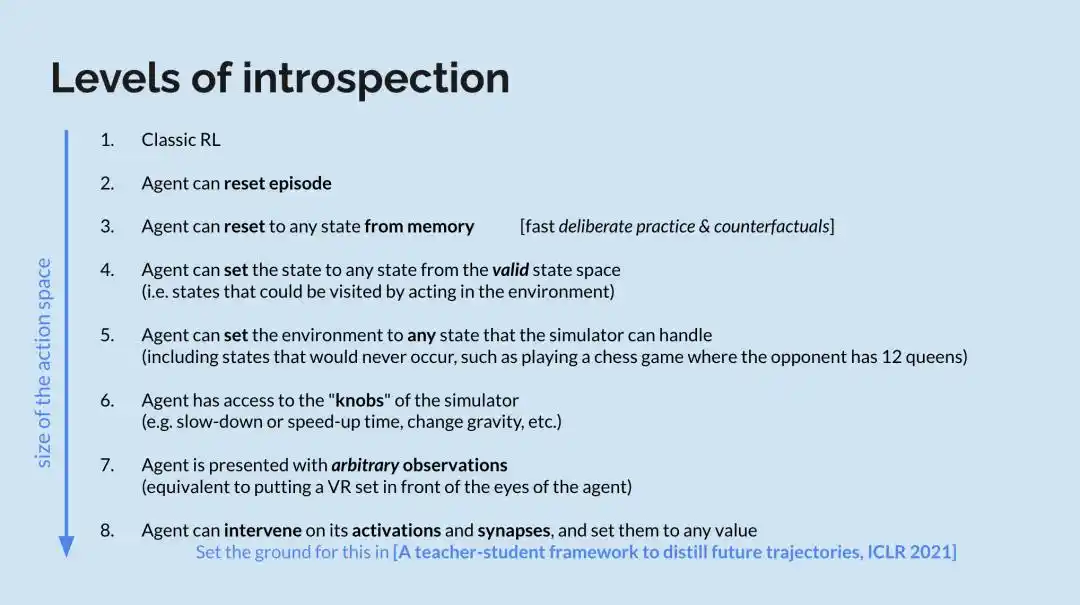
The PPT from five years ago almost wrote today's reasoning model roadmap.

We also dug up a blog post he wrote in June 2021, titled "Backprop, Evolution, and the ‘Two Dogs’ Fallacy."
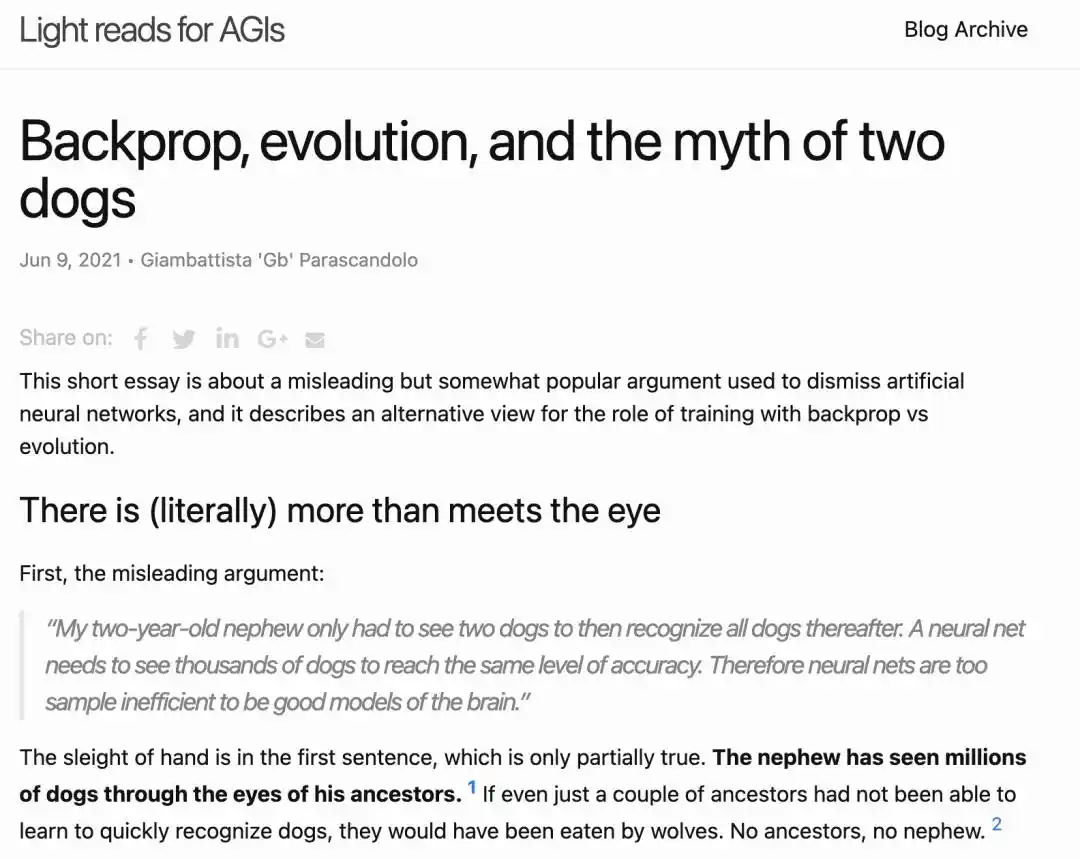
This blog post mainly refuted the view that "neural networks need massive amounts of data, therefore they are unlike the human brain."

Parascandolo argued that the fact humans can learn to recognize dogs after seeing just a few does not mean there was no prior accumulation of experience. Long evolution has already condensed the experiences of ancestors interacting with the world into the structure and inductive biases of the human brain.

From this perspective, the large-scale pre-training of neural networks can be analogized to biological evolution, while model fine-tuning and in-context learning are closer to the learning an individual does in a lifetime. GPT-3 has read far more text than any individual, but its pre-training served to compress massive experience and shape efficient learning capabilities. Therefore, one should not directly compare the model's entire pre-training data with the small number of learning samples an individual receives after birth.

This understanding also implies that continuing to scale data and compute could still bring significant improvements. He was drawing an analogy about the roles they play, not claiming that gradient descent and biological evolution share the same specific mechanisms.

What's this guy's background?

This guy is quite low-key. His latest post on X dates back to November 2024, when he was recruiting two Research Engineers (RE) and Software Engineers (SWE) for o1.
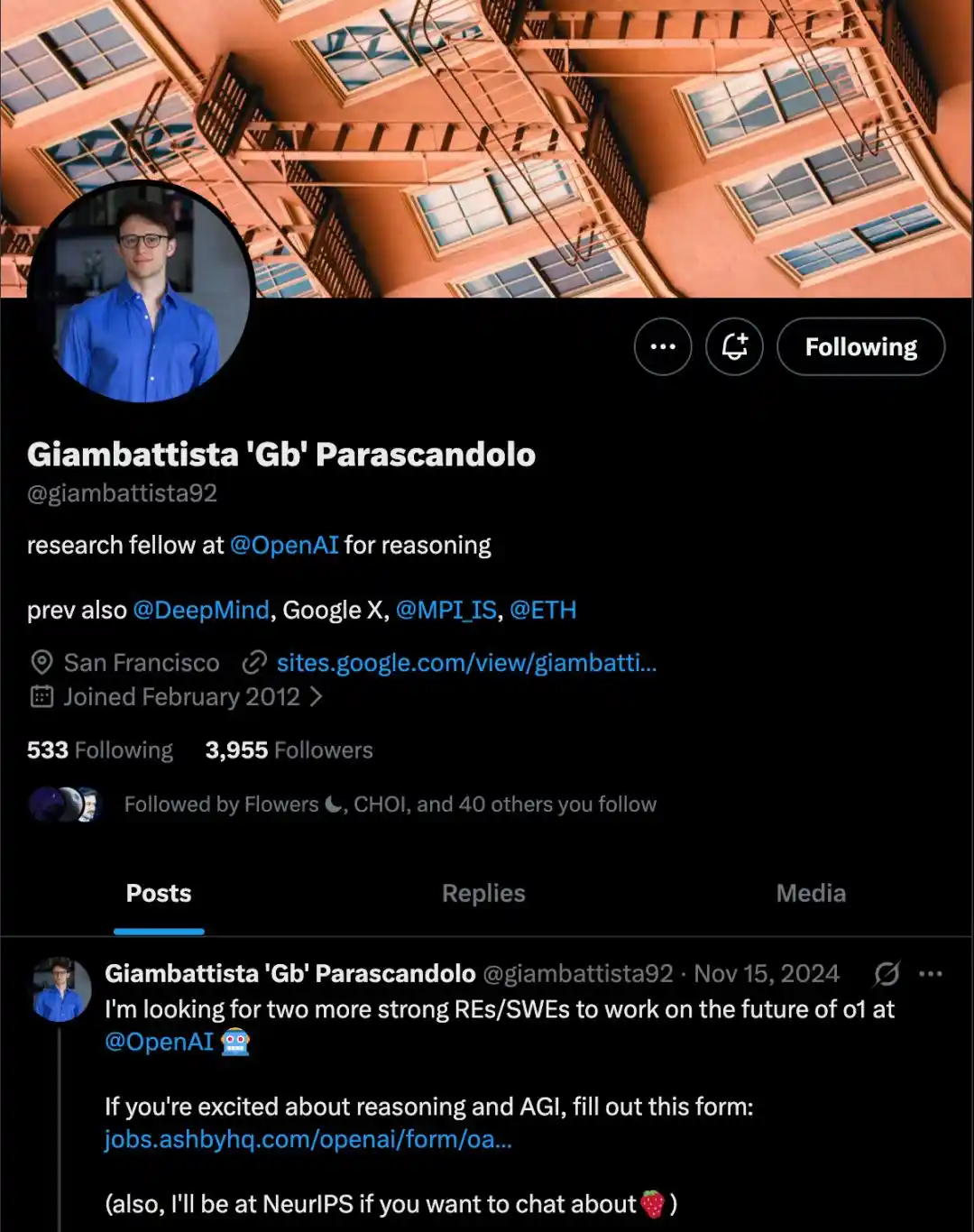
According to his personal homepage, Parascandolo's research experience has always revolved around generalization, planning, and reasoning.

In 2017, he began his Ph.D. at the Max Planck Institute for Intelligent Systems and ETH Zurich, supervised by Bernhard Schölkopf and Thomas Hofmann. His doctoral research focused on OOD generalization in deep learning.

During his Ph.D., he did internships at Google X in Mountain View and DeepMind in London, participating in research on automated design on ultra-large-scale simulators at the former, and research on divide-and-conquer Monte Carlo tree search at the latter.

After graduating with his Ph.D. in September 2021, he directly joined OpenAI. Initially, he entered the reinforcement learning team led by John Schulman, then moved to the algorithms team where Mark Chen was, and later joined the 🍓 (strawberry) team led by Jerry Tworek. The strawberry team was the internal codename for the o1 project.
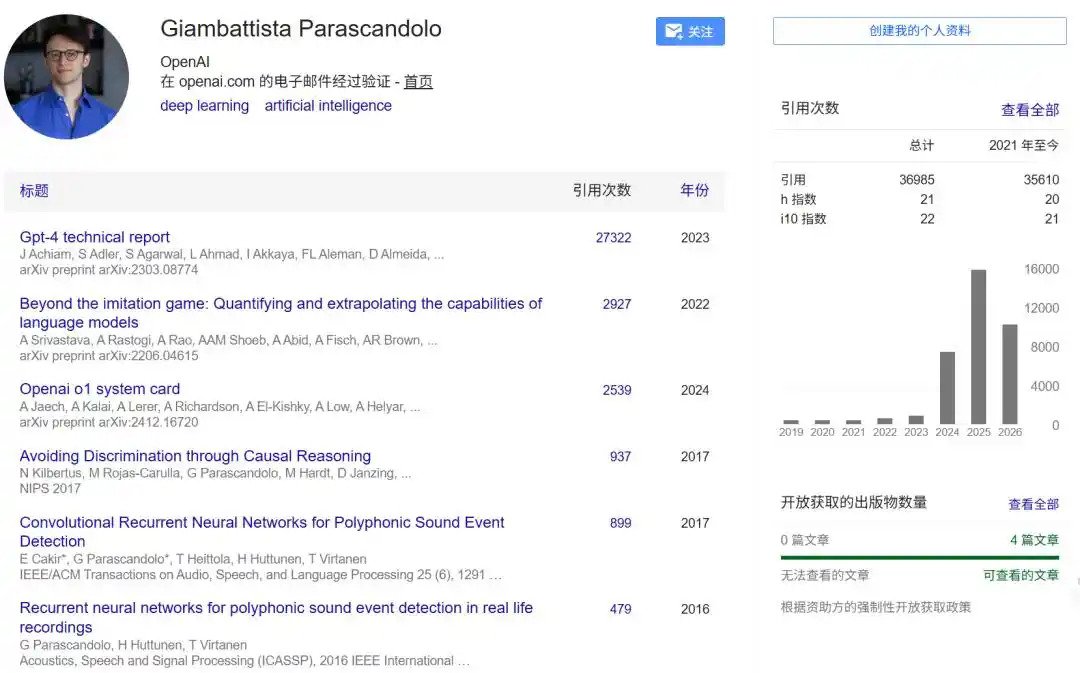
In 2023, he participated in GPT-4 development and formed a new team continuing reasoning research. Later, he participated in the foundational research for OpenAI o1 and o3, promoting the scaling of reward modeling, environment construction, and general reasoning algorithms. Part of the algorithm description is still covered by black blocks on his page.

Parascandolo didn't get the MIT professorship from that 2020 interview; he went to OpenAI instead.

Four years later, he helped build o1.

Life is always full of delightful surprises.

References:

https://x.com/giambattista92

https://sites.google.com/view/giambattista-parascandolo/home

https://gibipara92.github.io/2021/06/09/backprop-evolution-two-dogs.html

https://docs.google.com/presentation/d/1edd2GkAP31wNygaev3DO8gE1t2lgsx1z8TeVpBKqlYA/edit?slide=id.gc772610149_0_179#slide=id.gc772610149_0_179

This article is from the WeChat public account "Almost Human" (ID: almosthuman2014), author: Yang Wen


Tiền kỹ thuật số thịnh hành

Câu hỏi Liên quan

QWhat were the three key research directions proposed by Giambattista Parascandolo in his MIT job talk?

AThe three key research directions were: 1) Open-ended reasoning in neural networks (models allocating more time/computation for harder problems), 2) Using language as a substrate for reasoning in reinforcement learning to improve sample efficiency, and 3) Allowing AI systems to manipulate their own internal states (like activations and weights) to conduct deliberate practice and counterfactual learning.

QHow does Parascandolo's concept of 'open-ended reasoning' relate to modern AI like OpenAI's o1?

AParascandolo's 'open-ended reasoning' concept, where models spend more time and computation to refine answers for harder problems, directly foreshadows the core idea of 'reasoning-time compute scaling' used in modern AI systems like OpenAI's o1 and o3. These models dynamically allocate computational effort based on problem difficulty.

QWhy did Parascandolo argue that comparing a neural network's pre-training data to a human's lifelong learning is misleading?

AParascandolo argued that large-scale pre-training is analogous to biological evolution, compressing vast ancestral experience into the model's structure and inductive biases. Fine-tuning and in-context learning are more akin to an individual's lifetime learning. Therefore, comparing total pre-training data to a human's post-birth learning samples is an apples-to-oranges comparison.

QWhat role did Giambattista Parascandolo play at OpenAI leading up to the development of o1 and o3?

AAt OpenAI, Parascandolo initially worked in the reinforcement learning team, later joined the algorithms team, and was part of the 'Strawberry' team (the internal codename for the o1 project). He contributed to GPT-4, formed a new team focused on reasoning research, and worked on the foundational research for o1 and o3, specifically on reward modeling, environment construction, and scaling general reasoning algorithms.

QWhat was the main point of Parascandolo's blog post 'Backprop, Evolution and the "Two Dogs" Fallacy'?

AThe main point was to challenge the argument that neural networks are unlike the human brain because they require massive data. He posited that human ability to learn from few examples (like recognizing dogs) is built upon evolutionary history, just as a neural network's pre-training compresses vast experience. Thus, pre-training is analogous to evolution, not individual learning, justifying the value of scaling data and compute.

Nội dung Liên quan

Elon Musk và Công ty X Tiến Thêm Bước Về Tiền Mã Hóa! Một Kỷ Nguyên Thanh Toán Mới Đang Ló Dạng! Đây Là Chi Tiết

Nền tảng truyền thông xã hội X của Elon Musk đang xem xét khả năng sử dụng stablecoin để trả thưởng cho những người sáng tạo nội dung. Theo nguồn tin, X đang đàm phán về việc sử dụng stablecoin, chủ yếu là USDC, cho các khoản thanh toán này. Kế hoạch hiện vẫn đang được thảo luận và chưa có quyết định cuối cùng hay thời điểm triển khai cụ thể. Nếu được thực hiện, nó có thể cho phép các nhà sáng tạo nội dung trên toàn cầu nhận tiền nhanh hơn dưới dạng kỹ thuật số. Các chuyên gia nhận định việc sử dụng stablecoin, đặc biệt trong thanh toán xuyên biên giới, có thể trở thành một giải pháp thay thế cho các hệ thống thanh toán truyền thống. Bài báo cũng đề cập rằng SpaceX, một công ty khác của Elon Musk, đã sử dụng stablecoin để thực hiện các khoản thanh toán xuyên biên giới cho dịch vụ Starlink ở một số quốc gia. Mặc dù chưa được phê duyệt, việc X cân nhắc sử dụng các đồng tiền kỹ thuật số như USDC được coi là một tín hiệu mới về khả năng mở rộng ứng dụng của stablecoin vào các giao dịch thanh toán kỹ thuật số hàng ngày.

cryptonews.ru2 giờ trước

Elon Musk và Công ty X Tiến Thêm Bước Về Tiền Mã Hóa! Một Kỷ Nguyên Thanh Toán Mới Đang Ló Dạng! Đây Là Chi Tiết

cryptonews.ru2 giờ trước

Nhà đầu tư tiền điện tử mất 1010 ETH do truy cập trang web Tornado Cash lỗi thời

Nhà đầu tư tiền điện tử mất 1.010 ETH do truy cập trang web Tornado Cash lỗi thời bị chiếm đoạt. Các nhà phân tích từ Wu Blockchain cho biết nạn nhân đã sử dụng dấu trang trình duyệt cũ để vào trang trộn tiền điện tử, lúc này tên miền đã bị kẻ xấu kiểm soát và triển khai giao diện giả mạo. Tin rằng mình đang tương tác với hợp đồng thông minh Tornado Cash thật, nạn nhân đã cấp quyền truy cập tài sản cho bọn lừa đảo, và số tiền bị rút sạch trong vòng 12 giờ. Số tiền bị đánh cắp, hiện nằm rải rác trên nhiều địa chỉ ví do tội phạm kiểm soát, được rút thành nhiều lần nhỏ. Nhóm Tornado Cash đã mất quyền kiểm soát tên miền cũ sau lệnh trừng phạt của OFAC Mỹ năm 2022, và kể từ đó, bọn tội phạm đã đăng ký lại và vận hành trang web lừa đảo. Trong 12 tháng qua, trang web giả này được cho là đã đánh cắp tổng cộng khoảng 4.000 ETH từ nhiều người dùng. Trong bối cảnh này, các chuyên gia bảo mật Bitdefender cũng cảnh báo về phần mềm độc hại Lumma Stealer đang được phát tán dưới vỏ bọc là bản phim lậu của bộ phim "Oppenheimer" đạo diễn bởi Christopher Nolan.

cryptonews.ru2 giờ trước

Nhà đầu tư tiền điện tử mất 1010 ETH do truy cập trang web Tornado Cash lỗi thời

cryptonews.ru2 giờ trước

Các chuyên gia phân tích: MiCA chưa gây ra đợt rút vốn toàn cầu đáng kể khỏi USDT

Các nhà phân tích cho biết Quy định về Thị trường Tài sản Crypto (MiCA) của châu Âu chưa gây ra hiện tượng rút tiền hàng loạt trên toàn cầu khỏi stablecoin USDT. Dữ liệu từ Artemis Analytics và một nghiên cứu độc lập của Đại học LUISS và Đại học Surrey chỉ ra rằng việc hạn chế USDT trên các sàn giao dịch được quản lý ở châu Âu chưa dẫn đến sự sụt giảm đáng kể về nguồn cung hoặc nhu cầu toàn cầu đối với USDT. Nghiên cứu xác nhận MiCA đã thay đổi cơ cấu giao dịch trên một số nền tảng cụ thể ở châu Âu, nơi thị phần của USDC đã tăng lên sau khi USDT bị hạn chế. Tuy nhiên, thị phần và khối lượng giao dịch tổng hợp của các stablecoin hàng đầu hầu như không thay đổi trên quy mô toàn cầu. USDT vẫn giữ vị trí dẫn đầu với vốn hóa thị trường khoảng 183 tỷ USD vào cuối tháng 7. Hoạt động với USDT tiếp tục mở rộng mạnh mẽ bên ngoài châu Âu, đặc biệt trên các mạng như BNB Chain và Tron, phản ánh xu hướng áp dụng số hóa đô la trên các thị trường mới nổi. Trong khi đó, tại châu Âu, việc Tether không đăng ký theo MiCA đã khiến nhiều dịch vụ phải hạn chế USDT. Dù vậy, dữ liệu không cho thấy sự dịch chuyển thanh khoản quy mô lớn hoặc thay đổi đột ngột trùng khớp với thời điểm MiCA có hiệu lực.

cryptonews.ru2 giờ trước

Các chuyên gia phân tích: MiCA chưa gây ra đợt rút vốn toàn cầu đáng kể khỏi USDT

cryptonews.ru2 giờ trước

Giao dịch

Giao ngay

Bài viết Nổi bật

Làm thế nào để Mua CORE

Chào mừng bạn đến với HTX.com! Chúng tôi đã làm cho mua CORE (CORE) trở nên đơn giản và thuận tiện. Làm theo hướng dẫn từng bước của chúng tôi để bắt đầu hành trình tiền kỹ thuật số của bạn.Bước 1: Tạo Tài khoản HTX của BạnSử dụng email hoặc số điện thoại của bạn để đăng ký tài khoản miễn phí trên HTX. Trải nghiệm hành trình đăng ký không rắc rối và mở khóa tất cả tính năng. Nhận Tài khoản của tôiBước 2: Truy cập Mua Crypto và Chọn Phương thức Thanh toán của BạnThẻ Tín dụng/Ghi nợ: Sử dụng Visa hoặc Mastercard của bạn để mua CORE (CORE) ngay lập tức.Số dư: Sử dụng tiền từ số dư tài khoản HTX của bạn để giao dịch liền mạch.Bên thứ ba: Chúng tôi đã thêm những phương thức thanh toán phổ biến như Google Pay và Apple Pay để nâng cao sự tiện lợi.P2P: Giao dịch trực tiếp với người dùng khác trên HTX.Thị trường mua bán phi tập trung (OTC): Chúng tôi cung cấp những dịch vụ được thiết kế riêng và tỷ giá hối đoái cạnh tranh cho nhà giao dịch.Bước 3: Lưu trữ CORE (CORE) của BạnSau khi mua CORE (CORE), lưu trữ trong tài khoản HTX của bạn. Ngoài ra, bạn có thể gửi đi nơi khác qua chuyển khoản blockchain hoặc sử dụng để giao dịch những tiền kỹ thuật số khác.Bước 4: Giao dịch CORE (CORE)Giao dịch CORE (CORE) dễ dàng trên thị trường giao ngay của HTX. Chỉ cần truy cập vào tài khoản của bạn, chọn cặp giao dịch, thực hiện giao dịch và theo dõi trong thời gian thực. Chúng tôi cung cấp trải nghiệm thân thiện với người dùng cho cả người mới bắt đầu và người giao dịch dày dạn kinh nghiệm.

Tổng lượt xem 630Xuất bản vào 2024.12.13Cập nhật vào 2026.06.02

Làm thế nào để Mua CORE

Thảo luận

Chào mừng đến với Cộng đồng HTX. Tại đây, bạn có thể được thông báo về những phát triển nền tảng mới nhất và có quyền truy cập vào thông tin chuyên sâu về thị trường. Ý kiến ​​của người dùng về giá của CORE (CORE) được trình bày dưới đây.

活动图片